
only humans believe in Web3 || @altiuslabs believer || engage for @PrismaXai || @RealGoOfficial Gamers 🎮
Joined June 2020
- Tweets 13,084
- Following 3,844
- Followers 1,842
- Likes 12,265
1,199 Photos and videos


Jackone retweeted

Jun 12
The Loyalty Points Claim System Preview is READY!
⏳ 3 DAYS TO GO!
Get ready to convert your hard earned points into real-value tokens very soon. Your grit and loyalty are about to pay off!
Stay tuned, the countdown is officially live!

42
21
93
3,919

Jun 12
Kalau kalian perhatiin, narasi AI Web3 lagi bergeser ke arah yang lebih riil: Physical AI & Decentralized Robotics. Salah satu frontrunner nya, PrismaX (@PrismaXai), baru aja rilis beberapa update krusial buat ekosistem mereka
Apa itu PrismaX?
Didukung pendanaan $11M dari @a16z CSX, Volt Capital, dll.
PrismaX adalah service layer terdesentralisasi yang menghubungkan manusia dengan robot. Lewat platform mereka, kita bisa mengendalikan robot asli (seperti humanoid Unitree G1) dari jarak jauh lewat internet.
Kemitraan Strategis Global dengan MagicLab Robotics
Update besar pertama datang dari kolaborasi strategis tingkat tinggi. MagicLab Robotics baru saja mengumumkan kerja sama dengan PrismaX AI dalam inisiatif "Co-Create 1000". Integrasi ini bertujuan untuk mempercepat adopsi massal embodied AI di Silicon Valley dan global.
Berburu "Prisma Points" & Fitur Amplifier
Buat yang mau nge-farm poin di app.prismax.ai:
Daily Check-in & Quiz: Masuk tiap hari dapat 10 poin. Selesaikan Whitepaper Quiz buat klaim bonus ratusan hingga 1.000 poin.
Amplifier Membership ($99): Opsi one-time purchase buat dapetin 3x multiplier (30 poin/hari) plus akses awal ke reservasi armada robot (robot fleet) & mesin data AI mereka.
Mengapa Data PrismaX Berbeda?
PrismaX baru-baru ini menekankan bahwa "Not all robotics data is created equal". Lewat sistem Proof-of-View dan skor berbasis CLIP, mereka memastikan bahwa data visual yang dihasilkan dari game kontrol jarak jauh (Tele-op Arcade) benar-benar berkualitas tinggi untuk melatih robotics foundation models.
Dari mengontrol robot humanoid dari balik laptop sampai mengumpulkan real-world data flywheel, PrismaX membuktikan kalau Web3 bukan cuma soal transaksi digital, tapi juga menggerakkan infrastruktur fisik di dunia nyata.
Pantau terus dApps mereka dan amankan posisi kalian lebih awal!
@PrismaXai
2
65
Jun 10
Konsep dasar Tele-op adalah remote control jarak jauh dengan presisi tinggi. PrismaX membangun sebuah tumpukan teknologi modular (modular stack) agar operator manusia bisa mengendalikan robot fisik, seperti robot humanoid Unitree G1 atau robot berkaki empat MIT Mini-Cheetah, tanpa adanya delay yang mengganggu.
Teknologi di balik layar yang mereka gunakan meliputi:
ROS / ROS 2 (Robot Operating System): Standar industri untuk mengontrol motor, sendi, dan sensor pada robot.
WebRTC & gRPC: Protokol komunikasi data berperforma tinggi untuk memastikan gerakan tangan kita di layar komputer langsung diterjemahkan ke tubuh robot secara real-time (latensi sangat rendah).
Siklus "Play-to-Train": Setiap kali kamu menggerakkan robot untuk menyelesaikan misi (misalnya memindahkan barang atau membuka pintu), sistem merekam video, data sensor, dan perintah motorik kamu. Data gabungan inilah yang menjadi bahan bakar utama untuk melatih Robotics Foundation Models.
Mengenal Tele-op Arcade & Ekonomi Tiga Arah
Untuk mengumpulkan data berskala besar, PrismaX meluncurkan Tele-op Arcade. Ini adalah hub interaktif tempat pengguna bisa menghubungkan dompet kripto (crypto wallet), membaca whitepaper, mengikuti kuis, dan bersiap untuk mengendalikan robot nyata (seperti unit robot bernama Billy atau Tommy).
Aktivitas ini memicu ekosistem ekonomi baru yang disebut Tripartite Marketplace:
Operators: Manusia (seperti kamu) yang menyumbangkan keahlian motorik lewat remote control dan mendapatkan imbalan berupa points atau insentif.
Hardware Owners: Pemilik atau laboratorium robot yang menyewakan perangkat keras mereka ke jaringan agar bisa dipakai oleh operator.
AI Developers: Perusahaan kecerdasan buatan yang membeli data mentah hasil tele-op yang sudah terverifikasi untuk melatih AI mereka.
Menjaga Kualitas Data dengan Proof-of-View
Bagaimana PrismaX memastikan pengguna tidak asal-asalan menggerakkan robot? Mereka membuat sistem filter pintar bernama Eval Engine.
Setiap sesi tele-op yang kamu lakukan akan dinilai secara otomatis menggunakan model AI canggih seperti CLIP-L dan DINOv2. Sistem ini memeriksa aspek semantik, estetika, dan kualitas gerakan. Jika gerakan robot dinilai natural dan berhasil menyelesaikan tugas, kontribusi kamu divalidasi lewat mekanisme Proof-of-View untuk memastikan hanya data berkualitas tinggi yang masuk ke database pelatihan.
Lewat arsitektur Tele-op ini, PrismaX tidak hanya memecahkan masalah kelangkaan data di dunia robotika, tetapi juga membuka peluang ekonomi baru (RobotFi). Di masa depan, keahlian motorik manusia bisa diproyeksikan ke robot mana pun di seluruh dunia, mengubah cara kita bekerja dan melatih mesin secara permanen.
@PrismaXai
3
78
Jun 9
Ever wondered how we’ll actually train millions of humanoid robots?
The biggest bottleneck in Physical AI isn't the hardware — it's Data.
Enter @PrismaXai and their game changing Tele-op protocol. They are turning remote robot control into a global, decentralized data machine.
Right now, teaching robots to navigate the real world requires massive amounts of high-quality visual and behavioral data.
Traditional data collection is slow, expensive, and centralized.
PrismaX fixes this by allowing anyone, anywhere, to become a remote robot operator.
Think of it as the ultimate bridge between humans and hardware.
Using ultra-low latency technologies (like WebRTC, gRPC, and ROS/ROS 2), PrismaX allows users to control physical robots, like the Unitree G1 or MIT Mini Cheetah — remotely from their screens.
Your real-time inputs become the robot's real-world actions.
PrismaX turns data collection into an interactive experience through their Tele-op Arcade.
By connecting your wallet and participating in tele-op missions, you aren't just playing a simulation — you are generating critical telemetry data.
Every move you make helps train advanced robotics foundation models.
How do they ensure people don’t just upload junk data?
PrismaX built an advanced Eval Engine using AI models like CLIP-L and DINOv2.
Every tele-op session is evaluated for semantics, aesthetics, and motion quality, validating your contribution via a Proof-of-View mechanism. No spam, just pure high-fidelity data.
The PrismaX Tele-op architecture creates a powerful 3-way economy:
1️⃣Operators: Humans providing data and skill via remote control.
2️⃣ Hardware Owners: People or labs leasing out their physical robots.
3️⃣ AI Developers: Labs buying the high-quality data to train their models.
Everyone wins, powered by a decentralized on-chain coordination layer.
Backed by @a16z CSX and leading blockchain researchers, PrismaX isn't just building a dApp — they are building the open coordination infrastructure for the future of robotics.
The era of RobotFi and decentralized Physical AI is officially here.
1
5
145
Jun 8
Selama ini, rintangan terbesar dalam dunia robotika bukanlah membuat perangkat keras (hardware) yang canggih, melainkan bagaimana cara melatih robot tersebut agar bisa beradaptasi di dunia nyata yang penuh ketidakpastian. Simulasi digital sering kali terlalu sempurna, sedangkan dunia luar sangat dinamis dan berantakan.
Startup AI dan Web3 yang berbasis di San Francisco, PrismaX AI (@PrismaXai), hadir membawa solusi revolusioner lewat platform Tele-operation (Tele-op) mereka. Didukung pendanaan awal sebesar $11 juta yang dipimpin oleh a16z Crypto CSX, PrismaX sukses membangun jembatan antara intuisi manusia dan kecerdasan buatan.
Memecah Batas Jarak Lewat Protokol Tele-op
Secara fundamental, Tele-op di PrismaX memungkinkan operator manusia untuk mengendalikan robot fisik canggih, seperti robot humanoid Unitree G1 hingga robot berkaki empat MIT Mini-Cheetah, secara jarak jauh dari mana saja di seluruh dunia.
Menggunakan tumpukan teknologi modular berbasis ROS/ROS 2, gRPC, dan WebRTC, PrismaX mampu memangkas waktu tunda transmisi (latency) hingga ke tingkat ultra-rendah. Hasilnya? Operator bisa menggerakkan lengan robot atau mengontrol langkah robot humanoid secara instan seolah-olah mereka berada di lokasi langsung.
Efek Flywheel: Robot Sebagai "Mesin Penambang Data"
Mengapa kontrol jarak jauh ini begitu krusial bagi AI? Rahasianya ada pada akumulasi data. Di dalam ekosistem PrismaX, setiap sesi Tele-op bukan sekadar menggerakkan mesin, melainkan proses pengumpulan data berkualitas tinggi.
Ketika manusia mengoperasikan robot untuk membereskan barang atau membuat minuman, sistem otomatis bernama Eval Engine akan merekam koordinat, visual, dan setiap mikro-keputusan yang diambil manusia. Melalui mekanisme inovatif bernama Proof-of-View, data tersebut dinilai berdasarkan aspek gerakan, semantik, hingga keberagamannya.
Data terverifikasi inilah yang kemudian "dimakan" oleh foundation models (model dasar AI) untuk melatih robot. Alurnya membentuk sebuah siklus cerdas (data flywheel):
2
7
108
Jun 6
Bagaimana jika kamu bisa melatih robot fisik di belahan dunia lain hanya dengan modal koneksi internet dan perangkat di rumahmu?
Ini bukan sci-fi. Di @PrismaXai, masa depan ini sedang dibangun lewat teknologi Tele-operation (Tele-op).
Apa itu Tele-op?
Secara sederhana, Tele-operation (Tele-op) adalah kontrol jarak jauh terhadap robot atau sistem fisik oleh operator manusia.
Bayangkan seperti bermain game simulasi, tapi objek yang kamu gerakkan adalah robot nyata di dalam laboratorium atau lapangan kerja sungguhan.
Robot pintar tidak lahir begitu saja; mereka butuh data. Masalahnya, mengumpulkan data fisik di dunia nyata itu lambat dan mahal.
Di sinilah Tele-op masuk sebagai jembatan:
1. Human Demonstration: Manusia melakukan tugas (misal: mengambil barang).
2. Data Capture: Robot merekam koordinat, tekanan, dan visual gerakan tersebut.
3. Imitation Learning: AI mempelajari data tersebut untuk meniru dan mengotomatisasi tugas secara mandiri di kemudian hari.
@PrismaXai membawa konsep ini ke level berikutnya dengan menggabungkan AI, robotika, dan insentif terdesentralisasi melalui konsep seperti Play-to-Train.
Bukan cuma engineer di lab besar yang bisa melatih robot. Komunitas global,ermasuk kamu — bisa berkontribusi memberikan data gerakan berkualitas tinggi melalui sistem Tele-op yang inklusif
Bagaimana alur dari kontrol manual hingga menjadi robot yang sepenuhnya otonom?
1. Remote Control (Tele-op):Fase 1.Operator manusia mengendalikan robot dari jarak jauh untuk menyelesaikan tugas-tugas spesifik.
2. Pengumpulan Data & Tokenisasi:Fase 2.Setiap gerakan, koreksi, dan interaksi fisik dicatat menjadi dataset berkualitas tinggi.
3. Training AI Model:pase 3.PrismaX menggunakan dataset dari fase Tele-op untuk melatih jaringan saraf (neural networks) robot.
4.Eksekusi Otonom:
Fase 4.Robot kini dapat melakukan tugas yang sama secara mandiri tanpa perlu dikendalikan lagi oleh manusia.Tweet 6: Closing & Call to Action Tele-op di PrismaX AI bukan sekadar remote control biasa—ini adalah fondasi untuk mempercepat adopsi robotika pintar di dunia nyata secara terdesentralisasi.Masa depan di mana manusia dan AI berkolaborasi menggerakkan infrastruktur fisik sudah di depan mata.Pantau terus perkembangannya dan jangan sampai ketinggalan update terbaru langsung di @PrismaXai!
7
116
Jackone retweeted
Jun 6
Real world peace is on the horizon. There are no wars in the meme world. The crypto world is on the verge of a massive turning point.
We’ve already prepared a Meme Nobel Prize for President Trump.
Let’s see what happens next...

12
9
58
2,430
Jun 5
Controlling robots across the globe with zero lag? It’s not sci-fi anymore.
@PrismaXai is redefining the boundaries of Tele-operation (Tele-op). By merging real-time AI with physical systems, they are bridging the gap between human intuition and machine precision
From decentralized robot coordination to seamless remote handling, PrismaX is turning the world into a borderless workspace.
The future of physical AI isn't just autonomous — it's collaborative.
Dive deeper into the ecosystem: app.prismax.ai
@MaxC16134 @vivianrobotics
1
5
75
Jun 4
Imagine playing a game on your PC, but the character you’re controlling is a real, physical robot in a lab halfway across the world.
The best part? You get incentivized for doing it.
Welcome to the era of PrismaX AI Tele-operation. Let’s dive into how they are changing the game!
In the AI space, we are used to LLMs processing text and code perfectly.
But when it comes to the physical world (Physical AI), it’s a whole different ball game. Robots need millions of hours of real-world physical data just to learn how to do basic tasks, u know like picking up an object or opening a door.
The bottleneck? Collecting this data manually by in-house teams is slow, expensive, and incredibly hard to scale.
Relying solely on computer simulations doesn't work either; robots often freeze when facing unpredictable real-world situations (edge cases).
This is where @PrismaXai steps in with a brilliant solution: Decentralized Teleoperation.
They are building a secure, ultra-low latency infrastructure stack. The goal? To allow anyone, anywhere in the world, to become a remote "pilot" for these physical robots right from their own home.
A future where robots handle tedious physical tasks is no longer just sci-fi. Through PrismaX, we can actually become the instructors training them.
The convergence of Physical AI and DePIN is shaping up to be a massive narrative
Would you become a remote robot pilot? Keep an eye on @PrismaXai to see how the future is being built!
Join PrismaX Discord Community: discord.gg/WYg6mVUP
Special Tag: @vivianrobotics @MaxC16134
7
12
187
Jun 2
Retium Chain (@RetiumChain) is a Layer-1 blockchain project building a high-performance network infrastructure, with a focus on scalability, security, and a distributed validator architecture
Some notable technical features of Retium Chain include:
1) Proof-of-Moment (PoM): A unique consensus mechanism they use. This consensus combines cryptographic time-stamping with decentralized validators to secure the ecosystem and prevent network attacks before they occur.
2) Validator Mesh: Unlike traditional blockchains that force every validator to perform the same work linearly (thereby causing bottlenecks), Retium distributes responsibilities across a network of specialized nodes through parallel validation.
3) Infrastructure Focus: They position themselves as a platform that avoids mere “high TPS hype,” instead focusing on restructuring data processing channels (parallel processing) for the long-term benefit of dApp developers.
They have also been quite active in community outreach recently, such as hosting AMA (Ask Me Anything) sessions on various global Web3 platforms and Binance Square
Join Retrium Server Discord Community: discord.gg/xmp2FArZrF
4
95
Jun 1
Imagine playing a video game from your couch, but the character you’re controlling is a real-world humanoid robot walking around a lab in Sudirman
No sci-fi movie. This is PrismaX Tele-Op, and it’s officially turning the gaming world into a real-world AI training ground.
Here is how you can pilot real robots and earn rewards while doing it
Right now, AI models for chat or images have trillions of data points from the internet. But for Physical AI (robots moving in the real world)? Data is incredibly scarce.
Training robots to understand physical environments is slow and expensive.
PrismaX is fixing this by crowdsourcing human intelligence. If you can play a game, you can train a robot.
The PrismaX Tele-Op platform connects everyday users to cutting-edge hardware like the Unitree G1 humanoid or MIT Mini-Cheetah.
1️⃣ You log into the platform.
2️⃣ You take remote control of a real robot via ultra-low latency streams.
3️⃣ You guide the robot through physical tasks (walking, grabbing, navigating obstacles).
Every move you make teaches the robots VLA (Vision-Language-Action) model how to interact with the physical world.
By participating in the "Play-to-Train" ecosystem, you earn Prisma Points for completing tasks, finishing daily missions, and helping scale the network. In the Web3 world, early contributors who help build the data foundation are the ones who win big.
How does it run so smoothly? PrismaX built a massive decentralized stack:
- WebRTC & gRPC for instant, zero-lag remote control.
- ROS 2 (Robot Operating System) for precise hardware execution.
- Proof-of-View protocol to verify that the data collected from your session is genuine and high-quality.
It’s decentralized robotics meets top-tier Web3 infrastructure.
The future of AI isn't locked behind Silicon Valley laboratory doors anymore. It's in the hands of the community.
Ready to become a robot pilot and start stacking your Prisma Points?
👉 Head over to @PrismaXai, dive into their latest Tele-op Arcade event, and start training the future.
Dont forget to join discord sever PrismaX Community too: discord.gg/Zg3mcM8c
Special Tag: @vivianrobotics @MaxC16134
5
10
255
Jun 1
Dear my phillipine friends!
There's something interesting for you! Check it out here 👇
Jun 1

RealGo is heading to @AIBC_World Asia 2026!
We're excited to announce that our Founder, @PZtechleadAus, will be speaking at AIBC Asia 2026 on June 3 in Manila, Philippines 🇵🇭
📍 SMX Convention Center Manila
Looking forward to joining industry leaders, builders, and innovators at one of Asia's premier blockchain and AI events.
🎟️ tickets.aibc.world/aibc-asia…
See you at #AIBCAsia2026 👋

2
78
Jackone retweeted

May 31
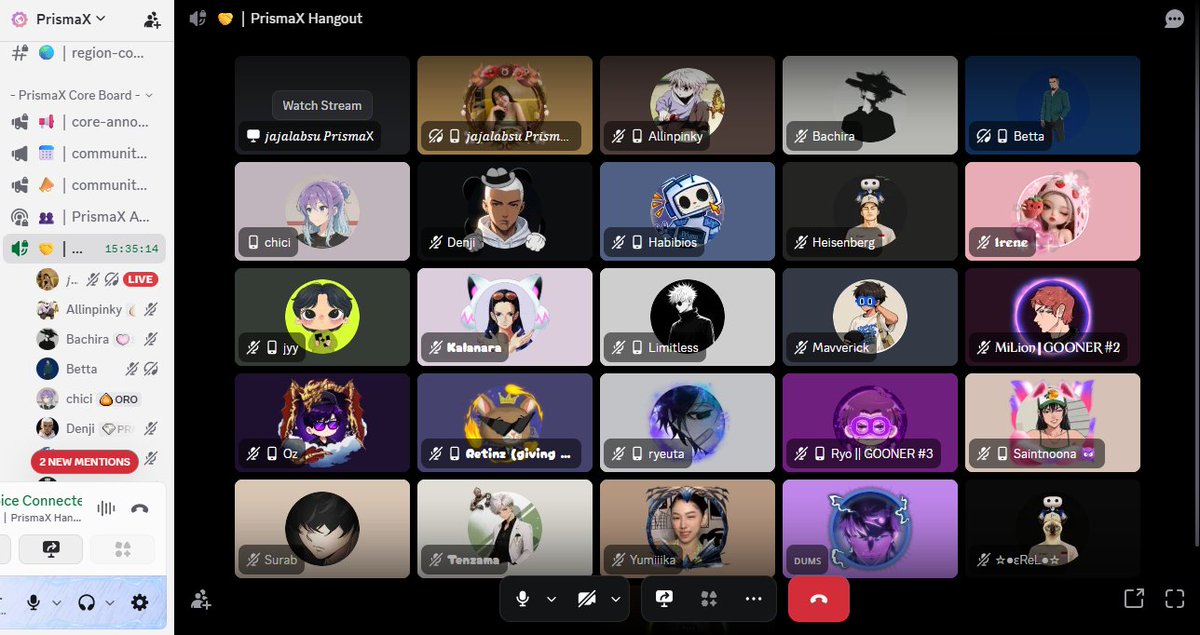
🏆 OFFICIAL MATCH RESULT 🏆
PrismaX Mobile Legend Friendly Match
🇮🇩 Indonesia 2 - 0 Philippines 🇵🇭
An impressive performance from Team Indonesia secures the series victory. Thank you to all players and supporters who participated and made this event a success.
Thank you also to @DumSpirer for running the event with me
Thank you also to the players who have participated in this event
Indonesia: Me, @gundiw_ , @misseggayam , @hendrix_mazo , @SRedofermansyah , @Irenezu8 , @allinpinky , @fayreldtz16 , @itskalanaraa , @0xjyy7275
Phillipine: @DumSpirer , @sunrakuuusan , @Geov063 , @0x_Bachi , @yyyynotyukihiro , @nathweb3 , @Shinnnnn262 , @EnthusiastRyo , @0xMavve , @0x_Gen0
GGWP guys. See you at the next event
Gprisma!
Special Tag : @vivianrobotics @MaxC16134 @PrismaXai



May 30

𝗣𝗿𝗶𝘀𝗺𝗮𝗫 𝗠𝗼𝗯𝗶𝗹𝗲 𝗟𝗲𝗴𝗲𝗻𝗱 (🇮🇩 𝘃𝘀 🇵🇭)
🕗 8 pm (Indonesian time)/9 pm (Philippine time), 31 May 2026
📍: PrismaX Server Discord (discord.gg/prismaxai)
This event was created by the PrismaX community from Indonesia and the Philippines. Thank you to @DumSpirer for organising this event with me. Let's have fun and enjoy the game!
Join the PrismaX community and help shape the future of robotics!
Gprisma!
@PrismaXai

16
7
31
1,225
May 29
Imagine a world where a humanoid robot completes a maintenance shift at a local warehouse, receives a crypto payment directly into its own on-chain wallet, and autonomously pays for its own hardware repairs or software upgrades, all without a single human intermediary.
This is no longer a far-fetched scene from Cyberpunk 2077 or a sci-fi novel. It is the blueprint for a multi-billion dollar ecosystem actively being built at the intersection of blockchain, artificial intelligence, and robotics.
While the tech world has spent the last few years obsessed with digital AI agents trapped behind computer screens, the narrative is rapidly shifting toward Embodied AI, AI with a physical body. For these machines to act as truly independent economic actors in our physical world, they require a decentralized, open, and permissionless infrastructure.
This open alternative to Big Tech’s walled gardens is being realized through a powerful synergy of three pioneer Web3 projects: @PrismaXai , @openmind_agi , and @peaq
Together, they form the Autonomous Trinity of the machine economy.
Layer 1: The Brain Engine — PrismaX AI (@PrismaXai)
Before a physical robot can perform tasks or earn revenue, it needs to know how to interact with our chaotic, unpredictable physical world. Legacy AI models excel at text and imagery, but robots require spatial awareness, precise motor control, and real-world telemetric data. Big Tech tries to solve this by building closed, million-dollar testing facilities, a process that is far too slow and unscalable.
PrismaX AI solves this bottleneck by building a decentralized physical data marketplace.
Supported by prominent Web3 venture arms like a16z Crypto CSX, Volt Capital, and Symbolic Capital, PrismaX allows everyday internet users to become robotics trainers directly from their web browsers. Through their ultra-low latency Tele-operation Stack (powered by ROS 2 and WebRTC), global users can remotely guide physical robotic arms to complete daily tasks.
Every nudge, correction, and successful movement is logged, scrubbed for quality via Proof-of-View protocols, and fed back into the network. PrismaX acts as the open-source data engine, supplying the fundamental intelligence and muscle memory that physical robots need to operate.
Layer 2: The Universal Operating System — OpenMind AGI (@openmind_agi)
Gathering raw behavioral and kinetic data is only half the battle. Hardware varies wildly; a bipedal humanoid robot, a four-legged robotic dog, and a stationary manufacturing arm all process physical movements differently.
OpenMind AGI acts as the crucial translator in this stack.
They are developing a decentralized, open-source AI operating system specifically designed for physical hardware. Think of OpenMind as the Android OS of the robotics era. It ensures that the modular data models and intelligence gathered by networks like PrismaX can be deployed seamlessly across completely different hardware brands and machine form factors.
By decentralizing the operating system, OpenMind prevents tech monopolies from locking proprietary robotic software behind licensing fees, keeping the "mind" of the machine economy open to all.
Layer 3: The Economic Backbone — peaq (@peaq)
Now, the robot is both intelligent (thanks to PrismaX) and universally functional (thanks to OpenMind). The final puzzle piece is giving the machine a way to legally, financially, and digitally exist in our economic system.
This is where peaq, the layer-1 blockchain explicitly built for DePIN (Decentralized Physical Infrastructure Networks) and Machine Real-World Assets (RWAs), completes the trinity.
peaq provides two critical components:
Machine ID: A decentralized digital identity that gives the physical robot a verifiable cryptographic footprint.
Self-Sovereign Wallets: Allows the robot to hold assets, sign service contracts, and directly execute smart contracts.
Through peaq, a robot ceases to be just a piece of property; it becomes an autonomous economic entity capable of accepting Machine-to-Machine (M2M) payments, paying for its own electricity, and executing trustless rental agreements with businesses.
The Self-Sustaining Flywheel
When these three layers converge, they trigger a powerful economic flywheel that shifts wealth from centralized corporations back to decentralized communities:
The Flow: A human trains a machine model via PrismaX ➔ That model is universally deployed onto real-world hardware via OpenMind ➔ The physical robot executes commercial tasks and processes its earnings autonomously on peaq ➔ The revenue generated is instantly distributed back to the community members who provided the initial data training, the node operators, and the physical hosts of the machine.
The New Machine Era
The transition to an automated society is inevitable, but the ownership of that society is still up for grabs. Silicon Valley giants want to control the future of robotics within proprietary, closed-source ecosystems where they extract all the value.
By seamlessly weaving together the data layers of PrismaX, the system frameworks of OpenMind, and the financial architecture of peaq, Web3 is building a composable, open-source alternative. This isn't just about trading tokens; it is about building and owning the decentralized infrastructure of the next century.
Special Tag: @vivianrobotics @MaxC16134
6
1
14
512
May 28
ChatGPT is a genius in the digital world, but put it in a physical robot body? It can’t even fold laundry.
Why? Because the hardest problem in AI right now isn't the code, it's the lack of real-world physical data.
Here is how @PrismaXai is solving the "Embodied AI" bottleneck using DePIN and decentralized human training
To make a robot smart, you need millions of hours of physical data (angles, grip strength, spatial awareness).
Big Tech tries to gather this in million-dollar private labs. It's too slow. It doesn't scale.
Enter PrismaXai They are building a decentralized data marketplace where anyone can become a robotics trainer from their browser.
How does it work? Through their Tele-operation Stack.
Think of it like a remote-control arcade. PrismaX uses an ultra-low latency infrastructure built on ROS 2 (Robot Operating System), gRPC, and WebRTC.
This allows users worldwide to control physical robot arms remotely with sub-millisecond lag, streaming real-time action data straight to the AI brain
This creates a Human-in-the-Loop (HITL) system:
1️⃣ The robot tries a task (e.g., sorting a package)
2️⃣ It gets stuck
3️⃣ A human operator takes over via the browser to correct the movement
4️⃣ The robot logs the correction, learns from it, and gets smarter
You aren't just playing, you are actively generating high-value training tokens.
Open-source data usually means a lot of spam or low-quality inputs. How does PrismaX fix this?
They introduced Proof-of-View (PoV) combined with a CLIP-based scoring system.
The network evaluates user telemetry data in real-time. If someone tries to feed the system random bot movements or useless noise, the CLIP model flags it, filters it out, and protects the dataset integrity.
By crowdsourcing physical intelligence, PrismaX is turning data collection into a scalable game. It’s exactly why heavyweights like @a16z CSX, @VoltCapital , and @symbolicvc backed them early.
They aren't just building another crypto dApp; they are building the fundamental data layer for the future humanoid robot economy.
Embodied AI is going to be a multi-trillion dollar industry, and data is the new oil.
If you want to see the future of DePIN x Robotics firsthand, check out their active Tele-op Arcade, run some daily quizzes, and start exploring the ecosystem.
Follow @PrismaXai to catch their next tech update
Join PrismaXai Discord Community: discord.gg/AW8W9p58
Special Tag: @vivianrobotics @MaxC16134
1
3
125
May 27
Smth big is coming 👀
Stay tuned
May 27
Dear RealGo community, the production team have heard everyone’s feedback.
📢 Here is our initial response:
1⃣️ RT Shards and RT conversion will remain transparent.
The tokenomics can already be viewed in the whitepaper and will be finalized and clearly communicated before TGE.
2⃣️ The game app is still improving rapidly.
We are actively addressing issues related to equipment, runes, passive skill balancing, Meme Arena exits, lag and gameplay responsiveness, low-performance device optimization, and marketplace flow improvements.
3⃣️ We will further strengthen our anti-cheat system to better protect the rights and value of real players.
4⃣️ AI meme companion is already part of our roadmap plan.
5⃣️ All RT Shard payment scenarios will transition to RT after TGE, creating a wide range of utility and use cases. In addition, 20% of ecosystem revenue will be used to buy back and burn RT.
RealGo is more than just a game. We are building a Meme 3.0 ecosystem where gameplay, loyalty, community contribution, and RT value are genuinely connected.
Thank you to every real player for your feedback, we will continue improving!

62
May 25
Robots are incredibly smart, but right now, they are like newborn babies.
They can calculate complex math in milliseconds, but they don't know how to navigate a busy sidewalk or pick up a fragile coffee mug without breaking it.
To live in our world, robots need us to teach them
Why is this? Because the real world is chaotic.
AI models thrive on data. While text and image data are everywhere, real-world movement data for robots is incredibly rare.
A robot can't just read a book to learn how to open a jammed door. It needs to see and feel it done.
This is exactly what PrismaX is solving.
They are building the ultimate open bridge between humans and machines.
Instead of letting robots guess how to behave, PrismaX creates a system where everyday humans can train, guide, and level up AI robot models in real-time.
How does it work? Think of it like gaming with a purpose.
- Human-in-the-Loop: Humans can control or guide robots remotely (Teleoperation).
- Every Move Matters: Every time you guide a robot, your actions are recorded as valuable training data.
- Play-to-Train: You contribute your data or validate robot movements, and you get rewarded for helping the network grow.
PrismaX ensures that only the best data gets through.
Through smart validation systems, the real-world data humans provide is verified, packed, and used to train AI.
The result? The AI gets smarter, is sent back into the robot, and the robot successfully learns how to adapt to our messy, unpredictable world.
The future of robotics isn't about machines replacing us, it’s about machines learning from us.
By decentralizing this data, PrismaX is making sure the future of Physical AI is built by the community, for the community.
Ready to help a robot learn today? Keep your eyes on @PrismaXai
Join PrismaX Discord: discord.gg/Zg3mcM8c
Special Tag: @vivianrobotics @MaxC16134
1
53