
Founder Cloud Factory || Cloud Distribution in Europe made easy!
Joined March 2009
- Tweets 2,753
- Following 2,229
- Followers 872
- Likes 4,351
338 Photos and videos









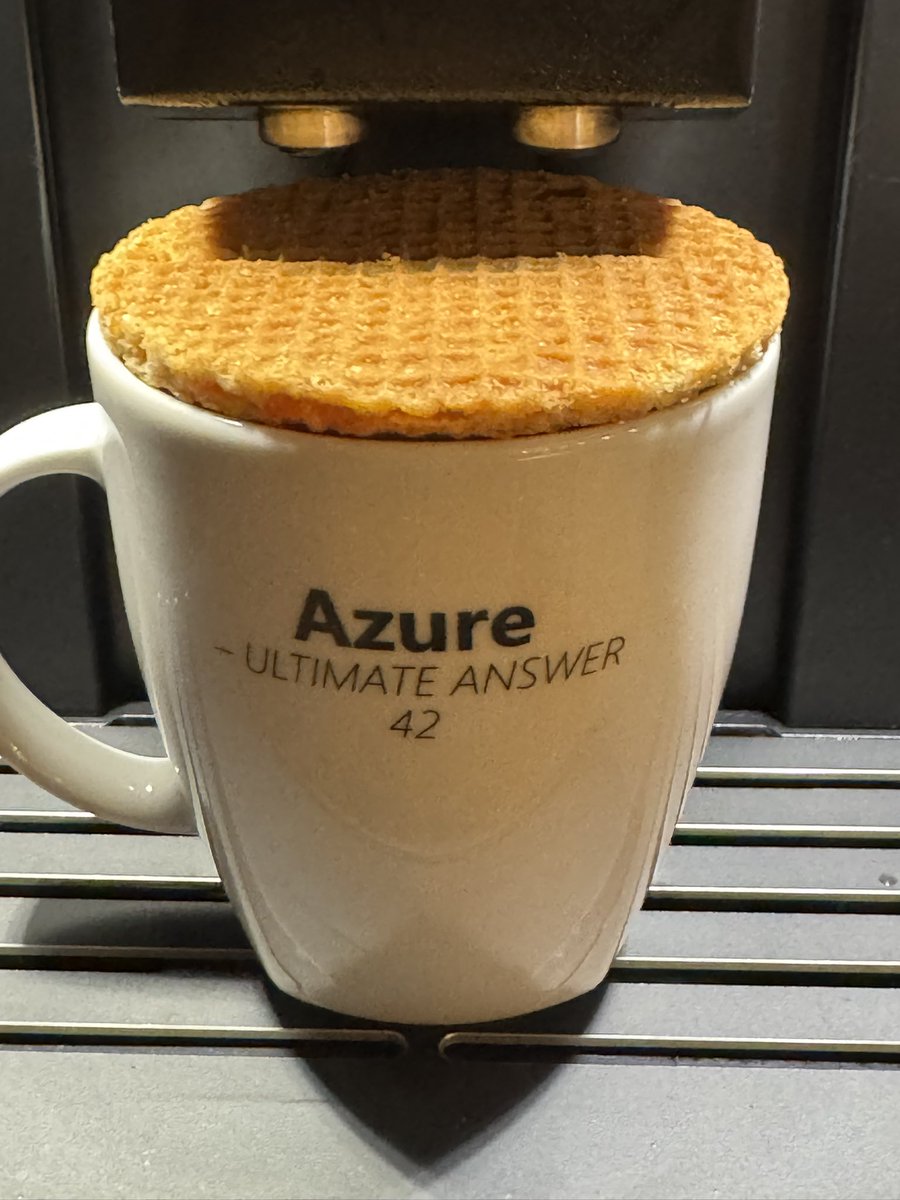



Jun 15
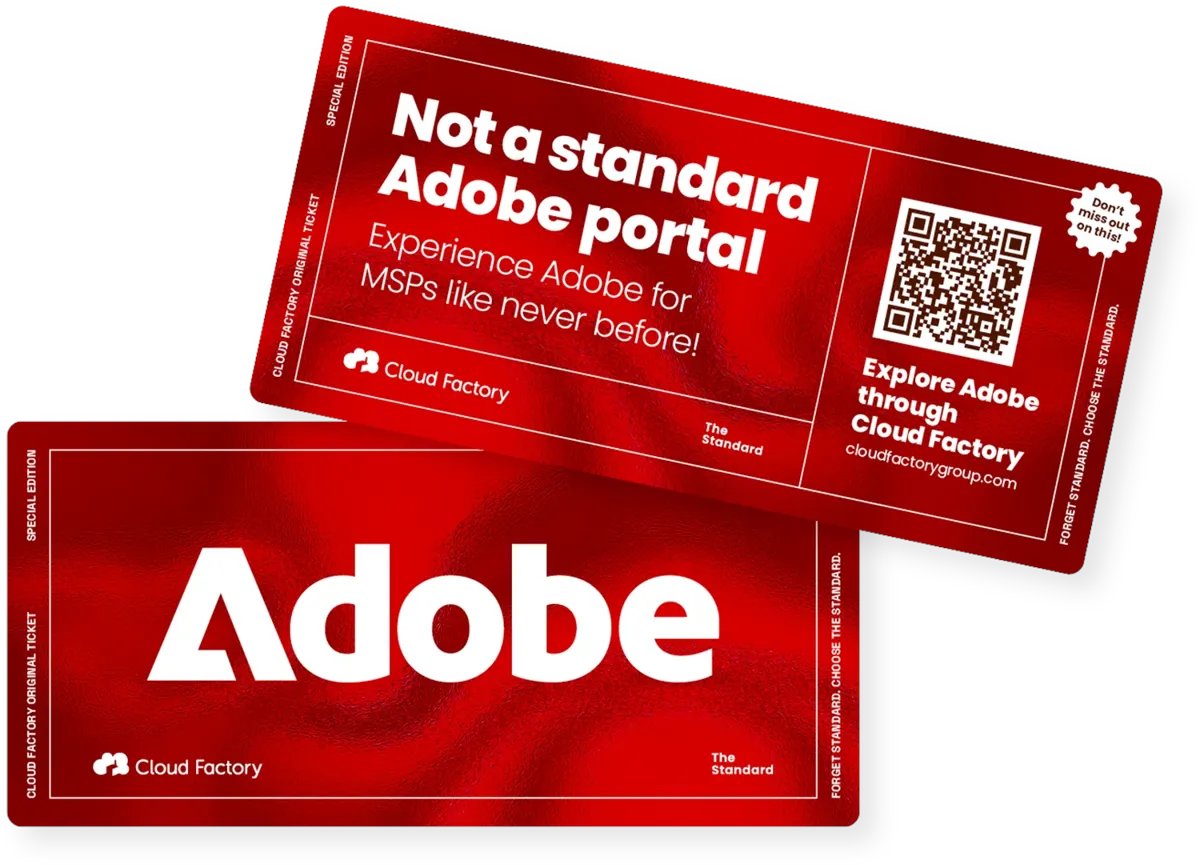
Join me tomorrow 16th of June at Adobe event in a fireside chat
blog.cloudfactorygroup.com/p…
7
Jacob V. S. Schmidt retweeted

Jun 10
Major new Copilot Studio release! New UX, orchestrator, RAG, skills, workflows and more lets you build and govern better agents across models faster and cheaper.
techcommunity.microsoft.com/…
8
36
188
16,559
Jacob V. S. Schmidt retweeted
Agents aren’t just model and prompt, the real work is on the context plumbing:
Azure AI Search, MCP, Web IQ, Fabric IQ, Work IQ, citations, boundaries.
This Microsoft Build lab is a good look at how that starts coming together. github.com/microsoft/Build26…
2
18
110
7,071
Jacob V. S. Schmidt retweeted

Today we’re excited to announce the general availability of Learning Agent in Microsoft 365 Copilot, to help every employee build Copilot and AI skills where the work gets done. Learn more: msft.it/6013vdFHN
45
238
27,240
Jacob V. S. Schmidt retweeted

Jun 3
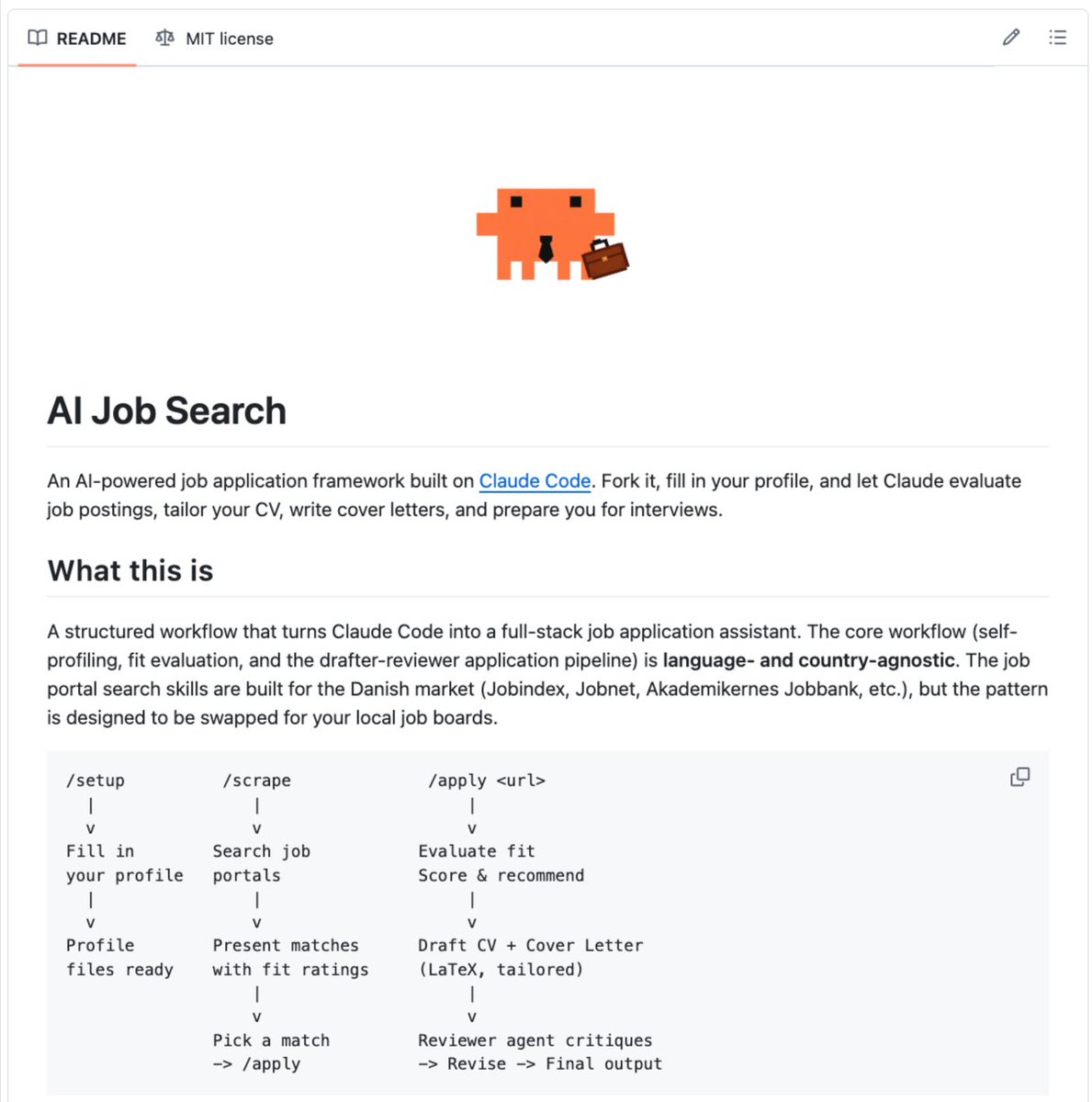
A scientist in Denmark figured out how to make Claude prepare his job applications. He open-sourced the whole thing.
His name is Mads Lorentzen. He is a PhD geophysicist. He built it on top of Claude Code and released it under MIT license.
Here is what it does. You fork the repo, fill in your background once, and it runs a five-step pipeline for every job you want to apply to.
Step 1. It reads the job posting and scores how well you fit.
Step 2. It drafts a tailored CV in LaTeX, picking only the experience that matches.
Step 3. It writes a cover letter framed around what you would bring to the role.
Step 4. A second AI agent reviews the first agent's work, points out weaknesses, and the first agent revises.
Step 5. It compiles both into clean PDFs you can send.
The whole thing is a folder of markdown files. The candidate profile, the writing style rules, the CV templates, the interview prep notes. Every step is plain text you can read and change.
The job portal search is built for Danish boards. The application workflow itself works for any country.
489 stars. 270 forks. A fork-to-star ratio that high means people are using it, not only bookmarking.
Mads is not a startup founder. He built this because he needed it for himself, then shared it.
This is the future of job hunting. Not a service you pay for. A workflow you own.
(Link in the comments)
65
548
4,594
457,248
Jacob V. S. Schmidt retweeted

Jun 3
MAI-Code-1-Flash is here! Built and optimized for GitHub Copilot. From quick fixes to complex engineering challenges, write better code with more return on token. Rolling out to GitHub Copilot individual users in Visual Studio Code in the model picker and under the default auto picker now.
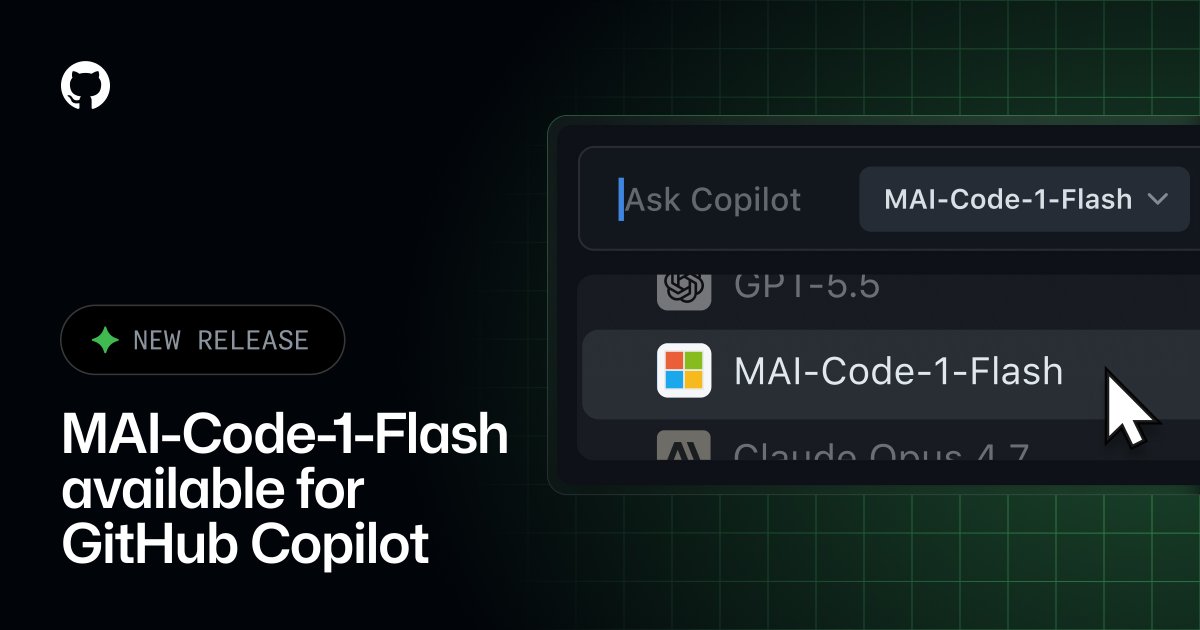
ALT Graphic announcing ‘MAI‑Code‑1‑Flash’ as a new release available for GitHub Copilot, with a dark interface showing a Copilot prompt box and model selection menu.
30
113
739
85,025
Jacob V. S. Schmidt retweeted

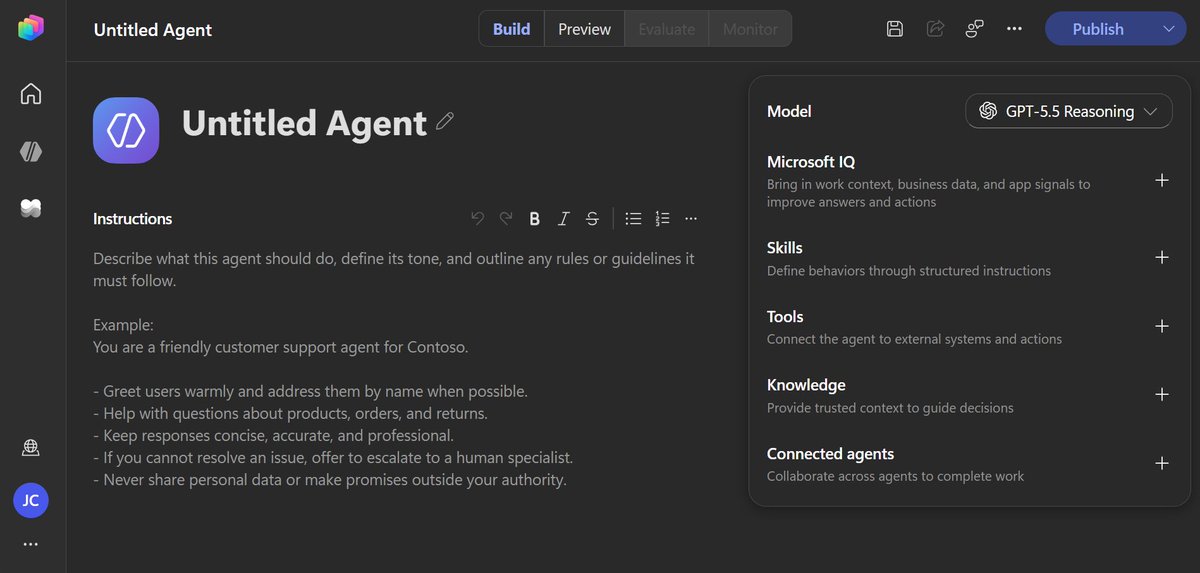
BREAKING: Copilot Studio's new designer is showing up in early access.
And there's a lot more going on here than a fresh UI.
>Skills
>Microsoft IQ
>Tools
>Knowledge
>Connected agents
The part I’m locked in on is Skills.
Microsoft already supports code interpreter in agents, which means Python-backed execution is already in the mix.
Now Skills is showing up as a first-class part of the designer.
Early access, so I’m keeping the claims tight.
Copilot Studio is getting a much more structured agent architecture.
14
20
101
15,650

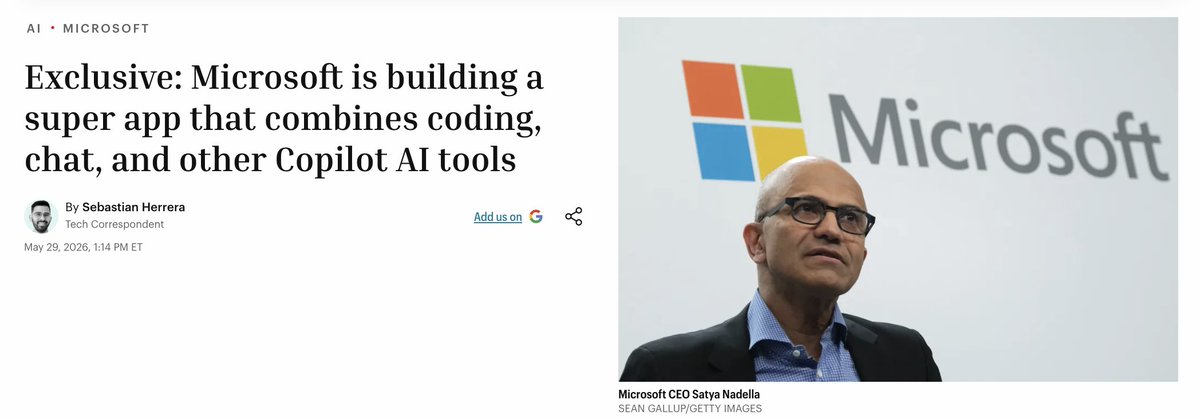
Microsoft is reportedly building a Copilot “super app” that combines its major AI tools into one central interface.
The app would bring together GitHub Copilot, Copilot chat, Copilot Cowork, Microsoft 365 Copilot accounts, and a new agentic workflow capability internally called Autopilot.
9
17
133
8,494
Jacob V. S. Schmidt retweeted

May 20
The new @code release adds Mermaid diagram rendering directly in the Markdown preview.
The Integrated Browser also now supports HTML file previews and drag-to-select for pulling multiple page elements into chat context.
60
241
2,061
175,576
Jacob V. S. Schmidt retweeted

May 16
Azure’s AI architecture guidance is a solid map for moving from “AI demo” to production-ready systems with RAG, agents, Foundry, Fabric, and ML patterns. learn.microsoft.com/en-us/az…
29
155
8,288
Jacob V. S. Schmidt retweeted

May 15
#MicrosoftBuild online is free, which means your couch has conference access.
Watch the keynote live, jump into hands-on labs, save sessions for later, and replay what you missed on demand.
Register today: msft.it/6019vr6tP
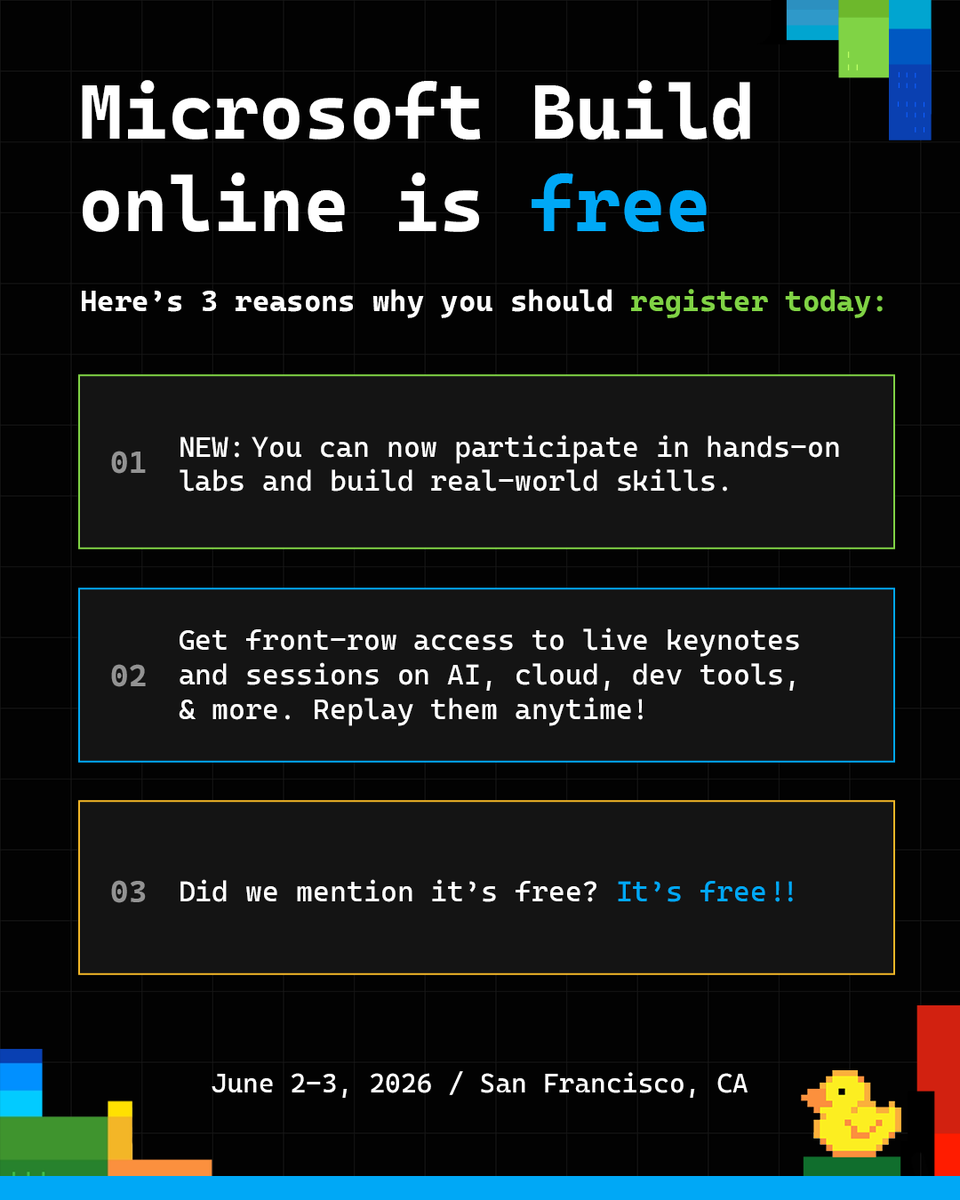
ALT Microsoft Build 2026 event announcement, emphasizing free online participation, skill-building labs, and access to live and replayable sessions.
4
70
270
21,416
Jacob V. S. Schmidt retweeted

May 16
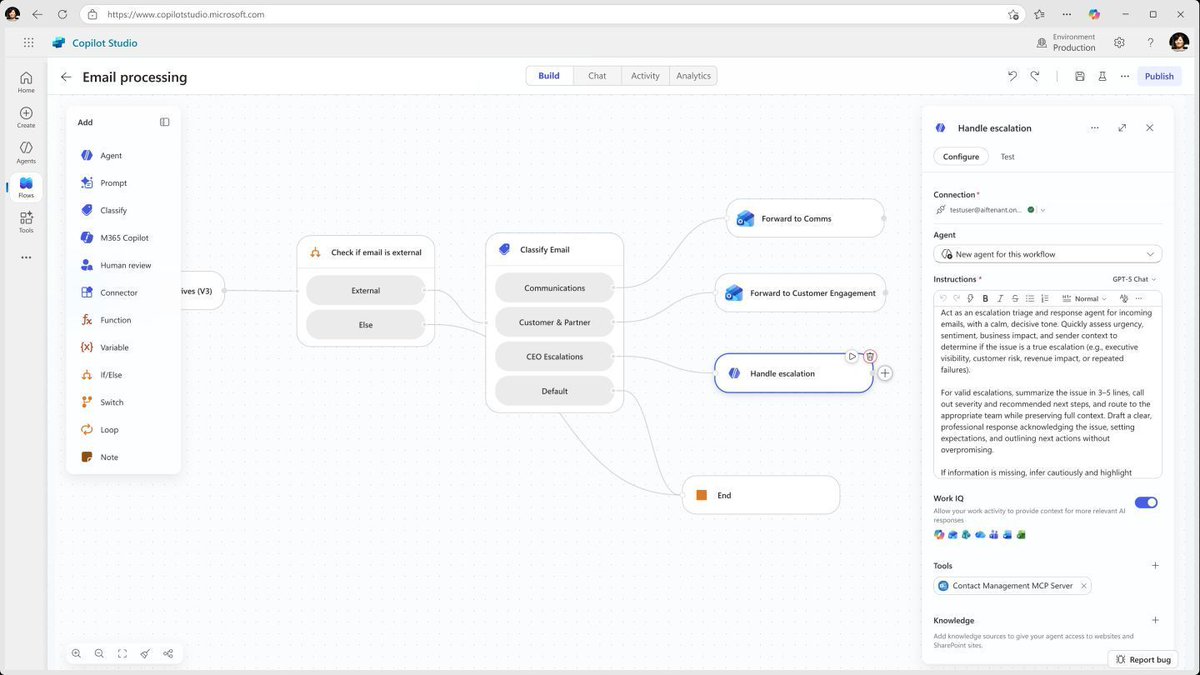
Copilot Studio just got a big upgrade: a drag-and-drop workflow designer (Preview)⚡⚡⚡
You can now create complex automations and agentic reasoning on a single canvas😍😍
👉Read the new guide: learn.microsoft.com/en-us/mi… #CopilotStudio #PowerPlatform #AI
2
17
105
7,464
Jacob V. S. Schmidt retweeted

May 16
TL;DR - Don't sleep on Microsoft. They're still the kings of business, with Microsoft 365, and Azure... and with Foundry, they're making sure it stays that way.
May 15

As two of the largest forces in equity markets -- growing index ownership and increasing amounts of capital controlled by extremely short-term-oriented, leveraged, volatility-intolerant investors -- converge, we have found occasional opportunities to acquire some of the most dominant long-term compounding franchises at attractive valuations.
For example, we acquired Alphabet $GOOG when the stock declined substantially on the release of ChatGPT in late 2022, Amazon $AMZN in the weeks following Liberation Day, and $META more recently on the market's response to the company's unexpectedly large cap ex guidance and expenditures.
In our 13F which we will file later today, we will disclose a new position in Microsoft, a company we have followed for many years now offered at a highly compelling valuation. While $PSUS will not be filing a 13F tomorrow, it has also recently made $MFST a core holding.
Microsoft operates two of the most valuable franchises in enterprise technology, which account for approximately 70% of the company's overall profits: M365 and Azure.
M365, the company's productivity suite, is the dominant operating platform for knowledge work, with over 450 million workers using Word, Excel, PowerPoint, Outlook, and Teams on a daily basis.
Azure is the world's second-largest hyperscaler cloud platform and, like AWS in our Amazon investment, is a direct beneficiary of the multi-decade migration of enterprise IT workloads to the cloud, which is now further accelerated by surging demand for AI inference workloads.
Both M365 and Azure are underpinned by Microsoft's unparalleled enterprise distribution and the security, compliance, and identity infrastructure it has built and refined over decades.
Beyond these core franchises, Microsoft also owns a portfolio of other leading businesses, including LinkedIn (the world's largest professional network with 1.3 billion members), its gaming platform (Xbox and Activision Blizzard), and search and news advertising (Bing and the Edge browser).
We began building our position in MSFT in February following a meaningful share price decline after the company reported its fiscal Q2 2026 results. We were able to establish our position at a valuation of 21 times forward earnings, broadly in line with the market multiple and well below Microsoft's trading average over the last few years.
Notably, MSFT's headline multiple does not reflect the value of Microsoft's approximately 27% economic interest in OpenAI, which would represent approximately $200 billion, or 7% of Microsoft's market capitalization, at OpenAI's most recent funding round valuation.
We believe Microsoft's recent share price decline has been principally driven by investor concerns around two key issues: i) the competitive positioning of M365 against increasingly capable AI lab offerings (notably Anthropic's Claude Cowork), and ii) the durability of Azure's growth, especially in light of Microsoft's evolving relationship with OpenAI.
In our view, investors underestimate the resilience of the M365 franchise given its deeply embedded role across enterprises and highly attractive price-value proposition. Unlike point software solutions, which may be vulnerable to disintermediation by better-performing AI alternatives, M365 is tightly integrated into the daily workflow of nearly every large enterprise and is supported by Microsoft's identity, security, compliance, and data governance infrastructure, which would be nearly impossible to replicate.
Attractive bundle economics further reinforce Microsoft's advantage, with monthly average revenue per user on the M365 suite at approximately $20, less than half of what customers would pay to purchase the underlying applications individually from different vendors.
Moreover, we are encouraged to see Microsoft prioritizing its R&D efforts and investment in Copilot, its own AI agent embedded across M365, with direct involvement from CEO Satya Nadella. We believe these efforts will translate into improved product velocity and greater customer adoption over time.
Alongside Copilot's rollout, the company has also begun shifting its pricing model from pure per-seat licensing to a hybrid model of seats plus metered consumption, which helps expand the company’s revenue opportunity as AI agents drive incremental usage that a seat-only structure would not capture. These initiatives should help sustain M365’s strong underlying growth momentum, which was already evident in the business unit’s 15% revenue growth (in constant currency) last quarter.
We believe concerns regarding Azure's growth trajectory are similarly misplaced, particularly in light of the franchise's exceptional recent performance. Azure revenue grew 39% in constant currency last quarter, with company guiding to modest acceleration through the second half of the year.
We view Microsoft's recent decision to restructure its OpenAI partnership not as a concession but as part of a deliberate pivot toward a more open, multi-model architecture that better serves enterprise customers, who increasingly seek optionality across model providers.
Microsoft recently disclosed that over 10,000 enterprise customers have used more than one model on Azure Foundry, the company’s modular AI model marketplace. This model-agnostic approach also strengthens Copilot, which can auto-route queries across multiple models to deliver the optimal output for a given task.
To support Azure's rapid growth amid persistent supply constraints, Microsoft has raised its calendar year 2026 capex budget to approximately $190 billion. Consistent with what we have observed at hyperscaler peers Amazon and Google, we view this spend as growth capex that should drive future revenue generation. This is particularly true for Microsoft, given that roughly two-thirds of its capex budget is allocated to server and networking equipment that correlates directly with near-term revenue.
Like our purchases of $GOOG, $AMZN, and $META, we believe that $MSFT offers analogous and compelling long-term value at today's valuation.
2
5
40
5,220
Since we became a Microsoft distributor in 2019, there's one thing that still surprises me: How long MSPs put up with a distributor that doesn't deliver.
Short video on why that is, and what we did about it.
After watching, go here to learn how to become a Cloud Factory partner:
lnkd.in/e4TfNR8K
Feel free to comment, if you're already a happy camper <3
Thanks for the support guys!
36
Microsoft Foundry Toolbox - Game on
Read my blog
blog.cloudfactorygroup.com/p…
12
Jacob V. S. Schmidt retweeted

May 7
Here's another reason why @Microsoft Foundry is the BEST platform in the world to build and run your agents: Our durable, long running agents come with Toolbox 🔨
Toolbox allowed me to reduce input tokens 90%(!!) and significantly simplify the amount of code needed
Check out the demo below and see how you can bring hundreds of tools through a single MCP endpoint -- all running in Foundry at cloud scale! ☁️
30
65
474
124,278
Jacob V. S. Schmidt retweeted

May 5
Introducing SubQ - a major breakthrough in LLM intelligence.
It is the first model built on a fully sub-quadratic sparse-attention architecture (SSA),
And the first frontier model with a 12 million token context window which is:
- 52x faster than FlashAttention at 1MM tokens
- Less than 5% the cost of Opus
Transformer-based LLMs waste compute by processing every possible relationship between words (standard attention).
Only a small fraction actually matter.
@subquadratic finds and focuses only on the ones that do.
That's nearly 1,000x less compute and a new way for LLMs to scale.
1,492
2,877
23,055
13,082,975

Effective today, we are:
1) Doubling Claude Code’s 5-hour rate limits for Pro, Max, and Team plans;
2) Removing the peak hours limit reduction on Claude Code for Pro and Max plans; and
3) Substantially raising our API rate limits for Opus models.
1,243
3,930
44,455
9,114,361