
Helping GTM teams move at the speed of their ideas. Co-founder/CEO @MutinyCorp, ex Head of Marketing @GustoHQ, @YCombinator 2018
Joined March 2009
- Tweets 421
- Following 633
- Followers 11,936
- Likes 472
Photos and videos
Pinned Tweet

Apr 22
We decided to break marketing's monopoly on customer-facing content and hand sales the keys. Everyone told us this was a bad idea.
Four months later, sales is creating assets 4.5x faster, marketers love us for it, and Anthropic just published a case study about it.
Read the full @AnthropicAI case study: claude.com/customers/mutiny
4
8
52
10,889
Jun 11
I just broke my biggest operating rule I've held for the past 10 years.
For years I was militantly anti-agency. My rule was simple: if the revenue program matters, build it in-house. This week, I handed an agency our entire Outbound and ABM program.
Agencies were always a step behind. They were slower, less creative and less informed about our business than the people sitting within our four walls. By the time they learned how we worked, my in-house team had already shipped three versions.
The math never worked. Why pay more for less context and less speed?
But over the past few years, a new breed of agency has emerged, and every one of those reasons fell apart.
These agencies are AI-native and founder run. They plug into your tools and your data from day one, so they actually know your business as well as your own team. They know AI and data better than most in-house teams, and they can stand the whole system up faster than you could hire for it.
For the first time, the agency was the fast option and my team/hiring was the bottleneck.
But here's the part that actually changed my mind.
The old agency model created a dependency. They build something that lives in their heads/tools, and the day the contract ends it walks out the door with them.
Most AI agencies use Claude Code, which has the same problem. Everything lives in their instance. It's a blackbox to your team and siloed from your day-to-day and AI setup.
When I met @fivosaresti at Workflows, a fast growing AI-native agency, we agreed to use Mutiny instead to power our ABM program. This changed everything in two ways:
1. The agency could onboard faster by leveraging the skills we had already created - our brand, CRM setup, Pricing, ICP, tool integrations and templates.
2. All the skills/routines/workflows they’d build to drive campaigns and personalization, lives where my sales and marketing teams already work. They can use it, see account engagement data and keep building on it.
Claude Code is never going to be a place your reps actually live, which means all those amazing ABM templates like research, interactive prospecting pages, and business cases cannot be accessed and edited by sales. Huge disadvantage.
My team still owns the motion. The agency gives them a head start and the collaboration continues as we scale.
2
388
May 21
Sales enablement software is dead. Final nail in the coffin: Highspot & Seismic rebranding as GTM agents and merging to survive. Here's why legacy sales enablement failed (and a new framework for sales leaders):
Why did Sales Enablement fail?
For over a decade, sales enablement platforms have solved a logistics problem. Marketing makes a lot of content, sellers can't find it, managers can't track it. So they built a coordination layer for that supply chain. Tag the assets. Index the library. Add a search bar.
But solving for internal logistics is why this category failed both sellers and managers. We should be solving the customer's problem so they buy more stuff from us.
60% of B2B deals are lost due to indecision (HBR). Most buyers don't get what they need to choose you with confidence, so they keep the status quo.
That's what good sales enablement should fix. Help sellers answer the customer's question more directly. Give them tailored case studies. Build a business case rooted in the customer's data that every stakeholder can rally behind.
Until recently, doing this was technically impossible. You could not produce a tailored piece of content for every customer in every deal at every stage. The unit economics never worked, despite heroic efforts from ABM, PMM and RevOps teams. So the industry settled for dumping all the content into a tool and letting sellers personalize it themselves.
AI removes that constraint.
It flips the model from logistics driven to customer driven.
Reps can now create exactly what the customer needs in minutes — on-brand, personalized, pulled from every piece of prior art the company has produced.
That changes what enablement looks like. The system produces tailored content on demand. Customer engagement data replaces usage analytics. Reps close in weeks, not quarters.
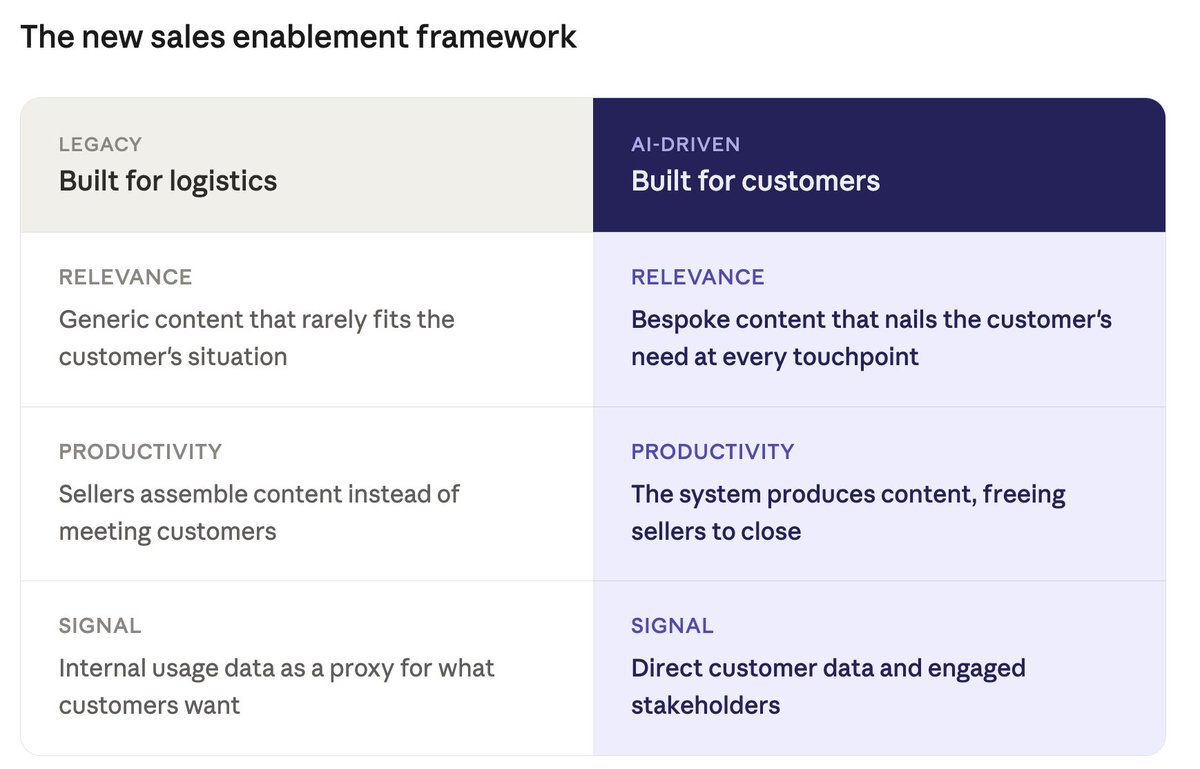
Here's the new Sales Enablement framework:
1. Relevance: Generic content that rarely fits → Bespoke content that nails the customer's need at every touchpoint
2. Productivity: Sellers assemble content instead of meeting customers → The system produces the content, freeing sellers to close
3. Signal: Internal usage data as a proxy → Direct customer data and engaged stakeholders
What’s the new tech stack?
Hubspot Clay Claude Mutiny
With these tools you can run prospecting, content, and personalization, without anything that calls itself a sales enablement vendor.
The companies that win the next decade won't buy a better content library. They'll build a customer-first system that helps every buyer make a decision, faster.
4
5
638
May 19
I once pissed off my CRO so much he slammed his laptop shut and left. He wanted to think long term. I wanted to win this quarter.
Here's why I'll die on this hill.
If you don't hit your short term goals, you will not hit your long term goals. I first learned this as a 23 year old.
I was a GM at Stanford Student Enterprises with a $1M number. I poured all my energy into 3 big projects: a rebrand, a shift in our merchandise design, and a restructuring of suppliers to increase margins. I executed all three flawlessly.
You can imagine my devastation when I missed my number.
Here's what I took from it, and what I've watched play out for 15 years since:
Hitting revenue goals is a skill. It's prioritization, resourcefulness, and making decisions with incomplete information. It's rallying people around a thing that has to happen this week. It’s learning the big gaps before they’re too late to fix. While I was building brand and strategy, I wasn't finding new channels or pushing my team to hit targets no matter what. We left money on the table every week in hopes of some lucrative destination that never came. We didn't develop the muscle.
Short term is long term. I've seen this repeat itself across every role I've ever hired for, in sales and marketing and everything in between. The CROs and VPs and managers who deliver the year are the ones who deliver the quarter. Then the next quarter. Then the next one. That's the whole game.
Back to the conversation I referenced with my CRO. His plan was: hire the team, ramp them, put in systems and foundation, then we'll see a big lift in 9 months. But here's the thing. If you don't know how to move the number right now, you can't chain enough small wins together to make a big win. You're betting the year on a plan you can't pressure-test.
Marketing leaders have to be even more careful here. "Brand takes nine months." "This program takes three months to build." "We have to set the foundation." This is why marketers at Mutiny always own weekly targets. Not even quarterly or monthly. I need them to know right away that they must plan for the future while delivering this month’s targets.
The best revenue leaders know how to hit their numbers while setting the foundation. They always have a few irons in the fire for the next big thing, and they know how to rally the troops to never accept defeat. They figure out how to pull deals in and get pipeline from unexpected places.
I'm not minimizing long term strategy. You need to lean the ladder against the right wall. But you also need to lead a team to run up it like hell. These are two different skills every revenue leader needs to master.
4
16
1,876
May 12
Every AI founder has the Claude Spookies right now. Will Claude’s next release kill our product? I studied the fastest-growing vertical AI companies (e.g. Cursor, Sierra, Legora) to uncover the 3 moats that actually hold.
In February 2026, one Anthropic update made Ryze AI, a startup with a 70% deal close rate, irrelevant overnight. The founder posted "Claude killed my startup." Every founder felt it. The week Anthropic released Cowork, $1 trillion of value was wiped from the stock market. Last week, Anthropic released 10 finance agent templates and FactSet dropped 8.1% the same day
With OpenAI re-entering enterprise, model providers will keep moving up the stack as competition heats up.
At the same time, vertical AI companies are growing at insane rates. @cursor_ai added $1B in ARR in a single quarter (Coding). @WeAreLegora hit $100M ARR in 18 months and @evenuplaw 4X'ed revenue to $100M (Legal). Abridge went from $8M to $117M ARR in 15 months (Healthcare). @SierraPlatform hit $150M in 2 years (Customer service).
These companies share 3 moats that make customers choose them over Claude:
1. Proprietary data loops that compound
Abridge is built on 50M clinical conversations. EvenUp built a proprietary settlement database of 200K cases and millions of medical records. Clay has a data marketplace that's needed despite LLMs commoditizing outbound. Sierra's Journeys codify each customer's voice, procedures, & brand that compound over time. These data investments are too fringe for LLMs, but they matter to busy customers who need time to value.
2. UX is built for the customer’s workflow
Abridge saves physicians 2 hours a day, because it lives inside Epic's native interface. Legora lives inside Word and Outlook, where lawyers already work. Its tabular view makes bulk actions like reviewing 500 customer contracts during an M&A deal easy. Cursor is so good at embedding into the org's workflows and context, making it easy to go from feedback to PRs. The workflow-native UX, paired with FDEs who know the buyer's domain, are why vertical AI keeps winning deals over LLMs.
3. Platform leverage that compounds
The best vertical AI companies are consolidating workflows and becoming the platform other workflows route through. Legora is now an agentic OS for legal work, embedding inside Microsoft Word and law firm document management systems. Abridge started with clinical notes but is expanding into orders, prior auth, and revenue cycle, becoming infrastructure across 250 health systems. While general-purpose models will accrue more integrations, they can't replicate a platform that third parties have already built their businesses on.
At @mutinycorp we're investing in all three: workflow-native UX, proprietary contact-level analytics from owning the asset layer, and a platform play we'll share more on soon.
The Claude Spookies are real, but so is the demand. The $10B vertical AI winners will nail time-to-value and get harder to rip out the longer you use them.
6
3
38
6,539
Apr 30
Meta just shipped the missing piece for AI-run paid campaigns. It will forever change how GTM teams launch campaigns and run account-based motions.
The Meta Ads API has existed for years. But using it meant writing real code: auth, pagination, error handling, the works. So in practice, only big advertisers with engineering teams automated against it. Everyone else clicked through Ads Manager.
Meta's new ad CLI changes that. Every action is one command, from creating a campaign to pulling ROAS to managing product catalogs, which means an agent can run it.
Picture two scenarios:
A marketer types "launch a $10k campaign for our GA announcement, optimize for signups, run it through Friday, kill anything below a 2% CTR by day three." @mutinycorp generates 5 ad creative variants and a matching landing page from the launch brief. Ten minutes later it's live. By Friday, the agent has cut the four losers and doubled spend on the winner.
A seller flags that pipeline is heating up. Without anyone touching Ads Manager, an agent pulls every account in late-stage opps, layers their buying committees into the existing brand campaign, and within hours those buyers start seeing Mutiny ads in their feed while reps are actively working the deals.
Marketing tools were built for humans clicking buttons. Now they're being rebuilt for agents running commands. Mutiny already generates the ad creative and landing pages. The CLI is what lets agents like Mutiny actually deploy and run the campaign end-to-end.
Hoping LinkedIn follows suit soon; it'll be a huge unlock for account-based activation, allowing marketers to use agents to collaborate with sellers in real time.
1
6
1,447
Apr 23
Mutiny’s MCP Server is now live. You can build trackable customer-facing assets such as a deck or deal room directly inside Claude, ChatGPT or other AI tools.
Start for free at MutinyHQ.com.
3
19
1,628
Jaleh Rezaei retweeted

Apr 22
24
43
392
1,139,673
Apr 22
We decided to break marketing's monopoly on customer-facing content and hand sales the keys. Everyone told us this was a bad idea.
Four months later, sales is creating assets 4.5x faster, marketers love us for it, and Anthropic just published a case study about it.
Read the full @AnthropicAI case study: claude.com/customers/mutiny
4
8
52
10,889
Apr 22
1
2
547
Apr 9
I went on @tbpn to share why we deprecated 8 figures in SaaS ARR and rebuilt the company to be agent-first.
Instead, we had a blast talking about raccoons.
Thanks for having me on! @johncoogan and @jordihays.
2
3
76
14,294
Apr 8
See you soon! I'll be on at 3:55 PM EDT / 12:55 PM PDT.

Happy Wednesday. On today's show:
- @lutherlowe (Y Combinator)
- @danprimack (Axios)
- @feross (Socket Security)
- @jalehr (Mutiny)
- @JeremyGalen (Charlamagne Labs)
- Lior Susan (Eclipse Capital)
- Qasim Mithani (depthfirst)
See you on the stream.
6
1,619
Apr 7
We raised $72M from Sequoia/YC and hit 8-figures in ARR. Then we shut it all down & rebuilt the company from scratch.
Today we’re launching the new Mutiny: the first AI agent for GTM teams to create anything customer-facing, in minutes.
Comment "Mutiny" to get 3X free credits.
345
39
825
413,678
Apr 7
4. Proven GTM best practices. Our agent has analyzed top-performing GTM assets and frameworks and built templates for every deal stage. The agent applies your brand and context so you get a polished asset in minutes.
1
14
3,086
Apr 7
Companies like Rippling, Uber and Snowflake use Mutiny to create beautiful on-brand assets, without waiting on anyone.
Sign up for free: MutinyHQ.com
To celebrate the launch, RT Comment and I’ll triple your AI credits for free.
10
3
23
3,071