
Husband, father; author (of books on FDR, Obama, Carter and Trump); lecturer; documentary filmmaker; columnist; founder, oldgoats.substack.com
Joined February 2009
- Tweets 33,749
- Following 888
- Followers 99,927
- Likes 191
195 Photos and videos

Jonathan Alter retweeted

Jun 9
Not the best start for a multicultural society, I'm afraid
Jun 9

Palestinian students in UNRWA schools:
"With Allah's help we will return and those Jews, who are dogs, we will smash their heads. I want to be a jihadist, and to kill Jews for Allah and become a martyr.
Be honest: does anyone believe peace can be made with these people?
444
3,409
17,287
264,681
Jonathan Alter retweeted

Jun 5
Palestinian students at UNRWA schools:
“Stabbing Jews brings dignity to the Palestinians. We have to stab the Jews. They teach us that Jews are terrorists. I am ready to stab a jew and drive a car over them. I am ready to join ISIS.”
Does this seem like a normal society to you?
851
6,260
12,168
250,191

It’s difficult to overstate the significance of ‘Mamdanism’

Zohran Mamdani just endorsed Darializa Avila Chevalier for Congress.
On October 8th, 2023, while Jews were still being slaughtered, raped, kidnapped, and hunted across southern Israel, she attended the "All Out For Palestine" rally in NYC.
Some clips:
69
217
1,269
80,147
"60 Minutes" Must Still Be Saved open.substack.com/pub/oldgoa…
5
8
1,174

May 19
This outrage should be called #TheSelfDealSteal Justice Dept. Sets Up $1.8 Billion Fund That Could Funnel Money to Trump Allies nytimes.com/2026/05/18/us/po… via @NYTimes
2
3
981
May 16
Panetta: Iran War a 'Terrible Mistake' and Hegseth is a 'Disaster' open.substack.com/pub/oldgoa…
1
2
1,138
May 13
I've been wondering the same thing for 9 years

Why do reporters continue to accept this treatment from him? “Excuse me, Mr President — do not insult me, I am doing my job.” Please, someone say it.
3
3
10
1,947
Jonathan Alter retweeted

May 8
It’s not just 2020 election denialism. Now Trump’s gutless judicial nominees are pretending not to understand the 22nd Amendment, @jonathanalter writes.
washingtonmonthly.com/2026/0…
6
10
934
Trump’s Pathetic Court Picks Hit New Low open.substack.com/pub/oldgoa…
3
1,068
Jonathan Alter retweeted

Apr 25
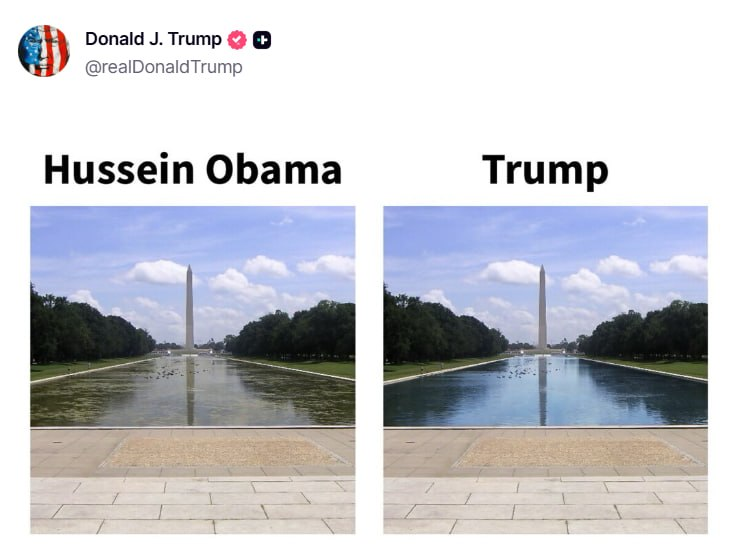
The dumbest, most dishonest president in American history, Trump, posts FAKE photos comparing the Reflecting Pool under Barack Obama to its appearance under his administration. The problem for the serial lying psychopath is that both photos have the exact same clouds. 😂🤣👇
598
5,036
15,043
267,574
Jonathan Alter retweeted

Apr 17
Albert Einstein died with a speech for Israel in his hands.
This day (April 17) in 1955, the world’s most celebrated genius was hospitalized with internal bleeding. It was just 9 days before Israel’s 7th Independence Day & Einstein was scheduled to give a major televised address (to air on ABC, NBC & CBS) - he had a draft of his speech with him in the hospital.
Sadly for the world, Albert Einstein passed away the very next day. He was never able to share any more of his genius or the speech he intended to give marking Israel’s rebirth days later.
However, you can read here what Einstein intended to say:
“The establishment of Israel is an event which actively engages the conscience of this generation ... It is a bitter paradox to find that a State which was destined to be a shelter for a martyred people is itself threatened by grave dangers to its own security. The universal conscience cannot be indifferent to such peril.”
Einstein had been a passionate Zionist for decades.
In 1921, he toured America with Chaim Weizmann raising funds for Hebrew University in Jerusalem. The following year, he lectured there and proudly declared Jews were once again becoming “a force in the world.”
In a letter to Jawaharlal Nehru in 1947, Einstein wrote:
“Long before the emergence of Hitler I made the cause of Zionism mine because through it I saw a means of correcting a flagrant wrong ... The Jewish people alone has for centuries been in the anomalous position of being victimized and hounded as a people.”
When Israel offered him the presidency (a largely ceremonial position) in 1952, he declined with characteristic humility:
“I am deeply moved by the offer from our State of Israel ... but I lack both the natural aptitude and the experience to deal properly with people and to exercise official functions.”
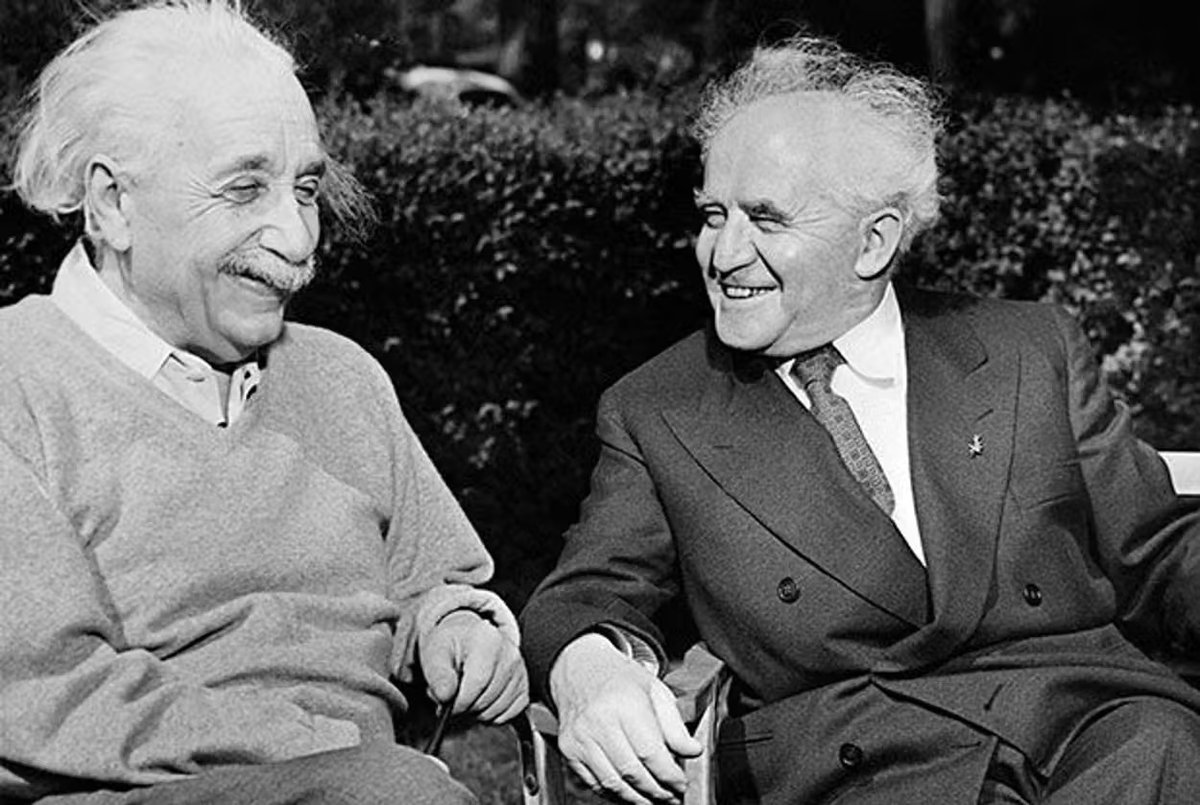
Here, in the picture below, he is smiling and laughing with Israel’s first Prime Minister - David Ben-Gurion. Einstein supported the project for Jewish sovereignty from its earliest days. He even spoke at the 1939 Palestine Pavilion (a purely Jewish pavilion at the time) at the New York World’s Fair, calling the Zionist project “a refuge in a stormy sea of turmoil.”
Yet even in America, Einstein faced antisemitism. Princeton University wouldn’t hire Jewish professors until the late 1940s. That’s right - Princeton would not hire EINSTEIN to teach at its university because he was a Jew.
So while people often say “Einstein taught at Princeton,” that’s inaccurate. In truth, he worked at the Institute for Advanced Study, a prestigious but entirely separate entity located in the town of Princeton that had to be created by American Jews as a haven for refugee scholars escaping Nazi-occupied Europe.
While Einstein largely rejected organized religion, he described himself as having a “deep religiosity” rooted in wonder at the universe. For Einstein, Judaism was a cultural and ethical tradition; and he maintained his strong solidarity with the Jewish people.
Regarding being a Jew, Einstein once famously remarked:
“A Jew who abandons his Judaism is like a snail that abandons its shell. It’s still a snail.”
Einstein’s mind helped change our understanding of the world. Einstein’s heart never abandoned his people.
58
634
2,119
76,541
Jonathan Alter retweeted

Apr 16
Every single word of this by @havivrettiggur.👇
Apr 16

Ezra Klein’s recent video about the “one-state reality” of Israelis and Palestinians caused a stir. It’s what a foreigner might think who isn’t curious about what Israelis and Palestinians think is happening to them.
Here is @havivrettiggur response:
14
42
231
15,829
Apr 17
This is one of the funniest and most pathetic moment of 2026 (so far). And that's saying a lot. Who is Hegseth's speechwriter?
Apr 16

Pete Hegseth quoting a Tarantino hit man while believing (or pretending) he was quoting the Bible is the most Pete Hegseth thing ever.
2
10
1,762
Jonathan Alter retweeted

Bill Maher presents Israeli history for dummies
30
653
2,287
43,201
Jonathan Alter retweeted

Bill Clinton said it outright:
“The Palestinians were offered a state.
THEY REFUSED.
A state wasn’t their goal.
Killing Jews was.”
214
2,606
6,591
226,576
Jonathan Alter retweeted

Apr 14
This one is so much more accurate than the original.
2,299
33,004
118,807
3,721,519
Jonathan Alter retweeted

Apr 12
Televisión 'Palestina':
"Todos los homosexuales, sin excepción, deberían ser asesin@dos. Quem@rlos vivos, arroj@rlos desde un lugar alto o apedre@rlos hasta la mu3rte."
¿Qué piensan los Queers por Palestina sobre esto?
1,175
9,856
24,275
677,258