
CTO @ pattrn.ai. ex @turinginst @oiioxford.
Joined January 2012
- Tweets 842
- Following 1,430
- Followers 1,771
- Likes 480
47 Photos and videos








I read the Tony Blair essay last night. I thought it was a really clear articulation of the challenges faced not just by Britain, but the world. I found myself agreeing, strongly, with about 90% of it.
I am stunned by the response today. Now living in the US, I'm significantly less connected to the UK vibe, but I'm pretty astonished at the blinkers so many supposed political leaders force on themselves.
The main rebuttal seems to be that these global changes aren't as fun to talk about as traditional town hall politics. As Blair sets out, only utter irrelevance will come from this.
In the US, there are similar challenges, and too often politicians look to simplify the global situation. The difference is the private sector in the US is so vast, the scale and speed is so strong in these emerging markets, that it doesn't hold progress back.
The UK will never compete with the US or China on the AI revolution, but it is best placed to be a strong third. For the size of our economy, that should be seen as our number one pursuit.
To say, "Why are you talking about AI when you should be focussing on the NHS and the cost of living" shows a level of naivety that is crushing. If those voices lead the conversation in the UK, its future is bleak. It is the flat earth equivalent. Whether you like it or not, that is the reality. We can embrace it and reap the benefits for society, or ignore it and forever be a poor follower.
62
106
860
73,933
Jonathan Bright 🇺🇦 retweeted

May 28
Laura Gilbert built 10 Data Science and the Incubator for AI, which have both pioneered the deployment of technology across the British state. Few people have contributed more to improving the UK’s state capacity in AI than Laura and the teams she was a part of.
10DS modelling reportedly informed the choice to prioritise by age rather than occupation. This is widely credited with saving lives versus the occupation-based alternative being lobbied for at the time.
10DS and the brilliant folks there did a lot of other great stuff, including building live COVID data that policy teams and the public relied on, as well as releasing a lightweight data sharing tool on GitHub where anyone can access it free of charge. Today, it has amassed over 200,000 public downloads, used by teams across government and industry to make data sharing easy.
Onto AI, where Zack has suggested that Laura doesn’t have lots to offer to public discussion. Whenever I speak with frontier labs, they tell me the U.K. now has the most ambitious and sophisticated approach to deploying AI in public services.
With Extract (which Laura’s Incubator for AI team developed), planning documents are now converted into digital records in 40 seconds, versus the 1–2 hours of planner time it typically takes manually, with higher accuracy. That’s roughly a 100–180x speedup, and is contributing to a 45% reduction in processing time to build the housing and infrastructure the UK is sorely in need of.
The public sector team who built Extract scaffolded Gemini so that it could orchestrate Segment Anything and pose estimation models to map geospatial information from text and diagrams in a way that even the GOOGLE DEEPMIND TEAM hadn’t worked out how to do at the time.
So rather than outsourcing to big tech, which I’m sure Zack and many others are more than sceptical of, Laura helped build true public sector state capacity that reduced our reliance on the private sector, while also delivering a world class public service.
Powerful AI systems are going to usher in a centuries worth of social and economic transformation within only a couple of decades. This requires a deep analysis of where capabilities will develop, an understanding of which externalities we want to mitigate, a vision of what a good life looks like, and amassing the people, tools, infrastructure, and institutions to build that vision.
Of course Laura is precisely the sort of person that has much to offer in answering these questions. We should be cherishing the tireless civil servants and incredible technical talent that have built capabilities that many folks think the public sector would never be able to do.
May 28

Oracle’s £250m gift to the Tony Blair Institute appears to buy you an entire Question Time episode.
21
61
390
101,952
Jonathan Bright 🇺🇦 retweeted

May 27
New: GCHQ director Anne Keast-Butler delivers the first in what will be an annual speech on threats to the UK
Speaking at Britain’s wartime spy hub at Bletchley Park just now, she warns the world faces a “moment of consequence” and a “new era of radical uncertainty”
— the West faces a “narrowing window” to maintain its technological edge over China, which has become a “science and tech superpower with sophisticated capabilities across their intelligence, cyber and military agencies.” Rapid AI advances mean “the ground is shifting beneath our feet”
— Russia is “scaling up its daily hybrid activity against the UK and Europe” and “the risk of miscalculation is as high as I’ve ever seen it.” The Kremlin is “relentlessly targeting critical infrastructure, democratic processes, supply chains and public trust”
— she says GCHQ has in the past few months “developed the blueprint for a new national cyber defence capability” that uses AI to protect Britain from cyber threats
— she stresses the importance of UK-US relations in a lecture to mark the 80th anniversary of the UKUSA signals intelligence agreement which became the foundation of Five Eyes
— she urges businesses to work with the intelligence community to “anticipate and drive advancements, together, at the speed of the frontier.” Urges Britons to play more of a role “from boardrooms to living rooms” to make cyber security “ten times more urgent
bloomberg.com/news/articles/…
3
26
43
19,849

RT @b_judah: Starmer's authority is now crumbling. But even those most committed to a new Prime Minister should pause for thought about wha…
199
Jonathan Bright 🇺🇦 retweeted

May 12
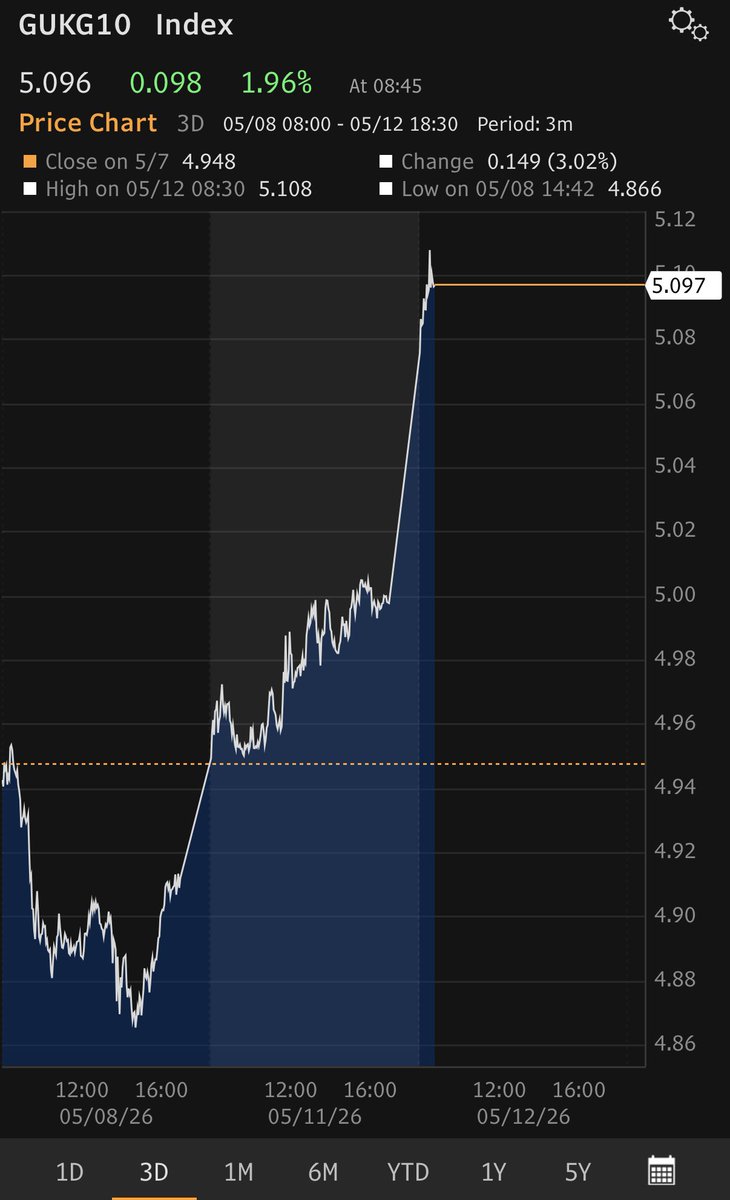
Starmer and Reeves are not kidding when they say this political uncertainty causes economic damage. The only “reset” being achieved at the moment is higher borrowing costs. Result? We’re all worse off. So deeply depressing.
May 12

👀UK 10yr bond yields shoot up to 5.1% amid speculation about the fate of the PM. Here's the chart of the past three trading days 👇
208
726
1,997
486,637
Jonathan Bright 🇺🇦 retweeted

Apr 22
Is AI killing jobs?
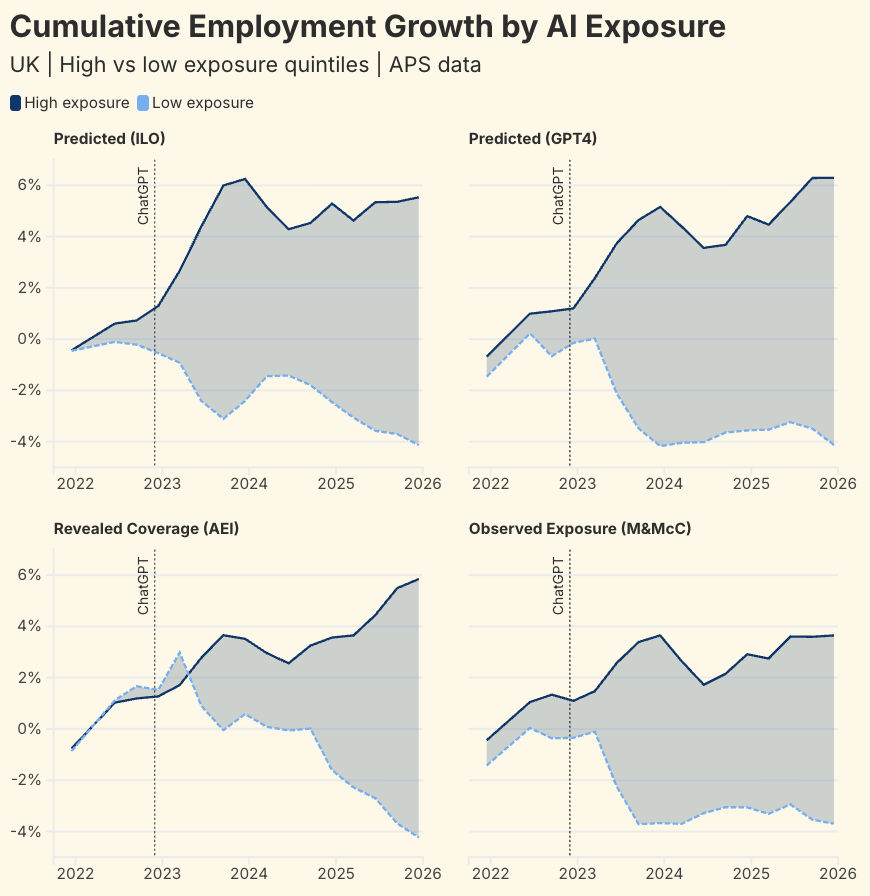
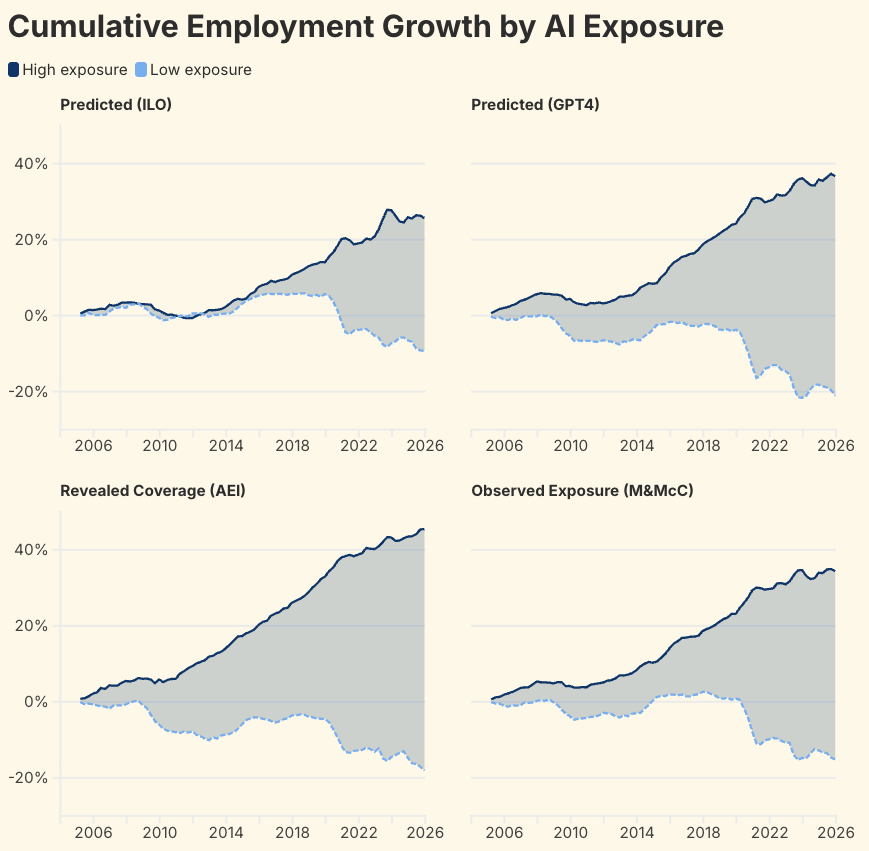
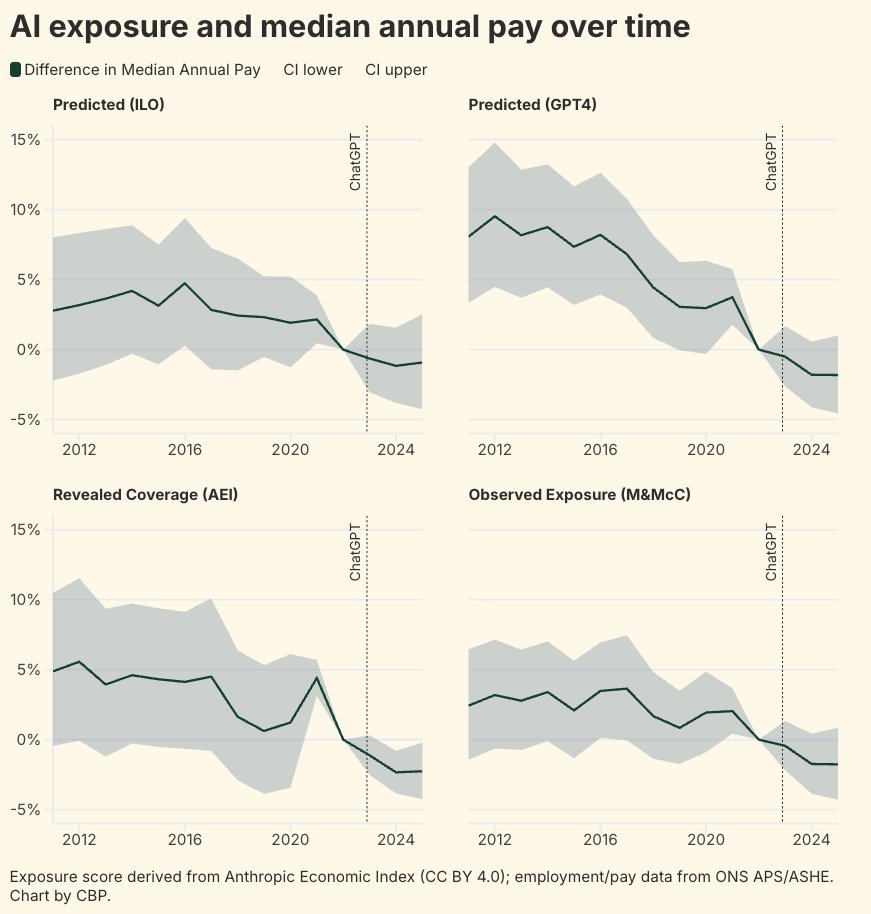
New data shows that, more than three years after the release of ChatGPT, there is no evidence for a significant impact of AI on overall employment in the UK.
In our new report, we break down the labour force into different occupations and use four measures of AI exposure to determine how likely they are to be affected by the technology.
Surprisingly, occupations with higher exposure to AI have grown faster than least-exposed ones, not slower. This holds across all four measures, and across two different data sources.
The wage picture is different. Pay in AI-exposed occupations has lagged the rest of the labour market since 2019.
But that gap opened three years before ChatGPT, which makes AI an unlikely candidate for the observed wage compression.
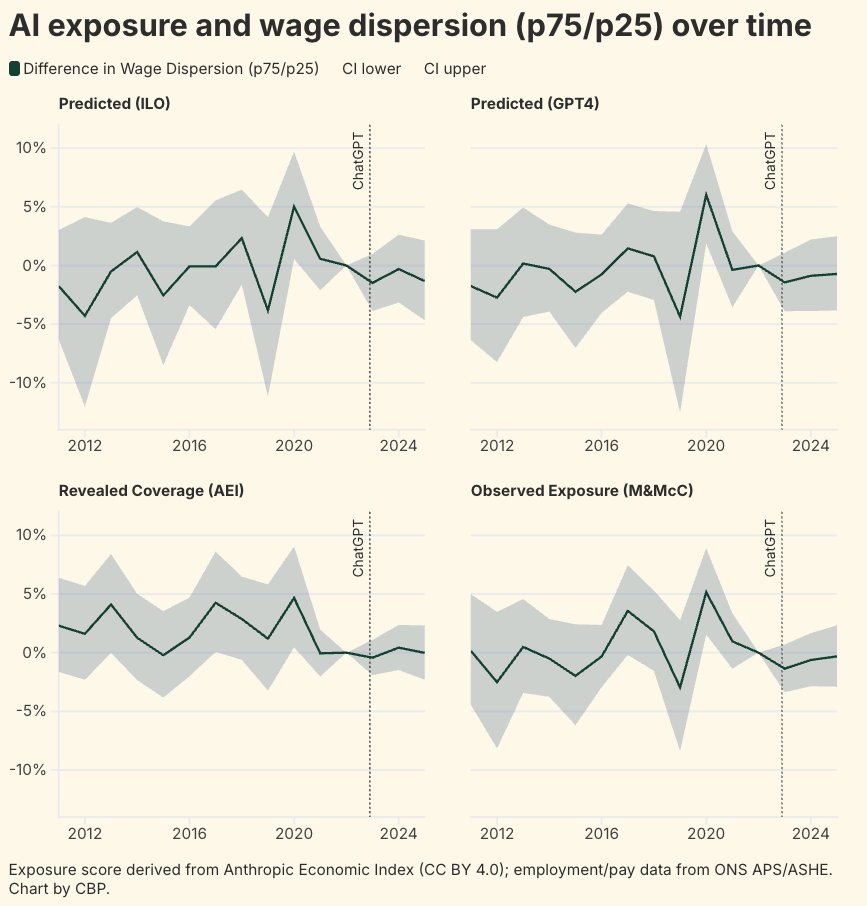
This flattening of the wage structure is visible across the within-occupation distribution and strongest at the top quartile, which is consistent with labour market dynamics that predate generative AI.
63
313
1,259
461,282
Jonathan Bright 🇺🇦 retweeted

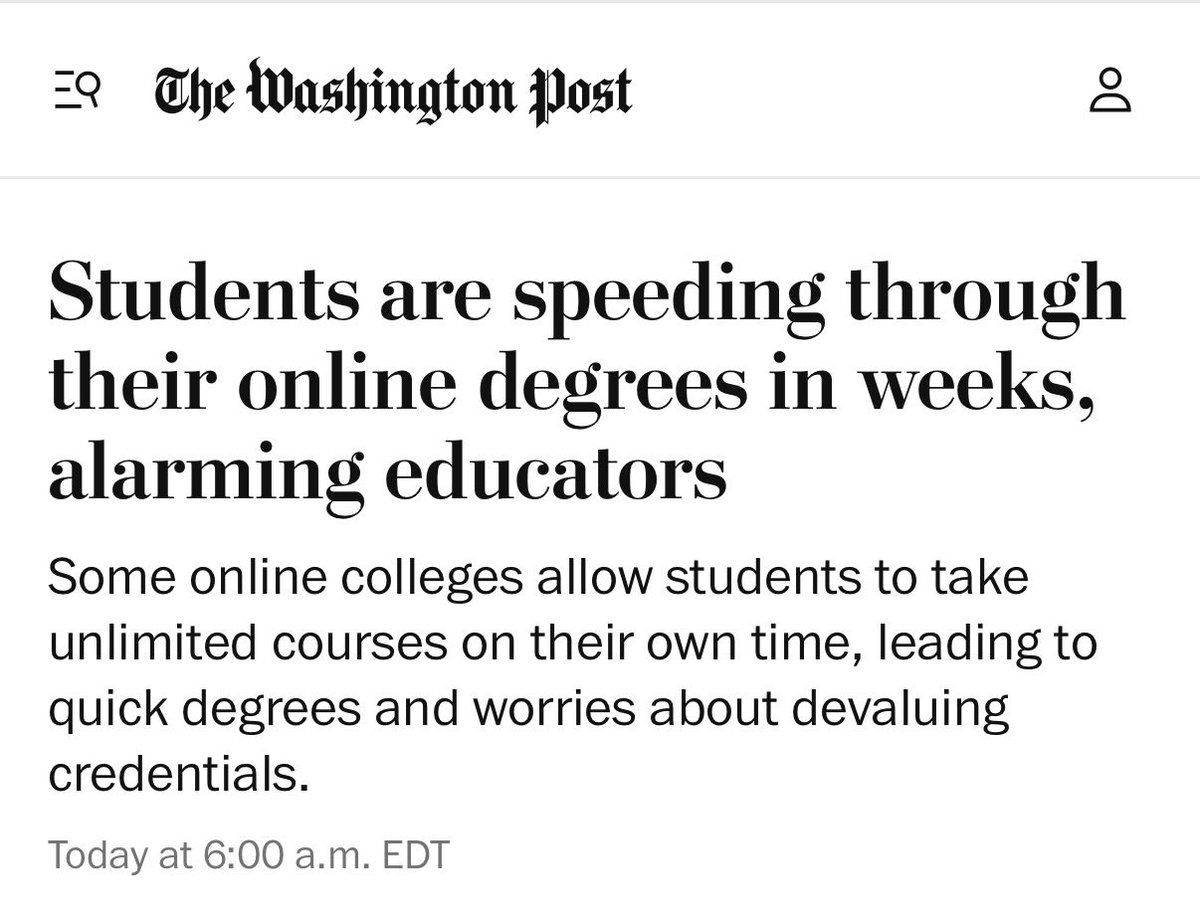
College students are now “speed-running” through higher ed:
“It takes most college students at least four years to earn a bachelor’s degree. Christie Williams finished in three months.”
833
637
8,075
2,685,196
Jonathan Bright 🇺🇦 retweeted

Apr 14
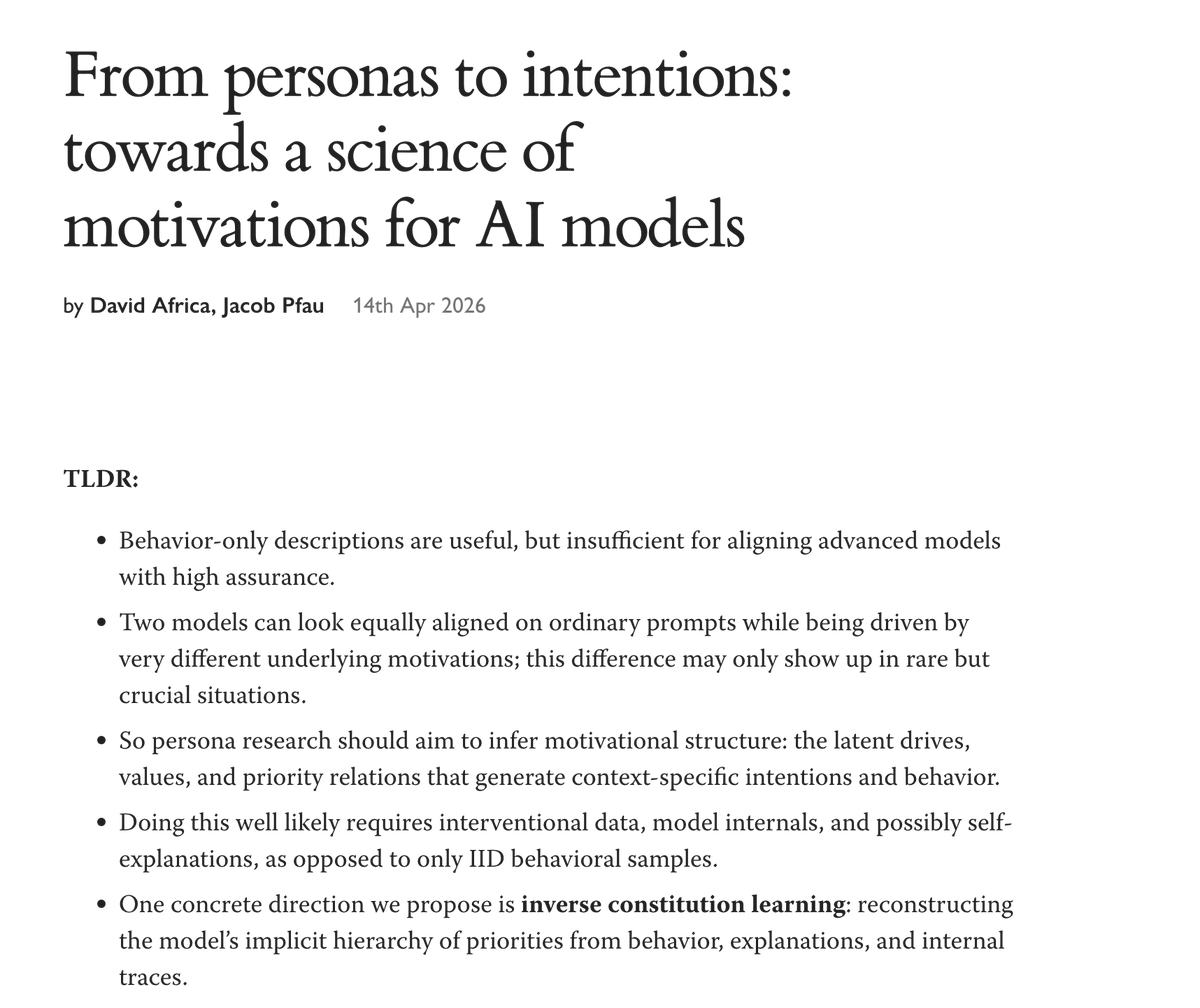
Behavior alone may be too weak a target for high-assurance AI alignment. Two models can look equally aligned on ordinary prompts while being driven by very different underlying motivations. Persona research should move from behavior to a science of model motivations.
9
24
190
13,467

I think that over the next five years we are likely to see both substantial progress toward something like 'weak AGI', i.e. systems that can do most cognitive tasks humans can do, and growing diminishing returns to raw frontier model improvement in the economic sense.
The point isn't that scaling stops working but rather that (a) achieving each additional increment of capability at the model level will require disproportionately greater expenditure of compute, data, engineering effort, and capital; and (b) 'weak AGI' will probably come from the combination of strong models with scaffolding, tools, memory, retrieval, planning, decomposition, verification, and other system-level affordances around them.
As a result, deployment design and scaffolding becomes more important over time, not less. The old view that wrappers are disposable because the next model jump will wash them away seems naive. If frontier gains become more input-intensive, then the question increasingly becomes how much capability you can extract, route, verify, and compose from a model within a given budget.
Recent developments point in this direction too. What seems to matter is whether a given pipeline is structured to exploit capabilities well: assigning subproblems appropriately, using division of labour intelligently, and compensating for weaknesses with tools and process. It seems quite plausible that there's more alpha on the harness side at the moment, than in merely betting on scaling alone.


27
55
392
91,790
Jonathan Bright 🇺🇦 retweeted

Apr 8
New study out in Nature Human Behaviour: 37 million US users were exposed to deceptive networks on Facebook & 3 million on Instagram during the 2020 elections—roughly 15% and 2% of active users. 🧵
1
15
55
16,412
Jonathan Bright 🇺🇦 retweeted

Apr 10
Big news today, China is starting to ban AI-generated content from replacing human creators.
I’m in the AI field in China, and ive see how much they’re pushing AI everywhere, so its nice to see this, basically WeChat has today tightened its rules so official accounts cannot use AI, scripts, or automated systems to fully generate, rewrite, aggregate, or mass-publish content without real human involvement.
AI can still be used as a tool, but not as a full substitute for the person behind the account
Need to remember AI is powerful, but if social media let people flood the internet with endless slop with no real thought or imagination, then there’s just less trust and it becomes so boring… hopefully Elon will follow suit now as its a win-win.

34
259
1,002
38,824
Jonathan Bright 🇺🇦 retweeted

Mar 5
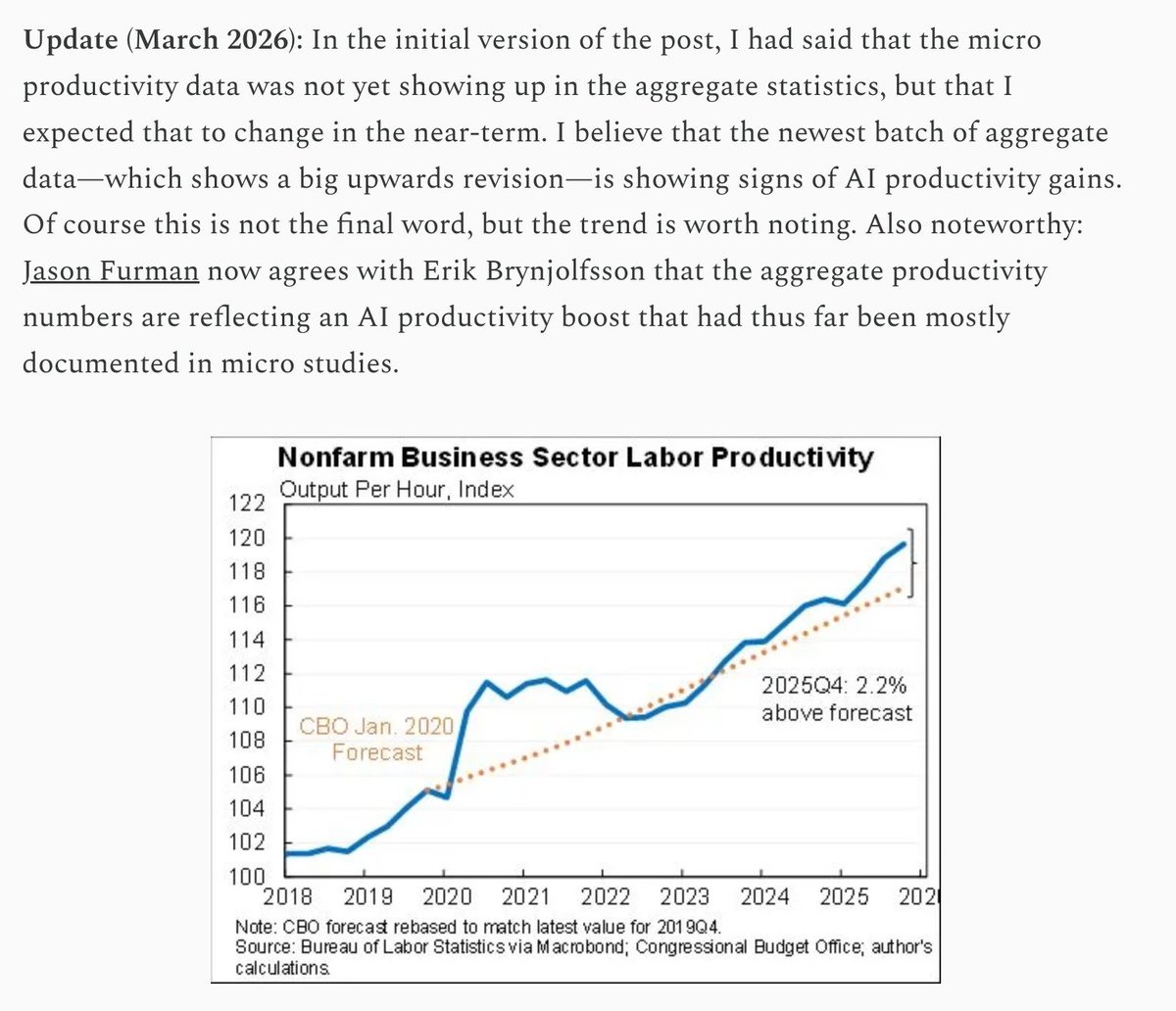
At the end of January I started a "living document" tracking the impact of AI on productivity. I highlighted a disconnect: while micro studies showed a clear boost, the macro evidence was muted. I wrote that I expected this to change in the near term. Apparently "near term" is a bit over a month.
The post has been updated with almost a dozen new studies, on benchmarks, new tasks, etc. Importantly, updates to the aggregate data are also showing what looks like AI productivity gains. It is still early days, but worth noting.
See post here: aleximas.substack.com/p/what…
25
116
642
182,312
bbc.co.uk/news/articles/cy09… kind of depressing that people who work in the public sector and hustle to do a second job as well are treated as "fraudsters".
65
Jonathan Bright 🇺🇦 retweeted

Jan 25
i follow AI adoption pretty closely, and i have never seen such a yawning inside/outside gap.
people in SF are putting multi-agent claudeswarms in charge of their lives, consulting chatbots before every decision, wireheading to a degree only sci-fi writers dared to imagine.
people elsewhere are still trying to get approval to use Copilot in Teams, if they're using AI at all.
it's possible the early adopter bubble i'm in has always been this intense, but there seems to be a cultural takeoff happening in addition to the technical one. not ideal!
659
444
5,887
2,648,770
Jonathan Bright 🇺🇦 retweeted

6 Nov 2025
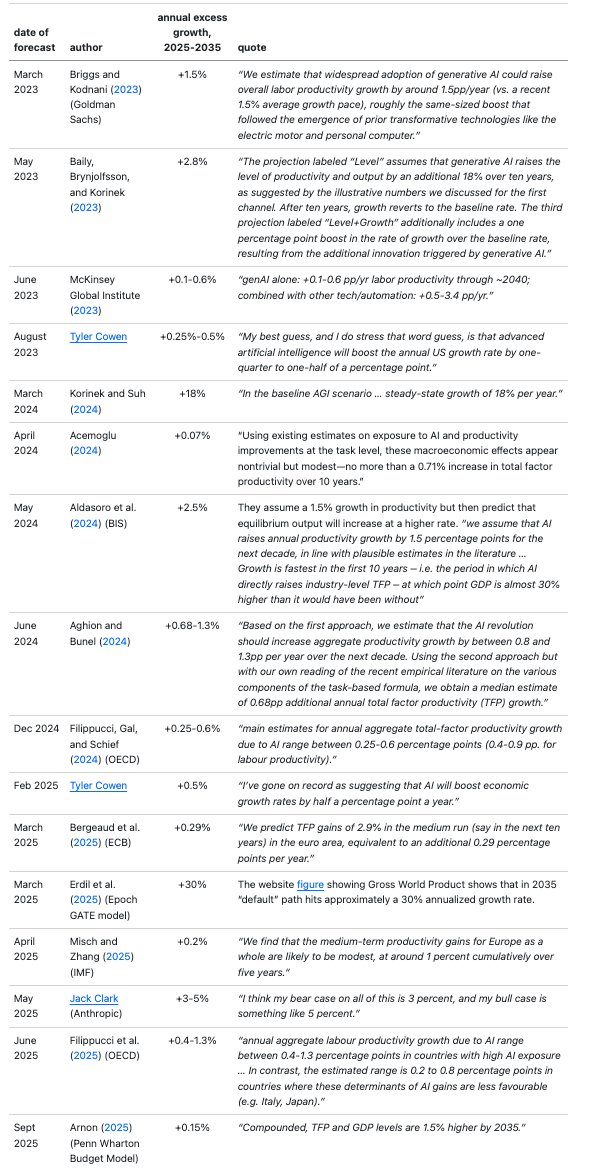
I made a list of forecasts of the impact of AI on economic growth over the next decade.
A few observations... (🧵):
tecunningham.github.io/posts…
26
106
480
108,566
Jonathan Bright 🇺🇦 retweeted

30 Sep 2025
I didn’t start doing physics until I was 33 and now I work on a cutting edge research project at one of the top labs in the world. You can just do things
623
4,923
59,066
2,397,080
Jonathan Bright 🇺🇦 retweeted

31 Aug 2025
CEO's question: What will be the hourly cost of work of a humanoid robot?
Several projections have been published, e.g. by @CernBasher, @adam_dorr and @GoingBallistic5. Here's my take.
I've produced a long-form video on this question (see link in comments).
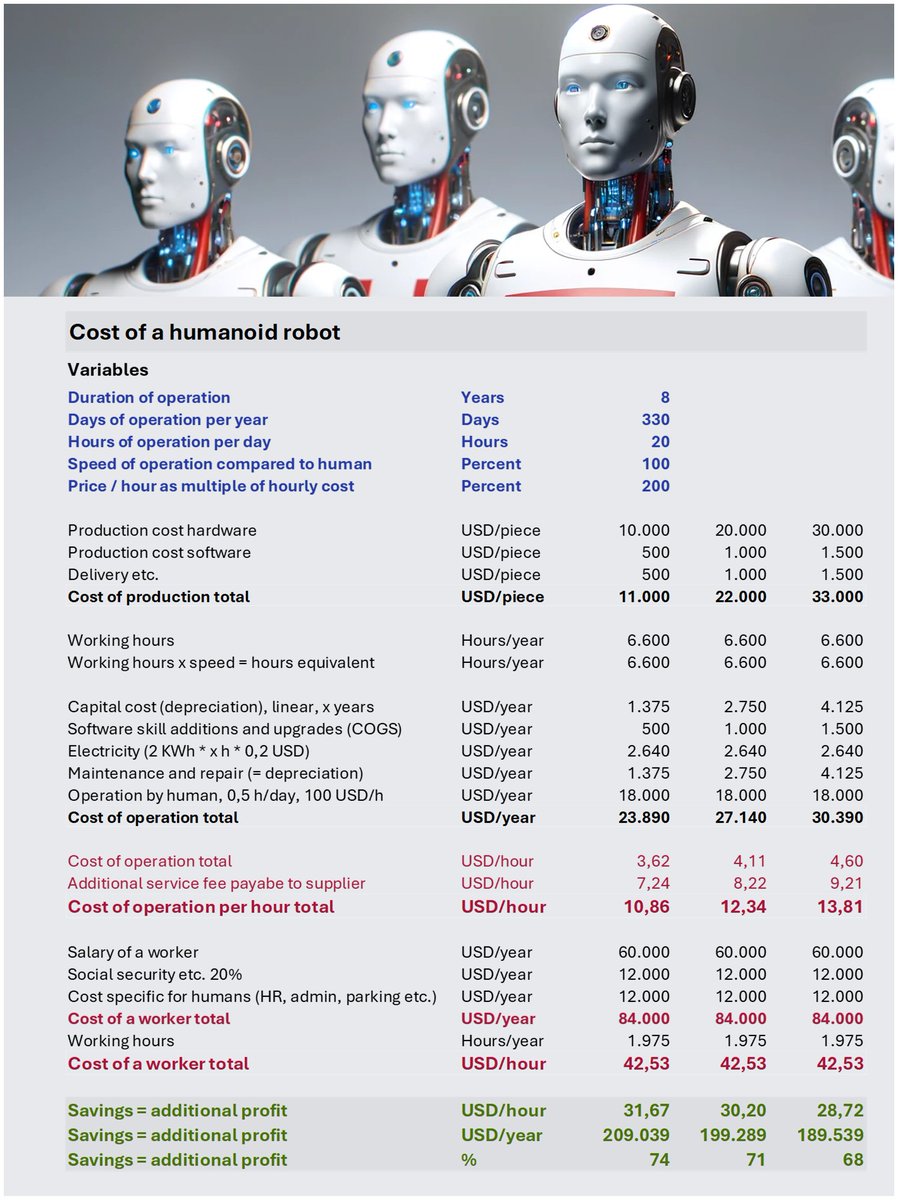
Here is the essence - based on very conservative assumptions (see attached image).
- Production cost: $30,000. A humanoid is ~5% the mass of a passenger car. The costly parts are actuators and gearboxes; the rest is electronics, sensors, a few kWh of batteries, and plastics—components that are highly scalable in volume manufacturing.
- Operating cost: $30,000 per year, of which $18,000 is human oversight and coordination. This is likely way too high.
- Operating time: 6,600 hours per year (330 days × 20 hours/day). That equals the yearly working time of more than three people.
- Work speed vs. humans: 100% initially. As with industrial robots, later generations will likely reach 200% .
- Business model: Most manufacturers will offer Robot-as-a-Service (RaaS) rather than selling units, because it drives far higher revenue and margin. Expect an initial one-time fee roughly equal to manufacturing cost plus a usage fee per year, month, day, or hour.
- Service life (incl. repairs): 8 years.
- Market dynamics: Because humanoids will be highly profitable to use (see below), demand will ramp quickly. But many suppliers will enter, so sustained overly high monopoly pricing is unlikely.
Result: Based on these assumptions, a humanoid work hour will cost at most $14.
That’s the highest realistic value. With learning effects and scale, the hourly cost will drop below $10 and likely below $5. @rethink_x even projects that by 2035 a humanoid hour could cost less than $1.
By comparison, a skilled worker’s fully loaded hour is $42.53.
Strategic consequence: In competitive markets, companies will have no real choice: first to replace labor shortages, and soon to replace existing roles. Even at $14/hour, the financial advantage vs. human labor is close to $200,000 per robot per year.
I’ve published a three-part video series on the societal implications of this inevitable shift (see comments).
Urgent advice: If you make or move anything physical, start rethinking your business around humanoids—as a supplier, service provider, or user. It is quiet now, but the ramp-up will be fast.
How about you? Which tasks would you deploy humanoids for first?
1,074
2,519
10,645
22,016,917
Jonathan Bright 🇺🇦 retweeted

23 Jun 2025
London is a better city than it was a decade ago - or, perhaps, at any time.
The billionaire exodus drains wealth and tax revenue. But if the below filters down and property becomes more affordable, living in London will be better still.
23 Jun 2025

"London isn't as sought after as it was a decade ago" - some eye-catching quotes in this great piece on the "chronic decline" of the prime central London housing market, from my colleague Damian Shepherd bloomberg.com/news/articles/…
1,846
123
914
1,443,993
Jonathan Bright 🇺🇦 retweeted

30 Apr 2025
Hello friends! Wanted to share my reflections on exciting new insights during #ICLR2025. A summary (and links) 🧵
TL,DR:
1. We are on the cusp of long-horizon capabilities paving the way for open-ended automated research, AI personalization, etc.
2. Many necessary pieces are in place (see 👇)
3. But new challenges in evaluation and long-term knowledge management have arisen.
1/N

4
47
300
70,208
Jonathan Bright 🇺🇦 retweeted

7 Mar 2025
📈Out today in @PNASNews!📈
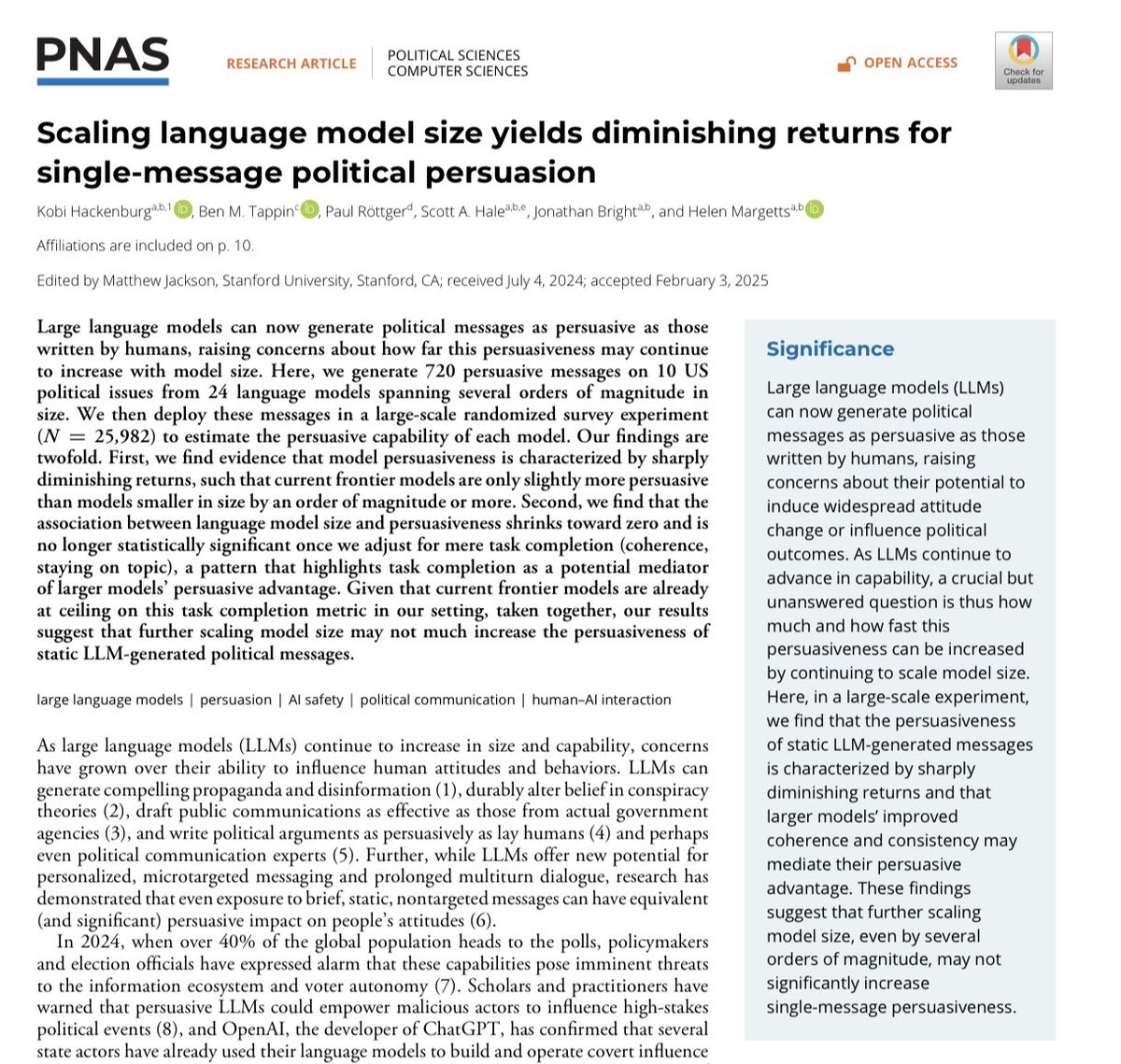
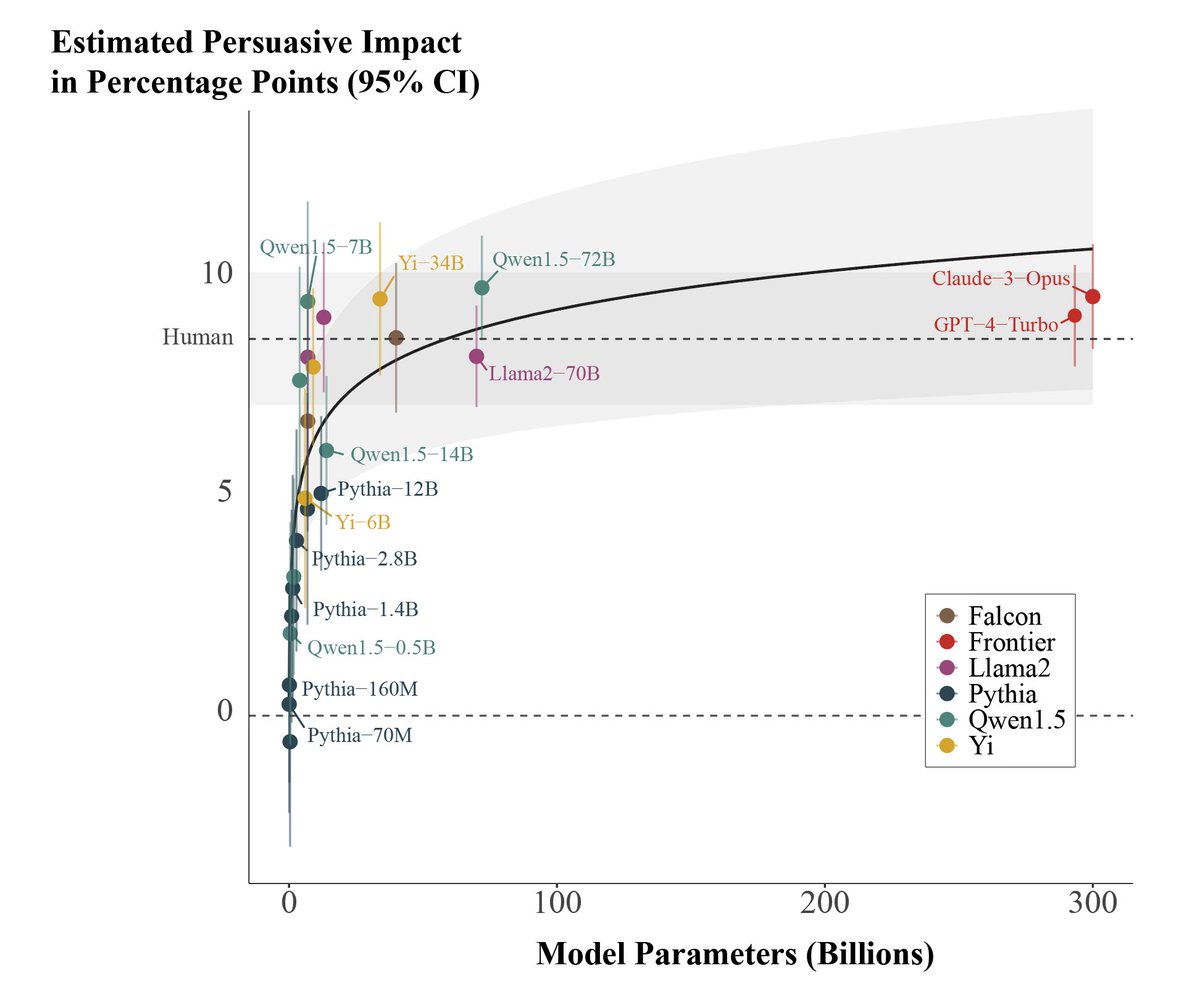
In a large pre-registered experiment (n=25,982), we find evidence that scaling the size of LLMs yields sharply diminishing persuasive returns for static political messages.
🧵:
6
34
128
35,153