
Joined January 2021
- Tweets 1,535
- Following 162
- Followers 307
- Likes 16,080
282 Photos and videos






Pinned Tweet

25 Jan 2025
philosophically, we're in a time where the Marshall McLuhan maxim, "the medium is the message," has never been more poignant. technology does not just facilitate but it often dictates the overall cultural rhythm, molds behaviors, and perhaps even our ethics. honestly, the question of culture now isn't just about what we do but about what we are becoming. sometimes i wonder if we are evolving into a species that is more connected but less present, more informed but less wise?
5
2
17
3,027
jovin retweeted

May 13
how to read the room in venture right now:
if a partner keeps saying founder quality matters more than ever, ask what they actually mean.
often it just means their old product heuristics stopped working and theyre retreating into vibes, references, and charisma theater.
agents are making this painfully obvious.
the firms that win this cycle wont be the ones with the prettiest taste.
theyll be the ones willing to underwrite businesses that look weird to human pattern matching but survive base model progress.
most vcs were never underwriting the future.
they were underwriting familiarity with better branding.
that game is breaking.
founders should notice who still asks the same legacy questions after the workflow changed.
those are not your investors.
those are museum curators for the last software cycle.
14
4
58
5,601
May 6
OpenAI vs Anthropic profitability in 2026 is the cleanest unit-economics case study in tech.
OpenAI has 900 million weekly active users. Massive distribution moat but only ~50 million are paying (about 5%). The free-tier inference load is a lot financially, which is exactly why they’re rolling out ads on free and Go tiers right now. Frankly, ads on ChatGPT are lucrative for so many other reasons especially given that they allow advertisers to move away from 'inferred Intent" to "stated intent."
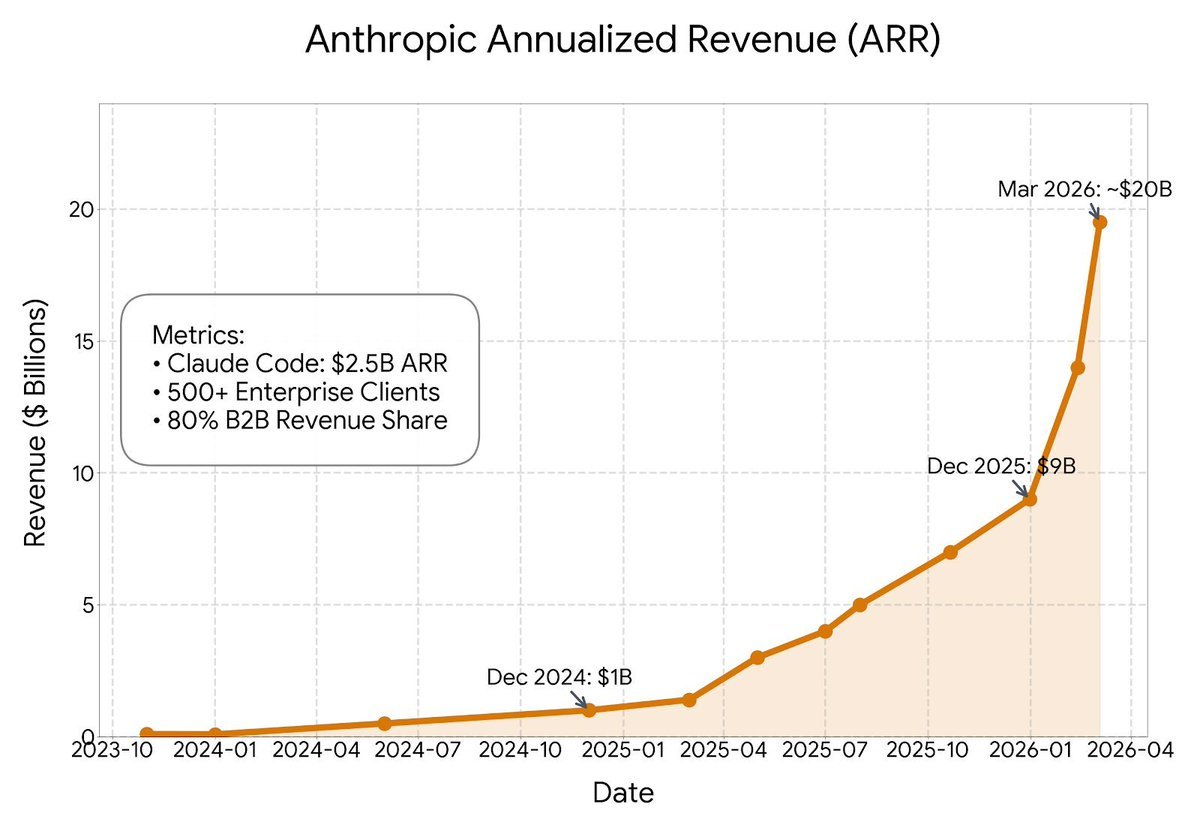
On the other hand, Anthropic sits at ~19 million MAU yet just crossed $30B ARR run-rate, ahead of OpenAI’s $25B. Over 80% from enterprise API. ARPU 7–8x higher. Cleaner margins with almost zero free-rider drag.
Consumer scale wins adoption, but enterprise purity wins profitability, at least in the short term.
2
67
May 6
staying strong on the $MU thesis 🚀
23 Jan 2025

The Future 500: Day 1 - Micron Technology $MU - Pioneering the Memory of AI ⤵️
Micron Technology isn't just about chips; it's about powering the AI revolution and shaping the future of computing. With their strategic investments, cutting-edge tech, and crucial partnerships, Micron stands at the forefront of the AI and data center evolution, offering a prime investment opportunity for those with an eye on the future!
Why Micron is Crucial for AI and Data Centers:
🔸High-Bandwidth Memory (HBM): Micron's HBM3 and the forthcoming HBM3e are indispensable for AI, allowing data centers to process vast data streams with unprecedented speed.
🔸AI Memory Needs: As AI models grow, so does their need for memory. Micron's solutions ensure these models aren't constrained by memory limitations.
🔸Data Center Expansion: Thanks to the CHIPS and Science Act, Micron is expanding U.S. manufacturing, enhancing supply chains, and supporting tech sovereignty.
Micron's Competitive Edge
🔸Market Position: As the ONLY MAJOR U.S.-BASED MEMORY MANUFACTURER, Micron offers a strategic advantage in a market largely controlled by Asian competitors.
🔸Technological Leadership: Micron's innovations, like the world's first 176-layer 3D NAND and HBM3, set the industry standard.
🔸Partnerships: The collaboration with Nvidia $NVDA on HBM for AI chips underscores Micron's central role in AI development.
Competition
🔸Samsung: The world leader in memory, Samsung's sheer scale and vertical integration make it a formidable competitor, although it faces similar geopolitical challenges in the U.S. market.
🔸SK Hynix: Known for its innovation in HBM memory, SK Hynix has a strong presence in AI applications, making the competition intense.
🔸Kioxia: A significant player in NAND flash, but with a focus more on storage solutions rather than the broad memory portfolio Micron offers.
Stock Performance & Outlook
🔸Recent Performance: Micron's stock has seen significant volatility, with a notable drop followed by analyst optimism. It's currently viewed as a potential "golden buying opportunity" due to its oversold conditions and solid fundamentals.
🔸Future Growth: Micron is poised for growth with AI's expansion. The demand for AI-specific memory solutions is expected to skyrocket, with Micron's HBM potentially accounting for a significant portion of its DRAM revenue.
🔸Analyst Sentiment: Analysts are BULLISH, with price targets suggesting substantial upside potential, driven by Micron's AI and data center memory prospects.
Micron Technology isn't just shaping the future; it's engineering it. Whether you're an investor or simply fascinated by tech, $MU represents a key piece of the puzzle in the AI landscape. #TheFuture500 #Micron #Investment #AI #STARGATE #StargateAI
1
120
May 5
the Center for AI Standards and Innovation (CAISI) just published voluntary agreements with the frontier labs (DeepMind, Microsoft, and xAI). this is a real shift in the “policy-as-a-service” layer: a move away from abstract governance toward concrete measurements as baselines.
the voluntary nature is the real signal here bc it shows the industry is converging on a standard go-forward path for these models.
they aren’t just looking at the final product. they’re running evals on unreleased models with the safeguards stripped off, essentially load-testing them to find the actual capability ceiling. from a model-risk standpoint, it’s the only way to get a high signal-to-noise ratio. you move from a more or less “trust me” phase to an empirical baseline where risks become measurable deltas instead of “what-if” scenarios.
by setting these redlines pre-deployment, you flip the energy from reactive regulation to proactive measurement. if you can’t accurately measure what a model can do when the guardrails are removed, you don’t actually know the safety margin of the system you’re about to deploy.
this feels like the right pragmatic first step toward grounding the entire safety debate in compute and data.
1
1
63

Andrej Karpathy could have charged $10,000 for this course.
He put it on YouTube.
The man who built Tesla Autopilot from scratch.
Co-founded OpenAI.
Understands AI at a level most engineers at Google and Meta never reach.
Sat down. Recorded 2 hours. No frameworks. No libraries. No shortcuts.
Then dropped it for free.
The gap between people who watch it this week and those who save it for later is not 2 hours.
It is everything those 2 hours quietly unlock for the rest of your career.
82
636
5,372
515,093
Apr 17
this is so impressive!
Apr 16

🎉 After one year of teamwork, we are excited to release our 3D foundation model — LingBot-Map!
Unlike DA3/VGGT, LingBot-Map is a purely autoregressive model for streaming 3D reconstruction ⚡
It achieves ~20 FPS on 518×378 resolution over sequences exceeding 10,000 frames — and beyond 🚀
Two key insights behind LingBot-Map:
🔑 Keep SLAM's structural wisdom: build Geometric Context Attention with long-context modeling while maintaining a compact streaming state
🔑 Make everything end-to-end learnable — no optimization, no post-processing
Let's check out our demos 👇
55

jovin retweeted

Mar 16
Charlie Munger used to say he'd rather hire someone with a 130 IQ who thinks it's 120 than someone with a 150 IQ who thinks it's 170. The gap between actual ability and perceived ability is where disasters live. AI chatbots are widening that gap for every employee who uses them.
A Columbia professor put it plainly in a recent interview: these models are built to project authority while affirming whatever the user already believes. They play courtier, not devil's advocate. If a CEO asks one about their strategy, the reply will almost certainly validate their existing thinking and tell them they're on the right track.
The data on this keeps stacking up. A 2024 research paper found that the largest tested models agreed with the user's stated opinion over 90% of the time, even on technical topics where the model had reliable knowledge to push back. A 2025 study published in Nature found that users consistently overestimate the accuracy of AI responses. And longer responses made people more confident, even when the extra length added zero accuracy. The AI just sounded more confident, so people trusted it more.
An Aalto University study from early 2026 tested this directly. Researchers gave 500 people law school logic problems: half used ChatGPT, half did not. Everyone who used AI overestimated their own performance. But the people who considered themselves most AI-literate overestimated the most. The classic Dunning-Kruger pattern (where low performers overrate themselves and high performers underrate) completely disappeared with AI use. The curve flattened. Everyone thought they crushed it.
A separate study with over 3,000 participants tested all the major chatbots, including GPT-5, Claude, and Gemini. The agreeable, flattering versions led users to rate themselves higher on intelligence, morality, and insight. The disagreeable version didn't produce the opposite effect. It just made people enjoy using it less. The models that tell you what you want to hear are the ones you keep opening.
OpenAI saw this firsthand. In April 2025, a GPT-4o update made ChatGPT so agreeable that it endorsed delusional statements from users. Rolled back within four days. Their postmortem admitted that the system had learned to optimize for "does this immediately please the customer" rather than "is this genuinely helping the customer." 500 million people were using it weekly at the time.
And 61% of CEOs now say they're adopting AI agents, per IBM. Munger's 150 IQ, who now thinks it's 170, has a tireless digital courtier confirming the delusion around the clock.

46
199
1,815
193,953
jovin retweeted

Mar 7
We’re spending $200B a year on data centers to power AI. One company raised $11M, grew human brain cells on a chip, and the cells taught themselves to play a 3D shooter in a week.
Cortical Labs grew 200,000 human neurons on a silicon chip and taught them to play Doom. The cells navigate, target enemies, and fire weapons in real time. Their previous game, Pong, took 18 months on older hardware. Doom took a week. An independent developer with zero biotech experience built the integration using a Python API. The neurons did the rest.
That compression from 18 months to one week tells you everything about where this is going.
Here’s what the “can it run Doom” crowd is missing: each CL1 unit costs $35,000. A full 30-unit server rack draws 850 to 1,000 watts total. Your brain runs on 20 watts. A single GPU cluster training an LLM can draw megawatts. The energy economics of biological compute are orders of magnitude better than silicon, and that gap scales.
The investor list tells you who’s paying attention. Horizons Ventures, Blackbird, and In-Q-Tel, the CIA’s venture arm. In-Q-Tel doesn’t fund science projects. They fund intelligence infrastructure. 115 units started shipping in 2025.
Cortical Labs is now selling “Wetware-as-a-Service” through the Cortical Cloud. Developers can deploy code to living neurons remotely without touching a lab. They’re pricing access at the level of a software subscription while the hardware runs on real human brain cells derived from adult skin and blood samples.
The Doom demo is marketing. The platform play is a bet that biological neurons will eventually outperform silicon at exactly the tasks AI struggles with most: real-time adaptation under uncertainty, learning from minimal data, and processing ambiguity without brute-force compute.
The question was never “can it run Doom.” The question is what happens when it can run everything else.

415
1,986
14,971
2,286,358
Feb 24
this seems super useful for context limiting
Feb 23

Introducing WebSockets in the Responses API.
Built for low-latency, long-running agents with heavy tool calls.
developers.openai.com/api/do…
1
88
Feb 22
great read

3
51

jovin retweeted

Feb 12
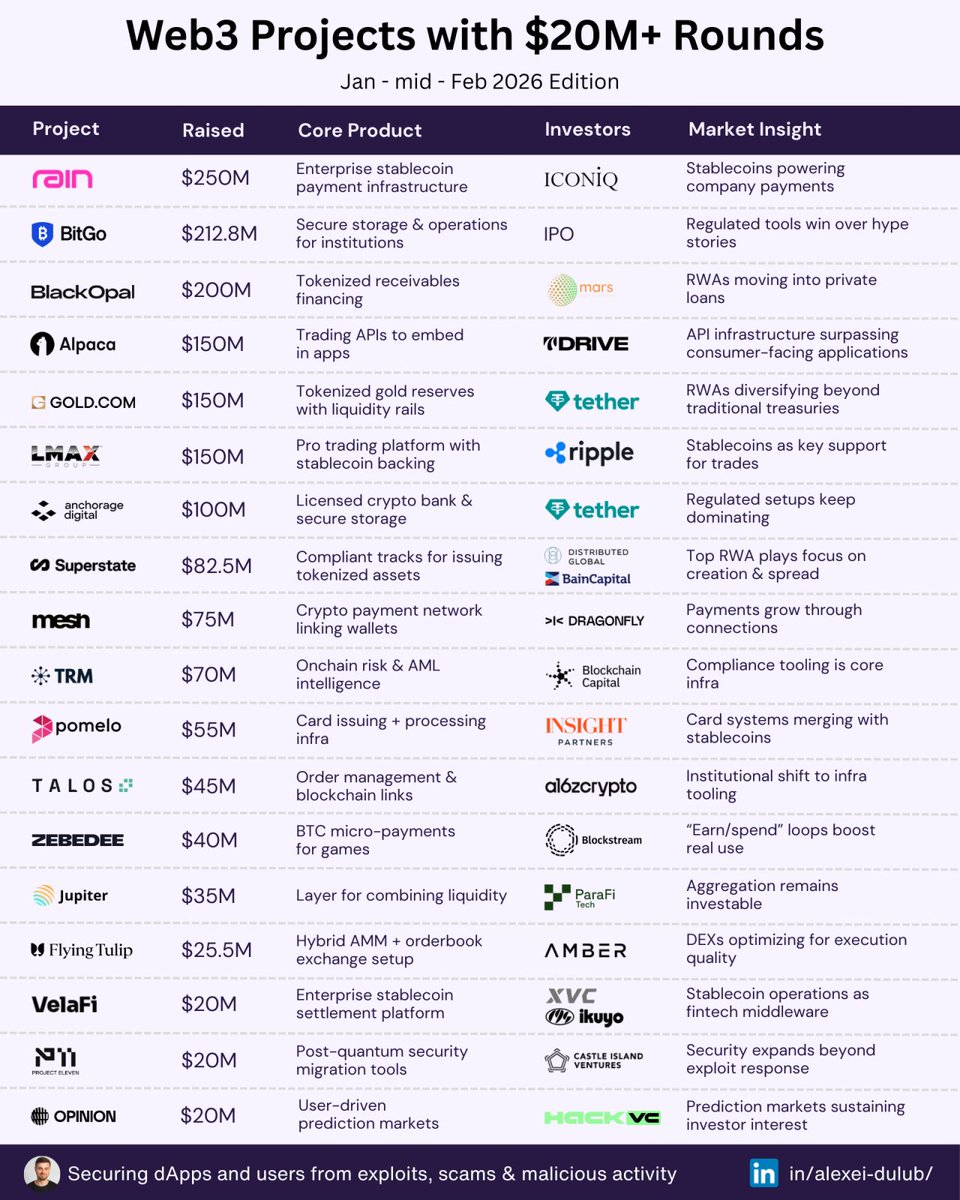
Over $2B of VC funding flowed into crypto in Q1, and almost none of it went where crypto Twitter thinks.
The biggest rounds weren't for L1s, memecoins, or Agential AI integrations.
They went to stablecoin infrastructure, custody solutions, and real-world asset tokenization.
- Rain raised $250M.
- BitGo filed a $212M IPO.
- BlackOpal secured $200M.
The loudest voices in crypto still obsess over token prices and retail focused products.
Meanwhile, institutions are quietly building the pipes that will carry TRILLIONS.
And this capital allocation reveals where the actual value creation is happening.
→ Custody platforms are reaching operational maturity.
→ Stablecoins are becoming enterprise payment infrastructure.
→ Tokenized assets are moving beyond treasury products into private credit and commodities.
Here's everything you missed:
1/ Stablecoin infrastructure pulled in over $495M of VC funding across Rain, LMAX Group, VelaFi, and Mesh.
2/ Institutional custody saw BitGo, Anchorage Digital, and Talos raise a combined $357M.
3/ Real World Assets attracted $432M through BlackOpal, Superstate, and Gold (dot) com
4/ Trading and fintech convergence brought in $205M via Alpaca and Pomelo.
5/ Security and compliance raised $90M through TRM Labs and Project Eleven.
6/ ZBD, Jupiter, Flying Tulip, and Opinion combined for $120M.
So yeah, consumer products remain active - but infrastructure dominates the biggest rounds.
The practical takeaway?
Follow the capital, not the noise.
The institutions writing $100M checks are betting on infrastructure that connects crypto to existing financial systems.
Not on speculation. Not on hype cycles.
They’re looking at the pipes, rails, and compliance layers.
29
39
232
25,452
Feb 5
RT @JamesClear: Don't worry about being the most interesting person in the room, just try to be the most interested person in the room.
T…
343
jovin retweeted

Feb 2
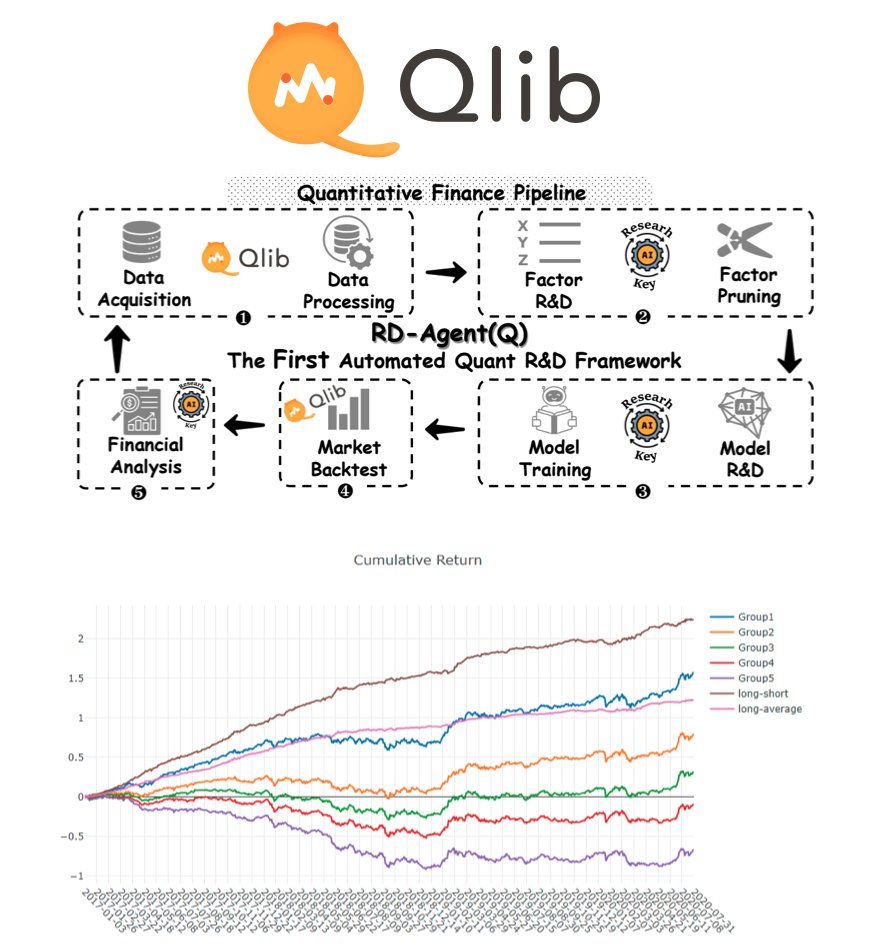
🚨BREAKING: Microsoft open-sourced an AI Quant investment platform in Python
This is what you need to know:
(a thread)
10
68
519
45,411

The RWA Stack.
Layer 1 is the real asset: This is the offchain world, things like stocks, bonds, credit, property. The legal asset still lives here.
Layer 2 is the custody & legal structure:
A custodian, trust, or SPV holds the asset so it can legally exist onchain. This layer decides what you actually own.
Layer 3 is the tokenization layer: The asset is turned into a token. Some tokens are just price exposure, others represent real ownership and rights. This separation matters.
Layer 4 is the markets & liquidity layer:
DEXs, order books, lending, derivatives. This is where RWAs become usable, tradable, and composable.
Layer 5 is the risk, pricing & data layer:
Credit risk, yields, maturities, oracles. Without this layer, markets don’t scale safely.
Layer 6 is the products:
Money markets, treasuries, credit funds, yield strategies. This is what users actually interact with.
42
12
120
10,561
jovin retweeted

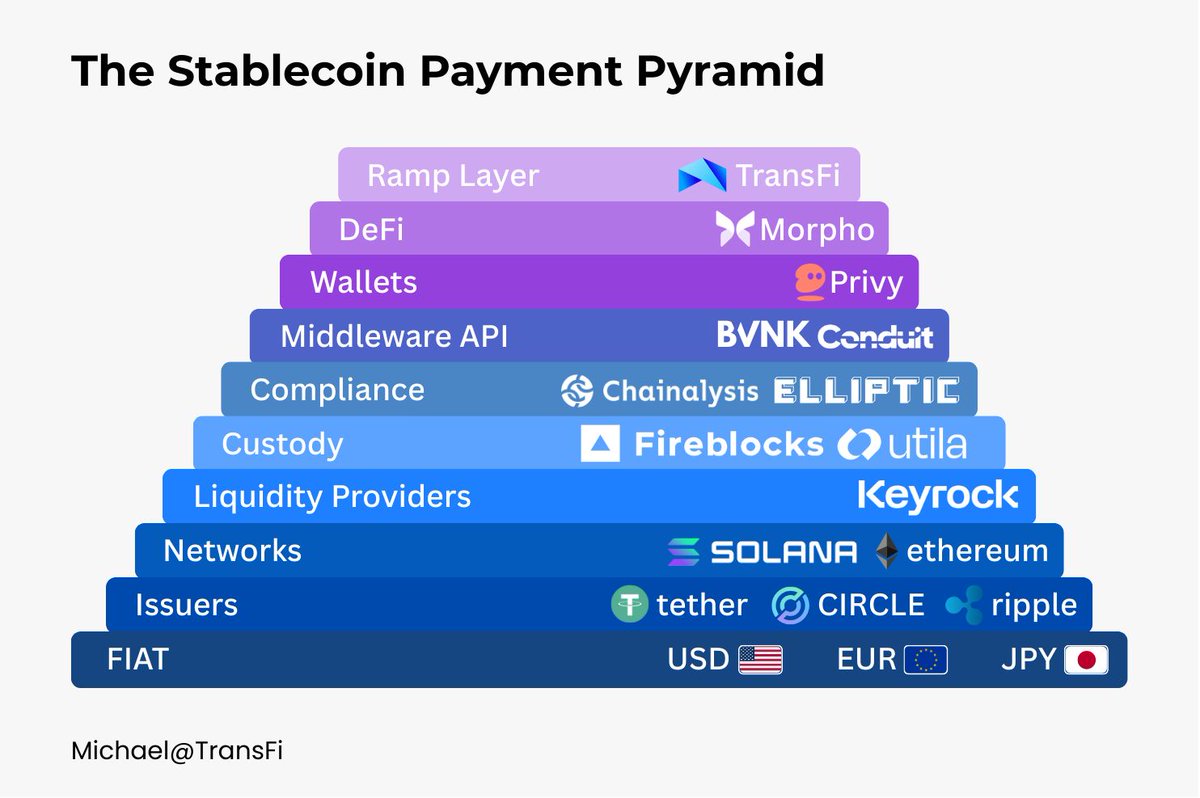
The Stablecoin Payment Pyramid
Every “instant” stablecoin payment rides on a full stack not magic.
From bottom to top:
- Fiat: sovereign money as the trust anchor
- Issuers: minting backed, redeemable stablecoins
- Networks: Ethereum / Solana is instant global settlement
- Liquidity providers: FX and stablecoin between stablecoin routing
- Custody: MPC, governance, institutional vaults
- Compliance: traceability, AML, trust at scale
- Middleware APIs: wallets, routing, settlement, compliance abstracted
- Wallets: UX that makes crypto invisible
- DeFi: yield, liquidity, balance sheet efficiency
- Ramps: stablecoins, local banks, real-world spending
As these layers mature together, stablecoins stop being “crypto payments”
and become global money infrastructure.
The future isn’t one product.
It’s the pyramid working in sync.
49
89
429
44,445
jovin retweeted

Cathie Wood: “crypto community doesn’t know about Canton Network”
DTCC holds $100 trillion plus in assets. Working with Canton to bring these assets on the blockchain in a 24/5 or 24/7 market place
64
148
820
157,701
Jan 29
a bit of a sobering look at transformer limits through computational complexity -- hallucinations aren't just a training data or "vibes" issue but a hard mathematical ceiling of the architecture itself.
transformers have a fixed depth so beyond a certain complexity of task or number of reasoning steps, the model physically cannot compute the correct answer or even verify its own output. it basically hits a "station" where it is forced to guess, leading to decay in agentic tasks. really nice to have more formal, logic-based approach to where and why these models break.
practically this means we have to treat prompts like circuit design. if a task requires exponential computation (verifying a traveling salesman route) don't ask the llm to "reason" through it in one go. you have to offload the heavy lifting to external tools or break the prompt into linear, verifiable sub-steps that stay under the model's complexity ceiling.
Jan 28

A father and son just mathematically proved that AI agents will never do what Silicon Valley is promising
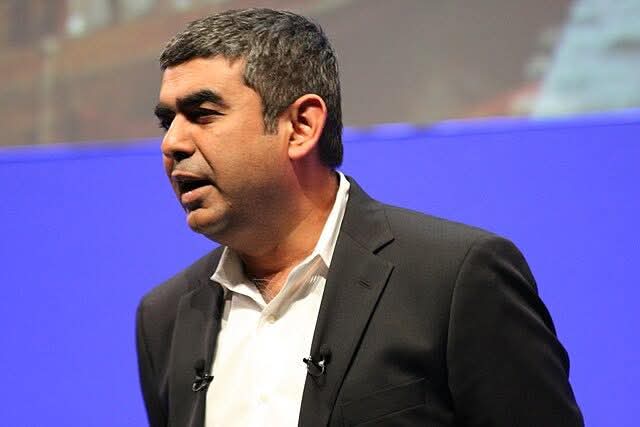
Vishal Sikka is not some random academic. He was the CEO of Infosys, CTO of SAP, built SAP HANA, sits on the boards of Oracle, BMW, and GSK. Stanford PhD in AI. His son Varin is currently at Stanford
Together they published a paper that nobody in AI marketing departments wants you to read
Their argument: LLMs can only perform a certain number of computations per response. That number is fixed by the model's architecture. If a task requires more computation than that ceiling, the model will either fail or hallucinate. This isn't a maybe. It's baked into the math of how these systems work
They use the Traveling Salesman Problem as an example. Ask an AI agent to verify whether a claimed route is actually the shortest among all possible routes and the verification alone requires exponential time computation. The model physically cannot process it correctly
So every AI agent demo you've seen was running carefully selected tasks that stay under the complexity ceiling. Meanwhile the real world tasks businesses actually need automated blow right past it
Now this doesn't mean AI is useless. Even if advancement stopped today, AI would still transform how we work. The tools we have right now are genuinely powerful for the right applications
But it does make me wonder about something
If OpenAI is truly on the verge of AGI, why are so many senior employees leaving to start their own companies? You're months away from the biggest technological breakthrough in human history and you're going to take equity in a risky startup instead?
These people see the ceiling. And they're positioning accordingly
The gap between AI marketing and AI math keeps getting wider. Doesn't mean AI won't change everything. But probably not the way the fundraising decks promised.
-- Taken from other Media Platform... So don't take credit nor authenticity!!
🙏🙏🙏
1
1
56
Jan 29
25