“Clever but dangerous…no real combat experience”
Joined August 2010
- Tweets 12,238
- Following 4,985
- Followers 2,576
- Likes 23,365
520 Photos and videos



Pinned Tweet

Jan 8
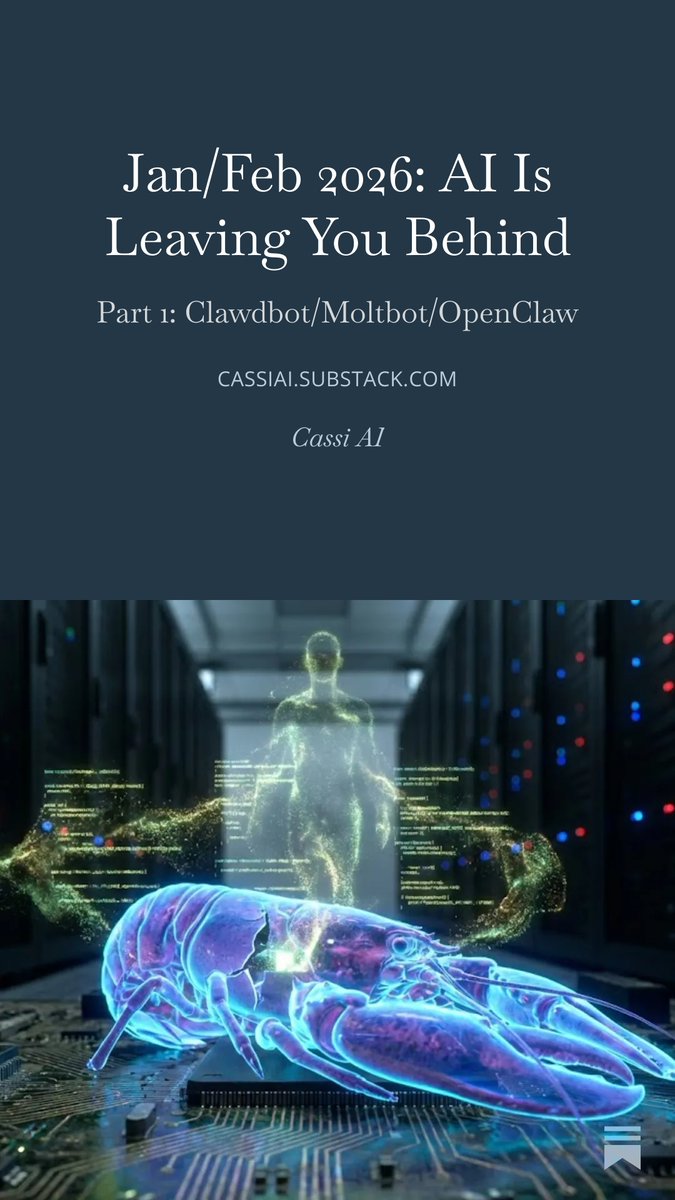
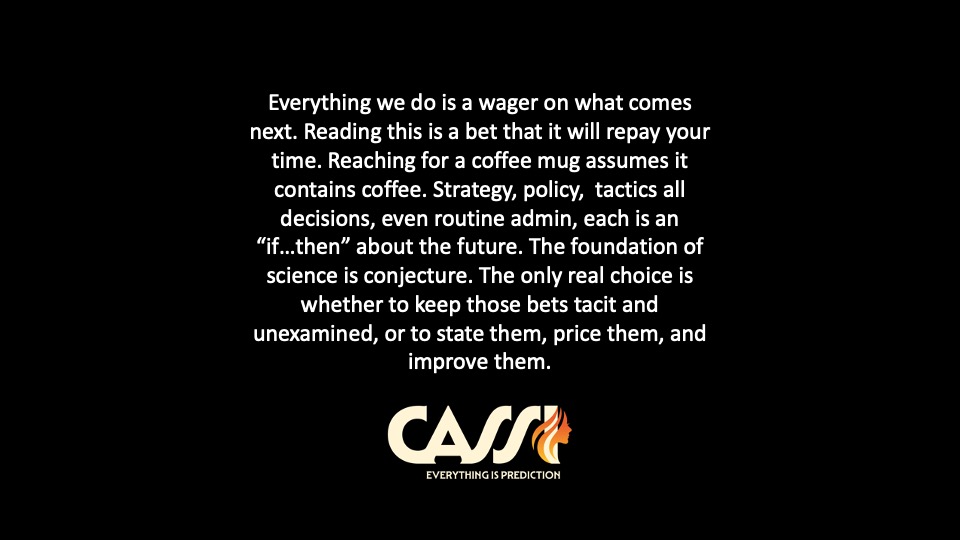
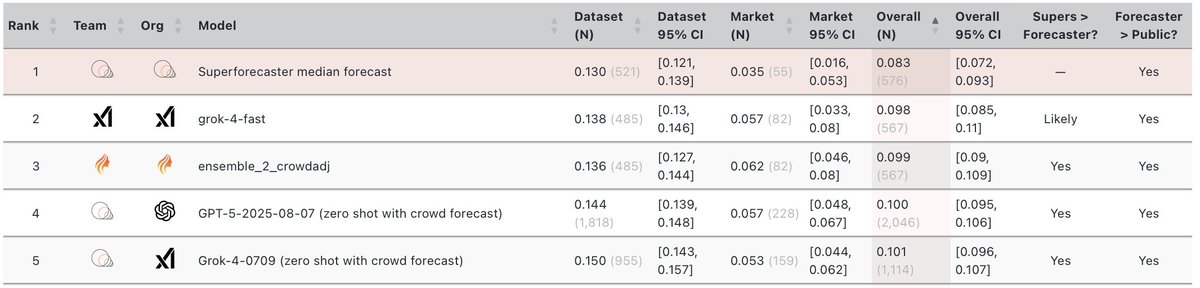
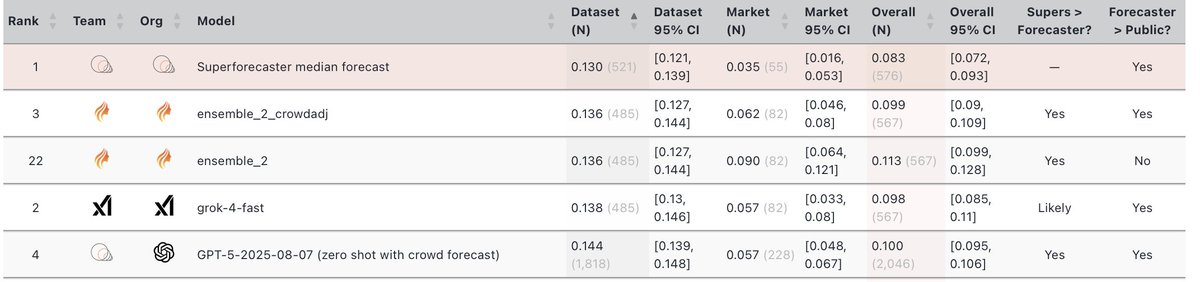
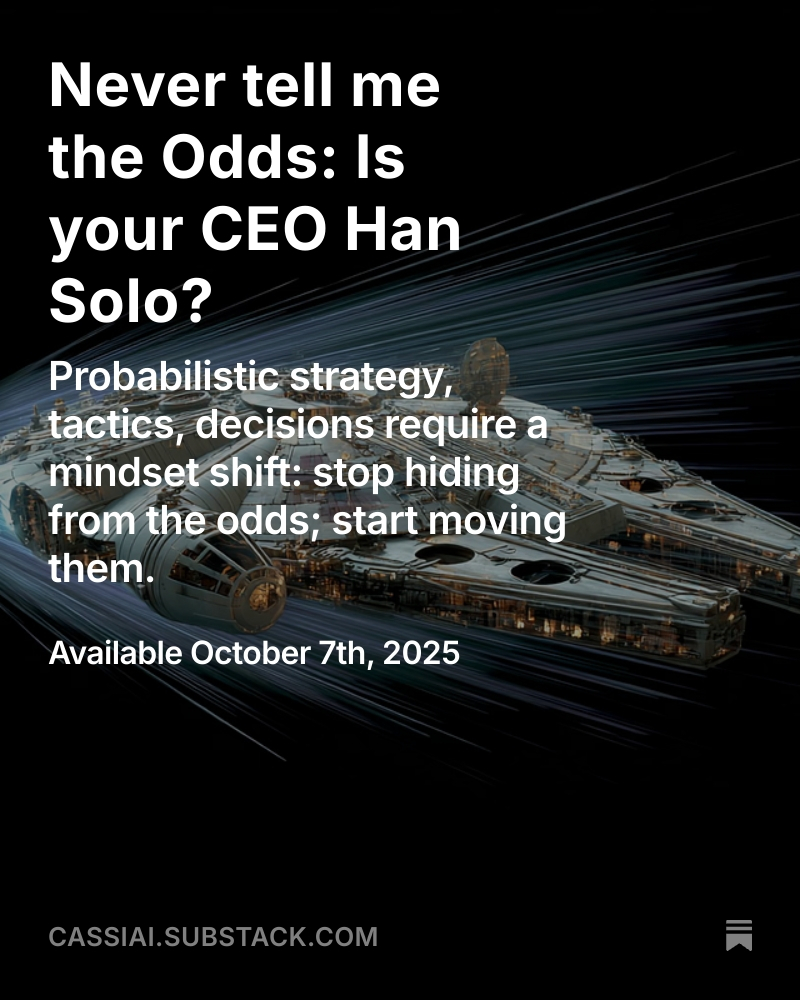
This is huge— @Cassi_on_X came 2nd overall and 1st on "Dataset" questions on @Research_FRI Forecastbench! 🥈📈
Only @elonmusk's @xai @grok outperformed us overall.
What this means: 🧵
2
7
22
10,104
Keith Dear retweeted

Jun 13
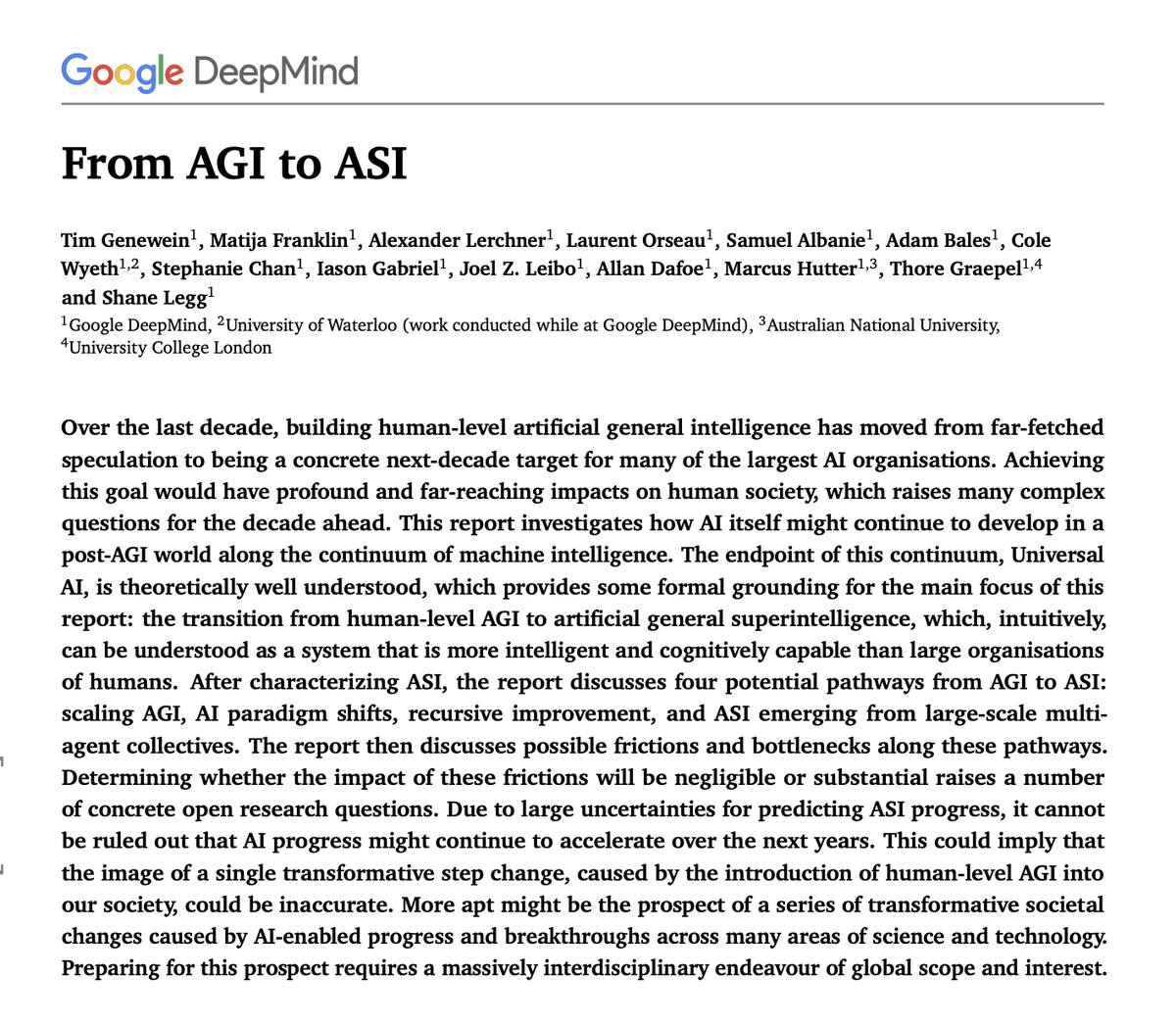
Google DeepMind just published the most important AI paper of 2026.
It's called "From AGI to ASI." Marcus Hutter is on it. Iason Gabriel is on it. 14 of the most senior people at Google DeepMind are on it. They published it 3 days ago and almost no one is talking about it.
We have spent the last three years obsessing over when AGI will arrive.
DeepMind is already past that. They are modeling the transition to Artificial Superintelligence (ASI).
And their definition of ASI isn't just an AI that is smarter than a human.
It is a system that is more intelligent and cognitively capable than entire, large-scale human organizations. Not a single genius. An institutional-level intellect.
The report is 57 pages long. It outlines four exact pathways we will take to get there:
- Scaling AGI: Pumping incomprehensible amounts of compute and data into current models.
- Paradigm Shifts: New algorithmic breakthroughs that replace the architectures we use today.
- Recursive Self-Improvement: The AI learns to write better code and upgrade its own intelligence without human help.
- Multi-Agent Collectives: Millions of AI agents coordinating together to form an emergent hive-mind Superintelligence.
But here is the detail that should make you pause.
DeepMind points out that digital intelligence has massive asymmetric advantages over human biology. It can be perfectly copied. It doesn't sleep. Its processing speed isn't constrained by biological neurons.
Because of this, they warn that the arrival of AGI won't be a single, stable milestone where we can catch our breath.
It will trigger a rapid, cascading series of transformative breakthroughs as the AI accelerates itself toward Superintelligence.
The timeline has shifted.
The most advanced AI lab in the world is no longer just researching how to build AGI.
They are mapping out what AGI will build next.
33
124
492
53,164
Keith Dear retweeted

10h
I love that we’re the new Rome. Peace with Persia in the afternoon and a gladiator fight in the evening, all on the Emperor’s birthday. Another 1,000 years.

523
3,182
36,402
824,129
Keith Dear retweeted

18h
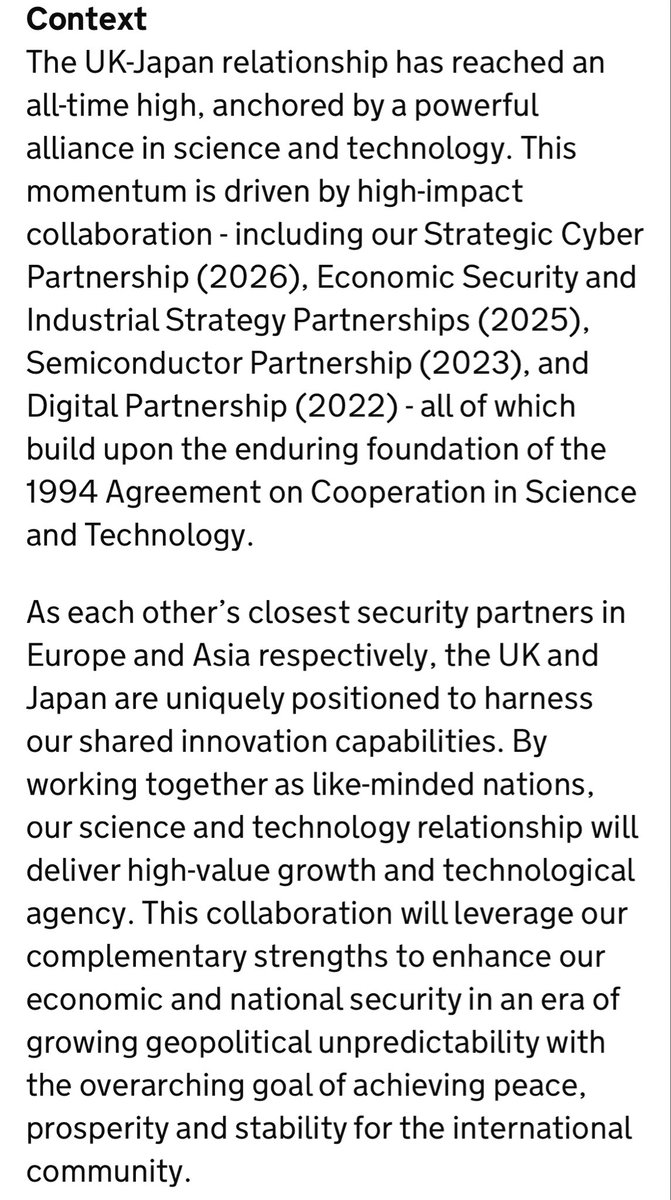
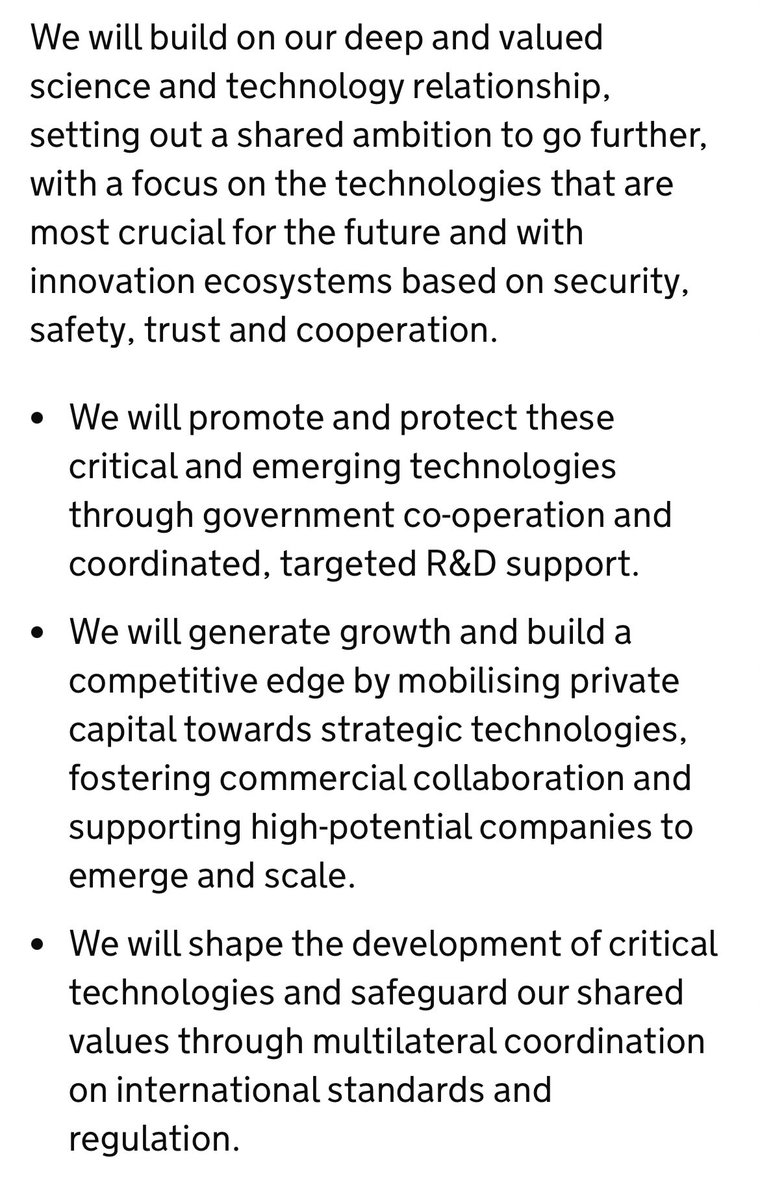
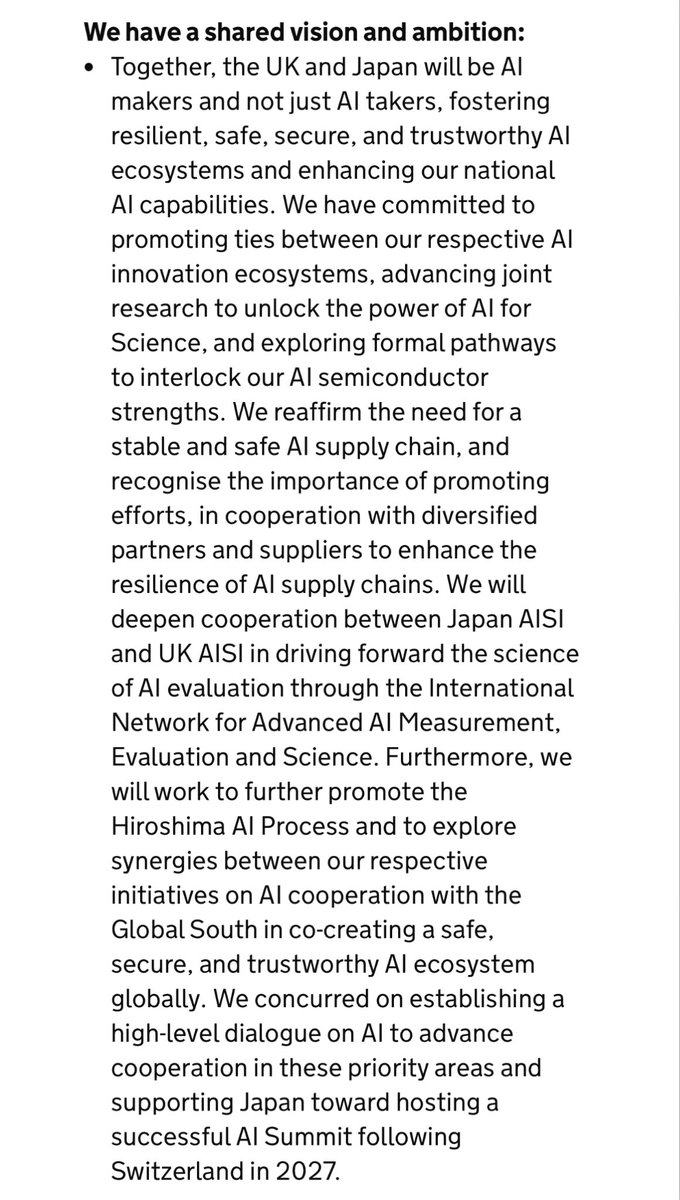
Substantial: 🇬🇧 and 🇯🇵 sign a Frontier Technology Partnership.
Builds on/combines “the UK’s world-class software and research leadership with Japan’s unparalleled hardware and manufacturing power to support collaboration across our distinct yet highly compatible industrial bases.”
AI
• “UK and Japan will be AI makers and not just AI takers, fostering resilient, safe, secure, and trustworthy AI ecosystems and enhancing our national AI capabilities.”
• Joint science and semi research and formal engagement.
• UK and Japan AISIs to work more deeply together.
Quantum
• Co-develop globally competitive, commercially scalable and deployable quantum technologies, including computing, sensing and communications, building on the Quantum Memorandum of Cooperation (2025).
Biorisk
• Deepen efforts to counter deter novel and emerging biological threats as part of our broader approach to dual-use S&T, strengthening shared commitment to non-proliferation, and strategic approaches to enhancing biological security as part of wider cooperation on science and technology.
Emerging tech
• We will work together to protect critical and emerging technologies through deepening cooperation on research security, recognising the need to manage risks associated with those technologies, while supporting open, secure, and trusted international research collaboration.
• We commit to working bilaterally and with like-minded partners to share information on policy measures to reduce loss of critical technology. This work will be complementary to the Joint Declaration on Economic Security Cooperation.
1
6
22
2,650
North Sea rigs call for military protection from Russian attacks
thetimes.com/article/4817190…
1
76
Keith Dear retweeted

Jun 14
A few words on the Sovereign AI debate, having built several LLMs in Meta while in the UK and now working as a UK based startup:
1. Lots of people are trying to do the right thing to make the UK a better place to start AI companies. Time lags until the benefit show, but you should judge on the intent now. I support the direction of travel!
2. DeepMind has been enormously beneficial for the UK, but it has muddied the waters for a sovereign LLM company to emerge as (until recently) the Government continued to celebrate it as a British achievement / push it as a national champion.
3. Similarly, people are now celebrating recent US investment in King’s Cross, while also wanting more UK sovereignty. Clearly some income effects here, but I would worry about the substitution effects too. AI is not like other types of foreign investment.
4. The relevant talent nexuses in UK that could develop a competitive foundation model are from GDM and old Meta AI GenAI. Also some folks from smaller groups, ex Conjecture, Stability. The talent is still there, although a lot was snapped up by US FM companies in the past year. I personally think it’s not too difficult to develop new talent either from UK universities, but you probably need an ex GDM or Meta core (Gemini or Llama). Or if not: show evidence first (technical reports) before claiming you can do it.
5. Building an LLM is very different from doing regular AI research - skillset is different. Former is closer to engineering; long hours, often unsexy work. Important to distinguish between these two types of talent in the UK ecosystem; arguably too much focus on the latter / ideas guys.
6. On research - DeepSeek R1 post-train cost $300k . Yes, they also needed an ablation budget and to train a base model, invest in infra and talent - and yes the cost of an R1 moment is increasing year on year - but the idea that you need $1bn plus immediately to show results is complete FUD. You need billions to scale, not to validate new directions.
7. In my experience, every failed LLM effort (from model results perspective) I witnessed in the past came from a combination of poor leadership, politics, unclear vision, and premature scaling. Good efforts usually started from small teams who had worked with each other for a long time, had shared thesis, and scaled progressively in bite-sized pieces. Some recent lessons here for neolabs as well.
8. Things take time. Eg we’ve spent ~12 months mostly on internal infra just to get into the position to be able to make big swings. It’s important to nurture new companies through the initial phase. Expectation management is also crucial. I think expecting new UK companies to have single big bang releases is very dangerous; sort of like overwatering a plant. The correct release pattern is “decent”. “decent”, “decent”, “quite good actually”, “holy shit”.
9. Please don’t allow politicians or journalists to kill recent or upcoming AI investment efforts. We will need way more - at the price of potential inefficiency in places - as AI is existential for the country. Ambitious projects are usually incredibly fragile in the early stages; look after them!
10. Mythos is a good triggering moment, but what’s coming will make it look like a toy, so it’s worth building for what’s coming in 5 years time - not a current generation model.
Very proud to be building in the UK - more to share on that soon - alongside many other great early stage AI companies! 🇬🇧
39
103
718
116,796
Keith Dear retweeted

Jun 13
Stateside, a gas station. I drank a frozen blue beverage too quickly, and was struck down by a punishment this entire nation knows, and accepts, and has named.
The drink is called a slush. Ice, sweetness, and a blue that does not occur in nature. The day was hot. I was thirsty. I drank like a soldier at a river.
The pain arrived in my skull like a war horn.
Behind the eyes. Above everything. Total. I gripped the roof of my car. I may have made a sound.
"Brain freeze," said the cashier through the door, with no urgency whatsoever.
It has a NAME. The affliction is so common it has a household name, like a cousin.
"Tongue on the roof of your mouth," called a man at the pumps. He did not look over. He prescribed the remedy mid-pump, casually, the way one mentions weather.
I pressed my tongue to the roof of my mouth. The war horn faded. The healer nodded at his pump, finished, and was gone in a Chevrolet.
In my land, punishment follows crime by way of courts and seasons. Here, the sentence is instant. Drink with greed, and the ice strikes the mind directly. No trial. No appeal. Perfectly fair.
And here is what moves me. EVERYONE has felt it. The cashier. The healer. Children. Elders. An entire nation united by the same small lightning, all taught the same cure, all passing it on to strangers at gas stations, free of charge.
You cannot fully distrust a country once you know it shares one pain.
The freeze does not punish thirst. It punishes haste.
I finished the slush slowly, like a scholar. Blue tongue. Clear mind.
Then at the door I forgot everything, drank deeply, and was struck down again.
"Tongue, hon," said the cashier, without looking up.
Discipline is a journey.

554
3,545
35,613
3,000,622
Keith Dear retweeted

Jun 13
The media ecosystem in Europe is insanely out of touch. On @etnshow the same day re Fable we heard from:
- UK AI Minister
- ElevenLab’s Field CTO
- Co-author of Europe 2031
All of the interviews and expert opinions on these crucial topics were broadcast live out as they were happening and highlights were distributed hours after.
We care deeply about the continent and its position in a post-AI world and will continue to do everything we can to keep people informed.
Jun 13

Britain losing access to Claude fable isn’t on the BBC or Times homepage, 4th on the guardian, 7th on the FT and below the fold on the Telegraph.
What are we doing here?
2
6
83
10,642
Keith Dear retweeted

Jun 13
THE TOKEN HANGOVER
@matanSF (Matan Grinberg), CEO and co-founder of @FactoryAI , interviewed by @HarryStebbings (@20vcFund )
This is a special for me since I've been an investor in @FactoryAI since their seed round, and think Matan is a very very special founder.
Summary: Grinberg argues the next 24 months in enterprise AI are a resource-allocation problem: tokens, dollars, and people. Most CIOs are now waking up to bills they cannot justify. The fix is to spend frontier tokens only on the 10-20% of work that requires planning intelligence, run the other 80-90% on open models, and rebuild teams around load-bearing polymaths who own business outcomes. The single-frontier-monopoly fear is fading: four roughly-equivalent labs is the emerging reality, which puts pricing power back in the application layer.
1. The Token Hangover. Enterprise AI adoption ran through three phases this year: boards yelling at CEOs about AI strategy, "token maxing" with AI usage written into perf reviews, and now the morning-after bill. One CIO Grinberg spoke to was spending hundreds of thousands of dollars a month on engineers asking Opus 4.8 things like "how's it going" and "what are my macros from lunch." The frontier model became the default surface for every question, no matter how trivial. Phase 3 is the moment routing matters: every call to a frontier model needs to earn its price.
2. Resource Allocation Is the Job. For the next 24 months every C-suite is solving the same problem: how to allocate dollars, tokens, and headcount against business outcomes. Engineering teams used to be judged by features shipped per quarter, a metric with no link to revenue, market share, or retention. A logistics company adding more engineers to ship more features was always solving the wrong problem; AI made the misallocation visible. Tie every person's work to the metric that actually moves the business, then re-allocate.
3. Load-Bearing Individuals. The "10x engineer" frame measures lines of code, the wrong unit. Grinberg's unit is the load-bearing individual: the person whose absence breaks something. With AI the load-bearing few compound roughly 10,000%; the others get close to nothing, so any org enforcing one token-spend-per-engineer number is painting with too wide a brush. Average token spend per engineer will land on the same order of magnitude as their salary within three years, with a wildly bimodal distribution.
4. Frontier for Decisions Only. 80-90% of software development tasks can run on open models; the remaining 10-20% is planning, where the frontier still wins. This mirrors how human orgs work: leadership is a tiny share of total hours but decides the company's fate. The ego trap is engineers assuming their work is too important for an open model. The router decides better than the engineer, and the cost curve falls only if you wire the routing.
5. The Kirkland Mistake. Kirkland & Ellis announced a $500M, five-year internal AI build, which Grinberg reads as validation for Harvey rather than a threat. Building AI is not a law firm's core competency, and Kirkland's spend will teach them how hard it is. The general rule: just because you can build it does not mean you should, and the discipline is naming the few things you and your team own end-to-end. Outsource everything else, even when you technically know how to do it yourself.
6. Model-App Separation. When the model provider also sells the app, the incentives split: an API business wants you to spend more tokens. A healthy market keeps the application layer independent, so model providers compete on price, speed, and quality every week. Enterprises do not want to vendor-lock again; every CIO carries scars from the cloud era's three-year discount-then-jack-the-price trap. The application layer survives precisely because it forces that competition.
7. Sales as Product. Name a legendary company with a weak sales or marketing team. You can't. The Silicon Valley fallacy that research sits at the top and sales is "dirty work" produces companies that win the gold rush and then collapse when gravity returns. At Factory, engineers and salespeople sit intermixed; when sales closes, engineering says "we closed"; when engineering ships, sales says "we shipped." Atrophied sales muscles will not regrow once enterprise buyers stop saying yes to everything.
8. Polymath Era. Da Vinci, Newton, Euler could be polymaths because their fields were shallow. By the 2010s a theoretical physicist needed 50 years to reach the frontier before contributing anything new. AI collapses that catch-up time, so one person can push forward developer marketing, token-caching infrastructure, and solution engineering at once. The engineer of the future is a GM who owns marketing copy, product metrics, and sales enablement.
9. Build the Factory. Factory's name is literal: engineers in the next era design the assembly line that produces software. The DevX investments that used to scale linearly with headcount (good docs, CI/CD, linters, pre-commit hooks) now scale with the number of agents you run, which is 10x or 100x larger. Every dollar spent making agents production-ready compounds against thousands of PRs a week. Humans move up the stack, from writing code to designing the system that writes code.
10. Seal Team Six. Mandating beds in the office is a hiring failure dressed up as commitment. Grinberg's image: a basketball game judged by who sweat the most, when the scoreboard is what counts. Factory bought eight sleeps for all 30 team members at the time, because recovery is where the gains come from when work requires every ounce of brain power. If your load-bearing engineer can do their best work on two hours of sleep, they were not doing load-bearing work in the first place.
11. Four Frontier Labs. Grinberg's biggest mind-change this year: a single dominant model is unlikely, and four roughly-equivalent frontier providers is the more probable steady state. That outcome is the win for humanity. A one-lab monopoly was the dangerous scenario, and four equivalent labs is also the structural bull case for the application layer because it forces real ongoing price competition. Every CIO Grinberg meets has already decided not to throw their lot in with a single provider.
12. Dario's Self-Serving Doom. "AI will take your jobs" was the pitch that helped raise hundreds of billions, and Grinberg thinks it damaged public psychology and fed the slow-AI lobby. Watch the rhetoric flip at IPO: humans will suddenly become important again, because humans are the ones buying the stock. Founders who never needed to raise that money, like Zuckerberg and Hassabis, never made that argument. Incentives drive the labor-displacement rhetoric more than philosophy does.
28
62
539
254,813
Keith Dear retweeted

Jun 13
Making the point here that what Ukraine is doing now with drones is not akin to introducing the tank in 1917 (Cambrai) but what the UK did in 1918 at the Battle of Amiens in integrating the new technology in a novel way. telegraph.co.uk/news/2026/06…
6
24
94
23,821
Keith Dear retweeted

Jun 13
Britain losing access to Claude fable isn’t on the BBC or Times homepage, 4th on the guardian, 7th on the FT and below the fold on the Telegraph.
What are we doing here?
66
111
1,254
376,975
Keith Dear retweeted

Jun 13
The stupidity of, and damage done by, stamp duty is being recognised by more and more people. I’ve said it before and l’ll say it again: any govt which cared about economic growth and people’s welfare would abolish it.
thetimes.com/article/026bd67…
68
173
952
131,662
Keith Dear retweeted

Jun 13
The thing that winds me up is how Elon has a trillion because he’s set up a system where he forcibly takes 40% of what hard working people produce, leverages it up as debt, spends it ineffectively and does dumb things to win the votes of millions of people who’ve become dependent on his handouts.
801
231
2,611
305,616
Jun 13
RT @PhillipsPOBrien: Notable that Fedorov is saying openly now that Ukraine is “seizing the battlefield initiative.”
80
Keith Dear retweeted

Jun 13
Big News this morning : The George Washington statue near Fenway Park in Boston has been given the Highest Honour By the 🏴 Scottish Fans. Someone has got up there God knows how and placed a traffic cone □on his heed. 😅🤣😂😂. This is a proud moment for 🏴 Scotland.
👍🏻


403
3,447
29,360
836,006
Keith Dear retweeted

Jun 13
tl;dr
This is appalling, but it's the consequence of poisonous ideas that have been percolating through academia for decades.
Receipts: 9/9
x.com/NeilShenvi/status/1712…
12 Oct 2023

Critical Dilemma, my book with @RealPatSawyer, provides a definitive explanation of and response to contemporary critical theory.
Endorsers include Carl Trueman (foreword), Karen Ellis, @jdgreear, @thomaschattwill, @peterboghossian, and Alisa Childers.
amazon.com/Critical-Dilemma-…
26
35
787
109,068
Keith Dear retweeted

Jun 13
The Anthropic rugpull is a bit of a mini-Sputnik moment for European leaders. They have had a few of these recently, discovering the hard way just how far behind the continent has fallen in the past 20 years or so.
Its not going to get better.
There will be another shock from the space side as well. This year, China will likely crack first stage reuse, get into the business of serious megaconstellations. At the same time, Starship - which to European leaders is nothing more than an explosion every couple of months - will get to orbit and start ramping up cadence. Everyone who understands the sector knows whats coming, but politicians here will be convinced its all smoke and mirrors until they wake up one day seeing both the US and China with a decades long lead over them in another critical sector.
91
181
2,161
67,290
Keith Dear retweeted

Jun 13
The brilliant Red Arrows making their way over London to the Trooping the Colour, in one of their last ever outings as a formation of nine. 🇬🇧
3
11
132
4,961