
word quant @layerzero_core
Joined March 2020
- Tweets 15,177
- Following 1,166
- Followers 4,290
- Likes 21,409
1,510 Photos and videos





Pinned Tweet

1 Sep 2025
Slow Down and Zoom Out: Crypto Is Still in the 1980s Internet Era
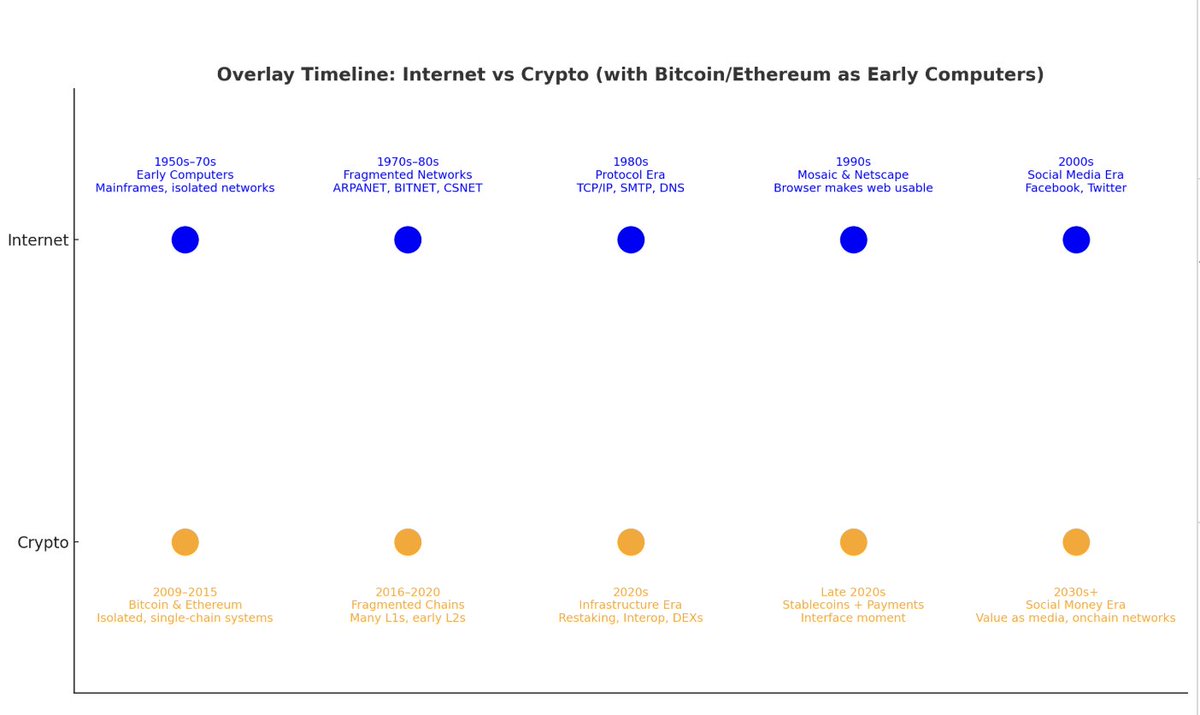
Crypto today is fractured in almost a 1:1 fashion to how computers were networked back in the 70s and early 80s. In the 1980s, there wasn’t one internet -- there were ARPANET, BITNET, CSNET, and dozens of other isolated networks. Fragmentation and interop are terms crypto borrows from the compute networking past, not first principles. Crypto’s L1s, L2s, and L3s is just a new version of an old problem.
Most of the energy in crypto today is going into infrastructure and protocol development. Chains, market making, restaking, interop, DEXs, borrowing/lending; it is all plumbing. Essential for the system to work, but invisible to most people (as it should be). It’s the same as the 1980s, when TCP/IP, SMTP, and DNS were being hammered out at the protocol level of standardization.
Back then, mostly just engineers and researchers were computer networking fiends because the systems were so complex to deal with, just as only the terminally online today understand the memetics and game theory of early DeFi. In the 80s, internet users were concentrated in universities, research institutes, and governments. The analog in crypto is VC-backed chains, fintechs, and money managers: BlackRock with stablecoins, Stripe with payments, Wyoming with state-backed tokens. These are different organizations, but the same types of people.
This isn’t to say the infra isn’t world-changing in crypto. It just isn’t consumer-facing yet. Just as the internet was invisible before Mosaic, crypto hasn’t had its browser moment. Wallets are clunky, exchanges hard to onboard to, UX mediocre (though improving). There are not enough use-cases that allow people to *use* crypto, outside of just buying bitcoin and watching it go up.
Early computers and internet had similar UX issues. But Netscape was the level-step for the web in terms of onboarding the masses. It took complex protocols and made them interactive; finally there was something to click and magic to feel.
The most obvious candidate for a level-step in crypto is stablecoins paired with a simple payment app. I think stablecoins are email — the first real use case for crypto networks that everybody will need. I think a payment app might be Netscape — the moment crypto becomes obvious: money that moves instantly, globally, without banks in just a click for less than a cent. This will probably look/feel like a wallet, if I had to guess. Lots of people want to speedrun history, but that shortchanges how big an idea crypto really is.
I just do not think we are in the app age yet. It is still an era of B2B; of onboarding the networks that coordinate value (banks, governments, fintechs). Actual users are downstream of these networks. In general, believe we haven’t even hit the personal computer phase yet of cyrpto -- no super simple, felt experiences for everyday people. Social money, where payments and value flow like media (what Zora hints at now), is still decades away. Just as Facebook was 15 years after Mosaic (which was 15 years after arpanet), crypto’s social layer is still far off from being felt at scale.
Crypto is the best money technology invented since government and it's going to take awhile for it to spread across humanity and such. Don't get me wrong: crypto is here, it’s inevitable, but the work right now is infrastructure, of networking the networks of civilizations. Get institutions issuing assets, get employers paying in crypto, connect banks and fintechs -- the same way early computers first connected governments, firms, and universities. Woo
33
10
88
10,248

I gave a (very) short talk last month at Dorm Summit to a bunch of college students on how they might think about their careers through the lens of reputation & personal brand
If you’re interested in listening to me yap about those topics, then check out the recording below 👽
32
17
146
8,657
kram retweeted

"As of today, Frax assets worth over $500M span 20 blockchains with LayerZero, having securely moved hundreds of millions across tens of thousands of messages and growing."
Incredible article. @samkazemian and @fraxfinance continue to set an amazing example as builders.

25
32
179
21,503


kram retweeted
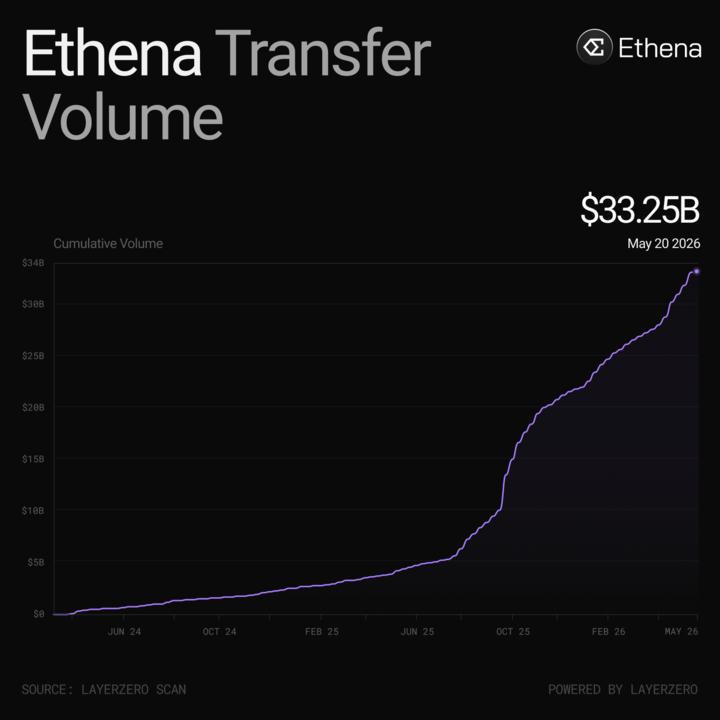
Guy and the @ethena team are some of the most impactful builders of internet-native/better money. Proud to have them building on @LayerZero_Core and see them setting an example for what a continuously improving security setup can look like.
USDe and sUSDe continue to be some of the most used assets in the space, moving $4B of their lifetime $33B in the last 30 days alone.
Extremely fortunate to get to work with people like @gdog97_ @n2ckchong & team. It's a long and fruitful road ahead, much more to come.

Ethena's cross-chain security infrastructure has been hardened across the full stack and we will continue to do so on an ongoing basis.
The security and risk contributors to Ethena remain comfortable operating on LayerZero infrastructure with hardened DVN configurations, reduced mesh complexity, and custom rate limits.
There are no plans to move off LayerZero infrastructure.
22
19
188
16,965

Ethena's cross-chain security infrastructure has been hardened across the full stack and we will continue to do so on an ongoing basis.
The security and risk contributors to Ethena remain comfortable operating on LayerZero infrastructure with hardened DVN configurations, reduced mesh complexity, and custom rate limits.
There are no plans to move off LayerZero infrastructure.
May 20

We’re sharing our completed post-mortem on the April 18th incident, prepared with @Mandiant and @CrowdStrike. We are publishing both an executive summary and the full report at the link below.
Over the past four weeks, we’ve worked with hundreds of partners to help them understand their current security posture, and harden it where appropriate. We’ll continue this work, alongside taking additional proactive steps for the benefit of not only our partners, but also the ecosystem as a whole.
We want to extend our thanks to our partners for their support and patience this past month. There’s a reason that over $12 billion has moved across the network in the past four weeks, and why the world’s most valuable asset issuers have stood by our side: they believe in us, in what the LayerZero protocol has to offer, and in the value of modular, isolated, application-controlled security.
The work continues. And we look forward to continue showing up for the applications that trust us with their business, as well as the broader ecosystem.
layerzero.network/blog/layer…
55
30
170
43,549
kram retweeted

May 20
We’re sharing our completed post-mortem on the April 18th incident, prepared with @Mandiant and @CrowdStrike. We are publishing both an executive summary and the full report at the link below.
Over the past four weeks, we’ve worked with hundreds of partners to help them understand their current security posture, and harden it where appropriate. We’ll continue this work, alongside taking additional proactive steps for the benefit of not only our partners, but also the ecosystem as a whole.
We want to extend our thanks to our partners for their support and patience this past month. There’s a reason that over $12 billion has moved across the network in the past four weeks, and why the world’s most valuable asset issuers have stood by our side: they believe in us, in what the LayerZero protocol has to offer, and in the value of modular, isolated, application-controlled security.
The work continues. And we look forward to continue showing up for the applications that trust us with their business, as well as the broader ecosystem.
layerzero.network/blog/layer…
365
120
505
198,686
May 18
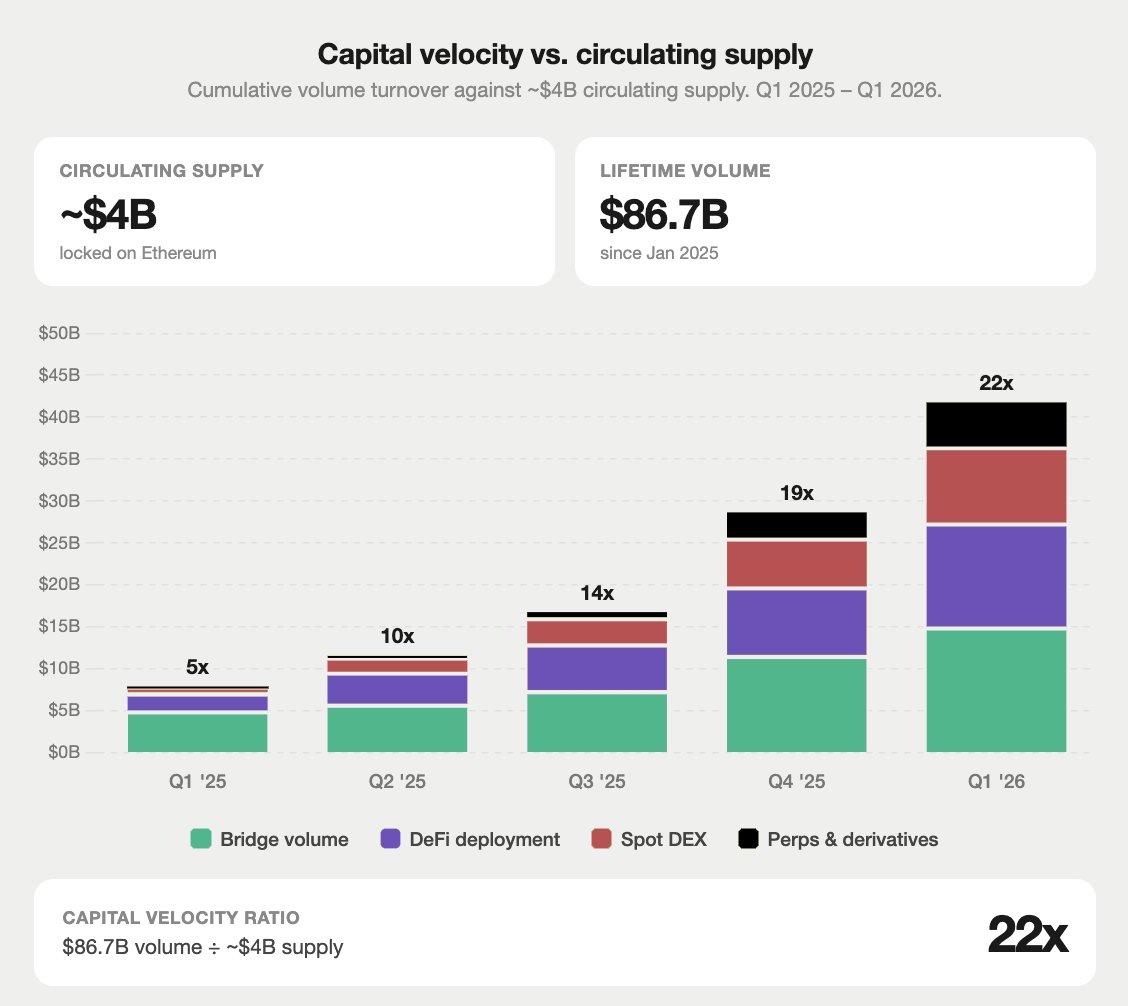
tokenization --> capital velocity

USDT0 has turned over its entire circulating supply 22 times since launch.
~$4B in circulation. $86B in lifetime volume.
A dollar cycling through an economy 10 times creates 10x the activity of one sitting idle.
USDT0 is one of the hardest working assets onchain.
1
9
244


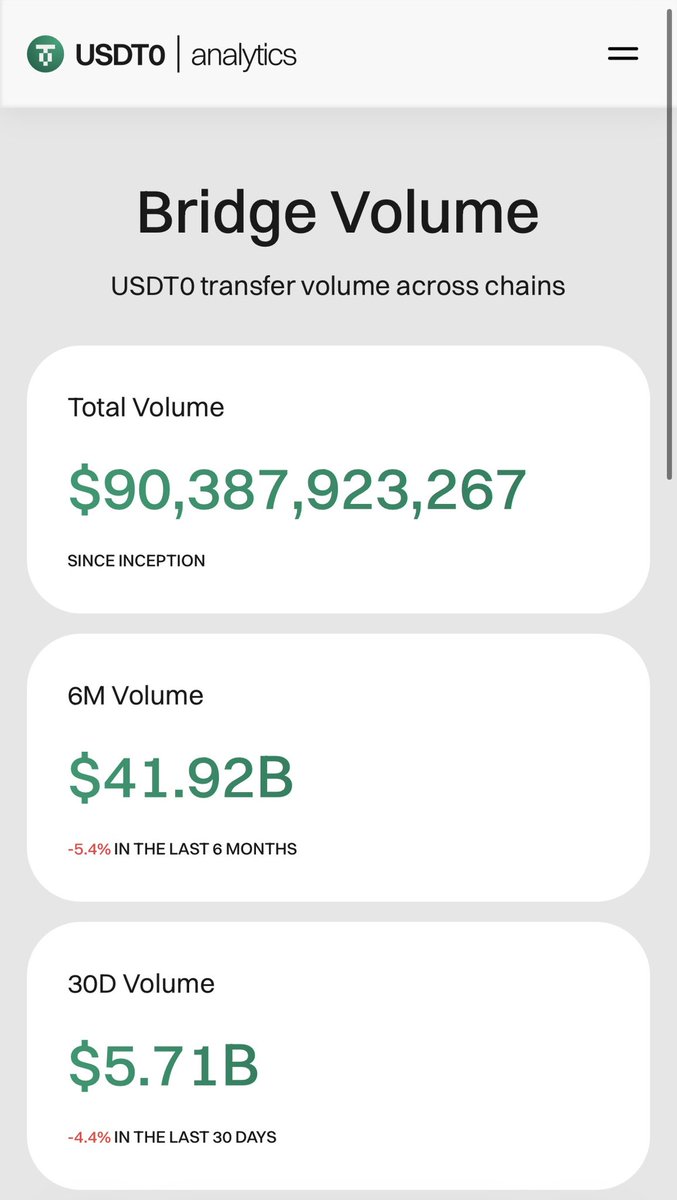
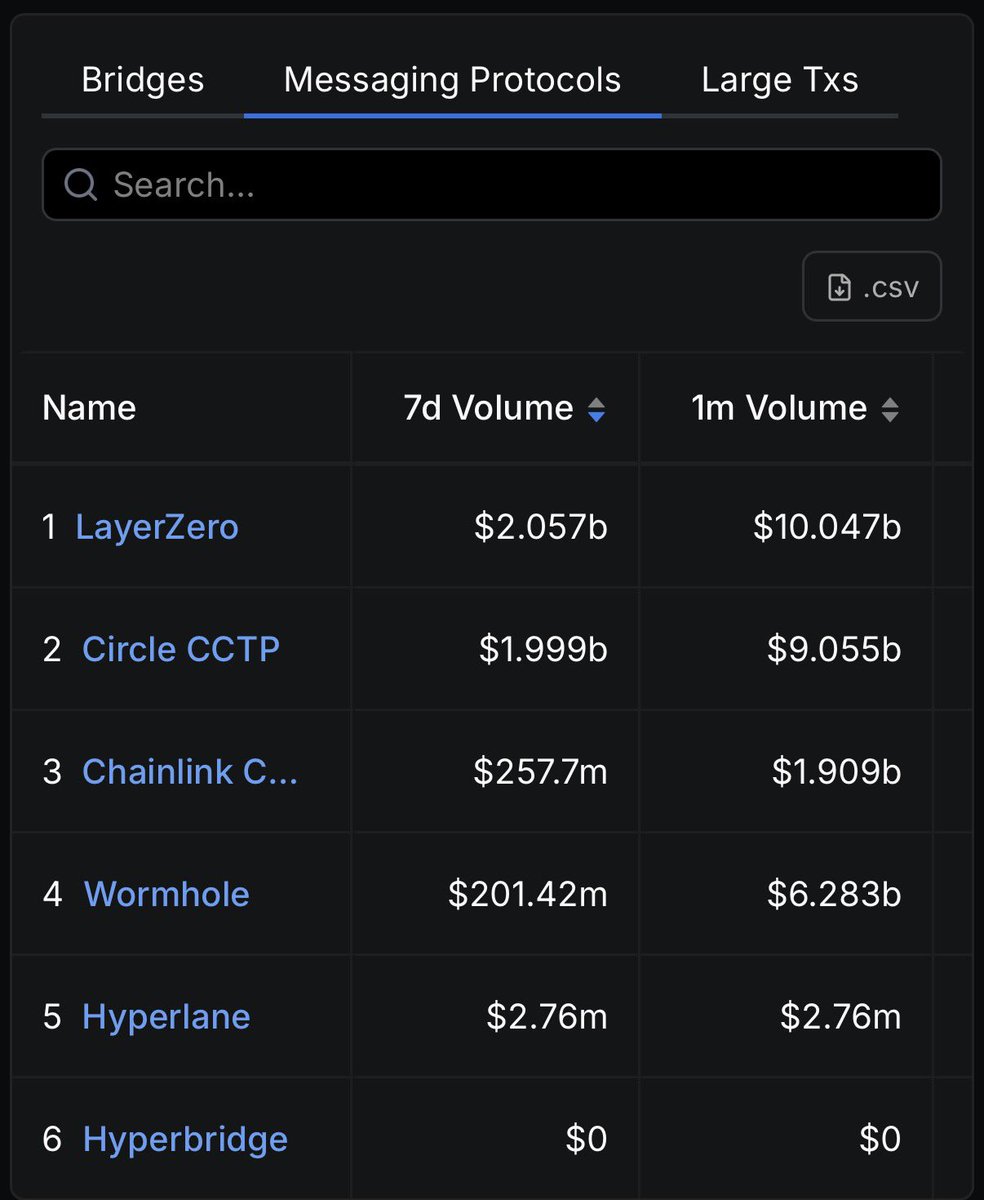
I’ve been around this industry long enough to know that when it gets too loud an easy way to cut through the noise is to dive into numbers.
-@LayerZero_Core did $10B in the last month.
-@USDT0_to moved close to $6B of that across our partner chains.
-We’re nearing $100B in total volume, 15 months in.
The dollar got upgraded. That’s a win for everyone building on top of our USDT0 rails.
4
7
56
25,493
kram retweeted
May 15
Over $700m of cross-chain volume flowed across LayerZero rails yesterday.
May 15

Messages (24 hr): 16,714
Messages (Historical): 160,562,906
Volume (24 hr): $712.2M
Volume (Historical) $263.4B
OFTs: 771
Chain Support: 171
For more @LayerZero_Core stats, visit Scan: layerzeroscan.com
61
46
261
60,088
May 14
gf in the arena

1
5
391

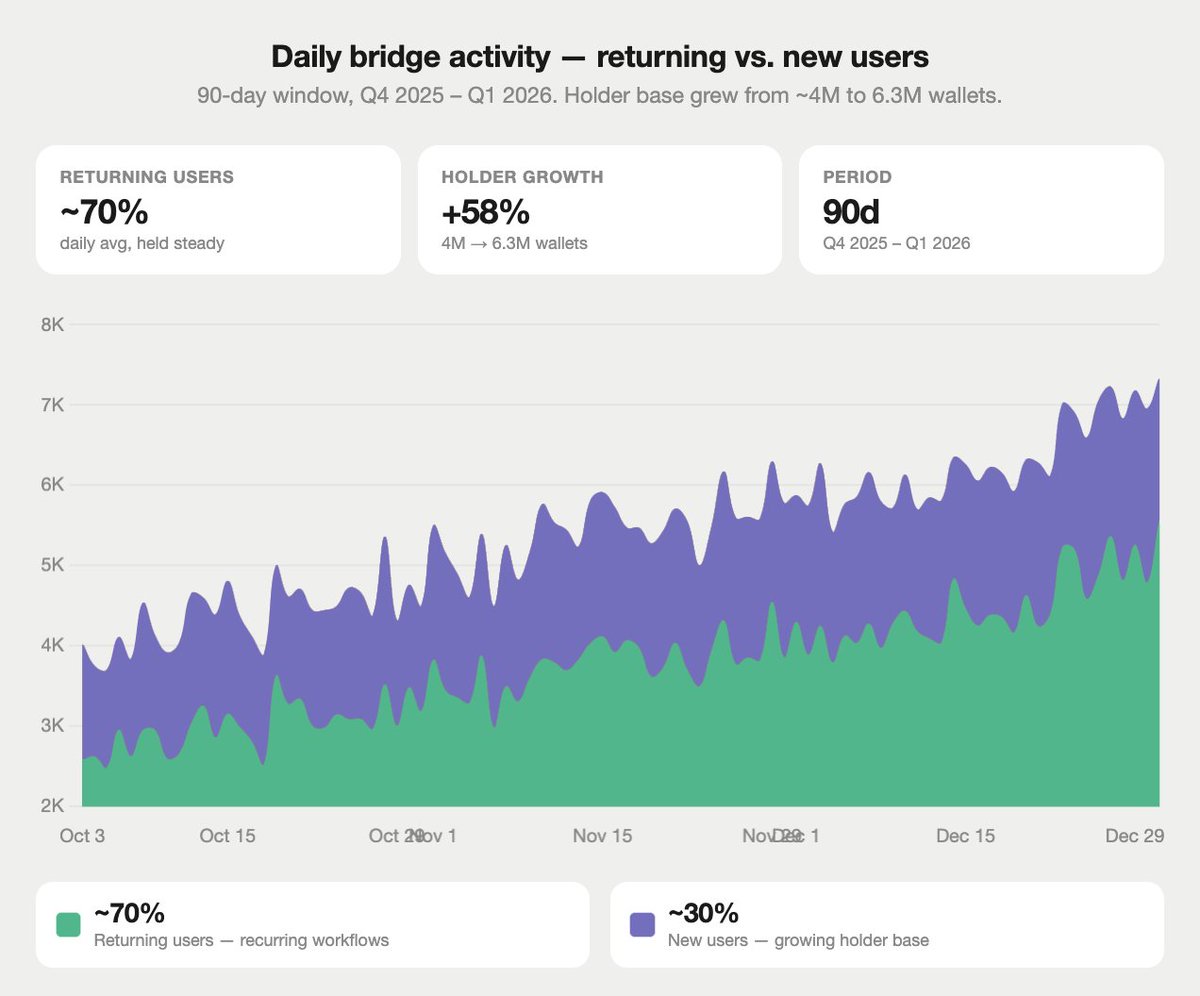
70% of USDT0's daily bridge activity comes from returning users, and user count grew from from 4M - 6.3M in Q1.
Traditional money gets harder to move the further it travels. USDT0 gets easier the more networks it reaches.
Same stablecoin. New use cases. Money in its final form.
3
2
19
5,766
May 11
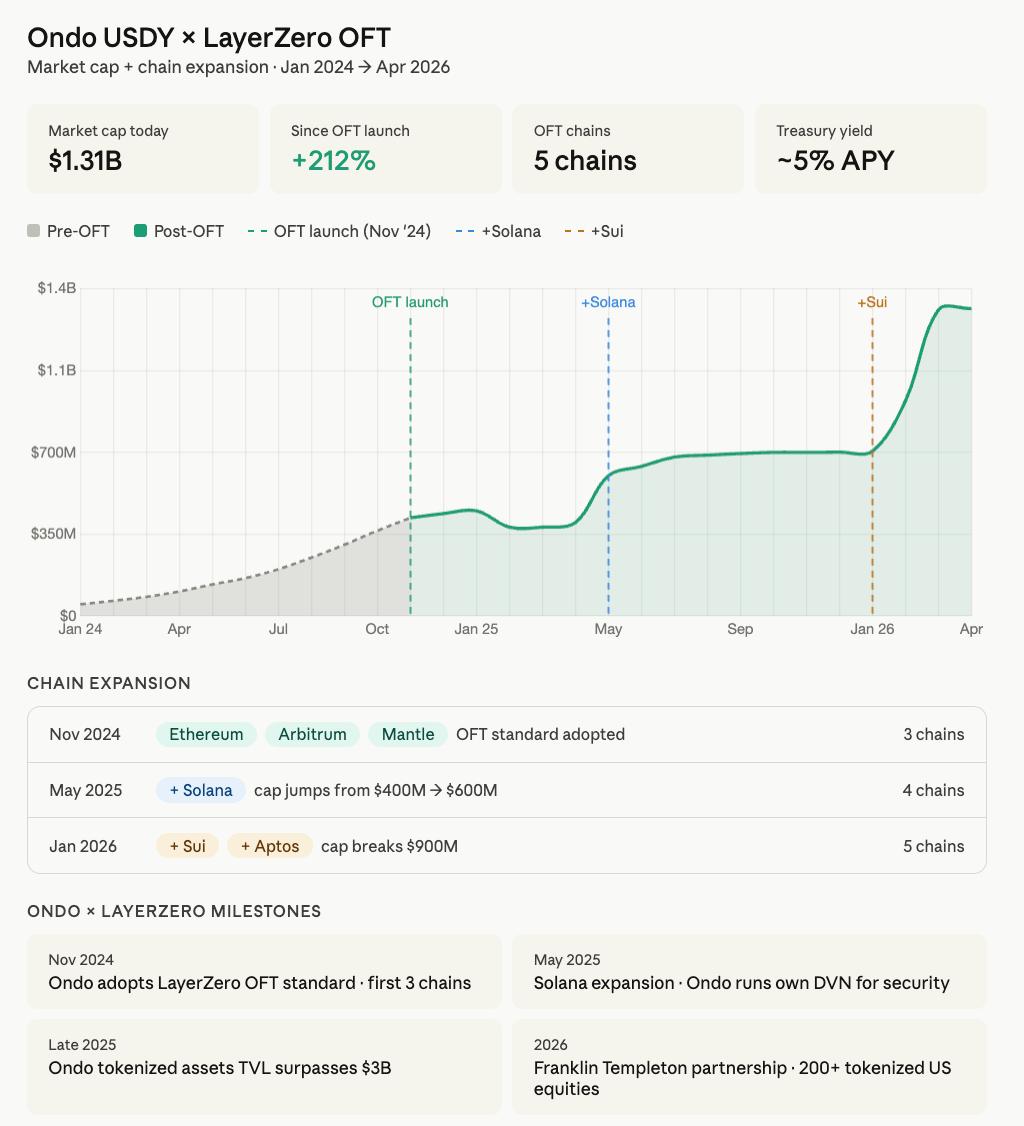
The stock economy now runs 24/7/365.
Congrats to @OndoFinance on the expansion -- should be interesting to see what bringing 35 stocks (worth $28T) unlocks for Hyperliquid eco.
May 11

Ondo tokenized stocks can now be bridged to Hyperliquid’s HyperEVM via @LayerZero_core.
Spot positions unlock advanced strategies for perp traders on applicable markets, such as basis trades and delta-neutral hedging.
@Meltfinance and @felixprotocol are among the first HyperEVM protocols to integrate Ondo tokenized stocks and ETFs.
2
17
630
kram retweeted

May 9
Huge respect to @LayerZero_Core for dropping this full post-mortem and owning every part of it.
Transparency real fixes (no more 1/1 DVNs, better defaults, OneSig, etc.) is exactly how you build long-term trust.
16
6
31
4,043
kram retweeted
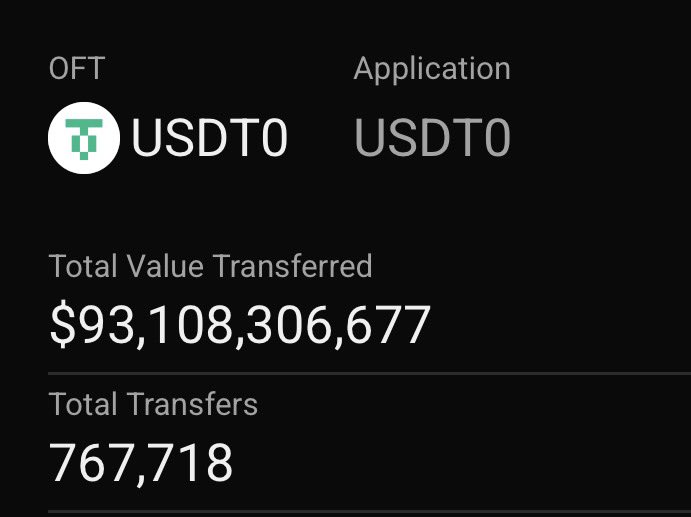
.@USDT0_to has been a leader in how they utilize @LayerZero_Core from the moment they launched. They continue to set an incredible standard for how to build and operate and are closing in on 1M transfers & $100B transferred.
Incredibly grateful to have them as partners

At @USDT0_to, we build with the specific intention of ensuring there is no single point of failure. Security is at the core of every single architectural and procedural decision we make along the way. For example:
Since launching last year, we’ve run a proprietary DVN with veto capability over every message, custom invariant checks built specifically for our infra, and pinned code libraries so that no external party can ever modify the code the system runs on.
Every chain deployment gets its own independent risk assessment. Every multisig transaction passes through internal and external review before a signer even sees it. We turn down chains, delay launches, and trade user experience for stronger security when instances require a trade-off.
During the KelpDAO incident, USDT0 remained secure with no impact on system integrity and has processed over $4 billion in volume since. Our proprietary DVN performed exactly as it was built to. We used the moment to raise the bar further, adding Canary as a third independent verifier, moving our DVN setup from 2-of-2 to 3-of-3. Exit confirmation times were also extended to guarantee finality before cross-network settlement.
In the coming months we are moving to 4-of-4 and then 5-of-5 as additional qualified candidates clear our validation process.
More details in our recent overview of USDT0's security architecture:
blog.usdt0.to/security-is-th…
41
23
200
27,946

LayerZero is the golden standard for cross chain interoperability BECAUSE of its high level of customizability. Unfortunately, this means application owners need to invest serious resources to match the security standard that the capital moving through our rails demands.
At @USDT0_to this has been our main priority from day 1. Security IS the product.
From our very first conversation, the @LayerZero_Core team made extremely clear to us what it would take to hit the security bar our infrastructure required. We did not launch into production until each of those steps was achieved.
Our system pins libraries, runs our proprietary veto-powered DVN with invariance checks developed specifically for our threat vectors, and owns multiple other invaluable parts of the security stack to make sure we are ALWAYS owning our security stack from A to Z.
My Co-Founder and CTO @0xKeno put together an overview of how we approach security at USDT0.
You can find it below.
We are the largest asset on the LayerZero network. We were fully unaffected by this incident because we built on top of the protocol responsibly. We did our homework well before this attack was on everyone’s mouth. Since then, USDT0 moved $4B across chains.
We have been, and will keep on, safeguarding our user's funds to the highest security standards available in this industry.
We are standing strong next to @PrimordialAA, @ryanzarick and the rest of the LayerZero team. Interoperability is hard. It is dangerous. It is constantly under attack by nation-state actors, with virtually unlimited resources. It’s like open heart surgery, every time something is changed.
It is also absolutely needed in the future-economy we are all trying to build.
The only way to avoid the next exploit is to understand the system deeply, invest resources in understanding the technology and build on a platform that lets applications own the vast majority of their building blocks.
For us, this platform is LayerZero. We’ll keep building on top of LayerZero.
At @USDT0_to, we build with the specific intention of ensuring there is no single point of failure. Security is at the core of every single architectural and procedural decision we make along the way. For example:
Since launching last year, we’ve run a proprietary DVN with veto capability over every message, custom invariant checks built specifically for our infra, and pinned code libraries so that no external party can ever modify the code the system runs on.
Every chain deployment gets its own independent risk assessment. Every multisig transaction passes through internal and external review before a signer even sees it. We turn down chains, delay launches, and trade user experience for stronger security when instances require a trade-off.
During the KelpDAO incident, USDT0 remained secure with no impact on system integrity and has processed over $4 billion in volume since. Our proprietary DVN performed exactly as it was built to. We used the moment to raise the bar further, adding Canary as a third independent verifier, moving our DVN setup from 2-of-2 to 3-of-3. Exit confirmation times were also extended to guarantee finality before cross-network settlement.
In the coming months we are moving to 4-of-4 and then 5-of-5 as additional qualified candidates clear our validation process.
More details in our recent overview of USDT0's security architecture:
blog.usdt0.to/security-is-th…
46
24
175
49,293
kram retweeted

May 7
artist friends: i like painting
musician friends: i like my guitar pedals
writer friends: every single time i have to write anything its like 10,000 horses dragging me through a field of broken glass, in fact i would prefer that
107
560
7,812
190,198