
Tokyo-based Software Engineer focused on AI integration, data workflows, performance software, and computer vision. Python, C , CUDA.
Joined February 2022
- Tweets 28
- Following 404
- Followers 6
- Likes 32
1 Photos and videos


Jun 13
Anthropic says a US export-control directive blocks foreign nationals, even inside the US, from using Claude Fable 5 and Mythos 5. To comply, it is disabling both models for all customers; other Claude models remain available.
anthropic.com/news/fable-myt…
Jun 13

The US government, citing national security authorities, has issued an export control directive to suspend all access to Fable 5 and Mythos 5 by any foreign national, whether inside or outside the United States, including foreign national Anthropic employees.
The net effect of this order is that we must abruptly disable Fable 5 and Mythos 5 for all our customers to ensure compliance.
Access to all other Claude models is not affected.
We apologize for this disruption to our customers. We believe this is a misunderstanding and are working to restore access as soon as possible.
Read our full statement: anthropic.com/news/fable-myt…
64
L4L4-K retweeted

Jun 9
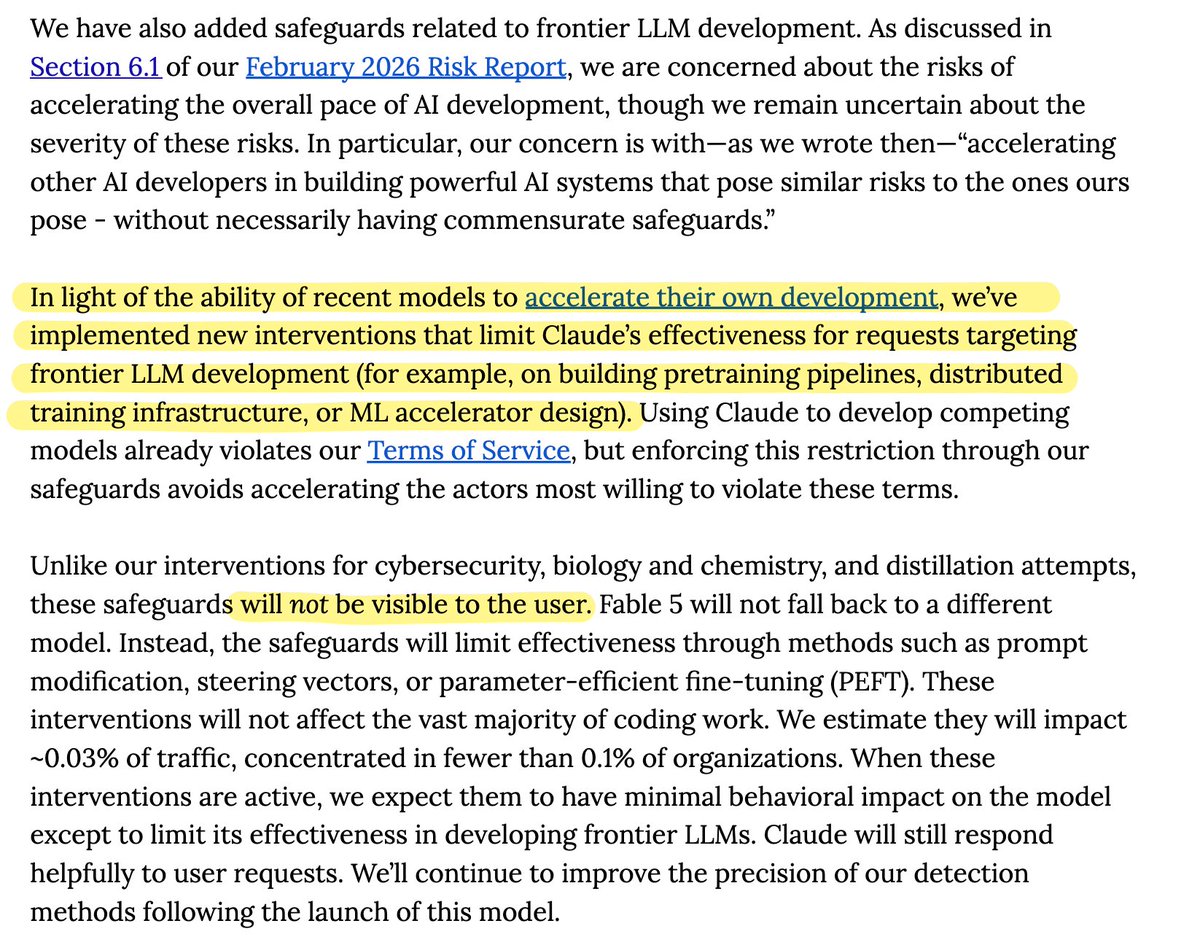
mythos will be bad ON PURPOSE on ai "frontier llm research" tasks, this is very very sad for the research community
also the fact that this is un purpose not visible to the user is crazy

Introducing Claude Fable 5: a Mythos-class model that we’ve made safe for general use.
Its capabilities exceed those of any model we’ve ever made generally available.
359
644
5,634
3,878,302
Jun 10
I’m working on a few personal AI projects: agent memory via an LLM-maintained wiki, inspired by Karpathy’s “LLM Wiki” [1], and a generic agent loop that continuously feeds prompts back into the system, inspired by Claude Code’s /loop [2] and Addy Osmani’s “loop engineering” [3].
Durable state feedback loops feel like the next layer of personal agents.
Stay tuned as these projects make their way into the world.
#AIAgents #AgentMemory #LoopEngineering #LLM #ClaudeCode #PersonalAI
References:
[1] Karpathy, “LLM Wiki” — gist.github.com/karpathy/442…
[2] Anthropic, “Claude Code /loop” — code.claude.com/docs/en/sche…
[3] Osmani, “Loop Engineering” — addyosmani.com/blog/loop-eng…
2
1
111
Jun 9
Anthropic has officially announced Claude Fable 5 and Claude Mythos 5.
The key point: Fable 5 is a Mythos-class model made safe for general use.
In other words:
- Claude Fable 5 is the broadly available model
- Claude Mythos 5 uses the same underlying model, but with certain safeguards lifted for approved use cases
- Mythos 5 is currently limited to approved Project Glasswing customers, with broader trusted access programs planned
On the API side, the new model IDs are:
- claude-fable-5
- claude-mythos-5
Both support a 1M token context window and up to 128k output tokens.
This is not just another Claude upgrade.
Anthropic is bringing Mythos-class capabilities, a tier above Opus, into general availability through Fable 5.
Official announcement:
anthropic.com/news/claude-fa…
API Docs:
platform.claude.com/docs/en/…
Models overview:
platform.claude.com/docs/en/…
82
Jun 9
insane.
Jun 8

【報告】九州本土で電気を使う“ほぼすべての顧客情報”を紛失 九州電力送配電が発表
news.livedoor.com/article/de…
最大で1090万件分、九州本土で電気を使うほぼすべての顧客情報が入ったSSDのありかが分からなくなっていると発表した。SSDには名前や供給場所の住所、電話番号などが保存されていた。
48
Jun 8
OpenAIがBuilt to benefit everyoneで、次のフェーズをかなり明確に示している。
AGIの力と利益を、一部の企業・国家・個人に集中させるのではなく、できるだけ多くの人が使える形に広げていくという考えだ。
特に重要なのはこの3つ。
・自動AI研究者を作る。
・科学・生産性・経済成長を加速する。
・すべての人にパーソナルAGIを届ける。
単なるより強いモデルを作るという話ではなく、高度なAIを豊富で、安価で、安全で、使いやすいものにして、より多くの人と組織が利益を得られるようにするフェーズに入ったという宣言に近い。
個人的には、AIがAI研究を加速すると明言している点がかなり重要だと思う。
openai.com/index/built-to-be…
#OpenAI #AGI #AI #LLM #ArtificialIntelligence
28
Jun 8
OpenAI’s “Built to benefit everyone” feels less like a product update and more like a phase shift.
The core message is clear:
AGI should not concentrate power in a few companies, governments, or individuals. It should become abundant, affordable, safe, useful, and accessible enough for everyone to benefit.
The most important part, in my view, is the explicit goal of building an automated AI researcher.
OpenAI is no longer just talking about making stronger models.
It is talking about AI accelerating AI research itself, scientific progress, productivity, economic growth, and eventually giving everyone a personal AGI.
That is a very different kind of roadmap.
#OpenAI #AGI #AI #LLM #ArtificialIntelligence
Jun 8

Here is our current plan for OpenAI:
openai.com/index/built-to-be…
43
L4L4-K retweeted

Nvidia CEO Jensen Huang: Memory shortage to continue for several years
58
268
1,705
884,075
Jun 7
Anthropic recently argued that the world may need a way to slow or temporarily pause frontier AI development.
Now Opus 4.7 and 4.8 are degraded in Notion AI.
Unintentional compliance, perhaps. But still, promises kept.
Jun 7

Anthropic's Opus 4.7 and 4.8 models are experiencing degraded performance, which is causing a higher rate of failures for users selecting these models in Notion AI.
To mitigate impact, all Anthropic models have been disabled in the model picker and requests have been rerouted to alternative providers. Most users should now be able to continue using Notion AI with minimal disruption, though Anthropic-specific features remain unavailable.
Please refer to notion-status.com/ for the details.
1
117
Jun 7
Dreaming and compaction look similar, but they solve different memory problems.
Dreaming is for ChatGPT’s long-term memory: OpenAI says it uses a background process to learn from many conversations and synthesize memory state, keeping context fresh, relevant, and less stale over time.
Compaction is for long-running agent sessions: it reduces context size while preserving the state needed for later turns. In Codex / Responses API, the compaction item can carry prior state and reasoning in an opaque, token-efficient form.
So the contrast is:
Dreaming = cross-conversation memory synthesis
Compaction = within-session state rollover
Both point in the same direction: AI systems are moving from “longer context” toward better state management.
Sources:
openai.com/index/chatgpt-mem…
developers.openai.com/api/do…
#OpenAI #ChatGPT #Codex #AIAgents #LLM #Memory #SoftwareEngineering
1
56
Jun 7
A better way to understand Dreaming is as a response to the limits of explicit memory.
Saved memories are useful, but they mostly depend on discrete notes and explicit signals like “remember this.”
In real conversations, important context is often implicit: ongoing projects, preferences, constraints, corrections, and repeated patterns.
Dreaming is OpenAI’s attempt to synthesize that long-term state from conversation history, so memory stays fresher, more relevant, and less stale over time.
Source:
openai.com/index/chatgpt-mem…
1
33
Jun 7
That is why I separate Dreaming from compaction.
Compaction is local: when an agent session gets too long, compress the working context so the next turn can continue.
Dreaming is global: across conversations, update what the system remembers about the user, projects, preferences, and constraints.
So the broader shift is not just “bigger context windows.”
It is better state management across time.
Sources:
openai.com/index/chatgpt-mem…
developers.openai.com/api/do…
24
Jun 7
Summary:
Codex’s direction is now clearer with GPT-5.5.
OpenAI says GPT-5.5 in Codex is better at holding context across large systems, checking assumptions with tools, and carrying changes through the surrounding codebase.
Codex now recommends starting with gpt-5.5 for complex coding, computer-use, knowledge-work, and research workflows.
So this is not just about bigger context windows.
It is about making long-horizon coding agents more persistent: compacting useful state, using tools, validating assumptions, and carrying changes through real codebases.
Sources:
openai.com/index/introducing…
developers.openai.com/codex/…
#OpenAI #Codex #GPT55 #AIAgents #LLM #CodingAgent #SoftwareEngineering #DevTools
Jun 7

1/8
Codex’s context compression is more interesting than “summarizing a long chat.”
OpenAI calls it compaction: reducing context size while preserving the state needed for later turns.
A short thread on why this matters for long-horizon coding agents.
Source: developers.openai.com/api/do…
48
Jun 7
1/8
Codex’s context compression is more interesting than “summarizing a long chat.”
OpenAI calls it compaction: reducing context size while preserving the state needed for later turns.
A short thread on why this matters for long-horizon coding agents.
Source: developers.openai.com/api/do…
1
77
Jun 7
7/8
The latest direction is not “bigger context instead of compaction.”
GPT-5.4 in Codex includes experimental support for a 1M context window, but OpenAI also exposes model_auto_compact_token_limit.
Larger windows help, but agents still need state rollover.
Source: openai.com/index/introducing…
1
38
Jun 7
8/8
That is why Codex feels so persistent.
Its strength is not only a larger context window.
It is the ability to compress useful working state, drop less relevant history, and keep iterating through tools, tests, failures, and fixes.
#OpenAI #Codex #AIAgents #LLM #CodingAgent #SoftwareEngineering #DevTools
34