
educated as electrical and computer engineer. Interests: embedded systems, mobile wireless networks, soccer(NY Red Bulls, US), Buddhist Dharma, craft beer
Joined August 2007
- Tweets 7,047
- Following 586
- Followers 159
- Likes 1,285
38 Photos and videos


Larry Y. ⚽️🍻☸️ retweeted

17 Oct 2025
It’s a measure of their insanity that leaders around the world are seriously considering nuclear war. Ivana Hughes of Columbia on what that would mean.
(0:00) How Powerful Are Nuclear Weapons?
(9:46) What Would Happen if a Nuke Detonated Over Times Square?
(19:53) What Is Nuclear Winter?
(24:56) Ozone Layer Destruction
(27:06) What Would Happen if a Nuclear Power Plant Was Hit With a Nuclear Weapon?
(29:08) How Many Times Have We Launched Nuclear Weapons?
(33:57) The Horrifying Effects of Radiation
(41:29) Is Nuclear Testing Infecting Our Food and Causing Cancer?
(49:41) How Many Nuclear Weapons Exist Today?
(51:14) Close Calls With Nuclear War and Lost Nukes
(54:47) The Cuban Missile Crisis and JFK’s Attempt to Ban Nuclear Weapons
(1:02:03) Why JFK Wanted to End Israel’s Nuclear Program
(1:06:16) North Korea’s Nuclear Program
(1:08:20) Is Iran Actually Trying to Build a Nuclear Weapon?
(1:11:48) The Moral Debate About Our Nuclear Defense Policy
(1:19:59) Are World Leaders Calling for Nuclear War?
(1:29:50) Should America Lead the Charge in Eliminating Nuclear Weapons?
(1:36:50) What Is the Doomsday Clock?
(1:41:26) How Much Money Is Spent on Nuclear Weapon Development?
(1:43:29) The First Step to Eliminating Nuclear Weapons
Includes paid partnerships.
612
1,529
6,056
1,026,852
Larry Y. ⚽️🍻☸️ retweeted

6 Oct 2025
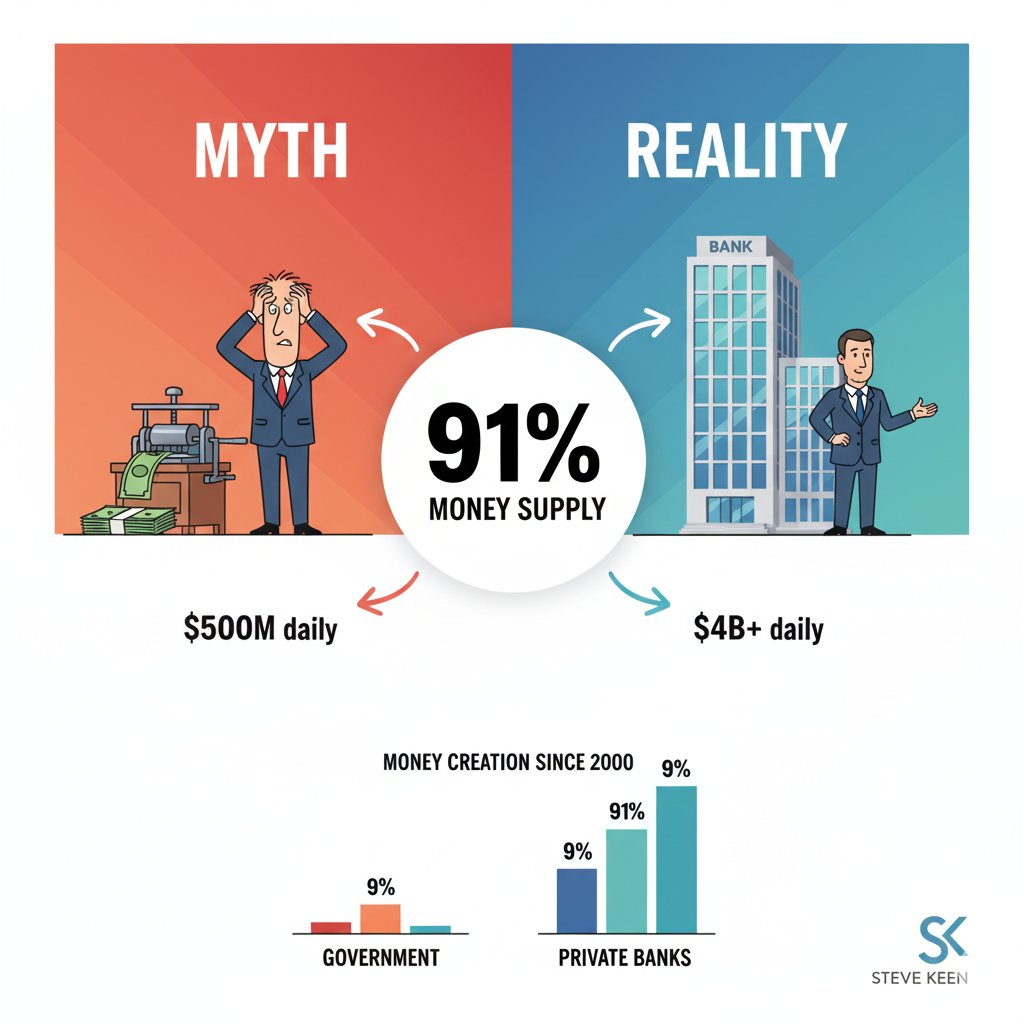
The $500 million daily money printing story is just the tip of the iceberg.
After 30 years studying how money actually works, I can tell you that 91% of money creation since 2000 came from private banks, not government printing presses.
Most economists get this backwards - they think government spending borrows from private savings, but the accounting shows government deficits actually CREATE money and reserves.
I break down the 8-entry accounting system that mainstream economists miss completely.
Link to full breakdown in comments.
#MoneyCreation #BankingSystem #EconomicTruth #PostKeynesian #ModernMonetaryTheory
16
100
225
19,756
Larry Y. ⚽️🍻☸️ retweeted

3 Jul 2025
My visit to NASA was illuminating: there is this engineering rule to use a 4x safety margin everywhere.
Now apply it to finance. How much $ do you need to retire? To be ~100% safe, estimate what you will spend & multiply by 4.
So many retirees underestimated how much they needed as a buffer against inflation, crises, unexpected expenditure, divorce,Trump tariffs, price of Gucci shoes, etc.
123
395
4,168
331,192
Larry Y. ⚽️🍻☸️ retweeted

7 Jul 2025
TOP ECONOMISTS IN PRAISE OF SPECIAL RAPPORTEUR FRANCESCA ALBANESE’S REPORT TO THE UNITED NATIONS: ‘FROM ECONOMY OF OCCUPATION TO ECONOMY OF GENOCIDE’
Yanis Varoufakis, Thomas Piketty, Nassim Taleb, Jayati Gosh, Michael Hudson, Giuseppe Mastruzzo, Jomo Kwame Sundaram, Robert H. Wade, Christopher Cramer and Nidhi Srinivas co-sign the open letter below supporting Albanese amid US calls to remove her as the UN special rapporteur on Palestine
History teaches us that economic interests have been key drivers and enablers of colonial enterprises and often of the genocides they perpetrated. The corporate sector has been intrinsic to colonialism since its inception, with corporations historically contributing to the violence against, the exploitation, and ultimately the dispossession, of Indigenous people and lands, a mode of domination known as racial colonial capitalism. Israel’s colonisation of the occupied Palestinian territories is no exception.
The recent report by Francesca Albanese, the UN Special Rapporteur on the situation of human rights in the Palestinian territories occupied since 1967, constitutes a major contribution to understanding the political economy of Israel’s Apartheid state, the ethnic cleansing of Palestinians and, now, their genocide. As such, we believe, it must be studied and debated widely and freely.
In view of the virulently hostile and indeed intimidating letter from the US government to the UN Secretary General demanding the dismissal of Ms Albanese and the quashing of her excellent report, we felt the need to express our strong support for Ms Albanese and to encourage the UN to dismiss the shrill demands of the US and Israeli governments.
Following a well-trodden path of genocide denial and of bullying anyone who challenges the right of the colonial power to dispossess Indigenous peoples, the US and Israeli governments, with most European governments too timid to take a stance, demand that the international community turn a blind eye to the ongoing genocide and, in particular, to the key role that multinational and national corporations are playing in maintaining the Apartheid regime and enabling the subsequent genocide.
As economists we feel the duty to highlight three key findings that Ms Albanese’s report unveils with clarity and precision.
First, occupation and genocide are highly lucrative for conglomerates. These include not only the usual arms and ‘defence’ big businesses (e.g., Lockheed-Martin, the primary maker of the F35s, ELBIT, Israel’s own arms manufacturer, and Palantir, the software company whose algorithms have most likely been crucial in the selection of ‘targets’ across Gaza) but also household brand names (e.g., Caterpillar, BNP Paribas, Barclays, Allianz, Chevron, BP, Petrobas, A.P. Moller-Maersk A/S). As Israel’s defence budget doubled, with the active support of the US government, it crowded in large ‘investments’ into Israel’s killing machine across this international network of complicit conglomerates in which thousands of Israeli companies are intertwined with US, European, Korean and even a Brazilian mega-corporation. This explains why Israeli equities rose by 161% at a time of falling demand, production and consumer confidence.
The second finding in Ms Albanese’s report that deserves extensive study is that the Palestinian territories Israel occupies have functioned as Big Tech’s ideal laboratory and testing ground – a function that the transition from occupation to genocide has only heightened. No country, for instance, has given as much access to a population’s biometric data as Israel has given to IBM. Since 7th October 2023, Microsoft, Amazon, Alphabet and Palantir have been expanding their cloud capital services at a breathtaking pace. Face recognition software, target selection algorithms and automated execution systems are being tested in real time, at will, and with fewer ethical constraints than in the case of experiments on laboratory rats. Big Tech could not be happier!
The third key finding is that top US and European universities are financially dependent on remaining wedded to Israel’s Apartheid and permanent occupation/conflict political economy. Many top US and EU institutions will face serious financial difficulties if they were to stop backing Israel’s genocide. Ms Albanese’s report must be commended for drawing this sordid dependency of stellar Western universities and research institutions (including the Technical University of Munich, MIT Labs, the University of Edinburgh among others). The peoples of Europe and America have a right to know that some of their most cherished academic institutions are financially reliant on helping Israel reproduce its political economy of occupation and genocide.
In a few years, almost everyone will claim they opposed this genocide. But it is now that people of good conscience need to take a stand. As economists we stand, today, with Francesca Albanese, the UN Special Rapporteur under attack by the US and Israeli governments because her recent report throws indescribably important light on the political economy of Israel’s occupation and genocide.
zeteo.com/p/exclusive-top-ec…
60
1,416
3,557
150,082
Larry Y. ⚽️🍻☸️ retweeted
11 Jul 2025
33
29
430
76,126
Larry Y. ⚽️🍻☸️ retweeted
11 Jul 2025
No.
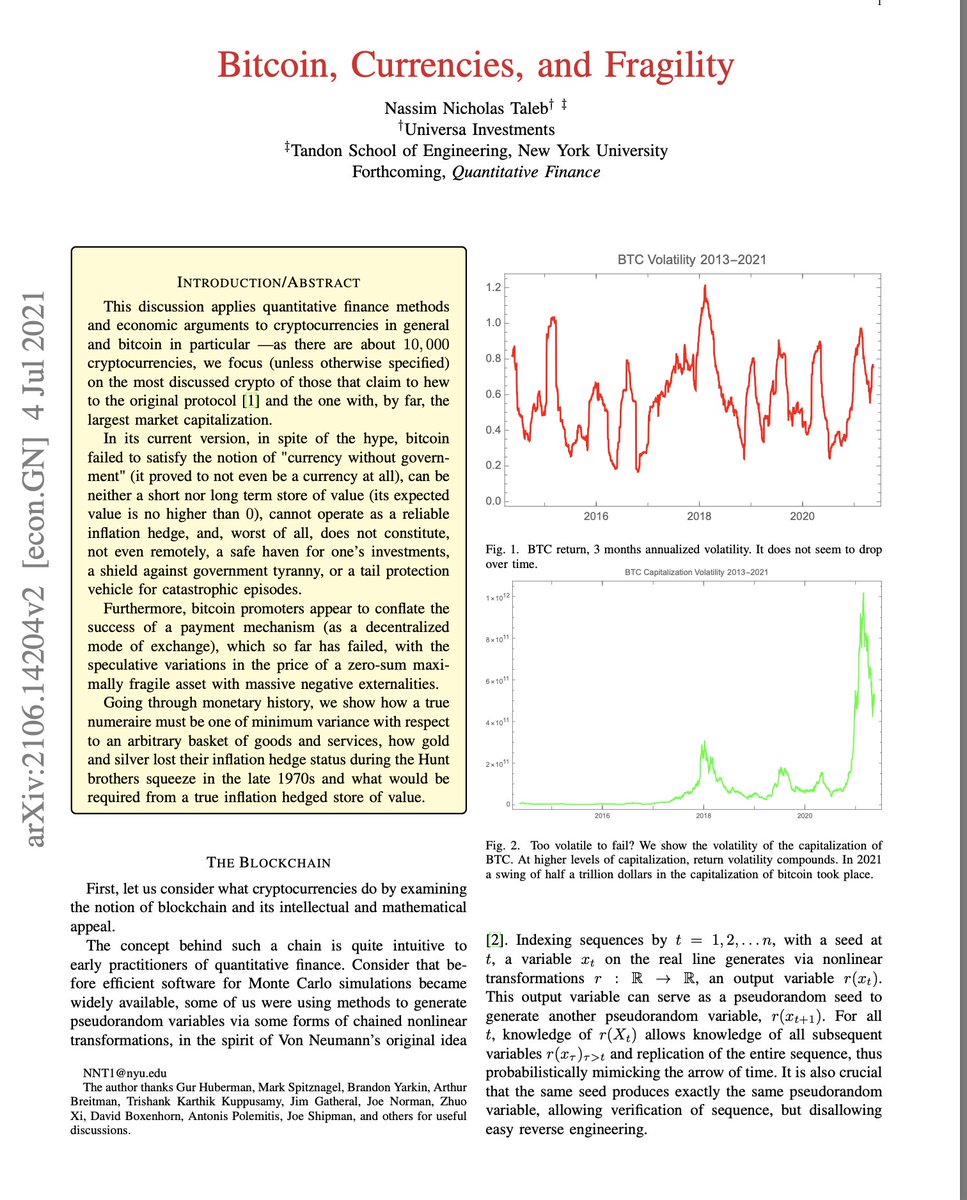
That's a decade old. Bitcoin turned out to NOT be a currency.
It is an electronic tulip, perhaps; not a currency.
11 Jul 2025

"Bitcoin is the beginning of something great: a currency without a government, something necessary and imperative." - @nntaleb
354
516
5,968
628,097
Larry Y. ⚽️🍻☸️ retweeted

12 May 2025
"A private equity firm can invest a hundred million dollars to build a steel plant and potentially earn a 7% profit starting in two years, or it can borrow a hundred million dollars and buy an existing company and sell that firm’s real estate immediately and lease it back to the company it just bought while shedding labor contracts in bankruptcy. Which one is a better return on investment?"
-Matt Stoller, explaining how America consciously decided to create an environment hostile to making things; instead, we take things apart for profit, leaving ashes behind. Wall Street, not China, stole America's productive capacity.
thebignewsletter.com/p/monop…
32
636
1,903
66,180
Larry Y. ⚽️🍻☸️ retweeted

13 Mar 2025
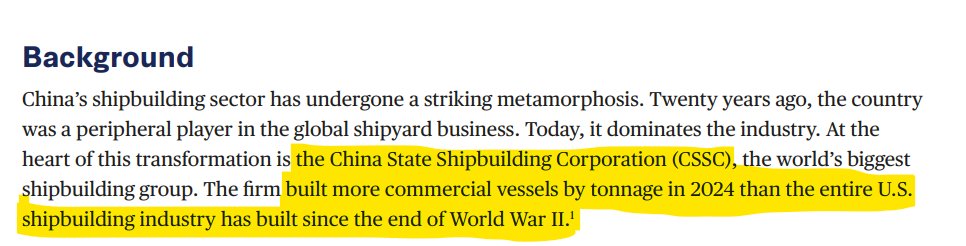
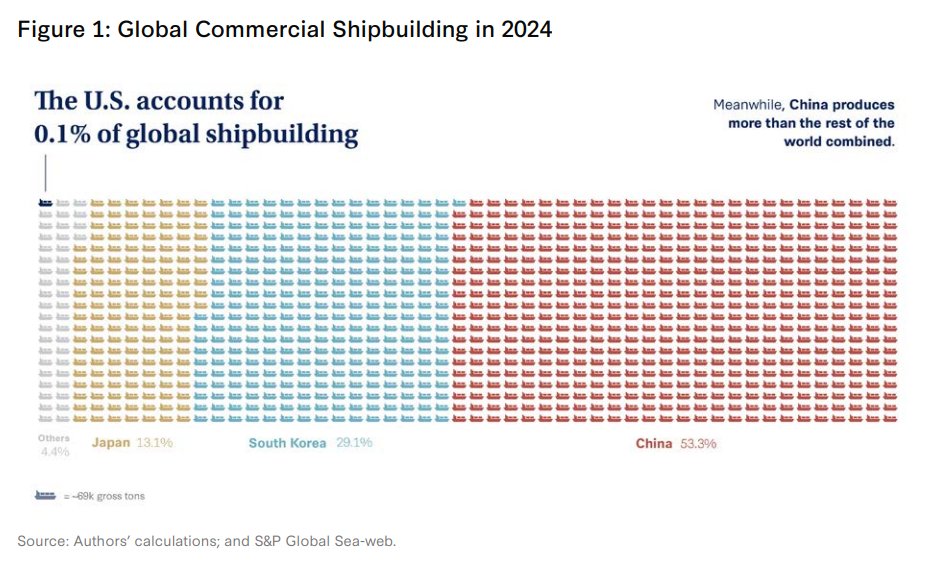
That's an absolutely insane statistic: in 2024 alone a single Chinese firm, the China State Shipbuilding Corporation (CSSC), built more more commercial ships by tonnage than the entire U.S. shipbuilding industry has built since the end of World War II.
Source: csis.org/analysis/ship-wars-…
66
651
2,499
155,336
Larry Y. ⚽️🍻☸️ retweeted

3 Mar 2025
My old friend John was right, as almost always.
An article from before the Guardian was completely captured by the security services.
archive.is/2024.11.07-234539…
56
921
2,422
329,179
Larry Y. ⚽️🍻☸️ retweeted

6 Feb 2025
White House Announces Appointment Of Virus As Head Of Pandemic Response

6
141
495
10,981
Larry Y. ⚽️🍻☸️ retweeted

2 Jan 2025
Is it me or has the quality of CIA productions got really bad? The 2000s felt like the golden age of black flags: major events, tight scripts, suspense, worthy villains. Today it's like watching a 3rd rate Netflix movie because you can't find the remote and are too lazy to look
249
1,123
6,621
162,197
Larry Y. ⚽️🍻☸️ retweeted
27 Dec 2024
The irony of Vivek's post is that his wrong analysis of how American culture is broken illustrates in itself how American culture is broken.
I mean, how out-of-touch must one be to think people will embrace a vision where childhood must be optimized for corporate success, with less sleepovers, hanging out and fun (what he calls "mediocrity") in favor of shareholder-value-maximizing "excellence"?
Especially when addressing Americans who have seen their lives destroyed en-masse by the same corporate priorities that produced this vision of "excellence". The average American family isn't choosing between math tutoring and sleepovers - they're choosing between paying for basic necessities while both parents work multiple jobs.
His examples unwittingly prove the opposite of his point: shows that he describes as corrupting American culture (Friends, Boy Meets World, Family Matters, etc.) celebrate friendship, family, and community values - exactly what the US has lost in their rush to optimize everything for economic output and create an hyperindividualistic and consumerist society. That's probably why they're popular: they reflect a lost world that people aspire to go back to.
He mentions China as the motivating factor here, because apparently the solution to avoid having their "asses handed to us by China" is more capitalism, treating people even more like cogs who must compete in "the global market for technical talent."
That doesn't only betray a misunderstanding of what Americans want but also of China. China themselves largely hate the extreme competitiveness of their system: the people hate it and the government hates it, they all want to move away from it (hence the government banning the tutoring industry). And in any case this isn't what made China rise - China rose with a largely uneducated population, as mass university-level education is a very recent phenomenon there.
No, I'm convinced that China, at a very fundamental level, rose so unprecedentedly fast for the very reason that it is one of the very few countries in the world which culture wasn't completely denaturalized by the sort of neoliberal dystopia that Vivek seems to idealize. In China's socialist system the market doesn't trump all, individualism doesn't reign supreme and, at a broader level, they still stay faithful to many of the ancestral values that have sustained their civilization for thousands of years. That's the culture that underpins it all and makes it work, not the fact that Chinese kids do too much homework.
All in all, this is what makes this debate so revealing: Vivek, in trying to diagnose America's problems, has instead unwittingly illustrated them. The belief that every human activity must be justified by its contribution to GDP, that collective bonds are mere distractions from the pursuit of "excellence," and that the solution to the problems created by predatory capitalism is, somehow, more predatory capitalism.
26 Dec 2024

The reason top tech companies often hire foreign-born & first-generation engineers over “native” Americans isn’t because of an innate American IQ deficit (a lazy & wrong explanation). A key part of it comes down to the c-word: culture. Tough questions demand tough answers & if we’re really serious about fixing the problem, we have to confront the TRUTH:
Our American culture has venerated mediocrity over excellence for way too long (at least since the 90s and likely longer). That doesn’t start in college, it starts YOUNG.
A culture that celebrates the prom queen over the math olympiad champ, or the jock over the valedictorian, will not produce the best engineers.
A culture that venerates Cory from “Boy Meets World,” or Zach & Slater over Screech in “Saved by the Bell,” or ‘Stefan’ over Steve Urkel in “Family Matters,” will not produce the best engineers.
(Fact: I know *multiple* sets of immigrant parents in the 90s who actively limited how much their kids could watch those TV shows precisely because they promoted mediocrity…and their kids went on to become wildly successful STEM graduates).
More movies like Whiplash, fewer reruns of “Friends.” More math tutoring, fewer sleepovers. More weekend science competitions, fewer Saturday morning cartoons. More books, less TV. More creating, less “chillin.” More extracurriculars, less “hanging out at the mall.”
Most normal American parents look skeptically at “those kinds of parents.” More normal American kids view such “those kinds of kids” with scorn. If you grow up aspiring to normalcy, normalcy is what you will achieve.
Now close your eyes & visualize which families you knew in the 90s (or even now) who raise their kids according to one model versus the other. Be brutally honest.
“Normalcy” doesn’t cut it in a hyper-competitive global market for technical talent. And if we pretend like it does, we’ll have our asses handed to us by China.
This can be our Sputnik moment. We’ve awaken from slumber before & we can do it again. Trump’s election hopefully marks the beginning of a new golden era in America, but only if our culture fully wakes up. A culture that once again prioritizes achievement over normalcy; excellence over mediocrity; nerdiness over conformity; hard work over laziness.
That’s the work we have cut out for us, rather than wallowing in victimhood & just wishing (or legislating) alternative hiring practices into existence. I’m confident we can do it. 🇺🇸 🇺🇸
297
1,379
6,235
440,897
Larry Y. ⚽️🍻☸️ retweeted
24 Dec 2024
Isn’t It A Great Thing That Covid Turned Out To Be Not A Big Deal. Also, Unconnected, Why On Earth Are A Quarter Of The Marines Medically Unfit For Duty?

29
286
1,177
29,978
Larry Y. ⚽️🍻☸️ retweeted

23 Aug 2024
The Democratic Party Exists To Make Sure Good People Do Nothing
Article with supporting links.
caitlinjohnst.one/p/the-demo…
6
122
351
12,729
Larry Y. ⚽️🍻☸️ retweeted
31 Jul 2024
As Olympic Swimming Records Stay Unscathed, We’re Desperate For Some Scientist Somewhere To Come Up With A Reason That Isn’t Covid.

8
124
450
12,777
Larry Y. ⚽️🍻☸️ retweeted
19 Apr 2024
EDITORIAL: It’s Time To Roll Back All Mitigations In Hospitals: Gloves, Masks, Goggles, Clean Floors, New Needles, Clean Scalpels, Everything. If We Want To Win The War On Immunity Debt, Doctors Must Do Their Duty And Infect Everyone With Everything All The Time.

9
231
771
26,418
Larry Y. ⚽️🍻☸️ retweeted

24 Mar 2024
Sorting through materials for my next book and stumbled on this piece outlining the influence of MMT in Chinese policymaking circles. 1/ bloomberg.com/news/articles/…
29
126
388
208,075
Larry Y. ⚽️🍻☸️ retweeted

19 Mar 2024
For professional programmers the most significant part of the job typically involves understanding a complex proprietary code base and how it supports the business requirements. The actual coding is a trivial part of the process. LLMs are useless in this area.
7
10
188
8,996
Larry Y. ⚽️🍻☸️ retweeted

6 Mar 2024
This is wild.
Corporate profits accounted for 54% of price increases between April 2020 and December 2021.
Typically, they account for just 13%.
While American families struggled with rapidly rising prices, companies raked in record profits.
4
60
121
15,194
Larry Y. ⚽️🍻☸️ retweeted

7 Mar 2024
DEI is what a civil rights movement looks like without unions.
7 Mar 2024

Actually I think much of the opposition to DEI is that people really don’t like it when puffed up HR departments for billion dollar institutions lecture them about social justice and make them sit through cult-like reprogramming sessions that help nobody and solve nothing.
10
11
93
18,932