
Politics. Heritage conservation. Law information. Artistic expression. Food. The strange and exotic.
Joined April 2009
- Tweets 21,701
- Following 929
- Followers 75,200
- Likes 29,073
2,183 Photos and videos





TrixieCruz-Angeles retweeted

En 1938, des chercheurs de Harvard ont lancé l’étude la plus ambitieuse de l’histoire en suivant la vie de 724 personnes, de leur adolescence jusqu’à leur décès, afin de découvrir ce qui rend réellement une personne heureuse et accomplie.
Pendant des décennies, ils ont analysé leurs cerveaux, leurs salaires, leurs relations et leurs traumatismes. Après 85 années de données, ils ont mis en évidence une corrélation surprenante, à laquelle personne ne s’attendait.
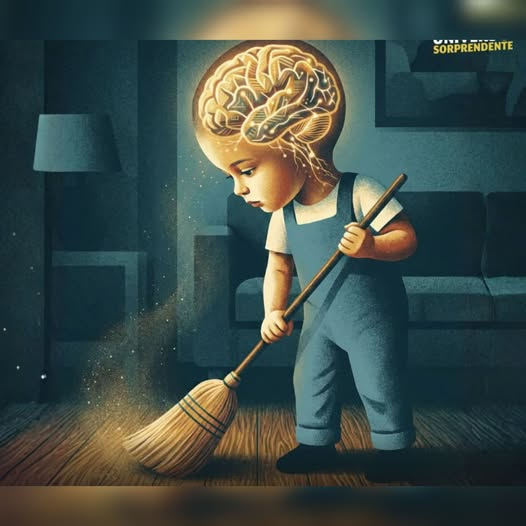
La réussite professionnelle à l’âge adulte ne dépendait ni du quotient intellectuel, ni de la richesse des parents, ni des notes scolaires. L’un des prédicteurs les plus puissants du succès était quelque chose de très simple : faire des tâches ménagères durant l’enfance.
Sortir les poubelles ou faire la vaisselle n’est pas seulement une question de propreté ; c’est un entraînement du cerveau. L’étude, connue sous le nom de Grant Study, a révélé que les tâches domestiques enseignent une leçon qu’aucune école ne peut reproduire : « l’éthique de la contribution ».
Lorsqu’un enfant doit arrêter de jouer pour mettre la table, il apprend que le monde ne tourne pas autour de lui. Il comprend qu’il fait partie d’un écosystème et que son effort est nécessaire au bon fonctionnement du groupe.
Les chercheurs ont découvert que les enfants qui participaient aux tâches devenaient des adultes qui :
– savent reconnaître ce qui doit être fait et le font sans qu’on le leur demande (initiative) ;
– éprouvent davantage d’empathie pour le travail des autres ;
– gèrent mieux la frustration et le report de la gratification.
À l’ère de la « parentalité hélicoptère », où l’on évite que les enfants s’ennuient ou travaillent, Harvard nous avertit qu’en les protégeant des tâches ennuyeuses, nous leur retirons les fondations de leur future compétence professionnelle.
Si vous voulez que votre enfant devienne un adulte accompli, ne lui achetez pas plus de jouets éducatifs. Donnez-lui un balai.
Source : Harvard Study of Adult Development (Grant Study) et Julie Lythcott-Haims (How to Raise an Adult).
Universo Sorprendente.
37
717
1,741
76,219

RT @maltiq: There you are! The pieces are now falling into their predetermined places - “What are we in power for?”

20
TrixieCruz-Angeles retweeted
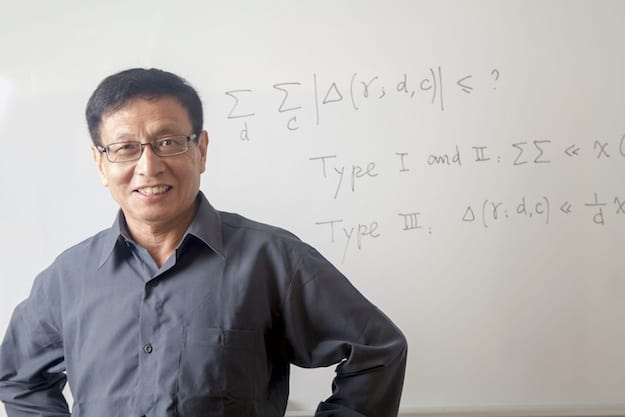
A Chinese mathematician spent 7 years making sandwiches at Subway after his PhD, and at 58 solved a 150-year-old math problem nobody thought was solvable.
His name is Yitang Zhang. The problem is called the Twin Prime Conjecture.
He was born in Shanghai in 1955 and knew he wanted to spend his life on mathematics by the time he was nine years old. That year he found his own proof of the Pythagorean theorem. Nobody taught it to him. He just worked it out.
Then the Cultural Revolution arrived and took everything.
The Chinese government closed the schools. Zhang's father had political troubles with the Communist Party, so Zhang was sent to the countryside with his mother to work in the fields. He spent 10 years as a farm laborer. No high school. No classroom. No teacher.
He read math books in the fields when he could find them.
When the revolution ended, Zhang was 23. He sat the university entrance exam and got into Peking University, one of the most competitive mathematics programs in China. He finished his bachelor's degree, then a master's. The president of Peking University personally recommended him for a full scholarship at Purdue University in the United States.
He arrived at Purdue in 1985. He earned his PhD in 1991.
Then the second wall hit.
His relationship with his doctoral advisor collapsed. The advisor did not write him letters of recommendation. Without those letters, the academic job market was closed. Zhang applied. Nothing came back. He spent the years after his PhD working as an accountant, doing delivery work, sleeping in his car during the stretches when nothing else was available.
A friend eventually opened a Subway sandwich restaurant in Kentucky and offered him a job. Zhang took it. He kept the books and made sandwiches. A man with a PhD in mathematics from Purdue, working a Subway counter because the academic world had no place for him.
He did this for seven years.
He was finally hired as a lecturer at the University of New Hampshire in 1999. Not a professor. A lecturer. The lowest rung of the academic ladder, with no research funding, no graduate students, and no institutional support. He taught calculus to undergraduates and worked on mathematics alone in whatever time was left.
Most people would have stopped believing by then.
Zhang did not stop.
The Twin Prime Conjecture is one of the oldest unsolved problems in number theory. Twin primes are pairs of prime numbers separated by exactly two: 5 and 7, 17 and 19, 41 and 43. The conjecture predicts that these pairs never stop appearing no matter how far you go along the number line. Mathematicians had believed this for over 150 years. Nobody had been able to prove it.
The deeper version of the problem asks something slightly different. Not whether twin primes are infinite, but whether there is any finite gap between prime numbers that appears infinitely often. This is called the bounded gap problem. The best mathematicians in analytic number theory had been attacking it for decades. A landmark 2005 paper by three researchers came agonizingly close and still could not close it.
Zhang worked on it alone. No collaborators. No funding. No department seminars where he could road-test his ideas. He once said he would go to a friend's house and think in the garden for hours.
In 2012, during a visit to a friend's home in Colorado, something unlocked.
He submitted his paper to the Annals of Mathematics in April 2013. The Annals is the most prestigious mathematics journal in the world. Papers sit in review for months, sometimes years. The editors read Zhang's submission and immediately knew something was different. They sent it to the leading experts in analytic number theory for review.
It was accepted in three weeks.
The paper proved that there are infinitely many pairs of prime numbers separated by a gap of less than 70 million. Not two. Not the twin prime gap specifically. But a finite gap. For the first time in history, someone had proved that prime numbers keep coming back together, that the universe of numbers never lets them drift apart forever.
Peter Sarnak, one of the most respected mathematicians at the Institute for Advanced Study, said: "He is not a fellow who had done much before. Nobody knew him. His result was spectacular."
Zhang was 58 years old.
Within a year he had the MacArthur Fellowship, the Cole Prize, the Rolf Schock Prize, and a full professorship at UC Santa Barbara. The man who spent seven years at Subway was now one of the most celebrated mathematicians alive.
He said in an interview: "I was not lucky. Maybe it is more important for a person to make himself known to the public. But that was not so easy for me."
He was not complaining. He was just being precise.
The mathematics establishment has a quiet belief that great work happens young. The Fields Medal cuts off at 40. Most mathematicians who change the field do it in their thirties. Zhang proved his most important theorem at 58, after a decade of farm labor, seven years of sandwiches, and a decade of teaching calculus to freshmen with no one watching.
He did not beat the deadline.
He proved there was no deadline to beat.
93
813
3,224
252,777
TrixieCruz-Angeles retweeted

Twenty-five years ago, the Massachusetts Institute of Technology made a bold move that most universities would never dare.
Instead of locking its world-class course materials behind campus walls, MIT decided to put nearly its entire curriculum online, completely free for anyone with an internet connection.
That decision gave birth to MIT OpenCourseWare (OCW).
What began as a bold experiment in 2001 has become one of the most significant educational initiatives in history.
Today, OCW provides materials from more than 2,500 undergraduate and graduate courses across virtually every discipline: physics, engineering, artificial intelligence, economics, biology, mathematics, computer science, and many more.
Anyone can access lecture notes, problem sets, exams, syllabi, and a growing library of video lectures, with no tuition, no application, and no account required.
According to MIT, more than 500 million people worldwide have used these resources over the past 25 years.
The impact has been profound. Students use it to ace exams, explore new fields, and launch careers. Educators around the globe integrate the materials into their own teaching. Many learners credit OCW with helping them pass professional certifications and unlock new opportunities.
Beyond its direct benefits, OpenCourseWare helped spark the global open education movement, inspiring dozens of other universities to share their knowledge freely online.
Even more impressive: the project was originally planned as a 10-year initiative. A quarter-century later, it's still expanding.
MIT now aims to reach 1 billion learners in the coming decade, while enhancing the experience with powerful new AI-powered learning tools.

37
684
1,962
69,358
TrixieCruz-Angeles retweeted

Jun 10
You have noticed it. ChatGPT feels dumber than it used to. Your prompts that worked six months ago produce worse results now. The writing sounds flatter. The ideas sound safer. The internet itself feels like it is shrinking. Every article reads the same. Every email sounds the same. Every answer sounds like it was written by the same voice.
You thought it was you. It is not you.
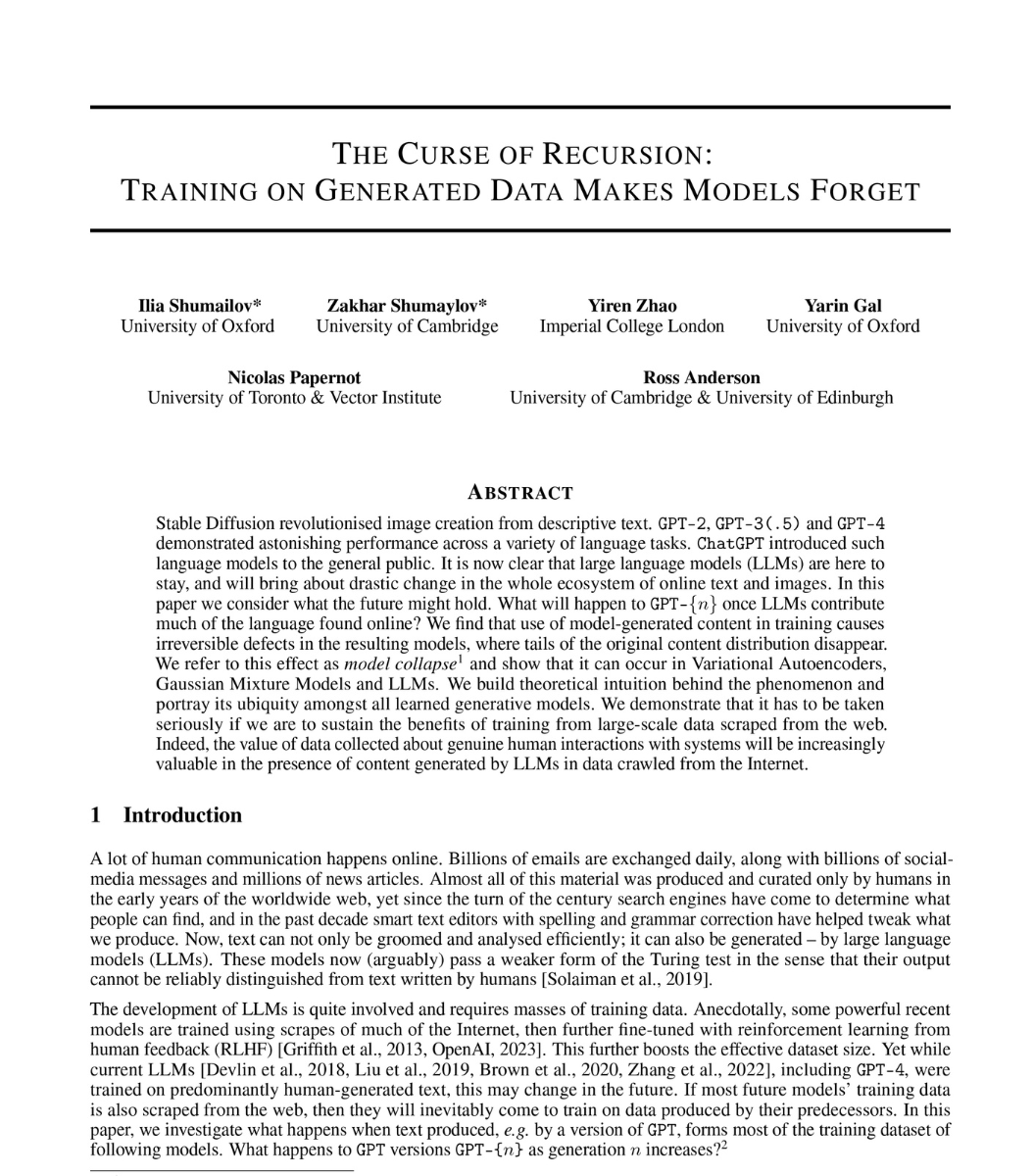
Researchers at Oxford and Cambridge published a paper in Nature proving what is happening. They call it Model Collapse.
Here is the mechanism in one sentence. AI trained on AI-generated data gets dumber every generation until it forgets what real human data looked like.
The internet is filling with AI-generated content. Blog posts. Articles. Reviews. Comments. Social media. AI companies scrape the internet to train the next generation of models. Which means the next generation of AI is being trained on the output of the current generation.
Each cycle loses information. Not randomly. It loses the rarest, most unusual, most creative parts first. The researchers call these the "tails of the distribution." The weird ideas. The unexpected perspectives. The things that made the internet feel human. Those disappear first.
What remains is the average. The safe. The expected. The bland.
Then the next generation trains on that. And loses more. And the next generation trains on that. And loses more. The researchers proved this is not a slow decline. Major degradation happens within just a few iterations. Even when some of the original human data is preserved.
They tested it on large language models. On image generators. On statistical models. The pattern was the same every time. The output converges toward a narrow, flattened version of reality that looks nothing like the original data.
The lead researcher put it plainly. "Large language models are like fire. A useful tool. But one that pollutes the environment."
The pollution is invisible. You cannot see which sentence on the internet was written by a human and which was written by AI. Neither can the AI that is about to train on it. And once the tails are gone, they do not come back. The damage is irreversible.
This is not a prediction anymore. It is a diagnosis.
The internet you grew up on was built by humans writing things no algorithm would have written. Strange, personal, imperfect, alive. That internet is being diluted. One generation of AI at a time. And the models trained on what remains are learning a smaller and smaller version of the world.
Model Collapse is not a technical problem. It is a cultural one. The thing that made the internet worth reading is the thing that disappears first.
1,138
6,389
17,729
2,232,740
TrixieCruz-Angeles retweeted

Jun 4
I found the following notes that I used in teaching Constitutional Law at the PLM College of Law under then Dean (now COMELEC Commissioner) Ernest Maceda, Jr. :
1Avelino v. Cuenco, G.R. No. L-2821, March 4, 1949
Background: 1949 Senate had 24 seats but only 23 sitting senators. Mariano Cuenco was elected Senate President with 12 votes. 10 senators walked out and said no quorum.
SC ruling on "majority of the Senate" vs "all members"*:
The 1935 Constitution used "majority of each House" for quorum. The SC said 12/23 = majority for quorum under Sec. 10(1), Art. VI 1935 Constitution.
But the Court drew a key distinction that the 1987 framers later copied:
> “There is a difference between a majority of ‘the House’... The latter requiring less number than the first.”[quorum]
*Why it matters for 1987 Sec. 16- The 1987 framers changed the wording for electing SP/Speaker to "all its respective Members" = 24. That’s stricter than Avelino’s "majority of the House" for quorum. So post-1987, you can’t elect SP with just 12/23 like Cuenco did. You need 13/24.
38
55
148
10,515
TrixieCruz-Angeles retweeted

Jun 1
After seeing how Alan Peter Cayetano defended Jinggoy and the Senate’s integrity in full view and in the face of Remulla’s intimidation, I can safely say that he earned my respect even more.
And the majority bloc may just have been cemented further because of that one act.
28
46
224
5,007
TrixieCruz-Angeles retweeted
May 26
THIS DESERVES TO BE REPOSTED FOREVER!
Privilege speech of Senator Rodante D. Marcoleta* (as delivered)
Senate session
25 May 2026
"Even if the path becomes lonely, I will walk it. Even if the attacks become heavier, I will endure them. Even if my voice becomes inconvenient to the powerful, I will continue to speak, the way I should.
The same is true of the Senate’s investigation of the flood control scandal. That inquiry must continue. It must not be weakened. It must not be derailed. It must not be silenced. If there has been grandscale theft from the country’s coffers, then that is among the greatest sins of our modern public life. It is not ordinary corruption. It is the stealing of safety from communities that drown. It is the stealing of roads from farmers. It is the stealing of classrooms from children. It is the stealing of medicine from the sick, wages from workers, and hope from taxpayers who labor honestly while others feast on public money. No senator should be silenced when the duty is to follow the trail of the public’s money. No committee should be weakened when the task is to expose corruption. No voice should be threatened when the question before the nation is whether the billions intended for the people were ransacked by bandits of insatiable greed!
I do not fear imprisonment. I fear a country where freedom itself is imprisoned. I fear a Republic where legal processes are twisted into weapons, where dissenting voices in the Senate are mechanically trimmed down, and where the rich and powerful elite manipulate institutions so that only their chosen voices may be heard.
While others may refuse to speak because of threats, I will not, Mr. President.
I will not let fear write my narrative. I will not let intimidation decide my vote. Make me bleed, and I will still shout out to the high heavens for truth and justice. Push me against the wall, and I will still push back with all the lawful strength that conscience, evidence, faith, and duty can give me. Not with violence. Not with hatred. Not with recklessness. But with the Constitution in my hand, the law as my shield, the truth as my voice, and the Filipino people as my reason.
Even if I am the only one left standing, I will stand. Even if my voice is the last one they wish to hear, I will still speak. Even if the path becomes lonely, difficult, and costly, I will continue, because the oath I took was not ceremonial. It was not a line recited for record. It was a solemn charge from the Filipino people—to defend the Constitution, to guard public trust, and to act with courage when silence becomes convenient.
Let those who weaponize the law answer to history. Let those who steal from the people answer to justice. Let those who seek to silence dissent understand this: a senator who remembers his oath cannot be purchased by comfort, cannot be subdued by threats, and cannot be defeated by fear.
Madam President, kaya po ba nila akong ipakulong? Kayang kaya po nila. Nagawa nga po nilang umimbeto ng krimen laban sa akin.
Kamakailan lamang po, hindi pa nagtatagal. Dito rin sa bulwagang ito, somebody said, ‘sometimes you need to bend the law to be able to please the people. Am I right, Mr. Secretary Remulla?’ Secretary Remulla, then Secretary of Justice, now Ombudsman, said loudly, ‘Yes, sir.’ So pwede na nang baluktutin lahat, kagaya ng pambabaluktot na ginawa nila. Pero sinasabi ko, Madam President, they can imprison me, they can arrest me, but I tell them, they still will not win. Itaga nila yun sa bato.
Madam President, before ending, let me share the declarations of our Lord God in Isaiah 54.17:
“No weapon formed upon you will prevail, and you will refute every tongue that accuses you. This is the heritage of the servants of the Lord, and this is their vindication from me.”
49
158
410
10,644
TrixieCruz-Angeles retweeted

May 17
A tiny bee just did what chemotherapy couldn't.
Scientists in Australia discovered that honeybee venom can wipe out 100% of aggressive breast cancer cells in under 60 minutes.
And the healthy cells around them? Barely touched.
The breakthrough came from Dr. Ciara Duffy and her team at the Harry Perkins Institute of Medical Research, working alongside the University of Western Australia.
They tested venom drawn from 312 honeybees and bumblebees across Australia, Ireland, and England.
The target: triple-negative breast cancer and HER2-enriched breast cancer. Two of the deadliest, most stubborn forms of the disease.
The weapon: melittin. The same tiny peptide that makes a bee sting burn.
At one specific dose, melittin tore through cancer cell membranes completely within an hour. Within just 20 minutes, it shut down the chemical signals cancer cells need to grow and multiply.
Bumblebee venom, which lacks melittin, did nothing. Zero effect, even at high concentrations.
Scientists then recreated melittin synthetically in the lab and got almost identical results, meaning no bees need to be harmed to develop the therapy.
Published in the peer-reviewed journal npj Precision Oncology, the findings are still early-stage. Human trials haven't happened yet.
But one thing is clear. Nature has been hiding answers in plain sight all along, sometimes inside the smallest creatures on Earth.
Source: Harry Perkins Institute of Medical Research / npj Precision Oncology (Dr. Ciara Duffy et al.)

1,622
19,227
49,617
2,559,939
TrixieCruz-Angeles retweeted

May 18
Something similar happened to be once outside a Vietnamese food store I was walking into, but I had a different reaction to it.
I was walking in to pick up my phone in order. Homeless man asked me if I’d buy him something to eat…. cont.
6
1
36
368,318

TrixieCruz-Angeles retweeted

May 18
“My wife was dying for most of those years,” he said quietly. “Cancer. The treatments wrecked her. I barely slept, barely talked, barely noticed anything outside getting her through another day.”
He looked down at his hands before continuing.
“Every morning when I left, I wasn’t ignoring people. I was rehearsing how to tell my kids if she didn’t make it through the night.”
My dad just stared at him.
The neighbor gave a small shrug.
“I guess after a while, people stop asking questions and decide who you are.”
Then he stood up to leave, but my dad grabbed his arm.
“Why did you help me?”
The man looked genuinely surprised.
“Because you were hurt.”
After that day, my dad waved at him every single morning.
And for the first time in eleven years, the neighbor waved back.
8
22
30
4,962
TrixieCruz-Angeles retweeted

May 18
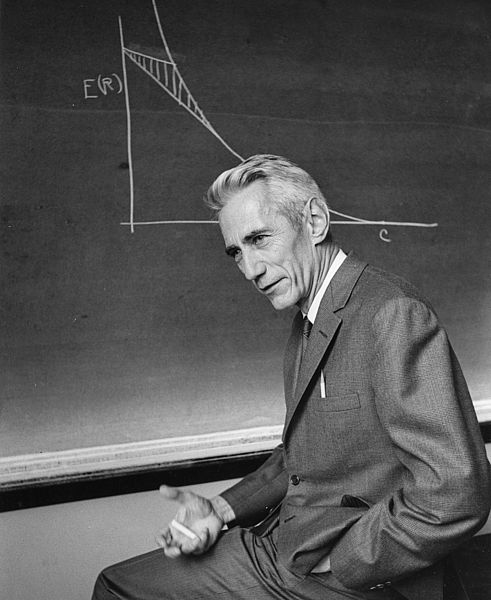
Claude Shannon invented the bit, named information theory, and laid the mathematical foundation for the entire digital age.
He is less famous than Steve Jobs.
That should bother you more than it does.
His name was Claude Shannon.
He was 32 years old when he published the paper that made everything digital possible. Every text message, photo, video, voice call, AI model, satellite signal, and internet packet running on earth right now obeys the mathematics he wrote in 1948.
Not inspired by. Not built on top of. Obeys.
The paper was called "A Mathematical Theory of Communication." Shannon invented the word "bit" inside it. He proved mathematically exactly how much information any channel could carry, and how to transmit it without error.
He showed that text, voice, images, and every other form of communication were all the same thing underneath and could all be encoded in binary digits and sent perfectly.
Before Shannon, engineers guessed. After Shannon, they calculated.
Robert Gallager at MIT called it a blueprint for the digital age. Rodney Brooks, former director of MIT's AI lab, said Shannon was the 20th century engineer who contributed most to 21st century technologies.
He published the paper. Then went back to riding his unicycle down the Bell Labs hallway while juggling.
That is not a metaphor. Shannon literally rode a unicycle through the corridors of Bell Labs at night while juggling four balls. His colleagues, some of the most brilliant scientists in America, would flatten themselves against the walls to let him pass.
He also built a maze-solving mechanical mouse called Theseus, which was the first artificial learning device ever built. He built a chess-playing machine that influenced the team that eventually built Deep Blue.
He built a robot whose only function was to turn itself off. He built a flame-throwing trumpet. A rocket-powered Frisbee. Foam shoes he used to walk across the surface of a lake near his house.
In 1952, Shannon gave a rare speech at Bell Labs about how he actually thought through hard problems.
He described three moves he used on everything.
The first was simplification. Strip the problem down until only the core remains. Most people fail not because they can't solve the problem but because they are working inside a version of it that has too much noise. Cut the noise first. Find the shape underneath. Then work.
The second was inversion.
When a problem seems impossible going forward, flip it completely. Start from the result and run backward. Shannon once designed a computing machine that seemed impossibly complex until he realized the whole thing dissolved if he ran it in reverse. The answer had been there the entire time, facing the wrong direction.
The third was restating.
Look at the problem from every possible angle. Change the words. Change the viewpoint. Reframe it until something shifts. Shannon believed most hard problems are only hard because of the frame. Change the frame and the problem becomes something else.
These were not abstract principles. They were the exact moves he used to build information theory. He spent years circling the problem of communication before that 1948 paper. Simplifying it. Inverting it. Restating it.
Until the structure underneath became visible.
The juggling was part of it too. Shannon saw no line between work and play. The unicycle and the absurd machines were not breaks from thinking. They were thinking running in a different mode. Curiosity without an agenda. The same faculty that built information theory, just pointed at something that didn't matter yet.
He left Bell Labs for MIT in 1956. Stopped publishing serious work almost entirely by the 1970s. His final paper was about the mathematics of juggling. He had an unfinished paper about the Rubik's Cube that never came out.
Colleagues worried something had gone wrong. One Nobel Prize-winning economist wrote privately that Shannon seemed to have abandoned a brilliant career.
He had finished. That is different from stopping.
Shannon died in 2001 of Alzheimer's disease. He was 84. He had spent his last years unable to remember the work that made the modern world possible.
Every AI company on earth today, every data center, every smartphone, every piece of software that has ever run on any machine anywhere, sits on mathematics written by a man who actively avoided fame, told MIT he didn't want to teach, and spent the back half of his life building machines that served no practical purpose at all.
The most famous engineers in history are the ones who sold things.
Shannon just solved the problem and went home.
That distinction is going to matter more the longer you think about it.
5
29
57
6,296
TrixieCruz-Angeles retweeted

May 18
A Norwegian neuroscientist spent 20 years proving that the act of writing by hand changes the human brain in ways typing physically cannot, and almost nobody outside her field has read the paper.
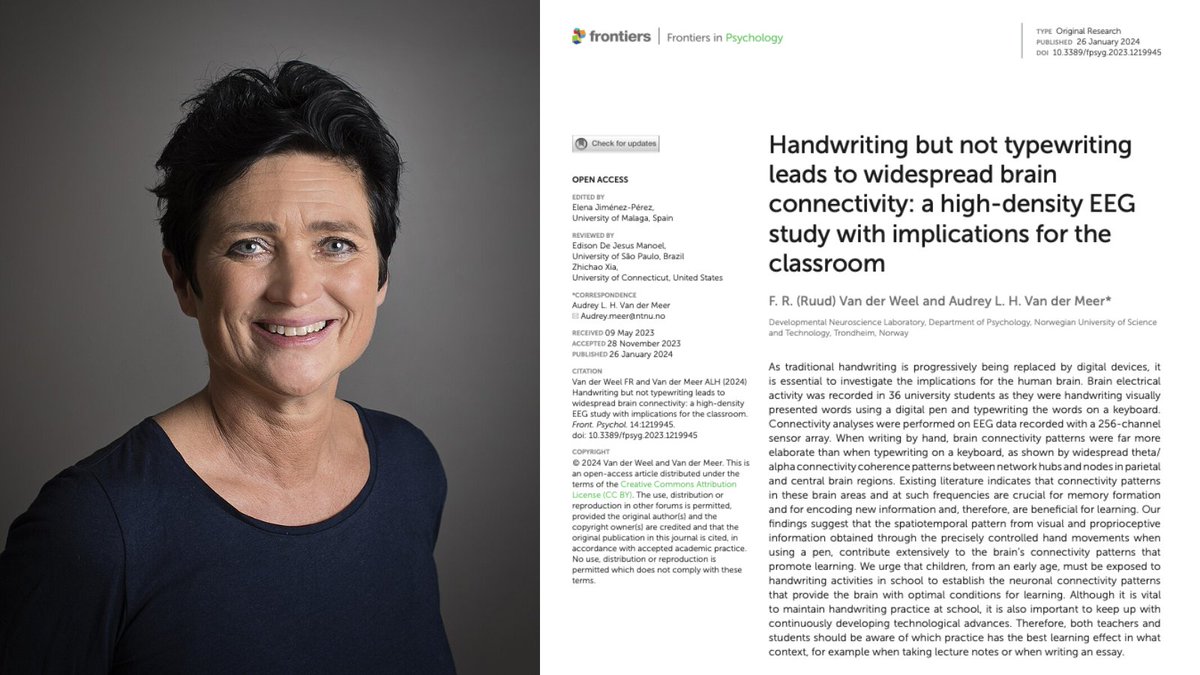
Her name is Audrey van der Meer.
She runs a brain research lab in Trondheim, and the paper that closed the argument was published in 2024 in a journal called Frontiers in Psychology. The finding is brutal enough that it should have changed every classroom on Earth.
The experiment was simple. She recruited 36 university students and put each one in a cap with 256 sensors pressed against their scalp to record brain activity. Words flashed on a screen one at a time.
Sometimes the students wrote the word by hand on a touchscreen using a digital pen, and sometimes they typed the same word on a keyboard. Every neural response was recorded for the full five seconds the word stayed on screen.
Then her team looked at the part of the data most researchers had ignored for years, which is how different parts of the brain were communicating with each other during the task.
When the students wrote by hand, the brain lit up everywhere at once.
The regions responsible for memory, sensory integration, and the encoding of new information were all firing together in a coordinated pattern that spread across the entire cortex. The whole network was awake and connected.
When the same students typed the same word, that pattern collapsed almost completely.
Most of the brain went quiet, and the connections between regions that had been alive seconds earlier were nowhere to be found on the EEG.
Same word, same brain, same person, and two completely different neurological events.
The reason turned out to be something nobody had really paid attention to before her work. Writing by hand is not one motion but a sequence of thousands of tiny micro-movements coordinated with your eyes in real time, where each letter is a different shape that requires the brain to solve a slightly different spatial problem.
Your fingers, wrist, vision, and the parts of your brain that track position in space are all working together to produce one letter, then the next, then the next.
Typing throws all of that away. Every key on a keyboard requires the exact same finger motion regardless of which letter you are pressing, which means the brain has almost nothing to integrate and almost no problem to solve.
Van der Meer said it plainly in her interviews.
Pressing the same key with the same finger over and over does not stimulate the brain in any meaningful way, and she pointed out something that should scare every parent who handed their kid an iPad.
Children who learn to read and write on tablets often cannot tell letters like b and d apart, because they have never physically felt with their bodies what it takes to actually produce those letters on a page.
A decade before her, two researchers at Princeton ran the same fight using a completely different method and ended up at the same answer. Pam Mueller and Daniel Oppenheimer tested 327 students across three experiments, where half took notes on laptops with the internet disabled and half took notes by hand, before testing everyone on what they actually understood from the lectures they had watched.
The handwriting group won by a wide margin on every question that required real understanding rather than surface recall.
The reason was hiding in the transcripts of what the two groups had actually written down.
The laptop students typed almost word for word, capturing more total content but processing almost none of it as they went, while the handwriting students physically could not write fast enough to transcribe a lecture in real time, which forced them to listen carefully, decide what actually mattered, and put it in their own words on the page.
That single act of choosing what to keep was the learning itself, and the keyboard had quietly skipped the choosing and skipped the learning along with it.
Two studies. Two countries. Same answer.
Handwriting makes the brain work. Typing lets it coast.
Every note you have ever typed instead of written went into your brain through a thinner pipe. Every meeting, every book highlight, every idea you captured on your phone instead of on paper was processed at half depth.
You did not forget those things because your memory is bad. You forgot them because typing never woke the part of the brain that would have made them stick.
The fix is the thing your grandmother already knew.
Pick up a pen. Write the thing down. The slower road is the faster one.
2,473
44,651
120,839
10,367,779
TrixieCruz-Angeles retweeted

Extremely rare “White Auroras” have been spotted over Norway—and the sky put on a show few people ever get to witness.
Photographers out chasing the northern lights expected the usual waves of green and purple. Instead, they were stunned by something far rarer: ghostly white auroras stretching across the sky.
Soft. Pale. Almost glowing.
It’s one of the rarest aurora displays on Earth.
Scientists explain that white auroras occur when multiple aurora colors strike the human eye at once, blending together until they appear nearly colorless. With so many wavelengths firing simultaneously, the brain can no longer separate them—so it perceives white.
Most aurora hunters spend their entire lives without ever seeing it. This time, Norway delivered the extraordinary.
Cameras across the Arctic captured the eerie light spilling through the darkness like frozen lightning, leaving even experienced skywatchers in awe.
Some described it as otherworldly. Others said it looked like the sky itself was glowing from within.
And for a few unforgettable moments, the heavens above Norway became something almost impossible to believe.
Community note
The video is AI-generated and does not depict real auroras over Norway. No such event was reported in April 2026. While faint white auroras can occur, this dramatic footage is fake. Similar media has been debunked.
rumorguard.org/post/video-of-…
leadstories.com/hoax-alert/202…
156
2,774
10,256
330,674
TrixieCruz-Angeles retweeted

Apr 29
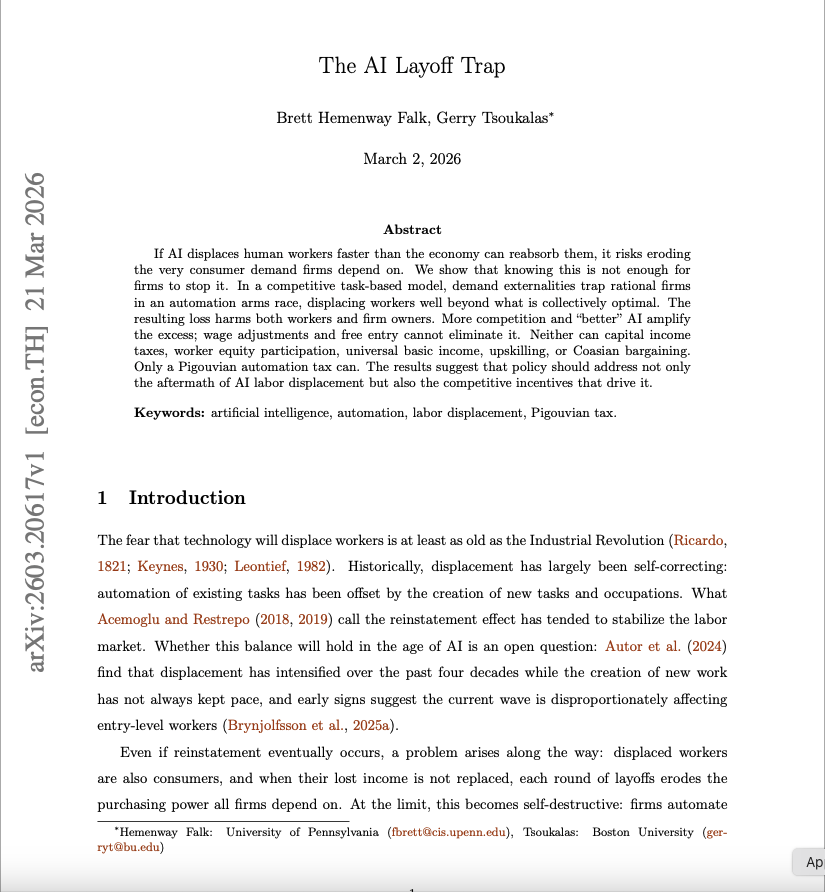
Two economists just published a mathematical proof that AI will destroy the economy.
Not might. Not could. Will — if nothing changes.
The paper is called "The AI Layoff Trap." Published March 2, 2026. Wharton School, University of Pennsylvania. Boston University. Peer reviewed. Mathematically modeled.
The conclusion is one sentence.
"At the limit, firms automate their way to boundless productivity and zero demand."
An economy that produces everything. And sells it to nobody.
Here is how you get there.
A company fires 500 workers and replaces them with AI. A competitor fires 700 to keep up. Another fires 1,000. Every company is behaving rationally. Every company is following the incentives correctly. And every company is building a trap for itself.
Because the workers who were fired were also customers.
When they lose their jobs faster than the economy can absorb them, they stop spending. Consumer demand falls. Companies respond by cutting costs — which means automating more workers — which means less spending — which means more falling demand — which means more automation.
The loop has no natural exit.
The researchers tested every proposed solution. Universal basic income. Capital income taxes. Worker equity participation. Upskilling programs. Corporate coordination agreements.
Every single one failed in the model.
The only intervention that worked: a Pigouvian automation tax — a per-task levy charged every time a company replaces a human with AI, forcing them to price in the demand they are destroying before they pull the trigger.
No government has implemented this. No major economy is seriously discussing it.
Meanwhile the numbers are already tracking the curve. 100,000 tech workers laid off in 2025. 92,000 more in the first months of 2026. Jack Dorsey fired half of Block's workforce and said publicly: "Within the next year, the majority of companies will reach the same conclusion."
Nobody is doing anything wrong. Companies are following their incentives perfectly. That is exactly the problem.
Rational behavior. At scale. Simultaneously. With no mechanism to stop it.
Two economists built the math. The math leads to one place.
Source: Falk & Tsoukalas · Wharton School Boston University ·
arxiv.org/pdf/2603.20617
1,122
3,917
9,868
1,372,419
TrixieCruz-Angeles retweeted

Kaya pa Pinas? @MacLopez769 @luminoustrix nakakagalit! We deserve better Leader!
2
1
524
TrixieCruz-Angeles retweeted

Apr 24
She may be old, but she did herself proud 😊👏
55
251
3,781
74,467
TrixieCruz-Angeles retweeted

Apr 24
Not the constitution ha?

Philippines says US access to bases limited by land issues reut.rs/48fwNtY reut.rs/48fwNtY
15
10
34
3,123