Psychologist & fMRI-nerd @Invicro & @ImperialMed. 🧠 psychedelics, cannabis, sex hormones. Instrument botherer. The secret is to bang the rocks together, guys
Joined June 2010
- Tweets 53,371
- Following 2,484
- Followers 9,301
- Likes 93,796
4,390 Photos and videos






Pinned Tweet

7 Oct 2020
*Ahem* What I did on my lockdown (part 1). I taught myself the basics of audio production, & recorded a silly song about my favourite imaging modality. I humbly present "The MRI song" in the hope it's a brief distraction from the general hideousness.
youtu.be/zfYINee1VA4

72
136
453
15 Jun 2025
Haven't done one of these for quite a while, but I regret to inform you that I've hideously butchered another classic song in the name of making some weak jokes.
I present: Psychedelic Therapy: The song.
Have a great time at #PS2025 everyone!
youtube.com/watch?v=4V2sGwB0…
1
1
5
964
Matt Wall (@mattwall.bsky.social) retweeted

6 Jun 2025
Grateful to @m_wall: Human [psychedelic] neuroimaging: fMRI sciencedirect.com/science/ar…
2
1
6
1,993
Matt Wall (@mattwall.bsky.social) retweeted

5 Jun 2025
This extraordinary psychedelic precision functional mapping dataset is now fully/freely available to all!
All the info to access & use it in a newly published Nature Scientific Data Resource: rdcu.be/epxe7
Thanks to the incredible team who created it - Subha S, Rick R, Ginger N, Demetrius P, Nick M, to name a few.
17 Jul 2024

After a high dose of psilocybin, the brain desynchronizes at a massive scale, causing loss of our sense of self, time, and space. This may drive the burst of plasticity caused by psychedelics. The next day, brain activity has largely returned to normal, but an echo remains – a reset of circuits critical to the sense of self.
Our study is out today in @Nature nature.com/articles/s41586-0…
4
27
93
12,357
Matt Wall (@mattwall.bsky.social) retweeted
3 Jun 2025
Very nice work here...

New in @NatureMedicine: ReSPCT "An international Delphi consensus for reporting of setting in psychedelic clinical trials" by @ChloePronovostM, Kyle Greenway, myself, and many ReSPCT Experts. "The ReSPCT guidelines and accompanying explanatory document provide a new standard for the design and documentation of extra-pharmacological variables in psychedelic clinical research."
nature.com/articles/s41591-0…
respctguidelines.com/
2
3
20
3,320
Matt Wall (@mattwall.bsky.social) retweeted

New in @NatureMedicine: ReSPCT "An international Delphi consensus for reporting of setting in psychedelic clinical trials" by @ChloePronovostM, Kyle Greenway, myself, and many ReSPCT Experts. "The ReSPCT guidelines and accompanying explanatory document provide a new standard for the design and documentation of extra-pharmacological variables in psychedelic clinical research."
nature.com/articles/s41591-0…
respctguidelines.com/
7
20
48
7,456
Matt Wall (@mattwall.bsky.social) retweeted

2 Jun 2025
Our (@GregFonzo and Charlie Nemeroff) commentary on @m_wall's recent paper comparing effects of psilocybin and escitalopram on emotional responses in the brain.
psychiatryonline.org/doi/10.…
1
2
16
1,118
24 May 2025
RT @PeterSjostedtH: Very sad to hear that Lady Amanda Feilding has passed. Without her much twenty-first century research on psychədəlics w…
4
24
Matt Wall (@mattwall.bsky.social) retweeted

8 May 2025
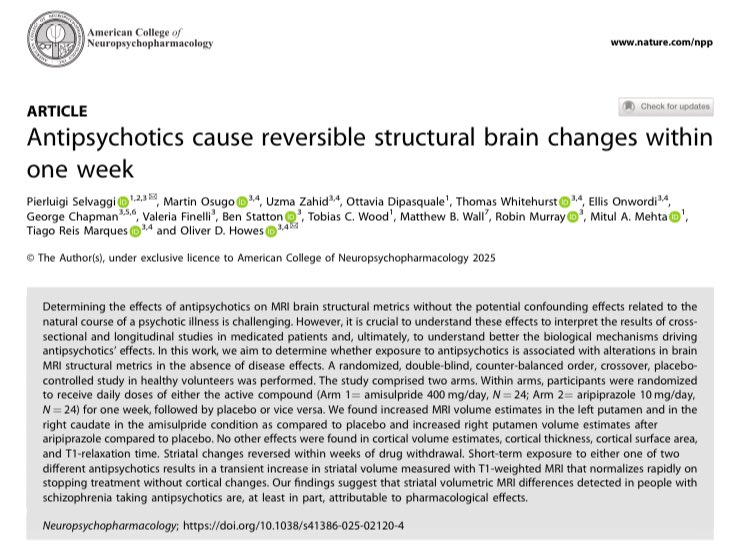
🚨New paper day! 🚨
Led by the super @pSelvaggi, we found that one week of (barely) treatment dose amisulpride or aripiprazole led to reversible increases in striatal volumes on MRI in healthy volunteers 👇
Why does this matter?? … …
2
6
17
1,975
Matt Wall (@mattwall.bsky.social) retweeted

8 May 2025
Otsuka Signs Joint Research Agreement with Keio UniversityIndustry-academia collaboration for infrastructure development toward the social implementation of psychedelics in Japan |News Releases | Otsuka Pharmaceutical Co., Ltd. otsuka.co.jp/en/company/news…
1
15
52
10,187
Matt Wall (@mattwall.bsky.social) retweeted
7 May 2025
This is a big one. Classic work by @m_wall and co! Reduced Brain Responsiveness to Emotional Stimuli With Escitalopram But Not Psilocybin Therapy for Depression pubmed.ncbi.nlm.nih.gov/4032…
6
14
45
7,352
Matt Wall (@mattwall.bsky.social) retweeted

11 Apr 2025
🚨New paper alarm🚨
Excited to share our new publication that breaks new grounds for #psychedelic medicine: the first data on #psilocybin’s effects in any neurodegenerative disease, specifically psilocybin for the treatment of #Parkinson's disease!
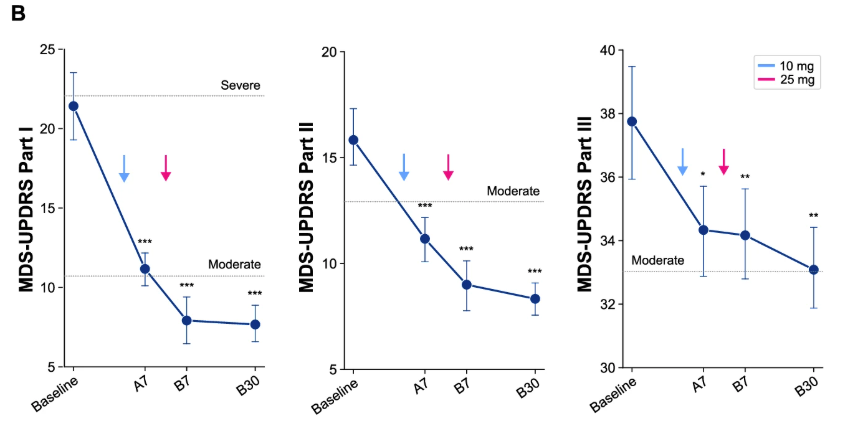
It was a phase 1 feasibility and tolerability study on 12 patients with all the usual limitations of such studies, e.g. lack of control condition. The treatment consisted of 2 psilocybin sessions, the first with 10mg and then a larger 25mg dose 2 weeks later. As usual psilocybin was coupled with therapy.
The study's primary objective was to treat the mood dysfunction associated with Parkinson's. We got the usual large and positive treatment effects as other psilocybin trials: three months after the last dose MADRS significantly improved by 9.3 points, corresponding to 1.0 standardized mean difference (SMD; i.e. large effect). Anxiety, as captured by the Hamilton Anxiety Rating Scale, also significantly improved by 3.8 points, corresponding to 0.7 SMD.
More surprisingly, Parkinson's symptoms also improved post-psilocybin! We captured Parkinson's with the standard MDS-UPDRS assessment, , and patients significantly improved in all domains at every post-treatment timepoint (!!!) with mostly moderate-to-large effect sizes. Benefits persisted at the 3 months post last dose timepoint.
No serious adverse events (AEs) occurred. As expected, most AEs occurred during psilocybin sessions (anxiety, nausea, headache) and were self-resolving and transient.
Even better than the paper that we are already running the follow-up phase 2 trial! If you know anyone in the Bay area who could be interested, please let them know: psychedelics.ucsf.edu/#Studi….
Full paper: tinyurl.com/y9rcp7mk
Celebrating with @EllenBradleyMD, @thebandlab and the whole @UCSF's @TrPR_Program crew! 🙏🫂❤️
6
35
113
12,092
Matt Wall (@mattwall.bsky.social) retweeted

28 Mar 2025
Neuroscience shows neural oscillations sync with music via neural resonance theory. Not just prediction—brain-body dynamics embody musical structure, driving perception. This may amplify psychedelic experiences, resonating with ASC.
nature.com/articles/s41583-0…
1
7
21
800
Matt Wall (@mattwall.bsky.social) retweeted

27 Mar 2025
🧠 Just out in Nature: A human brain map of mitochondrial diversity. A powerful collaboration with Mosharov and @MitoPsychoBio. Big step toward bridging cell biology and neuroimaging!
🔗 nature.com/articles/s41586-0…
🧬 #MitoBrainMap #neuroscience
5
70
204
9,880
Matt Wall (@mattwall.bsky.social) retweeted

11 Mar 2025
Visualizing Effective Connectivity in the Human Brain
Preprint: biorxiv.org/content/10.1101/…
Code: github.com/ComaRecoveryLab/S…
YouTube video: youtu.be/V0hqs-noYNg
Download video & figures: zenodo.org/records/14974861
Led by #XanderAtalay & #TeoFecchio
@MGH_CNTR @MGHMartinos @MGHNeuroICU
4
51
155
9,462
Matt Wall (@mattwall.bsky.social) retweeted

10 Mar 2025
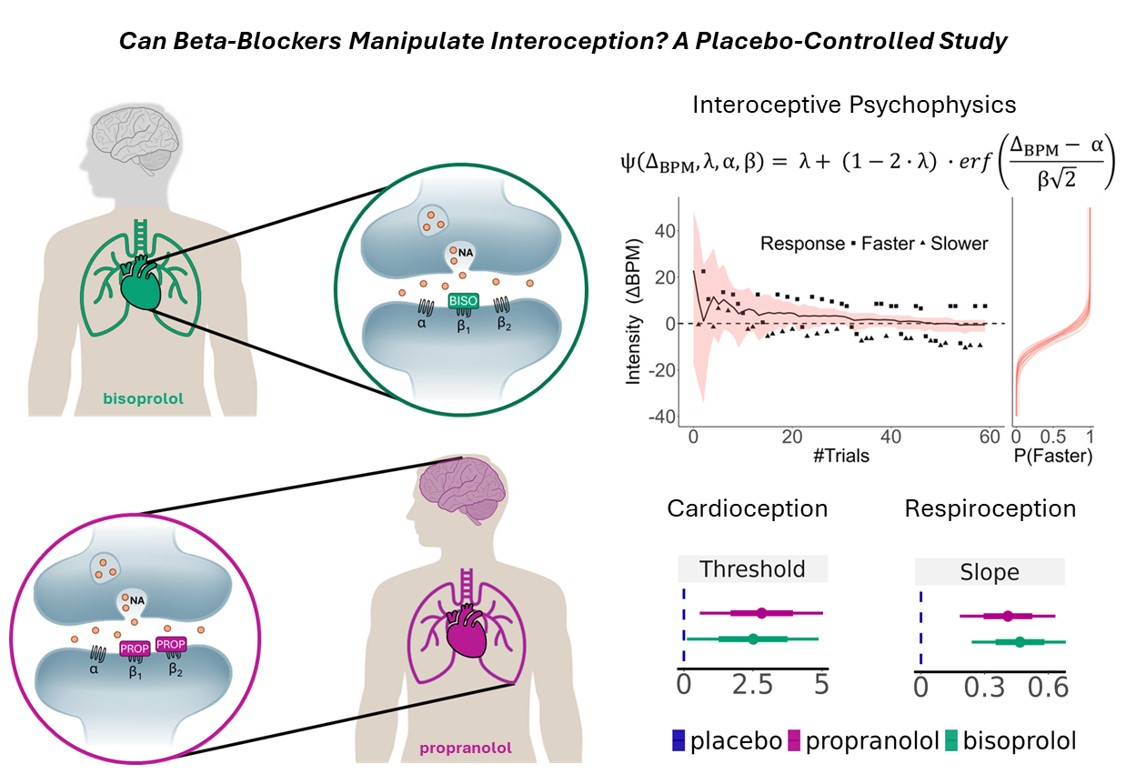
Beyond happy to share this study with you - Ashley and the team have really exceeded all expectations. Computational modelling of drug effects on multi-domain interoception!
10 Mar 2025

1/ We can measure interoception in many aspects, but can we actually manipulate it? I’m excited to share our new study, which shows that blockade of peripheral beta-adrenergic pathways improves cardiac and respiratory interoception in unique ways! 🧵👇biorxiv.org/content/10.1101/…
3
7
58
7,699
Matt Wall (@mattwall.bsky.social) retweeted

13 Feb 2025
New paper with @Matt_Nour , @tobypill , and Phil Cowen discussing different ways of thinking about and developing psychopharmacological treatments biologicalpsychiatryjournal.…
1
7
25
1,842
Matt Wall (@mattwall.bsky.social) retweeted

14 Feb 2025
My column on Donald Trump’s “peace plan” for Ukraine
theguardian.com/commentisfre…
9
43
169
57,319
Matt Wall (@mattwall.bsky.social) retweeted

14 Feb 2025
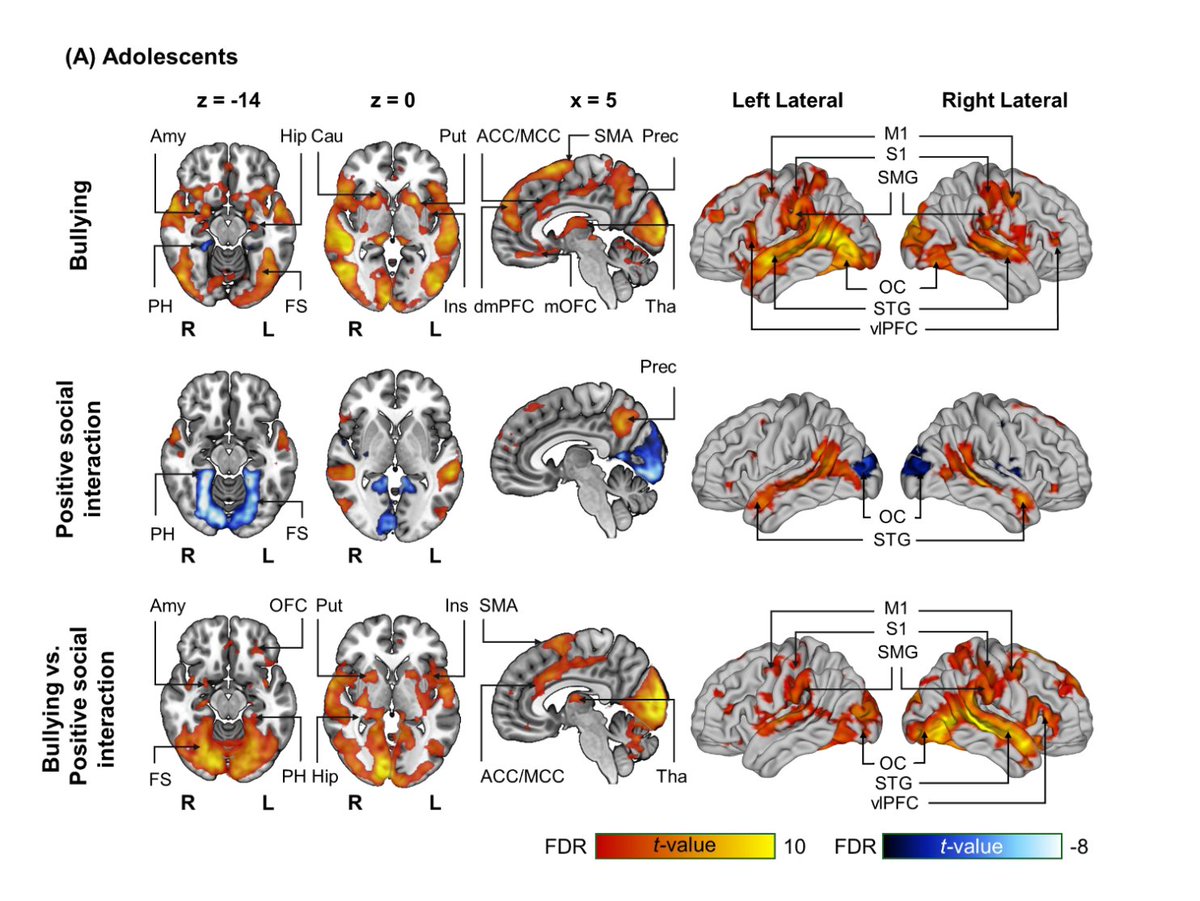
Bullying is a massive problem in schools, but what happens in the brain when the adolescents get bullied? Our @TurkuPETCentre mega-collaboration with @kivakoulu1 demonstrated that bullying leads to large-scale recruitment of the social distress circuits 👇biorxiv.org/content/10.1101/…
1
15
52
3,120
Matt Wall (@mattwall.bsky.social) retweeted
9 Feb 2025
🪩🕺💃30 ravers: what's your preferred party in terms of day/night, indoors/outdoors? I think majority prefers daytime/outside parties, yet that's so underrepresented. Lets research the issue with poll below👇Retweet if the issue speaks to you🥰 #trancefamily #partytime #PLUR
12%
night time / indoors
31%
night time / outdoors
14%
day time / indoors
43%
day time / outdoors
58 votes • Final results
2
9
11
2,675
10 Feb 2025
Hey kids, want to hear me babbling somewhat coherently for 35 mins about cannabis, psychedelics, addiction & more? Yes? What, really? Well OK... I had a lovely time talking to Dr David Hardy on the Hardy Brain podcast, and you can listen to it here too:
thehardybrain.ca/podcasts/th…
1
2
296
10 Feb 2025
Also available on Apple, Spotify, and probably whatever other morally questionable corporate hegemonizing monopoly you like to give your data to in exchange for half an hour's entertainment.
169