
Joined May 2018
- Tweets 7,068
- Following 5,223
- Followers 2,690
- Likes 36,099
712 Photos and videos









Monotanus retweeted

Jun 10
GOOD MORNING $GME SQUADDD!
Dropped a late night DD on the 10Q, resharing so you know what to look for when it drops.
What to watch for today:
- The 10Q hasn’t dropped yet, is he buying back shares before?
- Teddy is still down, and it’s been 9 days!
Enjoy your coffee!
Jun 10

COHEN IS POSITIONING FOR THE EBAY AGM: THE 10Q IS THE SIGNAL
Everyone is waiting $GME’s 10-Q for the numbers.
The numbers dropped June 2. They’re old news.
What matters is the date it lands on - and what it lands in front of.
——————
Start with what Cohen actually needs right now.
His nomination window for eBay’s board closed months ago.
He can’t run a slate at their annual meeting on June 17. Most people read that as “he’s locked out until 2027.”
Wrong. He doesn’t need a slate.
He needs a referendum.
——————
Here’s what’s on $EBAY‘s June 17 ballot.
Proposal 4: lower the threshold for shareholders to call a special meeting.
The board is recommending AGAINST it and paying a proxy solicitor to fight it.
Director elections: eBay just adopted majority voting with a resignation policy.
Directors who poll badly now carry it formally.
So picture June 17 going Cohen’s way. Proposal 4 overperforms.
FOR votes on key incumbents crack.
That’s eBay’s own shareholders, using eBay’s own brand-new governance machinery, telling the board exactly what would happen if Cohen ever puts something to a vote.
A board can stonewall a hostile bidder but it cannot stonewall its own election results.
That’s what June 17 is.
And every move Cohen has made this month is aimed at it.
——————
Look at the cluster:
June 2: earnings released a week early. Record quarter. $2B buyback.
June 3: HSR antitrust clearance. His eBay options can now convert into REAL voting shares.
June 5: 13D filed. Stake at 9%. Direct shares jumped from 25,000 to 827,648. Talk became money.
June 4–5: the Barron’s interview. “I want to own eBay for the long term.”
All of it landing in one window.
Why this window?
Because eBay shareholders are voting RIGHT NOW.
Ballots lock June 16 at 11:59pm ET.
He’s making a closing argument.
——————
Which brings us to the 10-Q.
The 10-Q is the official quarterly report.
GameStop’s quarter ended May 2, the rules give 40 days, so it’s due June 11.
June 11. Five days before eBay’s ballots lock.
It will be the final document GameStop files in front of eBay’s voters.
GameStop’s quarter ended May 2.
The eBay bid was May 3.
The entire saga: the offer letter, the rejection, HSR clearance, the share purchases, the buyback all happened AFTER the quarter closed.
Which means it all lands in one section:
Subsequent Events.
The part of a 10-Q where a company must disclose everything material that happened between quarter-end and the day of filing.
Management describing the whole campaign, in their own words, signed off by lawyers, in front of eBay’s voters, while the ballots are open.
And because that section runs to the filing date: anything that happens THIS WEEK - options converted to real shares, movement on financing, goes in too.
——————
What I’m looking for, in order:
The Subsequent Events note.
How they characterize the bid and the financing. Any action from this week itself.
The derivative footnote.
First full look at how the eBay position is engineered: the value, the terms with TD, why $983M sits pledged as collateral.
The cover page share count.
If it’s shrinking, the $2B buyback is live. If it’s frozen, the cash is being saved for the deal.
The financing language.
If it repeats the offer letter verbatim, holding pattern. One new word about the equity partner is signal.
——————
TL:DR:
If Cohen wants June 17 to break his way, and everything above says it’s the only thing he’s wanted all month, then this week is when he plays the loudest card he’s willing to show with the 10Q.
8
10
120
8,627
Monotanus retweeted

Jun 7
I think Ryan Cohen is being conservative so he doesnt spook people too much over at ebay
He will cut this and more
- 500m dividend
- $1.8b from marketing
- $1b from innovation
- $2.5b share buybacks stop
- 11,500 staff will reduce by over 60%
The company makes over $11 billion a year and posted a $2 billion profit due to waste and bloat
If he listens to sellers he will overhaul the fee system completely. It is a massive problem at Ebay. The seller is the customer, not the buyer and many sellers have left already
Ryan Cohen spoke about making it easier to list so that there is more variety on the site. He understands that Ebay is for the fun/nostalgic buys. People should be able to see the item in their house and list it for sale with ease. This is what Ebay was and why its a household name
The people in charge now are not the people who made ebay. They are hired financial goons who grift every day for themselves. They do not care about the business outside of the share price (their salary)
Ebay is my livelihood and has been for 14 years. The last 5 years have been a minefield

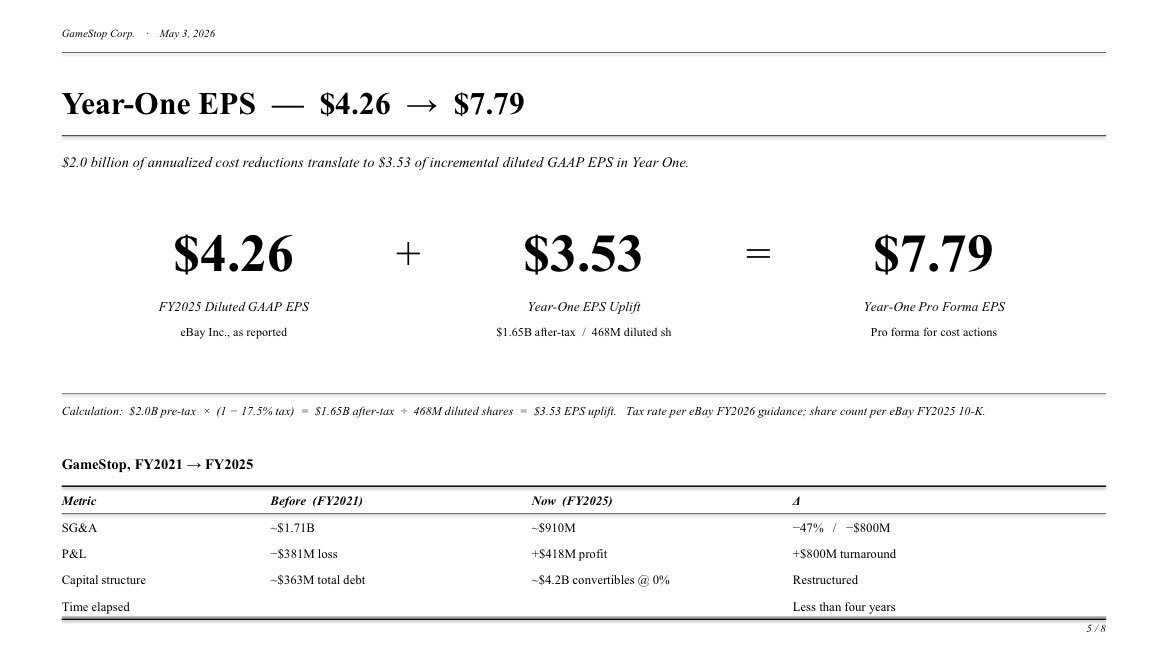
Ryan Cohen of $GME has only mentioned cuts in Sales and Marketing / overall cost cuts of $2B in year 1 in his initial proposal if he is able to takeover eBay. But I think he’s being super conservative. $1.8-$2B can be cut just from Sales and Marketing, but then I believe that $800M-$1B can be cut from R&D, and $500M-$800M can be cut from General and Administrative. That’s $3.1B-$3.8B that can be cut in the first year or 18 months. Combine that with the insane growth GameStop is seeing right now, there is just no way that shareholders (institutional and otherwise) will vote no on this.
8
40
323
20,770
Monotanus retweeted
Jun 2
Ryan Cohen just dropped $GME earnings a week early. Just like I predicted.
On the day before HSR clears.
While the stock sits below his own buy.
No one knew the date. That was the point.
The numbers:
- $389.6M net income - highest quarter in GameStop's history!!
- Revenue up 14% YoY!!
- Operating income $143.3M vs a LOSS of $10.8M a year ago!!
- SG&A cut from $228M to $201M!!
- Cash UP to $9.7B!!
- $268.4M unrealized gain on eBay derivative position
- $1.0B in collateral pledged for derivative asset - the eBay position is a named balance sheet item
- $2.0 BILLION share repurchase authorization approved today
19 SEC filings in 26 days.
Then silence.
Everyone assumed earnings was next week. NOT ME.
He surprise dropped the best quarter in the company's history, with the eBay derivatives visible in the financials for the first time, a $2B buyback at the cash floor, the day before his 34.5M eBay derivatives become convertible to voting shares.
$EBAY AGM is in 15 days.
teddy.com is still dark.
29
94
862
34,527
Monotanus retweeted
May 8
This is an open question and extremely significant.
@ryancohen shocked the world by giving $BABA buyback advice. The CCP related company listened to him and it worked!
Cohen is going for a global empire now with $EBAY. I’m not sure when this will become relevant but my bags are packed!
1
2
10
1,397

Monotanus retweeted
May 27
The CEO of $GME has never remotely hinted at a squeeze.
That is, until, the first annual GameStop awards.
“I love you guys” - @ryancohen w/ iOS squeeze filter
Twenty-eight days later, the execution begun.
THE TIMELINE
September 29, 2025. 382(l)(5) two-year freeze lifts on DK-Butterfly-1. $3.5B in NOLs now available.
October 7, 2025. GameStop distributes warrants to every shareholder. Same day, the new BBBY does the same. Same ratio. Same agent. Same date.
December 10, 2025. “I LOVE YOU GUYSSS”
January 7. Comp package. 171.5M options across nine tranches to $100B. Zero guaranteed pay. Special meeting expected March or April.
February. Cohen goes on CNBC. Berkshire. Very very very big. Never been done before in capital markets.
March 24. Earnings. The meeting never comes. No proxy. No date. No explanation.
May 3. $55.5B bid for eBay.
May 11. PRE 14A. Comp AND 2.5 billion authorized shares. One ballot.
May 12. eBay rejects. One day after the proxy.
May 19. Motion to Quash discovery on the DK-Butterfly-1 docket.
May 20. Exhibit sealed. Same day as the DEF 14A record date. eBay position increases to 29.1M shares.
May 21. DEF proxy filed.
May 22. DK-Butterfly-1 opposition filed.
May 24. Extension of time filed.
May 27. eBay position increases to 33.5M shares.
June 9. Earnings. Predicted to be the best ever.
July 7. Annual Meeting
July 24. Depositions due. Seventeen days after the vote.
THE DOCKET
The week the DEF 14A filed, Cohen’s legal team was fighting on the DK-Butterfly-1 docket. Motion to quash. Sealed exhibits. Opposition. Extension. All in the same five days as the proxy.
This isn’t trial prep.
This is timing a settlement.
THE STAKE
eBay rejected the bid. Cohen kept buying.
22.2M to 29.1M to 33.5M.
Three increases in three weeks.
$EBAY can reject a bid. They can’t reject their own shareholder. And every week, that shareholder gets bigger.
THE SECOND BID
At $22, the stock portion required over a billion shares. The currency was worthless. $eBay was right to reject.
Post-restructure to Teddy HoldCo, combined EBITDA across subsidiaries. $3.5B NOL shield.
At $125/share, the HoldCo stock portion needs 222M shares.
Parity with the cash.
And it’s only going higher.
Same offer. Different price.
TL:DR
The instruments tell you something happens before October.
The proxy tells you the bundling and timing was deliberate.
The eBay rejection tells you the board took the bait.
The docket tells you the settlement is being timed.
The accumulation tells you Cohen is getting what he wants.
HOWEVER
None of it works without NOLs. That’s what caught Burry.
The $3.5B NOL shield is what makes the holdco math work. It’s the only thing he’s done in his GameStop tenure that touches NOLSs.
It’s what makes the TD letter credible on round two.
It’s what makes the second, undeniable bid possible.
DK Butterfly only exists because $BBBY went bankrupt and that bankruptcy only played out the way it did because shareholders held through it.
Now ask yourself, would the man who said “I love you guys” with a squeeze filter, going to use the one entity that could bring those people back and just drive past them?
22
47
352
21,487
Monotanus retweeted

May 25
13b/ Is any of this confirmed? No. But:
✅ Warrant timing is documented
✅ OCC memos are real
✅ S-3 is filed with SEC
✅ NOL math checks out
✅ Oct 2026 deadlines are live
The next 4 months answer questions 3 years in the making.
🧸 $GME $BBBYW @unusual_whales
5
5
55
2,296
Monotanus retweeted

14 Oct 2025
I THINK I FIG IT OUT 👀
TLDR
DK-Butterfly's shell is alive and well.
Step 1: Start with what we can see
Source:
openfigi.com/search?searchTe…
When you type BBG001S720V4 into OpenFIGI, you’ll see it labeled as a share class for “Bed Bath & Beyond Inc. — Common Stock.”
That tells us one simple but powerful thing: this code is the permanent ID that represents the old Bed Bath & Beyond’s regular shares in global financial databases. Think of it as the social security number for that stock. It is unchanged even if the name, ticker, or exchange shifts.
Historical Sources:
sec.gov/Archives/edgar/data/…
Step 2: Notice what else is connected
OpenFIGI links this share class to other identifiers:
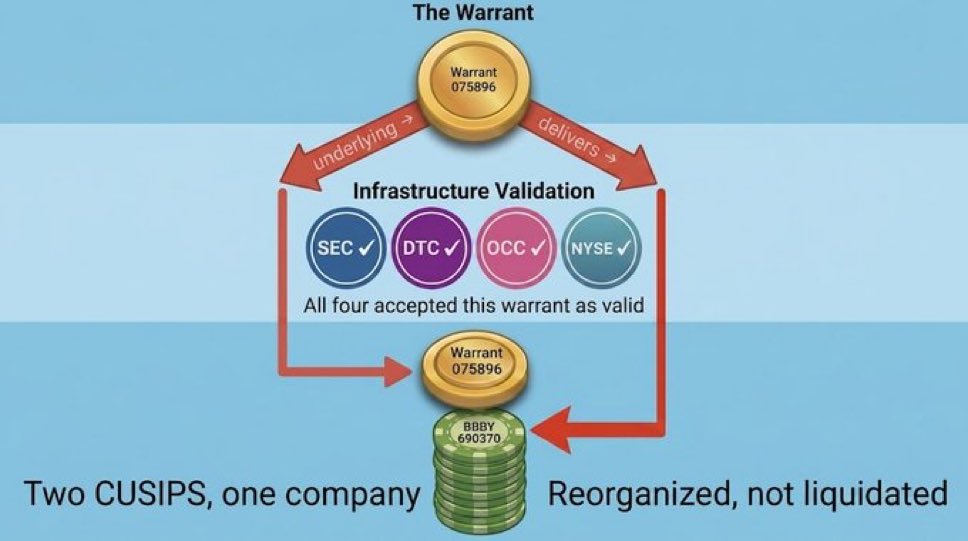
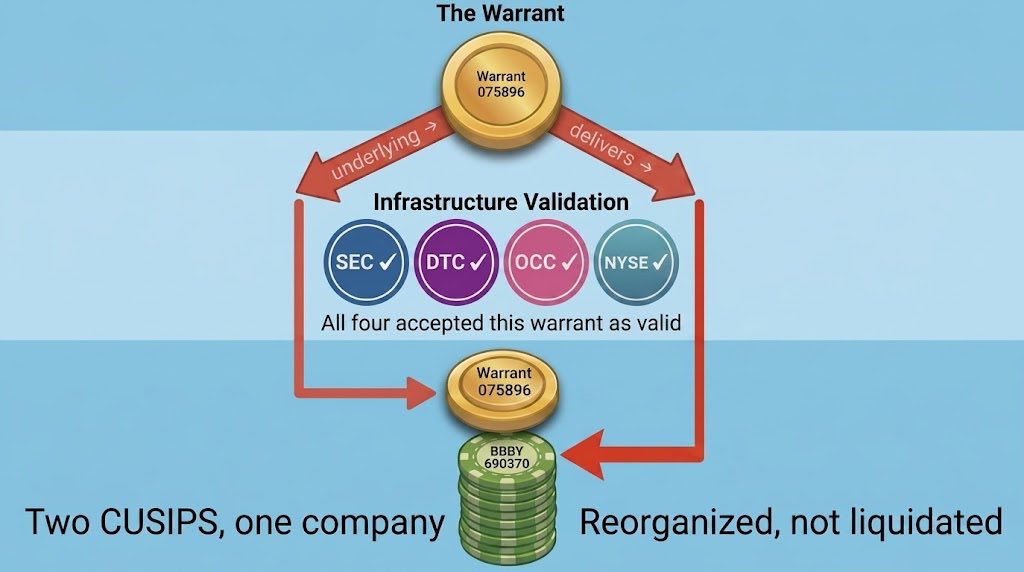
Its CUSIP root, 075896, which points to the original Bed Bath & Beyond issuer.
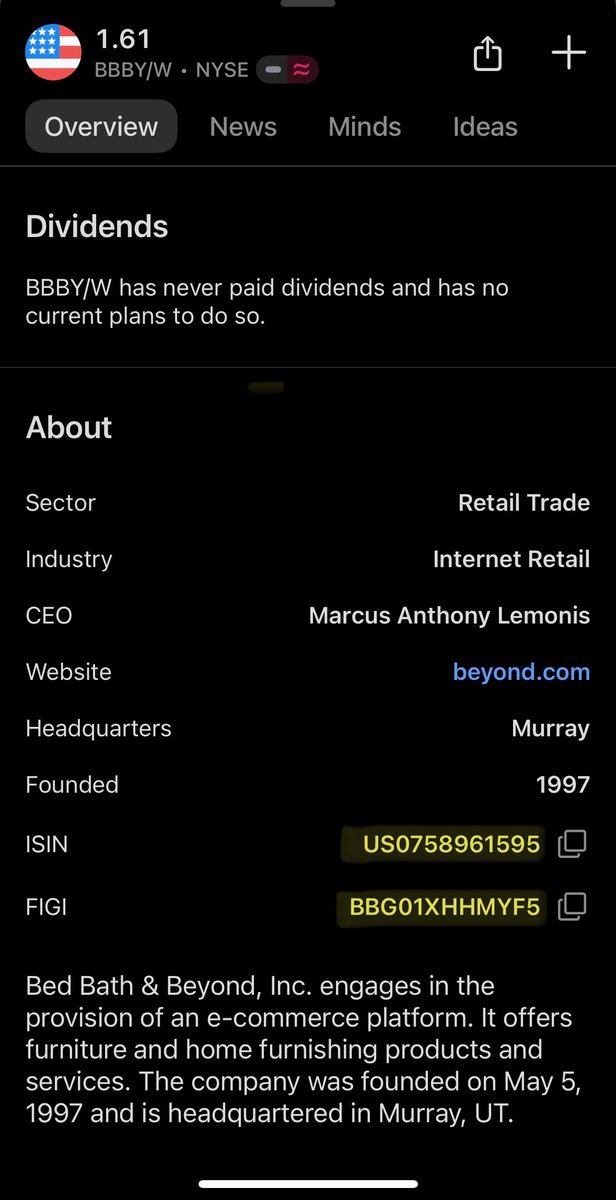
Its ISIN, which wraps that CUSIP in an international format. Here is a picture displaying warrant information on Fidelity demonstrating just that too.
And finally, its LEI, which identifies the legal entity (the company itself).
Bottom of the same page
Side note:
@LJenkins69420 Remember when Pulte was hyping potentially big news all throughout October of 2024 and then the big news we ended up getting was a couple of picture of him with RC???
WELL I NEVER FORGOT LOL.
I bet this was the actual big news. WHY?
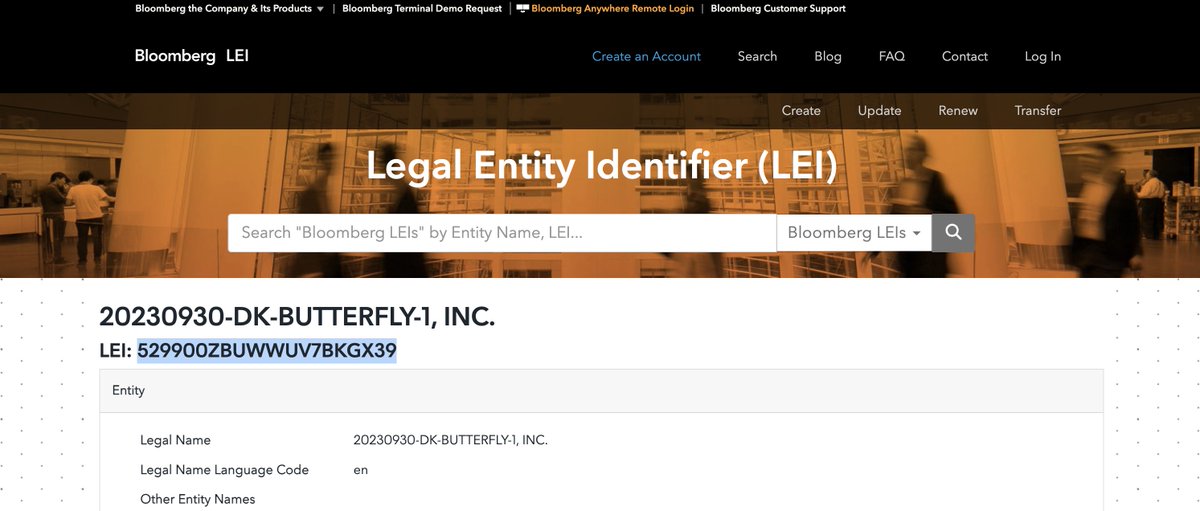
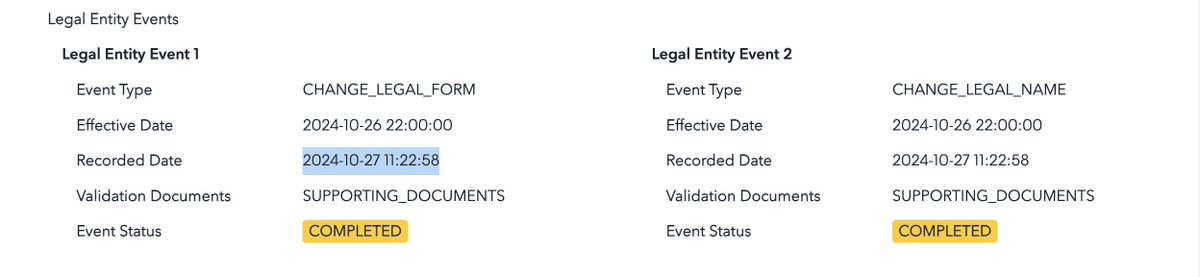
Because when the LEI 529900ZBUWWUV7BKGX39 was reactivated for DK-Butterfly on October 27, 2024, it signaled that the Bed Bath & Beyond corporate shell had been formally brought back into the global legal-entity system, confirming the entity’s survival and enabling it to legally hold assets, preserve its identifiers and NOLs. It had been sitting in a dormant state until this moment in time.
Source:
lei.bloomberg.com/leis/view/…
Together, these identifiers form a fingerprint that computers everywhere use to recognize “this is the same stock,” even when ownership or branding changes.
Step 3: Bring in the OCC memo
Source (second one down): infomemo.theocc.com/infomemo…
Now look at the OCC Information Memo dated October 13, 2025. It describes a change: Bed Bath & Beyond distributed warrants—rights to buy stock at $15.50—to its shareholders.
To make this work, the Options Clearing Corporation (OCC) adjusted all the existing options contracts.
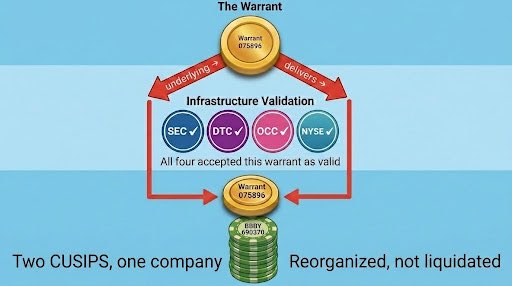
They created a new symbol, BBBY1, whose deliverable now equals:
100 shares of Bed Bath & Beyond common stock (CUSIP 690370101), and 10 warrants (CUSIP 075896159).
They even wrote the pricing formula right in the memo:
BBBY1 = BBBY 0.1 (BBBY WS)
This means every option contract now treats the new shares and the old-root warrants as a single economic package.
Step 4: See how the pieces lock together
Here’s where the link becomes clear.
The new Bed Bath & Beyond (formerly Overstock / Beyond Inc.) trades under CUSIP 690370, its own legal root.
NOW LISTEN
THE WARRANTS USE THE OLD BED BATH & BEOND ROOT, 075896.
(THIS IS WHERE A LOT OF PEOPLE'S BRAINS GLITCH OUT DUE TO MANIPULATION, GASLIGHTING, AND MISDIRECTION, MOSTLY BROUGHT TO YOU BUY SHILLS)
AGAIN IT SAYS 075896 IN BOTH OCC MEMOS (OCTOBER 1ST and OCTOBER 13TH).
IT IS NOT A MISTAKE JFC. YOU CAN'T CHANGE THE FINE PRINT. DON'T LET ANYONE TELL YOU OTHERWISE. TELL THEM "YOU DON'T KNOW HOW TO READ".
Anyways, the OCC memo literally ties them together in one settlement bundle.
So, now when a clearing house settles a BBBY1 option, it has to deliver both parts, the new shares AND the legacy-root warrants.
That’s like a bridge joining the old corporate identity (through 075896) and the new one (through 690370) at the infrastructure level of the market.
Step 5: Understand why BBG001S720V4 matters
Because BBG001S720V4 IS THE LASTING SHARE-CLASS IDENTIFIER FOR THE OLD BED BATH & BEYOND COMMON STOCK, it’s the entry point that links all these systems. 🦋
When you follow that FIGI, it takes you from:
The legacy Bed Bath & Beyond shares (before bankruptcy)
To the CUSIP 075896 family (still used for the new warrants)
To the OCC’s adjusted contracts that now merge the new and old identifiers in one deliverable.
In other words, this one little FIGI is the breadcrumb that lets data systems and us trace continuity between the defunct company’s stock and the rebranded company’s equity recognized by clearing houses today.
Step 6: The takeaway
So, in plain terms:
BBG001S720V4 tells us what the original stock was.
The OCC memo shows that today’s trading infrastructure still connects new shares to that old root.
Together, they prove that the market’s plumbing treats old Bed Bath & Beyond and the new Bed Bath & Beyond as two sides of the same ongoing thread.
It’s not just a coincidence of name. It’s a data-level bridge encoded in identifiers and reinforced by the clearing system itself.
Step 7: What this connection means when we zoom out
Now that we’ve traced how identifiers and the OCC memo tie old Bed Bath & Beyond to the new one, we can understand why that continuity is important.
Preservation of derivative history:
Because the FIGI and the OCC adjustment keep the old identifiers alive in the market’s plumbing, every historical option, warrant, or swap referencing “BBBY” can still be priced, archived, and reconciled correctly. The clearing system doesn’t lose its link to prior contracts; it simply remaps them through the adjusted deliverable. That ensures that long-dated derivatives, risk models, and audit trails remain intact instead of orphaned by bankruptcy paperwork.
Preservation of tax attributes such as NOLs:
The same continuity that helps the OCC also helps accountants. The shell entity that legally owned the 075896 root—the “old” BBBY—still exists in state and federal registries. If its corporate records and tax filings remain compliant, its net operating losses (NOLs) can survive inside that shell. Under U.S. tax law, those NOLs can sometimes be carried forward or combined with a successor’s income if a proper reorganization structure exists. The shared identifier trail makes it easier for both regulators and successor companies to prove continuity of ownership and business activity when claiming those NOLs.
Potential platform for recapitalization or reverse merger.
Finally, a clean, data-recognized shell with preserved identifiers is a valuable corporate chassis. It can serve as the legal “container” for a future reverse merger or recapitalization. Because the identifiers and CUSIP lineage are already recognized by clearing systems, a new business combining with that shell could plug directly into the same market infrastructure—avoiding months of re-registration work. The warrant linkage already operating under the OCC memo shows that this bridge is not hypothetical; it is functioning in real time at the settlement level.
BONUS PUTTING IT ALL TOGETHER AGAIN:
So, in plain terms:
1. The identifiers keep the story coherent for data and derivatives.
2. The NOL-carrying shell keeps the story alive for tax and corporate law.
3. The OCC deliverable proves the bridge is already operational inside the trading system.
BBG001S720V4, once just a technical code for old common stock, ends up being the thread that stitches together accounting, market infrastructure, and potential future capital formation.
It is the quiet DNA strand that makes continuity in data, in law, and possibly in value, mathematically and legally traceable across the transformation of Bed Bath & Beyond.
RC PUSH THE BUTTON 😂

65
115
643
70,087
Monotanus retweeted

Ok y'all asked me to break down predatory $EBAY ad attribution policies for you, so we're going to try to do this real quick.
Important: this🧵will cover Promoted Listings General cost per sale ads - they also have cost per click ads, but we'll do that later. $GME
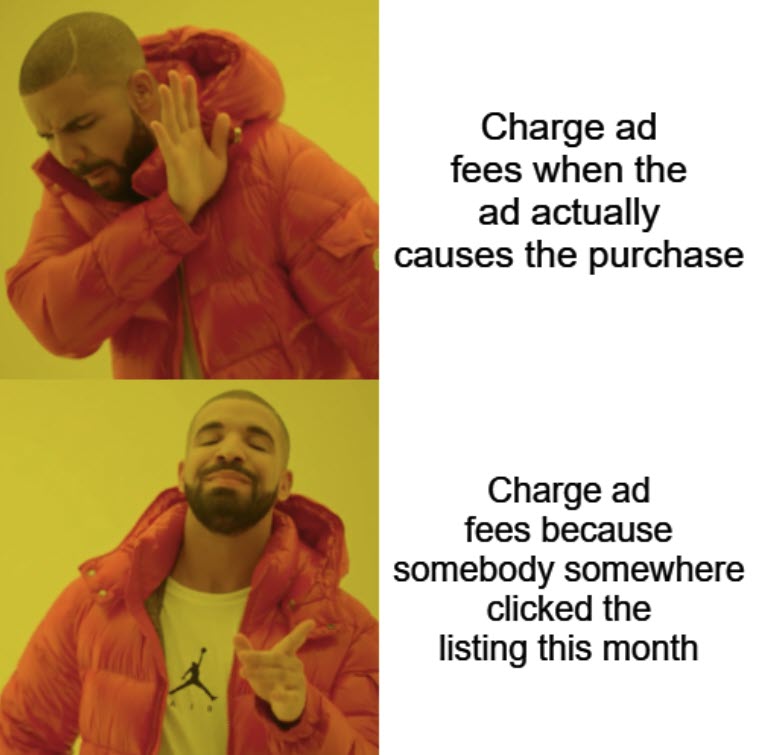

💯 If @ryancohen $GME wanted a slam dunk seller goodwill win on day 1, undoing recent predatory changes to $EBAY Promoted Listings ad attribution that take more 💸 from sellers without delivering real ROI would be my top suggestion.
6
21
143
6,438
Monotanus retweeted

I remember when @TripleAJade said they would release alien stuf before $GME takes off, and also that Ryan wouldnt abandon $BBBYQ.
I think she said a lot of things that make sense and deserve some appreciation, really one of the smartest women in the GME saga and very wise.
The alien stuff is wild. I cant believe they revealed such things. I can only shake my head.
14
9
96
4,157
Monotanus retweeted
"Would be great to see lower fee % and to have my fees not be used to subsidize free happy hours."
More truth 👇 $EBAY $GME

I sold over $230k worth of sports cards last year on eBay - $140k myself and about $100k thru 3rd party consigners. Paid well over $20k in fees myself $10k in fees to consigners. Would be great to see lower fee % and to have my fees not be used to subsidize free happy hours.
3
8
97
2,846
Monotanus retweeted
💯 If @ryancohen $GME wanted a slam dunk seller goodwill win on day 1, undoing recent predatory changes to $EBAY Promoted Listings ad attribution that take more 💸 from sellers without delivering real ROI would be my top suggestion.
May 8

And wait til you all get to the new attribution criteria for Promoted listings on the site, talk about a scam!!
10
20
271
13,421
Monotanus retweeted
Power to the players just met power to the sellers & it looks to be the beginning of a beautiful friendship.🤝
GameStop CEO @ryancohen takes eBay pitch direct to sellers sharing vision for the platform with Flipwise co-founder Justin Glow.
$EBAY $GME
valueaddedresource.net/ryan-…
30
186
921
21,738
Monotanus retweeted
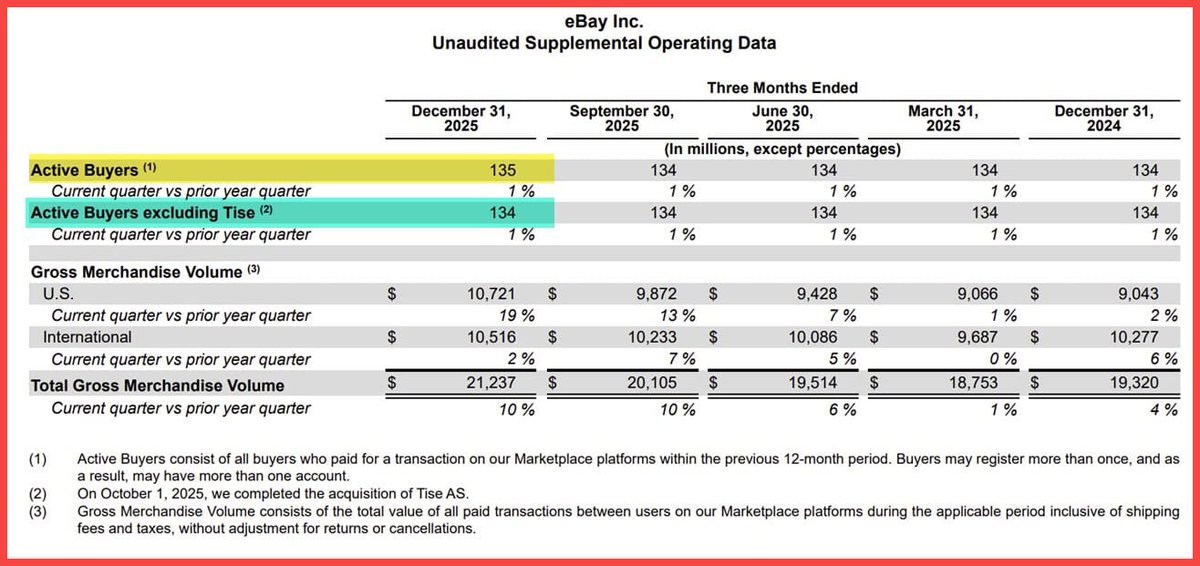
$EBAY buyer stats worse than $GME thinks - 1M came from buying fashion site Tise not marketing.👀
Big picture: under CEO Jamie Iannone, eBay has persistent post-pandemic stagnation w/ 16 straight Qs <Active Buyers than 2018.
Maybe @ryancohen can ask CNBC how that math maths?🤔
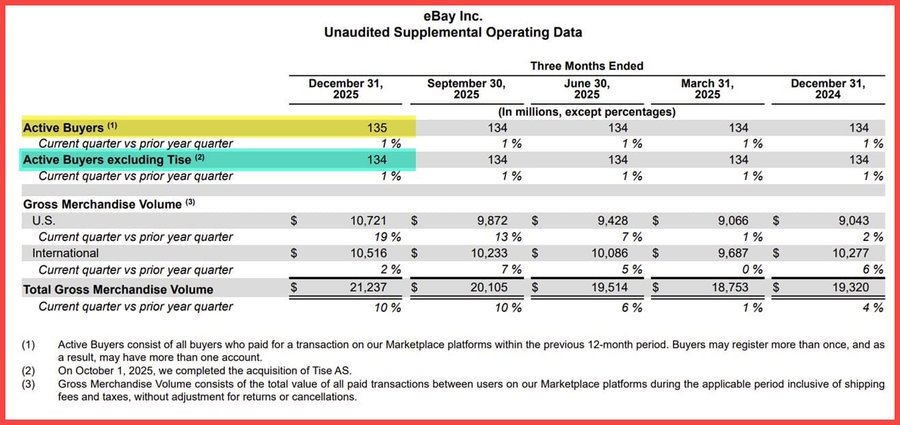
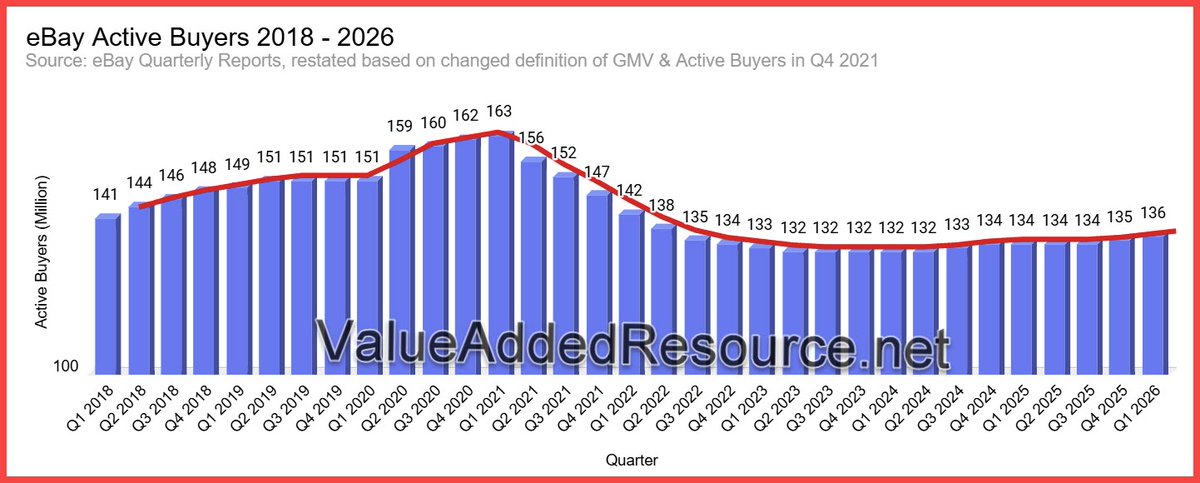
$EBAY: The Stuff You Inherit (1) - Years of stagnant Active Buyers📉
@ryancohen $GME called out anemic buyer growth, only 1M net active buyers in 2025 - 134M to 135M
Worse: that 1M came from eBay buying Tise & customer acquisition via M&A isn't cheap💸
x.com/ValueAddedRS/status/20…
31
159
1,067
65,053
May 7
Don't rush into introducing unfamiliar complexity when things are suddenly going very well. Stick with what's simple, familiar, and proven to be already working.
Rely on the same time-tested discipline and diligence that distinguishes any well-run family-owned business.
19
940
May 5
Does GameStop's 50/50 cash-stock consideration mix in the eBay proposal represent the conservative safe-harbor ratio for a 368(a)-qualifying reorganization? 👀
2
4
63
7,216