
Joined May 2021
- Tweets 2,093
- Following 1,069
- Followers 1,034
- Likes 4,130
250 Photos and videos










Pinned Tweet

23 May 2025
Check out our new result on regression with heavy-tailed noise !
Thanks to
@gaussianmeasure , @DimitriMeunier1 ,
@ArthurGretton
arxiv.org/abs/2505.14214
1
5
32
1,146
4 Jul 2025
My issue with #NeurIPS2025: if a co-author fails to submit their assigned reviews, jointly submitted papers are not receiving reviews.
Collective punishment is unfair and harmful,
discouraging collaboration, penalizing innocent researchers, worsening the academic culture.
1
8
2,967
Nic Mücke 🦩 🇪🇺 retweeted

23 May 2025
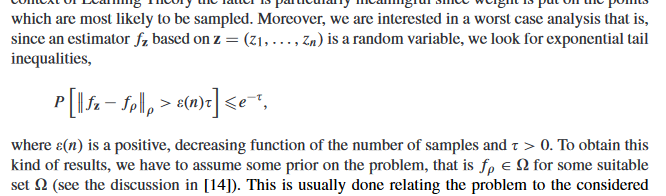
We introduce a Hilbert space version of the Fuk-Nagaev bound to the integral operator framework and generalize the typical “Bernstein-trick”: we use the capacity of the hypothesis space as a proxy for the higher moments, giving optimal rates.
1
4
360
Nic Mücke 🦩 🇪🇺 retweeted
23 May 2025
We show that the optimal rates from the work by Caponnetto & De Vito (2007) hold without the assumption of sub exponential noise - you only need some finite higher moment.
1
1
3
374
Nic Mücke 🦩 🇪🇺 retweeted

23 May 2025
Check out our new result on regression with heavy-tailed noise !
I learned a lot on this project, thanks to @gaussianmeasure for leading the project.
@moskitos_bite @ArthurGretton
23 May 2025

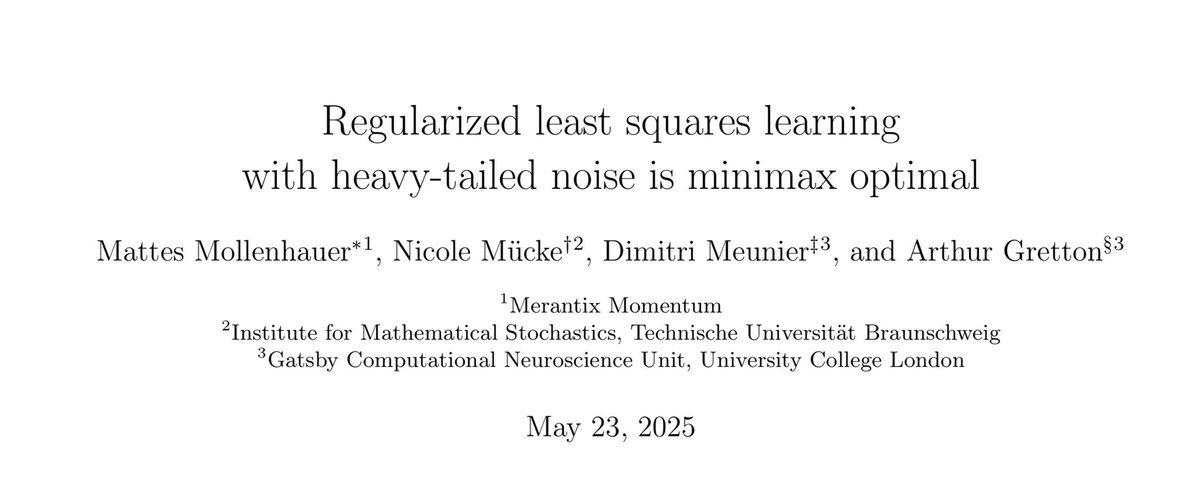
New preprint!
"Regularized least squares learning with heavy-tailed noise is minimax optimal"
joint work with @moskitos_bite, @DimitriMeunier1 and @ArthurGretton
1
2
18
1,280
17 Jun 2024
Link: oeaw-ac-at.zoom.us/j/6291264…
Meeting-ID: 629 1264 1909
Kenncode: mZc4Zu
17 Jun 2024

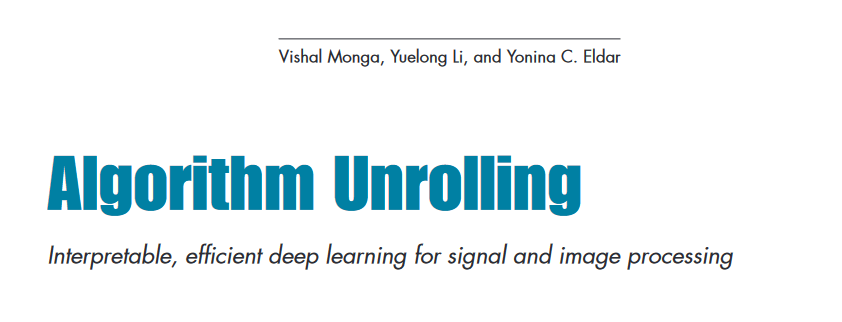
📢Next speaker in our online seminar about inverse problems and learning theory is
Dirk Lorenz @Dirque_L
with
** Learning regularizers - bilevel optimization or
unrolling? **
When: June 18, 14:00–15:00 (CET)
1
1
426
17 Jun 2024
Organizers
Werner Zellinger (RICAM), Nicole Mücke (TU Braunschweig), Luca Ratti (Uni Bologna), Tatiana Bubba (Uni Bath), Matteo Santacesaria (Uni Genoa), Sergei Pereverzyev (RICAM), Markus Holzleitner (Uni Genoa), Abhishake Rastogi (Uni LUT)
293
17 Jun 2024
📢Next speaker in our online seminar about inverse problems and learning theory is
Dirk Lorenz @Dirque_L
with
** Learning regularizers - bilevel optimization or
unrolling? **
When: June 18, 14:00–15:00 (CET)
1
5
1,083
13 May 2024
When you're asked to suggest the reviewers for your proposal and to send it to them in advance ....
4
365
11 May 2024
I wish all the codes of conduct for research integrity that our scientific community has established would be rigorously enforced.
4
638
Nic Mücke 🦩 🇪🇺 retweeted


1
1
320
30 Apr 2024
Are there any good mathy resources (intros or tutorials) about optimal transport, with applications in ML?
2
2
21
7,668
Nic Mücke 🦩 🇪🇺 retweeted

10 Apr 2024
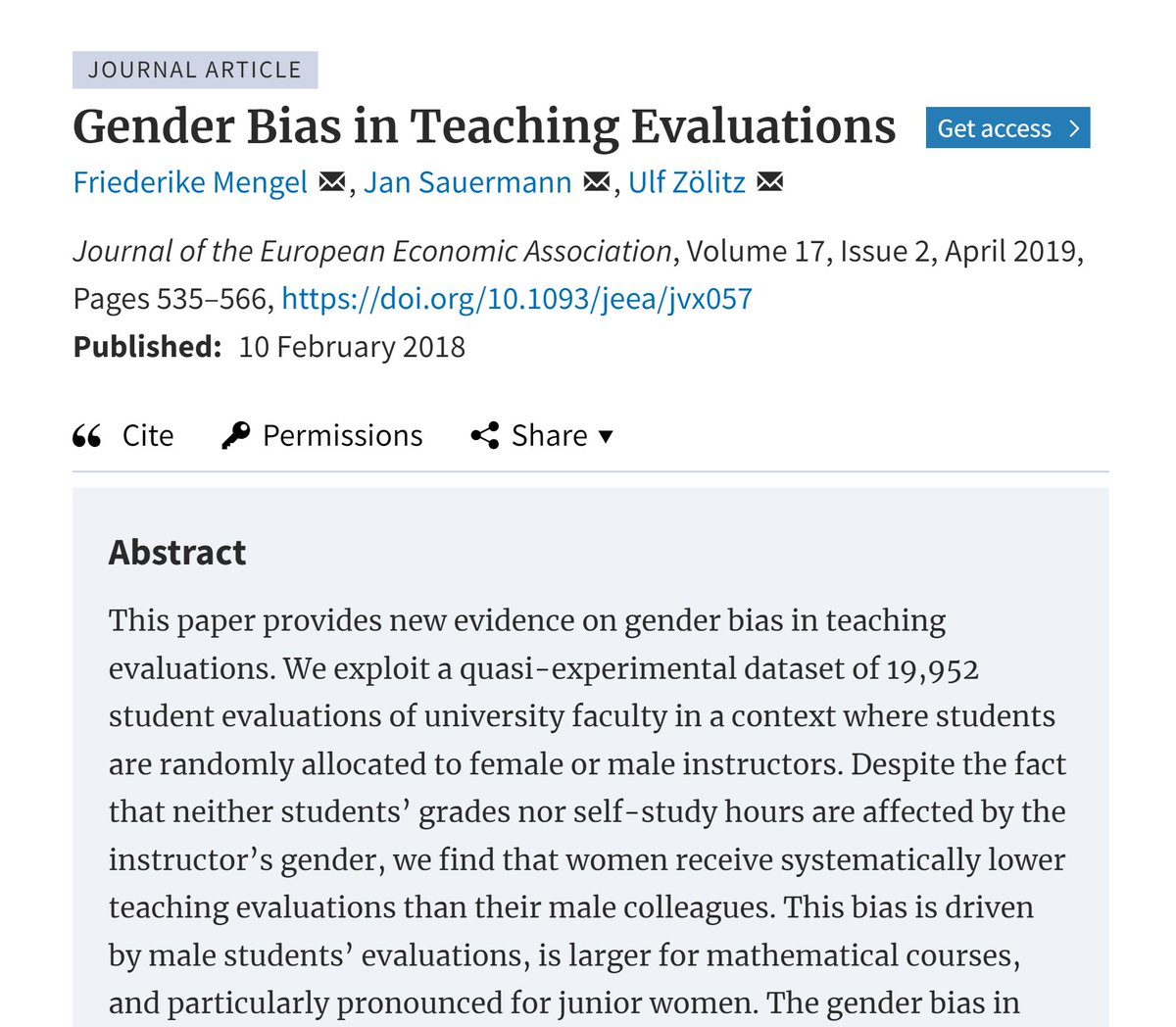
With another semester ending, here's your annual reminder that teaching evaluations systemically disadvantage women. Even when controlling for grades and other factors, students (esp. males) consistently give female professors lower scores. This can have serious ramifications.🧵
38
1,376
5,003
424,133
15 Apr 2024
I have strong concerns about mathematical organizations that charge money for membership in a group focused on equity, diversity, and inclusion.
3
479
Nic Mücke 🦩 🇪🇺 retweeted

11 Apr 2024
Do you know of a monograph PhD thesis written on the subject of Explainable AI (xAI)?
Re-tweets appreciated.
3
5
5
2,605
Nic Mücke 🦩 🇪🇺 retweeted

8 Apr 2024
📣The Blog Post Track 2024 is out!
22 Blog posts on ML topics ranging from optimisation to RLHF:
blog.iclr.cc/2024/04/02/blog…
Tell your colleagues and friends!
@iclr_conf
@gauthier_gidel @busycalibrating @velythyl @fpedregosa Léo Schwinn
1
30
121
38,403
Nic Mücke 🦩 🇪🇺 retweeted

1 Apr 2024
this is how statisticians computed linear regressions prior to the invention of the computer:
71
619
8,387
814,079
28 Mar 2024
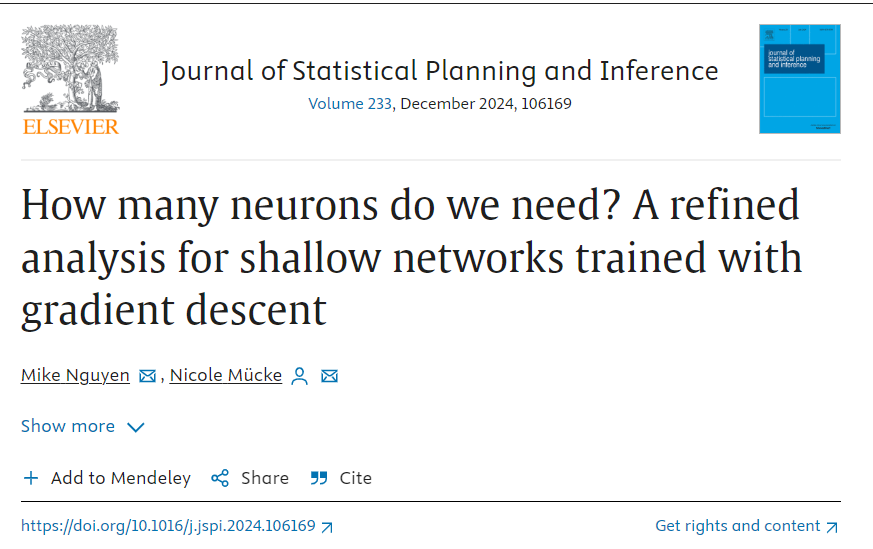
📢Our paper just got out:
For early stopped GD we derive minimax
rates of convergence. On our way, we precisely keep track of the number of hidden neurons required for generalization and improve over existing results.
sciencedirect.com/science/ar…
2
9
1,186