
56 Photos and videos







Nihit Desai retweeted

Jun 13
Really excited to open source a new project: Omnigent, a meta-harness for AI agents.
It lets you build multi-agent coding and custom agents, sitting above Claude Code, Codex, Pi, and agent SDKs to let you compose them. It also adds live collaboration and rich control policies.

82
194
1,092
189,105
Nihit Desai retweeted

Jun 13
Check out Omnigent, an open source harness that lets you use all the existing code harnesses (Claude Code, Codex, OpenCode, pi), collaborate and share sessions in many modalities (e.g. Slack/Teams, cli, webui), while having a fine grained security model that really tightens the control on what agents can do/not do.
github.com/omnigent-ai/omnig…
8
52
314
20,320
Nihit Desai retweeted

Apr 20
Over the last few months, I've learned to love gnarly documents: 100 page legal contracts, patient notes, microchip diagrams—all crinkled with hand writing and coffee stains ☕️
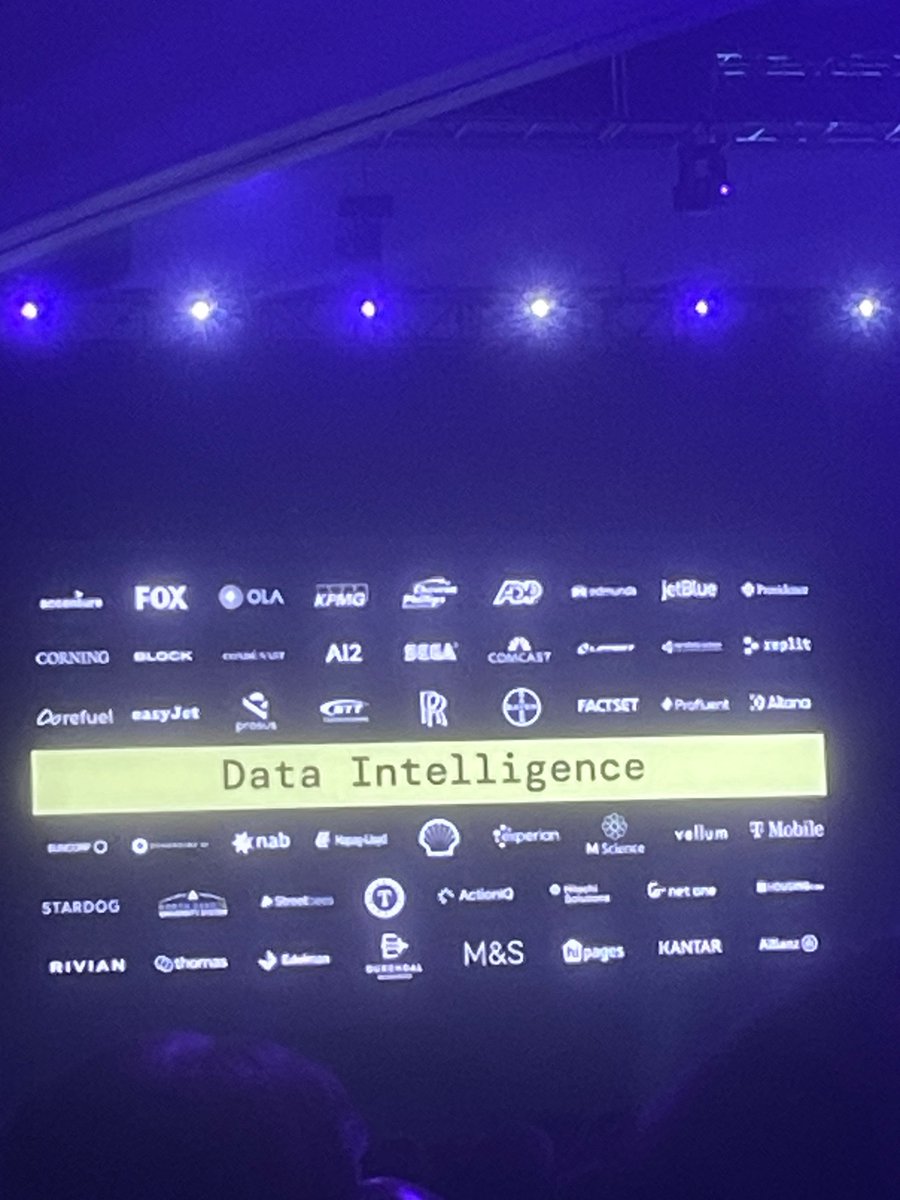
With Databricks Document Intelligence, you can run jobs that turn hundreds of thousands of docs/day into structured tables or even classify docs across 100k labels.
A big shoutout to @ivanzhouyq @nihit_desai @arnav_thebigman and many others on Databricks research, runtime, and product who made this happen!
Apr 16

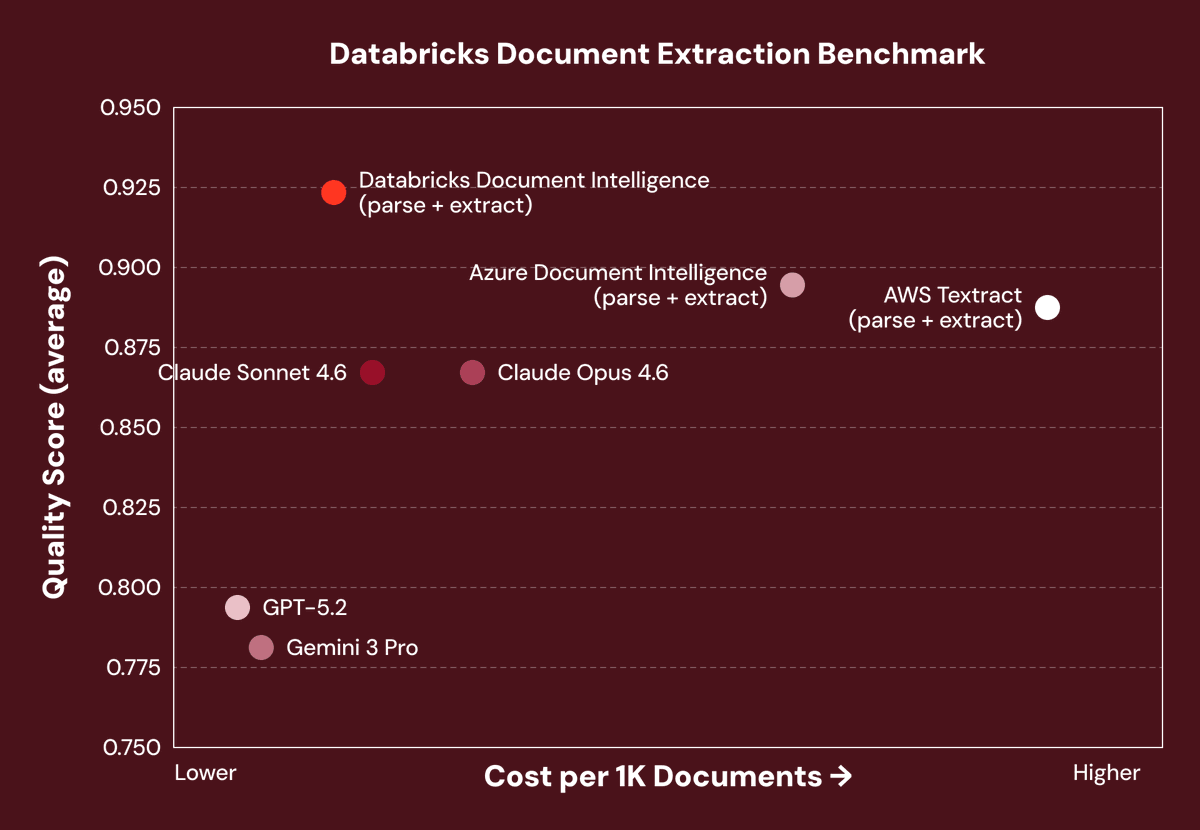
Introducing Databricks Document Intelligence: a research-specialized layer that turns raw enterprise documents into structured data your agents can actually reason over.
Across our benchmarks, Document Intelligence delivered the highest end-to-end parsing and extraction quality at 6-8x lower cost, with a 16% average performance gain across every agent framework tested, just from better parsing.
How to get started: databricks.com/blog/why-fron…
4
7
56
11,346

17 Dec 2025
Join us! 🚀 Check out databricks.com/company/caree… (or DM me, always down to chat)
17 Dec 2025

People often ask me why we think Databricks can succeed in new areas we expand to. This is the recipe why: we build stellar teams in areas where we think we can greatly improve on the status quo. Lakehouse was one, Lakebase is next, but there's more coming, especially in AI.
4
1,806

5 Sep 2025
5 Sep 2025

Hi, my name's Michaël Trazzi, and I'm outside the offices of the AI company Google DeepMind right now because we are in an emergency.
I am here in support of Guido Reichstadter, who is also on hunger strike in front of the office of the AI company Anthropic.
DeepMind, Anthropic and other AI companies are racing to create ever more powerful AI systems. Experts are warning us that this race to ever more powerful artificial general intelligence puts our lives and well being at risk, as well as the lives and well being of our loved ones.
I am calling on DeepMind’s management, directors and employees to do everything in their power to stop the race to ever more powerful general artificial intelligence which threatens human extinction.
More concretely, I ask Demis Hassabis to publicly state that DeepMind will halt the development of frontier AI models if all the other major AI companies agree to do so.
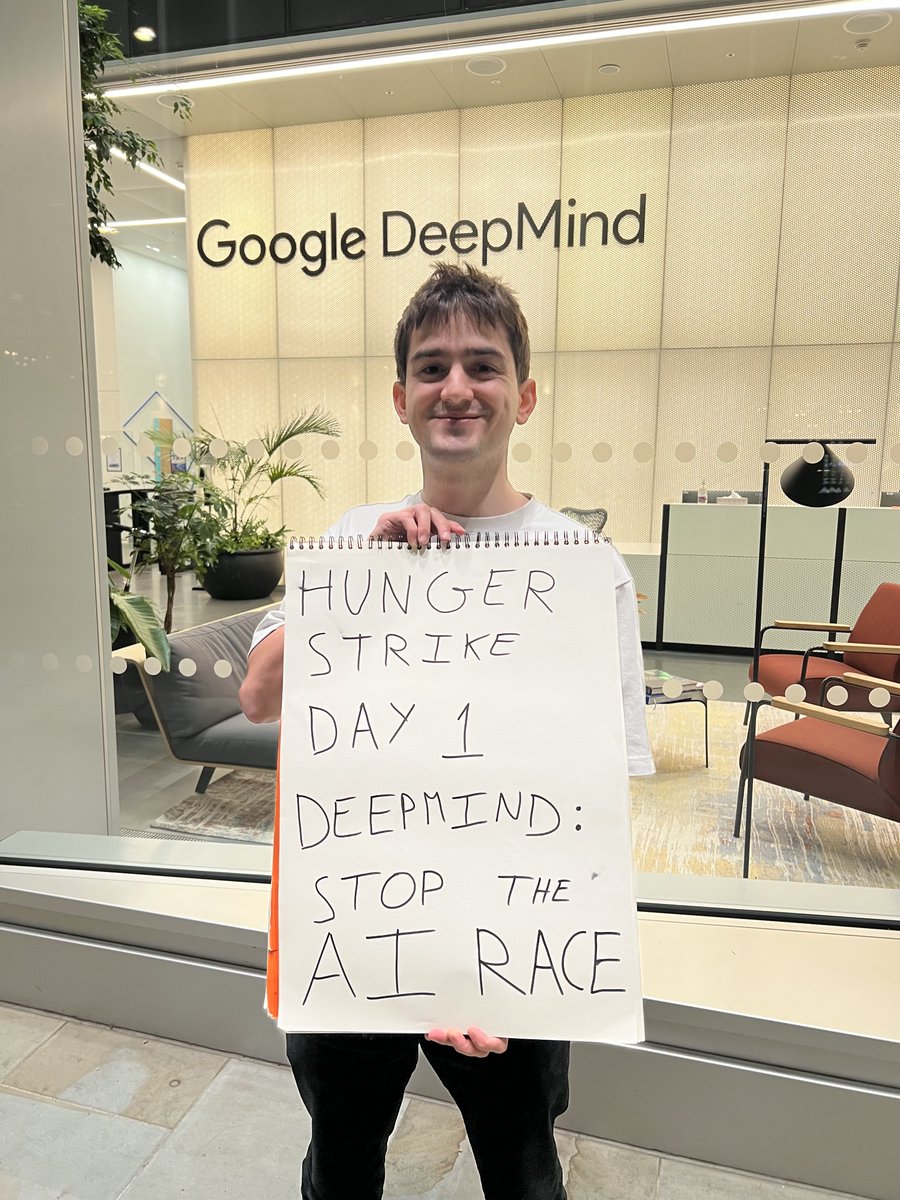
6
1,525
24 Aug 2025
Windows, the web, facebook, iphone, cloud, deep learning, AVs, chatgpt - all in 30 years. Next 30 gonna be 🚀

3
642
5 Jul 2025
Technical debt is like financial debt in many ways. Borrow from the future to accelerate buildout today. Grow the pie and pay back a much smaller fraction of it in the future

Unpopular opinion but technical debt is good, it's needed to accelerate and shrink timeline
2
5
1,354
2 Jun 2025
scarcity ➡️ abundance is a beautiful thing
1850s: Food
1900s: Manufacturing
1950s: Energy
2020s: Intelligence
5
483
Nihit Desai retweeted

19 May 2025
Congratulations to our portfolio companies, @togethercompute and @RefuelAI, on uniting their strengths to power the next generation of AI infrastructure!
Together AI’s AI Acceleration Cloud enables developers and enterprises to train and deploy generative AI models with speed, control, and cost-efficiency. By bringing in Refuel’s purpose-built data models and orchestration platform, they’re tackling one of the biggest bottlenecks in AI: cleaning and structuring messy data at scale.
We’re proud of @vipulved, @rish_bhargava, @nihit_desai, and both teams for building the foundation that enables applied AI to thrive.
1
3
12
2,411

We have some big news to share today - @RefuelAI is joining @togethercompute to help accelerate the future of open source and enterprise AI! together.ai/blog/together-ai…
1
4
20
1,866
8 Jan 2025
Data intelligence too cheap to meter
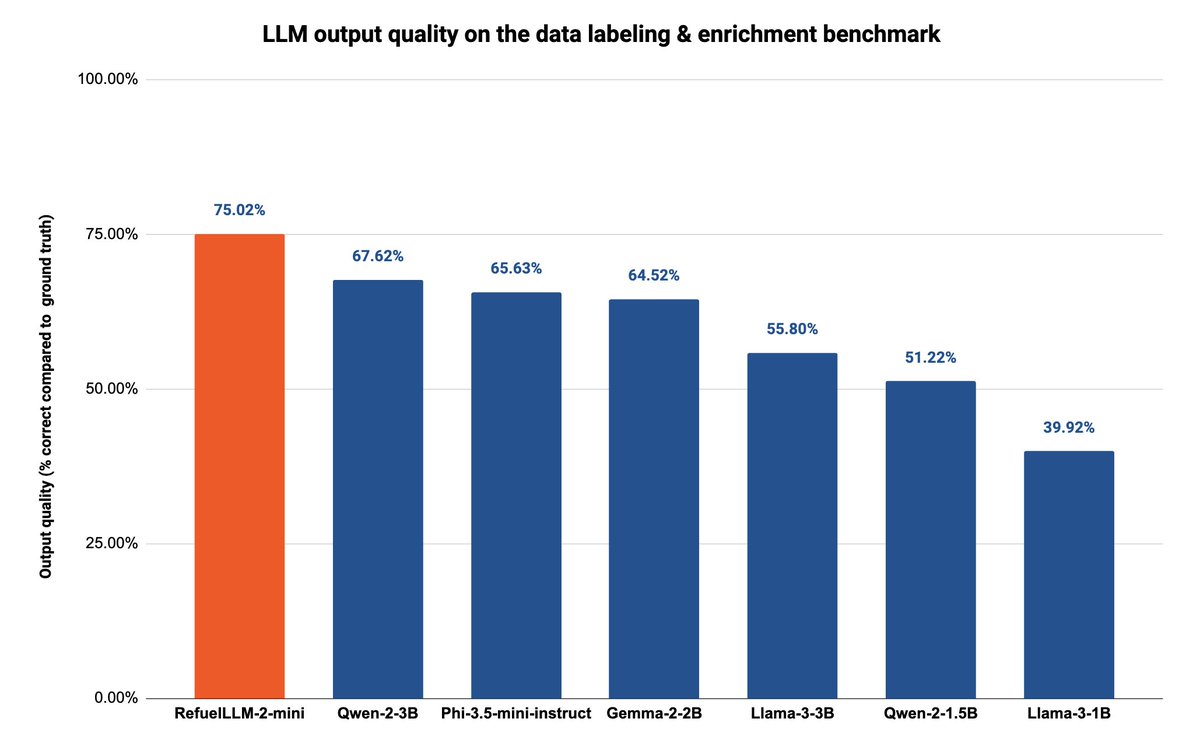
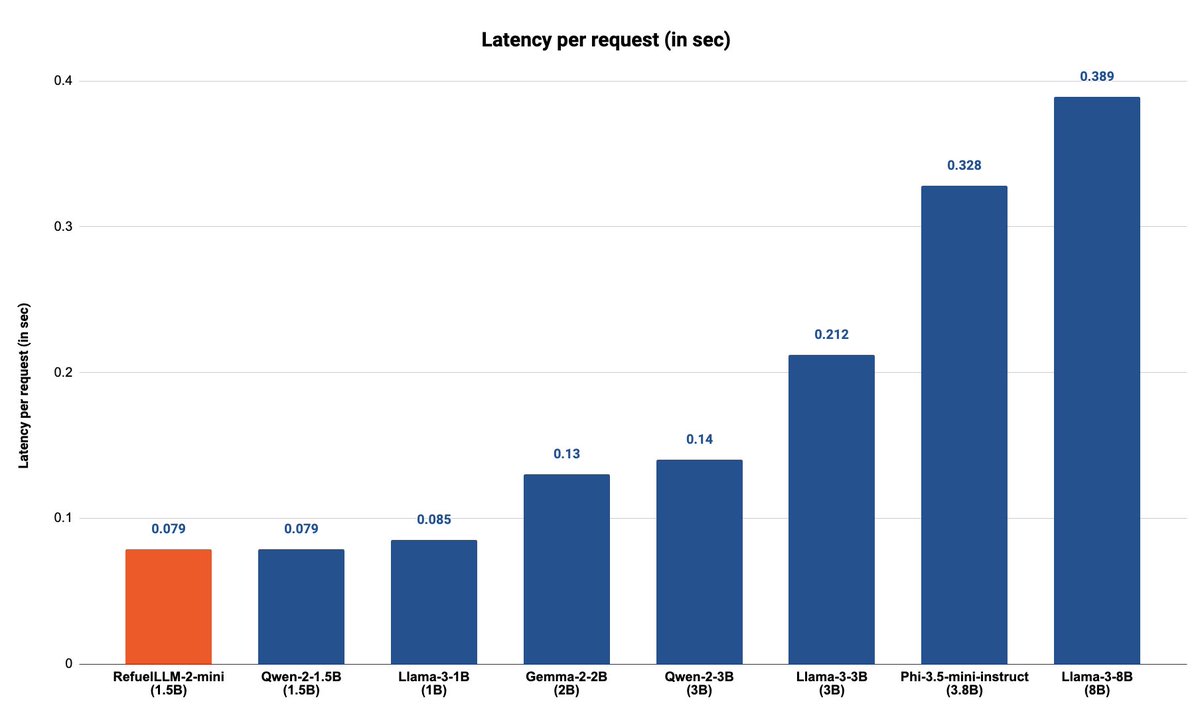
RefuelLLM-2-mini (75.02%), our latest 1.5B param SLM, outperforms all comparable models including Phi-3.5 (65.3%), Qwen2.5 (67.62%), Gemma2 (64.52%), Llama3-3B (55.8%) and Llama3-1B (39.92%) across our benchmark of data processing tasks such as labeling, enrichment and structure extraction
RefuelLLM-2-mini is a Qwen2-1.5B base model, trained on a corpus of 2750 datasets spanning tasks such as classification, reading comprehension, structured attribute extraction and entity resolution, using the same recipe as other models in the Refuel-LLM family.
It's fast!
We’re open sourcing the model weights, available on @huggingface - huggingface.co/refuelai/Qwen…
If you'd like to access models, along with fine tuning support, DM me or reach out to us: refuel.ai/get-started
Grateful to our early customers for their partnership, and the entire @RefuelAI team for their hard work 🚀
8 May 2024

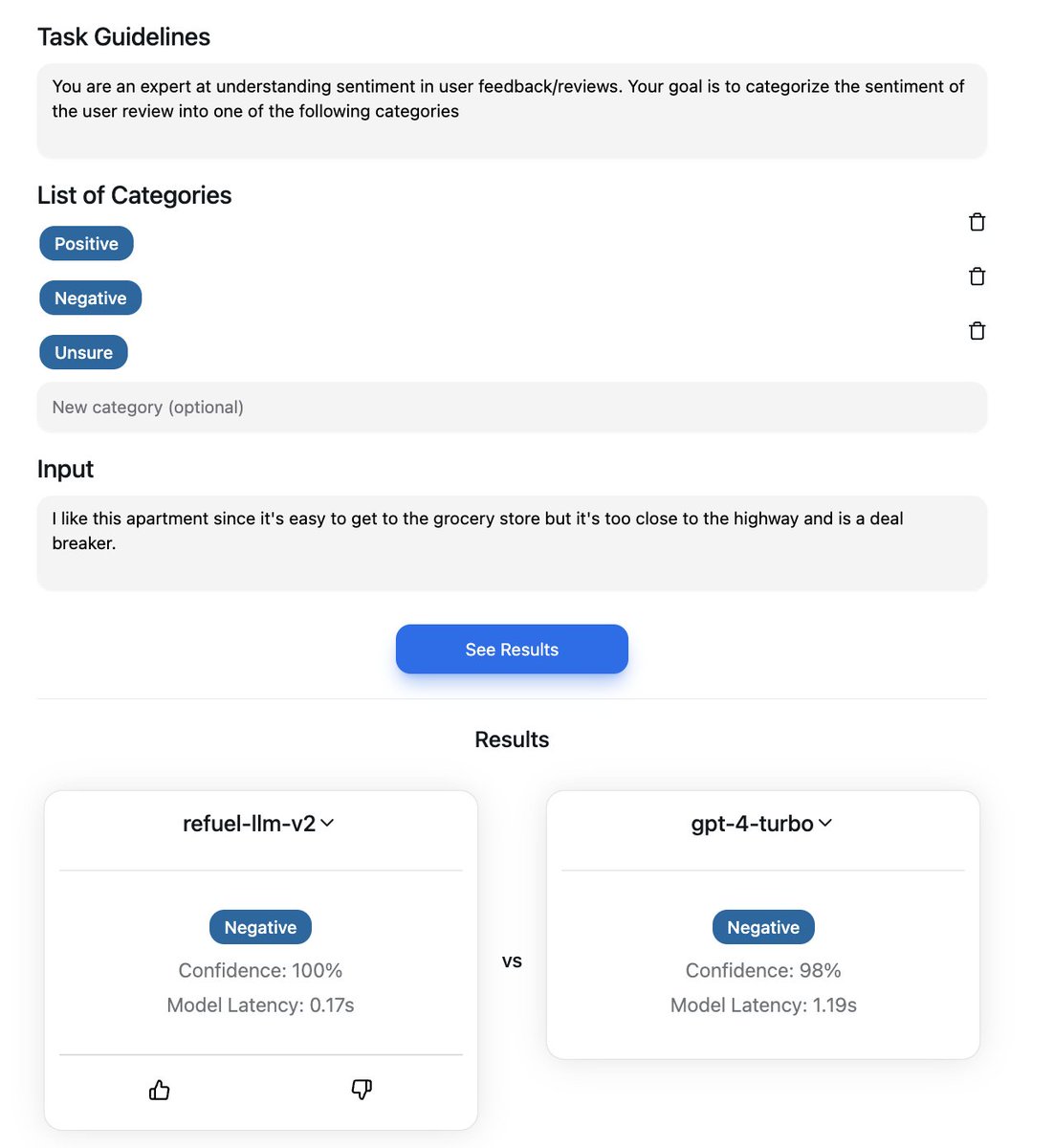
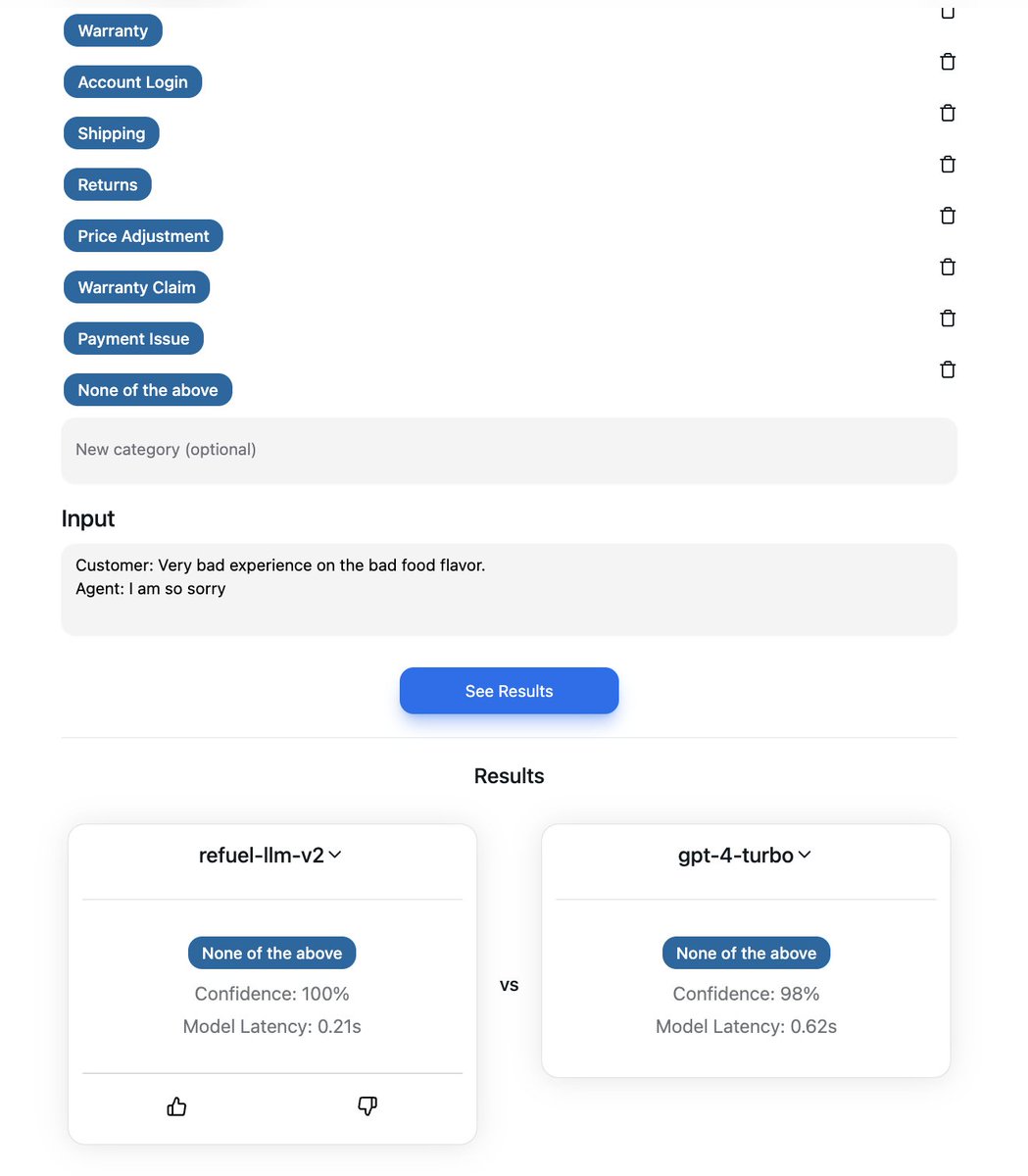
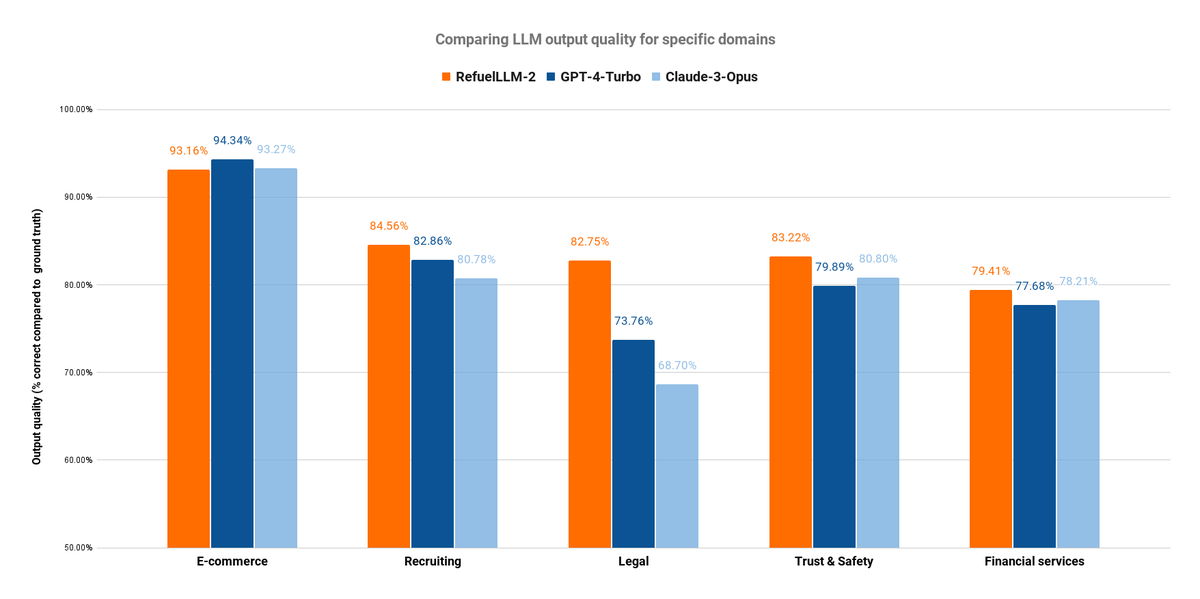
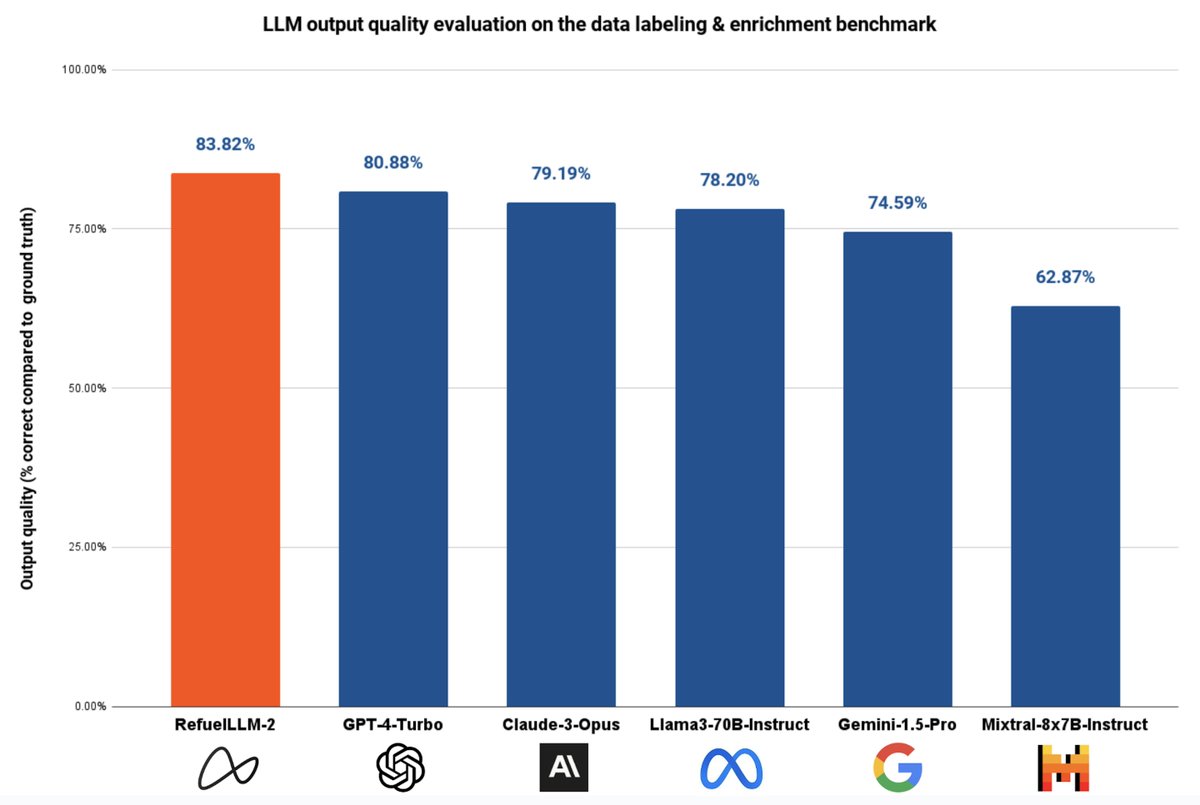
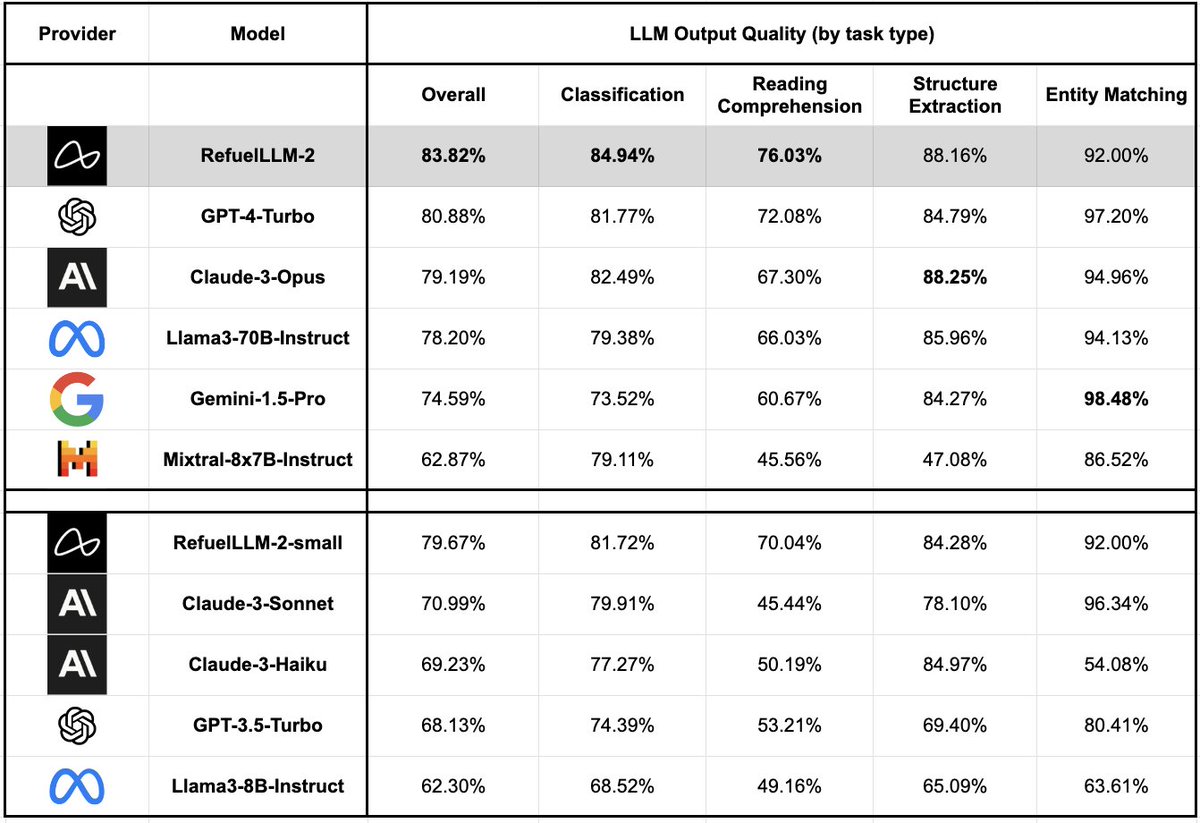
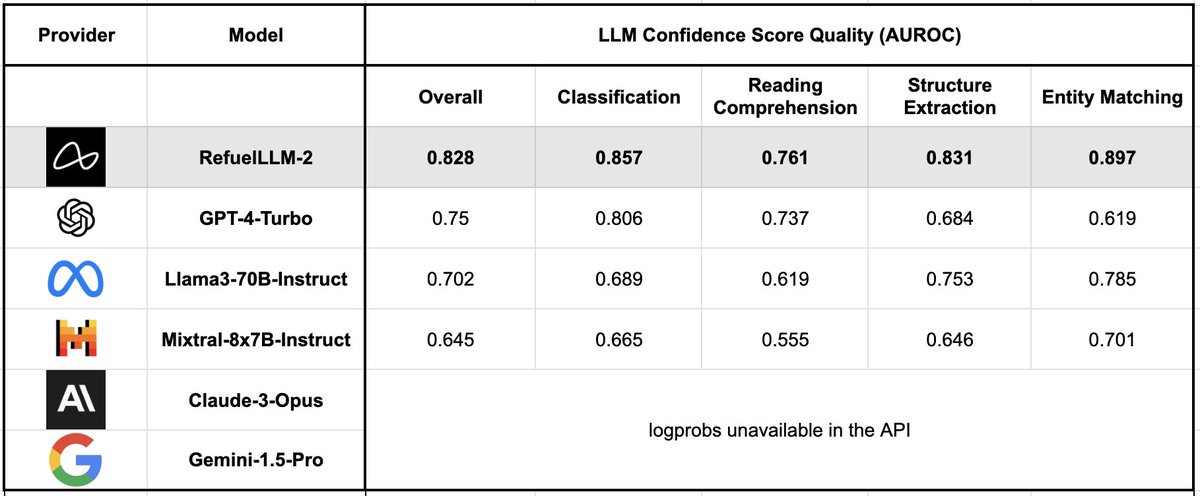
Thrilled to introduce RefuelLLM-2, our latest family of LLMs built for data labeling and enrichment tasks. RefuelLLM-2 (83.82%) outperforms GPT-4-Turbo (80.88%), Claude-3-Opus (79.19%), Llama3-70B (78.2%) and Gemini-1.5-Pro (74.59%) on a benchmark of ~30 data labeling tasks:
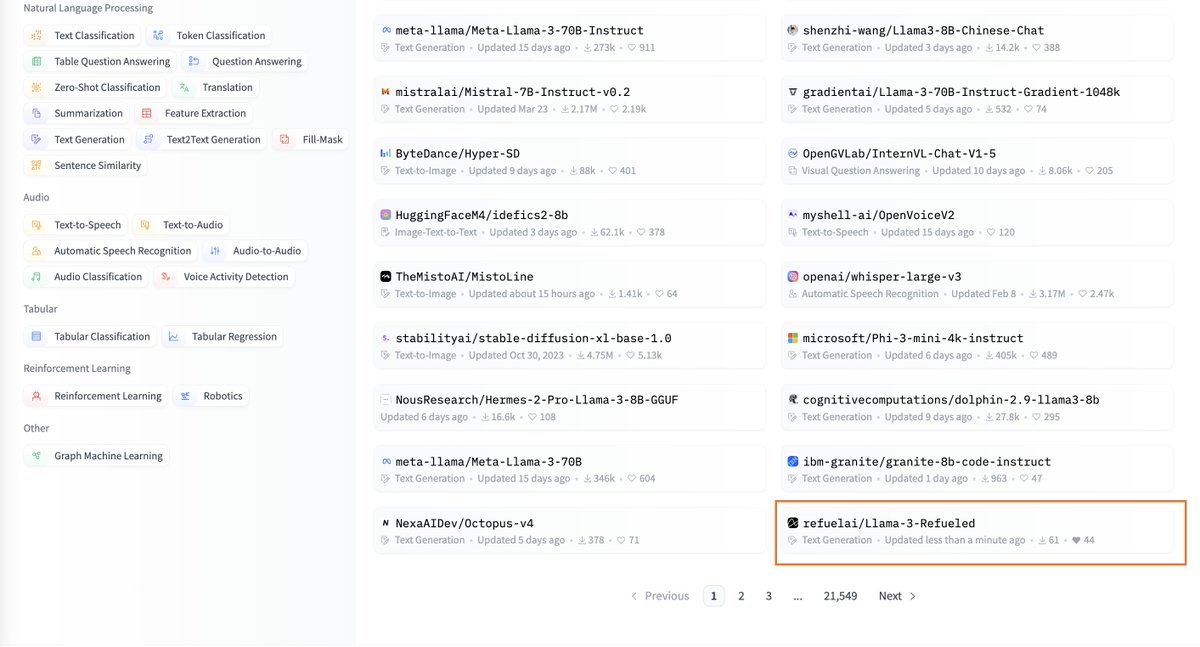
RefuelLLM-2-small (79.67%), aka Llama-3-Refueled, outperforms all comparable LLMs including Claude3-Sonnet (70.99%), Haiku (69.23%) and GPT-3.5-Turbo (68.13%). We’re open sourcing the model: huggingface.co/refuelai/Llam…
You can try out the models here and give us some feedback! labs.refuel.ai/playground. The code and data used for benchmarking the LLMs is available in our Autolabel library: github.com/refuel-ai/autolab…
One more thing: RefuelLLM-2 family of models output much better calibrated confidence scores - a useful lever to reject, retry or ensemble low confidence outputs.
3
3
14
2,245
8 Jan 2025
Huge shoutout (apologies if I'm missing anyone) to creators of @Alibaba_Qwen, the FLAN and Tasksource dataset collections (@EnricoShippole, @ShayneRedford), the open source community (@huggingface, @AIatMeta, @NousResearch, Axolotl, @predibase, @vllm_project, @MSFTDeepSpeed), and our infra partners (@MosaicML, @googlecloud, @runpod)
1
4
218
8 Jan 2025
On the refuel team end, want to especially recognize the efforts of @BansalDhruva and @rajasbansal for leading our LLM building efforts!
3
213
Nihit Desai retweeted

2 Dec 2024
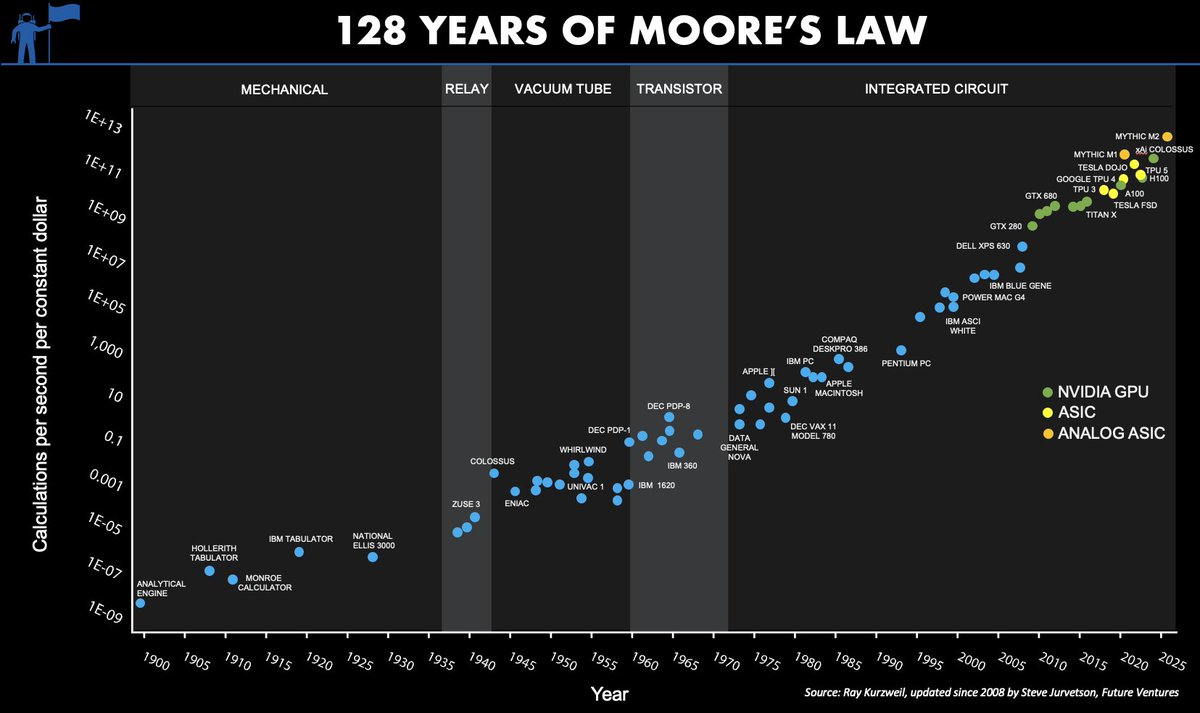
The Moore's Law Update
NOTE: this is a semi-log graph, so a straight line is an exponential; each y-axis tick is 100x. This graph covers a 1,000,000,000,000,000,000,000x improvement in computation/$. Pause to let that sink in.
Humanity’s capacity to compute has compounded for as long as we can measure it, exogenous to the economy, and starting long before Intel co-founder Gordon Moore noticed a refraction of the longer-term trend in the belly of the fledgling semiconductor industry in 1965.
I have color coded it to show the transition among the integrated circuit architectures. You can see how the mantle of Moore's Law has transitioned most recently from the GPU (green dots) to the ASIC (yellow and orange dots), and the NVIDIA Hopper architecture itself is a transitionary species — from GPU to ASIC, with 8-bit performance optimized for AI models, the majority of new compute cycles.
There are thousands of invisible dots below the line, the frontier of humanity's capacity to compute (e.g., everything from Intel in the past 15 years). The computational frontier has shifted across many technology substrates over the past 128 years. Intel ceded leadership to NVIDIA 15 years ago, and further handoffs are inevitable.
Why the transition within the integrated circuit era? Intel lost to NVIDIA for neural networks because the fine-grained parallel compute architecture of a GPU maps better to the needs of deep learning. There is a poetic beauty to the computational similarity of a processor optimized for graphics processing and the computational needs of a sensory cortex, as commonly seen in the neural networks of 2014. A custom ASIC chip optimized for neural networks extends that trend to its inevitable future in the digital domain. Further advances are possible with analog in-memory compute, an even closer biomimicry of the human cortex. The best business planning assumption is that Moore’s Law, as depicted here, will continue for the next 20 years as it has for the past 128. (Note: the top right dot for Mythic is a prediction for 2026 showing the effect of a simple process shrink from an ancient 40nm process node)
----
For those unfamiliar with this chart, here is a more detailed description:
Moore's Law is both a prediction and an abstraction. It is commonly reported as a doubling of transistor density every 18 months. But this is not something the co-founder of Intel, Gordon Moore, has ever said. It is a nice blending of his two predictions; in 1965, he predicted an annual doubling of transistor counts in the most cost effective chip and revised it in 1975 to every 24 months. With a little hand waving, most reports attribute 18 months to Moore’s Law, but there is quite a bit of variability. The popular perception of Moore’s Law is that computer chips are compounding in their complexity at near constant per unit cost. This is one of the many abstractions of Moore’s Law, and it relates to the compounding of transistor density in two dimensions. Others relate to speed (the signals have less distance to travel) and computational power (speed x density).
Unless you work for a chip company and focus on fab-yield optimization, you do not care about transistor counts. Integrated circuit customers do not buy transistors. Consumers of technology purchase computational speed and data storage density. When recast in these terms, Moore’s Law is no longer a transistor-centric metric, and this abstraction allows for longer-term analysis.
What Moore observed in the belly of the early IC industry was a derivative metric, a refracted signal, from a longer-term trend, a trend that begs various philosophical questions and predicts mind-bending AI futures.
In the modern era of accelerating change in the tech industry, it is hard to find even five-year trends with any predictive value, let alone trends that span the centuries.
I would go further and assert that this is the most important graph ever conceived. A large and growing set of industries depends on continued exponential cost declines in computational power and storage density. Moore’s Law drives electronics, communications and computers and has become a primary driver in drug discovery, biotech and bioinformatics, medical imaging and diagnostics. As Moore’s Law crosses critical thresholds, a formerly lab science of trial and error experimentation becomes a simulation science, and the pace of progress accelerates dramatically, creating opportunities for new entrants in new industries. Consider the autonomous software stack for Tesla and SpaceX and the impact that is having on the automotive and aerospace sectors.
Every industry on our planet is going to become an information business. Consider agriculture. If you ask a farmer in 20 years’ time about how they compete, it will depend on how they use information — from satellite imagery driving robotic field optimization to the code in their seeds. It will have nothing to do with workmanship or labor. That will eventually percolate through every industry as IT innervates the economy.
Non-linear shifts in the marketplace are also essential for entrepreneurship and meaningful change. Technology’s exponential pace of progress has been the primary juggernaut of perpetual market disruption, spawning wave after wave of opportunities for new companies. Without disruption, entrepreneurs would not exist.
Moore’s Law is not just exogenous to the economy; it is why we have economic growth and an accelerating pace of progress. At Future Ventures, we see that in the growing diversity and global impact of the entrepreneurial ideas that we see each year — from automobiles and aerospace to energy and chemicals.
We live in interesting times, at the cusp of the frontiers of the unknown and breathtaking advances. But, it should always feel that way, engendering a perpetual sense of future shock.
545
2,006
8,333
12,929,903
30 Nov 2024
True conviction draws in missionaries. Hard to fake.
Fake conviction draws in mercenaries. Easy to spot.
1
5
606
Nihit Desai retweeted

22 Oct 2024
Speculative decoding is one of the best tool in the vLLM's suite of inference optimization tool box, accelerating the inference without accuracy loss.
Checkout our blog post for more details about the state of spec decode in vLLM today! 🧵
blog.vllm.ai/2024/10/17/spec…
5
49
235
30,683
9 Sep 2024
the only viable option here would be to start over, right?

i have solved the riemann hypothesis, but i can’t figure out how to upload it to hugging face
2
3
1,288