
Online Pathology Journal Club #pathJC #pathology #JournalClub
Joined June 2016
- Tweets 3,630
- Following 4,012
- Followers 4,989
- Likes 987
120 Photos and videos



Pinned Tweet

6 Nov 2019
18 Oct 2019

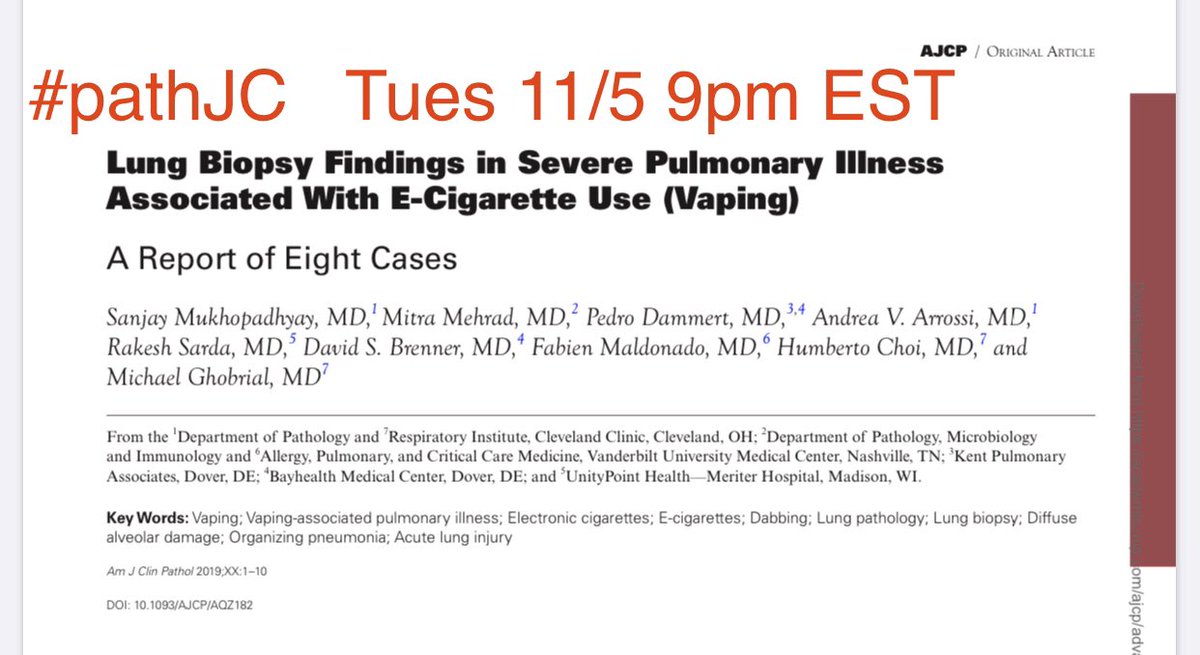
#pathjc is back! Join author/moderator/#pulmpath expert @smlungpathguy to discuss #vaping lung injury
🔺Tuesday, Nov 5, 9pm EST/8pm CST
🔺Full text from @AJCPjournal: academic.oup.com/ajcp/advanc…
1
11
18
Pathology JC retweeted

14 Apr 2022
#GIPathJC
- The study demonstrates chemotherapy can significantly alter the Ki67 index in high grade neuroendocrine neoplasms
- In post-treatment cases history and pre-treatment pathology facilitates the correct pathologic interpretation
1
3
8
Pathology JC retweeted
14 Apr 2022
#GIPathJC
- More evidence is needed to determine prognostic implications of treatment-associated alterations
- Until more evidence is available post-treatment PD-NECs should retain their originally established pre-treatment diagnostic classification
1
2
6
Pathology JC retweeted
14 Apr 2022
#GIPathJC morphology of pre-treatment and post-treatment samples fell in two categories
-first category (n = 9) showed cellularity, atypia, and pleomorphism similar to pre-treatment samples
-second category (n = 11), showed morphologic transformation of the neoplastic cells
1
1
3
Pathology JC retweeted
14 Apr 2022
2
1
Pathology JC retweeted
14 Apr 2022
#GIPathJC
In 18/20 cases (90%), post-treatment samples showed areas with Ki67 index significantly lower than matched pre-treatment samples or <20% that would not qualify for high grade based on the WHO grading system
3
3
Pathology JC retweeted
14 Apr 2022
#GIPathJC
-6 cases had post-treatment Ki67 index falsely suggesting a diagnosis of WD-NET G2 (3 cases) or G1 (3 cases).
-Degree of heterogeneity in the post-treatment samples was marked, 15/20 cases showing heterogeneity, 12 had a heterogeneity score >1 (mean score = 2.4).
2
2
Pathology JC retweeted

14 Apr 2022
The treated cases showed much more heterogeneity in KI67 labeling which is not so often observed in NECs #GIPathJC
3
1
Pathology JC retweeted
14 Apr 2022
#GIPathJC
-In 15/20 post-treatment samples, Ki67 index was <20%, at least focally (i.e., in a coldspot), and in 6 cases (30%) the overall Ki67 index based on the hotspot was <20%.
-In 3 cases, the highest Ki67 index in the entire sample was ≤1%.
1
2
3
Pathology JC retweeted
14 Apr 2022
Yes, Grade progression in in WD-NETs is a well known phenomenon. PD-NECs develop along a different pathway and progression of WD-NET to PD-NEC does not happen in our experience #GIPathJC
1
3
6
Pathology JC retweeted
14 Apr 2022
#GIPathJC
-Ki67 index was calculated as the percentage of neoplastic cells with nuclear labeling in the areas of maximum (hotspot) and minimum (coldspot) staining
-A mitotic count was performed in the areas of highest and lowest Ki67 labeling.
1
2
6
Pathology JC retweeted
14 Apr 2022
#GIPathJC
-Due to observations of reduction in proliferation rate of neuroendocrine tumors following neoadjuvant therapy this study was conducted
-20 cases with history of chemotherapy and/or radiation with pre and post treatment samples were included
1
3
4
Pathology JC retweeted
14 Apr 2022
#GIPathJC Though WD-NET can progress from grades 1 to 3, Often the recurrence or metastases of WD-NET is WD-NET, as opposed to progression to PD-NEC
1
2
3
Pathology JC retweeted
14 Apr 2022
#GIPathJC Ki67 index should be used for tumor grading, but is not by itself useful to distinguish between well differentiated neuroendocrine tumors (WD-NETs) and poorly differentiated neuroendocrine carcinomas (PD-NECs) particularly in high grade tumors or grade 3 WD-NET
1
3
6
Pathology JC retweeted
14 Apr 2022
#GIPathJC well differentiated neuroendocrine tumors (WD-NETs) are separated from poorly differentiated neuroendocrine carcinomas (PD-NECs) due to difference in clinical behavior, treatment, and molecular findings
1
2
1
Pathology JC retweeted
14 Apr 2022
1
1
Pathology JC retweeted

2 Dec 2021
In our study no patient had a visible lesion, though as endoscopies improve more and more low-grade dysplasia is visible. We don't use that as a criteria but I can't say for certain what the gastroenterologists use to make their final decision
2
1
Pathology JC retweeted
2 Dec 2021
I think you will lose sensitivity if you do not stain every block with BE in it. Definitely an area for further study
2
2
Pathology JC retweeted
2 Dec 2021
2 Dec 2021

That is a really good question and one that I don't think is fully answered. In our study we tried to stain every BE block we could and counted the endoscopy if any one of them had abnormal p53. We definitely had cases were not every block was positive.
1
Pathology JC retweeted
2 Dec 2021
2
2