Founder, Universal Edge AI, co-founder @dynamicplanner. AI software and education. All views strictly mine. universaledge.ai/
Joined December 2012
- Tweets 14,258
- Following 1,271
- Followers 466
- Likes 9,465
887 Photos and videos





PaddyOFitz retweeted

Jun 11
We are currently living in an era where political disagreement is no longer treated as a difference of opinion, but as a test of moral purity. Polarization in America is not driven by an honest debate over hard facts, but by a lucrative industry of grievance where elites on both sides find it far more profitable to manufacture outrage than to solve concrete problems. When a society begins to judge policies by the intentions of their sponsors rather than their actual consequences, it ceases to function as a republic and becomes a collection of competing tribes, each more interested in defeating the other than preserving the inheritance of the nation.
12
36
215
5,582

Jun 11
“Tax the rich dry” folk have no idea what this life is like. And seeing others sacrificing and failing. An economy needs to provide incentives for people to shoot at the moon. This guy has created jobs for families in NY and CA. Payroll coming from customers; not tax revenue.
Jun 11

Real talk.
Our third child, a beautiful baby boy, was born 48 hours ago. It's hard to express the joy we are feeling, and our other two kids cannot wait to welcome him home today.
Yesterday at the hospital, there was a last-minute work conference call. We have to make a critical and time-sensitive decision with large implications - and that was when everyone else was available to talk.
So, I made sure my wife and the baby were good, and I stepped out of the room. I would not that the call if it was not urgent. People can relay their opinions on those calls - but only I can make the final decision.
While leaving the hospital to pick up my son from school so he doesn't feel like his new baby brother immediately means sacrifice for him, another important work call came in. I let it go to voicemail, but called back when I got home.
I headed home with him to pick up his sister so we can all go visit my wife and our newborn - time-sensitive questions were coming in by email and text.
Yes, we have help of course, any my mother in law flew in for the week, and if you have been following me for a bit you know that nothing means more to me than my family, and to be there for my wife -- AND yes I know what some people are thinking right now...
Somebody asked me about paternity leave and how much time off I'll be taking. Paternity leave?
Of course that would be amazing. I would love to turn on an away message and check out, and have a salary for the next few months while I spend time with my family the entire time.
But it's not possible. It's not the life I signed up for.
I have over 100 investors who have put their trust in me.
We have a team of seven, with New York City and California payrolls.
There were offers the team had to send out, and I needed to review and approve terms. Your entire year, and the success of your business that year usually comes down to just a few deals that happen or don't.
And minutes of waiting too long will allow somebody else to jump in.
Those other buyers don't care what I have going on. They are not going to wait for me. Neither is the seller.
There is nobody else that can sign off on our final pricing. There is nobody else our investors point to if we get it wrong.
A tenant prospective tenant made a last minute request on a lease with big implications for our fund, and nobody else can make make that call. So I get a text.
None of this is a surprise. It's part of the sactifice. You try to do everything and be superman because you have no chice and because you're already used to this.
You signed up for it a long time ago. You understand the sacrifice. You know how great it can be and the heights you can reach, and you love it - but you also know the cost.
Entrepreneurship is the ultimate freedom?
Please.
An employee who can check out has that.
Not us.
33
PaddyOFitz retweeted

Jun 9
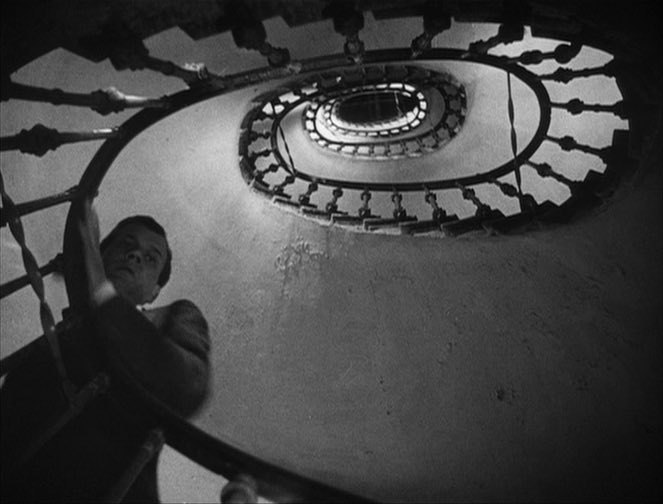
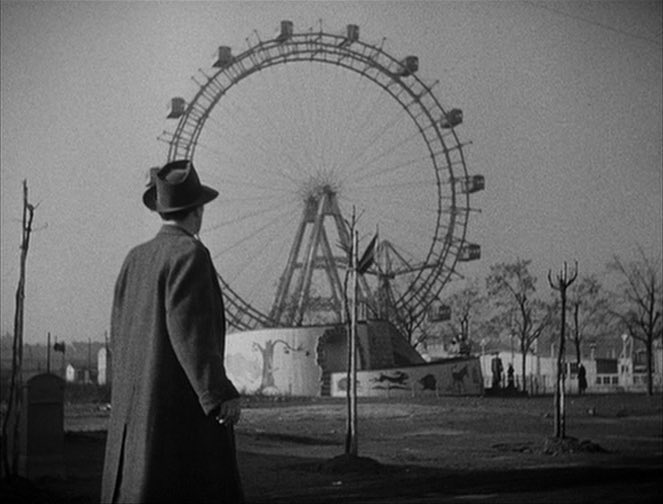
“Nobody thinks in terms of human beings. Governments don't. Why should we? They talk about the people and the proletariat, I talk about the suckers and the mugs - it's the same thing. They have their five-year plans, so have I.”
The Third Man by Carol Reed


3
20
1,179
WW2 was the great adventure story of the 20th century. Filled with death, politics, violence, bravery, evil, cowardice, horror, despair, hope and story arcs worthy of the Greeks. It also formed a bond for a generation of men returning home.
Jun 6

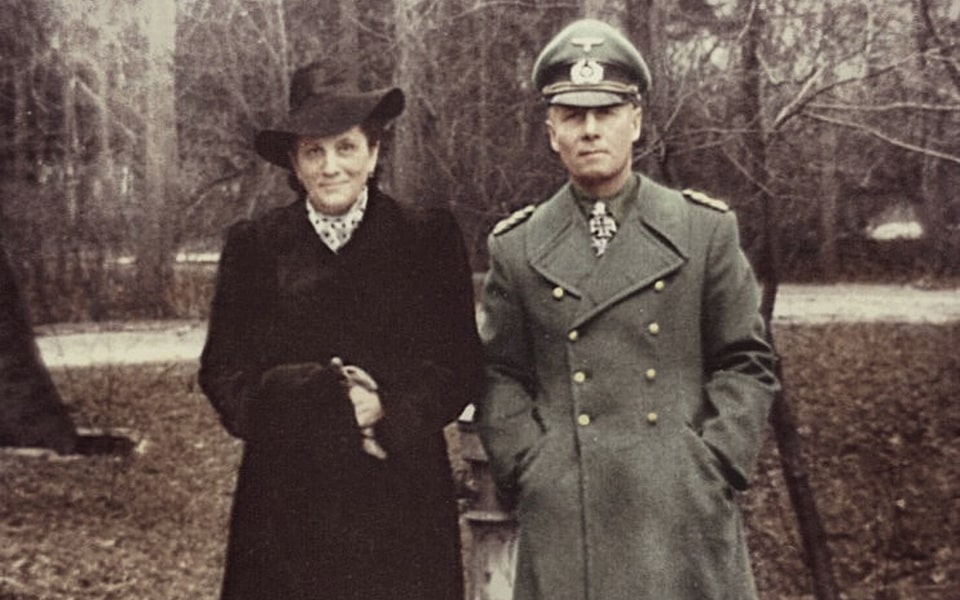
On June 6, 1944, the man who predicted D-Day almost word for word was home celebrating his wife's birthday.
Months before the invasion, Rommel told his aide:
"The first 24 hours of the invasion will be decisive. For the Allies, as well as Germany, it will be the longest day."
He wasn't being poetic. He genuinely believed Germany had exactly one chance to win the war: stop the Allies while they were still in the water. Get them on the beaches before they could breathe. After that, it was over.
So he became obsessed. He personally inspected every bunker on the Atlantic Wall. He demanded 6 million mines be laid along the French coast. He flooded inland marshes specifically to drown Allied paratroopers mid-drop.
Then on June 5, German meteorologists reported the Channel weather was far too rough for any crossing. Rommel exhaled for the first time in months.
His wife Lucie was turning 50 the next day. He had already bought her a gift on a recent trip to Paris: a pair of shoes.
He drove home to Herrlingen, Germany. Hundreds of miles from Normandy.
At dawn on June 6, the largest naval armada ever assembled opened fire on the French coast.
When Rommel's phone finally rang, tens of thousands of Allied troops were already ashore. He begged Hitler to release the Panzer reserves to crush the beachheads before they could solidify.
Hitler refused. He was still asleep. His staff would not wake him. When he finally rose, he was convinced Normandy was a decoy and the real invasion was still coming at Pas-de-Calais.
Rommel raced back through France. By the time he arrived that night, the beaches were lost.
The man who called it "the longest day" spent the most decisive hours of World War II at a birthday party, 600 miles away, holding a pair of shoes.
1
28
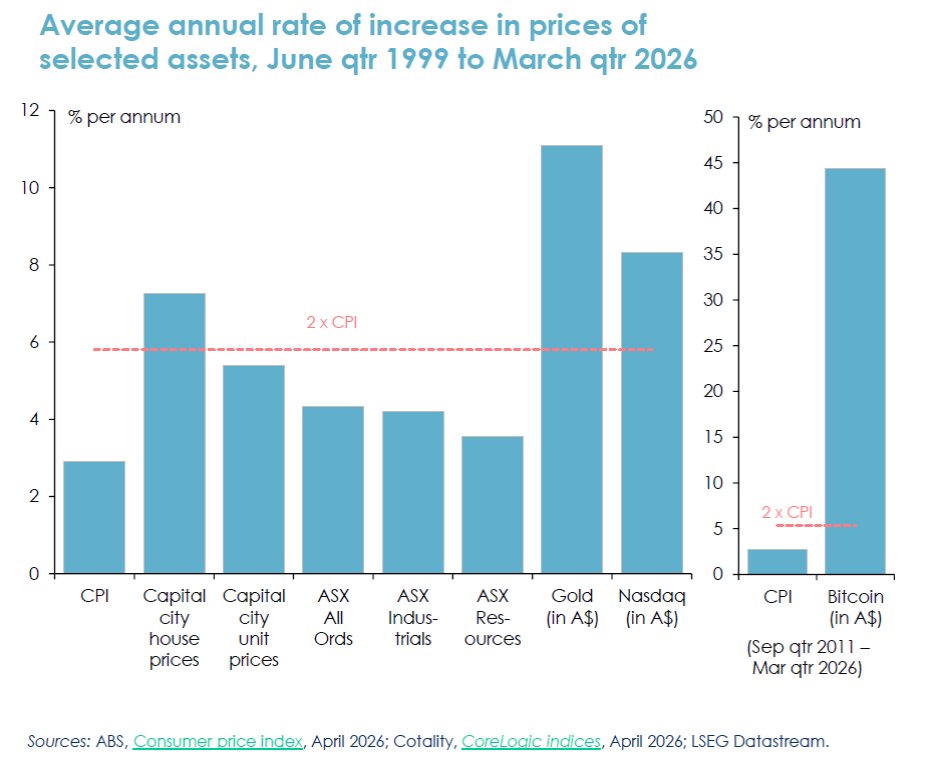
Who on earth wants to build a business that grows less than twice inflation?
Jun 1

We’re replacing the 50% CGT discount with inflation indexation.
Rule of thumb: if an asset’s price rises by less than twice inflation, indexation leaves you better off.
Saul Eslake’s analysis shows that’s been true for ASX share prices since 1999. #auspol #ausecon
23
May 29
We will tax them both at 50%, of course …
May 29

Australia should be a country where hard work, not what you inherit, gets you ahead in life.
13
PaddyOFitz retweeted

28 Jul 2025
World-renowned economist Richard Werner on where money comes from: banks just create it out of thin air, and keep a pile for themselves.
(0:00) How Werner Predicted the Japanese Financial Crisis
(14:16) How Banks Create Money From Nothing
(24:09) You’re Being Lied to About the Bank’s Role in Economics
(33:59) The Evils of the Federal Reserve
(38:51) Why Are Banks Allowed to Create Money?
(57:12) Was Leaving the Gold Standard a Mistake?
(1:09:30) The Difference Between Banks and Central Banks
(1:24:26) How Society and Culture Are Impacted by Banks
(1:33:11) Did the US Purposely Destroy the Japanese Economy?
(1:35:42) The Central Bank’s Attempt to Blacklist Werner
(1:39:03) The CIA’s Threat to Werner
(1:47:24) Why Werner’s Research on Credit Creation Scared the Central Banks
(2:03:55) The Link Between Central Banks and Warfare
(2:18:02) Where Is the US Economy Headed?
(2:29:49) The World Bank’s Debt Trap to Exploit Developing Countries
(2:35:34) The Dark Truth About Central Bank Digital Currency
(2:40:19) Where Can People Learn More About This?
Includes paid partnerships.
1,430
5,512
16,896
5,357,326
May 18
Amen: if you discovered a gold mine, would your first move be to go on to Twitter and say “post ‘Gold’ in the comments for the lat/long”?
May 18

with due respect, i personally think, no one would show others where the gold mine is
1
16
May 17
May 16

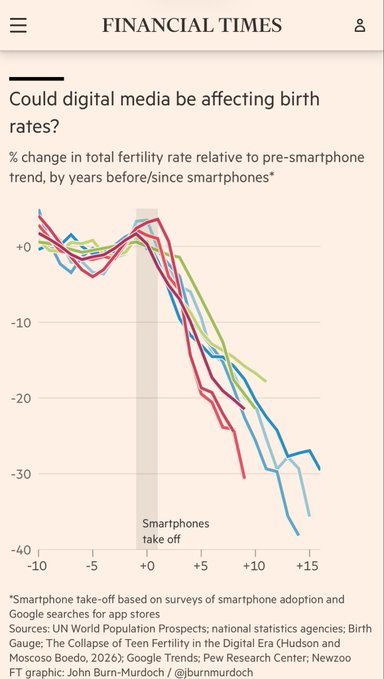
If Steve Jobs were still alive, he would have the moral authority to face and maybe even to solve this problem. But I doubt anyone in the phone business now does.
7
PaddyOFitz retweeted

Apr 20
Brief descriptions of the four main fallacies that have caused the macroeconomic management of the economy to fail.
jbhearn.wordpress.com/2016/0…
4
11
17
6,046
This would not be good for my versa-jim-cramer portfolio.
May 7

the next social network is a prediction market where your feed is ranked by accuracy not engagement. the person who is right 80% of the time gets seen while the person who is loud gets buried
25
Apr 30
We are one of three:
1. Thinking through outcomes
2. Knowingly ignoring them
3. Blissfully uncomprehending
Apr 29

Let me repeat what I've emphasized before: The post-Hormuz Crisis world will be radically different from the one we knew before. This is a life changing event for nations, governments, thinkers, businesses, and individuals.

1
31
Apr 30
This is how the Professional Managerial Class works. Nothing new here. Bounce like a pinball between: academia, business, politics, government, government-funded think-tanks. Salary and influence as high as you can make it. Accountability as low as you can make it.
Apr 29

Bill Shorten left politics and walked into a $990,000 a year job as Chancellor of the ANU.
He has never run a university.
He runs his network.
Dominic Perrottet went from premier to BHP international relations.
Joe Hockey went from treasurer to defence contracting. Politics in Australia is now a networking phase.
Voters pay the bill.
20
PaddyOFitz retweeted

Apr 25
Tordior is right. In the 1980s, the US and Europe encouraged Japanese investment because they thought it would bring the "Japanese" management style that explained Japan's manufacturing success.
But Japanese manufacturers ended up being no more successful than local ones once they were no longer protected by unlimited cheap financing, an undervalued currency, compliant labor unions, and government overspending on logistics and transportation infrastructure.
In fact by the late 1990s, when because of terrible debt burdens Japanese producers could no longer count on the factors that were the real secret of their international competitiveness, reformers in Europe and the US were no longer demanding that their businesses become more "Japanese" in order to succeed. It was now Japanese reformers who insisted that their businesses become more "American".
The point is that Chinese manufacturing is not more competitive than European manufacturing because of some special Chinese sauce that can be sprinkled abroad as easily as it is sprinkled at home. It is more competitive because it is based in an economy in which its competitiveness is driven by intervention in the country's external accounts. That is not to say that there aren't individual sectors in which Chinese manufacturers are genuinely more efficient that Europeans, but these sectors only emerged after many years of substantial protection and support from the Chinese government.
The point is that if foreign manufacturers are aggressively outcompeting EU manufacturers because of substantial direct and indirect subsidies, the EU has three options. First, do nothing and see its share of global manufacturing wither. Second, match the subsidies and risk seeing the EU's debt burden rise as quickly as China's. Or three, intervene in the external account by enough to neutralize the effect of foreign ontervention.
All of this would probably be more obvious if the EU's biggest economy, Germany, hadn't once enjoyed (and still enjoys to some extent) many of the very advantages that now threaten it. Manufacturers in extremely competitive, surplus economies think that because they are more competitive globally, they must also be more efficient.
In fact, as Japan's example overwhelmingly illustrates, the direct and indirect subsidies that made their manufacturers so globally competitive also undermined their efficiency to such an extent that, once they were eliminated, many of them, unable to compete, quickly went bankrupt.
Apr 24

There is too much free lunching in the European debate on Chinese FDI.
Those who oppose tougher trade measures tend to underline the need for more Chinese investment, but that’s a cop-out.
The EU wont get the investment without strategic tariffs.
49
245
1,077
106,036
Apr 24
An often-missed angle on regulation: operationally it can often provide more protection to incumbents than IP laws. People would be surprised at how much regulation push comes from incumbents: looking not to stop it, but to control it’s scope.
Apr 24

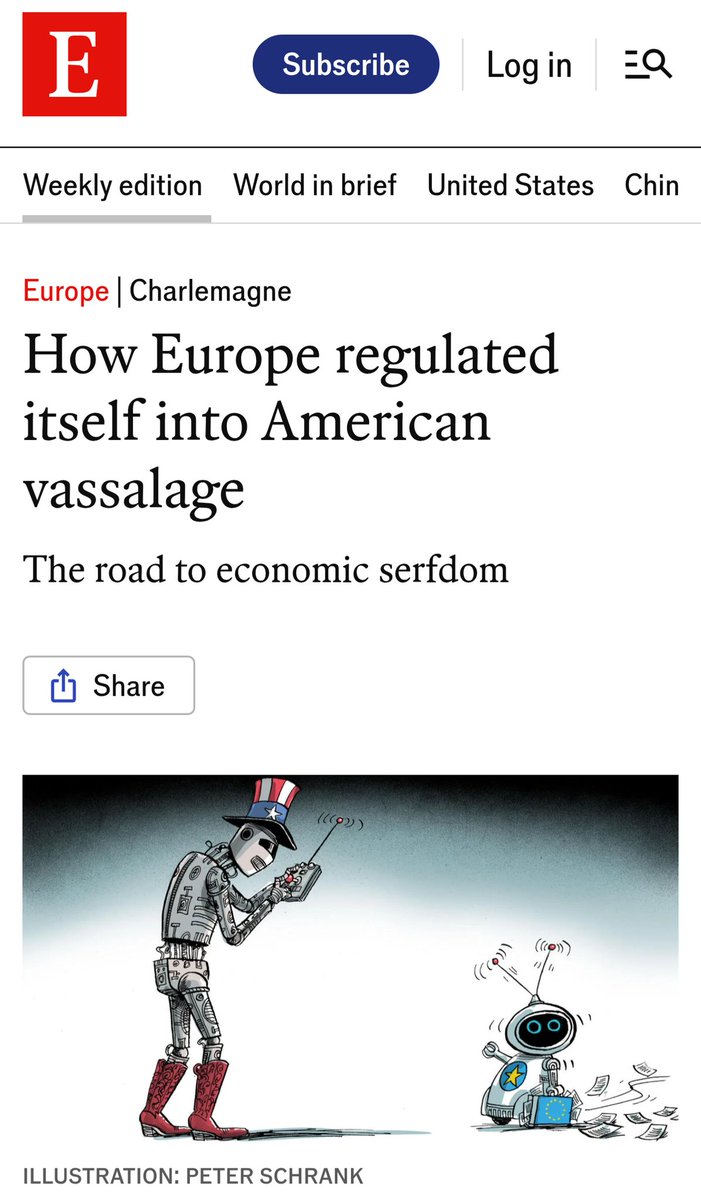
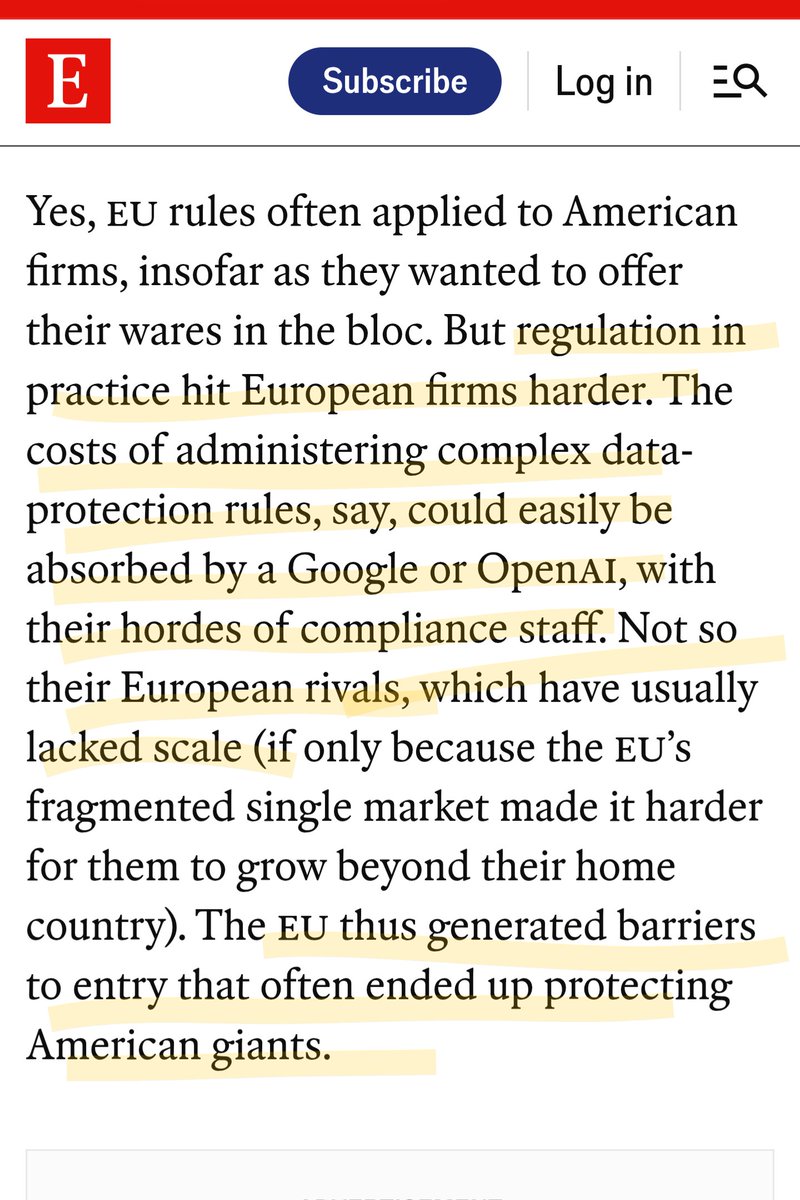
truly one of the most amazing developments in trans-Atlantic tech policy over the past 20 years is the way that Europe set out to regulate US tech giants into the ground, but only made them more dominant as a result.
This Economist headline really says it.
25
Apr 21
This is our bet. There are simply not enough good techies around to sort each company organically. Many of Lotus Notes failures came down to the lack of decent network admins who understood how to use it.

Mark Cuban just described the largest wealth transfer of the AI era.
Almost nobody understood what he said.
Cuban: “There are 33 million companies in this country. Aren’t going to have AI budgets. Aren’t going to have AI experts.”
Not tech startups.
The shoe store. The regional trucking outfit. The accounting firm with 12 employees.
The businesses that actually run the physical economy.
They know AI is coming. They have no idea what to do with it.
Cuban: “You’ve got the head of Microsoft saying software is dead because everything’s going to be customized to your unique utilization.”
Software is dead.
The SaaS era ran on one rule. Build a generic product. Force millions of companies to bend their workflows around it. Charge rent forever.
AI ends the contract.
The business stops bending to the software. The intelligence bends to the business.
But customized by whom.
The third-generation manufacturer cannot tell Claude from Gemini. The county hospital is staring at a reactor asking where the light switch is.
Cuban: “Who’s going to do it for them?”
That question is worth more than the frontier models themselves.
Hundreds of billions are being burned to build the foundation. The smartest engineers alive are locked in a bloodbath over who owns the base layer.
Let them fight.
Let them burn the capital. Let them drive the cost of raw intelligence toward zero.
Because the wealth does not collect where the brain is built.
It collects where the brain meets the business.
Every ambitious kid in college right now thinks survival means a seat at OpenAI or Anthropic.
Cuban is staring at the other 99 percent of the economy.
Learn the models. Then learn the messy, unglamorous reality of how a 50-person company actually operates.
Walk through the door. Understand their problems. Wire the intelligence directly into their revenue.
That is not a job title. That is an entire economic class being born.
You do not need to build the brain. You need to build the nervous system.
The biggest winners of the electricity era were not the engineers who built the generators. They were the ones who walked into dark factories and showed the owners where to plug in.
33 million companies are standing in the dark right now.
Silicon Valley is racing to build the god. The fortunes will belong to whoever teaches him a trade.
29
Apr 18
A sense of the trading world’s view of Venice on hearing of Vasco de Gama’s breakthrough voyage.
Apr 18

The Hormuz get-out-of-jail card turned to a grave.
iranintl.com/en/202604166412
29
Apr 17
This feels like the breast implant surgeon who pivots to being a implant removal surgeon.

"We made a huge mistake. And 'we' being business, government, and military."
Jamie Dimon on China:
"There was this general assumption they'd become more democratic and more free. And it didn't really happen that way."
"Too many people were changing the supply chains just because they're buying a piece of equipment for $10 less."
"Business was making a lot of money there and they were like, 'Leave me alone.' It was a mistake."
"We need to say: 'Can we, if they ever become an adversary, have all the things we need?' Now's the time to do it."
The Hill & Valley Forum 2026
@HillValleyForum @jpmorgan @ChairmanG
25
Apr 17
This is “decline of a Roman Empire” stuff. Like that empire, the main problem here is that all sides are doing it.
Apr 17

The insider trading is dishonorable behavior and annoys all normal US citizen taxpayers who are just trying to make an honest living
1
32