
Your Planet is Doomed
Joined August 2011
- Tweets 26,937
- Following 3,225
- Followers 737
- Likes 171,535
1,200 Photos and videos





Pinned Tweet

10 Nov 2022
TIL that one of the ways to say "I love you" in Japanese translates to "Will you make me miso soup every day?" and I'm just 🥹
6
1
31
molotovs against malarkey 𝕄 retweeted

Jun 12
Thanks I forgot:
Joe Biden received 81 million votes. More than any candidate for President in the history of this country. It was a total landslide. A wipe out of historic proportions. He then went on to pass more bipartisan legislation than any President since LBJ. Conversely Donald Trump has not done much except start a war no one wanted doubled inflation expanded the trade deficit to historic highs and enriched himself and his family to the tune of billions of dollars.
424
3,715
18,179
181,794
molotovs against malarkey 𝕄 retweeted

Jun 11
There’s more evidence of Trump being a child rapist than there is evidence of voter fraud.
823
7,338
42,313
370,529
molotovs against malarkey 𝕄 retweeted

Jun 11
HEY MAGA! 🤣
I’ve been saying this from jump. The Reflecting Pool was going to end up looking like a green swamp, not blue. I just didn’t expect it to happen this fast.
One day after it was filled, there’s already a ton of algae.
And let’s be clear: this dude vacuuming the bottom is only part of the process. Without filtration and chemical treatment, the algae is here to stay.
1,779
3,431
11,530
821,248
RT @LACentrist: Non-local election deniers commenting on LA’s election push absurd conspiracy theories. It is incredibly frustrating to see…
7
molotovs against malarkey 𝕄 retweeted

Jun 11
It’s not about arguments. It’s about facts.
I know one great fact about American elections, and I know it because the Republican Party has proved it to me:
There is no election fraud of any consequence anywhere in the United States.
The Republican Party and its allies, FOR DECADES, have been searching high and low, in every corner of our country, for evidence of election fraud.
This effort has been made with vast sums of money and other resources, and with some of the greatest powers in our nation at the party’s disposal:
A presidential commission under President Donald Trump.
The Department of Justice under President Donald Trump, armed with the resources of the FBI, and the powers of subpoena.
Committees of Congress under Republican control, also armed with the powers of subpoena and the investigative resources of the first branch of government.
State legislatures under Republican control, also with subpoena powers, have launched similar efforts to find evidence of election fraud.
Republican-controlled states have set up special commissions and task forces, some with subpoena powers, all well-funded and with access to the state’s electoral systems.
Conservative academics and think tanks have launched projects seeking out evidence of election fraud.
Fox News and the rest of MAGA media have dedicated significant resources to finding evidence of election fraud.
What is the result of this enormous Republican effort to find election fraud?
Ask The Heritage Foundation.
For nearly a decade, Heritage has maintained an “Election Fraud Database.”
The database contains “proven instances of election fraud.”
It covers elections going back nearly fifty years.
That’s billions and billions of American votes.
Right now, the total number of proven instances of election fraud that Heritage can document is:
1620.
That’s an infinitesimal number, vanishingly small, and it is solid proof of two things:
1. Some individuals commit election fraud.
2. There is no evidence at all of systemic or even widespread election fraud anywhere in the USA.
The election-fraud panic is the Big Lie of our time.
It is peddled by people who know better. Their own investigations over decades demonstrate that.
Stop trying to subvert our democracy.
🇺🇸 🇺🇸 🇺🇸

Whenever election fraud enters the news, libs seek out the worst arguments and mock them.
Instead of the straw men, why not seek a steel man argument?
Because when your tribal mind is made up, you're not interested in the steel man.
348
1,828
4,912
179,834
Finally a reasonable solution to the election credibility issue.

So would public executions for people found making baseless allegations of fraud.
Is there a way we can all meet in the middle instead?
50
molotovs against malarkey 𝕄 retweeted
Jun 9
Things the recovery industry will not tell you:
1. The drug worked. That is why people use it. Not weakness. Not moral failure.
A neurological event so complete and persuasive that any honest account of addiction has to start there.
The problem is not that the drug fails. The problem is that what it does is unrepeatable, and you will burn your entire life to the ground trying to get back to a place that no longer exists.
2. Shame is not guilt. Guilt says I did something bad. Shame says I am something bad. Guilt is appropriate. Shame is a cell with no windows. Most people use the words interchangeably. That mistake is lethal.
3. You cannot shame someone who has already named the thing you are holding over them. Say it first. Say it in plain light. The weapon drops.
4. Guilt can coexist with self-respect. Shame cannot. You can hold the damage and the dignity at the same time. I know because I live there.
5. Radical honesty does not give you back who you were. It hands you the clean slate of who you always wanted to be. The mask comes off. The cartoon other people drew of you stays on the page.
6. Nobody gets clean on a winning streak.
7. You have to be almost self-delusional in your forgiveness of yourself. (Go watch Chase Hughes)
8. The greatest sin was not the chaos. It was the absence. Being unavailable to the people who needed you.
9. Sustainable recovery starts with one thing: honesty with yourself. If you love an addict and want to help, that is the only door in.
10. I am only an expert on my recovery. Nobody is an expert on anyone else’s.
1,397
4,593
37,039
2,389,312
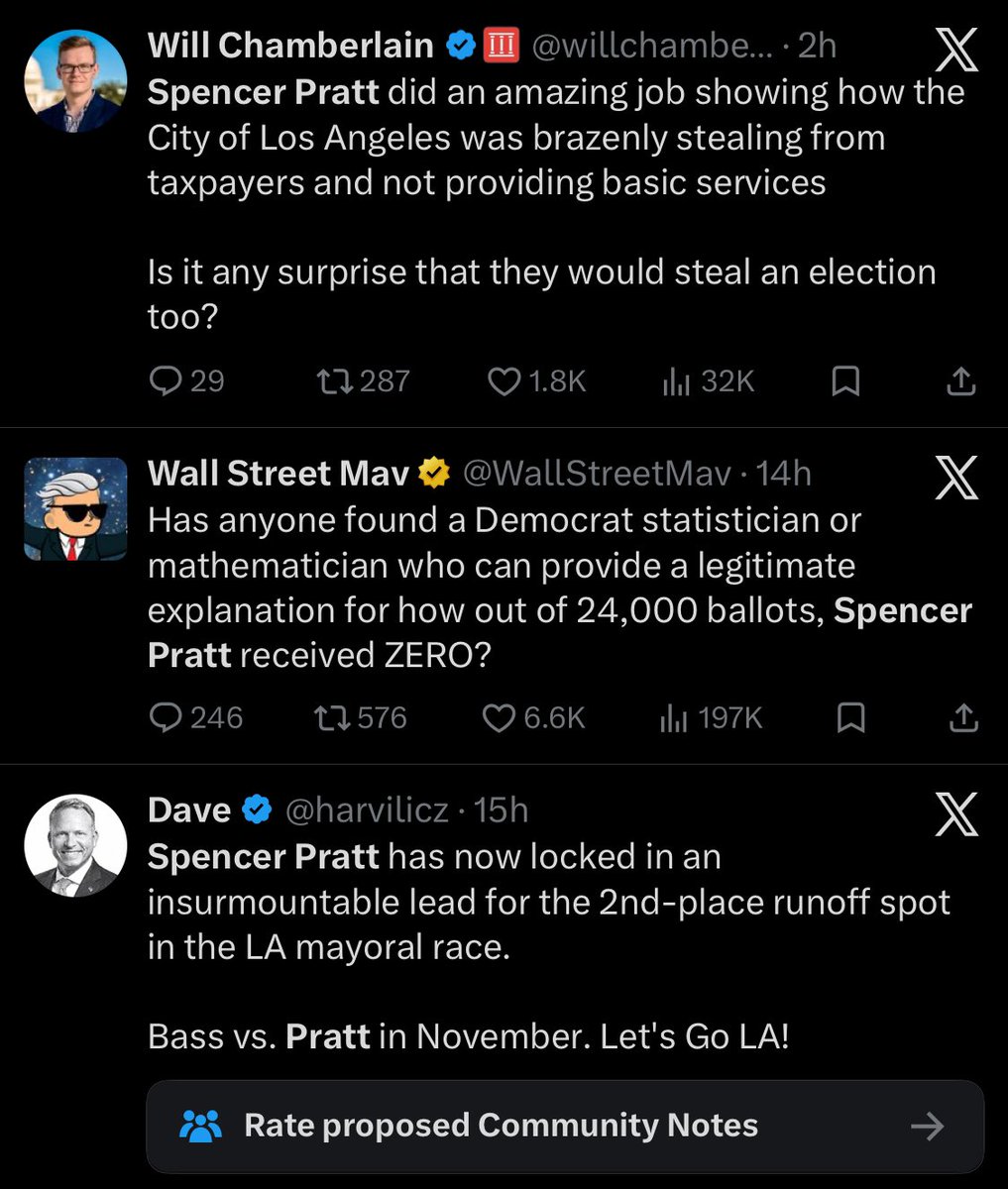
I knew there was cheating in the election. There's no way Pratt did better than Trump in LA lol
Jun 9

So this was MAGA’s idea to go to California and vote for Spencer Pratt illegally because some idiot told them they didn’t have to show ID.The funny part is they all swore they would show proof of them voting with no ID and they still haven’t. Why aren’t they all in jail.
22
molotovs against malarkey 𝕄 retweeted

Jun 9
While you’re here crying about ID in an election you can show no proof of fraud in, I can show you plenty of “verified” bots on X that undermine elections internationally and who you’ve personally amplified. Maybe start by requiring real verification if you’re boosting content?
175
39
458
11,343
molotovs against malarkey 𝕄 retweeted

Almost every sentence in this post is wrong.
“California’s universal mail-in ballots with no reliable post-election audits…”
California absolutely conducts post-election audits. By law, counties perform public manual tallies, and many counties conduct risk-limiting audits that compare paper ballots to reported results.
“lack basic verification”
California verifies voter registration, compares vote-by-mail signatures against signatures on file, contacts voters when signatures are missing or don’t match, allows voters to cure those issues, checks provisional ballots, reconciles ballot totals, and conducts a canvass before certification.
In fact, one of the biggest complaints people have about California is that counting takes too long. The reason it takes longer is because all of that verification is happening before certification.
“implement voter ID”
California already verifies voter identity. It simply does so through voter registration records, signature verification, and ballot validation procedures rather than requiring every voter to present photo ID at the polling place.
“paper trails”
California already uses paper ballots. That’s what makes recounts, manual tallies, and risk-limiting audits possible.
“same-day counting”
California accepts vote-by-mail ballots postmarked by Election Day and spends weeks verifying signatures, processing provisional ballots, curing ballot defects, reconciling records, and conducting the official canvass. The goal is accuracy, not speed.
“full transparency”
The process is already transparent. Ballot processing, signature verification, ballot handling, canvassing, and post-election audits are open to observers. Republican and Democratic observers routinely watch the process. Counting centers are under video surveillance, and many counties provide live video feeds so the public can watch ballot processing and counting activities in real time.
So your post is demanding audits California already performs, paper trails California already has, verification procedures California already uses, and transparency measures that already exist.
The only thing on that list California does not universally require is photo ID at the polling place. Everything else is largely a criticism of procedures that are already in place.
7
29
86
738
molotovs against malarkey 𝕄 retweeted

Jun 6
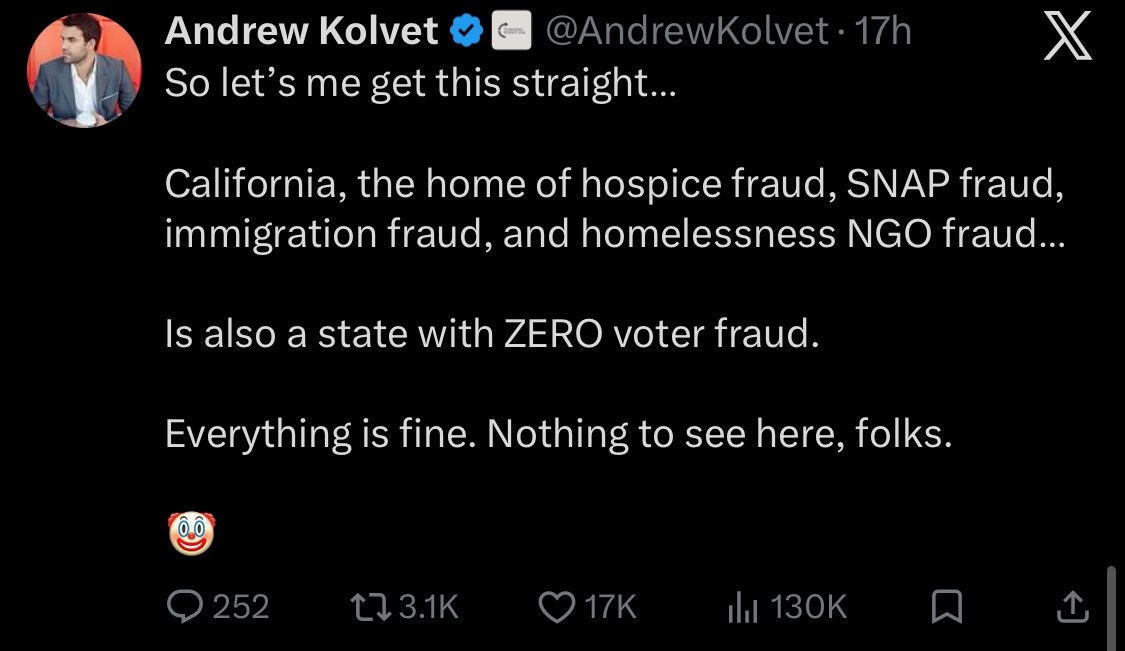
A key feature of American politics for the foreseeable future is Republicans brainwashing their supporters into thinking their election win rate is 100% and they only lose due to fraud. I think there are different, overlapping reasons for this. For TPUSA grifters it’s about keeping boomer donor money flowing at all costs because the right has lost young people and nobody else is giving them money. For others it is genuinely the result of ideological worms that have their brains in a chokehold. But all that is less important than the fact that the right is destabilizing force and there’s really no solution other than delivering one crushing defeat after another until the current GOP is swept into the dustbin.
20
154
710
31,078
molotovs against malarkey 𝕄 retweeted
Jun 7
You're arguing about whether the laptop was "real" because it's the only card you've got left. It was never the point. It was the bait - and you bit. Here's what the letter was actually about.
Long before that NY Post story, Trump's OWN intelligence community named Andrii Derkach a Russian agent running an operation to smear Biden over Ukraine. Not Schiff. Not CNN. Trump's own administration leaders - he was pissed about it.
Then Trump's OWN Treasury Secretary Mnuchin sanctioned Derkach — "an active Russian agent for over a decade." That's Giuliani's source. There are photos of the two of them cozied up in Kyiv with an OAN film crew to document it all.
Then Trump's OWN FBI director Wray went to Congress and said Russia was "very active," aiming "primarily to denigrate" Biden with a "steady drumbeat of misinformation." Trump hated him for it. You're to the right of Chris Wray on this.
So a laptop magically appears, through Giuliani, the guy taking material from a sanctioned Russian asset, to "prove" the exact narrative every serious agency had already flagged as a Kremlin op. And you think the suspicious thing was the letter?
The $5M "bribe" you still cite? FBI informant Alexander Smirnov pleaded GUILTY to fabricating it. He'd been talking to Russian intelligence. The whole case against the Bidens was a lie told by a Russian asset. Exactly what the 51 warned about.
The 51 didn't fall for it. You did. And you're STILL doing it. The laptop was never the story, you were.
76
1,150
4,760
70,947
molotovs against malarkey 𝕄 retweeted

Jun 6
This is really stupid, and it’s not getting enough attention.
The Trump administration is pulling a working $368 million ocean monitoring system out of the water, equipment taxpayers already bought, built, and sank into the deep ocean.
And they are doing it right when the oceans are behaving in ways that alarm the scientists who study them.
Record-breaking temperatures.
A system of Atlantic currents that may be lurching toward collapse.
The response?
Yank out the instruments and walk away.
That is not budgeting. That is smashing the gauges while the engine is on fire and calling it efficiency.
For what? The Trump administration dressed it up as a “nimbler approach” and “smart lifecycle management,” which is fancy nonsense for “we shut it off and hoped nobody would ask why.” There is no return-on-investment analysis. They cannot show taxpayers save a dime, because the gear is already paid for and the science it produces protects real money and real lives.
The kicker: the same people killing the monitors want to mine the deep sea for minerals. So they are destroying the only tools that could measure what that mining does. That is not an accident.
That is the point. You cannot see the damage if you break the instruments first.
cnn.com/2026/06/03/climate/o…
1,165
15,143
30,225
1,006,238
molotovs against malarkey 𝕄 retweeted

This is a devastating interview.
Scott Pelley tells the NYT that Bari Weiss directly put a “thumb on the scale” for Trump over the killing of Renee Good.
Here’s his explanation of exactly what happened.
1,278
15,968
53,472
3,131,259
molotovs against malarkey 𝕄 retweeted
Jun 6
Ha. No. So the “laptop” was never just a laptop. They hacked my could and there were several stolen devices. The legally blind (I kid you not) repair shop guy turned over a hard drive to Rudy and his lawyer. They (among others) then used that data I believe to hack into my cloud. They cobbled all of the disparate data together, organized it in sinisterly labeled folders and then distributed it first piecemeal through the NY Post and then ultimately put everything on the internet. Over 29 years of my digital footprint. I’d argue it the most egregious violation of privacy in modern politics. What they found was evidence of a man who suffered for a period of time from a severe addiction to crack cocaine and alcohol. What they did not find was anything to do with Bribery or foreign corruption or any crime aotside of those related to my drug use. Short answer I don’t have “the laptop “ - the whole world does and they’ve had it for 7 years now.
107
1,181
6,828
118,287
Based Hunter Biden just keeps on winning here. This should be common sense yet nobody’s willing to say it in U.S. politics.
Jun 5

I have lots to say about the atrocities being committed by Bibi Netanyahu in the name of the Israeli people. It must end. And there must be a two state solution. There must be a way for Palestinians and Israelis to live in peace. The murder of innocents is murder period.
1
93
molotovs against malarkey 𝕄 retweeted
Jun 5
Things most Americans agree on:
Groceries cost too much.
Tariffs suck and make no sense.
Congress and Presidents shouldn’t trade stocks.
The debt is a mess.
The border should be secure, but legal immigration is good.
Endless wars are stupid, especially ones that nobody wants and have never been explained.
Americans are exhausted.
AI is like my new best friend that also might be trying to take my job, my ability to think for myself, and my humanity in the process. Yo like I love you, but WTF, but I still love you.
Diversity is actually awesome! The opposite is boring AF.
Canadians are super fucking cool.
Mexicans are chill.
Putin isn’t a good guy looking out for America’s best interest. Rocky IV and Miracle are great movies.
Good neighbors are a blessing.
Freedom of religion and coexistence without having to blow each other up is probably a good idea.
We all question, are we alone in the universe?
We all fuck up along the way.
Epstein didn’t hang himself.
The Trumps and Epstein were best friends for decades. It’s like Bert trying to tell us Ernie was just an acquaintance in the same social scene on Sesame Street back in the day.
The Cowboys suck. Go Birds!
Things we’re told to fight about:
Me.
Laptop.
Vaccines.
Transgenders in sports.
Pronouns.
That’s the joke.
7,640
17,155
142,468
13,171,939
molotovs against malarkey 𝕄 retweeted
Jun 4
Stephen Miller is an ugly fuck.
1,178
6,742
80,466
2,452,390
molotovs against malarkey 𝕄 retweeted
Jun 4
WTF timeline are we on. Someone called me the MAGA whisperer and I’ll gladly take the title. Left, right, D or R we all want the same things. We’re being divided on purpose by the Epstein Elite Oligarch class because as long as we’re at each other’s throats, they get fat and rich off of our misery. The second we figure out we agree on more than we disagree, they’re done. Love your neighbor. Be yourself. Radical honesty. No fucks given, no fucks taken. Everything else is just noise. (But still fuck Jake “Brick Tamland” Tapper on any time line)
5,640
17,101
175,992
8,333,626