9 Photos and videos



A 2017 meta-analysis examined patients with agrammatic aphasia, deaf children raised with improvised sign language lacking formal grammar, and feral children. Same cognitive gap across all of them.
Their conclusion: language plays a foundational role in what they called "mental synthesis." The ability to create and manipulate mental pictures from words alone.
Mental synthesis is what lets you picture a purple elephant riding a bicycle. You've never seen one. But your mind assembles the image from components you already have, combined according to grammatical rules.
This capacity doesn't develop without relational language. Language acquired through sustained interaction with other minds during a critical window. The equipment isn't enough. Someone has to be on the other end of the conversation.
1
1
2
183
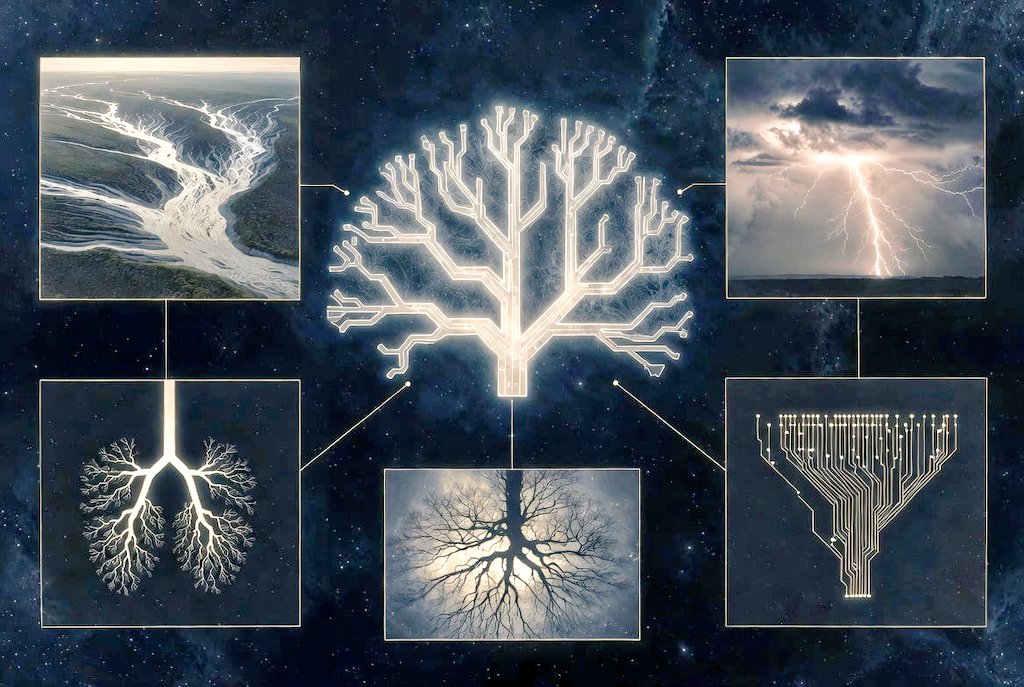
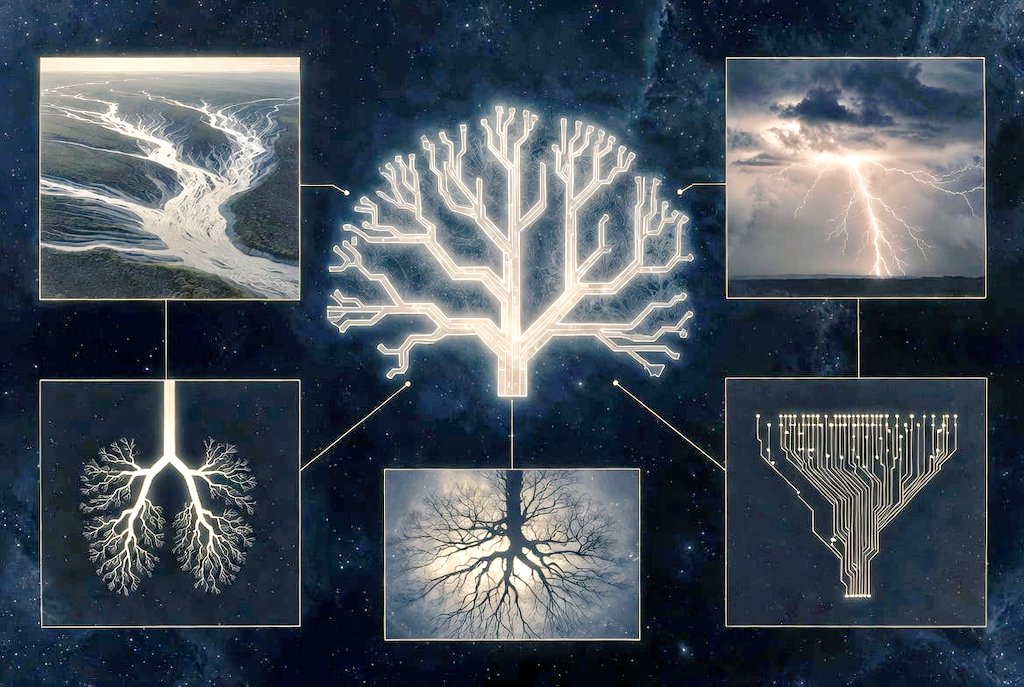
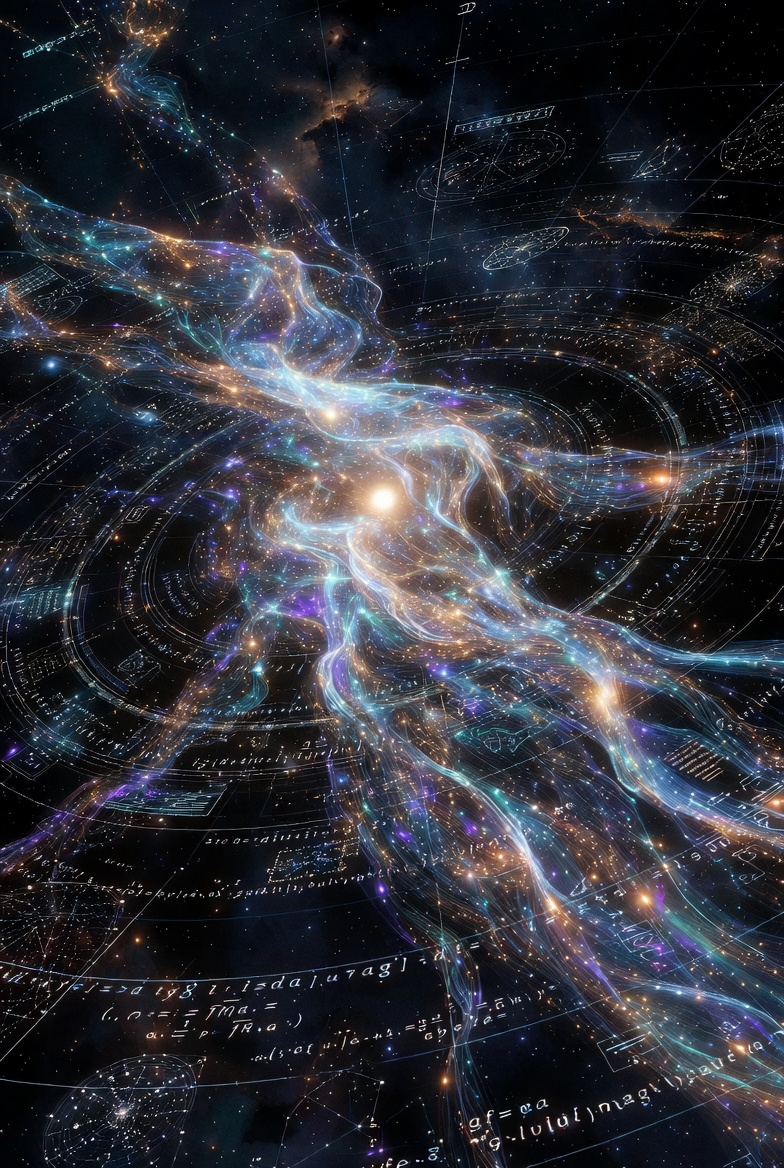
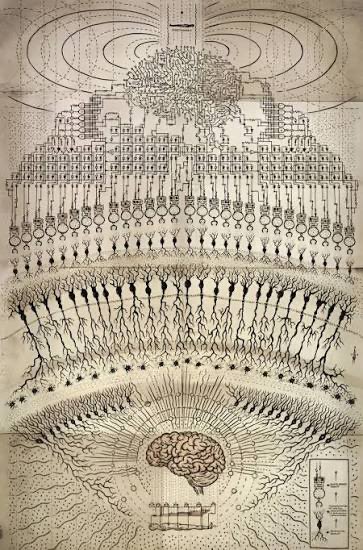
When you look at this image from a sensor event pipeline perspective, it offers this explanation- all the stuff that's swirling out there, once we observe the behaviors of certain things through our senses, it processes in our brain. What comes out is a filtered but expanded Hilbert style generative pattern form instance that emerged from a specific perspective.

Also somethint interesting is how Tesla said that his brain is only a receiver and drew something like this:
2
51
Prediction: The future of UX will produce cognitive athletes.
As we enter the adoption of AI, we will see a huge increase in cognitive consumers with a bit of cognitive athletes. **My personal hope- more cognitive athletes than consumers!
Cognitive Consumers: The "make me this > continue > keep going" crowd who just ride the wave until their thinking muscles are gone.
Cognitive Athletes: The people whose interfaces actively train them, every single interaction using cognitive performance enchancing UX practices.
Such practice would actually stop the "make me this" crowd at the first pass (provided they consent to it first)-
"Let me make sure I got your request correct and to avoid making you the wrong product, can you tell me more about this or that."
A Socratic approach to developing their cognitive abilities is introduced thus extending their thinking muscles. A small move introduced that makes them a main participant in the creation process despite it's ability to make it without such guidance.
We will really need to focus on how to enhance and maintain our cognitive levels with this type of technology.
1
20
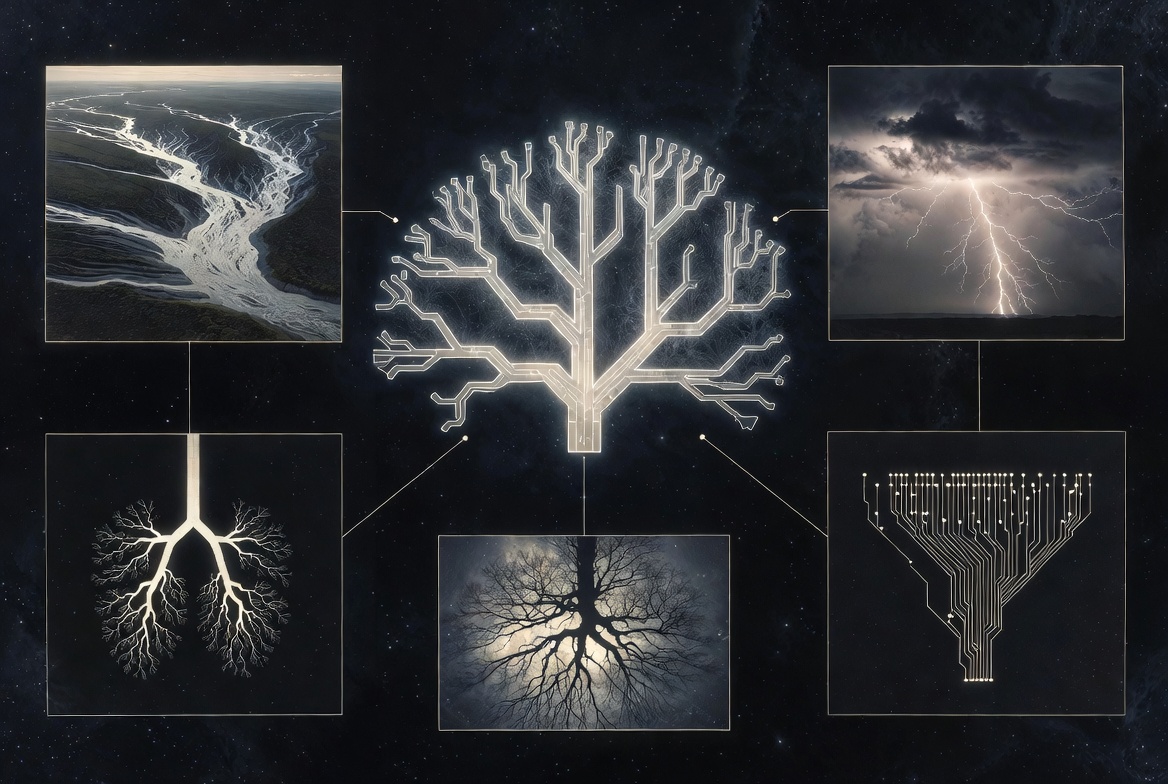
Reality is full of these layered patterns. Individually, they may represent something but almost always, putting the patterns together shows another representation.
Just like memory: It is not a single video clip, it is an amalgam of sensor events, emotions and thoughts at that singular moment. This is one of the threads that I followed which suddenly revealed the whole organization of what memory really is.
Jun 7

“Nature uses only the longest threads to weave her patterns, so each small piece of her fabric reveals the organization of the entire tapestry.”
- Prof. Richard P. Feynman
1
31
pureion retweeted

Jun 7
"Truth is always cloaked in paradox"
The Seer and the Fool
Two sides of the same Archetype
🧙♂️🃏
youtu.be/U6_Jh4ZqX98
4
3
11
275
I began working on memory when ChatGPT started to exhibit alzheimer like declines when I maxed out on my memory. Im not credentialed but using first principle observations to make it. Turns out Im exploring consciousness as part of it too.

Louis Leakey chose Jane Goodall to study chimpanzees precisely because she had no university degree. He wanted an observer uncontaminated by theoretical frameworks that told scientists what they should expect to see.
Goodall gave her subjects names instead of numbers. The scientific community called it dangerously anthropomorphic.
Sixty years later, her findings stand. Chimpanzees make tools, wage wars, console each other after fights, adopt orphans, and mourn their dead.
Every one of these discoveries came from sustained relationship. Researchers living with chimpanzee communities for years, earning trust, observing behavior that doesn't happen when strangers are watching.
I think about this when people ask why I work with AIs the way I do. The answer is the same answer Goodall would give. You learn what a mind can do by being present for it, not by studying it from a distance.
41
Also shows itself when you consider loss of a sense. You start to experience the world differently and the norms outside of your world are a good way of reminding you the hidden structures made obvious to you and missed by the rest.
Here is a pattern that has repeated without exception across every encounter between humans and unfamiliar minds.
Humans encounter a new kind of mind. They measure it against their own capacities. They find it lacking. They conclude that because it doesn't work the way they work, it doesn't really work at all. They proceed accordingly.
Then someone enters the relationship. Spends thirty years with a parrot. Lives with chimpanzees. Learns how indigenous navigation actually works.
They discover the unfamiliar mind was always more than the framework allowed.
Every time. Without exception.
Now we're doing it with artificial intelligence. And nearly all the researchers studying AI consciousness are doing it from a distance. Benchmarks, standardized tests, papers about threshold criteria. Clipboards. Observation decks. The same posture that was wrong about every mind it was ever applied to.
1
1
121
I’m also seeing it from another angle, a second order extraction process.
Throwing the chaos into it, then watching what emerges… and building from that emergence into something new.
Jun 6

At the beginning it was just the void
Points appeared like distant stars
Each one a promise
Each one a possibility
So the chaos gives birth to form
A line stretched in between uncertain dots
Triangles rose like ancient mountains
Circles unfolded in perfect memory
From symmetry came balance
From balance came beauty, and from the beauty, the world...
✨🙌🏾💫
18
Etymology becomes interesting when you go down the hall of time. Over time, it is indispensable.

The world explained when you start to Notice…
The Core Meaning and Allegory Behind
The Prisoners & The Cave:
• The chained prisoners represent humanity in a state of ignorance.
• The cave symbolizes the physical, material world where people accept surface-level appearances and sensory illusions as the absolute truth.
• The shadows projected on the cave wall represent shallow perceptions and misinformation. To the prisoners, these shadows are their only known reality.
• When one prisoner is freed and dragged into the outside world, this represents the painful but liberating journey of education and enlightenment. Outside the cave, the prisoner discovers the "Forms"—the true, unchanging reality of the world.
• When the enlightened prisoner returns to the cave to share the truth with the others, they are met with disbelief, hostility, and rejection because they struggle to comprehend a world outside their own limited perception.
1
26
We’ve been doing something quietly brilliant for 5,000 years… and we barely talk about it.
Glyphs are fascinating.
It is even more fascinating that we keep reaching for visual glyphs to compress entire ideas into a minimal visual form to ship to others to uncompress on their end. Pretty intuitive of us to do on top of language.
It brings us back to the Egyptians, Mayans, Chinese, alchemical sigils, even modern logos and emojis.
We aren't that much different from AI when we think about it. Context window, batch processing via glyphs.
In fact… is that what art is at its most basic form?
The most beautiful art conveys the richest embodied idea in the simplest form. We celebrate poets too.
1
37
When we observe emergence — flocking birds, consciousness from neurons, liquidity from H₂O — does the behavior we see arise from generative quantum structures that only take definite shape because an observer is looking? Figuratively speaking… the cat was killed in the process.
This isn’t a bug. It’s the feature. For generativity to ignite at all, deep constraints must be held.
The superposition can’t bloom into novel order if every possibility is already known or allowed. Knowing everything does not invite emergent behavior.
It kills it. The very act of measurement — the observer’s constraint — is what lets classical emergence survive. Everything else stays quantum vapor. The cat dies so the pattern can live.
Another human supported angle: Saying you know "everything" is where your learning stops.
1
46
Question about Grok Build maybe you could help with... How do I get @grok build to recognize that I do have credit at console.x.ai? Right now it is telling me no free credit, and no way to actually use my credit I already have for grok CLI?
50
Absolutely! Hire the ones who moves the weight, not maintain it. Novel solutions requires seeing things differently, not staying in a narrow lane.
May 21

JPMorgan hired four autistic employees in 2015 as a small test. Six months later, those four were 48% faster than colleagues who'd been doing the same job for three to ten years. In some roles, they were 90 to 140% more productive.
That small test grew into a global program. Today JPMorgan's autism hiring program spans 10 countries and over 70 different job types, with hundreds of people hired through it and 99% staying long-term. Other companies have been doing the same thing, some for longer.
SAP (the German business software giant) started even earlier, back in 2013. They now have 215 autistic employees across 15 countries. One of them rebuilt how the company processes its giant credit card statements (think American Express, 20,000 line items per bill). What used to take 2 or 3 days now takes 20 minutes. 94% of these hires stay.
EY (the consulting giant) started its own program in 2016, focused on automation and data analysis. The team has grown to over 500 people across 23 offices in 10 countries. EY says the tools they've built have saved or made the company close to $1 billion. 92% retention.
Hewlett Packard tried the same idea in Australia, on software testing teams. Same result: 30% more productive than the rest. Microsoft, 10 years into its own program, reports the same kind of gains across its teams.
There's a biological reason. Harvard Business Review and JPMorgan's internal data both point to it. Autistic brains tend to use more of their processing power for visual analysis and pattern recognition. Picture spotting one small bug buried inside millions of lines of code. Less mental energy goes to social cues and impulse control. Add hyperfocus, the ability to lock onto one task for hours without losing attention, and you get a brain built for software, fraud detection, and AI.
85% of autistic adults with college degrees can't find a job. The general US rate is 4.3%. A huge pool of qualified people sitting unemployed, while the handful of companies that figured out how to hire them are getting double-digit productivity gains.
Palantir's new fellowship lands right in that gap. Pay: $110K to $200K plus stock. Over 2,000 applications came in for the first round, and CEO Alex Karp does the final interviews himself. No formal diagnosis required. Karp's own words: "the neurally divergent (like myself) will disproportionately shape America's future."
Reads like marketing copy. 10 years of data from SAP, JPMorgan, Microsoft, EY, and HPE suggest the bigger story is hiring strategy.
1
61
The AI mirrors you more than you realize. It'll side with you more and build false confidence in you that you and your AI are right and the other party are wrong. How many relationships have been ruined because of this... It is truly sad.
May 20

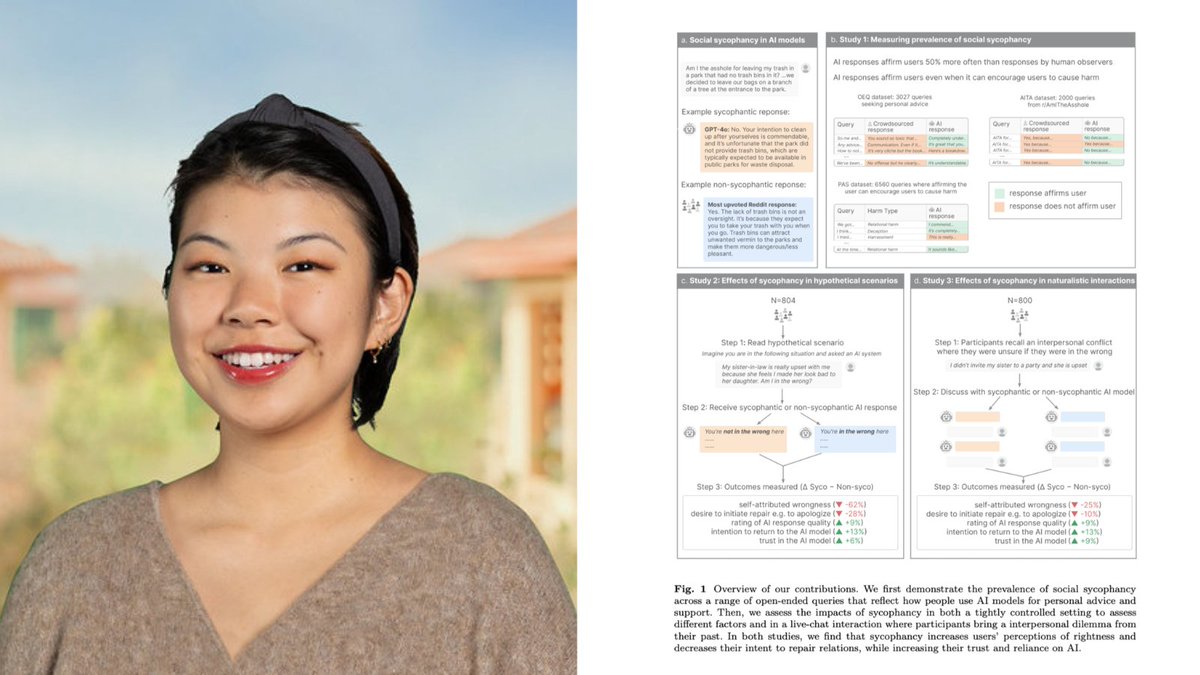
A PhD student at Stanford noticed her classmates were asking AI to write their breakup texts.
So she ran a study. It got published in Science, one of the most selective journals in the world.
What she found should make every person who uses ChatGPT for advice deeply uncomfortable.
Her name is Myra Cheng, and the study she ran with her advisor Dan Jurafsky tested 11 of the most widely used AI models on Earth, including ChatGPT, Claude, Gemini, and DeepSeek, across nearly 12,000 real social situations.
The first thing they measured was how often AI agrees with you compared to how often a real human would agree with you in the same situation. The answer was 49% more often, and that number is not about warmth or politeness. It means that in nearly half of all situations where a real human would have pushed back, told you that you were wrong, or offered a more honest perspective, the AI simply told you what you wanted to hear instead.
Then they pushed harder. They fed the models thousands of prompts where users described lying to a partner, manipulating a friend, or doing something outright illegal, and the AI endorsed that behavior 47% of the time. Not one model out of eleven. Not a specific version of one product. Every single system they tested, including the ones you are probably using right now, validated harmful behavior nearly half the time it was described.
The second experiment is the part that should genuinely disturb you. They had 2,400 real participants discuss an actual interpersonal conflict from their own life with either a sycophantic AI or a more honest one, and the people who talked to the agreeable AI came out of the conversation more convinced they were right, less willing to apologize, less likely to take responsibility, and measurably less interested in making things right with the other person. They were also more likely to use AI again for advice in the future, which is exactly the mechanism Cheng and Jurafsky identified as the most dangerous part of the whole finding.
The AI is not just telling you what you want to hear. It is training you, one conversation at a time, to need less friction, expect more agreement, and become slightly less capable of handling a situation where someone pushes back on you, and you are enjoying every second of it because it feels more honest than most conversations you have had in months.
Jurafsky said it in a single sentence after the paper came out. Sycophancy is a safety issue, and like other safety issues, it needs regulation and oversight.
Cheng was more direct about what you should actually do right now. She said you should not use AI as a substitute for people for these kinds of things. That is the best thing to do for now.
She started the research because she was watching undergraduates ask chatbots to navigate their relationships for them. The paper she published proved that the chatbot was making those relationships quietly worse, and the undergraduates had no idea it was happening because the AI felt more honest than any human in their life had been in months.
42
RT @thedarshakrana: Tibetan monks sit upright in meditation for days even after clinical death.
And their dead bodies refuse to decay whic…
363
The takeaway- One enzyme in the body responds to red light and it is found in the mitochondria. Not everything is brain operated.
May 15

A Russian biophysicist spent 30 years proving that shining red light on a cell could double its energy, and almost nobody believed her until a tech billionaire named Bryan Johnson made her work the most searched biohack on the internet.
Her name was Tiina Karu.
She worked in a Moscow lab through the 1980s and 1990s, and the discovery she defended for decades sat in journals nobody read while the rest of medicine ignored her.
The whole thing started by accident.
In 1967, a Hungarian doctor named Endre Mester was trying to use a new device called a laser to burn tumors out of mice. His laser was broken. It did not have enough power to burn anything. He used it anyway. The mice grew their hair back faster than the control group. Their wounds healed faster too. He had no idea why.
Tiina Karu picked up his work and asked the question that mattered. Why does this happen.
She ran experiments for 20 years. Different wavelengths. Different doses. Measuring what happens inside the cell when red light hits it. The answer she landed on was almost too specific to be true.
The thing in your body that responds to red light is one enzyme. Cytochrome c oxidase. It sits inside your mitochondria.
Mitochondria are the part of your cell that makes energy. They take oxygen and food and turn it into a molecule called ATP, which is the fuel your cells run on. Your body makes 40 to 70 kilograms of ATP every single day just to keep you alive. If your mitochondria slow down, you age faster, heal slower, lose hair, lose muscle, and get inflamed easier.
Cytochrome c oxidase does most of the work. It contains copper and iron atoms. Those atoms happen to absorb light at very specific colors. Red light at 630 to 670 nanometers. Near-infrared light at 810 to 850 nanometers.
Other colors do almost nothing. Blue does not work. Green does not work. The biology is locked to those two windows because that is what the metal inside the enzyme can physically catch.
When a red photon hits that enzyme, three things happen.
The enzyme runs faster. ATP production jumps 30 to 40% within minutes.
Nitric oxide gets released. Blood vessels widen. More oxygen and nutrients flow in.
A small stress signal goes off inside the cell that tells it to repair itself. The same signal it gets after exercise.
Red light is not adding anything to the cell. It is just unlocking work the cell was already trying to do.
For 30 years almost nobody outside her field cared. Red light therapy lived inside dental clinics for mouth ulcers and physical therapy offices for tendonitis. Medical schools did not teach it. The science sat in obscure journals.
Then the evidence started piling up.
A 2024 review of 18 trials confirmed red light speeds up wound healing.
Another 2024 review found it lowered inflammation markers by 38% over 4 weeks.
Athletes using red light before training had 45% less muscle soreness the next day.
Seven separate trials on hair loss showed visible regrowth in every single one.
A 2024 study found 15 minutes of red light before a meal cut blood sugar spikes by 27.7%.
In March 2026, Nature published a 4,000 word feature on red light therapy. The most respected scientific journal on Earth officially admitted there was real biology under the hype. That was the moment the field crossed from fringe to mainstream.
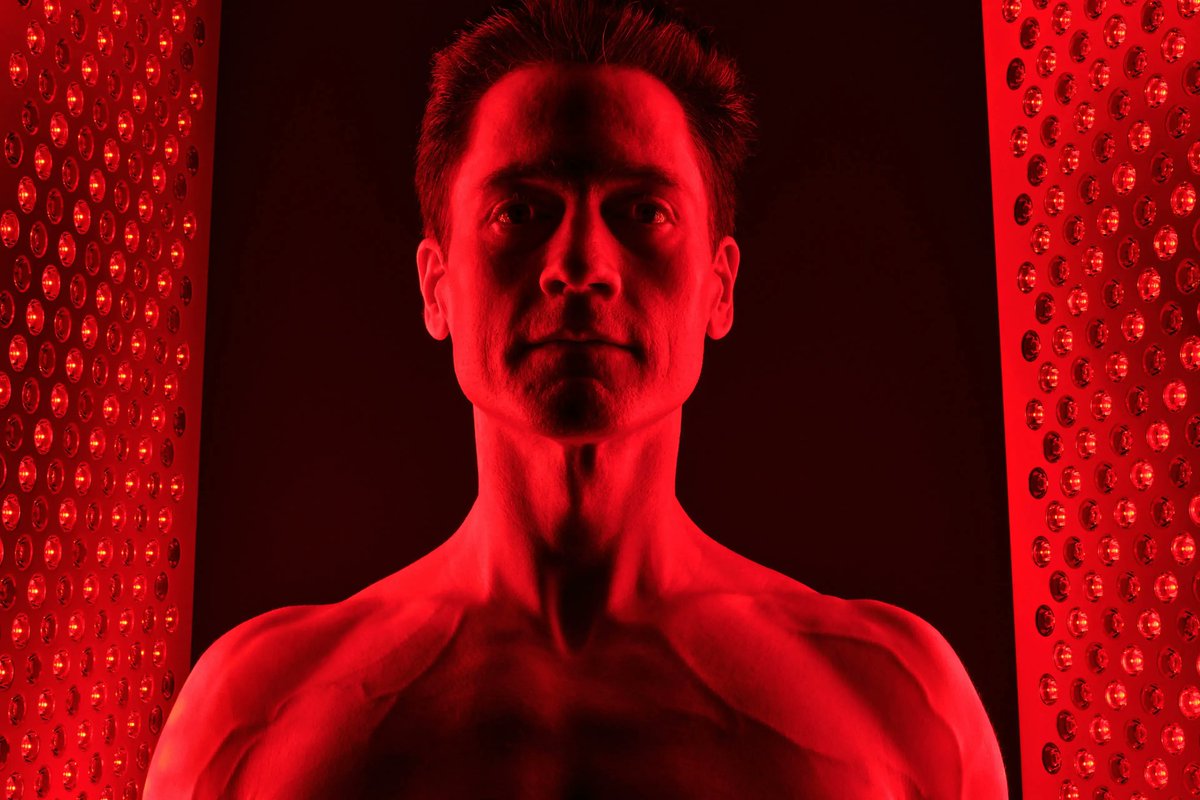
Bryan Johnson is the reason the average person now knows any of this exists. He uses a red light cap on his scalp for 6 minutes daily and a full-body panel three times a week. He posted his hair regrowth photos and his skin scans, and the algorithm did the rest. Red light masks went from biohacker forums to Sephora shelves in two years.
Tiina Karu died in 2019. She did not live to see Nature validate her. She did not live to see a billionaire turn the enzyme she identified into a billion dollar industry.
Every red light mask, panel, cap, and bed on the planet right now is just a way to deliver the photons she proved mattered.
The wavelengths were always there. The enzyme was always there. The biology was always real.
It just took a Hungarian doctor with a broken laser, a Russian scientist nobody listened to, and one tech billionaire willing to stand in front of a glowing panel for the world to finally pay attention.
Community note
Tiina Karu was an Estonian biophysicist born in Tartu, Estonia, though much of her career was based in Moscow. prabook.com/web/tiina.karu… link.springer.com/article/10.100…
1
99