
Joined September 2016
- Tweets 8,049
- Following 1,183
- Followers 527
- Likes 9,120
234 Photos and videos
















4h
Haven't followed @MPelletierCIO enough to know his general @elonmusk assessment, but I feel like he's either anchored on Elon and teams as not being as exceptional as I do or is failing to see that Elon Inc. succeeding is supportive of his point.
Elon and his teams dragged these companies through the reg capture and industry concentration that Martin points to. He and the team's he has built are the dramatic exception to the norm. And they have accrued the disproportionate value as a result.
We NEED more success stories that don't require this level of exceptional talent, execution, luck, etc. to succeed. Exactly to your point.
7
Jun 3
Wen $EOSE starting a rocket company that will buy an EOSE founded AI company to buy all the indensities? @JoeMastrangelo8?
Jun 3

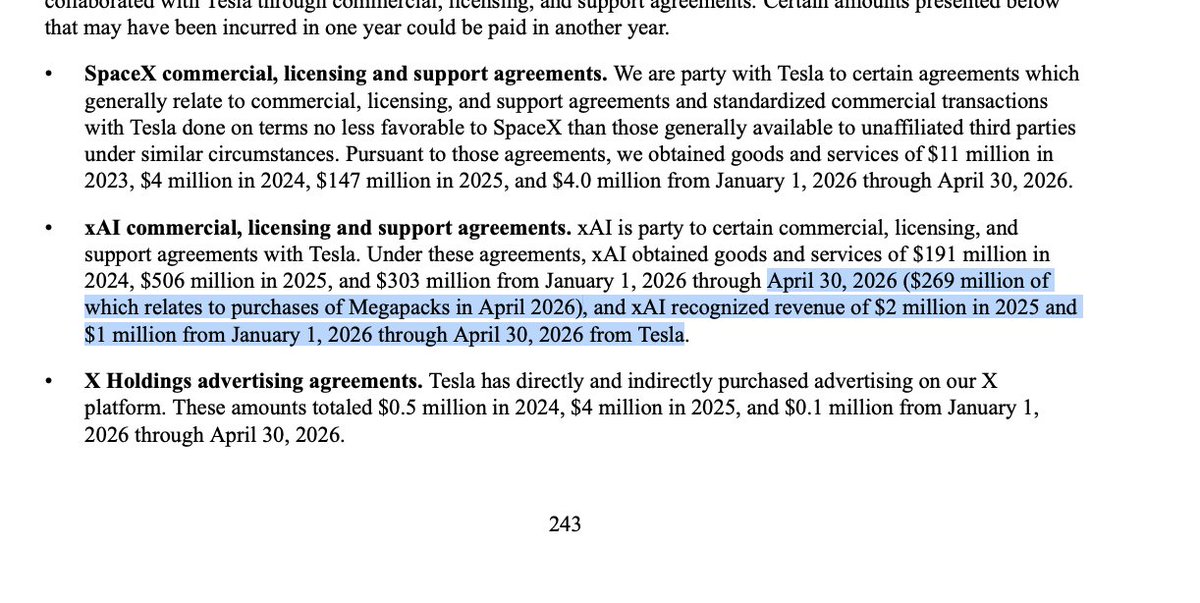
SpaceX has just revealed that it purchased $269 million worth of @Tesla Megapacks in April 2026, according to a new filing.
This is on top of the $430 million worth of Megapacks that SpaceXAI bought last year.

1
592

Three years since the first flight of Starship, the next generation is here. New ship. New booster. New engines. New pad and new test site. SpaceX engineers are working to solve one of the most difficult engineering challenges in history: developing a fully, rapidly reusable rocket
1,763
5,980
31,885
7,390,039
Paul retweeted

Apr 11
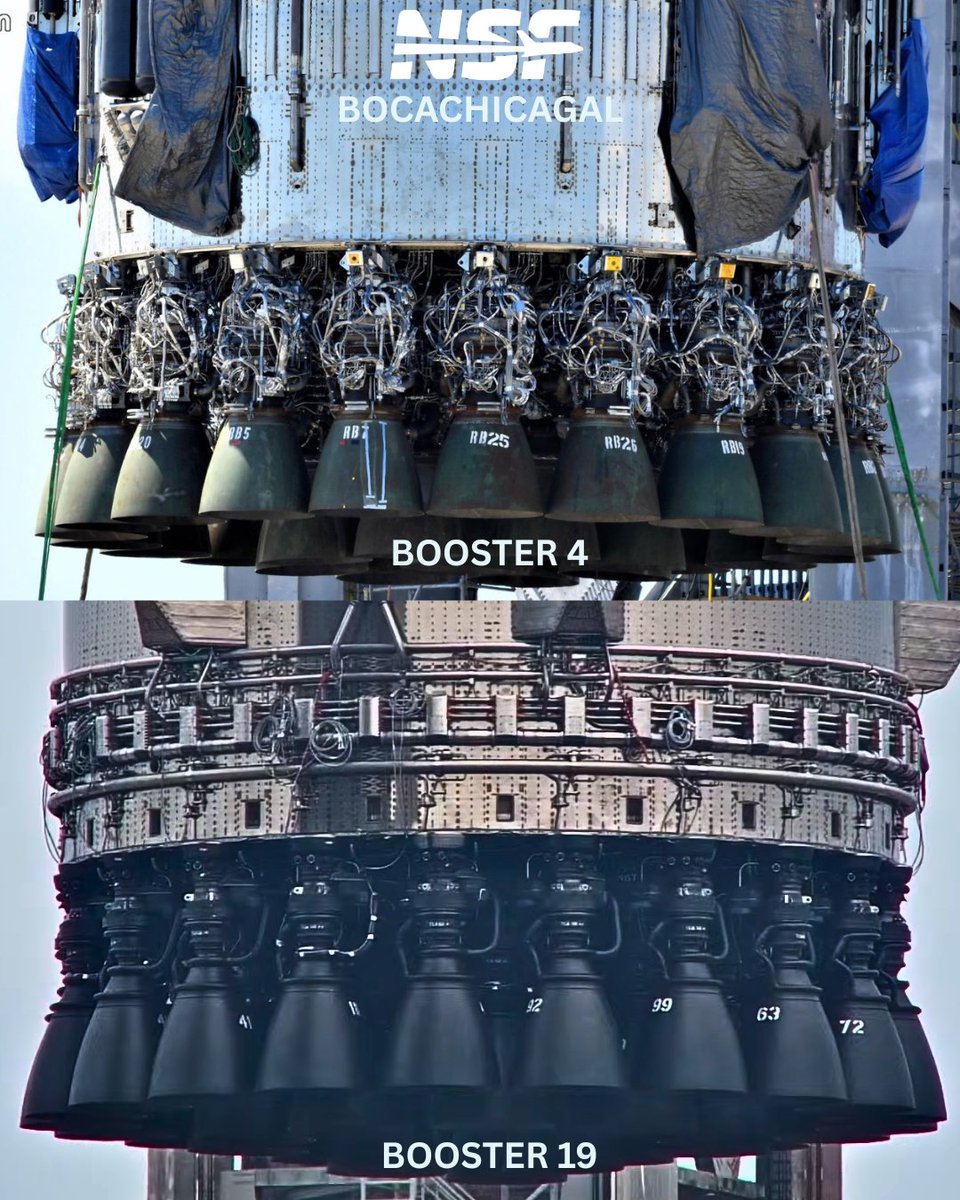
Superheavy's evolution has been quite something to watch over the years! 😍
📸: @BocaChicaGal | @NASASpaceflight
441
2,012
19,760
30,603,353
Paul retweeted

Mar 28
Share a bit. I don’t want to belittle the category of software. People did amazing work in the world of payroll software (agile manifest etc). But at some point a csv is created and it has a row per payee and it happens twice a week. Shopify pays out millions of businesses and moves billions a day. And we took 20m of financing ever before we went public (and had it all still in the bank when we did).
The scale of nonsense that’s happening with government bespoke software is just unexplainable without fraudulent intent. But it also tracks with everything else you hear about government efficiency (minus maybe military). It’s not that it costs 10b to make a payroll software that is the problem. It’s that it costs this much for anything that the government tries to do itself. The only conclusion is that the government needs to do a lot less.
45
39
972
46,798
Feb 26
$EOSE What did Javidi see?🧐
4 Mar 2025

Strengthening Eos leadership to drive growth! CFO Nathan Kroeker promoted to CCO, applying his expertise to enhance customer solutions as Eric Javidi joins as our new CFO, bringing years of investing, banking & leadership experience in the energy space! investors.eose.com/news-rele…

1
4
370
Feb 26
Looking at my distribution of possible outcomes for this $EOSE release sure looks moronic my worst case scenario <$75m Q4 Rev and <$400m Guide. haha... fuck
1
3
843
Paul retweeted

Feb 22
Ashlee is one of the few journalists who can look at this space without jumping into the hype cycle. He was covering hardware back when working at SpaceX was not fashionable. When it looked irrational. When Elon Musk was mostly seen as a software founder burning PayPal money on rockets.
Unlike early commercial space, reindustrialization has attracted hype very early. That is both a signal and a risk. When capital flows in fast, narratives get shaped fast. “Kings” get crowned before capacity exists. Media (who has ties to capital 😉) sometimes amplifies what capital prefers. Storylines form ahead of execution.
That is not strategy. That is theater.
We just raised a significant round at Machina, and let me tell you that the political noise is real. You can feel how quickly this conversation shifts from engineering and throughput to positioning and perception. It is distracting if you let it be.
Look at the actual arc of SpaceX. “Occupy Mars” hasn’t happened yet. Elon and team had to find a long and creative and painful way to it. It was orbital launch 1st. Then commercial and military satellites. Then partial reusability. Then Starlink to create an internal revenue engine. Then full reusability. Now data centers in space. Detour to Moon on the way. Mars still ahead. 25 years in and the mission is still compounding.
The lesson is structural. You start with your orbital rocket.
If you are building in manufacturing, what is that equivalent today? What is the product you can ship now that generates real revenue, builds real capability, and funds the next layer? That is where you begin. Not with the end-state narrative.
Reindustrialization will not happen overnight. We will not close the gap with China in a single cycle. It will require founders and teams to sequence the climb intelligently. Revenue today. Capacity tomorrow. Strategic leverage after that.
And here is the hard truth: most of the investors backing companies in this wave will not have 25 year patience. So you design around that. You fund creatively. You stack wins. You build resilience for when the hype cools.
Because it will cool.
The real question is simple: when the spotlight moves on, are you still compounding capacity? Are you structured to survive the quiet years?
If the answer is yes, then you earn your way to “Mars.” Not through noise.
Feb 22

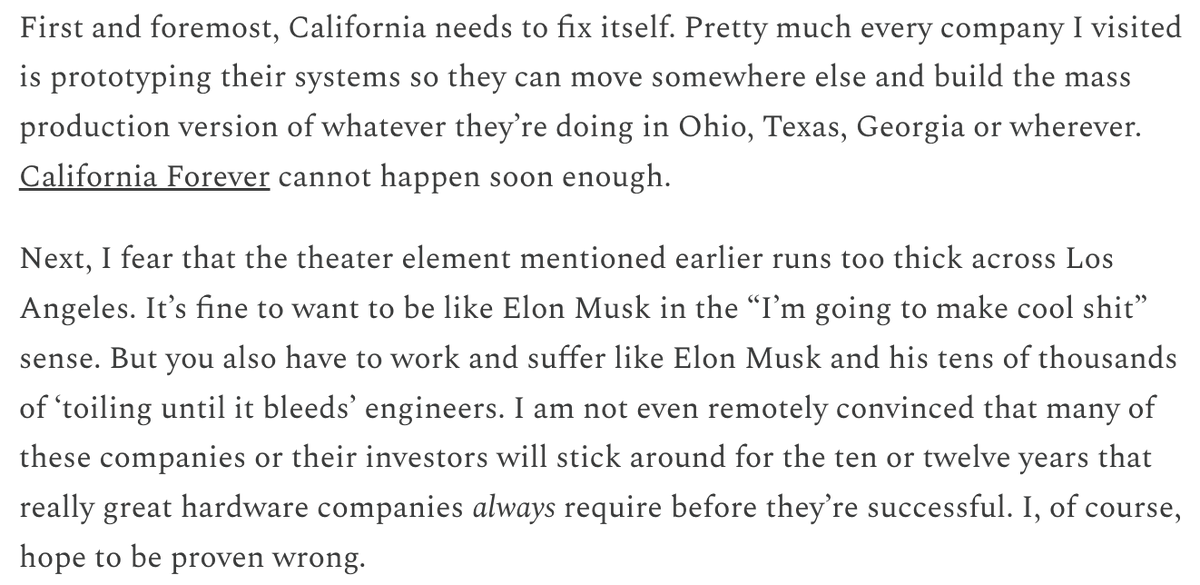
You can want to be like @elonmusk, but do you really have the stomach for it. corememory.com/p/los-angeles…
11
18
196
28,117
Paul retweeted

$EOSE
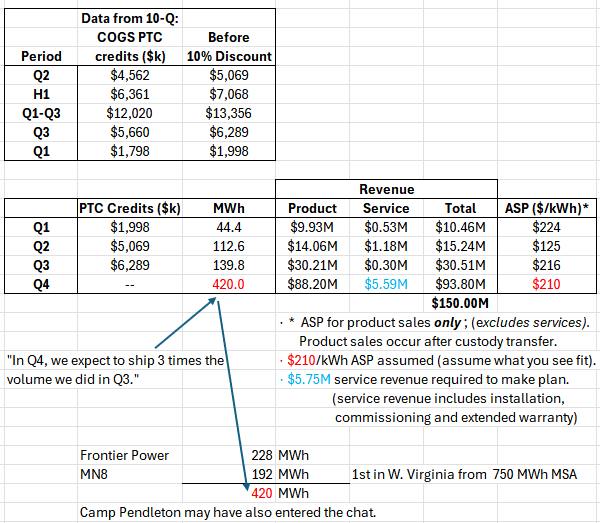
How Eos can make plan for 2025. 🧩
Read carefully before commenting.
10
6
102
18,860
Paul retweeted

Jan 16
Thoughts on the Indensity Release
Reactions to the Indensity announcement have ranged from exuberance to outright disappointment. As usual, I think the truth sits somewhere in the middle.
For those of us who follow EOS closely, this was not a technical surprise. Indensity is largely a system-level evolution built on the same proven Z3 platform, not a new chemistry. At the same time, it did need to be formally released to the market. Products don’t really exist until customers, EPCs, regulators, and procurement teams can point to a name, a configuration, and a clear use case.
Whether there was too much or too little hype leading into the announcement is debatable. Through the lens of long-time followers who track every EOS move, expectations were clearly elevated. That said, I thought the launch video itself was very well done. Joe and Francis were polished and clear in their delivery. The one thing I would have liked to see was a short follow-on deep dive - 15 or 20 minutes - explicitly walking through the target customer for Indensity, and clarifying whether it was intended to replace the Cube or augment EOS’s lineup. Leaving that to speculation is what created much of the reaction we’re seeing.
That aside, this post isn’t about communications style. It’s about the product lineup - and specifically the assumption many people seem to be making that Indensity replaces the Cube.
I don’t think that’s the case.
My view is that Indensity is an addition to the product lineup, not a replacement. Time will tell, of course, but I believe the Cube remains highly attractive to utility-scale customers, particularly public utilities. There are several reasons for this.
First, public utilities operate under multi-year capital investment plans that are reviewed and approved by state public utility commissions. These investments ultimately flow through to rates paid by customers and are subject to formal regulatory processes, hearings, and approvals. Unlike private companies, public utilities cannot easily “add on” or reconfigure systems over time without triggering additional review. As a result, flexibility in the form of modular, expandable “lego-style” systems is not especially valuable to them. Predictability, standardization, and pre-approved configurations matter far more.
Second, density is not free.
Packing significantly more energy into a smaller footprint - with integrated racking, power management, onboard cooling, software, and vertical scalability - almost certainly comes at a higher installed cost on a per-kWh basis compared to a more traditional Cube deployment. That’s true not just at the R&D level, but at the product and installation level as well. Higher integration, tighter tolerances, and vertical designs generally trade off lowest possible $/kWh in favor of siting flexibility and speed.
That trade-off makes perfect sense for the right customer.
Indensity appears purpose-built for private enterprises operating in dense urban or suburban environments where land is scarce, permitting is difficult, and proximity to load matters. Think data centers, mission-critical infrastructure, industrial campuses, and similar sites where footprint constraints, safety, building-code treatment, and deployment speed can justify a pricing premium. In those cases, the value proposition is not “the cheapest battery/kWh,” but the battery that can actually be sited, permitted, and built where it’s needed. By contrast, the Cube remains well suited for utility-scale and public-utility deployments where land is available, projects are planned years in advance, and regulatory certainty is prioritized over modular flexibility.
Seen through that lens, Indensity doesn’t narrow EOS’s strategy - it broadens it. It reframes part of the storage discussion away from chemistry and duration alone, and toward real-world constraints like land use, siting, permitting, and adjacency to load. Those constraints are becoming increasingly important as storage moves closer to population centers and mission-critical infrastructure.
So while Indensity may not have been the dramatic reveal some expected, it is a meaningful step in expanding EOS’s addressable market - not by replacing what already works, but by adding a system designed for customers with fundamentally different constraints and economics.
7
4
46
3,894
Paul retweeted

Jan 14
These motherfuckers really do seem to see and solve every problem differently than everyone else.
Really inspiring.
Congrats Tesla.
Jan 14

Our Lithium Refinery ushers in energy independence for North America
Regionalized access to critical battery minerals brings jobs, cuts emissions & helps accelerate our mission
455
1,344
22,072
933,743
Paul retweeted

Jan 15
elon's side-side-side-side-side-side-side-side-sidequest
The largest Lithium refinery in America
Jan 14
Our Lithium Refinery ushers in energy independence for North America
Regionalized access to critical battery minerals brings jobs, cuts emissions & helps accelerate our mission
67
193
5,413
134,613

Jan 13
$EOSE Anyone ever heard of this Steve Feinberg guy? We should try to get info to him about American made battery to deploy across the DoD. He sounds like a real power broker there.

Secretary of War Pete Hegseth:
That's why today, at my direction, I'm establishing a Barrier Removal SWAT Team under R&E (Research and Engineering), with the authority to waive non-statutory requirements and escalate to our great Deputy Secretary Steve Feinberg anything that slows down the acceleration of AI capabilities.
We will invest heavily in expanding our access to AI compute from data centers to the tactical edge, and we'll tap into hundreds of billions of dollars in private capital flowing into American AI.
President Trump's executive order has directed us to build data centers on military land and to work with the Department of Energy to ensure that we dramatically increase the number and breadth of resources needed to power this computing infrastructure.
We will work together with our partners at Google, AWS, Oracle, SpaceX, Microsoft, and others on these initiatives.
1
11
4,831
Jan 12
BREAKING: tomorrows pixelated image leaked from $EOSE. Any one know what this means?
3
15
1,554
Jan 9
RT @AlinejadMasih: It’s been over 24 hours now that the dictator of Iran has shut down internet connections for 90 million Iranians.
Intern…
27
36
Jan 6
Like EV “competition” years ago, the biggest risk to Tesla is poorly executed competition. NVDA pursuing the same approach from a hardware perspective would ensure we don’t get any dumb lawfare targeting fsd (must require LiDAR or radar or whatever). I like it.
Everyone wasn’t going to license FSD.

80
Paul retweeted

Jan 3
This did not age well.

Trump talks tough on Venezuela, but admires thugs and dictators like Nicolas Maduro.
As President, I will stand with the Venezuelan people and for democracy.
289
3,342
27,550
1,712,931