
Associate Professor at Stanford. Quantum Information and Quantum Gravity. Currently at @Openai
Joined June 2017
- Tweets 3,270
- Following 454
- Followers 4,203
- Likes 41,548
29 Photos and videos








Pinned Tweet

26 May 2021
In 1993 the Superconducting Supercollider was cancelled. Estimated cost: $8 billion. An exodus of physicists left to Wall Street, bringing fancy maths and dubious risk management. 15 years later the global financial crisis cost ~$20 trillion. This is why you don't defund physics!
70
493
2,576
Geoff Penington retweeted

You may be able to ask Mythos if "the image of an ell-adic Galois representation attached to an specific abelian variety with complex multiplication is surjective onto the maximal subgroup of Aut(T_ell(A)) allowed by its CM" but what good would an answer be if you don't know what any of these words mean? How would you formulate such a question in the first place?
What you call "high priests" are people who have dedicated their lives to understand extremely technical fields. If AI systems lower the entry bar and students are able to understand what these words mean faster, we would all welcome that.
But if you are going to produce quick AI answers that you yourself do not understand, and expect *us* to verify them for you, then that's not how any of this works or should work.
Jun 13

There is a new emergent caste system in academia. The high priests, thinking what they do is special and rare, look down on AI use as "slop."
Unfortunately for them, Fable / GPT 5.5 Pro can do in 10-15 min what they spent years learning and feeling special about.
So like true high priests they will develop more guardrails and initiation ceremonies to determine who enters the temple. This would be a mistake. The correct approach is to embrace AI use and do more creative science that was not possible before.
12
30
328
22,741
Geoff Penington retweeted

Jun 13
I think there’s no feasible way to comply with administration’s directive except to completely withdraw the model.
3
1
25
1,164
Utterly absurd if true
Jun 13

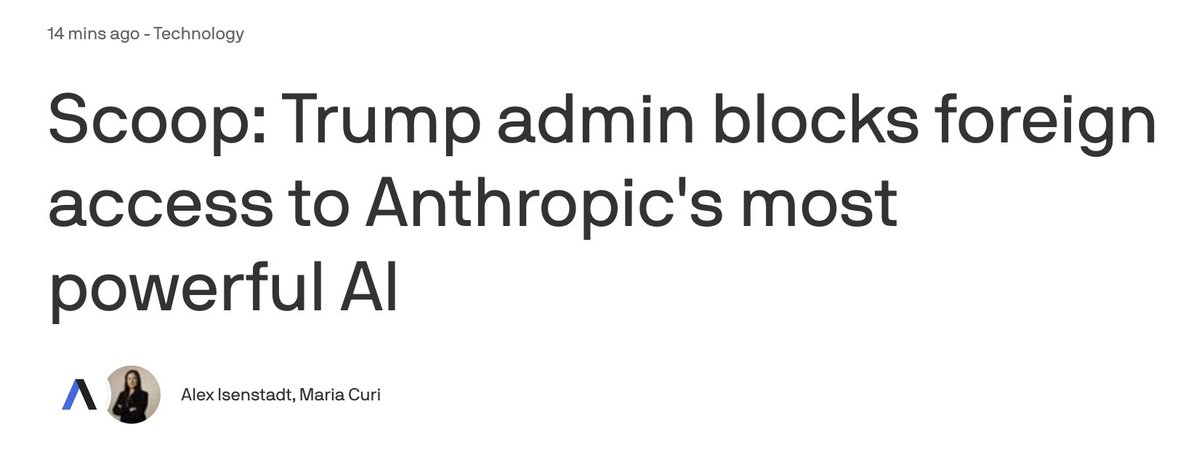
Oh whoa, this Anthropic news is insane. The Commerce Department is placing both Mythos 5 and Fable 5 under the guise of US export controls, blocking access outside the US and foreign persons in the US.
4
19
2,734
Geoff Penington retweeted

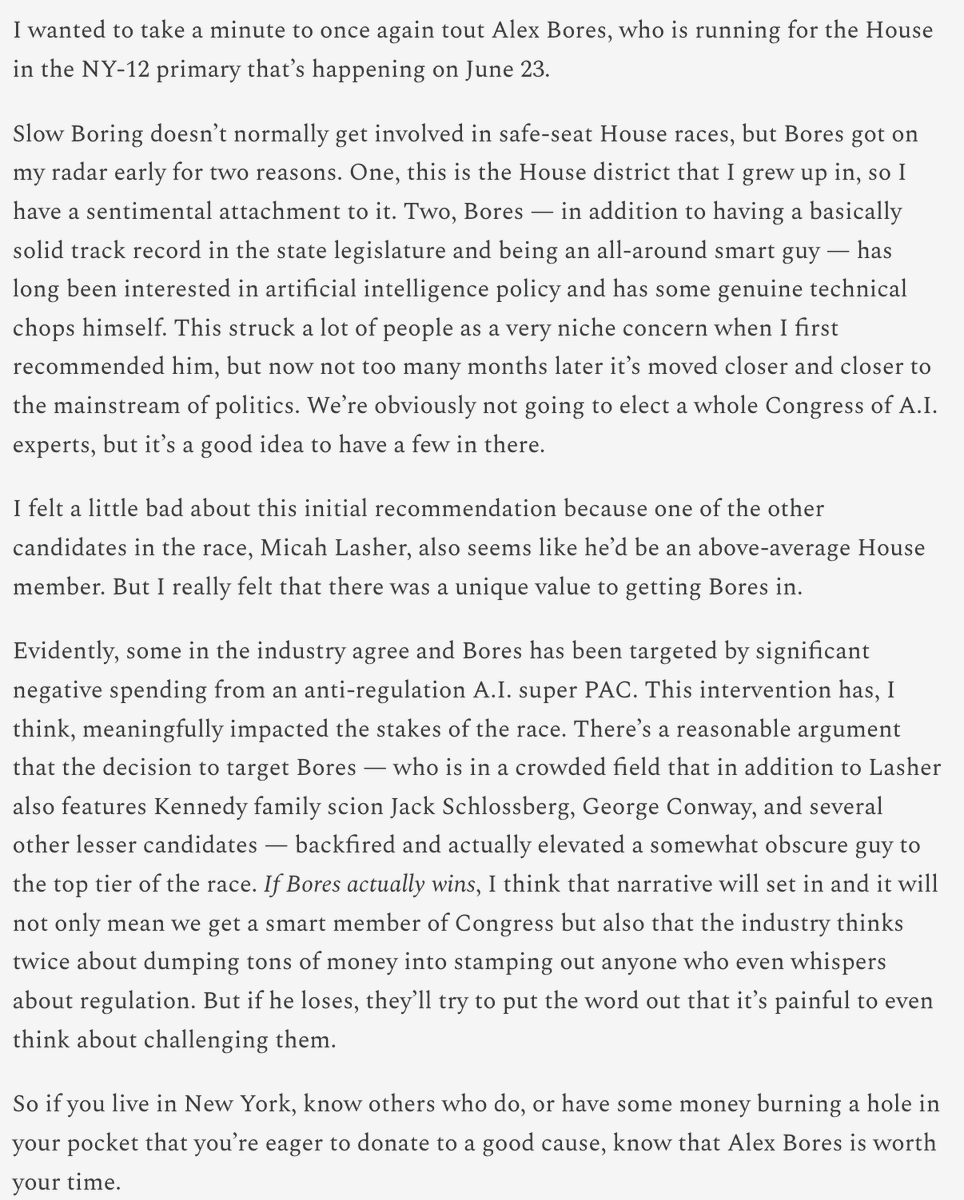
I liked @mattyglesias 's comments about @AlexBores
- Bores has a solid track record
- Bores understands AI
- Bores has been targeted by industry and Bores winning will be important for setting a narrative that industry can't succeed at blocking smart AI candidates
1
12
81
3,418
Geoff Penington retweeted

Jun 11
"The Regents vote went completely contradictory to the faculty recommendation to retain the SAT...what I keep hearing from people is your faculty want this. 1400, 1600, whatever. And the January 2020 report that unanimously recommended retaining standardized testing from the faculty, which the Board of Regents then unanimously voted against." -- President Milliken (just now in a meeting of the Assembly of the Academic Senate)
O.M.G.
10
29
306
37,348
Geoff Penington retweeted

Jun 2
I’m happy OpenAI put out this statement. Personally I really dislike a lot of things I’ve heard about LTF, and I’ve donated in personal capacity to Bores.
This is just a small step and people may still rightly be skeptical, but I hope we can earn trust through our actions going forward. One thing I’ve learned through being more engaged in our policy work lately is that there are so many people at OpenAI both inside and outside Global Affairs who care deeply about how the right policies could help ensure that AGI benefits all of humanity.

OpenAI’s approach to AI policy and political advocacy, including how we represent our policy views publicly and why we believe AI policy debates should be transparent
openai.com/index/our-views-o…
10
7
146
28,478
I’m not as extreme on this as eg Jared Kaplan, but I really don’t see the point right now in making plans for projects that are meant to start in 2041. The boundaries of what will be possible by then depend hugely on how AI (and robotics) development goes over the next 15 years…
May 22

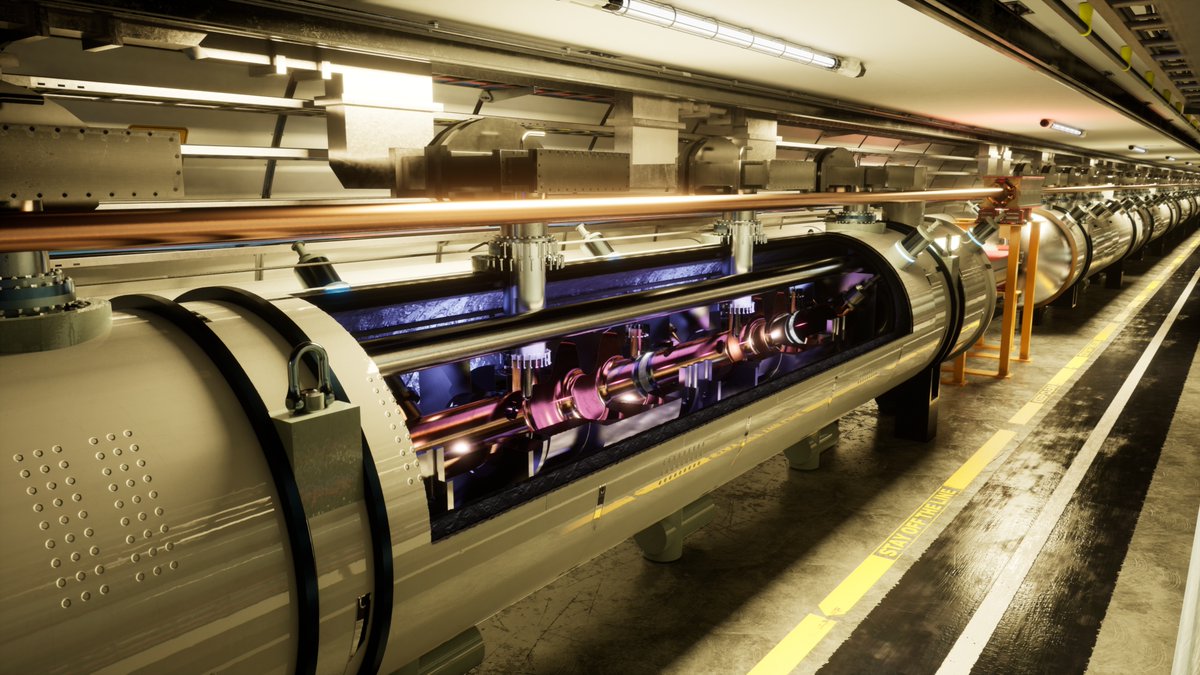
[Press Update]: The CERN Council decided to update the European Strategy for Particle Physics (#ESPP)
Find out more: home.cern/the-cern-council-d…
#FrontlinePhysics
8
6
88
19,328
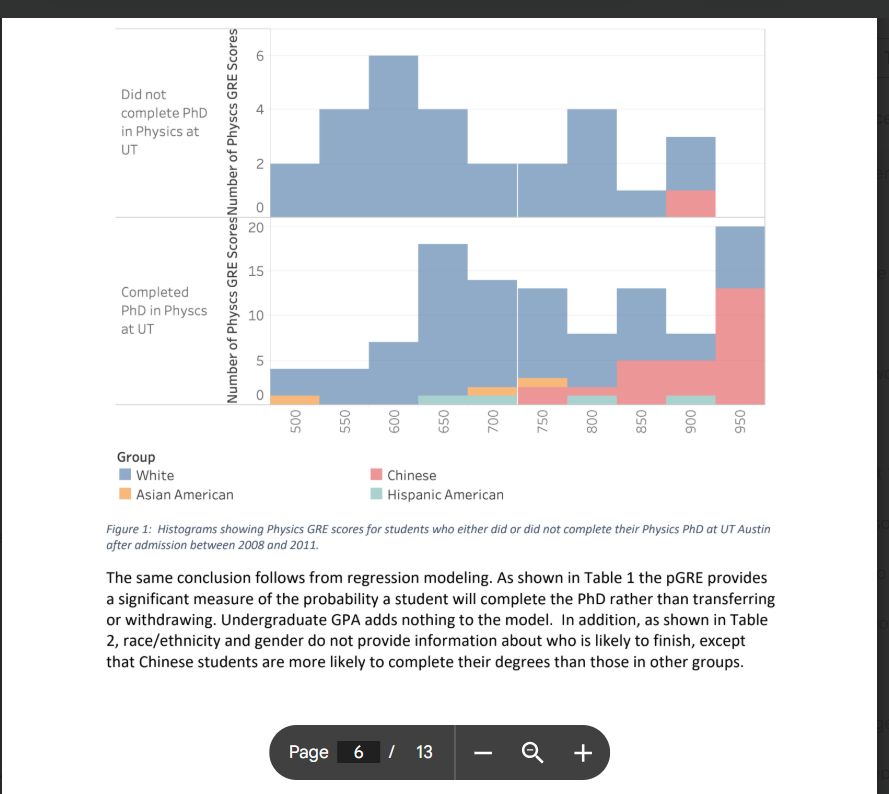
It’s honestly embarrassing for undergraduate departments that the GRE was a good signal. But it was a good signal compared to what we currently have to work with
May 27

This is the data we looked at here at UT when deciding whether to ask for the Physics subject GRE or not. Unlike UGrad GPA, the physics GRE was a good predictor on whether a sudent would complete their PhD or not. We ended up abandoning it anyway.
2
1
51
8,229
Separately the GRE was horribly run and really annoying to deal with for students, particularly international ones. Every test in the UK was booked out six months in advance, so I had to take it in Germany. And then they charge you extra if you apply to more than four places…
1
18
1,369
(This is literally why I never applied to Princeton for grad school)
1
9
1,000
Geoff Penington retweeted

May 23
I think I can follow the proof at a technical level, but I don’t think I can give a good assessment without having worked on the problem in order to develop a feeling for why it is challenging or even interesting. The construction looks extremely clever to me, but being distant from the field I cannot ascertain how much of the cleverness is novel to GPT’s argument and how much is layered upon prior cleverness of others. For example, I was very impressed with the idea to use Golod-Shafarevich towers, but the 9-author paper suggests this is not a novel idea. The level of technical intricacy is striking. On the other hand, it seems to me that the proof does not contain any conceptual breakthrough, which is what I personally would value most.
I was also trying to digest this from a machine learning perspective. I have a mental model of the mathematical capabilities of current AI, and I’m not sure how much this event shifts that distribution; it depends a lot on whether it really came from a base model. I know the solution was also elicited from GPT 5.5 Pro with minimal prompting, but I suspect GPT Pro is already a harness in the sense of calling a base model more than once. I am not sure if those people who claim that the OpenAI solution did not involve a harness were working with the same definition.
More and more I feel that mathematics should not be thought of as a single activity, but should instead be viewed as a collection of loosely related activities, like the Olympics is to individual sports. I think AI has mastered some of the sports but is still poor at others, a nuance which doesn't seem to be appreciated on X.
5
19
210
13,488
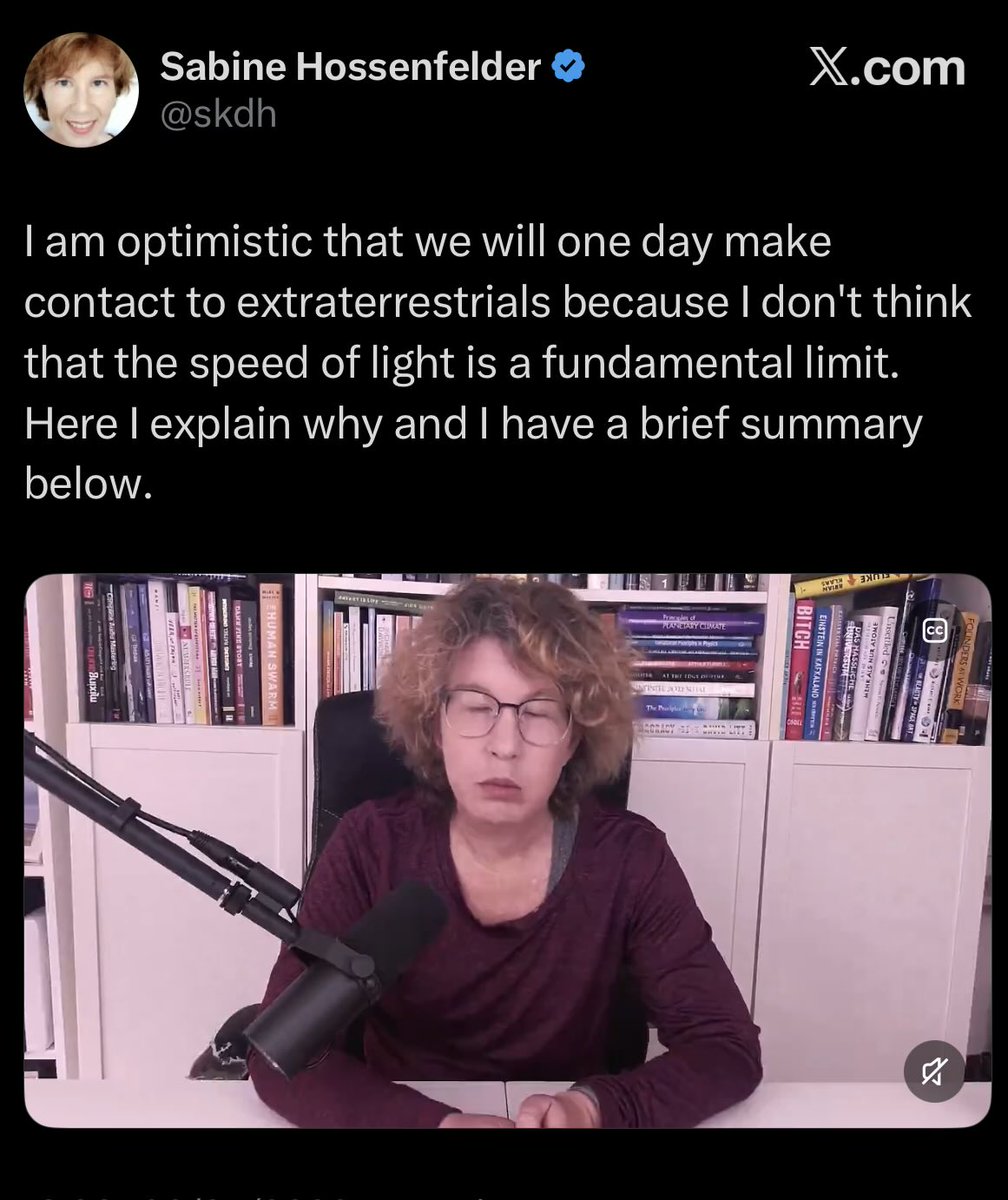
Sometimes I think I understand the philosophical position @skdh is coming from and then she comes out with stuff like this or embracing superdeterminism…
May 20

For the people genuinely interested in physics : this is an example of wishful thinking rather than evidence-based physics
13
1
50
7,132
ChatGPT is a physicist at heart
May 21

gpt-5.5-pro is very smart and all, but it also... redefined what 1 means?
idk maybe it's not my place to question its genius

5
4
155
11,518
Geoff Penington retweeted

May 20
72
238
1,772
564,428
He is wrong on both counts here. It’s easy to check that if Ballmer picks randomly, binary search will give an expected payoff of $0.20. Of course, if he knows your strategy he can choose a number that you will never pick in the first six turns and thereby win 1/
May 19

Steve Ballmer reveals the interview test Microsoft used to separate problem-solvers from gamblers:
"I'm thinking of a number between 1 and 100. First guess, I give you $5. Then $4, $3, $2, $1. After that, you pay me."
"There are far more numbers on which you lose than win."
26
4
327
244,936
But with a bit more work you can find an ensemble of strategies (think binary search with noisy guesses) where every fixed choice he might make has positive expected payoff (across strategies). So the Nash equilibrium has a positive payoff and you should always play
12
2
248
22,230
My opinion is that if she wasn’t a coward the first line of the Odyssey would have been “Tell me about a polytropic man”. Scans perfectly. As with the iambic pentameter, it’s nicely Shakespearean (making up a word whole cloth). And the twitter arguments would be incredible
May 17

Does anyone have any opinions about the Emily Wilson translation of the Odyssey?
13
25
1,060
124,974
Geoff Penington retweeted

May 16
The fact that you think this is a workable analogy really doesn't bode well here but let me try to explain this: Pro lifers think abortion is murder in the sense that it is an innocent life is being taken.
What they do NOT necessarily believe is that abortion can or should be *legally categorized and prosecuted* in the same way as, say, a premeditated mass shooting (first degree murder), or accidentally hitting someone with your car (manslaughter), or leaving a loaded gun out where someone was able to pick it up and shoot themselves (negligent homicide).
Some pro-life people think that women who abort are victims themselves -- that they don't fully understand the implications of the choice they've made, and they deserve compassion. Some pro-life people really just want the procedure banned but have no particular desire to punish women for accessing it, because it's only the former thing that will actually save lives.
And some pro-life people would in fact like to see women prosecuted for aborting, but they keep it to themselves and don't pursue it as policy, because they know it's an extraordinarily unsympathetic position and that making it part of the platform would be political suicide, hurting their ability to accomplish what they want more -- which, again, *is to reduce or eliminate abortions.*
You don't have to find this persuasive in the sense that it makes you rethink your own beliefs about whether abortion is murder, but if you want to understand the mindset of pro-life people, you have to accept that this is how they think about the issue and the tradeoffs that surround it. This is what they believe.
James Surowiecki has had all this explained to him a dozen times over, of course, and more eloquently than this; he just doesn't want to hear it because he doesn't actually want to know how pro-life people think. He prefers the made-up villain version of them inside his head, which is easy to mock and dismiss. But that's his impoverishment; feel free to not duplicate it!
15
4
141
25,758
I found this experiment very interesting. For context, @the_Kth_mean proposed using Claude to learn about a technical topic he wasn’t familiar with. I suggested Yang-Mills because 1. (quantum) Yang-Mills is so technical that there’s a $1M prize just for defining it properly… 1/
May 15

Ok so I did the experiment as described here, trying to wrap my mind around the Yang-Mills theory. The idea is to see if Wittgenstein was right about the expressibility of even deep ideas: if I can glean the intuition of this thing without immersing myself in 2 years of theoretical-physics material, perhaps he was.
Some “experimental setup”: In total I spent about 2 hours talking to Claude, most of which were spent on reading its initial message to my prompt, although subsequent clarifications were essential.
It really helped that this was such an fascinating theory, I might have given up this thankless task otherwise. My initial prompt was, “Explain the Yang-Mills theory to me. I don't have background in it (only computer-science math, not a theoretician), so please try to abstract away the details and notations to the extent possible, and focus on the ideas, significance, positioning, motivation, etc.”
My actual background: aced special relativity and kinetics in undergrad, almost failed second-semseter electro-Maxwell shit; this was years and years ago, though. From popular science I know, and it turned out to be useful, that the 2 important models of physics are the Standard Model, understood to govern “anything really small” (like electrons and other particles), and General Relativity, understood to govern “anything not super small”, like planets and black holes and biological cells and people. (Not even sure where molecules fall.) Interestingly, the SM models 3 forces (electromagnetism and 2 others — none of which are gravity) whereas GR models gravity alone.
What I learned here: the Yang-Mills theory allowed physicists to cast the behaviors of all 3 forces in the Standard Model(*) under one general framework where, for each force:
(1) Every point in spacetime is associated with a mathematical entity that I’ll call “potential” (concretely a vector/tensor or some such).
(2) The differential of potential across any given path in spacetime, i.e., to how potential changes across spacetime, isn’t path-invariant. Two paths from A to B accrue different changes in potential. A specific measurement of this path-insensitivity (roughly, measuring change in a small-loop path (?)) corresponds to the “field”, i.e., the physical reality that’s operating on particles in that point in spacetime.
(3) Here’s where it gets interesting: the potential has degrees of freedom, you can transform the potential _at any point in spacetime separately_ and it will imply the same field. This is called local symmetry. And, the field’s behavior is the ~unique solution to the requirement that there should be local symmetry under a specific type of transformation.
IIUC this was all known about EM force before Yang-Mills. What Yang-Mills showed was that, if you consider a “more elaborate” transformation (somewhat like matrix multiplication is “more elaborate” than scalar multiplication) than what had been considered until then, you can get different unique solutions. With time (decades later!), it turned out that two such unique solutions (corresponding to different "elaborate" transformation types) behave *exactly* like the weak and strong nuclear forces, the two other forces in the Standard Model. Which is like super cool.
That’s it — there goes the least authoritative scientific post you’ll ever see from me. Hopefully not completely embarrassing, and ideally vindicating Wittgenstein, whose work I’ve never actually read (too dense, keep it simple man).
(*) I actually want to say it also expresses the way gravity behaves, but there is some sort of nuance whereby the SM forces are just forces and gravity bends spacetime itself (?) maybe I’ll dig in another time…
4
16
124
28,427
Yang-Mills theory was the key ingredient in figuring out how to build the Standard Model: the SM is just a particularly (somewhat arbitrary) collection of Yang-Mills forces other particles that happens to fit experimental data 17/
1
1
5
1,639
Summary of a long thread: @the_Kth_mean definitely learned some cool correct stuff. Hopefully he now has a somewhat better sense of how the universe works. Learning physics still take (almost) anyone several years of hard work 18/18
1
22
1,521