
Student of knowledge and justice
Joined July 2009
- Tweets 9,511
- Following 5,231
- Followers 549
- Likes 20,057
1,113 Photos and videos
















RomansFight retweeted

Jun 15
Incoming EARTHQUAKE? 😳 Southern California’s fault system is reportedly under stress levels not seen in 1,000 years. They cannot predict the day, but the warning signs are lining up in a way that should have every family paying attention.
27
97
435
23,174
RomansFight retweeted

Jun 13
🚨 MERCEDES JUST PUT A MOTOR ONLY 8 CM THICK INTO A CAR THAT CAN HIT 62 MPH IN 2.1 SECONDS.
Instead of conventional radial flux motors, Mercedes is betting big on axial flux technology. In these motors, the electromagnetic force flows parallel to the axle, allowing two magnetic rotors to sandwich a central stator in a flat, disc-like layout.
The result is dramatically smaller and more powerful. The front motor in the new all-electric Mercedes-AMG GT 4-door Coupe is just 9 cm wide. The rear motors are even thinner at roughly 8 cm each. Despite their tiny size, they help launch the heavy performance car from 0-62 mph in just 2.1 seconds, with a top speed of up to 186 mph.
Why this matters:
• Axial flux motors are significantly more power-dense and can be up to 50% lighter than traditional designs
• Their extreme thinness frees up packaging space in the vehicle for better weight distribution, aerodynamics, or interior room
• Mercedes acquired YASA in 2021 and has spent years developing the complex manufacturing processes needed to build them at scale
• The technology is debuting in a high-performance AMG model, showing Mercedes is serious about using it in its most demanding cars
The deeper implication:
While most of the EV conversation focuses on batteries and software, the electric motor itself is undergoing a quiet revolution. Axial flux designs have long been seen as theoretically superior but extremely difficult to manufacture at scale.
By solving the production challenges and putting these motors into a real high-performance car, Mercedes is pushing the entire industry forward. The next generation of electric performance cars may not just have bigger batteries they may have fundamentally better motors.
We’re watching the physical hardware of EVs evolve as dramatically as the software has.
How important do you think motor technology (rather than just battery size) will be for the future of electric performance cars?
Follow for more frontier automotive engineering and electric vehicle technology.
113
401
2,222
396,867
RomansFight retweeted

Jun 12
Look up the founders of Apogee Engineering.

Grusch said files are at NASIC, in this clip below he talks about FME & FMP being used as a umbrella program with off book activities. Think it's fair to say the UFOs CR files are under NASIC FMP/E at WPAFB (maybe in the archive known as the "Ballroom" 😁). Moondust & Zodiac etc
1
1
3
1,182


RomansFight retweeted

Listen to Mack Maloney's Military X-Files wherever you get your podcasts.

1
1
1
25
RomansFight retweeted

Jun 6
Follow this account and you will be 6 months ahead of the average retail investor.
Jun 6

Trump is meeting with US AI executives next week about direct government equity stakes in their companies.
This is going to move markets.
These 10 companies could be the ones they pick:
55
21
724
358,711
RomansFight retweeted

May 31
And now we have a high-performance Artificial Intelligence model that can be asked to detect anything. I wrote a few lines to detect unidentified phenomena in the sky. In this case, just a Starlink train, but it opens up many possibilities for UAP research.
24
44
581
41,383
RomansFight retweeted

May 30
i like big splats and i cannot lie.
you can now compress, tile and stream city scale 3d gaussian splats -- glTF has an official 3DGS extension now too.
this is what the future of google earth looks like. no more broccoli trees. no more melted powerlines. immaculate ground level detail that actually holds up.
22
98
807
59,815
RomansFight retweeted

May 24
So I been doing more testing, found a dead easy way to trigger the sphere network to reposition. They are triggered by direct strong IR beams shot into the night sky. monitor using NV scopes and you will see the triangles react. VIDEO below.
Disclosure is easy!!!
940nm.. is what you need... now #uaptwitter has no excuse.
vm.tiktok.com/ZNRnXCyL2/
4
9
68
2,412
RomansFight retweeted
May 19
🚨 SCIENTISTS MAY HAVE DISCOVERED AN ENTIRELY NEW TYPE OF MAGNET.
It’s called an altermagnet.
And it behaves in a way physicists thought shouldn’t be possible.
Unlike normal magnets…
the material has almost ZERO net magnetism yet it still behaves electronically like a ferromagnet.
That means it may combine:
• the stability of antiferromagnets
• with the speed and functionality of ferromagnets
Researchers just observed a giant magneto-optical Kerr effect inside hematite one of Earth’s most common iron minerals.
Why this matters:
This could open the door to:
• ultra-fast memory
• low-power computing
• next-generation spintronics
• advanced quantum materials
• AI hardware beyond silicon
The strangest part?
The magnetism is hidden in the material’s symmetry itself.
Not in obvious magnetic alignment.
Physics may have just uncovered an entirely new way matter can store and process information.
We are entering the era of programmable quantum materials.
Follow for more future physics and technology breakthroughs.
16
162
598
26,428
RomansFight retweeted

May 15
John Travolta is experimenting with an incredibly powerful look. I will be monitoring this situation


1,003
4,080
82,331
5,756,474
RomansFight retweeted

🚨 Coming soon to UAP Reporting Center's YouTube.
You won't want to miss this one so subscribe now and turn the bell on!
youtube.com/@uapreportingcen…
5
8
38
2,670
RomansFight retweeted
May 12
🚨 BIOLOGY UPDATE
Scientists are discovering that mitochondria — the tiny powerhouses inside your cells — may communicate using ultraweak flashes of light.
Not metaphorically.
Actual light.
Which means inside you right now…
trillions of microscopic structures may be exchanging information through glowing biological signals invisible to the human eye.
The strange part?
Your body may be far less “mechanical” than we once believed.
You are not just chemistry.
You are electrical. You are energetic. You are alive in ways science is only beginning to understand.
Maybe consciousness itself emerges from an orchestra of light deep inside living cells.
The closer we look at life…
the less dead matter it seems to become.
78
404
1,323
33,183
RomansFight retweeted
May 11
It’s wild and depressing to me that Ocean posts these actual, real, completely authentic physics posts about sexy and cutting edge applications
And none of you crackpot physics weirdos comment or post.
But Ashton or MFLeischman or any one of these ZPE shilling frauds posts some delusional bullshit and you all lose your minds.
Your boos mean nothing I’ve seen what makes you cheer
May 11

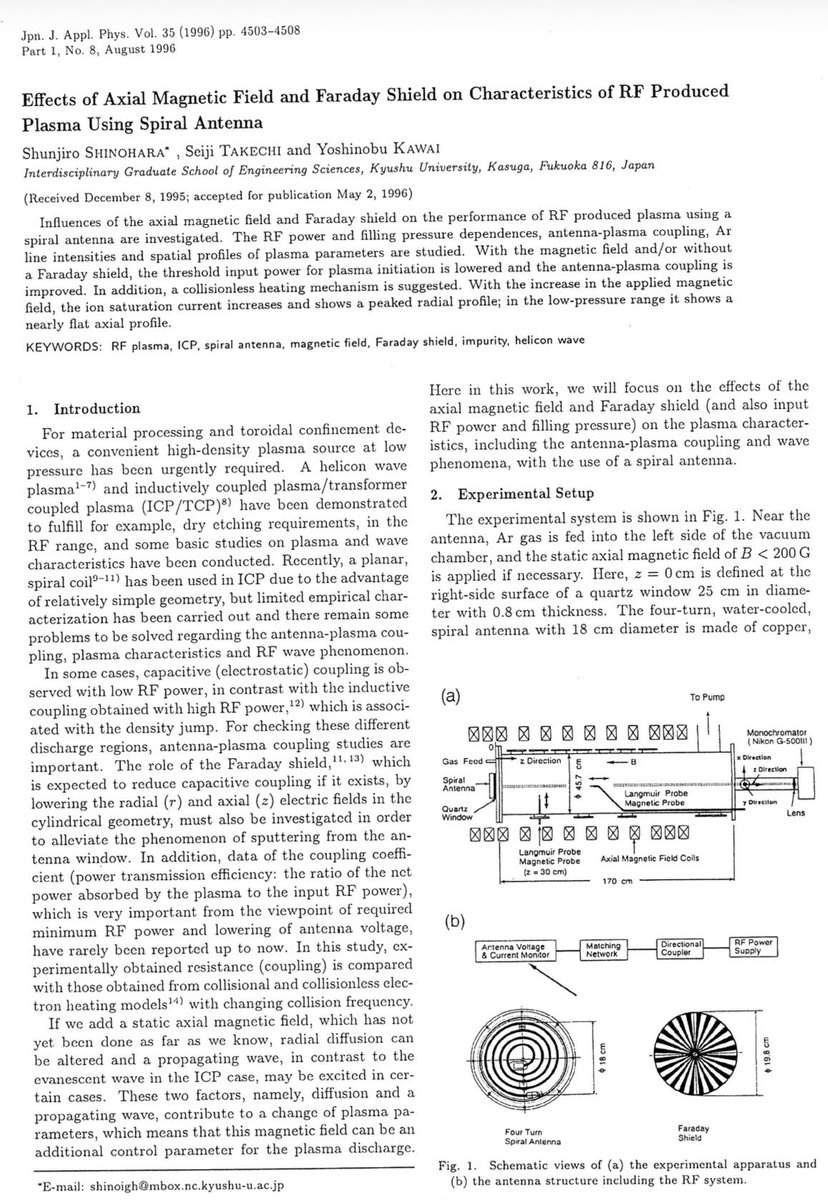
Effects of Axial Magnetic Field and Faraday Shield on Characteristics of RF Produced Plasma Using Spiral Antenna examines how static axial magnetic fields and electrostatic shielding influence the performance of radiofrequency plasmas generated by a planar spiral antenna. This configuration is widely used in large-diameter plasma processing for semiconductor manufacturing and materials science, where efficient power coupling, high plasma density, and operational stability are essential.
Shunjiro Shinohara, Seiji Takechi, and Yoshinobu Kawai published this experimental study in the Japanese Journal of Applied Physics in August 1996. Using a spiral antenna operating at RF frequencies, the researchers systematically investigated plasma initiation thresholds, density profiles, and antenna-plasma coupling efficiency under varying axial magnetic field strengths and with or without a Faraday shield.
Key findings show that applying an axial magnetic field significantly lowers the threshold input power required for plasma breakdown and improves overall coupling efficiency. The Faraday shield, which reduces unwanted electrostatic fields while permitting inductive coupling, further enhances plasma production characteristics, leading to higher densities and more stable discharges. Detailed measurements of electron density, temperature, and power transfer efficiency demonstrate the synergistic benefits of combining magnetic fields with shielding in spiral antenna systems.
This early work provided foundational insights into optimizing helicon and inductively coupled plasma sources, influencing subsequent developments in high-density, large-area plasma generation for industrial applications. The study remains relevant for researchers designing RF plasma devices requiring improved performance and reduced power requirements.
For the full paper: researchgate.net/profile/Shu…
28
5
102
9,850
RomansFight retweeted

May 10
Receipts:
[1] CBS News, May 10, 2026 — “French passenger of hantavirus cruise ship starts showing symptoms on evacuation flight, prime minister says”
cbsnews.com/news/cruise-ship…
[2] CBS 58 / AP, May 10, 2026 — “Waves of passengers aboard hantavirus-hit cruise ship taken to shore in Tenerife and start flying home”
cbs58.com/news/waves-of-pass…
[5] NBC News, May 10, 2026 — “17 American passengers aboard hantavirus-hit cruise ship...”
nbcnews.com/health/health-ne…
[6] Yahoo News / AP Live Updates, May 10, 2026 — “Hantavirus latest updates: French passenger develops symptoms...”
yahoo.com/news/world/live/ha…
[7] BBC News — “What is hantavirus and how does it spread?”
bbc.com/news/articles/c8r8j1…
[12] AP News, May 10, 2026 — “Passengers evacuated from hantavirus-stricken cruise ship...”
apnews.com/article/hantaviru…
[15] PBS NewsHour — “What we don't know about the hantavirus outbreak on the cruise ship”
pbs.org/newshour/health/what…
2
12
36
3,519
RomansFight retweeted

Watch Dark Alliance: The Next Generation (2025) - Free Movies | Tubi tubitv.com/movies/100053908/…
4
12
31
9,310

This will probably explode AI/ML in ways I can barely understand.
You can build any Boolean logic circuit (aka your whole computer) using nothing but NAND (or NOR) gates. We use them to evaluating formulas.
But they came up with an “eml” that is analogous to the NAND gate. Except it’s a primitive that allows you to search the space for possible continuous functions instead.
May 3

A mathematician has come up with a new way to derive all mathematical operations from merely one. I've had a look at the paper.
46
66
921
116,141

May 3
Its the same story since the Garden of Eden. Faith in God isn't about having more comfort than Job.
29 Sep 2023

"Aliens can give you gifts of clairvoyance, healing powers, & other paranormal feats if you cooperate with them."
Gifts-often seen as a sign of benevolence-but there's more to the story:
"These are trivial trinkets in exchange for obedience."
@TomMontalk #ufotwitter #aliens

1
12
RomansFight retweeted

Apr 2
We're living in the BEST era for doing research. 💪
After I graduated from my PhD, the rise of AI-native research gave me a new chance to revisit my research experience.
Lately, doing research feels incredibly rewarding to me. I get to experience the pure joy of curiosity-driven science because I no longer have to worry about the lower-level implementations or getting bogged down by infrastructure 🚀
(I'll be sharing some of my own recent research driven by this very soon!)
But today, let me introduce the New Orchestra 🎻. We wanted to ship a product that absorbs the friction and brings science back to the curiosity.
25
59
462
53,618
RomansFight retweeted

May 2
FREE Math and Physics Book.
Wolfram's "A New Kind of Science," a manifesto arguing that the entire universe (and all its complexity) can be understood as the result of simple computational rules running on something like a vast cellular automaton. Computer experiments reveal that complexity is cheap and emerges everywhere from the most minimal rules, which Wolfram suggests fundamentally rewrite how we should approach science, physics, and reality.
Link: wolframscience.com/nks/

10
82
407
18,859