
Photos and videos
Ryan Lanman retweeted

May 22
Data centers revitalize American manufacturing by driving massive demand and upgrading the power infrastructure in former industrial hubs.
Building American technological infrastructure is good for America.

210
281
2,013
50,986

May 15
Just busted out my latest @Bitkey model, upgrade from one device to another, smooth as silk. Really nice touches in how the new screen and app work together. Beautiful work cc @max_guise @BEN0WHERE and team!
2
3
11
1,316
Ryan Lanman retweeted

Today I was proud to advance the Digital Asset Market Clarity Act. This legislation is vital to supercharging innovation and preparing our economy for the 21st century.
What the GENIUS Act is doing for the stablecoin ecosystem, CLARITY promises to do for all digital assets.
While today marks an important milestone, the legislative work continues.
125
244
2,530
58,066

Ryan Lanman retweeted

May 12
«And rather than admit we as an industry have handed them the hardest part of the problem, we call it “personal responsibility”—as if it were a moral virtue, not a design failure. »
Excellent breakdown of why seed phrases are an anti-pattern.
27 May 2025

Seed phrases were a breakthrough for Bitcoiners. But they also handed users the hardest part of the problem: securing them.
Bitkey takes a different approach.
bitkey.build/seedless-is-saf…
10
4
25
5,826
Ryan Lanman retweeted

Harvard, apparently, is about to adopt a new policy to combat grade inflation. I devised my own anti–grade inflation policy 25 years ago. I’ve shared it with provosts and deans, to no avail. Here it is:
The Muñoz Plan Against Grade Inflation
The plan has three key components:
128
195
2,381
856,503
Ryan Lanman retweeted

May 1
Most people have never managed anyone. Those who have, most have never managed anyone smarter than themselves.
This is about to change for everyone. You will be surrounded by agents that are smarter than you, working for you 24/7. In a world of cognitive abundance, your understanding becomes the bottleneck.
You can genuinely delegate a lot of cognitive work now. This is not sci-fi. It's already permanently changed the texture of knowledge work.
But the less you understand what your agents are doing and how they're doing it, the less you will be able to get out of them. This is why it's still important to understand things like software, coding, economics, math, statistics, game theory. Not because you need to DO them (you don't), but you need to understand what's easy and what's impossible.
Try to be as smart as your agents. You will inevitably fail, but you don't need to get all the way there. You just need to become smart enough to manage things smarter than you.
Feb 4

you can outsource your thinking
but you cannot outsource your understanding
25
28
293
38,320

Hot take: DeFi doesn't have a smart contract security problem. It has a key management problem.
April's biggest losses (KelpDAO $292M, Drift $285M, Wasabi $5M) were admin key compromises. No timelocks. No multisig.
Write better code all you want. But the ops problem still remains.
16
4
81
29,988
Ryan Lanman retweeted

Apr 27
Bitcoin only works if people use it.
Today at @Blocks, we’re making that easier:
• New @Bitkey with 100% more screen
• 5% BTC Back with @CashApp at @Square merchants
• Turn P2P payments into bitcoin on @CashApp
• Soon, NFC tap to pay and bitcoin toggle on @Square
• Proof of Reserves you can verify
This is how bitcoin becomes everyday money.

64
151
1,165
485,839
Ryan Lanman retweeted

Apr 24
"Lelli's result is the practical counterpart to those optimizations. The distance from 15 bits to 256 bits is large, but the gap is increasingly viewed as an engineering problem and not a fundamental physics problem."
The 2029 transition deadlines from Google and Cloudflare look more responsible than ever. The people saying there's a 0% chance of q day, even within ten years, look increasingly irresponsible.
I hope we can collectively update our probabilities and throw support behind developers.
It will be tempting to punish and humiliate people whose probability judgments have gone the wrong way. But we'll be better off if we don't block the exits.
Apr 24

Project Eleven Awards 1 BTC Q-Day Prize for Largest Quantum Attack on Elliptic Curve Cryptography to Date
Researcher breaks 15-bit ECC key on publicly accessible quantum hardware in a 512x jump from the previous public demonstration.
Project Eleven today awarded the Q-Day Prize, a one Bitcoin bounty, to Giancarlo Lelli for breaking a 15-bit elliptic curve key on a publicly accessible quantum computer. The result is the largest public demonstration to date of the attack class that threatens Bitcoin, Ethereum, and over $2.5 trillion in ECC-secured digital assets.
"The resource requirements for this type of attack keep dropping, and the barrier to running it in practice is dropping with them," said @apruden08, CEO of Project Eleven. "The winning submission came from an independent researcher working on cloud-accessible hardware. No national lab, no private chip. It shows that tangible progress is possible and highlights the urgency to migrate to post-quantum cryptography sooner rather than later. Google just committed to being quantum-secure by 2029. The window to get ahead of this is closing.”
Lelli derived a private key from its public key across a search space of 32,767 using a variant of Shor’s algorithm. Shor's targets the Elliptic Curve Discrete Logarithm Problem (ECDLP), the math underlying the digital signature schemes securing Bitcoin, Ethereum, and most blockchains.
Quantum attacks on ECC have moved from theory to practice over the last seven months. Steve Tippeconnic's 6-bit demonstration in September 2025 was the first public break on quantum hardware. Lelli's 15-bit result extends it by a factor of 512.
Theoretical resource estimates for a full 256-bit attack, the scale Bitcoin operates at, have fallen sharply over the same period. Google's April 2026 whitepaper put the requirement at under 500,000 physical qubits. A subsequent paper from Caltech and Oratomic brought that figure as low as 10,000 qubits in a neutral-atom architecture.
Lelli's result is the practical counterpart to those optimizations. The distance from 15 bits to 256 bits is large, but the gap is increasingly viewed as an engineering problem and not a fundamental physics problem.
Roughly 6.9 million Bitcoin sit in wallets whose public keys are visible on-chain, exposing them to quantum attack. All blockchains using ECC share similar risks with vulnerable assets.
Project Eleven is developing its next challenge, focused on the intersection of frontier AI models and quantum cryptanalysis.
Community note
The method used to recover the 15-bit ECC key relies on classical verification of outputs indistinguishable from random noise, equivalent to classical guessing. While quantum threats to cryptography are advancing, this does not demonstrate effective quantum key-breaking.
github.com/GiancarloLelli…
github.com/GiancarloLelli…
5
2
14
4,900
Ryan Lanman retweeted

Apr 24
Alright. That's the starting gun. This is nothing to start panicking over right now, but it's time to actual start being serious about what version of hash-based signatures we are doing with BIP 360, and start considering activation timelines.
Apr 24
Project Eleven Awards 1 BTC Q-Day Prize for Largest Quantum Attack on Elliptic Curve Cryptography to Date
Researcher breaks 15-bit ECC key on publicly accessible quantum hardware in a 512x jump from the previous public demonstration.
Project Eleven today awarded the Q-Day Prize, a one Bitcoin bounty, to Giancarlo Lelli for breaking a 15-bit elliptic curve key on a publicly accessible quantum computer. The result is the largest public demonstration to date of the attack class that threatens Bitcoin, Ethereum, and over $2.5 trillion in ECC-secured digital assets.
"The resource requirements for this type of attack keep dropping, and the barrier to running it in practice is dropping with them," said @apruden08, CEO of Project Eleven. "The winning submission came from an independent researcher working on cloud-accessible hardware. No national lab, no private chip. It shows that tangible progress is possible and highlights the urgency to migrate to post-quantum cryptography sooner rather than later. Google just committed to being quantum-secure by 2029. The window to get ahead of this is closing.”
Lelli derived a private key from its public key across a search space of 32,767 using a variant of Shor’s algorithm. Shor's targets the Elliptic Curve Discrete Logarithm Problem (ECDLP), the math underlying the digital signature schemes securing Bitcoin, Ethereum, and most blockchains.
Quantum attacks on ECC have moved from theory to practice over the last seven months. Steve Tippeconnic's 6-bit demonstration in September 2025 was the first public break on quantum hardware. Lelli's 15-bit result extends it by a factor of 512.
Theoretical resource estimates for a full 256-bit attack, the scale Bitcoin operates at, have fallen sharply over the same period. Google's April 2026 whitepaper put the requirement at under 500,000 physical qubits. A subsequent paper from Caltech and Oratomic brought that figure as low as 10,000 qubits in a neutral-atom architecture.
Lelli's result is the practical counterpart to those optimizations. The distance from 15 bits to 256 bits is large, but the gap is increasingly viewed as an engineering problem and not a fundamental physics problem.
Roughly 6.9 million Bitcoin sit in wallets whose public keys are visible on-chain, exposing them to quantum attack. All blockchains using ECC share similar risks with vulnerable assets.
Project Eleven is developing its next challenge, focused on the intersection of frontier AI models and quantum cryptanalysis.
Community note
The method used to recover the 15-bit ECC key relies on classical verification of outputs indistinguishable from random noise, equivalent to classical guessing. While quantum threats to cryptography are advancing, this does not demonstrate effective quantum key-breaking.
github.com/GiancarloLelli…
github.com/GiancarloLelli…
39
8
97
26,370
Ryan Lanman retweeted

Apr 22
Most people forget that cryptocurrency is the field of Trust engineering:
- Identify Trust
- Measure Trust
- Minimise Trust
Trust exists everywhere: in cryptographic assumptions, software implementations, social coordination, and every point of human intervention.
It is impossible to build a Trustless system.
Trust-minimisation is a spectrum and it always comes with trade-offs.
For example, one may wish to 'turn off governance and upgradeability of a system', but this does not remove Trust. It transfers it to the assumption that the current implementation is bug-free and capable of surviving the test of time.
An engineer's goal is to manipulate and shape Trust. To design and build a system that Trusts software and cryptography 99.9% of the time, and human intervention less than 0.1% of the time.
That is what all thrive to build. It is significantly better than the legacy financial system. That is why they are now moving onto our rails and will continue to do so at size and speed.
5
9
54
3,049
Ryan Lanman retweeted
Apr 21
FYI, this is a validity violation, not a decentralization violation. They say governance will vote on what to do about the cordoned off assets. In principle, governance could vote to let DPRK bridge out.
It's possible (in fact, core to the value proposition of crypto) for a large set of people to agree to do something that a plurality want to do.
19
9
178
61,521
Ryan Lanman retweeted

Apr 21
Stuff DeFi is doing:
- analyzing exploits transparently in real time
- identifying enhancements to harden protocols
- challenging operators to address security failures
- persevering despite setbacks and sentiment lows
Stuff DeFi is not doing:
- asking government for a bailout
37
53
371
31,328
Ryan Lanman retweeted
Apr 20
DeFi learns through failures. Whether it's from the collapse of Terra, broken auctions during Black Friday in 2020, or the stETH depeg in 2022, it has failed over and over again--but with every failure, it improves.
People talk all sorts of shit about this, but it's no different from how TradFi learned from banking crises, lending contagion (2008), or fraud (savings and loans crises in late 80s).
The important thing is that these failures are not fatal. The heart of DeFi is risk-averse and robust. AAVE might take on some bad debt, but it has the equity to pay it.
DeFi isn't going away. And seeing the vigorous debate around how to improve it is exactly the process by which it keeps getting better.
Bullish DeFi, and bullish this community.
71
54
460
34,372
Ryan Lanman retweeted

Apr 15
Let Jon Stewart know if you want a nuanced bitcoin expert on his show.
Like this post, and then comment on your favorite expert.
Apr 15

Big fan of your work Jon, for like 20 years.
But you could find better guests on this topic. More nuanced.
396
209
5,235
200,357
Ryan Lanman retweeted

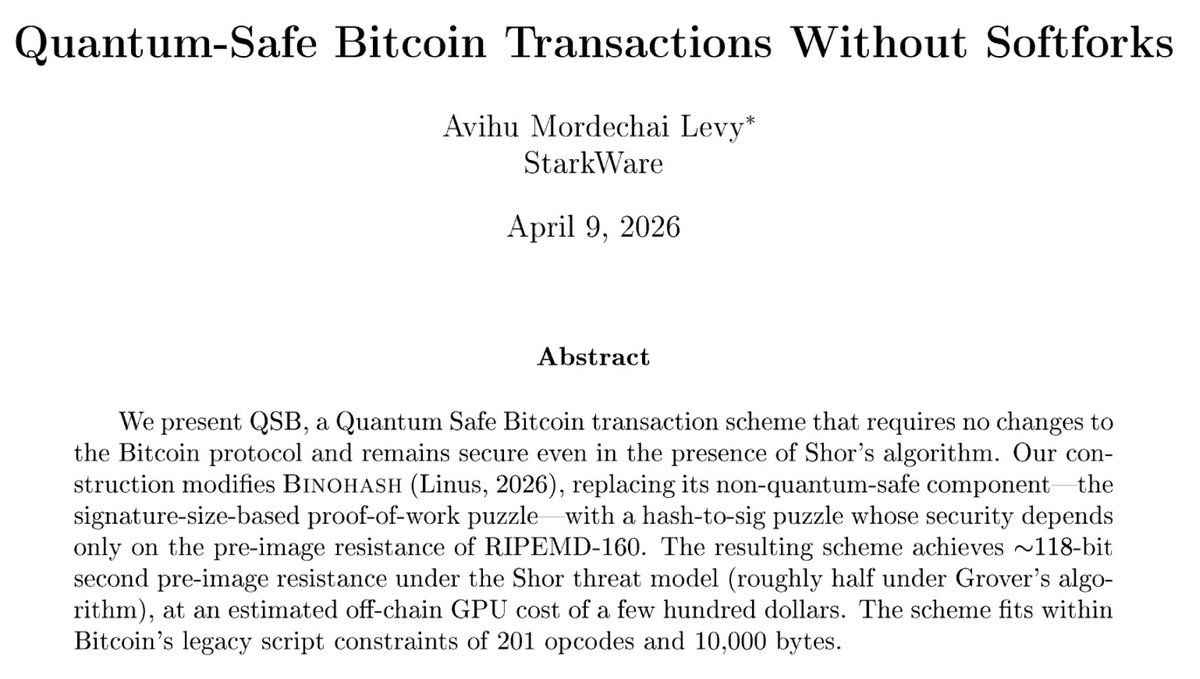
Just to be clear: does this mean Bitcoin doesn't need to upgrade to be post-quantum secure? ABSOLUTELY NOT.
Bitcoin should ABSOLUTELY take the necessary steps to become PQS.

30
27
227
36,637
Ryan Lanman retweeted

Mar 17
Ah, perfect an argument so nakedly emotional it saves everyone the trouble of pretending this is about engineering. 🤦
If your justification for a consensus change boils down to "i don't think people hate them enough” then you're proposing that Bitcoin become a vehicle for your personal grievances.
Consensus rules are not there to hit someone on the nose. They are there to define a neutral, predictable system that doesn't care who you like, who you hate, or what cultural battle you think you're fighting this week.
The moment you cross that line, when you start modifying consensus to punish a class of users, you've already abandoned the core property that makes Bitcoin valuable: credible neutrality.
And the irony here is absolutely painful:
You're trying to "fight spam" by rewriting the rules… when the system has already done it for you.
The fee market worked.
Spammers paid. Heavily.
Scammers paid. Heavily.
JPEG enjoyers lit absurd amounts of money on fire. 🤡
That is the mechanism. That is the defense.
There was no need for social crusades, no need for rule changes, no need for moral arbitration. The market priced their behavior, and literally all of it collapsed under its own weight.
WE ALREADY WON.
The only thing BIP-110-style thinking accomplishes is reopening the door you claim to want closed because once you demonstrate that consensus can be bent to target undesirable use, you invite an endless cycle of new rule changes, new targets, and new attack surfaces.
You don't eliminate spam that way you create a ethereum style governance game around defining it.
And that's far more dangerous than any JPEG wave ever was.
Whats really going on here is an inability to accept that the bitcoin solved the problem without you.
That's an ego problem, not a protocol problem.
Slay the ego.
Recognize that the market already delivered the punishment you wanted. The losses are real, the incentives are clear, and the behavior has adjusted accordingly
Bitcoin doesn't need you to swing a hammer at things you dislike (and I know hammers) 🔨 It needs you to _build_
If you've realized that JPEGs don't hold value and that spam is self-limiting under a functioning fee market, then your time is far better spent doing something productive:
Make Bitcoin more useful for actual financial activity.
Make it easier, cheaper, safer to use for people who derive real value from it.
Expand the demand for blockspace instead of trying to curate who is "worthy" of it.
Mar 17

.@knutsvanholm on why we should change Bitcoin’s consensus rules with BIP-110:
“From my point of view, even if all it accomplishes is like a hit on the nose on these spammers, I think it’s worth doing it because I don’t think people hate them enough”
🤡🤡🤡
youtu.be/hBvlmFgQENw?si=deG6…
30
48
200
31,076
Ryan Lanman retweeted

Feb 17
10
22
87
19,461