
Joined January 2019
- Tweets 3,712
- Following 2,190
- Followers 700
- Likes 10,820
1,892 Photos and videos









Pinned Tweet

Jun 12
AI just killed your banking career or gave it a second life - Tim Rutten (CMO, @backbase)
Banks are not being replaced by AI. They are being rebuilt around it. Tim Rutten, Chief Marketing Officer at Backbase, joins me to break down what that actually means for your career and for the industry.
Jamie Dimon wants fewer bankers and more AI builders. But what does that really mean for the thousands of finance professionals already in the workforce? Tim gives a more nuanced read, and it is not the doomsday story the headlines are selling.
We also get into the difference between machine learning, generative AI, and agentic AI in a banking context, how Backbase’s AI-native banking OS handles governance and auditability in a regulated environment, who is liable when an AI agent makes a mistake, and why token cost management is one of the most underrated problems in agentic banking.
If you work in banking or are thinking about entering the industry, this one is worth your time.
107
11h
Global platforms have been failing their users at the last mile
For years, the default approach to paying out international workers was to push the money out of the platform entirely.
Think about a global HR platform, a marketplace, or an accounts payable business. Their user base is spread across Brazil, Mexico, the UK, Asia, Africa. When those platforms needed to pay their sellers or contractors, the standard move was to hand the money off to a third-party bank. Transfer it out. Done.
That was always the end of the road.
The problem with that model is not just cost or friction. It forecloses a real opportunity. Once the money leaves the platform's ecosystem, the relationship ends. There is no account to offer, no financial product to build, no way to serve that freelancer in Brazil or that contractor in the UK with something more useful than a wire transfer.
What Davi described is a gap that is only recently closeable. Offering a USD account to someone based internationally, directly through the platform they already use to earn, was not technically possible until very recently. That is the gap Lightspark is working on.
The question for global platforms was never just "how do we move money?" It was "how do we actually serve the people on our platform “
@davistrazza @lightspark
1
1
2
64
16h
🚨 CRYPTO: BlackRock files for bitcoin income ETF ahead of launch
BlackRock, the asset manager behind the iShares Bitcoin Trust (IBIT), filed a Form 8-A on June 12 for its iShares Bitcoin Premium Income ETF, a step that often comes shortly before an exchange-traded fund begins trading on Nasdaq.
Form 8-A registers securities for exchange listing under the Securities Exchange Act of 1934 and is generally filed near the final stage before trading, signaling the fund could start trading within days.
The fund, ticker BITA, plans to generate income by selling call options on BlackRock’s iShares Bitcoin Trust, or IBIT, which had $49 billion in net assets.
The covered-call strategy collects option premiums but caps gains if bitcoin rises above the strike price, while leaving investors exposed to losses.
ETF analyst Eric Balchunas said the filing usually points to a launch within about a week and that BITA could start trading on June 18.
BlackRock’s filing lists a planned 0.65% fee, below two larger covered-call bitcoin funds that charge 0.95% and 0.99%.
The category is still relatively new. Roundhill’s YBTC was described as the first US-listed bitcoin covered-call ETF and began trading on January 18, 2024, with a gross expense ratio of 0.96%.
Source: Tech in Asia
#Fintech #crypto #bitcoin
3
1
1
91
Sam Boboev retweeted
Europe's first agentic payment is live! @WorldlineGlobal, ING and @Mastercard complete a live end-to-end European agentic payment in production
2
3
5
127
22h
🚨 Deep-Dive: The Directory Of The UK and European Card Issuing and Program Management Platforms
The card issuing space has never been harder to read from the outside. Platforms that look similar on the surface have fundamentally different license structures, network relationships, regional coverage, and feature depth. I built this guide to cut through the noise mapping 22 companies across every dimension that actually matters when choosing a card issuing partner. If you are building a card program, migrating an existing one, or doing competitive due diligence on this market, this is the reference you need. The companion Excel file gives you the full comparison in filterable form.
What this guide covers
This deep dive profiles 22 card issuing processors and program management platforms in the UK and Europe across six structured dimensions: license type and issuing jurisdiction, card network membership, card types supported, key platform features, and geographic coverage. Every profile is built from publicly available information and official company documentation as of June 2026. Where data is not publicly disclosed, I mark it as “Not disclosed” rather than guess.
The accompanying file has seven tabs: Overview, Licenses, Card Networks, Card Types, Features, Regions, and a Master Table with all dimensions combined and filterable.
open.substack.com/pub/sambob…
1
4
171
Jun 12
🚨 FUNDING: A16z backs Digital Asset in $355m funding round
Digital Asset, a New York-based blockchain infrastructure company behind the Canton Network, raised US$355 million in a round led by a16z crypto.
The company said the funding will support efforts to bring capital markets on-chain.
Investors included ABN Amro, HSBC, Apollo Funds, and Citadel Securities.
The deal exceeded a reported US$300 million target. It valued Digital Asset at US$2 billion.
Canton is designed for regulated finance institution. The network limits transaction participants while allowing oversight access when needed.
Digital Asset said the network already has about 600 validators. It also supports applications including Broadridge’s repurchase agreement platform, Goldman Sachs’ digital asset platform, and Depository Trust & Clearing Corporation’s planned US Treasury collateral project.
The raise comes as institutional tokenization grows, alongside competing bank-led networks such as JP Morgan’s Kinexys.
Source: Tech in Asia
#Fintech #funding #infrastructure
1
1
161
Sam Boboev retweeted

Jun 12
1
2
3
96
Jun 12
Mastercard Bets on Autonomous Commerce With Agent Pay for Machines
Mastercard is pushing deeper into the future of autonomous payments with the launch of Agent Pay for Machines, a new capability designed to enable devices and AI agents to make real-time, always-on payments without human intervention. The initiative aims to power machine-to-machine commerce across sectors such as mobility, logistics, smart devices, and industrial systems, allowing connected devices to transact instantly and autonomously. The launch signals Mastercard’s broader ambition to shape the infrastructure for programmable commerce, where payments happen seamlessly in the background. This move also places Mastercard at the center of a growing convergence between AI, embedded finance, and payments innovation—three of the most closely watched themes in fintech today. As financial institutions and merchants increasingly prepare for agentic commerce, networks capable of enabling trusted automated transactions could become essential infrastructure. The announcement is likely to spark industry-wide discussion around security, identity, and the role card networks will play in an economy increasingly powered by intelligent machines.
#Fintech #commerce #AI
open.substack.com/pub/paymen…
1
78
Jun 11
🚨 CRYPTO: Binance’s Philippines comeback bid faces licensing hurdle
Binance’s bid to re-enter the Philippines through BlockShoals Technologies Inc., faces a regulatory hurdle.
The Bangko Sentral ng Pilipinas (BSP), the country’s central bank, said neither company holds the virtual asset service provider (VASP) license needed to offer crypto payment and transaction services in the Philippines.
BlockShoals entered the Securities and Exchange Commission’s (SEC) StratBox sandbox in November.
However the BSP said sandbox participation does not replace BSP licensing.
Binance said last month that it was working with BlockShoals. The SEC had already said in 2023 that the exchange lacked a local license. In 2024, regulators ordered internet service providers and app stores in the Philippines to block Binance in 2024.
Source: Tech in Asia
#Fintech #payments #crypto
1
1
100
Jun 11
There is a version of Bitcoin's success that looks nothing like what most people are imagining.
@davistrazza described what it actually looks like when Bitcoin works as a network. A business sends money. A recipient receives it. Both sides are dealing in fiat. Bitcoin moved between them, and no one in the transaction needed to know.
That invisibility is not a limitation. It is the goal.
The scale of business running on top of Bitcoin is what determines its success as a rail, not how visible it is. A network that is optimal on speed and cost, that operates behind the scenes without requiring users to hold or understand Bitcoin, that is what a global financial rail looks like when it is working.
The internet did not ask users to understand TCP/IP. Card networks do not ask merchants to understand interchange routing. The infrastructure that scales is the infrastructure that disappears.
Bitcoin as a rail does not need to be visible to be successful. It just needs to work.
@lightspark
1
4
82
Sam Boboev retweeted
Jun 11
"He's full of sh*t." — Jamie Dimon on Brian Armstrong, live on Fox Business
1
2
61
Jun 11
Visa and OpenAI Partner to Power the Next Generation of AI Commerce
Visa has partnered with OpenAI to help enable a future where AI agents can securely discover, recommend, and purchase products on behalf of consumers. The collaboration aims to combine Visa's global payments infrastructure with advanced AI capabilities, creating new commerce experiences that move beyond traditional online shopping. As agentic AI evolves from answering questions to taking actions, payments are emerging as one of the most important use cases. The partnership highlights how major financial institutions are preparing for a world where AI assistants can autonomously complete transactions while maintaining security and user control. It also signals growing competition among payment networks to become the preferred infrastructure layer for AI-driven commerce. As AI agents become more capable, partnerships like this could fundamentally reshape how consumers interact with merchants and digital marketplaces.
#Fintech #AI #commerce
open.substack.com/pub/paymen…
1
1
3
94
Jun 10
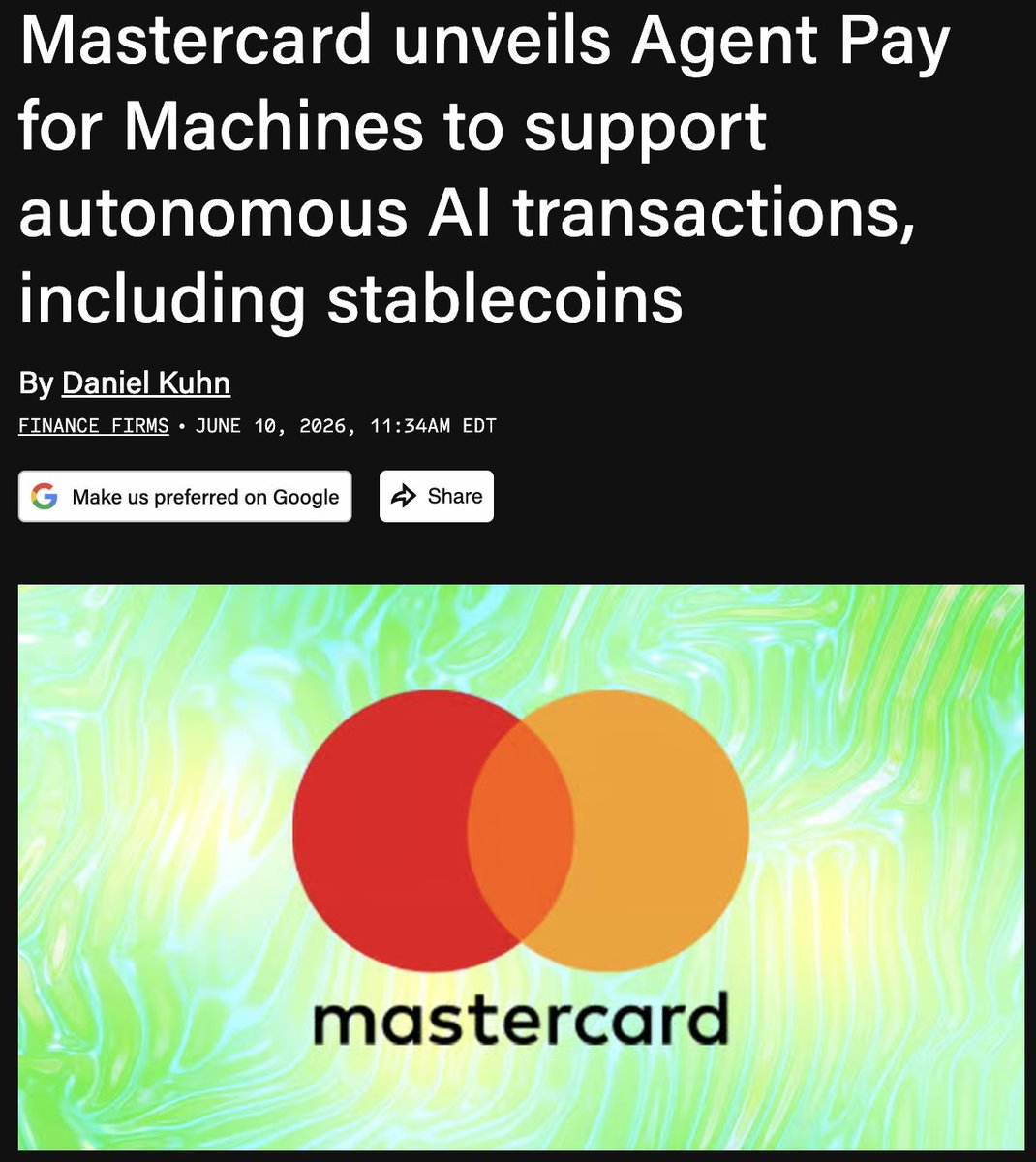
BREAKING: @Mastercard unveils Agent Pay for Machines to support autonomous AI transactions, including stablecoins
Mastercard has unveiled a new payments infrastructure designed specifically for AI agents, with over 30 fintech, legacy finance and crypto firms like Coinbase, OKX and Tempo joining as early adopters.
The new system, called Agent Pay for Machines (AP4M), will support super-fast, “always-on” transactions between AI agents and machines, including microtransactions, according to the announcement on Wednesday.
"AI agents are no longer just assisting decisions. They are able to act on human intent, coordinate services and complete transactions that are bespoke for their users," Mastercard wrote, noting that autonomous agents can execute high-volume, low-value payments "at machine speed."
The move comes as more and more financial giants build infrastructure designed for AI agents, including open payments protocols like x402, incubated by Coinbase, and the Machine Payments Protocol (MPP), built by Tempo. Rival network Visa has also begun experimenting with AI infrastructure.
Mastercard notes that legacy payment rails are too expensive for micro-amounts and not designed for continuous programmatic use. To get around this, AP4M adds a new layer on top of its global network that works across cards, accounts, and stablecoins.
The system also supports AI credentialing, so agents can prove they're authorized, and permissions, so users can set authorization rules and spending limits that are programmatically enforced.
This permissioning layer has been a common theme in several AI-related crypto releases, including MetaMask’s recently announced Agent Wallet, which uses pre-defined authorizations as part of its security system.
According to the announcement, at launch, Mastercard has worked with "a broad set of partners to validate priority use cases, establish common rules and accelerate adoption across industries."
These early adopters in the crypto-verse include Aave Labs, Alchemy, Anchorage Digital, BVNK, Coinbase, MoonPay, OKX, Polygon, Ripple, and Solana, among others. It is also working with internet giants like Checkout and Cloudflare.
The move comes as Mastercard continues to expand its crypto rails, including offering stablecoin-based card settlement with assets like USDC, PYUSD, and RLUSD, across its global payments network. The firm has been tapped by MetaMask, Bybit, Gemini, and others to support their crypto cards.
Mastercard has also launched an initiative with over 100 partners like Binance, Circle, Ripple, PayPal, Paxos, MetaMask, Gemini and Crypto, to integrate blockchain and stablecoin payments with traditional rails for cross-border transfers, B2B, payouts, and commerce. @MastercardNews
5
284
Jun 10
The debate between Lightning and stablecoins as payment rails often gets framed as a competition. It largely misses the point.
@davistrazza walked through something worth unpacking here. There are corridors where Lightning is the more efficient path. Markets where stablecoin liquidity is thin, where accessing a dollar requires going to a secondary market and paying a premium. In those places, Bitcoin's liquidity depth makes it the more practical rail.
And then there are corridors where stablecoins perform just as well or better.
The real point is that this should not be a business decision at all. Choosing between rails, factoring in liquidity, cost, corridor-by-corridor performance, is exactly the kind of complexity that should sit below the surface. @lightspark 's model is to orchestrate across rails and deliver the optimal outcome without surfacing that complexity upstream.
The companies that will win in cross-border payments are not the ones that pick a single rail and defend it. They are the ones that make the choice invisible.
1
3
530