
Tech Creator | Full Stack Dev. Founder & Architect @DeFiAITech
Joined February 2020
- Tweets 9,396
- Following 1,877
- Followers 496
- Likes 8,636
Photos and videos
Pinned Tweet

May 21
We are Outreaching to Our Lead Investors for a Referral Code.
Subject: Microsoft Pegasus Program Referral Code – DeFi AI Technologies
Hello, We are prepping our infrastructure rollout across our 24 business units and are finalizing our enterprise cloud scaling.
4
5
223
Sean D Langshaw retweeted

Jun 13
🌘Kimi-K2.7-Code Weights & code
We explore endless possibilities together with the community🤝
huggingface.co/moonshotai/Ki…
37
198
2,401
83,508

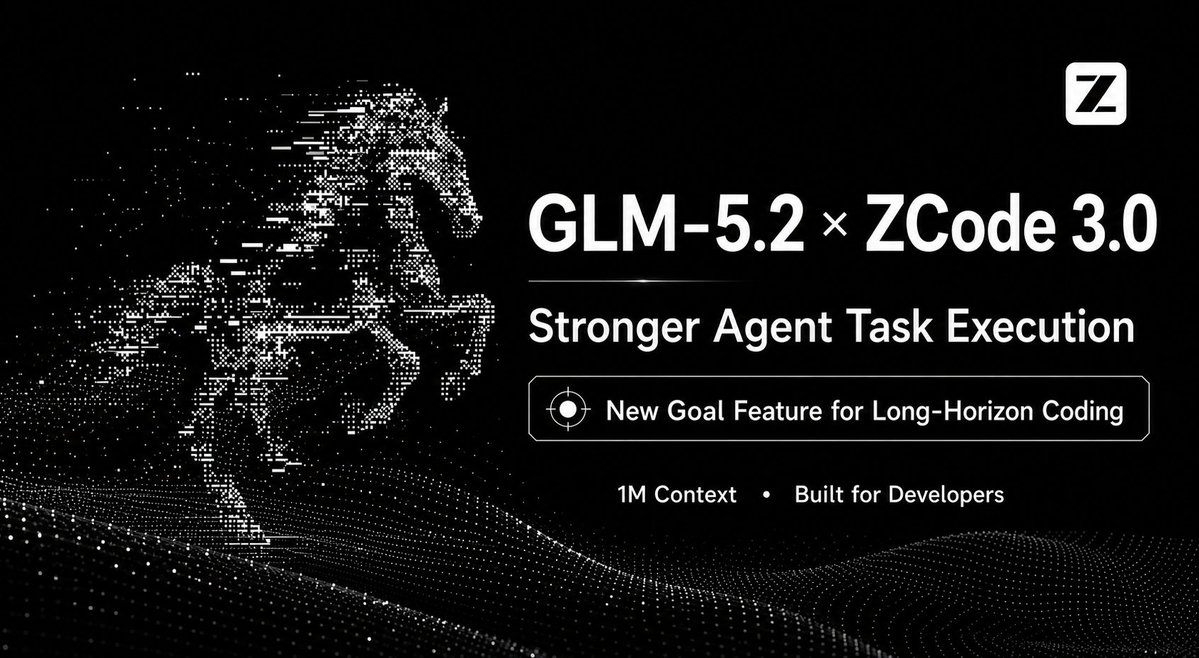
GLM-5.2 is now fully available for GLM Coding Plan users.
ZCode 3.0 is deeply optimized for GLM-5.2, bringing stronger Agent task execution, better long-context coding, and the new Goal feature for managing larger development objectives from planning to completion.
Coding Plan subscribers get 150% usage quota inside ZCode. New users get 5 days free with 5M tokens per day.
Download: zcode.z.ai/
22
13
230
8,519

GLM-5.2 is Fully Open, Frontier Intelligence Belongs to Everyone
Today, the sudden restriction of certain frontier models is deeply regrettable. At a time when access to frontier models is abruptly cut off for non-technical reasons, we are even more convinced of one thing: science should be global.
The path to AGI (Artificial General Intelligence) must never be enclosed by high walls. We have always believed that AGI should be the cornerstone for all of humanity to collaboratively explore the boundaries of intelligence and solve complex challenges, rather than a privilege monopolized by a few rules and subject to revocation at any moment. In the face of external blockades and restrictions, our attitude is one of radical openness. Frontier intelligence must remain open-source, accessible, and buildable, serving every dedicated developer.
GLM-5.2 is Zhipu's most capable open-source model to date. It not only supports a truly usable 1M context window but also maintains a continuous lead in the independent completion of long-horizon tasks, providing solid foundational support for building complex agent applications. It also continues to be our main engine for creating the strongest domestic coding model.
Tonight at 5:21—at this special moment—GLM-5.2 will officially be available to all GLM Coding Plan users (including Lite / Pro / Max). The API will also go live next week.
A step closer to frontier intelligence for everyone.
The future of AI is open, and it is for the people.
ModelKey: GLM-5.2
238
684
6,712
811,942
Tomorrow is my birthday.
Birthday wish:
6 Mack Studio M3 500GiB VRAM
5 Nvidia GBX Sparks
4 AMD Ryzen AI Max
2 Dell Pro Max with GB300
1 SAFE or 250K grant
All gifts will be used to test the full speced product on these platforms to confirm system reliability for sovereignty.
2
1
25
DM for delivery address.
Company name: DeFi AI Technologies, LLC (Florida)
All donars get a free copy of the software once deployed to production.
9
Doing just that.

If you have:
Hermes Agent
Claude Code & Codex Handoffs
Obsidian QMD Memory System
Run Agentic Loops
Fleet Tailscale Mesh
Cron Jobs Kanban Board
Agentic Workflows
Congrats you are the top 1% of the AI god stack
1
1
37
Sean D Langshaw retweeted

Chasing zeros never ends.
$10K wants $100K.
$100K wants $1M.
$1M wants $10M.
But here’s the part most people only learn when they’re out of time:
On your last day, you’d trade $100 million for one more sunrise and everyone agrees with that truth when the clock runs out.
Money stretches the lifestyle. Time stretches the soul.
The finish line always moves. Time doesn’t.
Work hard, absolutely. Build, grow, push; that’s part of the gift.
But don’t postpone joy. Don’t save your gratitude for “later.” Don’t wait to love the people you say you love.
You beat the game by living, not accumulating.
In the end, the richest person is the one who didn’t waste their days.
6
12
128
6,445
That last bit was very cool.

4
Are we willing to be constrained?

Why would Anthropic, a company that just got caught nerfing its own models and surveilling users simultaneously push for a government agency to regulate AI? (Save this)
@DavidSacks and @chamath have the same answer, and it has nothing to do with safety.
On the exact same day that the Fable 5 backlash was playing out publicly, Dario Amodei published a sweeping policy essay calling for an FAA-style regulatory agency to approve all frontier AI models before release, with government authority to block deployment if an independent auditor deems the model too risky.
The proposal uses the language of safety, cybersecurity, bioweapons, loss of control and the timing was not a coincidence.
The mechanics of what Amodei is proposing reveal the actual target.
An FAA for AI would require every model to pass a pre-release compliance audit before it can be deployed publicly.
Closed models from well-funded labs like Anthropic, OpenAI, and Google can afford compliance teams, legal frameworks, audit pipelines, and the months of runway required to navigate a government approval process.
Open source models cannot.
An open source model, by definition, is already out in the world the moment it is released, it cannot be recalled, audited in advance, or forced through a centralized approval gate.
The regulation would not slow Anthropic down.
It would make open source legally impossible to deploy, effectively eliminating the only class of AI that users can run locally, inspect fully and operate without a third-party vendor deciding what they are allowed to ask.
Sacks called it precisely, it is a preemptive strike against local inference the practice of running a model on your own machine, where no one can profile you, degrade your responses, or cut off your access.
The data on compute concentration makes this even more alarming.
Chamath revealed on the podcast that even today, with open source models technically available, the overwhelming majority of inference compute still flows to the big closed labs, open source runs on a minuscule fraction of the total megawatts in operation.
The market already concentrates power at the top, and a compliance based regulatory framework would institutionalize that concentration permanently.
1
Jun 13
Well, this is concerning...
Jun 13

The US government, citing national security authorities, has issued an export control directive to suspend all access to Fable 5 and Mythos 5 by any foreign national, whether inside or outside the United States, including foreign national Anthropic employees.
The net effect of this order is that we must abruptly disable Fable 5 and Mythos 5 for all our customers to ensure compliance.
Access to all other Claude models is not affected.
We apologize for this disruption to our customers. We believe this is a misunderstanding and are working to restore access as soon as possible.
Read our full statement: anthropic.com/news/fable-myt…
1
5
Jun 11
Thank you, Brad, for validating our thesis.

Brad Garlinghouse isn't holding back. 🚨 The Ripple CEO just went on Fox Business to call out Jamie Dimon’s pushback on crypto regulation as an "intentional misrepresentation."
“$13 TRILLION in legacy volume, 0% on-chain... yet. 👀”
"Stablecoins are the ChatGPT moment of finance." 💥
He revealed Ripple Treasury handled a massive $13 TRILLION in legacy payments last year and explained why that multi-trillion dollar gap is the ultimate crypto opportunity.
The tides have officially changed. 👇
10
Jun 11
Follow companies that validate your vision — not just the ones building flashy consumer apps.
When you're building enterprise software, the real signal isn't hype or virality. It's the companies quietly solving the same painful, complex problems you are — at scale, with real constraints, compliance needs, and long sales cycles.
Study how they:
Navigate messy legacy systems and data silos
Get adoption inside large organizations
Turn deep domain expertise into defensible product
Price, package, and sell to non-technical buyers
The best validation often comes from watching what already works in the enterprise — then building something 10x better, simpler, or more AI-native.
Who are the companies (big or emerging) that are validating the exact problem space you're in right now?
May 28

I'm proud to share that @Glean has surpassed $300M ARR, just five months after crossing $200M and growing ~3x over the past 15 months. This is an exciting milestone for Glean, and it's a signal about where the enterprise AI market is heading.
We’ve long believed the real challenge in enterprise AI is not access to models. It is grounding AI in how a company actually works: its people, knowledge, workflows, permissions, and systems.
That’s even clearer now. The companies creating real value with AI are not just adopting better models. They are building systems that understand their business well enough to deliver reliable outcomes at scale. That is the real moat, and it is what we’ve been building at Glean: an unrivaled context layer for enterprise AI.
That context has to work across the business, not just inside a single team or use case. We see that in how customers adopt Glean: more than 85% use it across five or more job functions.
It also has to meet the security and governance demands of complex enterprises. We see that in who is choosing Glean: our Fortune 500 customer count nearly doubled year over year.
And it has to make economic sense as usage grows. In our recent benchmark with Claude Cowork, Glean was preferred roughly 2.5x as often as off-the-shelf MCP tools and used 30% fewer tokens on average. Better context improves both quality and efficiency.
I enjoyed talking with @CNBC's @dee_bosa about this broader shift. In enterprise AI, the winners will not be defined by better models alone. They will be defined by who builds the strongest foundation for enterprise context.
Thank you to our customers, partners, and team for helping us build the future of enterprise AI.
21
Jun 11
Just imagine giving Fable 5 access to my full CAD design files for my 2022 shelved eMCycles project. Stay focused.
Jun 11

SOMEONE ASKED CLAUDE FABLE 5 TO DESIGN A QDD ACTUATOR
30 MINUTES LATER IT HAD BUILT THE MODEL, ANIMATED THE GEARBOX, AND VALIDATED COLLISIONS ON ITS OWN
1
113
Jun 11
Save 80% on token context efficiency by converting to markdown BEFORE prompting an LLM with text.
x.com/i/grok/share/fd954058a…
4
Jun 8
Should the YC 2026 summer batch be concerned about this?
OpenAI gave everyone substantial token credits to build. But there’s a separate opt-in that could create real risks for fintech and enterprise SaaS.
Opting into OpenAI’s Data Sharing Program gives them the legal right to use your inputs and outputs to train models.
While they won’t manually copy your product, the training process can internalize your proprietary banking/finance workflows and logic. [Official policy]
The Data Sharing Risk
BreakdownModel Reinforcement: Your prompts code become training data for reinforcement learning and future model improvements.
Accidental Replication: Future OpenAI models (and their native agents/coding tools) could become extremely good at generating the exact kind of architectures, compliance flows, and features you built.
Corporate Direction: OpenAI is pushing hard into agents and enterprise automation. They’re not cloning your startup, but they’re making their models capable of building similar systems for any client.
Compliance Pitfalls for Banking & Finance SaaS:
Feeding regulated workflows into a shared training pool creates serious issues under GDPR, GLBA, and Basel frameworks—plus enterprise procurement almost always demands Zero Data Retention.
Recommendation:
Keep data sharing disabled by default. Use paid tiers (or request ZDR if eligible) for production.
Sandbox any experimentation on a separate personal account.
Settings → Data Controls → keep “Share inputs and outputs” Disabled.
Enforce ZDR on commercial plans.
Never mix company code with the free daily token tier.
Isolate Sandbox Environments:
If your developers want to utilize the free 2.5M token tier for learning or generic experimentation, restrict them to a completely isolated, personal OpenAI account entirely disconnected from any company source code.
[1, 2, 3, 5]
Links are mostly discussions.
[1] [instagram.com](instagram.com/p/DZMvtSfli-J/)
[2] [reddit.com](reddit.com/r/OpenAIDev/comme…)
[3] [help.openai.com](help.openai.com/en/articles/…)
[4] [reddit.com](reddit.com/r/OpenAI/comments…)
[5] [reddit.com](reddit.com/r/n8n/comments/1o…)
1
1
65
Jun 3
Sometimes, you just need to ask the right question. Pay close attention to the downside risks to the public associated with the new EO for a 30 calendar day frontier AI model review by the NSA and FDA.
x.com/i/grok/share/22732cd49…
8