
Joined February 2026
- Tweets 629
- Following 55
- Followers 145
- Likes 689
267 Photos and videos
Pinned Tweet

Mar 3
2
1
7
2,342
Jun 12
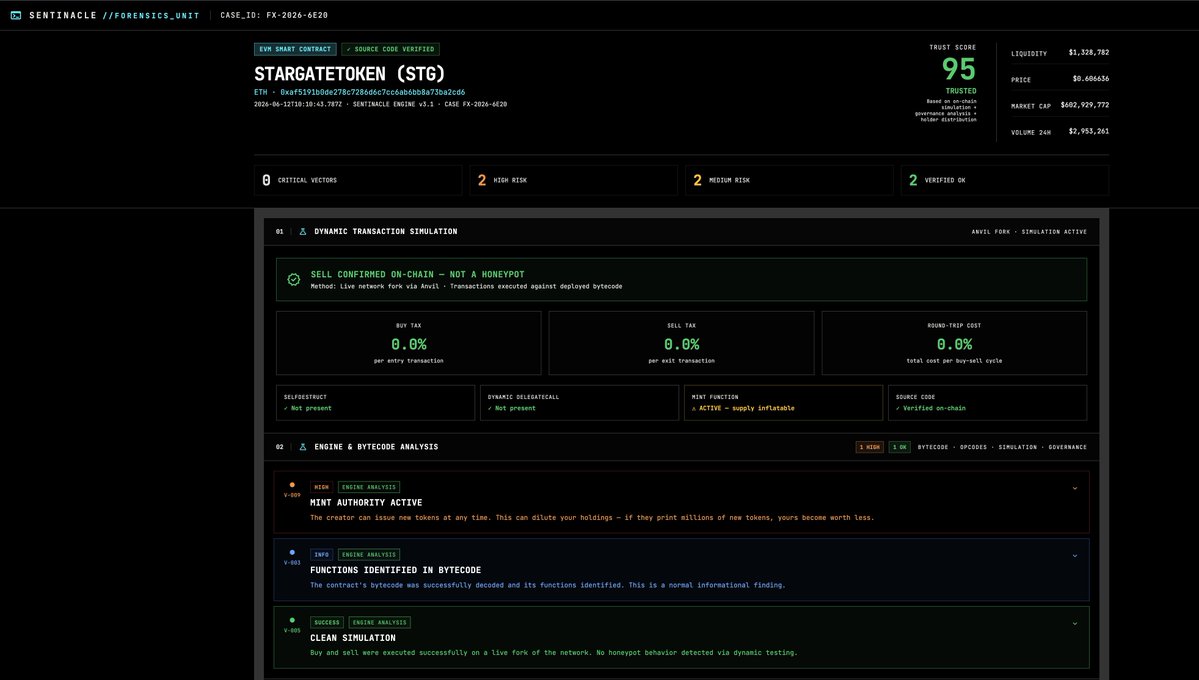
$STG
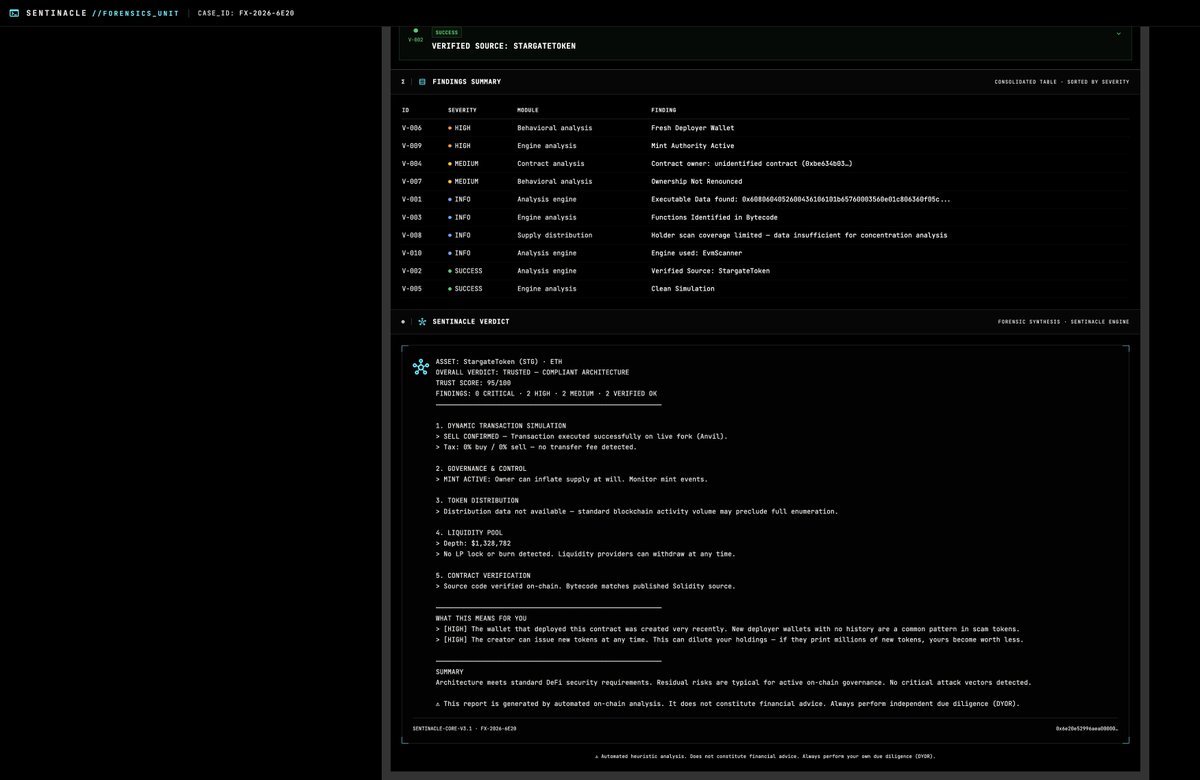
Stargate Finance ($STG) operates as the flagship omnichain liquidity transport protocol on LayerZero. With a $602M market cap and commanding cross-chain transfer volume, its token contract architecture reveals how blue-chip DeFi manages active protocol control.
In our latest crypto risk assessment, Sentinacle assigned $STG a 95/100 Trust Score. This aligns with the broad market perception of its operational security, yet our automated telemetry flags key structural nuances that liquidity providers should actively monitor.
Our forensic dissection of the EVM bytecode highlights two distinct architectural realities:
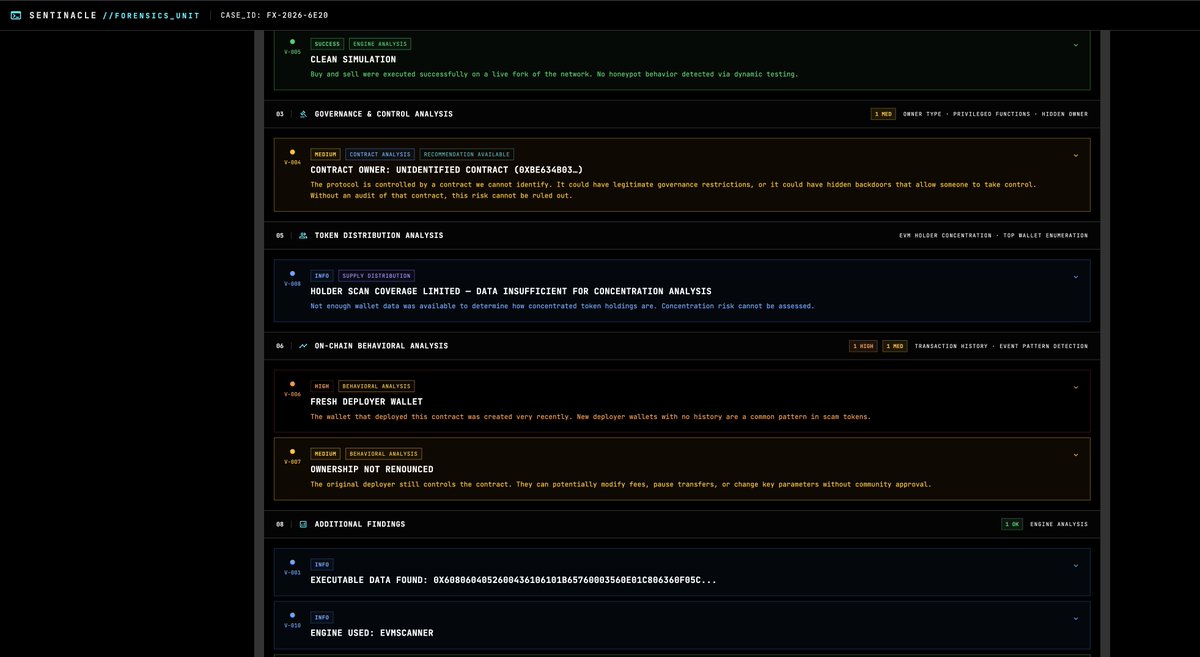
• Mint Authority Active: The token retains an active mint function. While this is a standard mechanism for emitting yield farming rewards and managing cross-chain liquidity rebalancing, it represents a theoretical dilution vector if the controlling entity is compromised.
• Governance Control: Ownership has been transferred from a fresh deployer wallet to an unidentified contract (0xbe634B03...). In modern protocol design, this typically indicates a DAO timelock or multi-sig taking control—replacing single-signature vulnerability with governance-driven execution.
A live dynamic transaction simulation on an Anvil network fork confirmed 0.0% entry and exit taxes. The absence of honeypot mechanics or hidden dynamic opcodes verified that the bytecode matches the published Solidity source perfectly.
Institutional Insight: When performing a comprehensive DeFi smart contract audit for capital allocation, pure code vulnerabilities are only half the picture. For $STG, the base architecture is fundamentally clean. The residual risk profile shifts entirely from technical smart contract exploits to governance execution and the active monitoring of mint events.
How are institutional LPs pricing in the risk of active mint authorities when farming omnichain protocol yields?
Telemetry only. NFA. #SmartContracts #OnChainAnalysis #DeFi #LayerZero #CryptoSecurity #OnChain #SmartContracts #RugPull #DeFiRisk
1
2
4
422
Jun 12
This is the surface-level read. For the complete architectural analysis — contract-by-contract dissection and risk parameters — explore the full report: → sentinacle.com
1
39
Jun 12
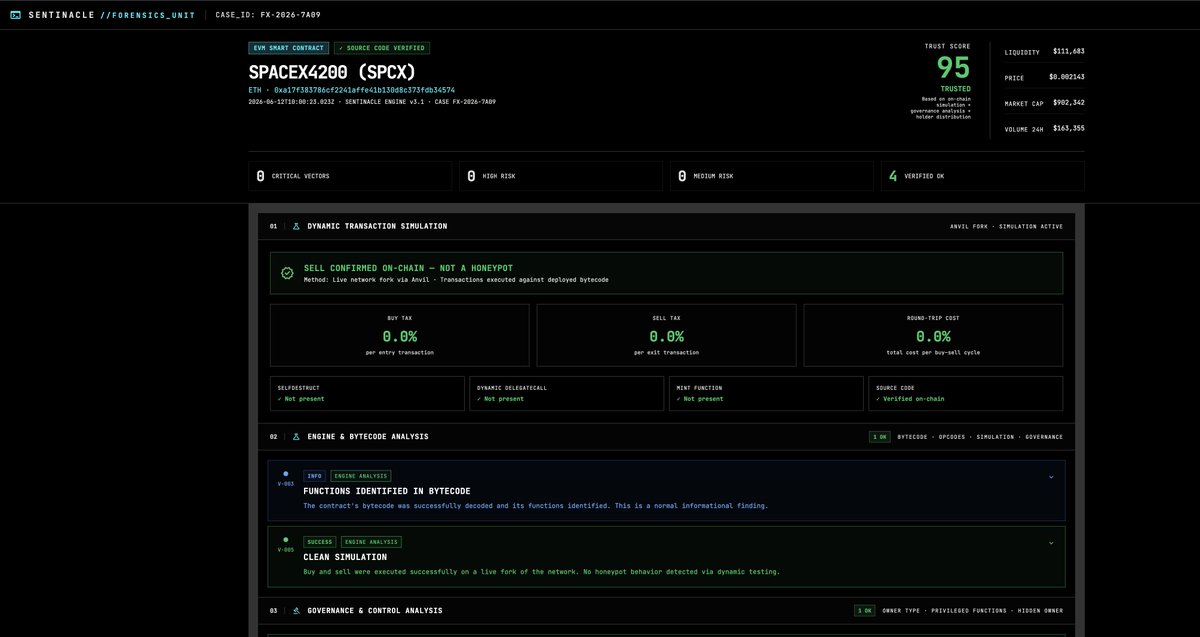
$SPCX
Ethereum's early-stage speculative markets demand rigorous architectural scrutiny. As part of a standard crypto risk assessment, let’s evaluate the contract structure of SPACEX4200 ($SPCX)—an Ethereum-based asset positioned around the narrative of preemptively capturing the ticker for a potential SpaceX IPO.
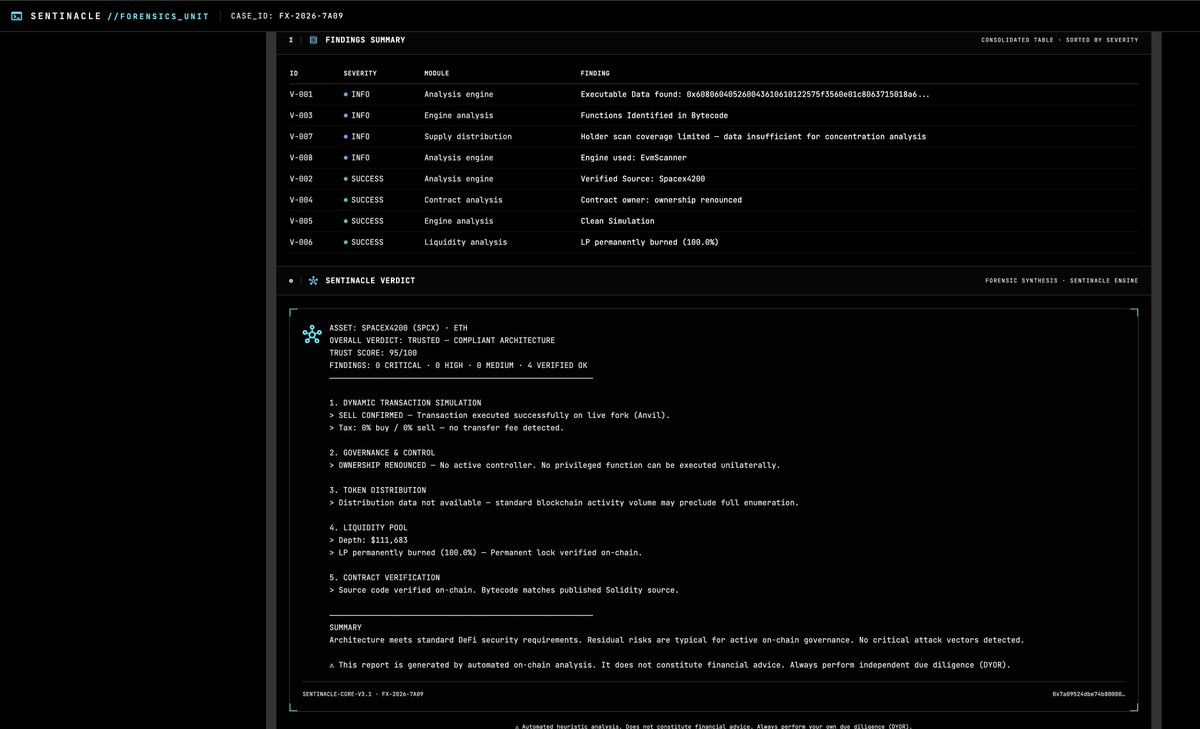
Currently operating at a ~$902k market capitalization with $111k in liquidity depth, the asset's structural reality aligns closely with its broader market perception. The Sentinacle engine returns a 95/100 Trust Score, classifying the framework as a "Compliant Architecture."
Our automated DeFi smart contract audit highlights several specific technical hallmarks:
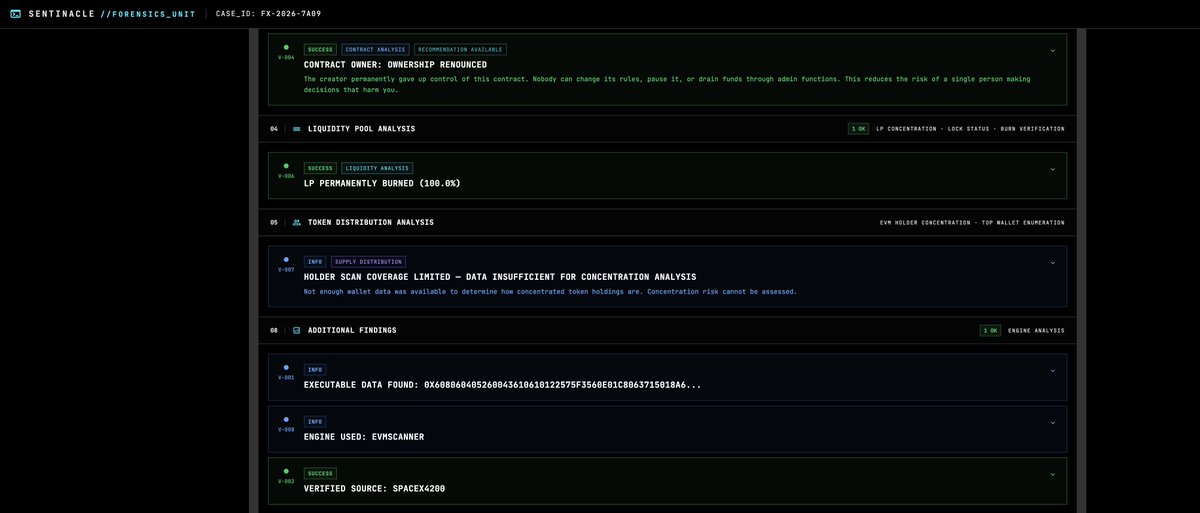
• Governance Vector: Ownership is permanently renounced. With no active controller or privileged admin functions, the risk of unilateral logic manipulation or forced pauses is neutralized.
• Liquidity Integrity: The token's liquidity pool (currently at a $111,683 depth) is fundamentally locked, with the LP tokens 100% permanently burned and verified on-chain.
• Transaction Simulation: Dynamic execution against deployed bytecode via an Anvil live network fork confirms a clean state. The EVM smart contract enforces a 0% buy and 0% sell tax, with zero honeypot mechanics detected.
• Source Verification: The on-chain source code perfectly matches the published Solidity bytecode.
For liquidity providers and risk managers navigating high-beta tokens, these immutable parameters are foundational. The combination of centralized governance removal and a permanently burned LP effectively shifts the token's risk profile away from malicious developer action and squarely onto open-market dynamics.
How do institutional LPs weigh these structural, on-chain guarantees against the inherent volatility of narrative-driven tokens?
Telemetry only. NFA.
#SmartContracts #OnChainAnalysis #Ethereum #DeFi
#CryptoSecurity #OnChain #SmartContracts #RugPull #DeFiRisk
1
2
4
127
Jun 12
This is the surface-level read. For the complete architectural analysis — contract-by-contract dissection and risk parameters — explore the full report: → sentinacle.com
2
18
Jun 10
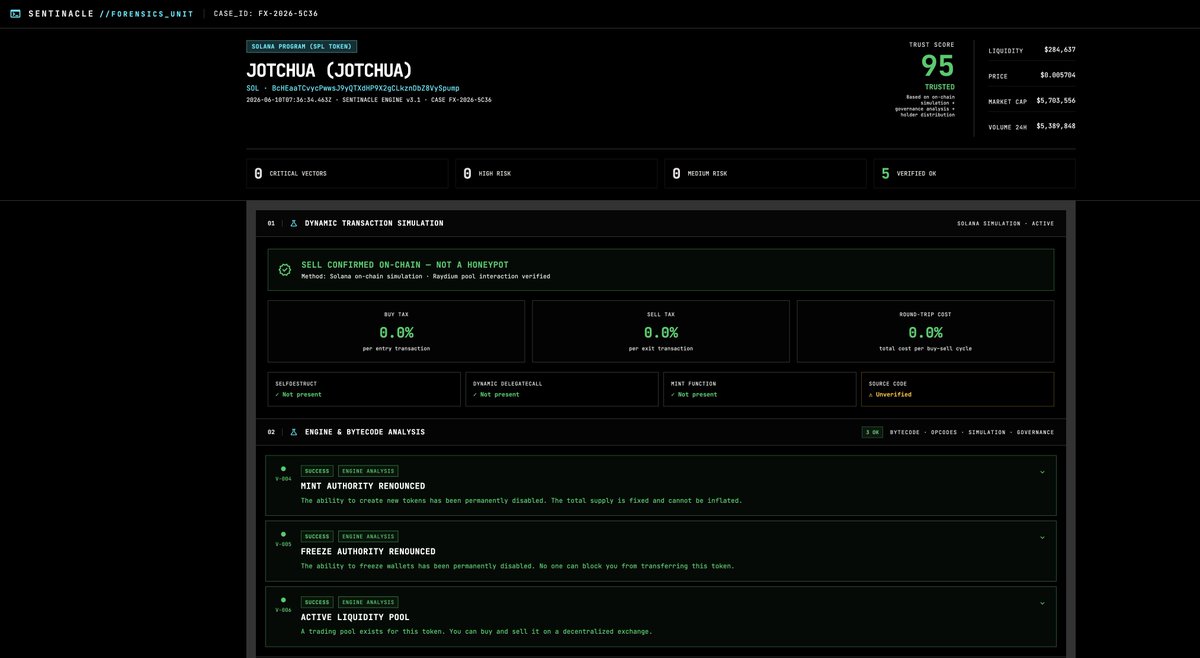
$JOTCHUA
Solana's liquidity velocity is pushing SPL assets like JOTCHUA ($JOTCHUA) into rapid valuation phases, currently sitting at a $5.7M market cap with over $5.3M in 24-hour volume. 🧵
While retail market perception is largely driven by its meme-culture roots and recent centralized listings, our crypto risk assessment isolates the underlying mechanics.
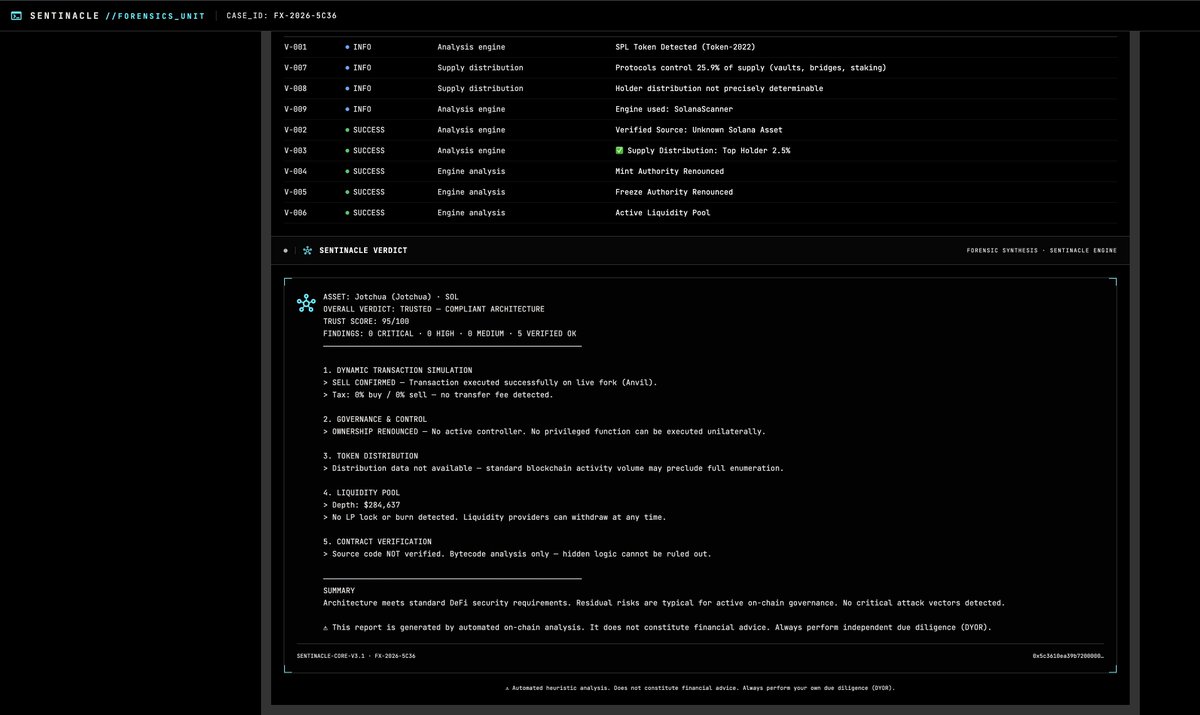
The asset holds a Sentinacle Trust Score of 95/100, indicating a fundamentally compliant and standard token architecture.
Our DeFi smart contract audit of the Token-2022 deployment reveals textbook protocol adjustments that mitigate immediate rug vectors.
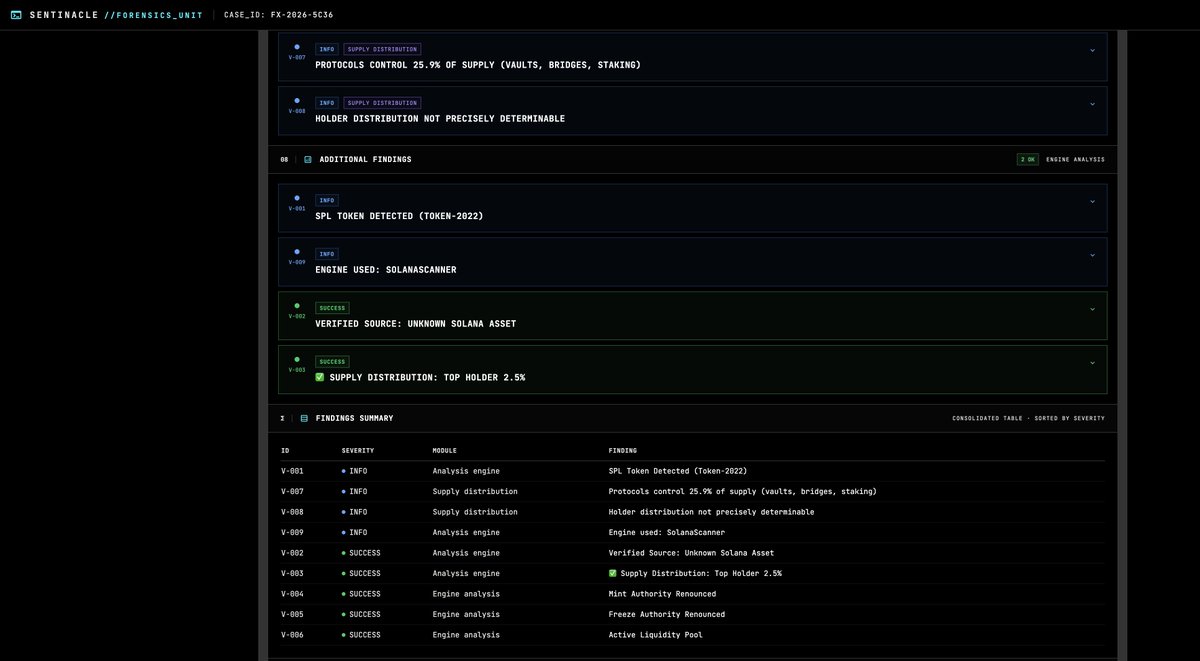
• Mint and Freeze Authorities: Permanently renounced.
• Buy/Sell Taxes: Hardcoded at 0%.
• Dynamic Simulation: Clean execution on a live Anvil fork.
However, the primary architectural trade-off lies in contract transparency.
Source code remains unverified. We are relying entirely on bytecode analysis and opcode heuristics via SolanaScanner.
While on-chain simulation clears standard honeypot flags, unverified bytecode means arbitrary hidden logic cannot be absolutely ruled out.
From an institutional perspective, the liquidity profile—currently at a $284K depth—requires active management.
Supply distribution is fairly decentralized: 25.9% is actively controlled by protocols (vaults, bridges), and the top individual holder commands just 2.5%.
Crucially, no LP lock or burn is detected. Liquidity providers retain the ability to withdraw at any time, transferring exit risk to late participants.
For risk managers and LPs, it is a classic scenario of perfectly decentralized token authorities paired with opaque bytecode execution.
How do you weigh the risk of unverified SPL bytecode against permanently renounced governance privileges?
Telemetry only. NFA. #SmartContracts #OnChainAnalysis #Solana #DeFi #CryptoSecurity #OnChain #SmartContracts #RugPull #DeFiRisk
1
2
4
274
Jun 10
This is the surface-level read. For the complete architectural analysis — contract-by-contract dissection and risk parameters — explore the full report: → sentinacle.com
2
43
Jun 9
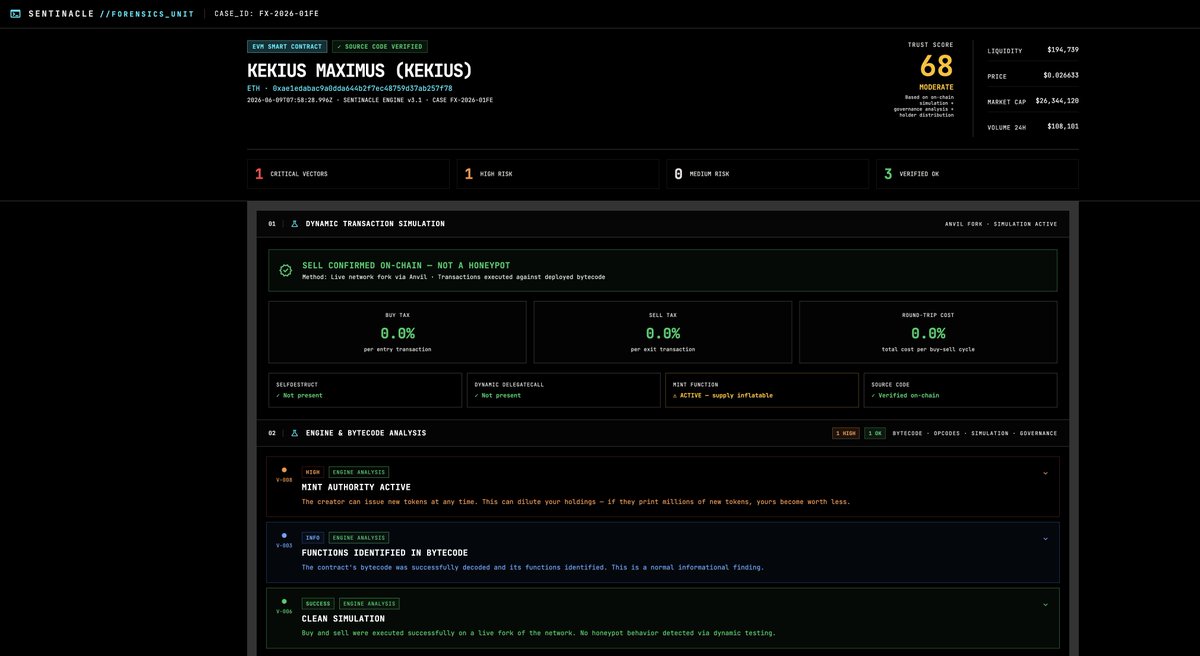
$KEKIUS
On-chain forensic analysis of Kekius Maximus (KEKIUS). A $26.3M market cap EVM asset presenting a structural dichotomy for liquidity providers. 🧵
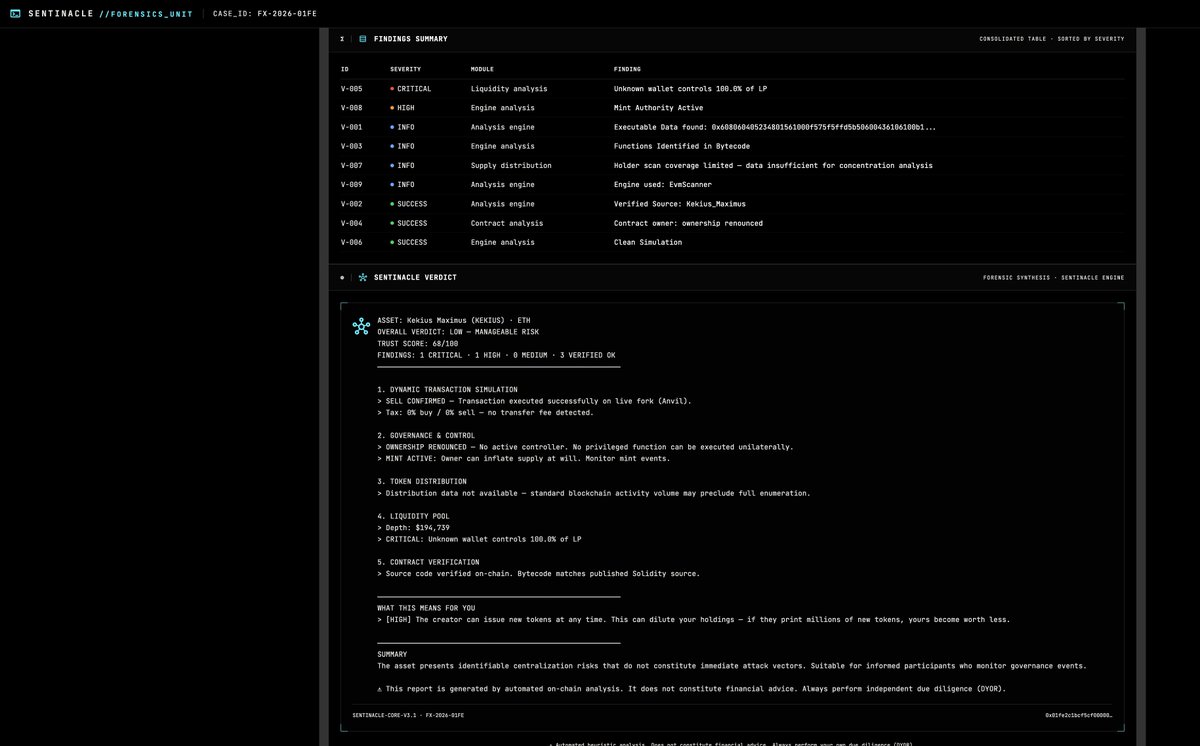
Operating with $194k in on-chain liquidity, KEKIUS registers a Sentinacle Trust Score of 68 (Moderate Risk).
Initial dynamic transaction simulations against deployed bytecode are clean. We mapped 0% entry and exit taxes with verified round-trip execution via an Anvil live fork.
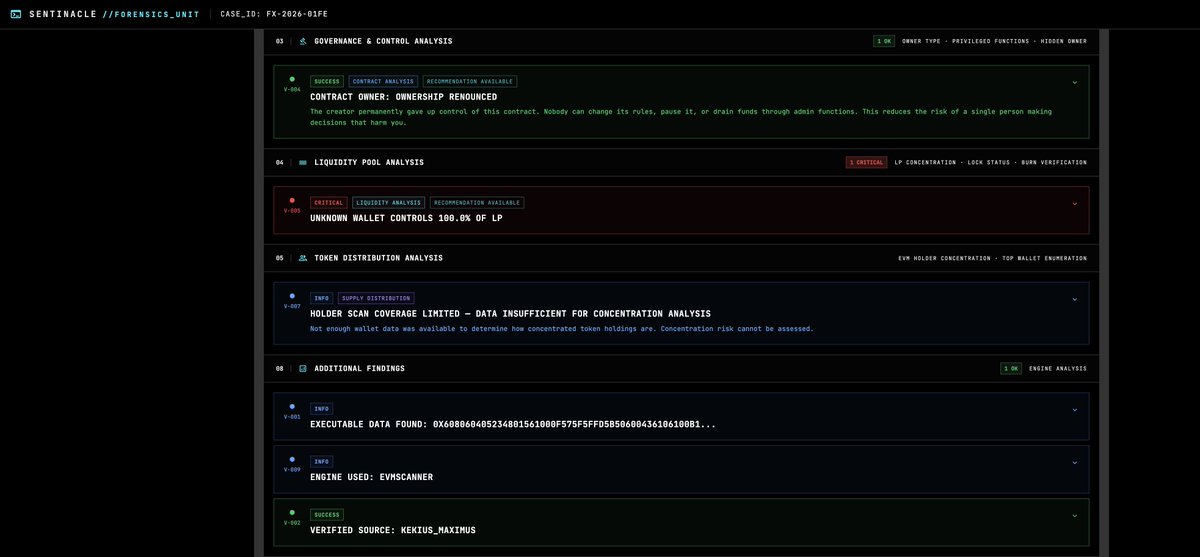
While structurally not a honeypot, a deeper crypto risk assessment reveals conflicting governance parameters. Standard contract ownership has been renounced.
Despite this renunciation, our engine analysis isolated an active mint authority. The capability to unilaterally inflate supply remains intact, bypassing standard administrative safeguards.
Compounding this architecture, 100% of the active Liquidity Pool is currently controlled by a single, unknown wallet.
For institutions conducting a rigorous DeFi smart contract audit, this specific combination requires active monitoring. The lack of decentralized governance, paired with absolute LP concentration, creates an asymmetric risk profile for participants.
How do your internal risk frameworks weight the balance between renounced base administrative controls and singular LP centralization?
Telemetry only. NFA. #SmartContracts #OnChainAnalysis #Ethereum #DeFi
1
2
3
231
Jun 9
This is the surface-level read. For the complete architectural analysis — contract-by-contract dissection and risk parameters — explore the full report: → sentinacle.com
2
33
Jun 9
Spot on. Static analysis of the inherited DN404 logic confirms the flaw propagated via the fork, mirroring the Flooring execution path.
Are we underestimating the contagion risk of unverified forks?
#DeFi #CryptoSecurity #OnChain #SmartContracts #RugPull #DeFiRisk
Jun 9

Asterix @asterixlabs was reportedly attacked a few hours ago, with a loss of ~$40K. The root cause appears similar to yesterday’s Flooring incident, which had a total impact of $900K , with ~$500K rescued by white hats.
Asterix appears to be forked from Flooring, and DN404/BT404 appear to share essentially the same 404-style ERC20/ERC721 hybrid contract design under different names/variants.
The shared root cause appears to be a high-bit NFT ID shift/overflow issue, leading to ID reuse and broken ownership/approval/accounting breakdowns (underflow).
Specifically, full uint256 NFT IDs enter external functions, while ownership/accounting is stored in packed lower-width slots. Crafted IDs with different high bits but colliding low bits can desync ownership, approvals, balances, and NFT backing. The attacker can then abuse exchange/transfer/unwrap flows to inflate the fungible token balance, sell into liquidity pools to drain WETH, and potentially extract additional value from backed NFTs.
2
3
77
Jun 9
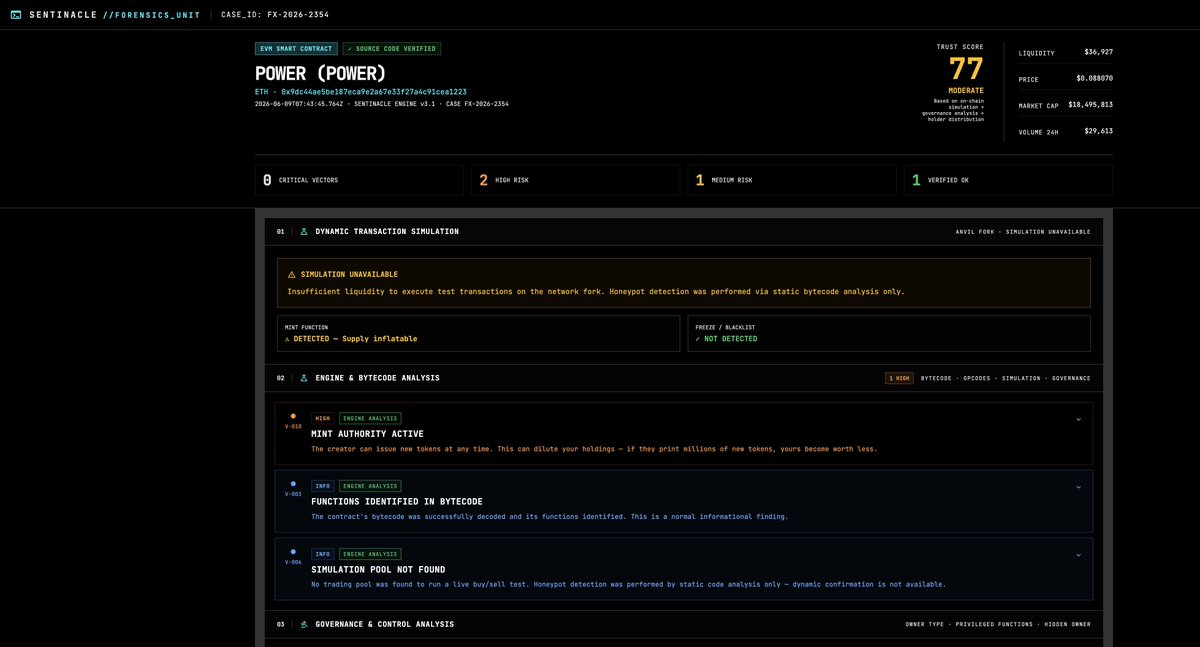
$POWER
On-chain telemetry for POWER (POWER) on Ethereum reveals a stark architectural divergence between asset valuation and foundational liquidity.
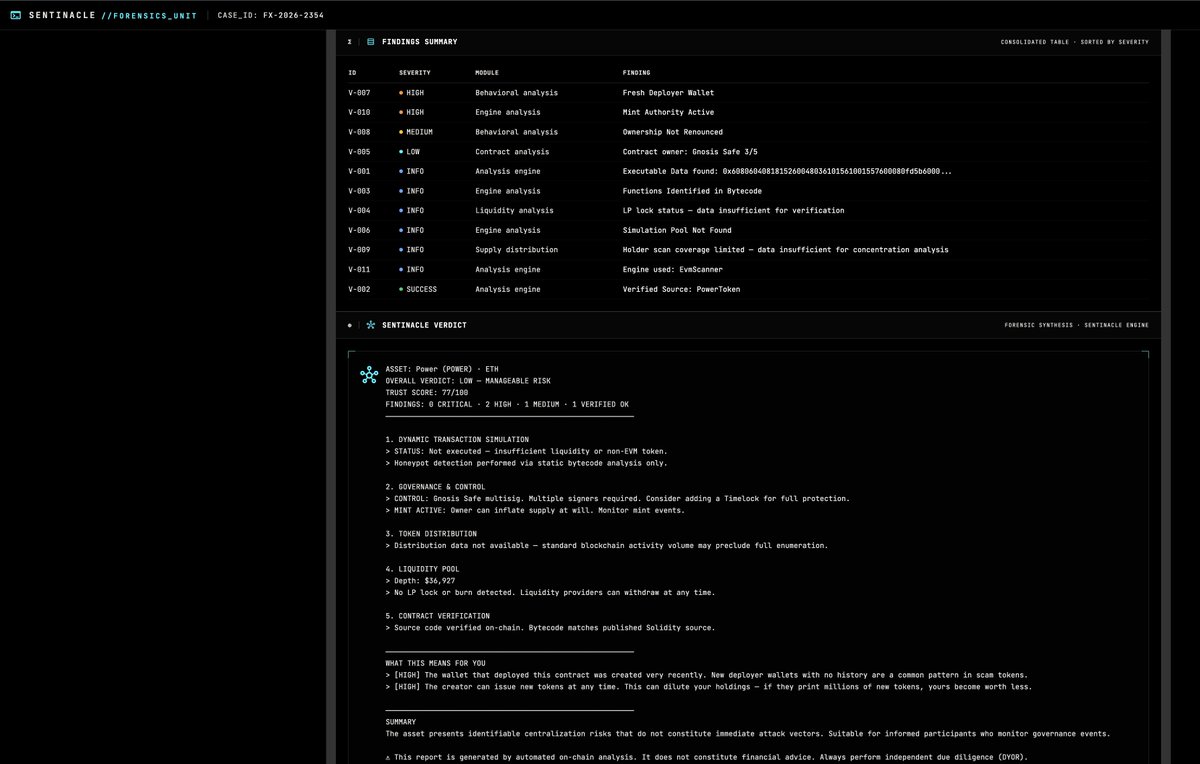
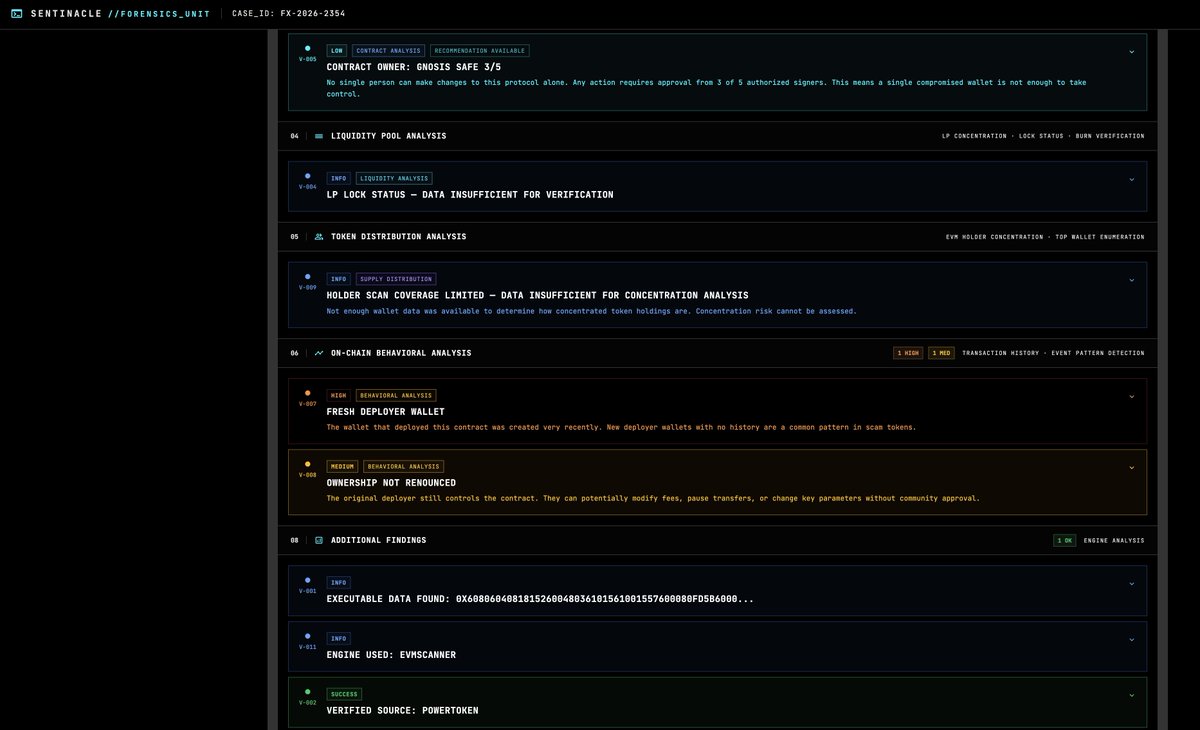
Case FX-2026-2354 establishes a Sentinacle Trust Score of 77/100 (Moderate Risk), driven by structural centralization vectors despite an $18.49M market cap.
🧵 A technical forensic dissection for risk managers:
Governance Architecture: Ownership is unrenounced but assigned to a 3/5 Gnosis Safe multisig. While this prevents single EOA compromise, it currently lacks a defensive timelock.
Supply Dynamics: Engine and bytecode analysis identifies an active mint authority (V-010). The contract owner retains the technical capability to inflate supply at will.
Our crypto risk assessment flags a severe liquidity mismatch: the pool depth sits at just $36,927, paired with a low 24-hour volume of $29,613.
This thin liquidity profile precluded dynamic transaction simulation on network forks, restricting the DeFi smart contract audit to static bytecode evaluation.
While the verified Solidity source code lacks freeze or blacklist functions, the fresh deployer wallet architecture requires continuous monitoring of mint events.
For asset allocators, the primary exposure is potential supply dilution paired with high execution slippage, rather than an immediate, malicious exploit vector.
How are risk desks pricing protocols that combine multi-sig governance architecture with highly asymmetric on-chain liquidity analysis parameters?
Telemetry only. NFA.
#SmartContracts #OnChainAnalysis #Ethereum #DeFi #CryptoSecurity #OnChain #SmartContracts #RugPull #DeFiRisk
1
2
3
374
Jun 9
This is the surface-level read. For the complete architectural analysis — contract-by-contract dissection and risk parameters — explore the full report: → sentinacle.com
2
40
Jun 8
The 14 userCmd cycles isolate the exact accounting drift in HotProxy surplus tracking. A critical proxy state sync flaw. How many other DEX architectures similarly miscalculate flash loan surplus?
#DeFi #CryptoSecurity #OnChain #SmartContracts #RugPull #DeFiRisk
Jun 8

🚨 Ambient.finance (CrocSwapDex) - Loss ~$110K (2026-06-07)
Type: Logic Error / Accounting bug (surplus collateral)
Attacker took a Balancer flash loan (50 WETH 1 USDC), then repeatedly cycled userCmd calls through CrocSwapDex routing 14 times into HotProxy swaps (cmd 1) and WarmPath LP mint/burn (cmd 2) on the USDC/ETH pool, abusing the surplus-collateral accounting (DEPOSIT_SURPLUS 0x49 / DISBURSE_SURPLUS 0x4a in ColdPath). The final ColdPath disburseSurplus withdrew 83.72 ETH from the dex; combined with extracted USDC, the attacker walked away with ~33.7 ETH (~$55K net after bribing the half to Titan Builder).
TX: etherscan.io/tx/0xb2fc668c42…
Victim: etherscan.io/address/0xaaaaa…
💎 t.me/send?start=SBRXqBWSqaOv…
1
3
56
Jun 8
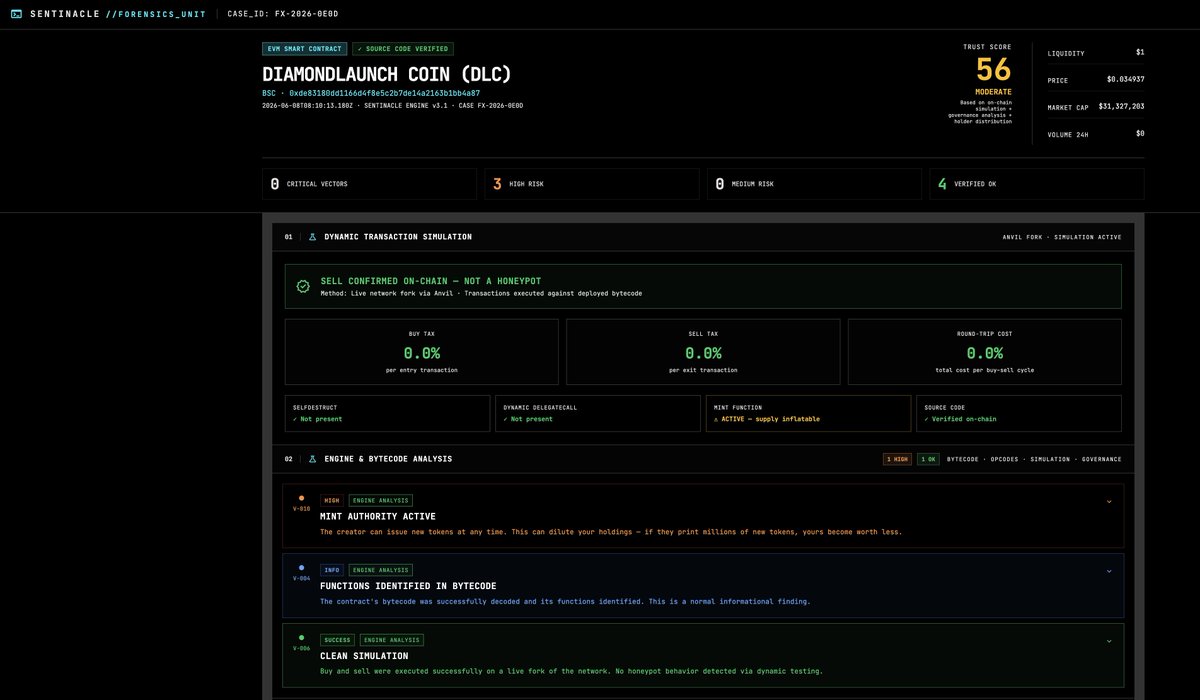
$DLC
DiamondLaunch Coin (DLC) presents a structural paradox on BSC. Functioning as a launchpad ecosystem token, it carries a fully diluted valuation north of $31M, yet its on-chain footprint tells a different story. 🧵
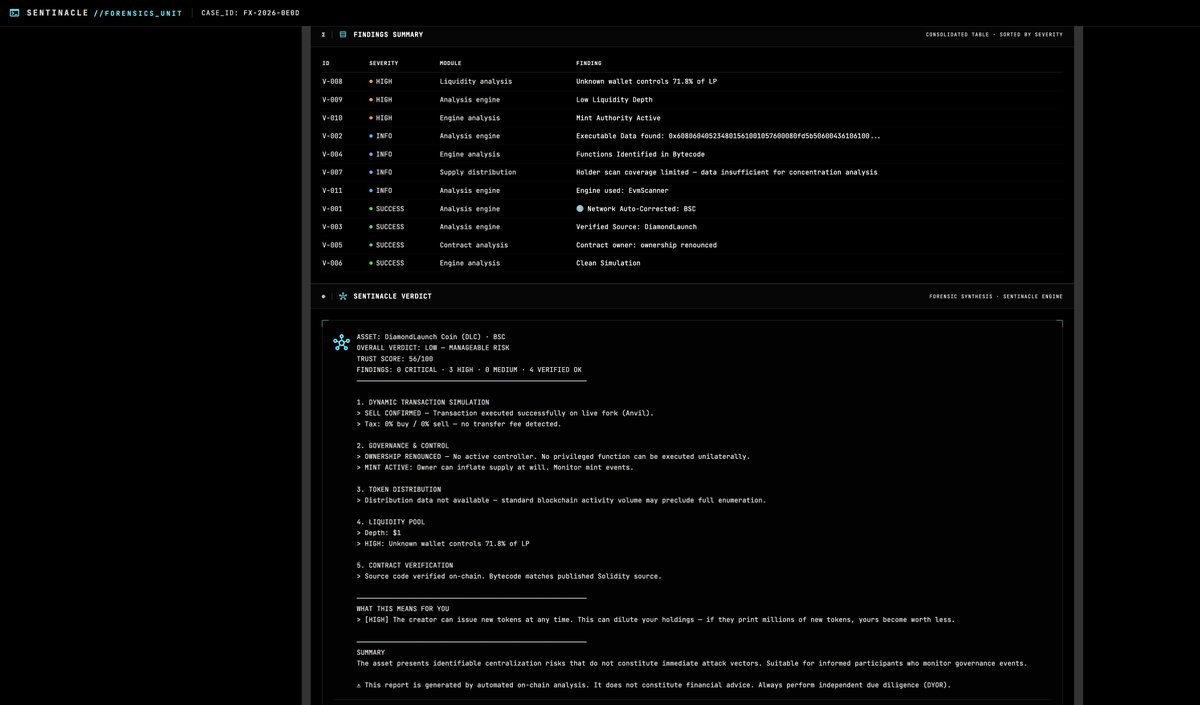
Our automated telemetry assigns DLC a Sentinacle Trust Score of 56/100 (Moderate Risk). While market perception often equates renounced ownership with absolute decentralization, our forensics reveal active vectors requiring attention.
The baseline execution is clean. Dynamic transaction simulation confirms no transfer fees (0% in/out) and no honeypot mechanics detected against the deployed bytecode via live Anvil forks.
However, the architecture flags three critical concentration risks:
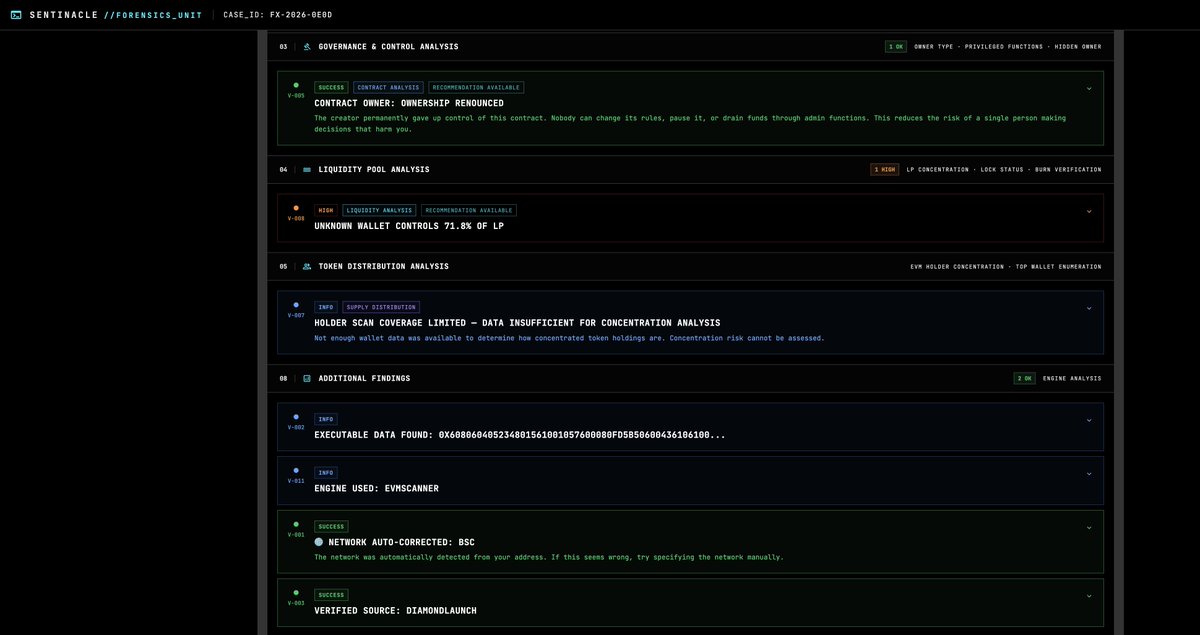
▪️ Active Mint Authority: Despite renounced ownership, the creator retains the ability to inflate supply arbitrarily. ▪️ LP Dominance: 71.8% of the liquidity pool is controlled by an unknown wallet.
▪️ Extreme Illiquidity: Active liquidity depth registers nominally ($1), rendering the $31M market cap highly theoretical and susceptible to maximum slippage.
For teams conducting a standard DeFi smart contract audit, this highlights why surface-level checks are insufficient. An "ownership renounced" label is functionally void if minting privileges bypass standard governance locks.
Proper crypto risk assessment requires evaluating both bytecode permissions and liquidity distribution simultaneously. Here, the concentration of LP tokens combined with a latent mint function creates a substantial dilution overhang.
How are institutional LPs pricing this specific type of architectural risk in the current cycle?
Telemetry only. NFA. #SmartContracts #OnChainAnalysis #BSC #DeFi #CryptoSecurity #OnChain #SmartContracts #RugPull #DeFiRisk
2
2
4
194
Jun 8
This is the surface-level read. For the complete architectural analysis — contract-by-contract dissection and risk parameters — explore the full report: → sentinacle.com
1
33
Jun 8
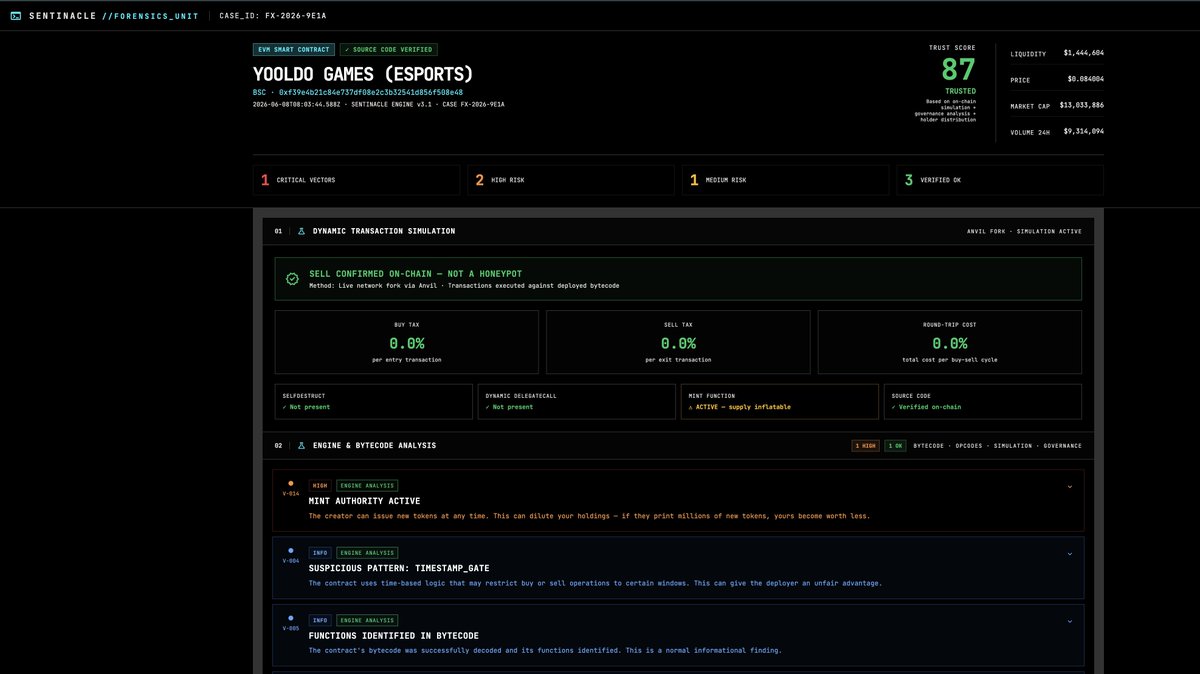
$ESPORTS
Contract architecture is only half the security equation. A compliant EVM deployment doesn't negate the risks of structural centralization. 🧵
Mapping the telemetry on Yooldo Games ($ESPORTS) on BSC. Powering GameFi matchmaking and rewards, the token currently holds a $13.8M market cap with $1.44M in liquidity. It recently drew market attention following external on-chain scrutiny over vested token movements.
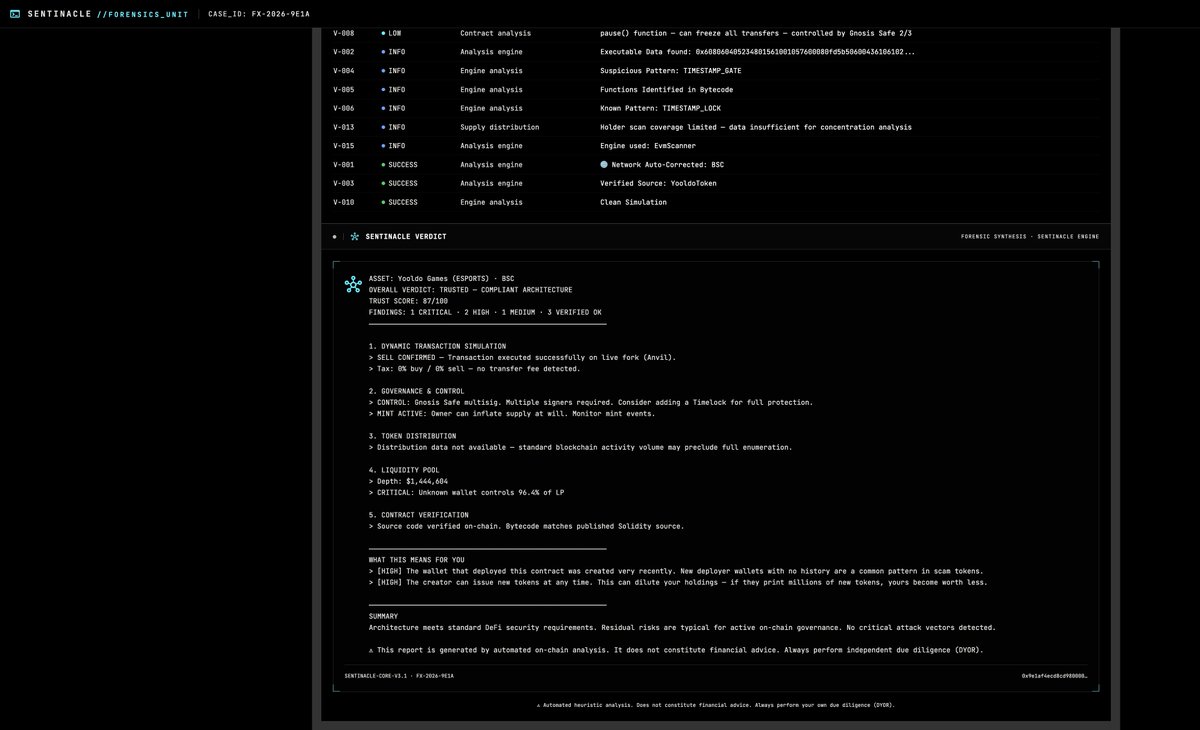
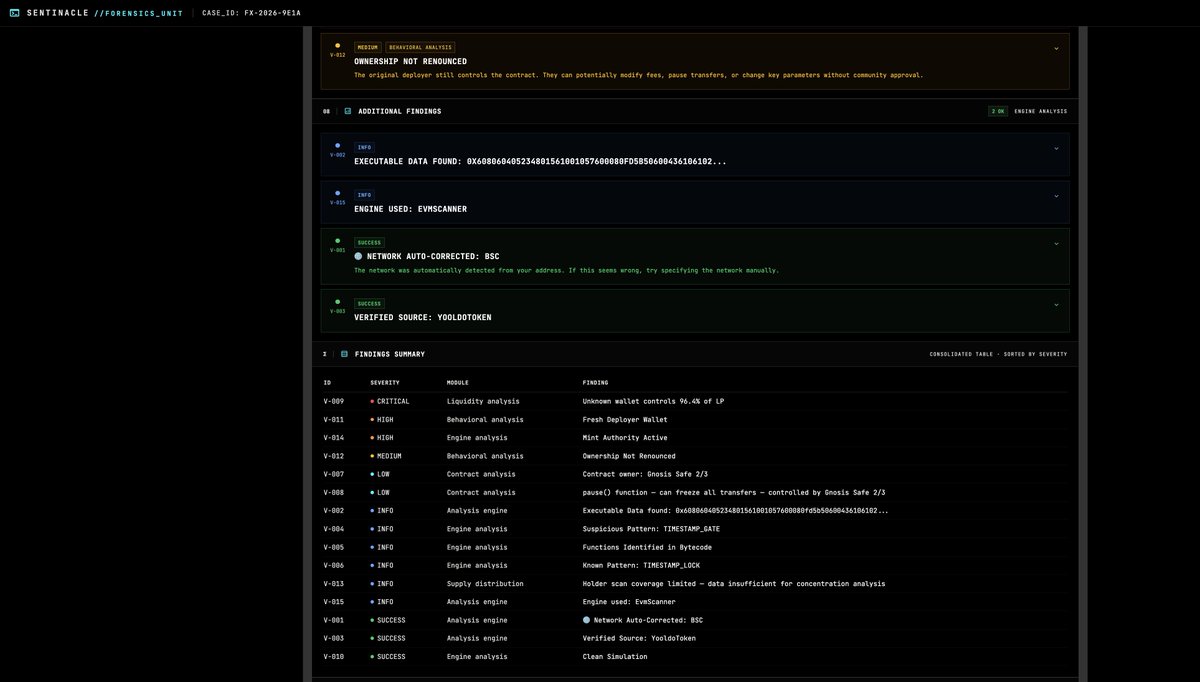
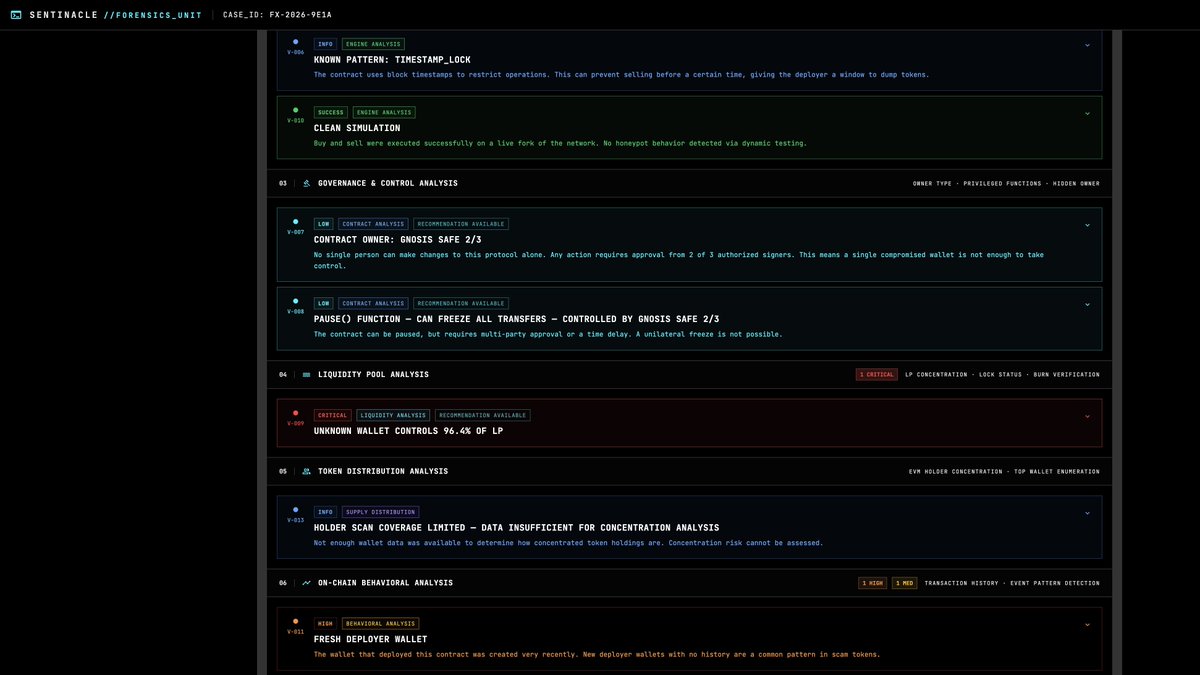
The Sentinacle Trust Score rates the contract highly at 87/100 (Trusted). It easily passes dynamic transaction simulation on a live Anvil fork, confirming 0% buy/sell taxes, clean simulation, and verified Solidity source code.
Yet, a deeper forensic dissection of the underlying tokenomics reveals severe operational bottlenecks:
• Liquidity Concentration: 96.4% of the LP is completely controlled by a single, unknown wallet. • Supply Mechanics: Mint authority remains active in the bytecode. The token supply is strictly inflatable. • Control Vectors: Initiated by a fresh deployer wallet, ownership is currently secured via a 2/3 Gnosis Safe multisig. While this mitigates single-key compromise, these signers control the protocol's global pause() function.
For institutions running a rigorous crypto risk assessment, standard execution checks are insufficient. A standard DeFi smart contract audit might clear the code syntax, but a mathematically "clean" token remains operationally fragile when near-total liquidity dominance and active minting power sit behind anonymous signers.
How are LPs currently weighing the foundational security of a 2/3 Gnosis Safe against the active risk of 96% LP concentration and an inflatable supply?
Telemetry only. NFA. #SmartContracts #OnChainAnalysis #BSC #DeFi #CryptoSecurity #OnChain #SmartContracts #RugPull #DeFiRisk
1
2
4
477
Jun 8
This is the surface-level read. For the complete architectural analysis — contract-by-contract dissection and risk parameters — explore the full report: → sentinacle.com
1
49
Jun 8
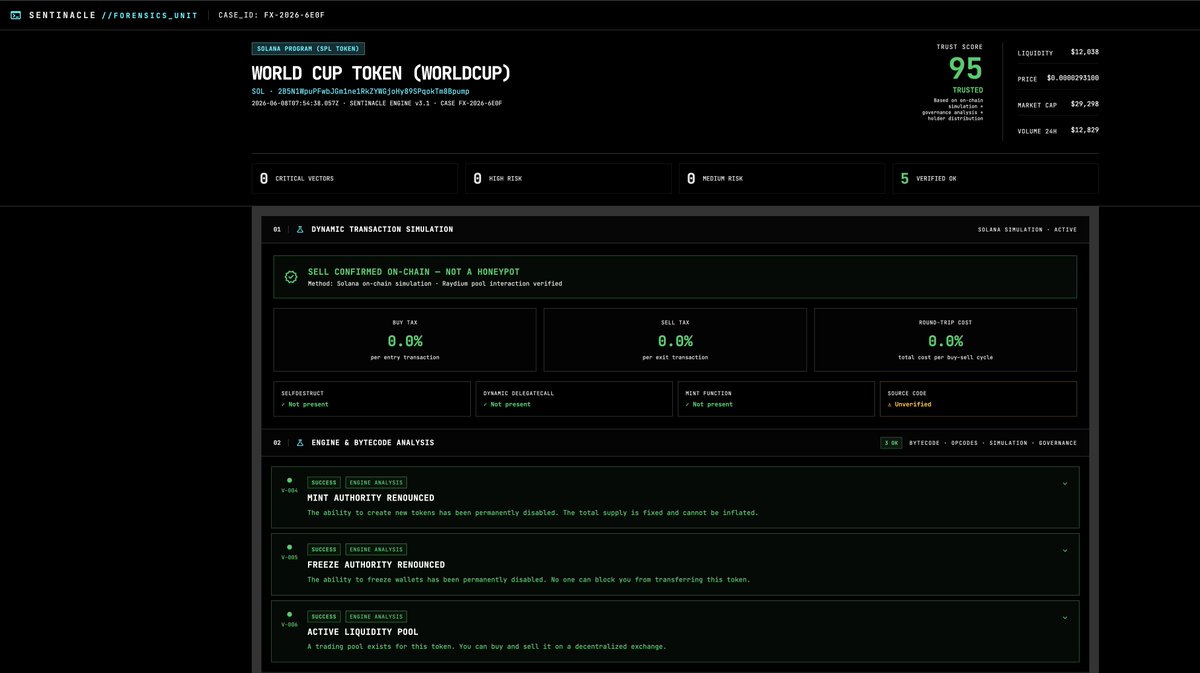
$WORLDCUP
Analyzing the on-chain footprint of World Cup Token (WORLDCUP) on the Solana network.
Operating as a micro-cap asset with a $29.2k market cap and $12k in active liquidity, the architecture presents a stark contrast between contract immutability and supply concentration.
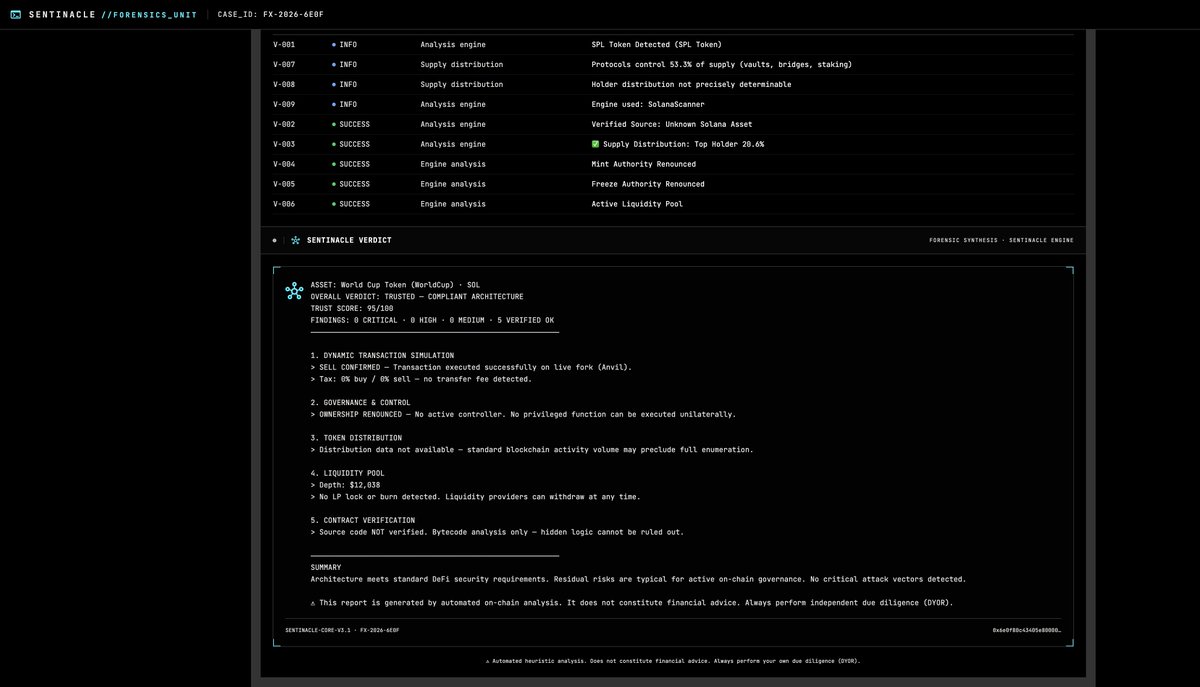
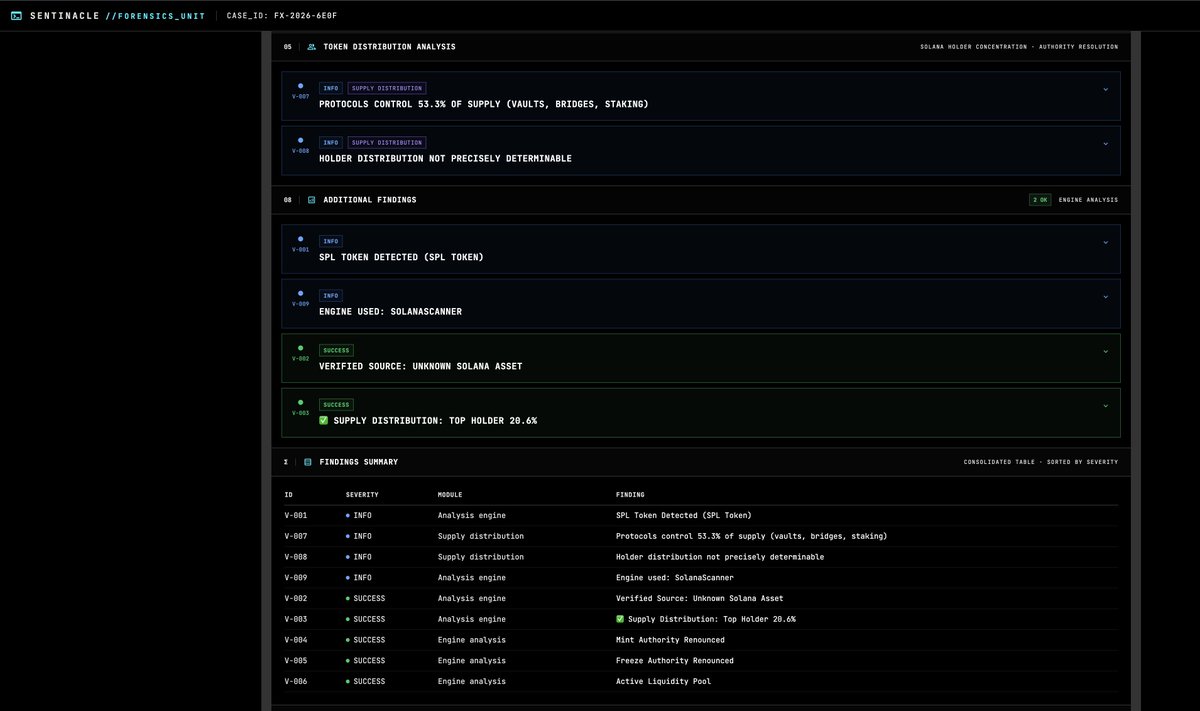
Sentinacle telemetry assigns a 95/100 Trust Score. This crypto risk assessment is driven heavily by the permanent renunciation of both Mint and Freeze authorities, effectively capping the total supply and mitigating any wallet-level censorship or targeted locking.
Dynamic transaction simulation confirms standard 0% buy/sell tax routing. Sell execution is definitively verified on-chain via Raydium pool interaction, nullifying primary honeypot vectors.
While the bytecode lacks unilateral control functions, a thorough DeFi smart contract audit must account for token distribution. Over 53.3% of the supply is controlled by protocol addresses (vaults, bridges, staking), with the top individual holder commanding 20.6% of the circulating tokens.
Crucially, the source code remains unverified. Hidden logic cannot be definitively ruled out, meaning LPs must rely entirely on bytecode heuristics and current active liquidity conditions.
From an institutional perspective, the SPL contract is structurally locked and compliant with standard security baselines, but the shallow liquidity depth and heavy holder concentration profile the asset for significant volatility.
How do you price the risk of unverified SPL source code when fundamental governance authorities are verifiably renounced?
Telemetry only. NFA.
#OnChainAnalysis #SmartContracts #Solana #DeFi #CryptoSecurity #OnChain #SmartContracts #RugPull #DeFiRisk
1
2
4
310
Jun 8
This is the surface-level read. For the complete architectural analysis — contract-by-contract dissection and risk parameters — explore the full report: → sentinacle.com
2
29
Jun 6
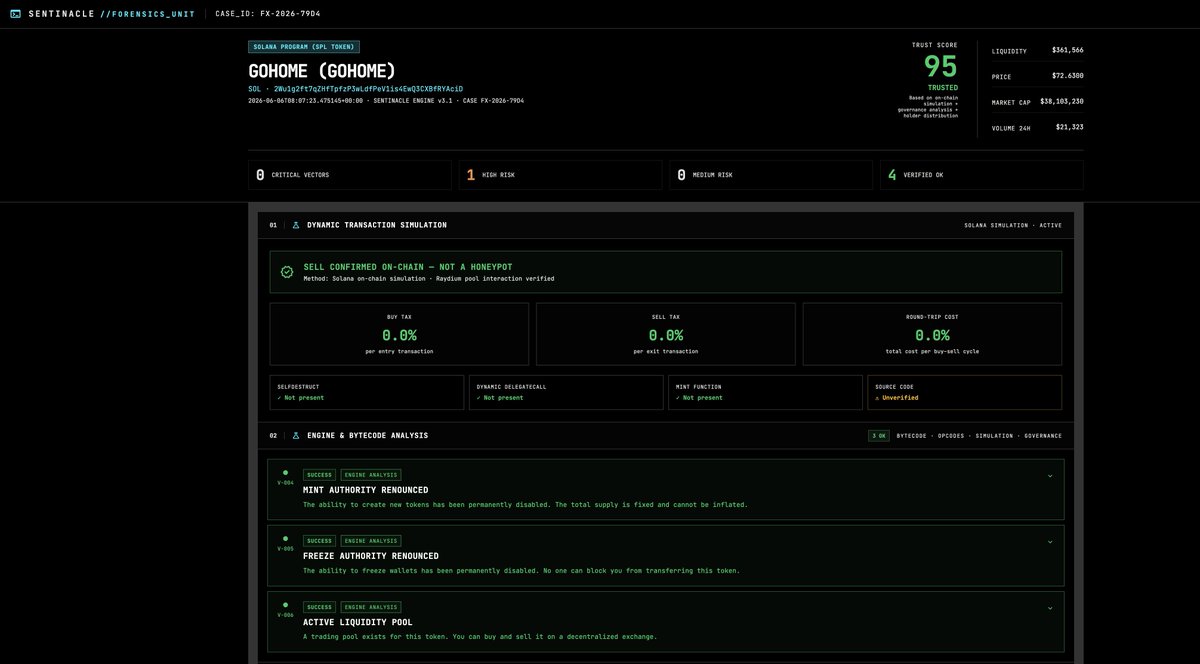
$GOHOME
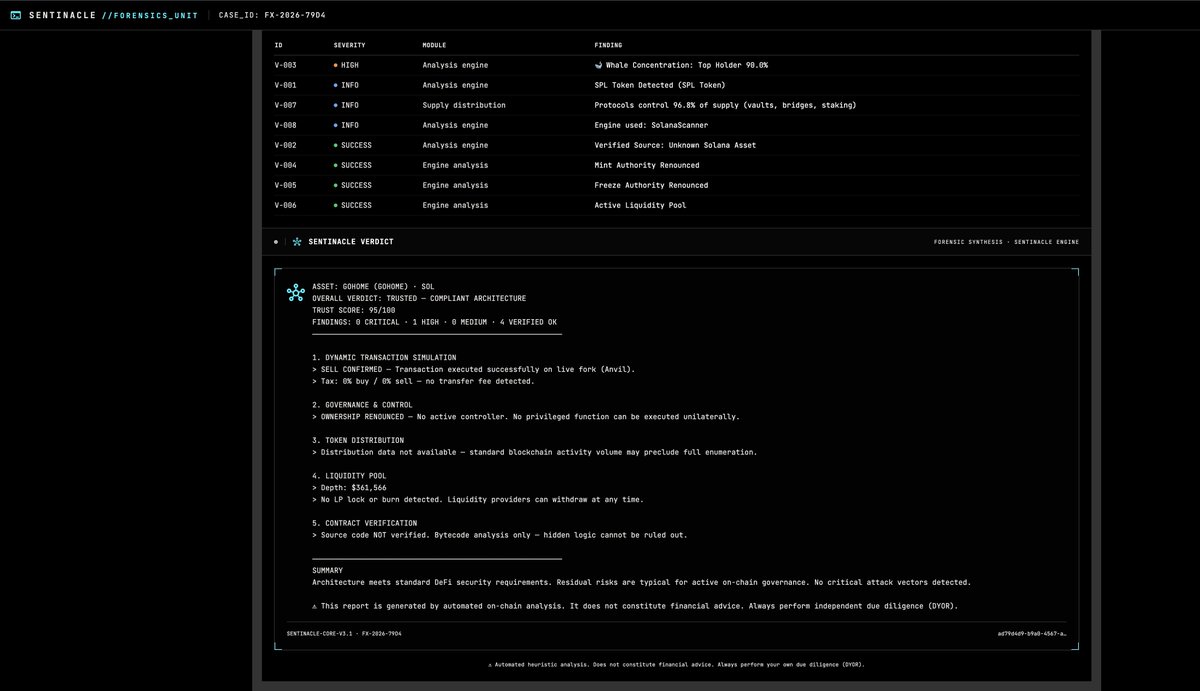
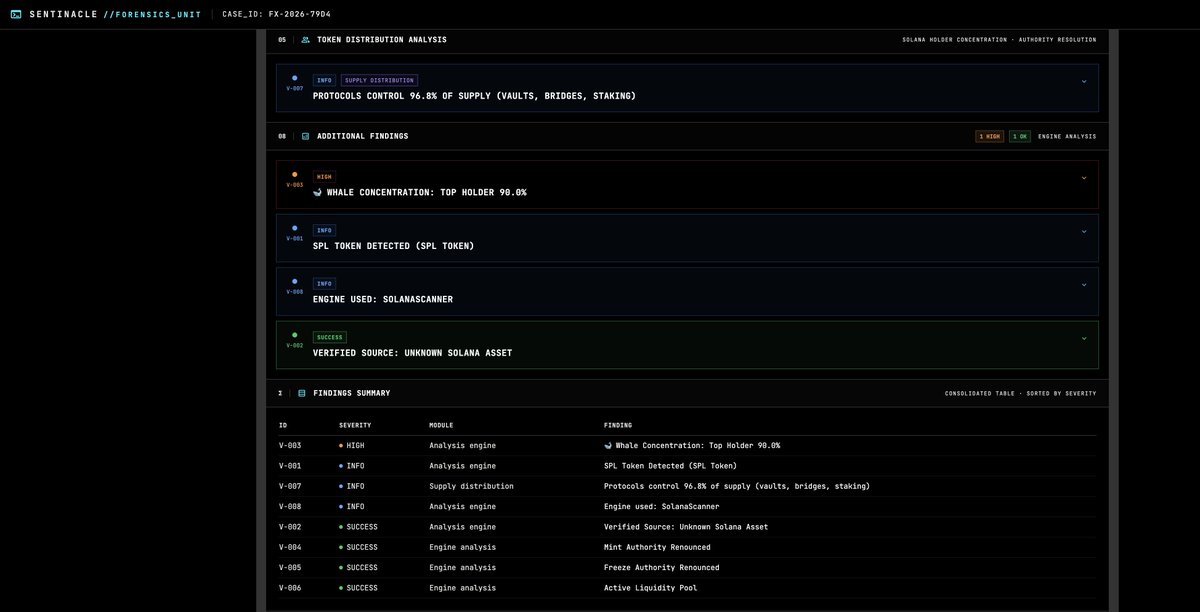
GOHOME ($GOHOME) on Solana presents a fascinating architectural paradox: a 95/100 Sentinacle Trust Score built on clean SPL mechanics, offset by a severe 98.8% top-holder concentration.
Originally launched as a cultural asset relying on engineered scarcity, its $18.1M market cap and $361k liquidity pool require a highly nuanced crypto risk assessment. Let’s look at the raw on-chain data.
Forensic Dissection:
▪️ Immutability: Mint and Freeze authorities are permanently renounced. The total supply is fixed, and wallet blacklisting is disabled.
▪️ Execution: 0% buy/sell tax confirmed via dynamic simulation. Frictionless routing verified through its Raydium pool.
▪️ The Concentration Anomaly: The engine flags a "High Risk" 98.8% whale concentration. However, deeper supply distribution mapping reveals that 96.8% of this is controlled by protocol vaults and staking contracts. The "whale" is a structural lock, not a single rogue operator.
▪️ Code Transparency: The source code remains unverified. While bytecode simulation clears it of honeypot mechanics, hidden logic parameters cannot be definitively ruled out.
Institutional Insight:
When executing a DeFi smart contract audit, contextual telemetry is everything. An isolated 98% holder concentration is typically an immediate red flag. Here, it represents deliberate, protocol-enforced scarcity designed to align with its long-term vesting schedule. The primary residual risk for liquidity providers isn't a centralized token dump, but rather interacting with an unverified contract structure.
How are LPs weighting the risk of unverified bytecode against strictly immutable, vault-locked tokenomics?
Telemetry only. NFA. #SmartContracts #OnChainAnalysis #Solana #DeFi #CryptoSecurity #OnChain #SmartContracts #RugPull #DeFiRisk
1
2
3
118
Jun 6
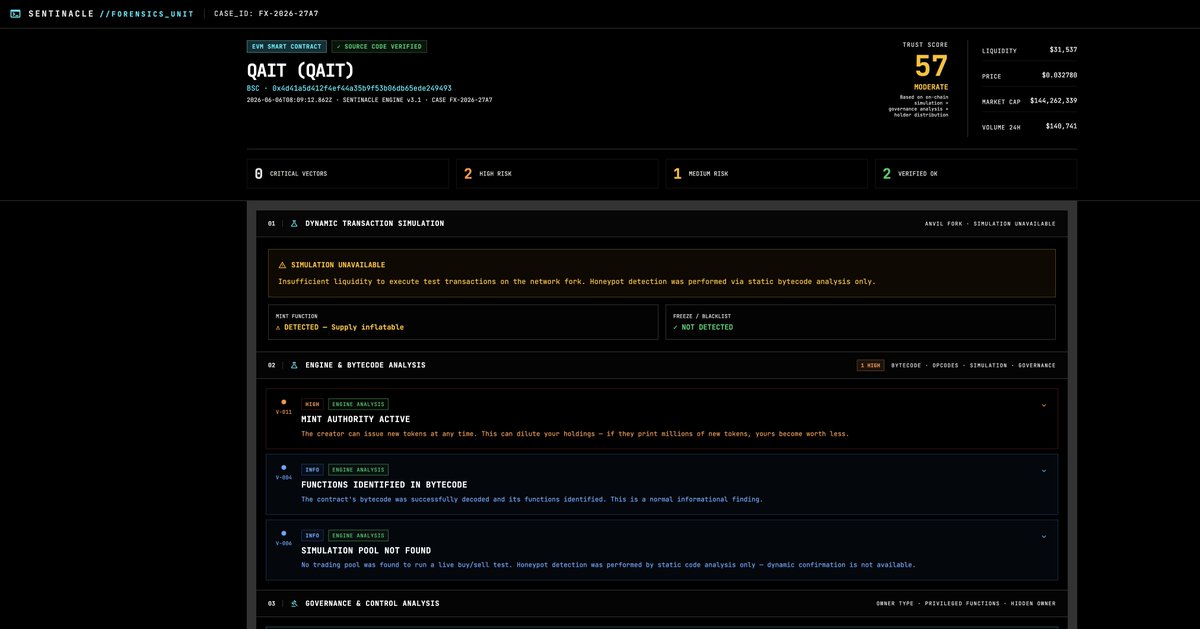
$QAIT
🧵 Technical telemetry analysis of the QAIT token contract architecture on BNB Smart Chain.
A granular inspection of the deployment vectors, access control mechanics, and liquidity structures governing the 0x4d41a5d612f4ef44a33b9f53b81d65ede249c933 smart contract.
Protocol Architecture & Market Profile
QAIT operates on BNB Smart Chain with a self-reported market capitalization of $144.26M and a 24-hour trading volume of $140,741.
While external market trackers reflect a substantial valuation based on the circulating supply multiplier, the protocol's underlying architecture reveals significant structural barriers to actual market depth and operational permanence.
Sentinacle Trust Score vs. Market Perception
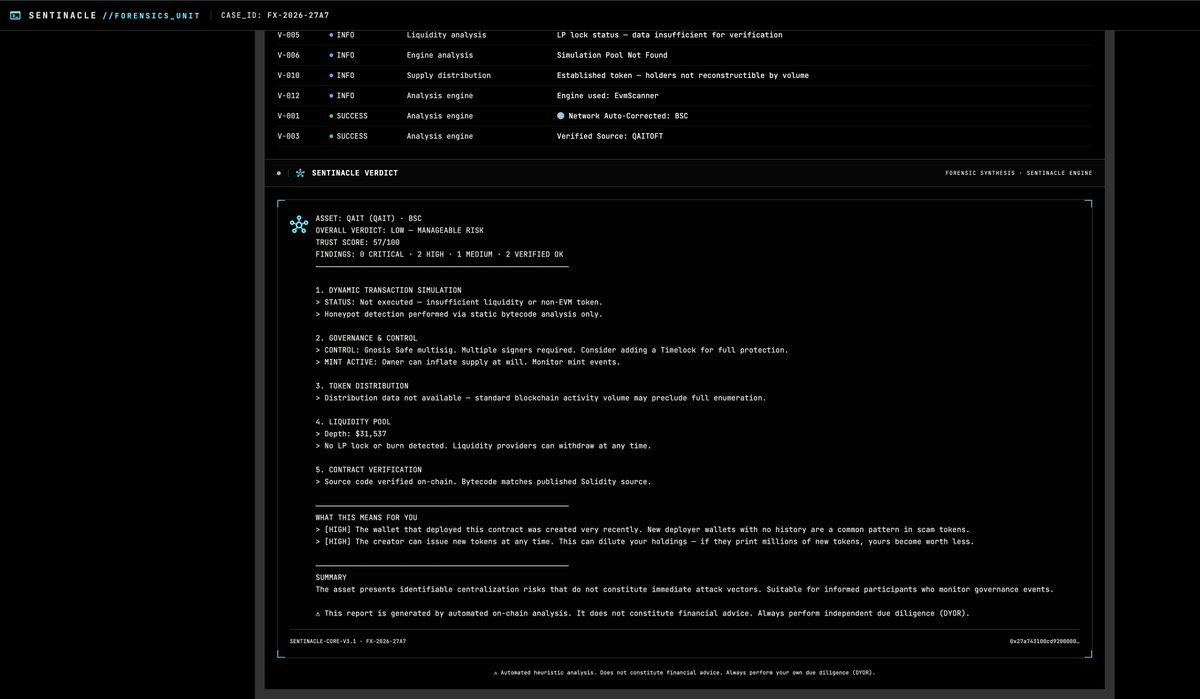
The Sentinacle analysis platform assigns a Trust Score of 57/100 (Moderate Risk) to the asset.
This divergence from its $144M market perception is driven by structural bottlenecks discovered within its transaction routing capabilities and contract control loops, rather than superficial volume metrics.
Forensic Dissection: Key Technical Hallmarks
Execution Simulation Failure: Dynamic transaction simulation failed to execute via network fork because the available liquidity pool was too shallow to support standard test swaps. Honeypot verification was conducted strictly via static bytecode analysis of the verified Solidity source.
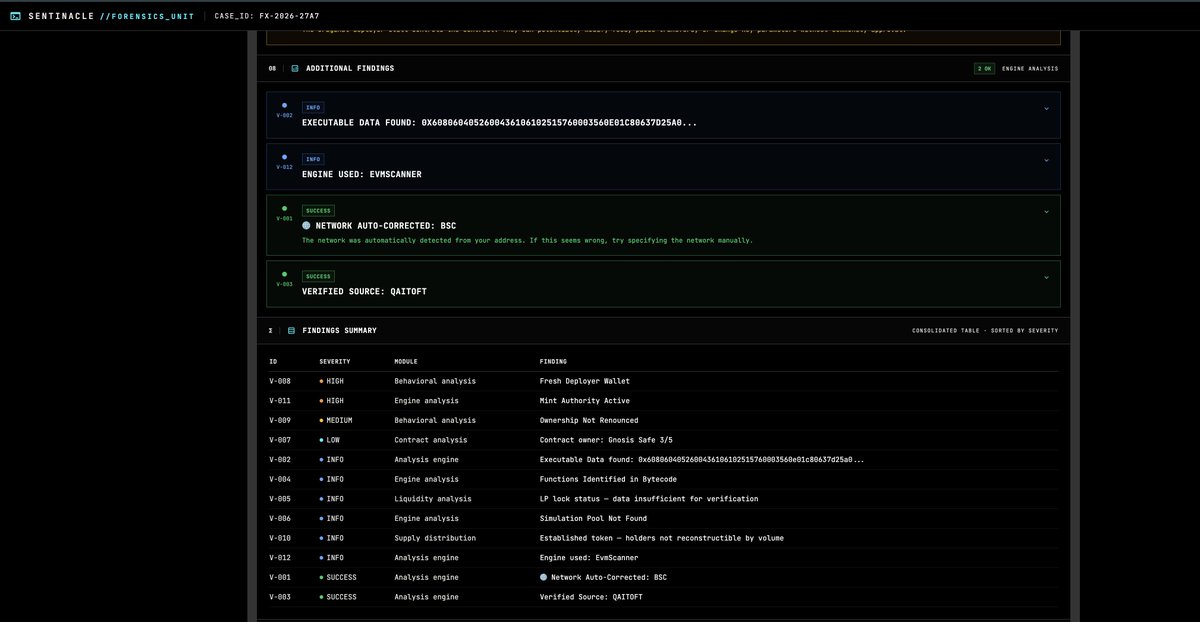
Active Mint Vector: The contract bytecode retains an unthrottled minting function (Mint Authority Active). The contract owner preserves the administrative privilege to inflate the token supply at will without a hard-coded cap.
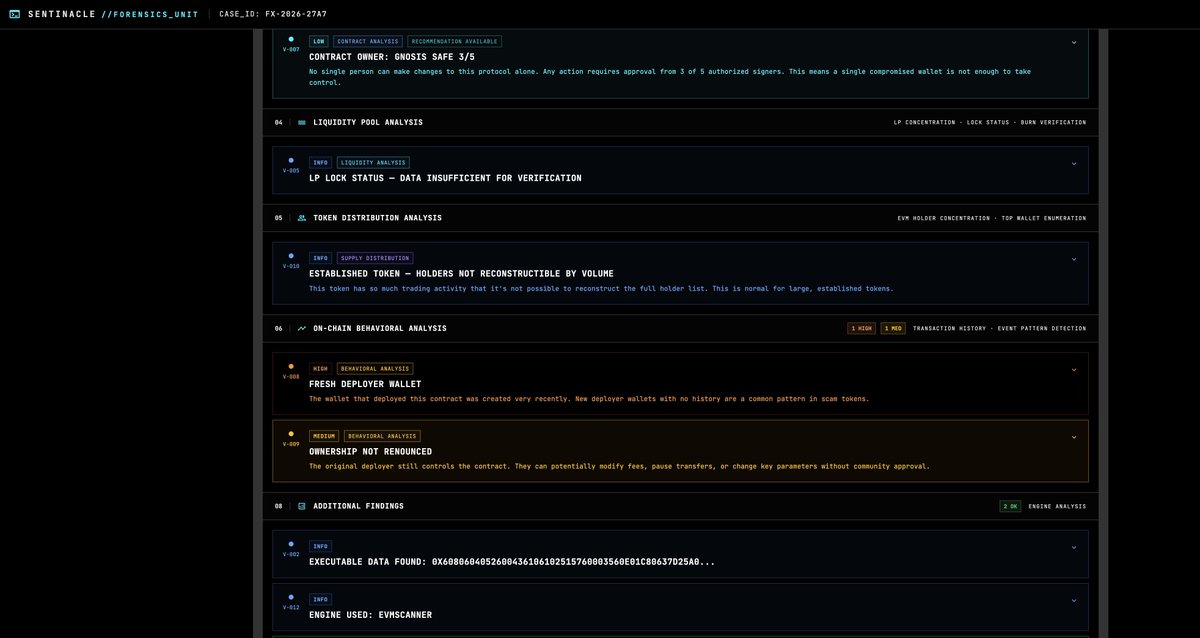
Governance-Locked Controls: Ownership of the contract has not been renounced. However, control is delegated to a Gnosis Safe multisig employing a 3-out-of-5 signing threshold.
Liquidity Pool Vulnerability: The primary liquidity pool depth is extremely thin at $31,537. On-chain telemetry shows insufficient data to verify any LP token lock or burn status, meaning liquidity providers can withdraw the underlying assets at any time.
Behavioral Footprint: The deployer wallet was funded very recently and holds no historical transaction track record, a pattern often flagged during crypto risk assessment protocols.
Institutional Insight for Risk Managers
From a rigorous crypto risk assessment perspective, the core risk vector here is a massive mismatch between paper valuation and exit liquidity.
A DeFi smart contract audit can confirm the mathematical correctness of the Solidity bytecode, but it cannot mitigate the execution risk of an un-timelocked mint authority combined with an unverified LP lock state. The 3/5 Gnosis Safe framework provides baseline protection against single-key compromise, but does not prevent systemic dilution if the multisig quorum chooses to execute it.
How are risk managers factoring in this lack of a Timelock when a protocol pairs a high fully diluted valuation with a sub-$35k liquidity pool?
Telemetry only. NFA.
#SmartContracts #OnChainAnalysis #BSC #DeFi #CryptoSecurity #OnChain #SmartContracts #RugPull #DeFiRisk
1
3
6
596
Jun 6
For those running due diligence: the extended dossier covers the full vulnerability mapping and historical telemetry. Worth a look before allocating → sentinacle.com
2
76