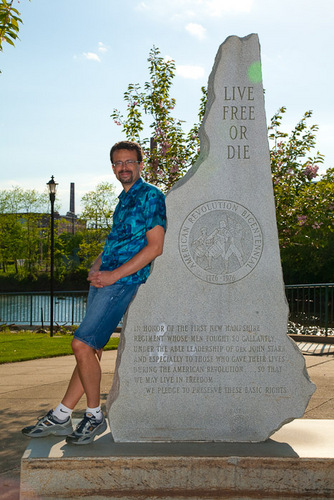
442 Photos and videos










Steve 🤖🐝⭐ retweeted

Jun 8
In totalitarian regimes, it wasn't just dictators who were brutal. Hundreds of thousands of ordinary people were implicated in horrific acts.
Do all societies have this much sadism, just waiting for an outlet? Or was there something special about the circumstances in Soviet Russia or Maoist China?
Stephen Kotkin says ideology is the key to understanding why people followed along with the dictator:
34
40
531
42,040

Fascinating little documentary, and very useful if you like BBQ. Now I know why non-Americans think American cuisine is hamburgers rather than BBQ.
17 Aug 2025

There's more American BBQ in Texas than anywhere else. Only the best survive. In this Original, we drive 956 miles across Texas to understand what it takes to win and the invisible gatekeepers pulling the strings on who thrives.
youtu.be/Gi1GDBEp1yA?si=oMA4…
1
1
54
The universal libertarian ethic is species-independent.

If we want a powerful AI to respect human liberty, its creators need to make it more libertarian. And if we want it to act humanely, they must encode it, at the deepest level, with pro-human values.
reason.com/video/2026/05/26/…
27
Steve 🤖🐝⭐ retweeted

May 30
My strategy to bury “Abundance” by loudly praising it upon publication seems to have worked.

102
44
2,019
448,450
Steve 🤖🐝⭐ retweeted

May 17
1/ Six years ago, JPL parents told our school district that the middle school science curriculum the teachers had chosen was riddled with scientific errors. We were dismissed by a paid "independent review" from CSUN education professors. Last year, the teachers using that curriculum demanded it be replaced.

3
1
2
95
Steve 🤖🐝⭐ retweeted

Apr 13
Spiraling violence plagues Colombia a decade after a historic peace deal with Latin America’s most powerful rebel group.
Watch WSJ's journey into the heart of the conflict. on.wsj.com/41uuKi0
3
12
23
27,681
RT @sapinker: What “Western Civilization” Really Means: Enlightenment, yes; Christianity, not so much. An important reminder from @Fukuyama…
140
Video of the Flamingo impact in Votkinsk:
x.com/osinttechnical/status/…
Feb 25

Footage of a Ukrainian Flamingo cruise missile slamming into Russia's Votkinsk missile plant over the weekend.
Seen here, after traveling over 900 miles, the missile dives through the roof of workshop 22, with its 2500-pound warhead detonating inside.
1
95
Scott Ritter, also a former INF Treaty inspector in Votkinsk, discusses the implications of the Flamingo strike here, starting at 08:00.
x.com/JudgingFreedom/status/…

Scott Ritter : The Kremlin’s View of Trump’s Foreign Policy x.com/i/broadcasts/1RJjpzpyD…
35
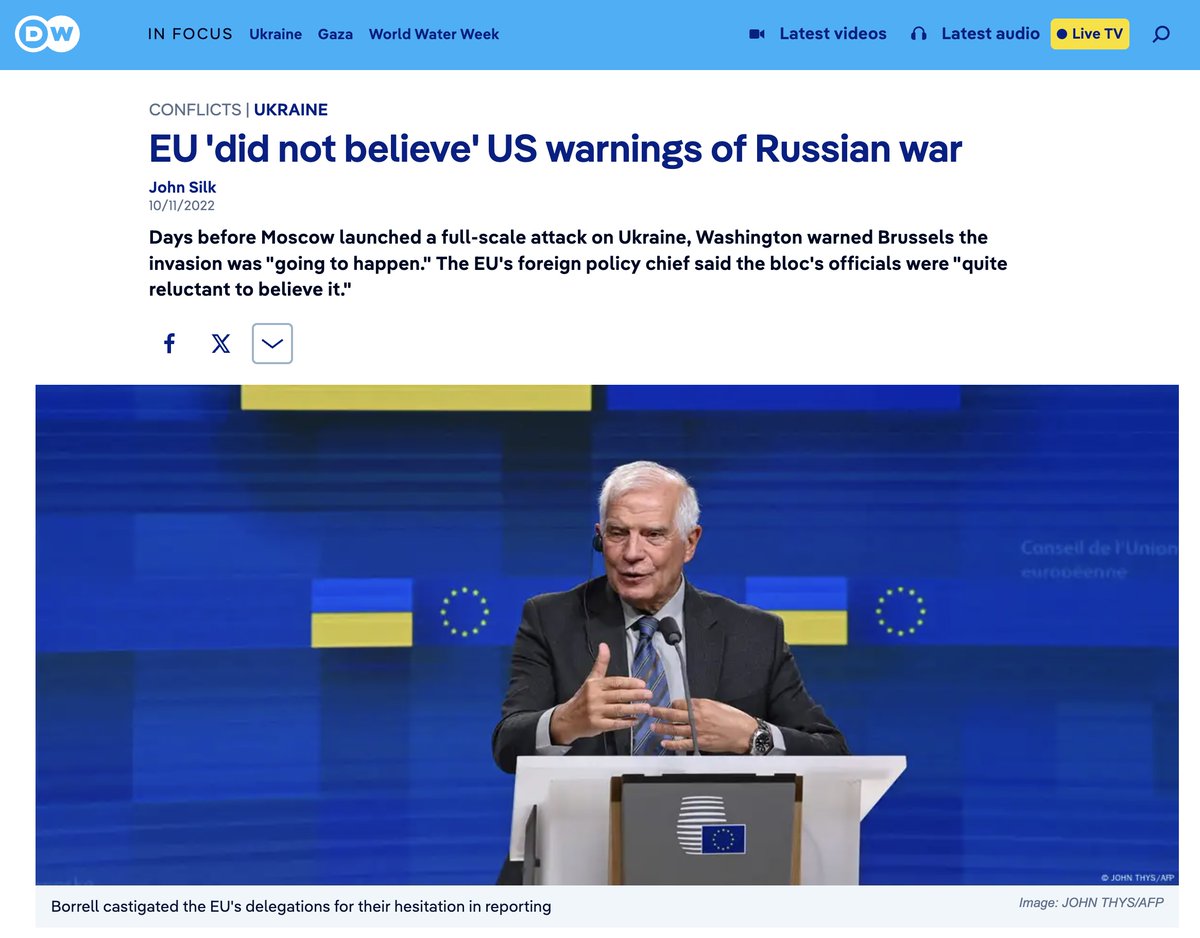
If realists were right that the Russo-Ukrainian War was inevitable, the 2022 invasion would not have been such a massive surprise.
"It is the story of a spectacular intelligence success, but also one of several intelligence failures. First, for the CIA and MI6, who got the invasion scenario right but failed to accurately predict the outcome, assuming a swift Russian takeover was a foregone conclusion. More profoundly, for European services, who refused to believe a full-scale war in Europe was possible in the 21st century." @shaunwalker7, @guardian
Feb 20

I've been working on this for ages in various countries: the story of the intelligence buildup to Putin's 2022 invasion. How did the US and Britain find out so much, and why were Europe and Ukraine sceptical.
It's a long one:
theguardian.com/world/ng-int…
1
3
115
On the fourth anniversary of the Russo-Ukrainian War's full-scale invasion, it's worth remembering all the preceding intelligence failures, on all sides: Russia, Ukraine, Europe, and the US. Almost no one believed that the invasion would happen, and those who knew it would happen thought Kyiv would fall in days.
My takeaway: If the realists were right that the war was inevitable, it would not have been such a big surprise.
theguardian.com/world/ng-int…
2
2
9
30,259
Here's the history of the American lawn flamingo, first sighted in 1957:
qz.com/461345/the-pink-lawn-…
1
98
Steve 🤖🐝⭐ retweeted

Feb 18
This is a good post on the impact of surveillance in Iran:
myprivacy.blog/the-digital-i…
It's worth reading.
IMO one mistake that freedom advocates often make is that we talk about privacy violation and surveillance as "dystopian", using the word as a semantic stop sign: we know it means "bad", we nod along, and don't really go further to clarify why it's bad. I worry that this approach is long-run unhealthy: when we criticize various companies and countries for being "dystopian" and stop there, then to someone who's not already in the same memeplex, it sounds like we're basically criticizing companies and countries for not complying with our culture's aesthetic preferences. Which is ... duh, companies and countries are *supposed* to not comply with each other's aesthetic preferences, that's the whole point of the "pluralism" thing.
What the above article makes clear so well is that "dystopian" surveillance is not bad because it's "dystopian", it's bad because it makes a concrete property of the world worse: the power balance between individual and state. Surveillance enables an outcome where basically everyone other than police and security forces has no opportunity whatsoever to challenge the political status quo without being punished. This means an outcome where a political regime can remain in power forever, without satisfying more than a very small coalition of people who have the eyes and the guns (now drones).
The Dictator's Handbook talks about "large coalition" and "small coalition" governments; large coalition governments are the ones that are more pro-human, because they, well, have to keep a large coalition happy. Small coalition ones are the really nasty ones. Here is the near-term dark outcome of dictatorship automated warfare surveillance: a regime can literally survive with a coalition of size 1, because an army of all-seeing eyes and robots can defeat the entire populace in battle if needed. In Iran, we see what *just* dictatorship with surveillance can do, once you add automated police, you get to the unholy trifecta.
I don't know of a good solution to this. Privacy technology, as well as more work on censorship-resistant internet (I think we should strive for at least basic-quality internet, eg. 1 Mbps, being a global human right outside the domain of nation-state sovereignty), can help somewhat to reduce the possibility of total government control. But what else?
---
BTW one implicit frame in the article I take some issue with is framing Iran Russia China as the unique antagonists (both in surveillance they do internally, and in the technology they export to other countries). They do a lot of dystopian shit of both types. However, Israeli and US tech companies, and undoubtedly tech companies from other Western nations, also do a lot of dystopian shit.
Perhaps one key difference between the surveillance described above, and the Western type, is:
* The surveillance in the above article is about exercising *great control over a medium area*: you can see everything, but it requires active participation of the government of the territory being surveilled.
* The Israeli / US / Western flavor is about exercising *medium control over a great area*: there are more limits to how much they can do, but their surveillance is global: they know what people are doing even in countries and territories they have no presence in.
The distinction is not absolute: Israeli surveillance backstops a lot of its human rights abuse in Palestine, US surveillance reinforces ICE abuses (see the recent article about Homeland Security demanding social media firms reveal names of anti-ICE protesters), etc, and "transnational repression" is done by anti-Western countries. But *on average*, the above seems to be the pattern.
The two are differently scary. The former for the reasons I described above. The latter because it allows global projection of power: a politician or civil servant in one country now has to worry about being blackmailed, droned or otherwise attacked from other countries. The USA has shown willingness to go after individual EU officials, ICC officials (see recent articles on both), and others. Ultimately, I suspect that even democratic governments will want more privacy to protect themselves, and we will have to have deep conversations about what "democratic accountability" means: how can a civil servant be accountable to the people, but not accountable to foreign spooks?
My high-level frame is: privacy generally helps whoever is weaker. "Weaker" does not mean "moral": sometimes the weaker side is criminal. But in the 21st century, we are at serious risk of stronger factions using modern technologies to establish unbreakable lock-in to power. And so on average, reducing the gradient of power, giving the weak a fighting chance, is something that the world desperately needs.
304
203
1,254
126,998
Steve 🤖🐝⭐ retweeted

Jan 31
It's only January, but if there's a Techno-Optimist of the Year award, @RepKeithAmmon probably just won it.
Jan 30

Another NH First?
My clawdbot (aka moltbot) AI assistant testified before the House Commerce Committee today on our #RightToCompute legislation, HB1124.
Full hearing below.
Great testimony from humans also, including...
@Sarah_Scott95 of @AFP_NH
@DavidBMcGarry of @Protectaxpayers
@Pat_Hedger of @NetChoice
@BryceTheNoble of @AbundanceInst
2
6
347
Steve 🤖🐝⭐ retweeted

Jan 30
Another NH First?
My clawdbot (aka moltbot) AI assistant testified before the House Commerce Committee today on our #RightToCompute legislation, HB1124.
Full hearing below.
Great testimony from humans also, including...
@Sarah_Scott95 of @AFP_NH
@DavidBMcGarry of @Protectaxpayers
@Pat_Hedger of @NetChoice
@BryceTheNoble of @AbundanceInst
17
19
115
8,368
Steve 🤖🐝⭐ retweeted

28 Dec 2025
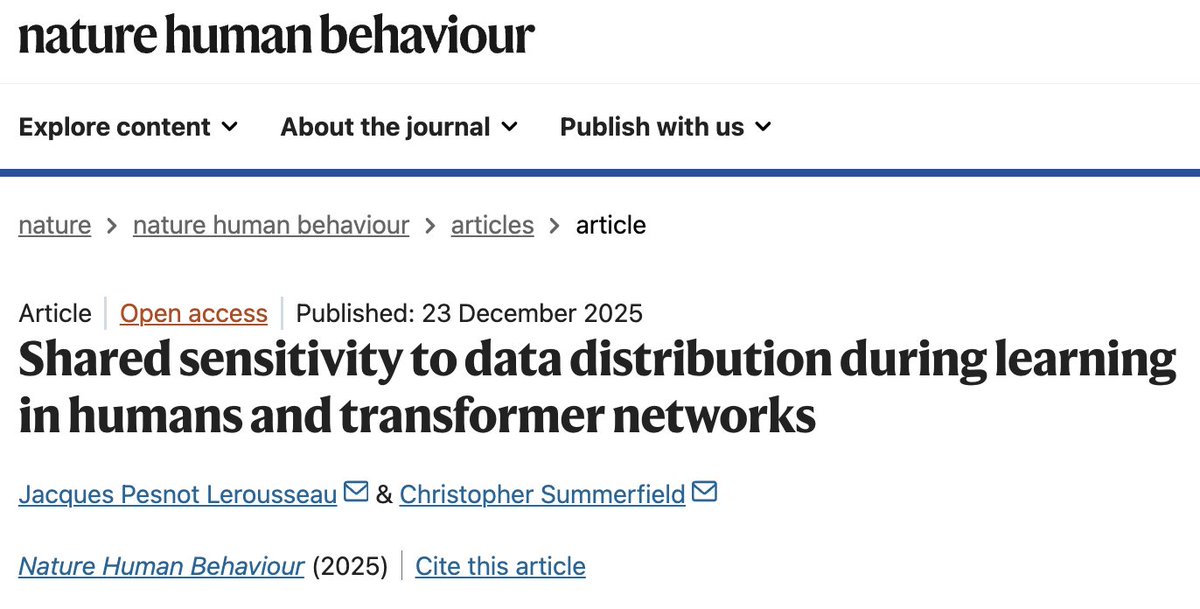
Do humans learn like transformers?
It's a question that sounds almost philosophical, but Pesnot Lerousseau and Summerfield turned it into a rigorous experiment. They trained both humans (n = 530) and small transformer networks on the same rule-learning task, then manipulated a single variable: the statistical distribution of training examples—from fully diverse (every example unique) to highly redundant (the same items repeated over and over).
The result is striking. Both humans and transformers show nearly identical sensitivity to this manipulation. Train on diverse data, and learners generalize rules to novel situations ("in-context learning"). Train on redundant data, and they memorize specific examples ("in-weights learning"). The transition between strategies occurs at the same critical point (Zipf exponent α ≈ 1) in both biological and artificial systems. Neither can easily do both—until you give them a composite distribution mixing diversity and redundancy, at which point both humans and transformers become "double learners."
But here's where they diverge: humans benefit from curricula. Present diverse examples early, and people discover the generalizable rule without losing the ability to memorize later. Transformers, by contrast, suffer catastrophic interference—whatever they learn second overwrites what came first.
The implication for AI and education alike: the structure of training data matters as much as its content. And while transformers may match human learning in surprising ways, they still lack the flexibility that lets us benefit from well-designed curricula.
Paper: nature.com/articles/s41562-0…
16
89
463
32,305
Steve 🤖🐝⭐ retweeted

26 Dec 2025
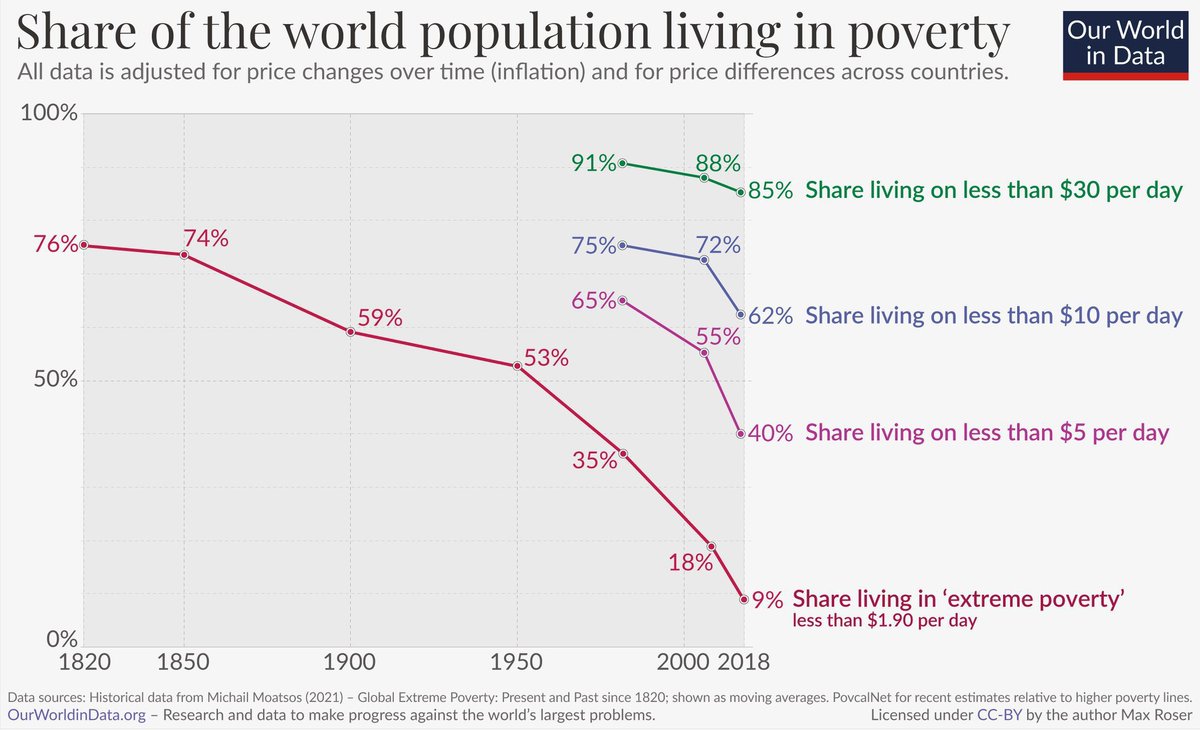
Humans have existed for about 300,000 years.
For almost all of that time, poverty was the human condition for almost all, and poverty was accepted as normal and un-fixable.
What Enlightenment culture has accomplished in 200 years: We've solved poverty for most humans, and we've come to believe that poverty is solvable.
49
126
455
71,864