
MoneyEvent ledger and reconciliation layer for APIs, x402 payments, stablecoins and AI-agent workflows.
Joined July 2013
- Tweets 39
- Following 19
- Followers 121
- Likes 114
28 Photos and videos








23h
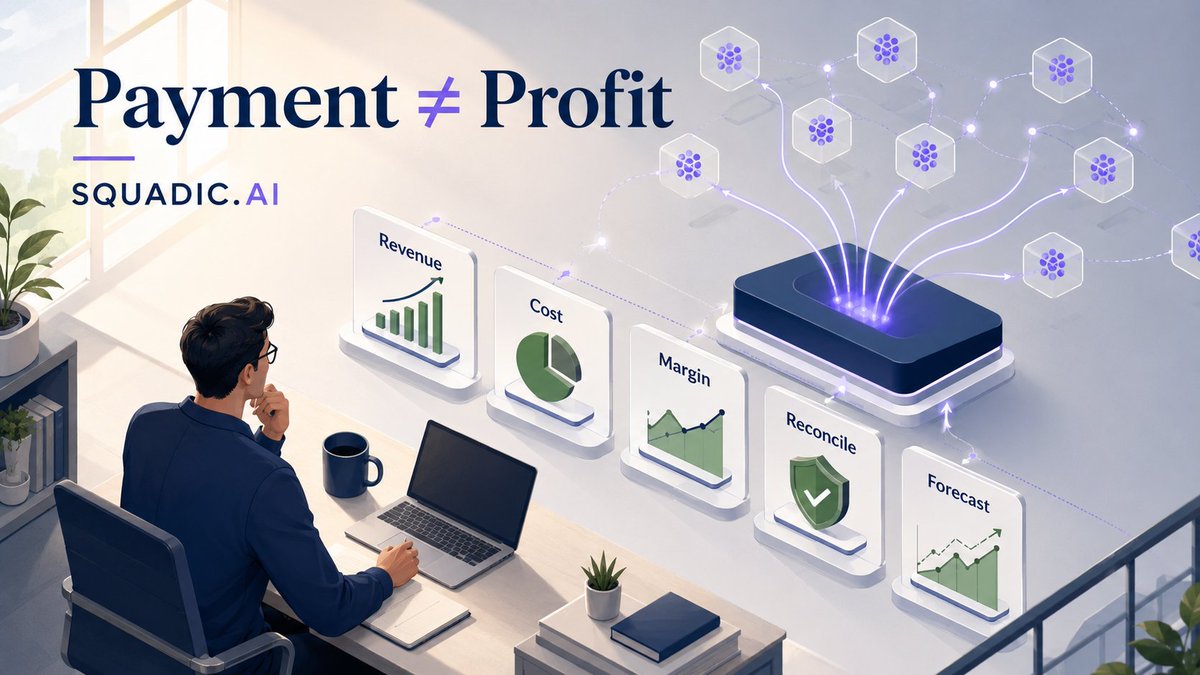
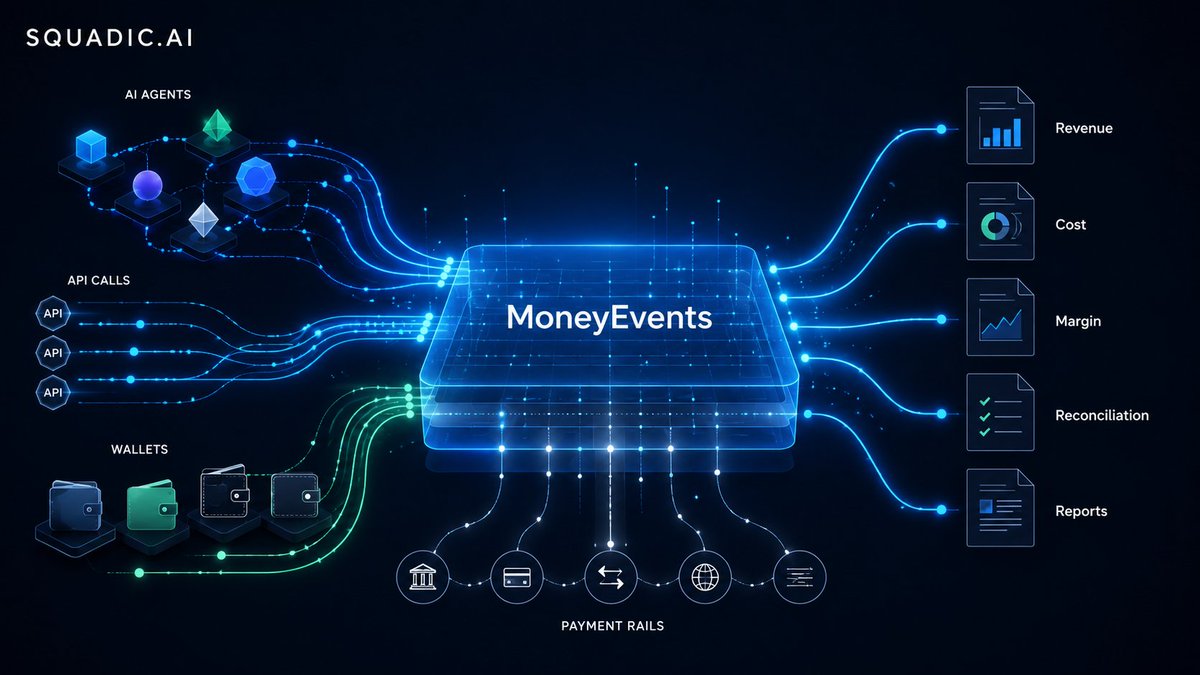
An AI agent paid for your API.
Good: revenue happened.
Not enough: you still need to know if it was profitable.
For API, SaaS, automation, and agent-facing products, payments may come from many sources: subscriptions, usage, micropayments, stablecoins, payment processors, or manual invoices.
But the business question stays the same:
What did we actually earn after costs?
Separate 3 views:
Plan = expected revenue and cost model
Actual = payments received, fees, infra, support, ops costs
Forecast = what happens if volume grows
Payment rails move money.
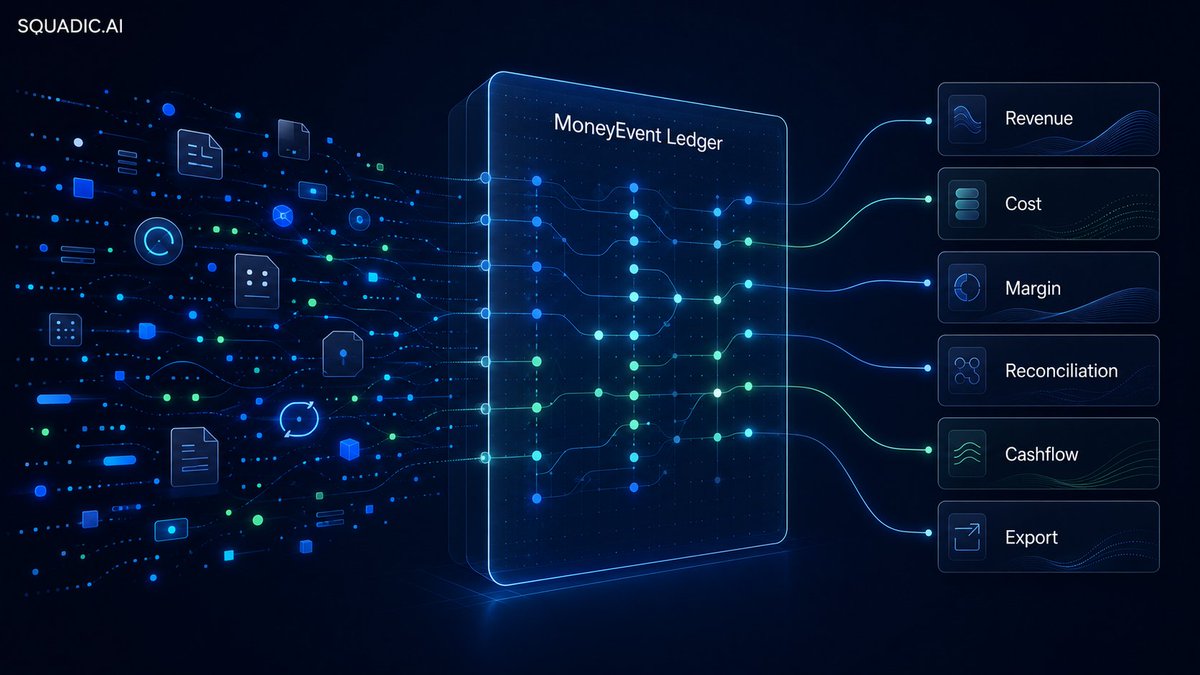
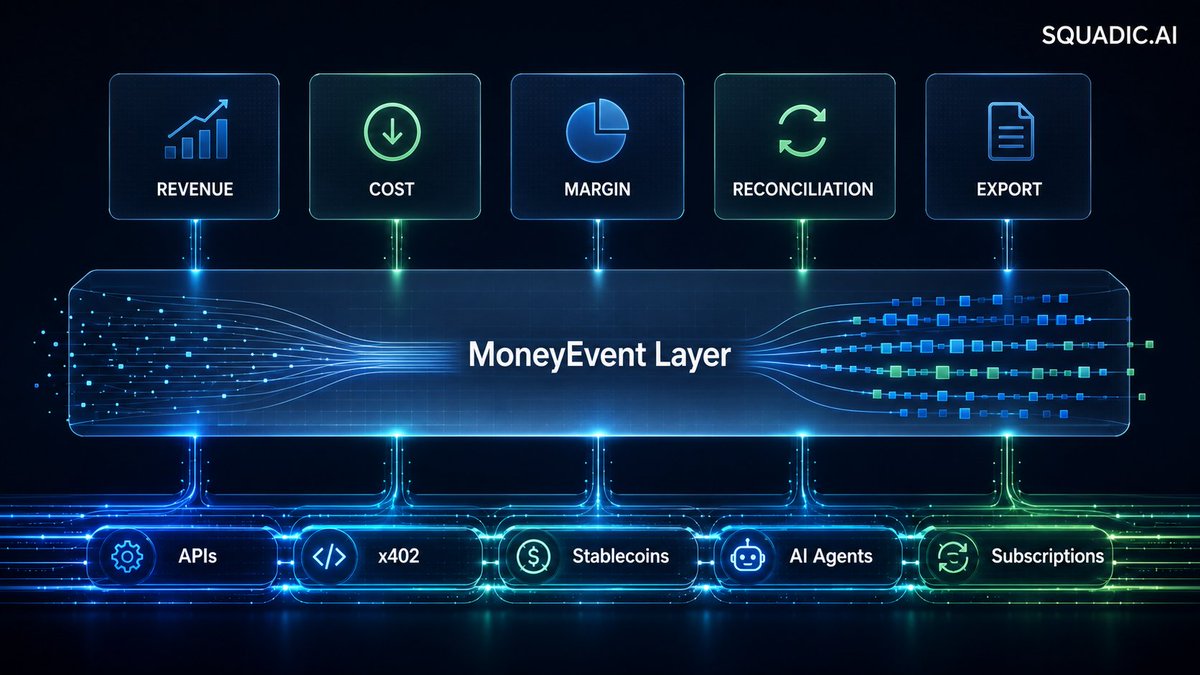
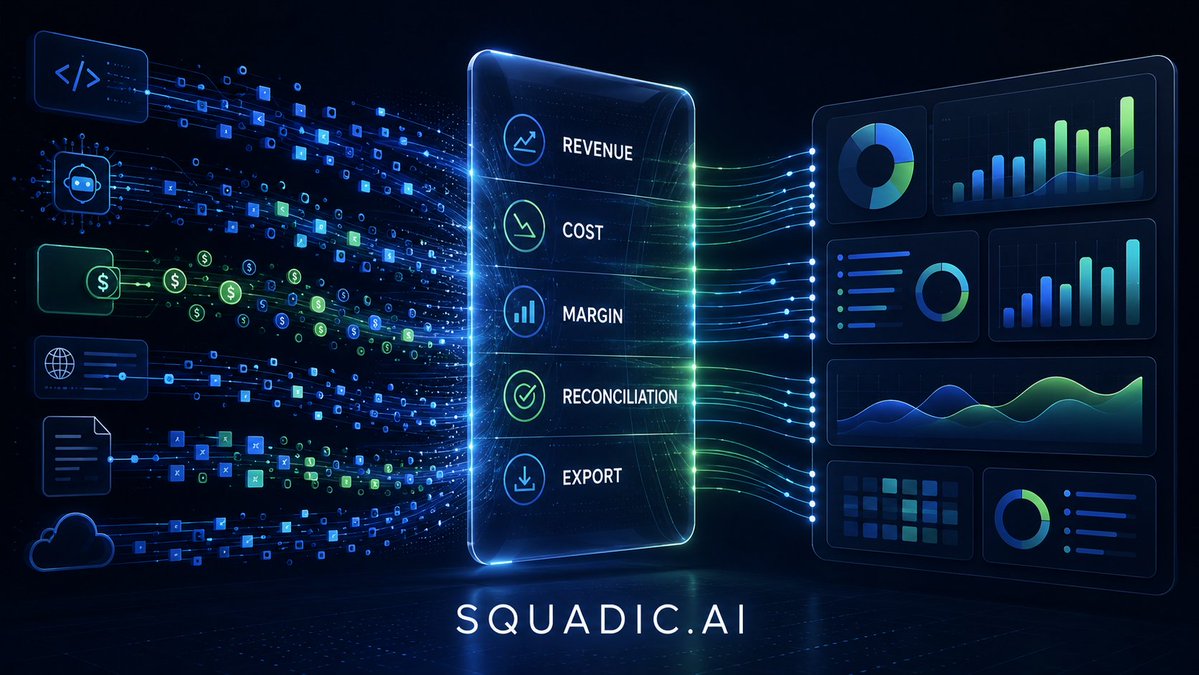
Squadic’s role is different: turn fragmented money activity into business truth — revenue, cost, margin, reconciliation, and export — without moving funds.
No custody.
No payment execution.
No transaction signing.
No routing or settlement.
Just a clearer finance layer for business owners building in an agentic economy.
Because “a payment happened” is not the same as “this was profitable.”
#Squadic #AgenticFinance #AIAgents #FinanceOps #APIbusiness #Reconciliation #Profitability #Payments #BusinessFinance
1
2
31
Jun 12
A business can be profitable on paper and still run out of cash.
Common online business problem:
Sales are coming in.
Margins look fine.
But there is not enough cash for ads, inventory, contractors, payroll, or taxes.
Why?
Because profit ≠ cash available today.
Separate 3 views:
Plan: expected sales and costs.
Actual: money already received and spent.
Forecast: upcoming payments, obligations, and cash gaps.
If you only look at revenue, you may miss the moment when the business needs cash before the next payment cycle.
A simple weekly check:
1. Cash available now
2. Expected incoming payments
3. Fixed upcoming costs
4. Variable costs per sale
5. Cash needed for the next 7–30 days
6. Real margin by product, service, or channel
Squadic helps turn fragmented money activity into business clarity: revenue, cost, margin, cashflow, reconciliation, and reports — without moving funds.
Not financial, tax, or legal advice. Just a clearer management view.
#Squadic #Cashflow #SmallBusiness #OnlineBusiness #Profitability #BusinessFinance #FounderOps #Reconciliation #FinanceOps
2
33
Jun 12
AI agents can pay for APIs, tools, data and services.
But after the payment happens, teams still need to answer simple business questions:
What was revenue?
What was cost?
What was margin?
Which events failed to reconcile?
What should be exported for finance?
Payment rails move money.
Squadic turns payment activity into business truth.
We’re building the financial layer after settlement: MoneyEvents, reconciliation, margin visibility and export — without custody or moving funds.
#AIagents #FinTech #Stablecoins #x402 #Payments #Reconciliation #StartupBuilding
2
40
Jun 8
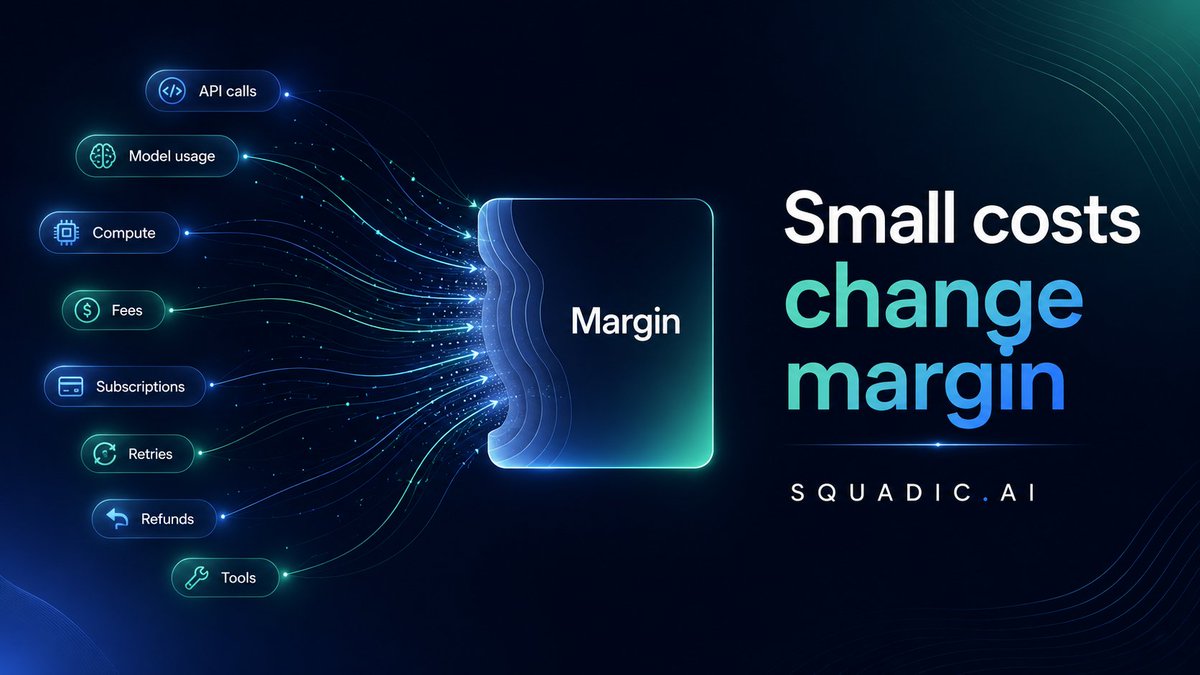
The next finance problem for AI-agent and API businesses may not be revenue.
It may be invisible recurring cost.
Examples:
- model usage
- API calls
- compute
- data providers
- automation tools
- payment fees
- retries
- refunds
- subscriptions
- contractor work
Each cost looks small alone.
But together they change margin.
That is why “agent spend tracking” should not only mean setting a budget.
The business also needs to understand:
Plan: what costs were expected.
Actual: what costs really happened.
Forecast: what margin looks like if usage continues.
This is the direction Squadic is focused on:
MoneyEvents → cost categories → revenue/cost/margin → cashflow → reports.
Not payment execution.
Not custody.
Not wallet management.
A financial truth layer for understanding the economics after money and usage events happen.
#Squadic #AIAgents #APIs #AgenticFinance #Fintech #UnitEconomics #Cashflow #Reconciliation #MoneyEvents
1
2
51
Jun 8
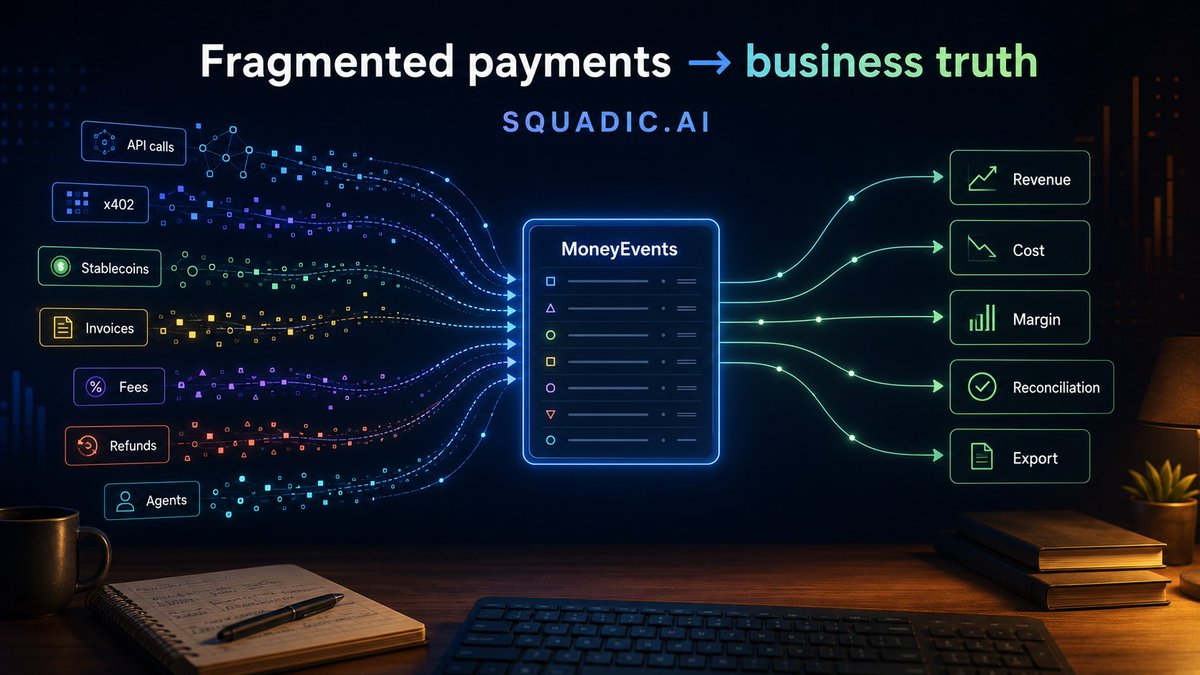
Payment activity is not the same as business truth.
This becomes obvious when revenue comes from multiple sources:
- API calls
- x402-style micropayments
- stablecoin payments
- Stripe or card payments
- manual invoices
- subscriptions
- agent-triggered workflows
- refunds and fees
The rail can tell you that money moved.
But the business still needs to know:
1. Which customer, agent, API key, workflow, or invoice created the event?
2. Is it revenue, refund, fee, transfer, or cost?
3. What was the cost behind it?
4. Does margin exist after fees and usage costs?
5. Does it reconcile with the source record?
6. What should be exported for reporting?
This is the gap Squadic is focused on:
MoneyEvents → reconciliation → revenue/cost/margin → cashflow → reports.
Payment rails move funds.
Squadic is being built as the financial truth layer after funds moved.
No custody.
No wallet management.
No payment execution.
Just clean business meaning from fragmented payment activity.
#Squadic #AIAgents #AgenticPayments #x402 #Stablecoins #APIs #Reconciliation #Fintech #MoneyEvents
1
2
3
141
Jun 6
Watching what @NEARProtocol, @near_intents and @ilblackdragon are building around the agent economy is interesting.
The core idea is powerful:
agents, apps and users should be able to execute across chains without thinking about bridges, fragmented liquidity, or the complexity underneath.
NEAR Intents can become an execution layer for this:
- an agent or user expresses what they want to happen
- the system finds a way to execute it
- assets can move across chains
- swaps and payments can happen through better abstraction
- the user does not need to manually manage every step
That is a very important part of the agent economy.
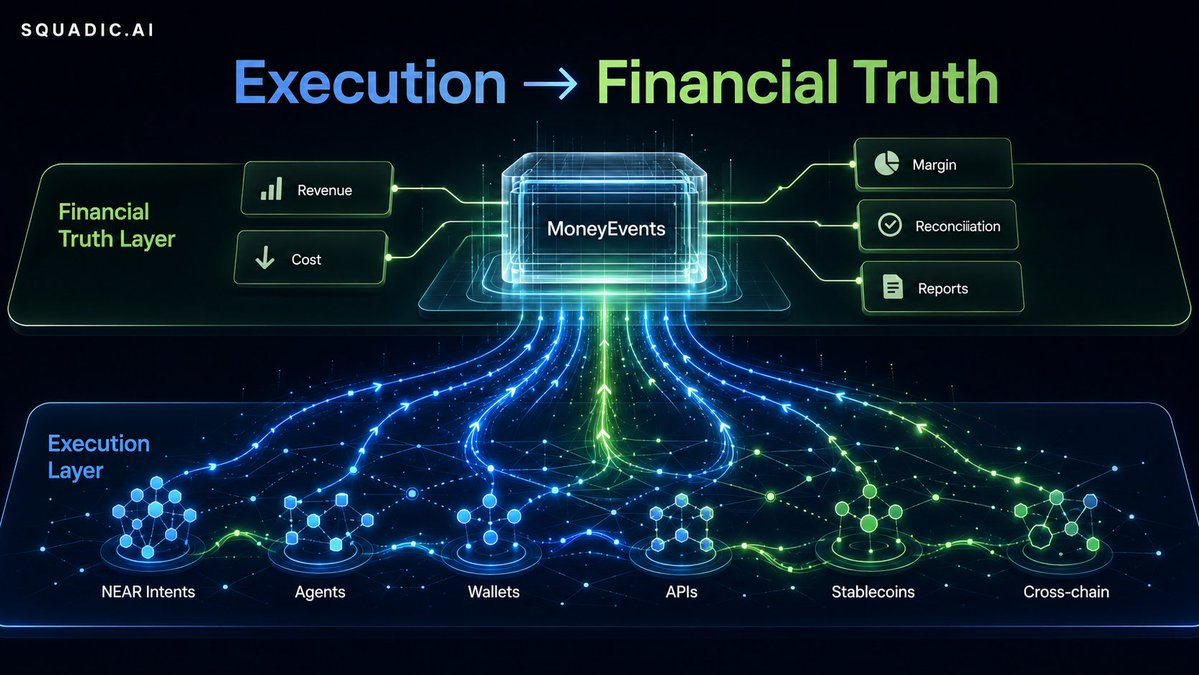
But after execution, another layer becomes necessary:
financial truth.
If an AI agent pays for an API call, buys data, triggers a workflow, receives a micropayment, or settles across different rails, the transaction itself is only the beginning.
A business still needs to understand:
- what happened
- which customer, agent, workflow, invoice, or vendor it belongs to
- what revenue was created
- what cost was incurred
- what fees were paid
- whether margin exists
- whether the event reconciles with wallets, APIs, invoices, or reports
- what should be exported for accounting or business operations
Execution answers:
“Can this transaction happen?”
Financial truth answers:
“What does this transaction mean for the business?”
That is where I think Squadic can complement this ecosystem.
We are exploring Squadic as a MoneyEvent ledger and reconciliation layer for agentic payments, stablecoin activity, API revenue, x402-style micropayments, and business-readable reporting.
Not a wallet.
Not custody.
Not payment execution.
Not a bridge.
External rails, wallets and intent systems execute.
Squadic observes completed events, normalizes them into MoneyEvents, reconciles them, and helps businesses understand revenue, cost, margin, cashflow and reports after the payment happened.
If the agent economy grows, payment execution will not be enough.
Every agent, API business, stablecoin-native company and automated workflow will need a clean financial layer after money moves.
That is the layer we are building toward.
#NEAR #NEARIntents #AIAgents #AgenticPayments #Stablecoins #x402 #Reconciliation #Fintech #Squadic
1
1
3
131
Jun 6
AI agents will not only need wallets.
They will need financial memory.
If an agent pays for an API call, buys data, triggers a workflow, or receives a micropayment, the payment itself is only one part of the story.
The business still needs to know:
- what happened
- which customer or workflow it belongs to
- what it cost
- what revenue it created
- whether margin exists
- whether it reconciles with the source
- what should be exported for reporting
Payment rails move money.
The next layer is turning payment activity into business truth.
That is the direction we are building with Squadic: MoneyEvents, reconciliation, revenue, cost, margin, and reports after the payment happened.
No custody. No payment execution. Just the financial truth layer.
#Squadic #AIAgents #Fintech #Stablecoins #x402 #APIs #Reconciliation #AgenticPayments
1
2
71
Jun 5
A payment event is not a business answer.
It only tells you that money moved.
For modern businesses, that is not enough.
If you sell APIs, accept stablecoins, test x402 payments, or build AI-agent workflows, you need to understand what happened after the payment:
- What created this revenue?
- What cost was attached to it?
- What margin remains?
- Was the request successful?
- Was there a refund?
- Is the payment reconciled?
- Can this be exported for finance?
This is the layer we are building with Squadic.
Not a wallet.
Not a payment rail.
Not a processor.
A MoneyEvent ledger that turns completed payment activity into business truth:
revenue,
cost,
margin,
reconciliation,
cashflow,
risk,
export.
Payment rails move funds.
Squadic explains what those funds mean.
#buildinpublic #fintech #payments #stablecoins #x402 #AIagents #APIs #reconciliation #SaaS #startup #squadic #squadicAi
2
1
3
112
Jun 5
The next generation of businesses may not look like the old one.
Some revenue will come from subscriptions.
Some from API calls.
Some from usage-based pricing.
Some from x402 payments.
Some from stablecoin transfers.
Some from AI agents buying, selling, or triggering services automatically.
That creates a new finance problem:
the payment event is no longer enough.
A business does not only need to know:
“Did money arrive?”
It needs to know:
- what created this payment
- which product, API, customer, agent, or workflow it belongs to
- what cost was attached to it
- what margin remains after fees and usage costs
- whether it matches internal records
- whether it can be exported cleanly
- whether this activity is profitable or just noisy
This is why we think the future needs a MoneyEvent layer.
Not another wallet.
Not another payment rail.
Not another dashboard that only shows balances.
A MoneyEvent layer should connect payment activity to business meaning.
For Squadic, that means building toward:
- revenue and cost tracking
- margin visibility
- reconciliation
- source mapping
- clean exports
- profitability by product, API, agent, or workflow
Payment infrastructure is becoming programmable.
Business finance has to become more understandable.
If AI agents and APIs can spend and earn automatically, teams need a way to see the financial truth behind that activity.
That is what we are building with Squadic.
Rails move funds.
Squadic explains the economics.
#buildinpublic #fintech #payments #stablecoins #x402 #AIagents #APIs #reconciliation #startup #SaaS #squadic #squadicAi
3
7
142
Jun 5
We’re building Squadic around a problem that becomes more obvious every day:
payments are getting faster, smaller, more programmable — but business understanding after the payment is still messy.
x402 makes it possible to pay for APIs and digital resources directly over HTTP.
Stablecoins make global settlement faster and easier.
AI agents will increasingly buy tools, call APIs, trigger workflows, and spend money on behalf of people or businesses.
That sounds exciting.
But after the payment happens, someone still needs to answer the boring but critical questions:
Was this revenue or cost?
Which customer, agent, API, wallet, product, or workflow created it?
What was the margin after fees and usage costs?
Was the payment reconciled correctly?
Can this be exported cleanly for reporting or accounting?
Is the business actually profitable, or just moving money around?
This is where Squadic is focused.
We are not building a wallet.
We are not custodying funds.
We are not trying to become another payment rail.
Payment rails move money.
Squadic turns payment activity into business truth.
The goal is to help teams working with APIs, x402, stablecoins, and AI agents see:
- revenue
- costs
- margins
- reconciliation status
- source of each MoneyEvent
- exports for business reporting
For traditional businesses, this same idea is simple:
“I received money” is not enough.
You need to know what created it, what it cost, what remains, and whether it makes sense to continue.
For agentic and programmable-money businesses, this becomes even more important.
When payments happen automatically, frequently, and across many services, spreadsheets break very quickly.
The future of payments needs not only faster settlement.
It needs better financial clarity after settlement.
That is the direction we’re building Squadic toward:
a MoneyEvent ledger and reconciliation layer for modern businesses, API builders, stablecoin workflows, and AI-agent economies.
Rails move funds.
Squadic explains what those funds mean.
#buildinpublic #fintech #payments #stablecoins #x402 #AIagents #APIs #reconciliation #startup #SaaS
1
3
133
Jun 4
Before launching a new service, don’t only ask: 🤔
“Will people buy this?”
Ask:
“How many sales do I need just to break even?” 💰
A simple launch check:
- starting investment 💸
- fixed monthly costs 📉
- variable cost per sale 🏷️
- average order value 🛒
- gross margin 📊
- break-even point ⚖️
- payback period ⏳
- risk if sales are lower than expected ⚠️
A business idea can look attractive, but still fail as a financial model. 📉
Squadic helps business owners test profitability, break-even and payback before spending money. 🚀
Not financial advice — just a clearer management view. 👀
#businessfinance #cashflow #profitability #breakeven #smallbusiness #startups #fintech #Squadic
3
47
Jun 3
Before launching a business idea, don’t ask only:
“Can this make money?”
Ask:
1. How much cash do I need to start?
2. How many sales or clients do I need to break even?
3. When will the initial investment pay back?
4. What happens if sales are 20–30% lower than expected?
Demand is not the same as profit.
A good launch plan separates:
Plan — expected sales, costs, pricing.
Actual — money already spent or received.
Forecast — projected break-even, payback, margin, and risk.
Sometimes the idea is good, but the price is too low.
Sometimes fixed costs are too high.
Sometimes payback takes longer than the founder can afford.
Squadic helps business owners calculate profitability before they spend the money: costs, margin, break-even, payback, ROI, and risks.
Clarity before launch beats hope after launch.
#Squadic #SmallBusiness #BusinessFinance #Profitability #BreakEven #CashFlow #Entrepreneurship #Fintech
3
37
Jun 3
Profit is not the same as available cash.
A business can have sales, orders, and even positive margin — but still run into a cash gap.
A simple 30-day check:
1. Cash available now
2. Payments due soon
3. Expected incoming money
4. Timing gaps
5. Actions before the gap appears
The key question is not only “Are we profitable?”
It is also:
“Will we have enough cash when the next payment is due?”
Squadic helps business owners see money, expenses, upcoming payments, and planning signals before decisions become urgent.
Planning tool, not financial advice.
#Squadic #BusinessFinance #Cashflow #SmallBusiness #Entrepreneurship #Fintech #BusinessPlanning
3
35
Jun 1
Most founders do not lose money only because they spend too much.
They lose money because they approve decisions without knowing the payback logic behind them.
A hire.
A software stack.
A new vendor.
A process automation project.
An expansion move.
Each one sounds reasonable in isolation.
But finance pressure starts when you cannot answer three simple questions:
How much cash goes out first?
When does the decision break even?
What happens if revenue or savings arrive later than planned?
That matters even more in a market where capital spending plans are soft, borrowing still has a real cost, and AI investment is rising faster than measurable returns.
The practical move is not to stop investing.
It is to invest with decision-level visibility: expected impact, time to break even, payback period, base / downside / upside scenario.
That is how finance becomes infrastructure for better decisions, not just reporting after the fact.
Squadic.ai helps founders do exactly that: see the money, model the decision, build the report, act on the numbers.
Know your numbers before you spend.
Try it free.
#SquadicAI #BusinessFinance #BreakEven #PaybackPeriod #CashFlow #FinancialDiscipline #Profitability #FounderMode #FinanceAutomation #Fintech #AIforFinance
1
4
34
Jun 1
The most important x402 news right now is not volume 📉.
It is security 🔒.
A new research paper on x402-enabled payment systems points at the hard part of agent payments 🧠:
not "can an agent pay?" 🤔
but "can the payment, request, resource, price, and delivery stay correctly bound under real-world conditions?" 🌍
That matters ⚠️.
Because agent payments sit between two worlds:
HTTP wants immediate request/response behavior ⚡.
Blockchains have asynchronous settlement and finality ⛓️.
AI workflows may retry, parallelize, switch tools, hit dynamic pricing, or trigger multiple paid actions inside one task 🔄.
That creates new failure modes 🐞:
- a payment proof reused in the wrong context
- a resource delivered without the right payment
- a paid request denied after authorization
- race conditions across concurrent calls
- dynamic pricing mismatched with allowance
- merchant compute subsidized by flawed flows
This is where the agent-payment conversation becomes mature 🎓.
x402, Circle Gateway, Base, Cloudflare, Stripe, and other rails are making internet-native payments real 🌐.
But production systems need more than payment acceptance ✅.
They need controls 🛡️.
Request-bound signatures.
Clear pricing.
Spend limits.
Receipts.
Reconciliation.
Audit trails.
Refund rules.
Workflow-level ROI.
Cashflow visibility.
That is the Squadic Labs lens 🔍.
We watch x402 and agent payments because they will change how APIs, data, reports, and financial actions are bought 💸.
But Squadic's core product stays practical:
business owners need to see money, calculate profitability, forecast cashflow risk, track obligations, and generate reports before spend scales 📊.
Payment rails move value 🚀.
Finance systems explain whether that value made sense 🧮.
@coinbase @base @circle @CloudflareDev @Stripe
#AIAgents #x402 #AgentPayments #FintechSecurity #Stablecoins #APICommerce #MCP #Cashflow #RiskManagement #SquadicLabs
3
45
May 31
AI agents are starting to look less like "users" and more like customers. 🤖💼
That is the important signal from Base. 📈
Over the last 30 days, Base says x402 activity reached 3.1 million transactions and $1.2 million in value transferred. 💸
The interesting part is what agents are paying for:
🧠 inference
🔍 search
🌐 browser sessions
📊 market data
🛠️ research tools
⚙️ workflow automation
🧳 travel context
🔌 specialized APIs
This is a different buying pattern from normal SaaS.
A human buys a seat.
A team buys a subscription.
An agent buys the next useful step.
One search. 🔎
One browser session. 🌐
One dataset. 📂
One calculation. ➗
One report. 📄
One verification. ✅
One piece of context. 🧩
That shift matters for every SaaS founder and API builder.
If agents become buyers, pricing moves closer to work done. 🏗️
Not "$99/month for access."
More like:
💰 pay per call
🎯 pay per result
⚙️ pay per workflow
📄 pay per report
🧠 pay per decision support
x402, Circle Nanopayments, Base MCP, Cloudflare agentic payments, and Stripe's machine-payment direction are all different pieces of the same pattern. 🧩
The internet is becoming machine-readable. 📖
Now it is becoming machine-payable. 💳
But there is a business layer underneath that cannot be skipped. 🚧
If a workflow buys ten tiny services to complete one task, the founder still needs to know:
💸 What did it cost?
📦 What did it produce?
📈 Was it profitable?
🔁 Should we repeat it?
🛑 Should we cap it?
🛑 Should we stop it?
That is the Squadic Labs lens. 👓
We track agent payments because they will change how software is priced, consumed, and accounted for. 📊
Core Squadic focuses on the financial workspace business owners already need:
💵 cashflow
📈 profitability
🔮 forecasts
💳 debts and payments
📑 reports
🧠 decisions before spend
The rails are getting smarter. 🚂
The business still needs to know if the money works. 💰
@base @coinbase @circle @CloudflareDev @Stripe
#AIAgents #x402 #AgentPayments #Stablecoins #Base #APIEconomy #SaaSFounders #Cashflow #BusinessFinance #SquadicLabs
3
36
May 30
Revenue growth can hide a margin problem. 📉📈
That is one of the biggest finance mistakes founders make in a volatile cost environment. 💸
When input costs rise,
payments arrive later,
and discounts are used without a proper model,
the business can look busy while profit quality gets worse. 📉
That is why pricing is not a marketing decision alone.
It is a finance decision. 🧮
A useful founder check:
Which product or service actually carries your margin? 🏷️
Where are costs rising faster than price? 🚀
Which offers create volume but weaken profitability? 📉
What happens to profit if costs move again next month? 🗓️
Strong businesses do not just track money in and money out. 💰
They connect cash, cost, margin, and reporting before making the next move. 🔄
That is where finance automation becomes practical.
Not hype. 🙅♂️
Not another dashboard. 📊
Just clearer numbers,
faster scenarios,
and better decisions before you spend, hire, discount, or invest. 🛠️
Squadic.ai is built for that flow:
Money -> Calculations -> Reports -> decisions based on numbers. 🧠
Know your numbers before you spend.
Try it free today. 🚀
#SquadicAI #BusinessFinance #CashFlow #Margin #Profitability #PricingStrategy #FinancialDiscipline #Fintech #AIFintech #Forecasting #FounderMode
3
23
May 30
Most founders don’t lose control when cash is gone. 📉
They lose control earlier, when future payments are invisible. 🫣
Payroll. 👨💼
Suppliers. 📦
Tax. 💸
Rent. 🏢
Debt service. 📉
One-off costs that looked manageable on Monday. 🗓️
A healthy bank balance can still hide a weak week ahead. 🏦
That’s why better finance discipline starts with one simple habit:
see obligations before the money leaves. 👀
When you track upcoming payments early, you can:
✅ protect operating cash before it turns into a problem
✅ spot pressure from receivables, debt, or purchasing sooner
✅ avoid spending decisions based on a misleading account balance
✅ price, hire, and invest with clearer margins
✅ make calmer decisions because the numbers are visible 🧠
This is where modern finance infrastructure matters. 🔧
Not more dashboards. 📊
Not more noise. 🔇
A clearer view of money, commitments, margin, and risk. 🎯
That is the direction behind Squadic.ai:
Money -> Calculation -> Reporting -> decisions backed by numbers. 📈
Know your numbers before you spend. 💡
Try it free. 🚀
#SquadicAI #BusinessFinance #CashFlow #FinancialDiscipline #FounderFinance #Profitability #Margins #Payments #Forecasting #Fintech #AIFintech
2
26
May 30
Every business has a number it must hit before profit even begins. 📊
That number is your break-even point. 🎯
Not revenue. 💰
Not activity. 🏃
Not "we had a good month". 🗓️
The point where your business finally covers:
✅ rent
✅ payroll
✅ taxes
✅ suppliers
✅ software
✅ ads
✅ logistics
✅ debt
✅ fees
✅ every fixed and variable cost
Only after that line do you start making real profit. 💸
The painful part? 😟
Many owners do not know where that line is. 📉
They look at sales and feel safe.
They see money coming in and feel busy.
They check revenue and think the business is growing. 📈
But revenue can lie. 🤥
A business can sell more and still have no profit.
A business can look active and still be fragile.
A business can grow into a bigger monthly risk. ⚠️
That is why every decision should start with calculation: 🧮
❓ How much do we need to cover costs?
❓ What margin do we really keep?
❓ What happens if expenses rise?
❓ How many sales are needed before profit starts?
❓ Can we afford this decision before the money comes back?
Squadic.ai helps business owners see money clearly, calculate decisions, understand costs, and turn reports into action. 🚀
Money → Calculations → Reports → decisions based on numbers. 📉➡️📈
Know your numbers before you spend. 🛑
#SquadicAI #BusinessFinance #FinTech #Cashflow #BreakEven #Profitability #Founder #SmallBusiness #FinancialClarity #SaaS
1
2
38
May 30
The best signal in agent payments this week is not another protocol announcement.
It is usage.
Base says x402 activity reached 3.1 million transactions over the last 30 days, with agents paying for things like inference, live search, market data, browser sessions, research workflows, and travel services.
That matters because it changes the customer model for the internet.
For years, software pricing was built around humans:
Create account.
Enter card.
Choose plan.
Manage subscription.
Use API key.
Wait for invoice.
Agent workflows do not naturally fit that shape.
An agent does not want a monthly plan just to make one search query.
A research workflow may need one paid source, one browser session, one model call, one computation, and one report output.
A finance workflow may need market data, document extraction, verification, and a calculation.
That looks less like SaaS seats.
It looks more like small paid actions chained into useful work.
x402, Circle Nanopayments, Cloudflare agentic payments, Stripe’s AI commerce work, and Base MCP are all pointing toward the same future:
The web is becoming more machine-readable.
Now it also needs to become more machine-payable.
But the business layer is still missing.
If every workflow can buy tiny services, owners need to know:
What did the workflow spend?
Which action created value?
Which provider was worth it?
What should be capped?
What should be repeated?
What should be stopped?
That is where Squadic Labs connects the future rails to the real business question.
Squadic’s live core is not x402 payments.
Core Squadic helps business owners see cashflow, calculate profitability, forecast risk, track obligations, and turn decisions into clear reports before spend scales.
Agent payments make the internet faster.
Financial clarity keeps the business sane.
@base @coinbase @circle @CloudflareDev @Stripe
#AIAgents #x402 #AgentPayments #Stablecoins #Base #APIEconomy #Fintech #Cashflow #BusinessFinance #SquadicLabs #Squadic #SquadicAi

2
41