
Tweets/ RT on AI, #ProductManagement, Tech & Startups. CXO. Finance. 💙 Cricket. Not here to give/ take offence. All commentary personal.
Joined June 2009
- Tweets 11,280
- Following 2,010
- Followers 615
- Likes 1,760
1,492 Photos and videos



Sreeram Narayan retweeted

Jun 6
Rafael Nadal, who won 22 Grand Slam titles during his two-decade-long career, has weathered a series of intense bodily ailments, which made his everyday life and, needless to say, his tennis playing, an exercise in near-constant anguish. But this pain, especially as the years went on, became almost a belief system. “It was a philosophy. To learn how to suffer through sport,” his mother, Ana María Parera, says, in the new Netflix docuseries “Rafa.” It’s a sentiment that his longtime physical therapist, Rafael Maymó, echoes, as well: “Rafa likes to suffer, to have the feeling that he’s pushed himself to the maximum.” Read more about Nadal’s career and the new docuseries: newyorkermag.visitlink.me/-i…

14
240
1,245
118,045
Sreeram Narayan retweeted

Jun 11
Anthropic’s Dario Amodei has only 1 direct report, his chief of staff.
The rest of Anthropic’s executive system flows through Dario’s sister, Anthropic President Daniela Amodei, who handles daily operations and reports to the board.
For some comparison, OpenAI CEO Sam Altman has around half a dozen direct reports, while Nvidia Corp. CEO Jensen Huang has 60 people reporting to him.
---
From "Bloomberg Originals" YouTube channel, (link in comment)
175
178
3,977
1,314,761

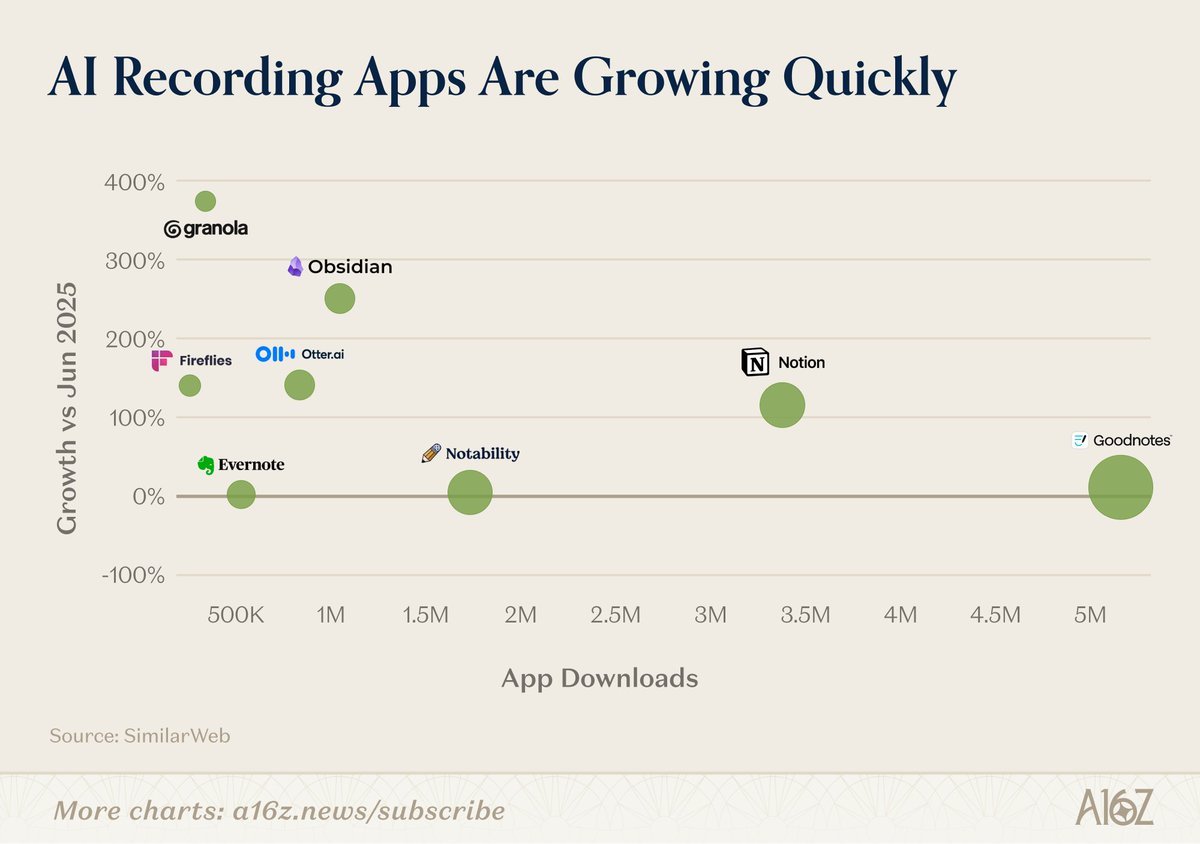
Most work conversations are now being recorded by default. You should probably assume that everything you say at work is getting recorded from here on out.
What’s emerging is a new category of enterprise software, organized around voice instead of text.
The system of record today is structured data: CRM entries, tickets, docs. But the highest-value context lives in conversation: the nuance on a customer call, the real argument in a product review, the offhand comment in a leadership meeting that quietly changes the roadmap.
LLMs are uniquely good at taking that unstructured voice data and making it structured, searchable, and queryable. That’s a large enterprise opportunity, and we’re still early in understanding what the software layer looks like and who owns it.
a16z GP David Haber on what AI recording means for the future of work: a16z.news/p/everything-is-re…

68
147
1,080
263,187
Sreeram Narayan retweeted

Jun 9
let the monthly migration from codex to claude code begin

24
42
1,967
152,413

Jun 9
A very interesting data study of 2026 isn't about models or benchmarks.
It's about who is building software now.
@Lovable just released "The Build Economy" a data study across 50M projects and 14,300 surveyed users.
The numbers tell a story that every product and engineering leader needs to sit with.
4 in 5 builders are non-technical. The fastest growing segments are founders,
designers, and sales professionals. Not engineers. Not CS grads.
55% have 11 years of professional experience. These are operators, clinicians, retailers, educators — people who spent a decade understanding a problem and now finally have the tools to solve it themselves.
And they're not tinkering. 54.6% are building a business. 3 in 5 plan to
monetize. Activity is 30% higher on weekdays vs weekends — this is professional work, not weekend hobby projects.
The output is real. 720M monthly visits to Lovable-built apps. 27x the number
of active builders. The software these people are shipping is reaching audiences
at scale.
Here's what this means for SaaS:
The competitive moat just shifted. It used to be engineering capacity — how
many developers you could hire, how fast you could ship features. Now the
constraint is context. Who understands the customer's workflow, pain, and
language? That person can now build the solution themselves.
For every vertical SaaS product sitting on a 2-year roadmap, there's a domain
expert in that industry building a focused alternative in weeks.
The re-founding of software has begun. And it won't be led by Silicon Valley
alone — Brazil is #2 on Lovable, and the fastest growth is coming from
Colombia, Mexico, Nigeria, and India.
The people closest to the problem are now the ones solving it.
That changes everything about how we think about product, engineering,
and competitive strategy.
Read the report here
thebuildeconomy.lovable.app/
31
Jun 9
4 in 5 builders on Lovable are non-technical.
55% have 11 years of domain experience.
The best software is about to be built by the people who understand the problem not the language.
Good report worth a read for all creators building in the Vibe economy
thebuildeconomy.lovable.app/
10
May 28
Why enterprises are shifting from AI hype to intelligence allocation economics?
open.substack.com/pub/sreesp…
7
May 28
Good read by @joeschmidtiv
AI models will continue to win because they own the model and they own the distribution for the horizontal tools they have designed.
Those who own the surface where the work actually executes, data flows and gets captured cannot be replaced easily
x.com/joeschmidtiv/status/20…

1
67
May 27
The most impactful leaders I’ve seen aren’t the smartest people in the room.
They are the fastest at identifying and removing bottlenecks.
Every organization eventually slows down because people stop working hard, but because invisible friction starts accumulating through slow decisions, approval layers, unclear ownership, cross-team dependencies, misaligned incentives, legacy processes, reporting overhead, fear-driven culture, and fragmented systems.
Over time, these issues become “normal,” and teams adapt around dysfunction instead of fixing it.
Great leaders operate differently. They constantly scan for where execution is slowing, where energy is leaking, where teams are confused, where customers feel friction, and where talent is silently disengaging. They treat bottlenecks like operational debt, simplifying relentlessly because they understand that much of business growth comes not from adding more, but from removing what never should have existed.
This is where psychology becomes incredibly important. Most bottlenecks are not technical problems—they are emotional problems disguised as operational ones. People delay decisions because they fear being wrong. Managers create approval layers because they fear losing control. Teams avoid accountability because they fear conflict. Organizations overcomplicate systems because complexity creates the illusion of importance. Great leaders understand human behavior deeply and know that fear slows execution more than lack of intelligence ever will.
That’s why elite leadership is often less about commanding people and more about reducing psychological friction. When people feel safe, they communicate faster, take ownership quicker, solve problems earlier, collaborate more openly, and innovate without waiting for permission. The highest-performing cultures are rarely the most rigid; they are the clearest. Clarity reduces anxiety, and reduced anxiety increases speed.
Every unresolved issue, unclear expectation, unnecessary meeting, or inefficient process consumes mental bandwidth. Over time, this drains motivation and decision quality. Leaders who remove friction are actually restoring cognitive energy back to their teams, and that energy compounds. One clear process can save thousands of hours.
One courageous conversation can remove months of hidden tension. This is why bottleneck removal is such a powerful leadership advantage as it creates momentum, and momentum changes everything. The best leaders operate almost like systems engineers for human performance. They notice tiny inefficiencies others ignore: delayed approvals, confusing dashboards, unnecessary meetings, talented employees trapped in bureaucracy, or customers repeatedly encountering the same frustration. While others chase visibility, these leaders quietly eliminate drag, making work easier for everyone around them.
Most people think transformation comes from massive breakthroughs. In reality, transformation is usually the accumulation of removed friction. The Japanese philosophy of Kaizen captures this perfectly: tiny improvements compound into massive advantages over time.
Over long enough periods of time, the people who consistently remove friction become nearly impossible to compete against because while others are adding complexity, they are creating flow. While others are reacting emotionally, they are thinking systemically. While others are chasing status, they are building momentum. That’s how leaders win, not by doing everything themselves, but by making success easier, faster, and more sustainable for everyone around them.
8
May 26
The 2–6 years hiring band is becoming the enterprise sweet spot for recruiting product managers
Because companies want:
– execution-ready PMs
– low onboarding cost
– manageable compensation
– high throughput
Enough experience to deliver.
Not enough to become expensive organizational gravity.
This is not wrong at all
But from a job market perspective, what about the 0–2 & 10 experience brackets. Who is having jobs for them?
24
May 26
People think the AI race is about GPUs.
It’s increasingly about:
– retaining researchers
– concentrated cognition
– small elite teams with asymmetric impact
The frontier labs aren’t just building models anymore.
1
19
May 26
2023: AI companies competed for users.
2024: They competed for GPUs.
2025–26: They’re competing for humans.
And perhaps that was always the real bottleneck.
1
1
23
May 24
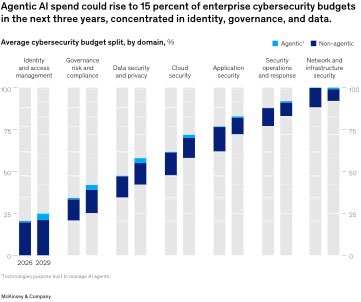
Cybersecurity budgets are projected to grow at a CAGR of around 2.5 percent over the next three years.
14
May 19
Agentic Anxiety
The smarter agents become, the more enterprises slow them down with policy.
Every breakthrough in autonomy creates equal demand for:
– human oversight
– governance
– traceability
– kill switches
“Agentic anxiety” may become the biggest driver of enterprise AI software spend
economictimes.indiatimes.com…
1
16
May 16
The new petrodollar - the token-dollar
May 15

AI inference cost (which we pay in dollars) may rival our oil import bill and blow up our current account deficit. Great post on that below.
What is the solution? I believe that high developer productivity can be achieved without the high AI inference bill. We have to invent our way out of trouble. Stay tuned.
1
21
May 14
Navigating the Indian economy and markets for the next 6 months
What the PM’s speech really signals: India is entering a demand compression cycle not by choice, but by necessity. When a government asks citizens to cut spending, it means the macro cushion has thinned enough that individual behavior now matters at a national level.
The next 12 months will likely see: rupee between 92-98, crude between $90-115, potential import curbs, possible fuel price hikes, tighter liquidity, and slower GDP growth (from 6.5% to possibly 5.5-6%). This isn’t a recession. It’s a forced slowdown.
Here are 5 essential things to follow
1. Tighten Consumption
Cut discretionary, protect essential, defer large purchases.
Defer for 6-12 months: New car purchase (auto loans will get expensive if rates rise), home renovation (building material costs are inflated), large electronics (potential import curbs could first spike then crash prices), and foreign vacations (save dollars, explore domestic).
Actively reduce: Dining out frequency (restaurant costs will rise with LPG shortage and food inflation), subscription bloat (audit all recurring subscriptions — keep 3-4 essentials, cancel rest), and impulse online shopping
2. The mindset shift
Think of the next 12 months as a financial “cutting season” not deprivation, but intentional reduction.
Why 12 months ? In a demand compression cycle, job markets tighten with a 6-9 month lag. IT sector layoffs, startup funding freezes, and MSME stress typically follow an oil shock by two-three quarters. Even if YOUR job is secure, the ecosystem around you may not be. Freelancers get paid late. Clients renegotiate contracts. Bonuses get deferred.
3. EMERGENCY FUND. Build the Buffer NOW
This is non-negotiable. Before any new investment, ensure you have 6-9 months of expenses in liquid form. If you currently have 3 months, build it to 6. If you have 6, build to 9.
Park it in LIQUIDBEES or a bank FD ladder
4: EXISTING INVESTMENTS. Protect, Rotate, Don’t Panic
Markets have recovered from every war, every oil shock, every currency crisis within 3-6 months. The 3-year forward returns from these drawdowns have been 42-228%. Your job isn’t to exit. It’s to survive the drawdown with your portfolio intact and capital available to deploy.
Geographic diversification is now a hedge against INR depreciation, not just a return play. This is the lesson this crisis is teaching. Your portfolio is ~95% India, ~90% equity. In a world where India’s CAD is widening and the rupee is weakening, concentrated India exposure means your entire net worth depreciates in global purchasing power terms.
5. PREPARE FOR WINTER. What If It Gets Worse?
The bottom line: the next 12 months reward discipline, not cleverness. The investors who emerge strongest won’t be the ones who called the oil top or the rupee bottom. They’ll be the ones who maintained their SIPs, kept their emergency fund intact, rotated from weak to strong, and deployed systematically into quality at lower prices
34
May 12
🧵 THREAD: Why did PM ask Indians to stop foreign travel & stop buying gold? A “5 Why” deep-dive for details 🇮🇳
Most people heard the appeal. Few understood the engineering behind it.
PART 1: “Reduce Foreign Travel”
Why #1: Every outbound tourist converts rupees to dollars. India’s outbound tourism spend: ~$28-30B/year. With Hormuz closed and oil at $100 , India’s oil import bill has spiked $15-20B. The country can’t afford discretionary dollar outflows on top of essential ones.
Why #2: RBI reserves are bleeding at $5-8B/week — down $38B in 9 weeks to $690.7B. At this pace, that’s only 17-19 weeks of cover. Not a crisis, but the trajectory is what triggers policy escalation.
Why #3: India can’t cut oil imports (economy stops), electronics (supply chains break), or fertilizers (food security). But 27M outbound tourists CAN vacation in Goa instead of Dubai. Tourism is the softest dollar-saving lever with the least economic damage.
Why #4: The Gulf war has a cruel irony — it’s disrupting remittance flows from the very region that sends India the most dollars. The usual safety valve (Gulf remittances) is partially blocked.
Why #5: This is a precursor. If voluntary compliance fails, formal LRS restrictions (capping the $250K/year overseas remittance) are Step 5 in the policy escalation. The PM would rather you change behavior than have the government restrict your freedom to send money abroad.
2
1
60
May 12
PART 2: “Buy Less Gold”
Why #1: India imported ~$47B of gold in FY25 — the 2nd largest import item after crude. Every gold chain requires dollars to import. In a dollar-scarce environment, gold imports are a luxury the BoP can’t afford.
Why #2: Gold is the only major import that produces zero economic output. Oil powers factories. Semiconductors build phones. Gold sits in a locker. Economists call it the “gold drain” — productive dollars converted into a non-productive asset.
Why #3: India tried hard restrictions in 2013 (80:20 rule). Gold smuggling exploded, customs seizures tripled, government revenue fell. Modi knows this history. Voluntary appeal first, formal curbs (duty hike from 15% to 20% ) only if this fails by July.
Why #4: Gold is India’s parallel financial system. For 700M Indians without adequate banking/pension access, gold IS the retirement plan and emergency fund. You’re not fighting a market preference — you’re fighting a 3,000-year cultural institution. That’s why the PM can ask but cannot force.
Why #5: Three shocks are hitting simultaneously for the first time since 2013: oil above $100, rupee down 10% in 5 months, and gold at all-time highs ($5,000 /oz). The same 800 tonnes of gold India imports annually now costs 2.6x more in dollars than 2 years ago. It’s a price shock × currency shock × oil shock.
1
1
135