
211 Photos and videos


sreesub retweeted

May 30
10 year old Vaibhav Sooryavanshi practicing at Gen Nex Academy in Patna with coach Manish Ojha.
Fast forward to 2026:
* 776 Runs in his first full IPL season
* Shattered Gayle’s record with 72 SIXES
* First player to cross 500 Powerplay runs in a season 🤯
8
140
1,138
59,524
sreesub retweeted

May 30
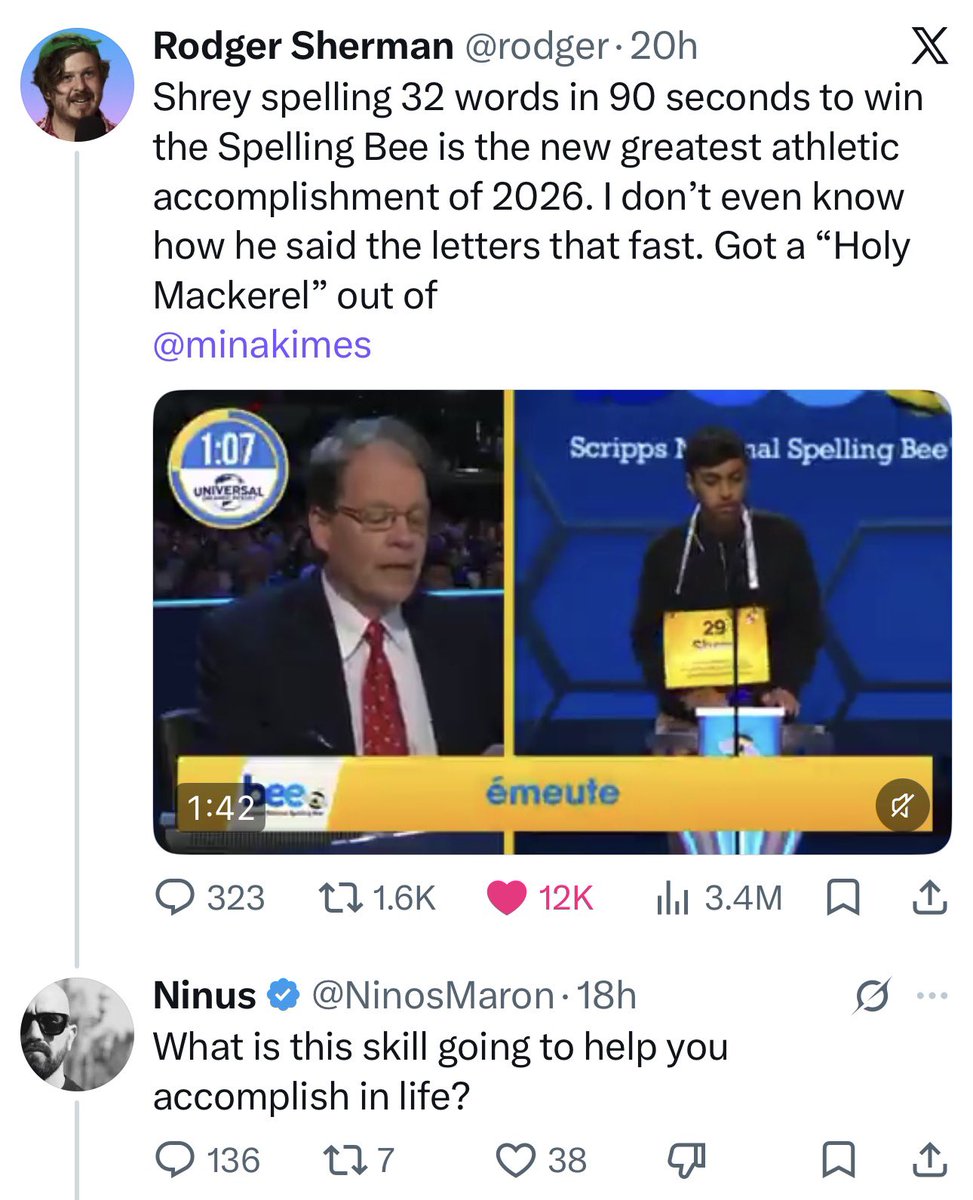
Why do so many spelling bee winners have done so well in their career
Most of them top doctors or in top medical schools or become Entrepreneurs VCs scientists
Spelling Bee is capacity building not skill building
It is “Memory working under pressure”
Because that’s actually rare.
Lots of people can remember things.
Far fewer can retrieve them accurately while being watched by millions
standing on a stage
under a countdown clock
knowing one mistake ends everything
That is a different cognitive state entirely.
A surgeon uses it.
A pilot uses it.
A CEO uses it.
A trial lawyer uses it.
An entrepreneur uses it.
The domain changes.
The capacity remains.
7
68
344
12,864
sreesub retweeted

May 27
The airline lost my bag for 72 hours.
They handed me a $50 “courtesy” voucher at the baggage desk and smiled like they’d done me a favor.
I kept the voucher. Then I opened my laptop and used a 1999 international treaty they never mention at check-in.
Total recovered: $1,650.
Here are the three legal weapons most passengers never know they have.
187
3,354
14,883
2,324,261




sreesub retweeted

May 27
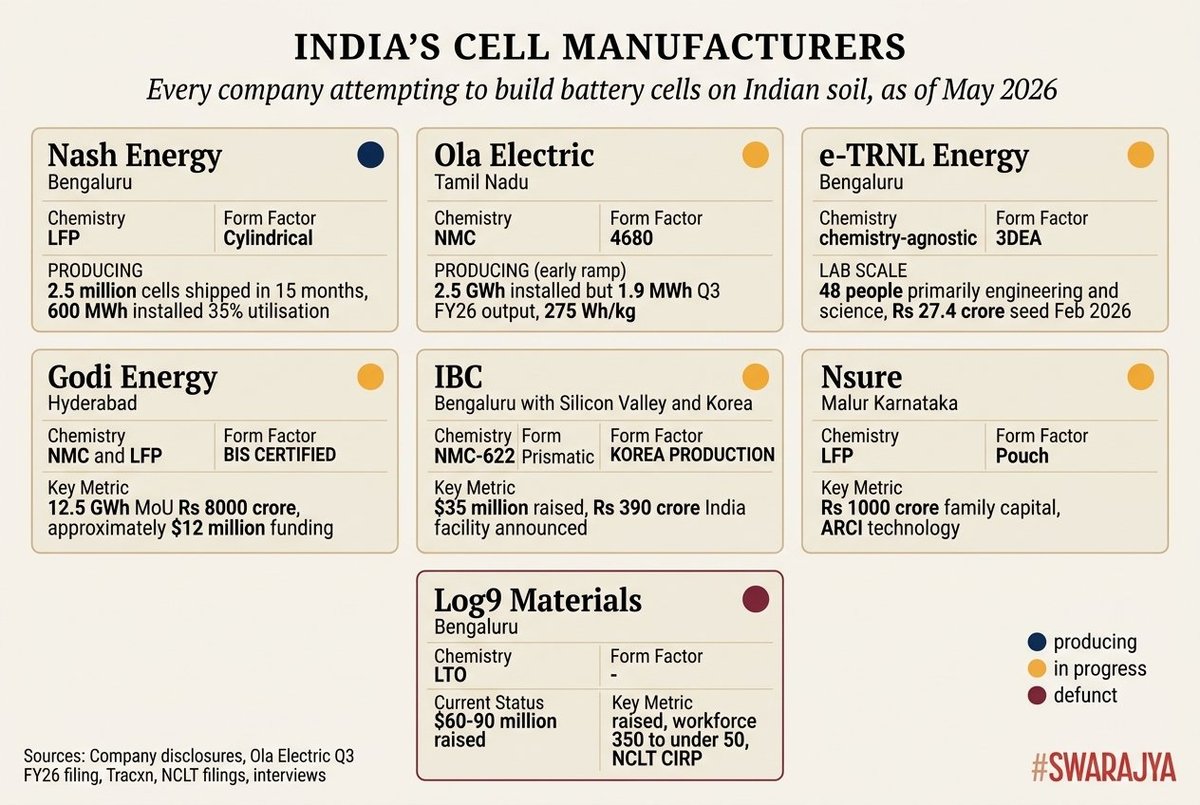
Nash Energy is the clearest example. It has shipped 2.5 mn LFP cells from near Bengaluru, using chemistry from a Japanese acquisition.
Around it are Godi (BIS-certified for NMC and LFP), International Battery Co (building a non-China supply chain), and Nsure (family-funded).
1
24
137
6,689

CLAUDE CODE CAN NOW PULL LIVE DATA FROM 17,000 STOCKS, CRYPTO PRICES, AND FINANCIAL STATEMENTS IN SECONDS.
One command. 60 seconds. Done.
Here is the exact setup:
Step 1: Open Claude Code and paste this:
claude mcp add --transport http financial-datasets mcp.financialdatasets.ai/
Step 2: Authenticate
Type `/mcp` inside Claude Code and complete the OAuth flow in your browser.
Verify the connection anytime:
claude mcp list
Step 3: Start prompting
- "What is Apple's current P/E ratio and market cap?"
- "Show me Tesla's income statement for the last 4 quarters."
- "How has Bitcoin's price changed over the past year?"
That is it.
Claude Code now has direct access to real financial data across 17,000 stocks, earnings reports, balance sheets, income statements, cash flow data, and crypto prices.
The analysts paying $24,000 a year for a Bloomberg Terminal are not going to be happy this exists.
Before this you needed a Bloomberg Terminal or a complex financial data API or hours of manual research across multiple sources.
Now you need one command and 60 seconds.
The quants, analysts, and portfolio managers who figure out how to combine Claude Code's reasoning with live financial data access will have a research edge that compounds every single day.
Bookmark this before you open your next brokerage account.
Docs if you run into errors: docs.financialdatasets.ai/mc…
Follow @cyrilXBT for every Claude Code integration that changes how you work with data.
107
514
4,072
484,591
sreesub retweeted

May 5
A few lines from Christopher Nolan’s Odyssey have become the loudest talking point ever since the new trailer has landed. Robert Pattinson’s silk-and-venom Antinous sneers at Tom Holland’s Telemachus: “You’re pining for a daddy you didn’t even know” not too long before Telemachus, raw with grief and defiance, declares: “My dad is coming home.”
And just when you’re absorbing those, Matt Damon’s battle-hardened Odysseus, rallying his men, barks: “Let’s go.” Three lines. Three gut punches. None of them sounding remotely like they belong in ancient Ithaca.
Or do they?
The case against is visceral and easy to make. “My dad” collapses a prince of Ithaca into a grieving teenager from Pasadena. “Let’s go” is what a coach shouts before a high school football game. “Daddy” — in Pattinson’s mouth, weaponised as political mockery — lands better in a therapist’s office.
The mythic register, that epic-weight language that separates gods-and-monsters storytelling from ordinary drama, seems to have been quietly euthanised.
The worry isn’t pedantry. It’s that without that register, the Cyclops is just a monster, Circe is just a villain, and Odysseus is just a dude trying to get home. The grandeur that makes Homer immortal, that sense of a universe where men’s fates are debated by gods over wine, risks dissolving into prestige television.
And then there’s the accent problem folded into all of this. Jon Bernthal, who plays King Menelaus, the Greek king of Sparta and husband of Helen of Troy, operates in full gravel-throated American mode. Tom Holland speaks in an American accent throughout. John Leguizamo (Eumaeus) too. Everyone sounds like they’ve stepped out of the American Civil War.
Meanwhile, Pattinson keeps traces of British frost even as Hathaway’s Penelope carries mid-Atlantic warmth. Nolan, himself British, has clearly decided that sonic coherence is optional. It has long been Hollywood practice for period pieces in non-English settings to use British accents to convey sophistication and a sense of time past, based on stereotypes of Britishness. Nolan is explicitly rejecting that convention.
Here’s the defence. None of these accents are accurate. Nobody knows what ancient Greek sounded like. It’s all performance. And the same logic applies to vocabulary. The Odyssey was oral poetry, performed by travelling bards for live audiences who needed to follow every word.
Homer didn’t sound archaic to the Greeks; grandeur was in the imagery, not the obscurity of diction. When Telemachus says “My dad is coming home,” he may actually be closer to the emotional directness of Homer than any Olivier-esque declamation could manage.
The raw, unadorned word ‘dad’, stripped of courtly distance, captures something perhaps Homer understood intuitively: that the wound at the heart of the Telemachy is simply a boy missing his father.
And “Let’s go” from Odysseus? That’s the line of a pragmatist, a strategist, a man who wins wars with cleverness rather than ceremony. It’s not heroic bluster. It’s efficiency. Which is exactly how Nolan has characterised him — an “amazing strategist, a very wily person.”
The real question isn’t whether these lines are modern. They obviously are. The question is whether modernity and myth can occupy the same screen without one cannibalising the other.
Nolan has threaded that needle before. Oppenheimer gave us quantum physics and Greek tragedy in the same breath. The difference is that the Odyssey already is myth, and myths carry the memory of their own grandeur. When “Let’s go” replaces “For glory and for Ithaca,” something genuinely is lost, even if what replaces it is truer to the emotional core.
The genius reading: Nolan is returning Homer to the vernacular where it was born.
The myth-killer reading: he’s handed a bronze-age epic to a guy who sounds like he manages a hedge fund.

2
3
29
5,434
sreesub retweeted

May 5
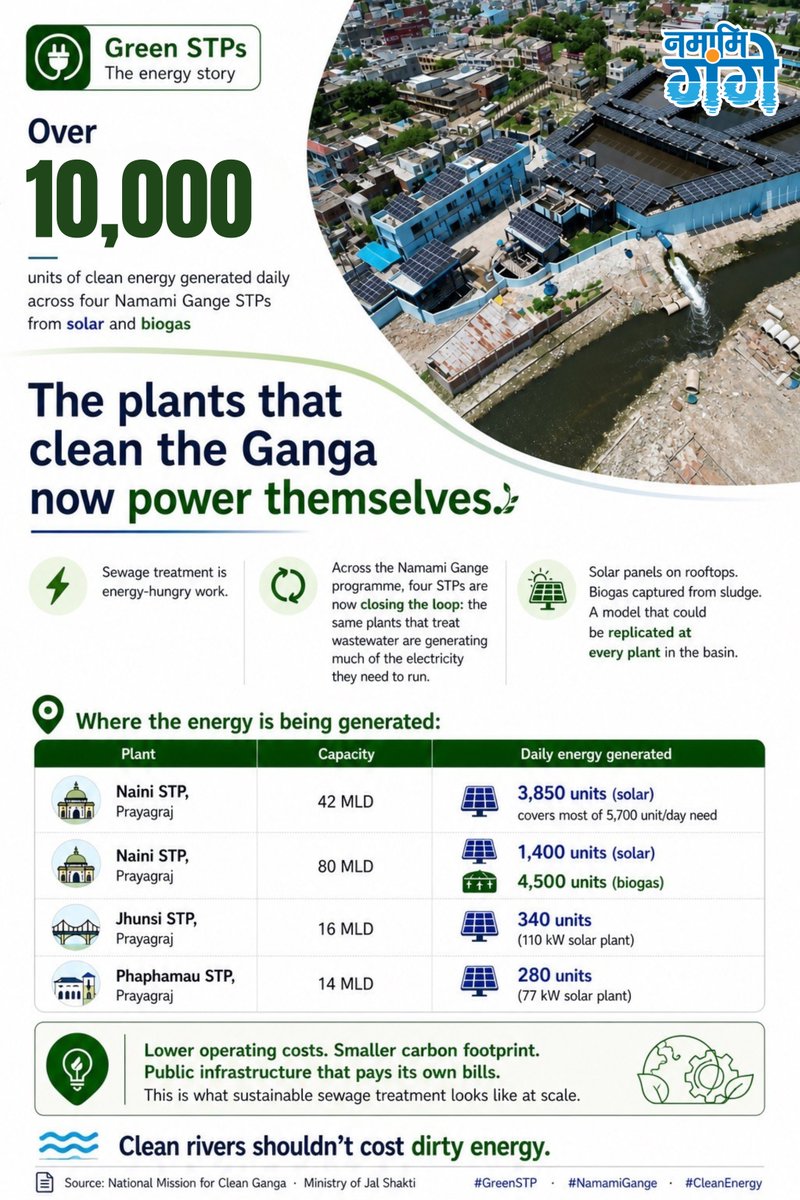
A sewage treatment plant that pays its own electricity bill.
Sounds impossible! It isn't.
Four STPs in the Namami Gange programme now generate over 10,000 units of clean energy daily, from rooftop solar and biogas captured from sludge.
The 80 MLD Naini plant alone produces 5,900 units a day. Most of that from biogas, using the very waste it treats.
The plants that clean the Ganga now power themselves.
4
55
136
5,118
sreesub retweeted

This technology can fix our roads within minutes!
Called ECOFIX, it’s developed by CSIR–Central Road Research Institute using steel slag waste.
Turning industrial waste into durable, sustainable roads- this is real innovation.
Faster repairs, lower emissions, longer-lasting roads.
2
25
77
3,156
sreesub retweeted

Apr 22
The title track of Tum Haseen main Jawan, by Rafi & Asha. Music SJ. Lyrics Hasrat. Directed by Bappi sonie , this is the first time the dream jodi of the Dream girl Hema Malini and Dharmendra appeared together. They went on to do 45 movies together, before they finally
Contd...
10
24
142
6,849

10 repos blowing up on GitHub this week that replace $1,500/month in AI tools
1. andrej-karpathy-skills → replaces paid Claude Code courses
one CLAUDE.md file from Karpathy's LLM coding observations
48,965 stars. 7,939 stars TODAY
github.com/forrestchang/andr…
2. claude-mem → replaces paid context/memory tools
auto-captures everything Claude does across sessions
compresses with AI and injects into future sessions
59,373 stars. 1,907 stars today
github.com/thedotmack/claude…
3. voicebox → replaces ElevenLabs ($22/mo)
open-source voice synthesis studio
18,963 stars. 887 stars today
github.com/jamiepine/voicebo…
4. open-agents → replaces paid agent platforms ($200/mo)
open-source template for building cloud agents. by Vercel
3,105 stars. 735 stars today
github.com/vercel-labs/open-…
5. cognee → replaces paid knowledge bases ($50/mo)
AI agent memory engine in 6 lines of code
15,733 stars
github.com/topoteretes/cogne…
6. magika → replaces paid file detection tools
AI file content type detection. by Google
14,603 stars
github.com/google/magika
7. GenericAgent → replaces paid agent infra ($100/mo)
self-evolving agent. grows skill tree from 3.3K-line seed
6x less token consumption than standard agents
2,661 stars. 883 stars today
github.com/lsdefine/GenericA…
8. omi → replaces Rewind AI ($25/mo)
AI that sees your screen listens to conversations
tells you what to do next
8,952 stars. 488 stars today
github.com/BasedHardware/omi
9. evolver → replaces manual agent optimization
self-evolution engine for AI agents
genome evolution protocol
3,074 stars. 866 stars today
github.com/EvoMap/evolver
10. wallet tracking copy trading → Kreo
tracks top Polymarket wallets. auto copies trades
the only tool on this list i actually pay for
because it makes more than it costs
→ t.me/KreoPolyBot?start=ref-k…
total before: ~$1,500/month in AI subscriptions
total now: $0 Kreo
like bookmark you'll need this
75
438
3,875
357,637
sreesub retweeted

Apr 15
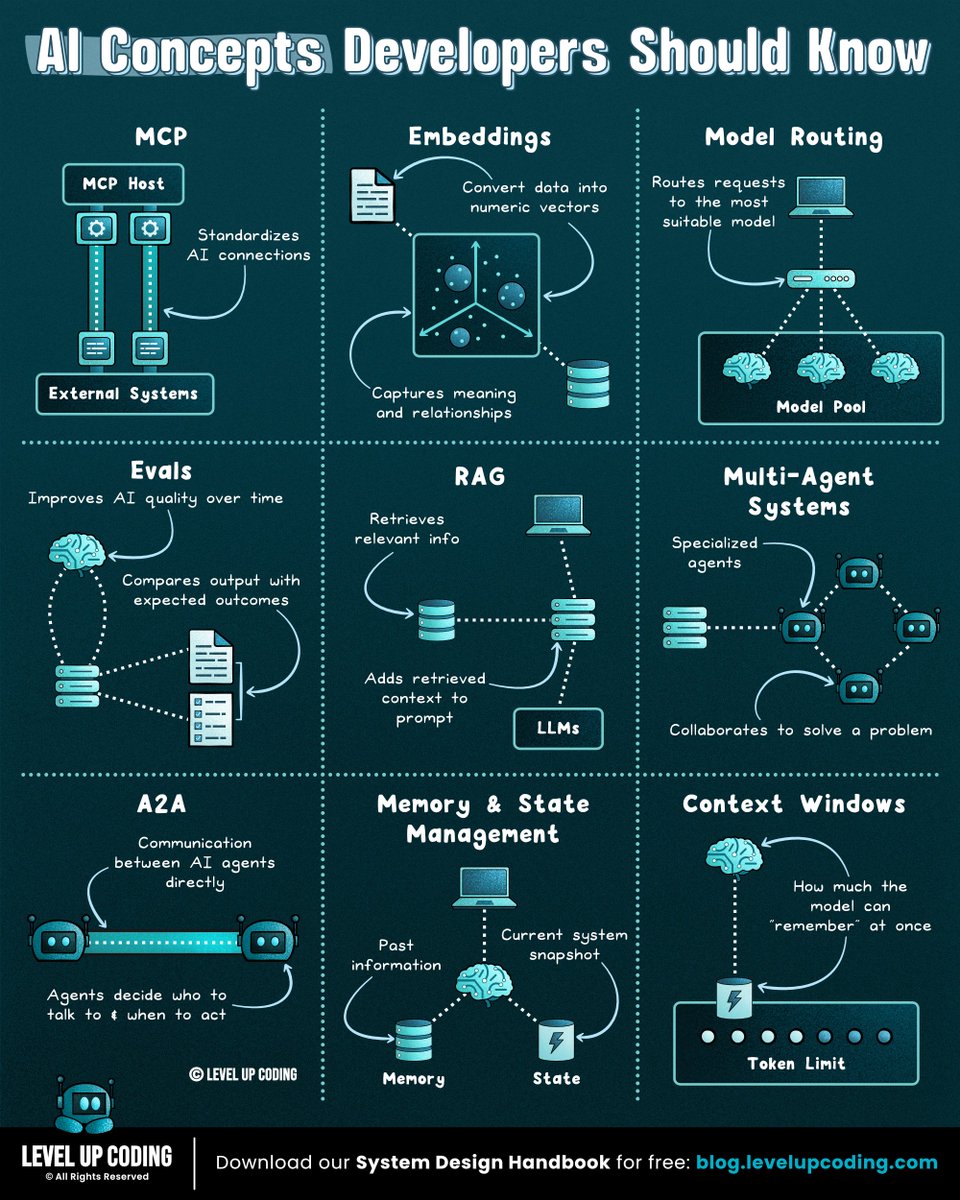
AI concepts developers should know:
1. RAG (Retrieval-Augmented Generation)
↳ Retrieves relevant external data to ground model responses.
2. MCP (Model Context Protocol)
↳ A standard for connecting models to external tools, data, and context.
3. Model Routing
↳ Dynamically selecting the best model for a given task.
4. Embeddings
↳ Turning data into vectors so models can search and compare meaning.
5. Context Windows
↳ The amount of information a model can process at once.
6. Evals
↳ Measuring the quality, reliability, and behavior of AI systems.
7. Multi-Agent Systems
↳ Multiple agents collaborating to solve complex tasks.
8. A2A (Agent-to-Agent)
↳ How agents communicate and coordinate with each other.
9. Memory & State Management
↳ Persisting and retrieving context across interactions.
Understanding these concepts is one thing. Seeing them work together is where it clicks.
Oracle has a great guide that walks you through building a scalable multi-agent RAG system → lucode.co/multi-agent-rag-vi…
Their free DeepLearning course on building memory-aware agents also puts these concepts into action: lucode.co/building-memory-aw…
What else should be on the list?
——
♻️ Repost to help others learn AI.
🙏 Thanks to @Oracle for sponsoring this post.
➕ Follow me ( Nikki Siapno ) to improve at AI engineering.
26
205
847
74,612
sreesub retweeted

Apr 14
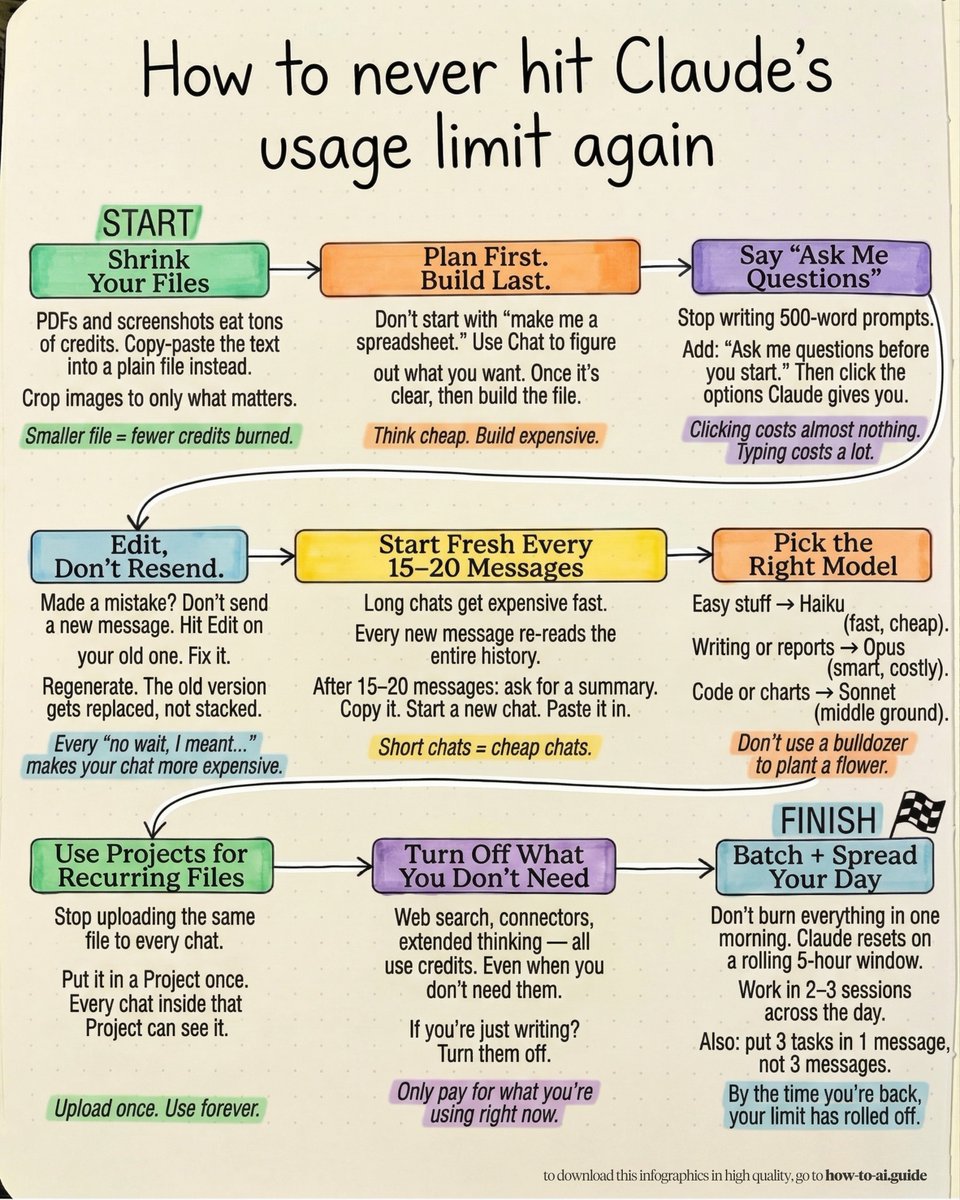
You don't need the $100 Claude plan.
Instead, you just need these 9 (free) fixes:
1. Shrink Your Files.
Open a Google Doc. Paste the text from your PDF.
Download as .md file format & upload that instead.
A 15-page PDF = 45,000 tokens.
The same text as the .md file = 2,000 tokens.
2. Plan First. Build Last.
Open Claude Chat. Prompt: "Help me plan a [financial model]. Ask me questions first."
Then paste the final plan into Cowork and prompt, "Build exactly this."
You just saved 1/10th of the cost.
3. Let Claude Ask You.
Stop writing long prompts. Prompt this instead: "I want to [TASK] to [SUCCESS CRITERIA]. Ask me questions using AskUserQuestion before you start."
Then just select answers. Clicking costs almost zero tokens. Your 500-word prompt costs 500.
Full guide here: ruben.substack.com/p/how-to-…
But here's what's really draining your credits:
4. Edit Your Messages, Don't Resend.
Click "Edit" on your last message to Claude.
Fix the mistake there. Hit Save. Claude regenerates without stacking a new message on top.
Every "no wait, I meant..." doubles your cost.
5. Summarize Every 15 Messages.
After having an entire chat with Claude. Prompt: "Summarize this entire conversation into a brief."
Copy it & paste it as the 1st message in a new chat.
You just compressed 105,000 tokens into 500.
6. Switch Models Before You Start.
Click the model dropdown. If the task takes Claude under 30 seconds to answer, pick Haiku or Sonnet. Only pick Opus for deep, multi-step work. This saves you 3–5x per message.
7. Use Projects, Not Uploads.
Go to Projects. Create one. Upload files there once.
Every new chat inside that Project reads it without re-tokenizing. Stop uploading the same contract to 5 separate chats.
8. Turn Off Extra Features.
Go to the tools panel. Turn off Web Search.
Turn off connectors. Turn off Extended Thinking.
Only turn on what this specific task needs.
Idle features burn credits silently.
9. Batch 3 Tasks Into 1 Message.
Instead of sending "Summarize this" then "List the key points" then "Write a headline" - send all three in one message.
Three messages = three full context reloads.
One message = one reload.
Access the free guides to copy my full system:
✦ 23-fixes breakdown: ruben.substack.com/p/how-to-…
✦ The infographic cheat sheet: how-to-ai.guide
Send it to the one who keeps hitting Claude's limits.

73
395
2,219
258,731
sreesub retweeted

Apr 13
This 1 hour Yale lecture will teach you more about options trading & the exact models Hedge Funds use than most people learn in their entire careers on Wall Street.
Bookmark this & watch, no matter what. It’ll be the most productive start for your week. Then read article below.

25
445
2,167
661,317
sreesub retweeted
Apr 11
This 2 hour Stanford lecture shows exactly how Stanford trains it's engineers to build AI systems. It's more practical than every Claude tutorial & prompting threads you've seen.
Bookmark & give it 2 hours, no matter what. It'll be the most productive thing you do this weekend.
158
1,904
13,652
1,667,009
sreesub retweeted

Apr 10
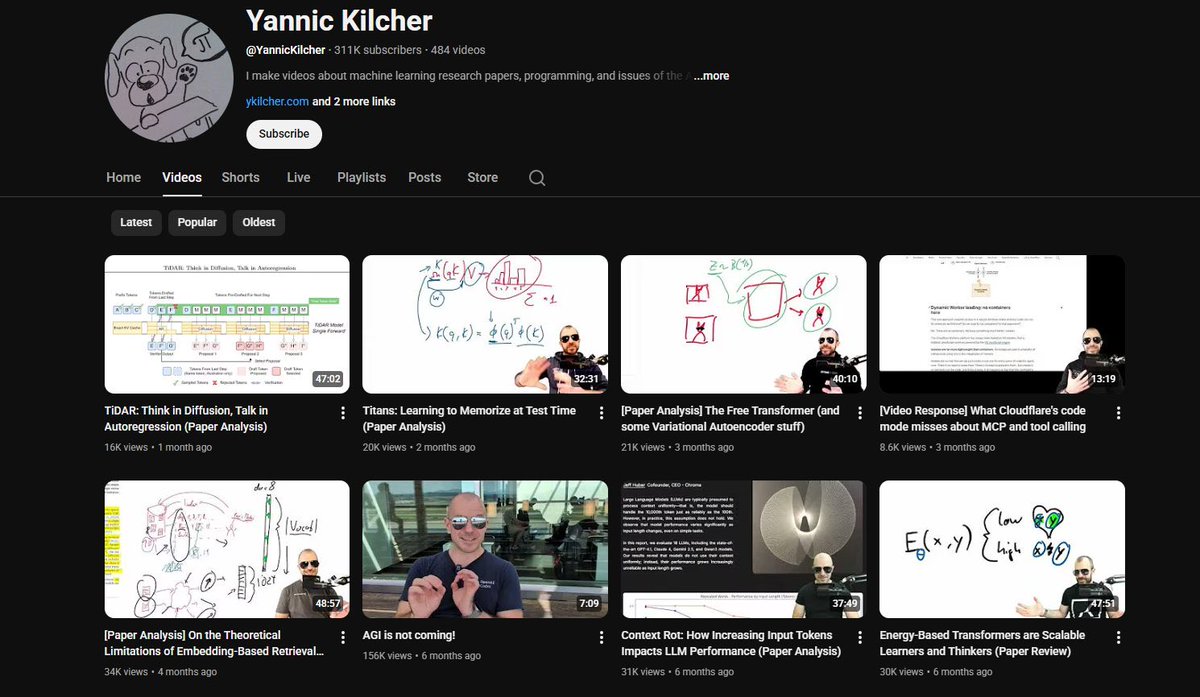
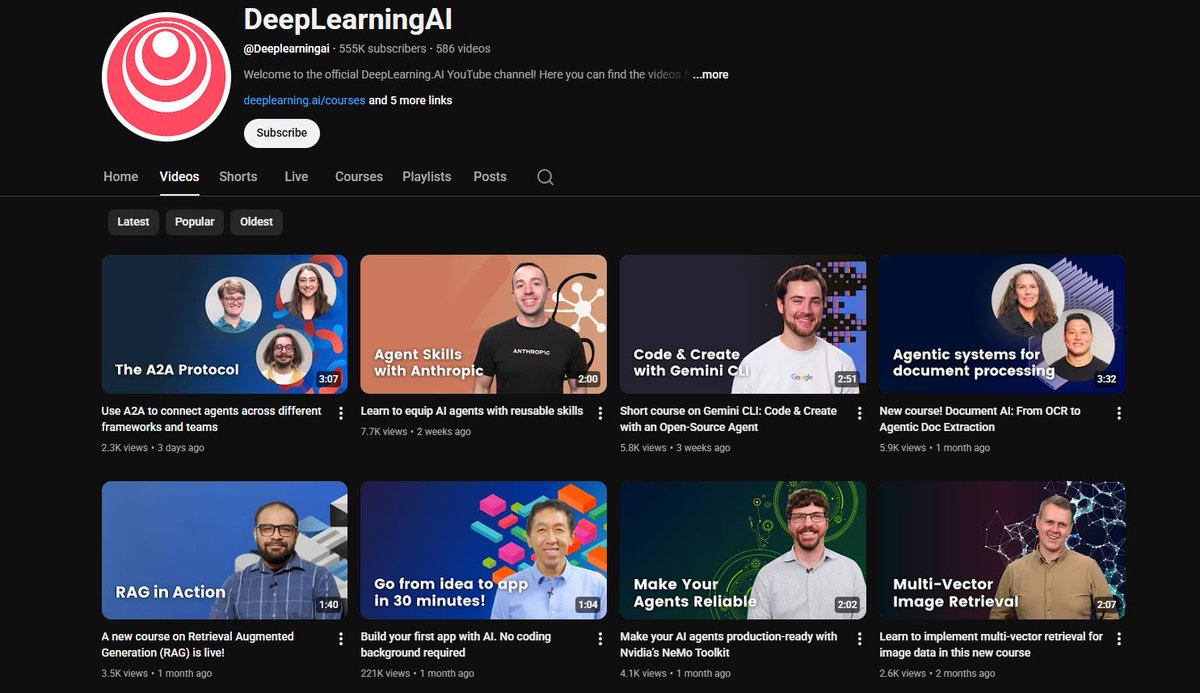
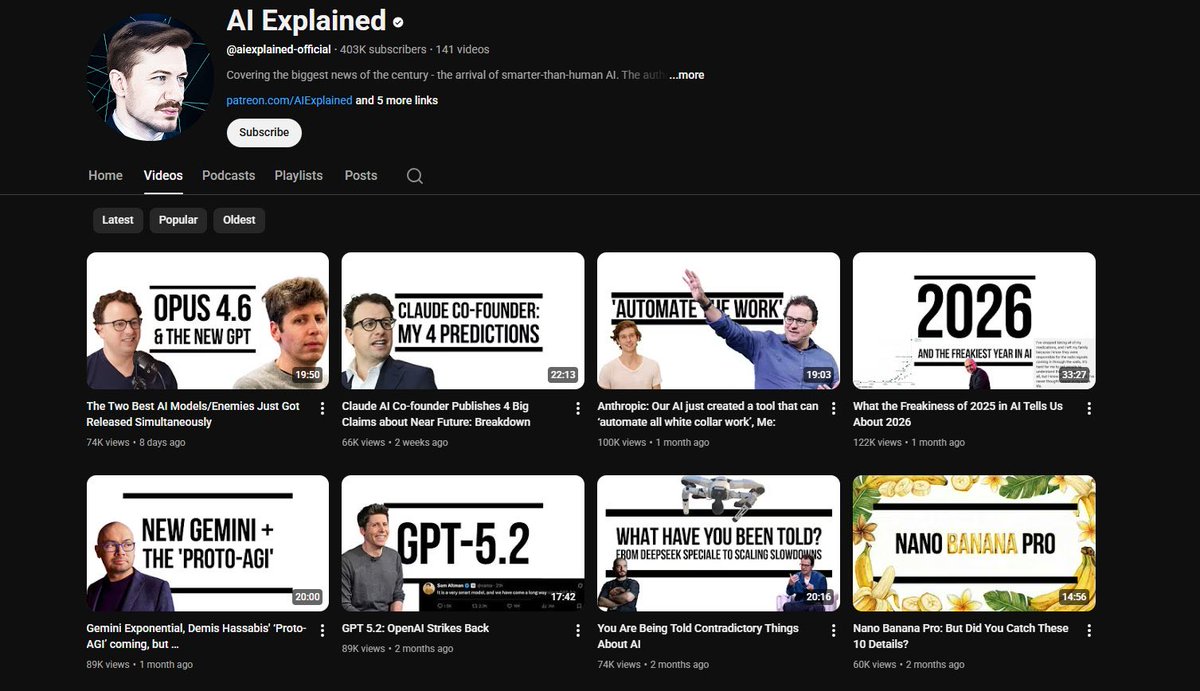
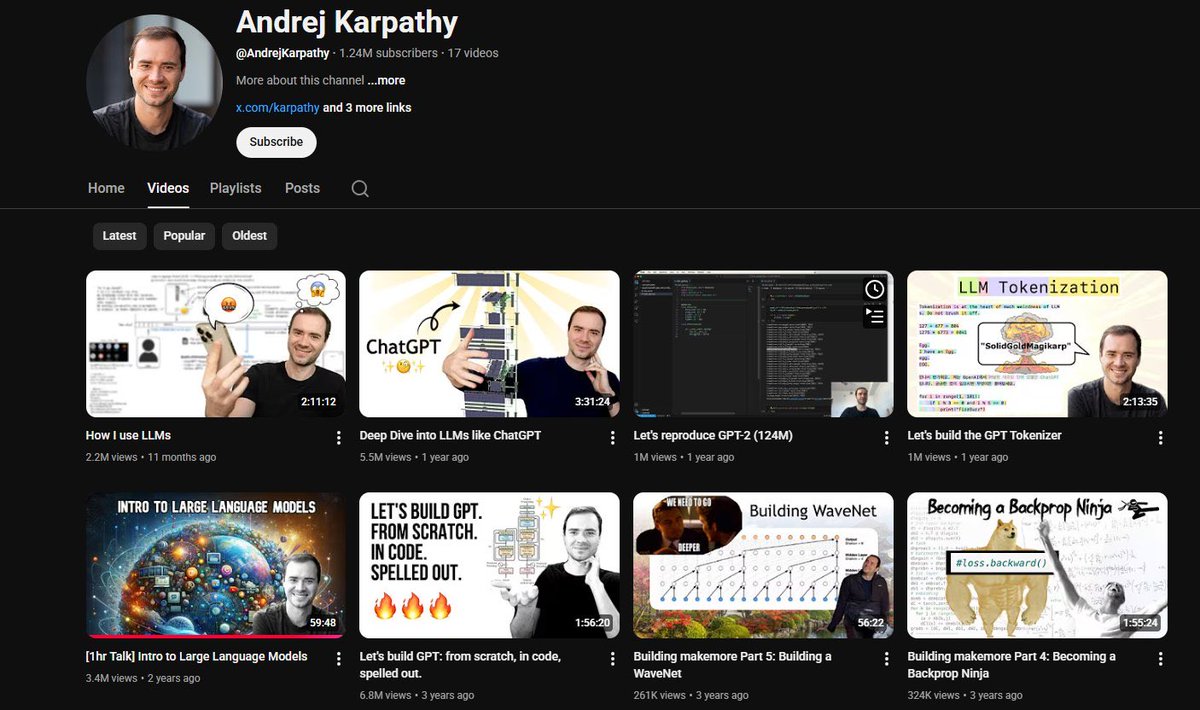
10 YouTube channels that will make you an AI expert:
1. Andrej Karpathy - modern, practical lectures
2. Yannic Kilcher - Breaks down AI papers
3. AI Explained - Makes tough ideas easy to get
4. CodeEmporium - Step-by-step AI coding
5. 3Blue1Brown - Visuals for neural networks
6. Lex Fridman - Interviews with top AI folks
7. CodeEmporium - Step-by-step AI coding
8. sentdex - Python for machine learning
9. DeepLearningAI - Courses from Andrew Ng
10. AI Coffee Break - Weekly updates on AI
Save this list.
4
122
495
23,819
sreesub retweeted

INSTEAD OF WATCHING NETFLIX TONIGHT.
Spend 3 hours with this.
Claude Code FULL COURSE that teaches you how to BUILD apps, teams, and anything.
The people who watch this tonight will wake up tomorrow with a new skill.
Watch it and Bookmark it now.
54
440
2,711
230,264
sreesub retweeted

Apr 10
🚨 ElevenLabs charges $5 to $99/month for AI voice cloning. Their Business plan costs $1,320/month.
Someone open sourced a voice AI that clones any voice from a short clip. 30 languages. Studio quality. Free.
It's called VoxCPM2.
Give it a short clip of anyone's voice. It clones their accent, emotion, tone, and pacing. Then generates any speech you want in their exact voice. 48kHz studio quality.
Type "A young woman, gentle and sweet voice" and it creates that voice from scratch. No reference audio. No voice actor. No recording. You describe a voice in words. It builds it.
2 billion parameters. Trained on 2 million hours of speech. 30 languages.
One command to install: pip install voxcpm
Here's what VoxCPM2 does:
→ Voice Design: describe any voice in words. Gender, age, tone, emotion, pace. AI creates it from nothing. No reference audio needed.
→ Voice Cloning: upload a short audio clip. AI clones the voice perfectly. Timbre, accent, rhythm, pacing.
→ Controllable Cloning: clone a voice AND control the emotion. "Slightly faster, cheerful tone." Done.
→ Ultimate Cloning: provide audio transcript. Every vocal nuance faithfully reproduced.
→ 30 languages. Arabic, Chinese, English, French, German, Hindi, Japanese, Korean, Spanish, and 21 more. No language tags needed.
→ Context-aware. It reads the text and adjusts emotion and rhythm automatically. News sounds like news. Stories sound like stories.
→ Real-time streaming. RTF as low as 0.13 on an RTX 4090. Faster than playback speed.
→ Runs on 8GB of VRAM.
→ Fine-tune with 5 to 10 minutes of your own audio using LoRA. Build a custom voice model.
→ 48kHz output. Studio quality. No external upsampler needed.
Here's the wildest part:
On the Minimax-MLS voice similarity benchmark:
→ English: VoxCPM2 scores 85.4%. ElevenLabs scores 61.3%.
→ Chinese: VoxCPM2 scores 82.5%. ElevenLabs scores 67.7%.
→ Arabic: VoxCPM2 scores 79.1%. ElevenLabs scores 70.6%.
A free, open source model is producing more realistic voice clones than a service that charges up to $1,320/month.
Professional voice actors charge $250 to $1,000 per project. AI voice platforms charge $5 to $100/month. Recording studios charge $200/hour.
This runs on your GPU. Locally. No API costs. No per-character pricing. No subscription. Free forever.
Already hit #1 on GitHub Trending. Built by OpenBMB and Tsinghua University. 2 billion parameters. Apache 2.0 License. Free for commercial use.
100% Open Source.

105
611
4,604
560,703

Learn AI for free directly from top companies
𝟭 - 𝗔𝗻𝘁𝗵𝗿𝗼𝗽𝗶𝗰:
anthropic.skilljar.com/
𝟮 - 𝗚𝗼𝗼𝗴𝗹𝗲:
grow.google/ai
𝟯 - 𝗠𝗲𝘁𝗮:
ai.meta.com/resources/
𝟰 - 𝗡𝗩𝗜𝗗𝗜𝗔:
developer.nvidia.com/cuda
𝟱 - 𝗠𝗶𝗰𝗿𝗼𝘀𝗼𝗳𝘁:
learn.microsoft.com/en-us/tr…
𝟲 - 𝗢𝗽𝗲𝗻𝗔𝗜:
academy.openai.com
𝟳 - 𝗜𝗕𝗠:
skillsbuild.org
𝟴 - 𝗔𝗪𝗦:
skillbuilder.aws
𝟵 - 𝗗𝗲𝗲𝗽𝗟𝗲𝗮𝗿𝗻𝗶𝗻𝗴𝗔𝗜:
deeplearning.ai
𝟭𝟬 - 𝗛𝘂𝗴𝗴𝗶𝗻𝗴 𝗙𝗮𝗰𝗲:
huggingface.co/learn
15
578
1,945
88,539