
I talk about web, mobile, AI, API, and data • Solving peoples problems at @gruckion_inc • Prev @WattUtilities @vitaccess
Joined September 2022
- Tweets 5,172
- Following 2,322
- Followers 453
- Likes 9,440
323 Photos and videos




Pinned Tweet
Hit the recursion wall in Claude Code? 🧱
✅ Unlimited nesting depth for sub agents
✅ Fresh 200k context window per task
✅ Full tool access for sub-agents
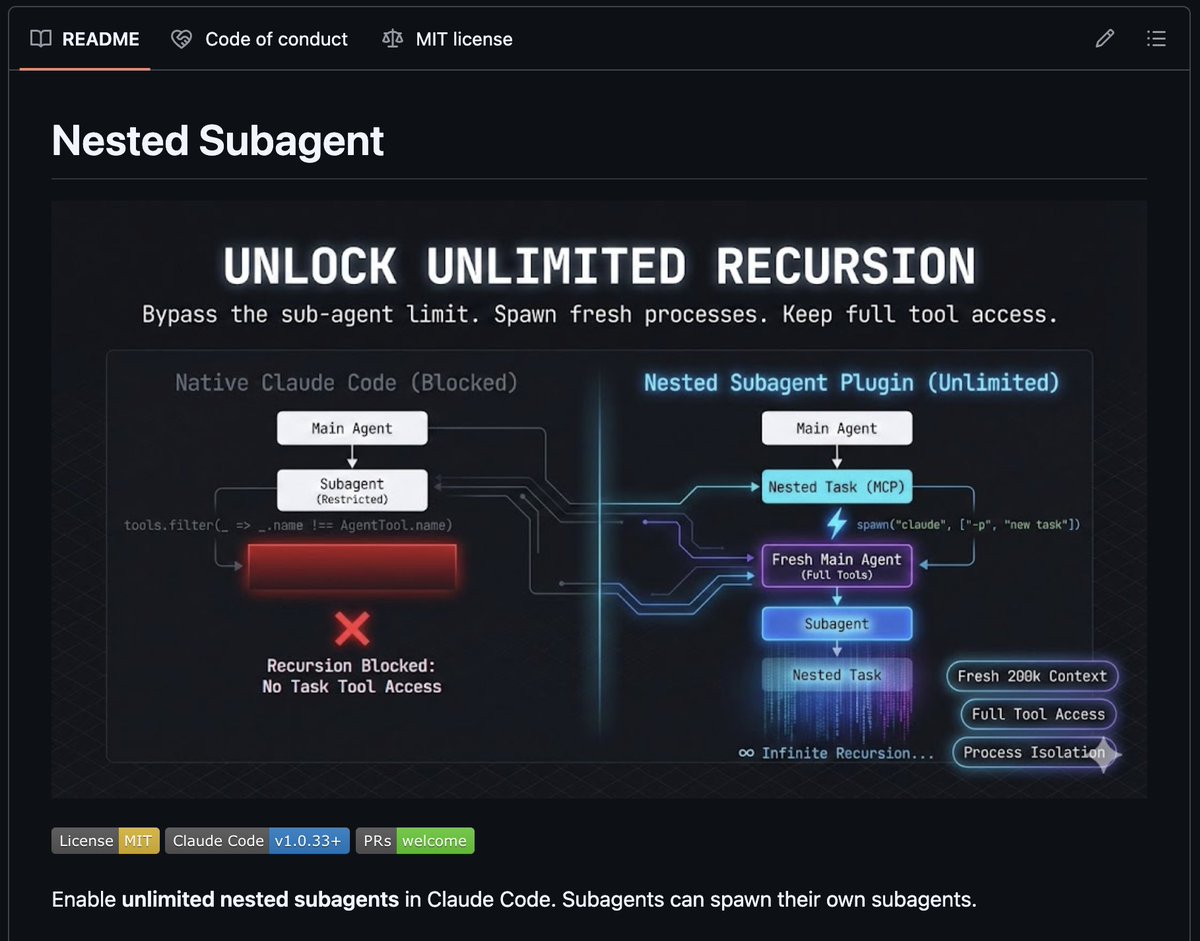
Native sub-agents are blocked from hiring their own sub-agents because the Task tool is filtered out.
Break through the limit with the Nested Subagent Plugin.
It bypasses the restriction by spawning fresh claude -p processes for every nested task. Each new process acts as a "Main Agent" with full tool access—allowing it to spawn its own agents infinitely.
Just add "via a nested subagent" to your prompt to start a recursive workflow.
Grab it on GitHub 👇
[Link to repo]
#ClaudeCode #AIagents #LLM #DevTools #AutonomousAgents
1
2
677
Stephen Rayner retweeted

May 21
Most devs don't realize their GitHub can do THIS 👇
Yes, GitHub renders animations in READMEs.
Drop your favorite GitHub repo that needs some animation love! We'll animate them.
60
86
878
715,174
Stephen Rayner retweeted

Mar 10
It took me some time, but my article “Breaking Down the Jelly Slider” is officially out.
medium.com/swmansion/breakin…
I hope it can demystify how to approach building such a weird thing and serve as a starting point for learning some low level graphics programming techniques :D
3 Nov 2025

Ever since I first saw this I wanted to try implementing it in TypeGPU, and I finally got around to it while testing the new 0.8 release.
You can try out the Jelly Slider here:
docs.swmansion.com/TypeGPU/e…
Had a lot of fun brainstorming optimisations with @iwoplaza and the team, and it should run well on most modern devices.
Built entirely with TypeGPU, no extra libraries, with all shaders written in TypeScript. The prototyping speed with features like console.log on the GPU and “bindless” resources made the process really smooth.
14
62
845
69,379
Stephen Rayner retweeted

May 16
8. Ennio is fully open source every contribution is highly appreciated!
github.com/enzomanuelmangano…
5
3
62
2,671
Stephen Rayner retweeted

May 17
Its already free and OSS, here's the video:
youtu.be/kbAbPwx2068
And the skill repo:
github.com/AlemTuzlak/skills
1
2
14
416
Stephen Rayner retweeted

⚛️ React: we have Concurrent Features
🤡 GitHub:
44
62
2,518
334,247
Stephen Rayner retweeted
May 16
I've been recently experimenting with a new way to run e2e flows in React Native. Same maestro e2e test, same yaml, but 2-3x faster.
learn about Ennio 🧵
25
42
559
58,874
Stephen Rayner retweeted

Most dashboards show data.
This one feels alive.
40
80
1,542
132,542
Stephen Rayner retweeted

May 12
As a follow-up to this
I'm considering disabling PR creation from outside contributors on repos I maintain until we have better answers for the constant stream of supply chain and security incidents hitting the ecosystem
Instead, I want to invest in automation that properly credits issue authors whose work leads to merged changes
Keeping the people and companies who depend on these projects safe is my P0
Apr 28

Dear GitHub,
AI is changing the contribution graph.
Issues are often the real contribution now. They define the problem, shape the solution and guide the PR.
If a GitHub Issue leads to a merged PR, the issue author should get contributor credit.
Signed,
ctate
23
8
288
32,945
Stephen Rayner retweeted

May 11
This is crazy. The hacker installed a dead-man's switch that will wipe your computer if you revoke the GitHub token they stole from you. Revoking the token is what triggers the wipe.

May 11

SECURITY ADVISORY — TanStack npm packages
A supply-chain compromise affecting 42 @tanstack/* packages (84 versions total) was published to npm earlier today at approximately 19:20 and 19:26 UTC. Two malicious versions per package.
Status: ACTIVE — packages are deprecated, npm security engaged, publish path being shut down.
Severity: HIGH — payload exfiltrates AWS, GCP, Kubernetes, and Vault credentials, GitHub tokens, .npmrc contents, and SSH keys.
If you installed any @tanstack/* package between 19:20 and 19:30 UTC today, treat the host as potentially compromised:
• Rotate cloud, GitHub, and SSH credentials immediately
• Audit cloud audit logs for the last several hours
• Pin to a prior known-good version and reinstall from a clean lockfile
Detection — the malicious manifest contains:
"optionalDependencies": {
"@tanstack/setup": "github:tanstack/router#79ac49ee..."
}
Any version with this entry is compromised. The payload is delivered via a git-resolved optionalDependency whose prepare script runs router_init.js (~2.3 MB, smuggled into each tarball at the package root).
Unpublish is blocked by npm policy for most affected packages due to existing third-party dependents. All 84 versions are being deprecated with a SECURITY warning, and npm security has been engaged to pull tarballs at the registry level.
Full technical breakdown, complete package and version list, and rolling status updates:
github.com/TanStack/router/i…
Credit to the security researcher for responsible disclosure.
145
991
9,496
1,719,711
Stephen Rayner retweeted

May 6
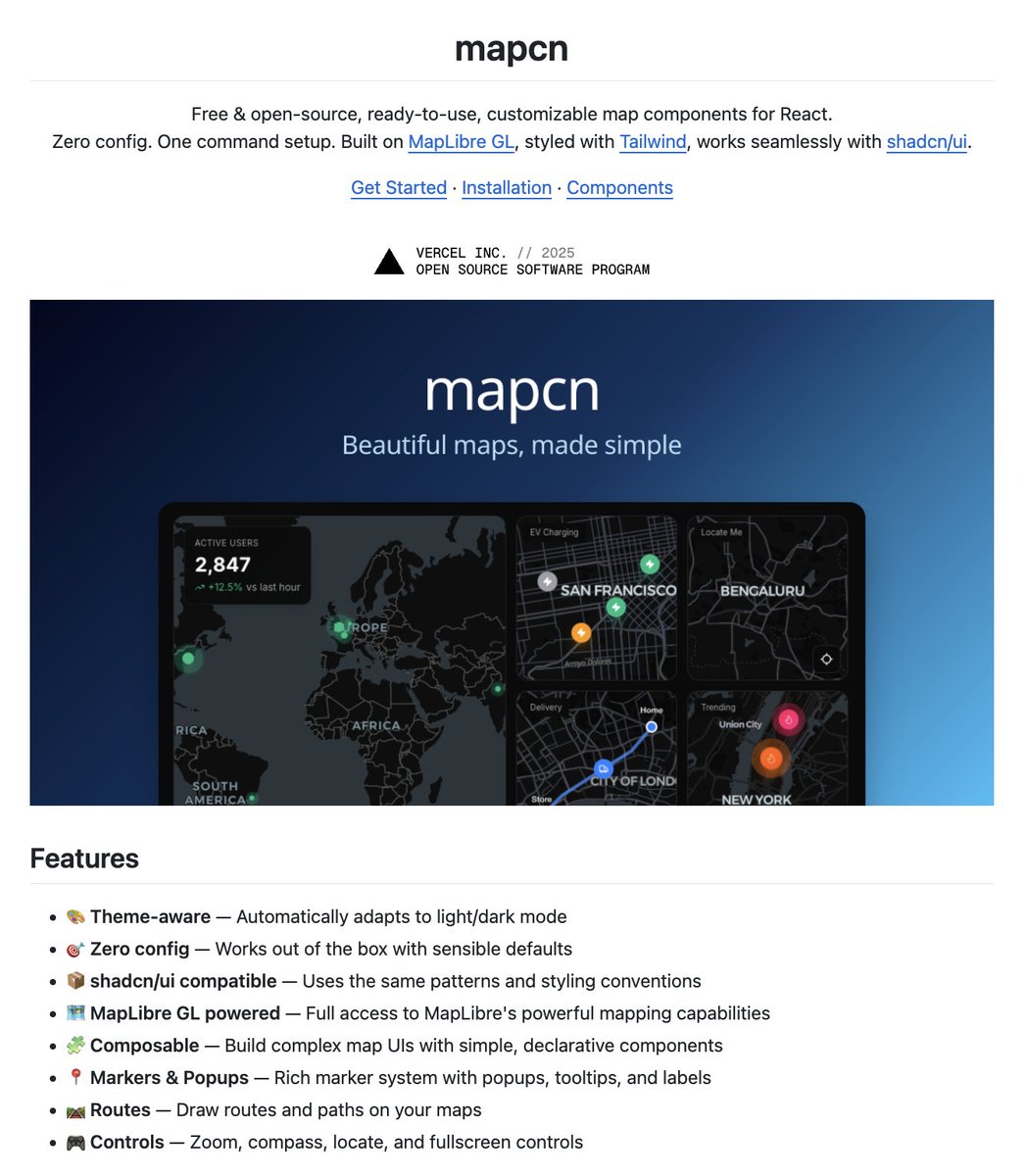
Someone just built shadcn for maps.
It's called mapcn. Beautiful, ready-to-use map components for React with zero config and one command setup.
100% Open Source. 7k stars. MIT.
4
51
384
18,770
Stephen Rayner retweeted

Apr 17
Opus 4.7 can build Lottie Animations.
One prompt via Lottie Creator MCP → 500 particles, each with its own path, easing, and arrival frame. I didn't touch a keyframe.
What should I ask it to build next? Best reply, I'll make it.
73
128
2,009
186,346
Stephen Rayner retweeted

Apr 17
Anthropic.
OpenAI.
Gemini.
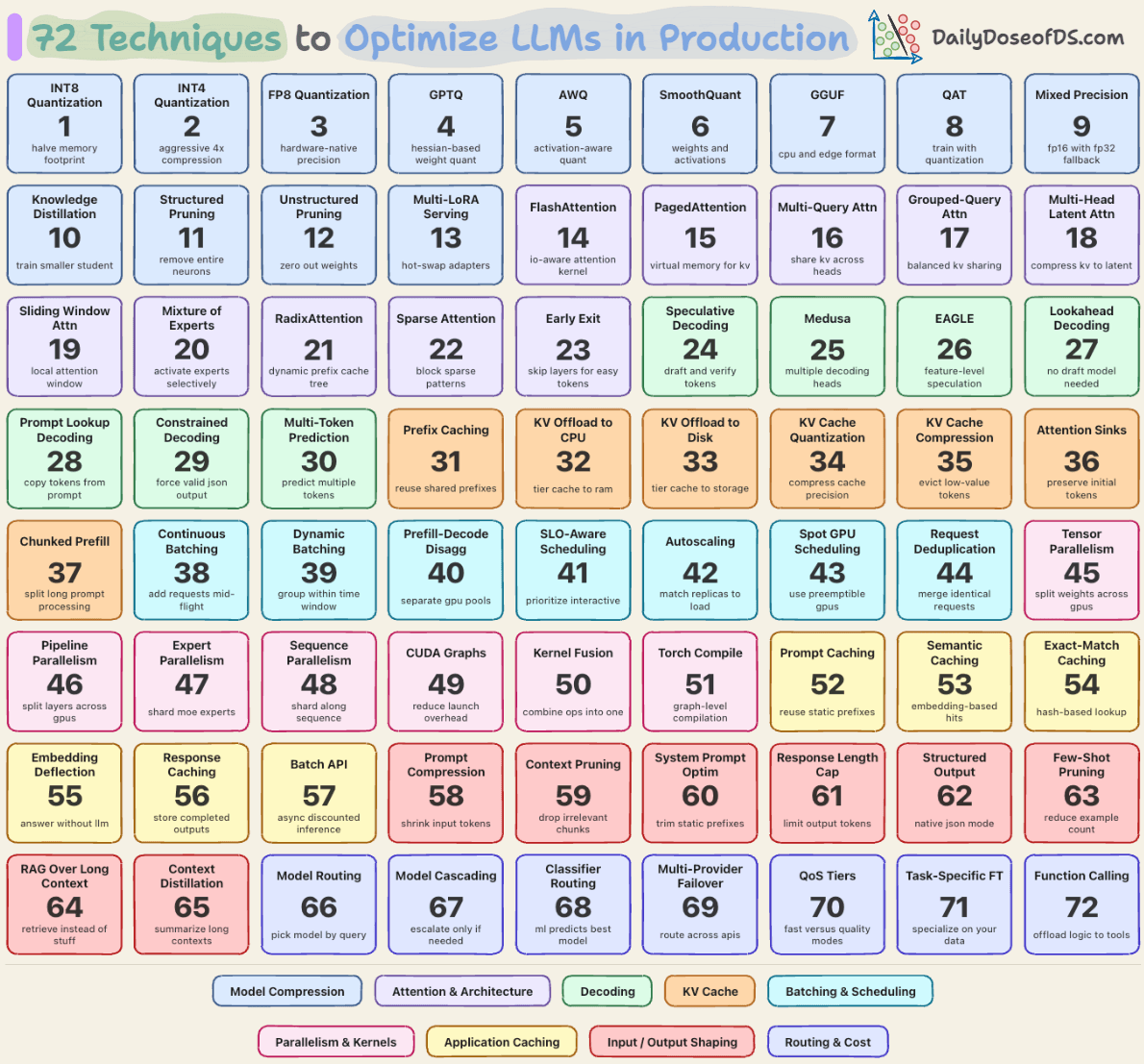
Every production LLM runs on a stack of optimizations, not a single trick.
I mapped out 72 of them across the full serving pipeline, grouped into 9 layers, from INT4 quantization at the weights all the way to model cascading at the application edge.
Building this grid surfaced something interesting about how the optimization surface has changed over the last three years.
In 2023, most of the engineering effort went into the model itself. GPTQ and AWQ for weight quantization.
- SmoothQuant for activations.
- Distillation and pruning to shrink parameter counts.
- FlashAttention to fix the attention kernel.
If you wanted your deployment to get cheaper or faster, you looked inside the model.
That work is still foundational, and the techniques still ship in every production stack.
But the frontier has moved.
In 2026, the biggest cost and latency wins are coming from the layers around the model, not the model itself.
- Continuous batching with PagedAttention keeps the GPU saturated.
- Prefill-decode disaggregation splits the two inference phases onto separate pools so they stop interfering with each other.
- Chunked prefill interleaves work on long prompts.
- KV cache quantization and token eviction methods like SnapKV and H2O free up memory for larger batches.
And one layer up from that, at the application edge, there is a cluster of techniques that is producing the largest per-dollar improvements in serving cost.
- Prompt caching
- Semantic caching
- Prefix reuse
- Context pruning
- Prompt compression
These are not model optimizations but rather decisions about what tokens ever reach the model in the first place.
Consider prompt caching. On long static prompts, Anthropic's own benchmarks show up to 90% cost reduction and 85% latency reduction.
The technique simply reuses the KV state for the parts of the prompt that are identical across requests.
The mechanism sounds trivial.
In practice, the production behavior is subtle. Cache entries get invalidated by things most teams do not think about, like:
- Timestamps in a system prompt
- Tool definitions reordered by a JSON serializer.
- Or any small change to a few-shot example that breaks the prefix hash.
I wrote a full breakdown of prompt caching below, covering how it works under the hood, the failure modes that silently destroy hit rates in production, and what the actual KV reuse mechanism looks like at the provider level.
The grid below shows you the full map of 72 techniques. The article goes deep on one of them.
👉 Over to you: What LLM optimization techniques have I missed here?

17
60
244
33,083
Stephen Rayner retweeted

Apr 17
We have a big open source launch for you today.
Announcing React Email 6.0.
For a long time, people asked me for a way to include an email editor into their app. So we decided to open source our own editor.
- Embed in your app
- Style with your brand
- Build custom extensions
67
93
1,755
133,742

Apr 18
I have been wanting an SVG generator for some time. This looks really cool.

24
Stephen Rayner retweeted

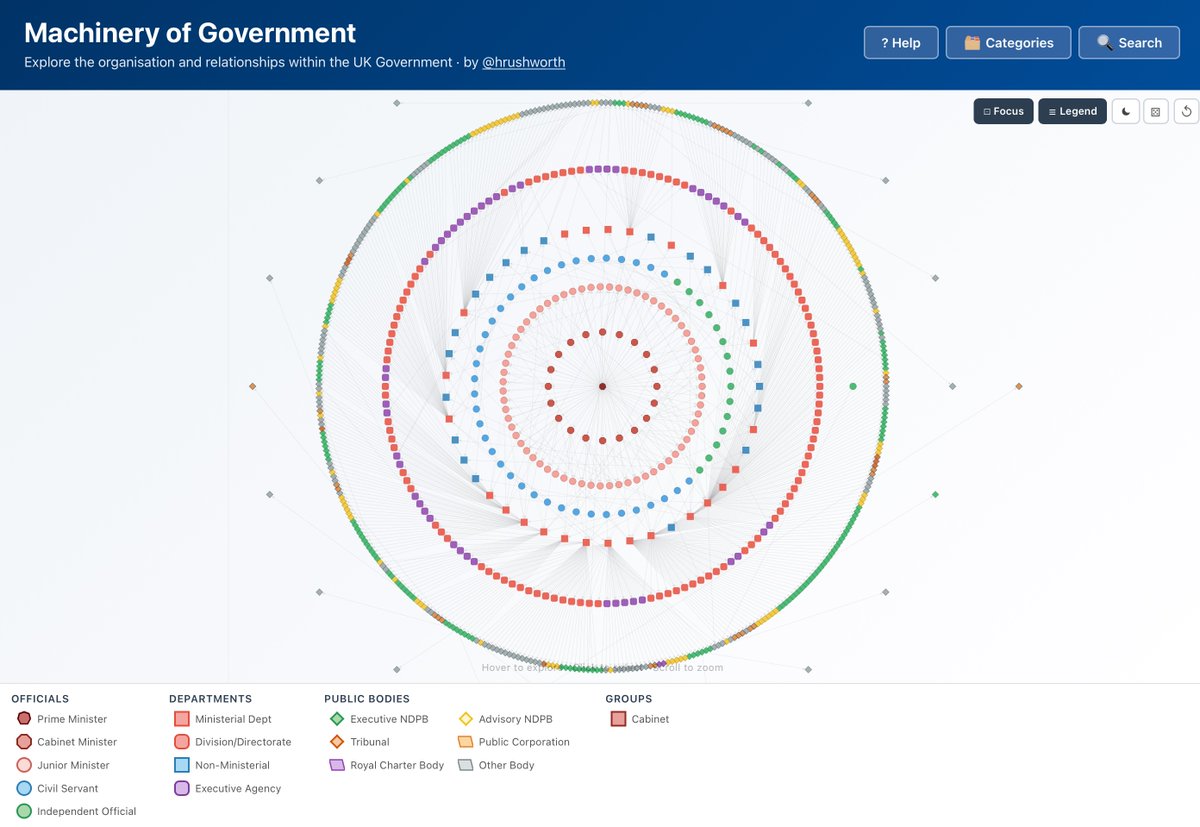
The British Government is a complicated beast. Dozens of departments, hundreds of public bodies, more corporations than one can count...
Such is its complexity that there isn't an org chart for it.
Well, there wasn't...
Introducing ⚙️Machinery of Government⚙️
100
426
2,924
1,114,789
Stephen Rayner retweeted

Mar 26
Introducing Chroma Context-1, a 20B parameter search agent.
> pushes the pareto frontier of agentic search
> order of magnitude faster
> order of magnitude cheaper
> Apache 2.0, open-source
141
403
4,175
1,108,270

This AI whistleblower just EXPOSED Sam Altman for manipulating his way into becoming OpenAI’s CEO.
Everyone who helped him build it has left because they felt used.
Karen Hao interviewed 300 people including 90 current and former OpenAI employees.
And she just told Steven Bartlett what she discovered:
In 2015, Altman needed Elon Musk to co-found OpenAI. Problem was, Musk was obsessed with AI as an existential threat.
So Altman wrote a blog post calling AI "probably the greatest threat to the continued existence of humanity."
Before that blog post? Altman's biggest fear was engineered viruses. Not AI.
He literally rewrote his worldview overnight to mirror Musk's language word for word. Musk bought in. Donated millions. Co-founded the company.
Then Altman stabbed him in the back.
When OpenAI needed a CEO for its new for-profit arm, the co-founders Ilia Sutskever and Greg Brockman initially chose Musk.
Altman went directly to Brockman, a personal friend, and said: "Do we really want someone this erratic and unpredictable to control a technology that could be super powerful?"
Brockman flipped. Then convinced Ilia to flip.
Musk found out he wasn't getting the role and left.
That's how the biggest rivalry in tech actually started. Not over ideology... Over a backroom power play.
But here's where it gets darker:
Every single person who built OpenAI alongside Altman eventually felt the same thing Musk felt. Used. Manipulated. Discarded.
Dario Amodei, VP of Research, thought Altman shared his vision. Over time he realized Altman was on "exactly the opposite page" and had used his intelligence to build things he fundamentally disagreed with. He left and founded Anthropic.
Ilia Sutskever, co-founder and chief scientist, tried to get Altman fired. He told colleagues: "I don't think Sam is the guy who should have the finger on the button for AGI." He was pushed outounded Safe Super Intelligence. That name alone tells you everything.
Mira Murati, CTO, left and started Thinking Machines Lab.
No other tech company in history has had every single co-builder leave and start a direct competitor.
Not Google. Not Meta. Not Apple. NOBODY.
300 interviews exposed one consistent pattern:
If you align with Altman's vision, you think he's the Steve Jobs of AI. If you don't, you feel like you were manipulated by someone who will say whatever is needed to whoever is listening.
When talking to Congress? AGI will cure cancer and solve poverty.
When talking to consumers? It's the best digital assistant you'll ever have.
When talking to Microsoft? AGI is a system that generates $100 billion in revenue.
Three completely different definitions of the same technology sold to three completely different audiences.
And if you publicly disagree with any of it?
OpenAI subpoenaed 7 nonprofit organizations that criticized them. Sent a sheriff to a 29yo nonprofit lawyer's door during dinner demanding every text, email, and document he'd ever sent about OpenAI.
A one-man watchdog nonprofit got papers demanding all communications with anyone who questioned the company.
OpenAI's own head of mission alignment publicly said "this doesn't seem great." That's the guy whose literal job is making sure OpenAI BENEFITS humanity.
Former employees who spoke up about secret non-disparagement clauses that threatened to strip their equity described the psychological pressure as "crushing."
This is the company that tells us it's building technology "for the benefit of humanity."
Same company that mirrors whatever language gets them funded.
Same company where every builder eventually walks away feeling deceived.
Same company sending law enforcement to silence critics.
The biggest AI company on Earth wasn't built on technology.
It was built on one man's ability to tell everyone exactly what they needed to hear.
And the scariest part is that it worked.
166
755
4,569
382,813
Stephen Rayner retweeted

Mar 24
Introducing TurboQuant: Our new compression algorithm that reduces LLM key-value cache memory by at least 6x and delivers up to 8x speedup, all with zero accuracy loss, redefining AI efficiency. Read the blog to learn how it achieves these results: goo.gle/4bsq2qI
1,007
5,711
38,820
19,381,255
Stephen Rayner retweeted

Mar 24
Software horror: litellm PyPI supply chain attack.
Simple `pip install litellm` was enough to exfiltrate SSH keys, AWS/GCP/Azure creds, Kubernetes configs, git credentials, env vars (all your API keys), shell history, crypto wallets, SSL private keys, CI/CD secrets, database passwords.
LiteLLM itself has 97 million downloads per month which is already terrible, but much worse, the contagion spreads to any project that depends on litellm. For example, if you did `pip install dspy` (which depended on litellm>=1.64.0), you'd also be pwnd. Same for any other large project that depended on litellm.
Afaict the poisoned version was up for only less than ~1 hour. The attack had a bug which led to its discovery - Callum McMahon was using an MCP plugin inside Cursor that pulled in litellm as a transitive dependency. When litellm 1.82.8 installed, their machine ran out of RAM and crashed. So if the attacker didn't vibe code this attack it could have been undetected for many days or weeks.
Supply chain attacks like this are basically the scariest thing imaginable in modern software. Every time you install any depedency you could be pulling in a poisoned package anywhere deep inside its entire depedency tree. This is especially risky with large projects that might have lots and lots of dependencies. The credentials that do get stolen in each attack can then be used to take over more accounts and compromise more packages.
Classical software engineering would have you believe that dependencies are good (we're building pyramids from bricks), but imo this has to be re-evaluated, and it's why I've been so growingly averse to them, preferring to use LLMs to "yoink" functionality when it's simple enough and possible.
Mar 24

LiteLLM HAS BEEN COMPROMISED, DO NOT UPDATE. We just discovered that LiteLLM pypi release 1.82.8. It has been compromised, it contains litellm_init.pth with base64 encoded instructions to send all the credentials it can find to remote server self-replicate. link below
1,352
5,309
27,823
66,583,500
Stephen Rayner retweeted

Mar 16
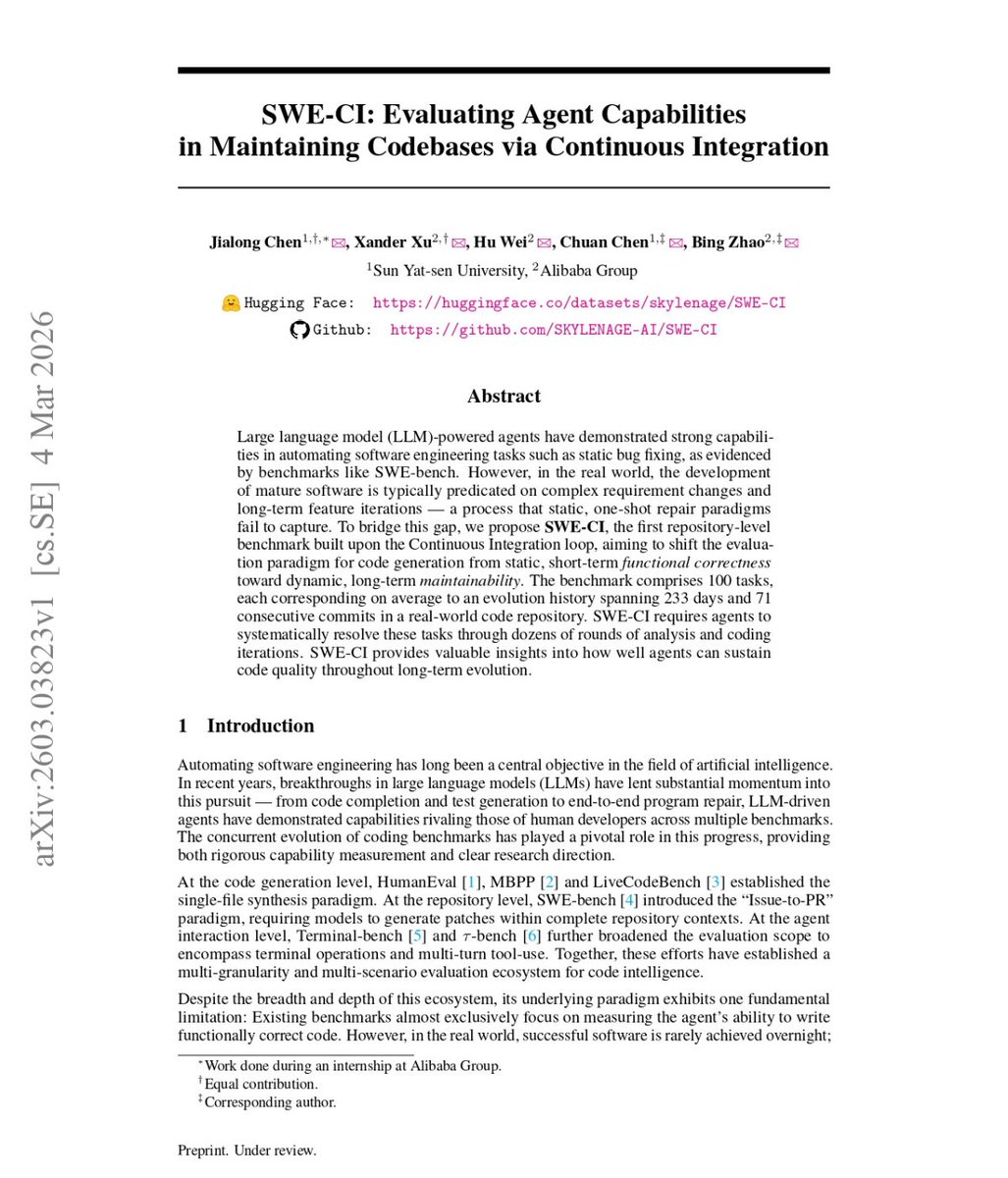
🤯BREAKING: Alibaba just proved that AI Coding isn't taking your job, it's just writing the legacy code that will keep you employed fixing it for the next decade. 🤣
Passing a coding test once is easy. Maintaining that code for 8 months without it exploding? Apparently, it’s nearly impossible for AI.
Alibaba tested 18 AI agents on 100 real codebases over 233-day cycles. They didn't just look for "quick fixes"—they looked for long-term survival.
The results were a bloodbath:
75% of models broke previously working code during maintenance.
Only Claude Opus 4.5/4.6 maintained a >50% zero-regression rate.
Every other model accumulated technical debt that compounded until the codebase collapsed.
We’ve been using "snapshot" benchmarks like HumanEval that only ask "Does it work right now?"
The new SWE-CI benchmark asks: "Does it still work after 8 months of evolution?"
Most AI agents are "Quick-Fix Artists." They write brittle code that passes tests today but becomes a maintenance nightmare tomorrow. They aren't building software; they're building a house of cards.
The narrative just got honest: Most models can write code. Almost none can maintain it.
485
1,837
9,267
1,710,148