
Exciting to be in the Tech Ecosystem - as Country General Manager @supermicro , but views personal. Ex @HCLTech, @intel @IIM_Calcutta
Joined November 2009
- Tweets 11,818
- Following 676
- Followers 1,751
- Likes 12,317
1,184 Photos and videos




Suresh T Kumar retweeted

They said cockroaches will never come on the ground…
4,171
13,530
66,366
1,719,073
Suresh T Kumar retweeted

May 29
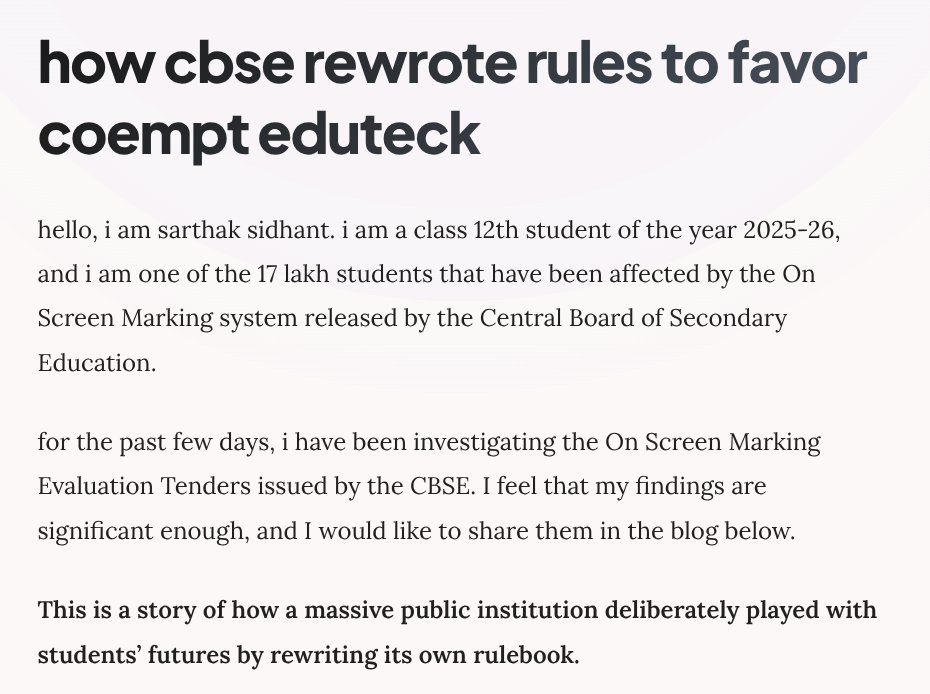
CBSE has systematically rewritten its rulebook to favor Coempt Eduteck.
check out the blog.
559
7,291
19,464
2,381,347
Suresh T Kumar retweeted

May 23
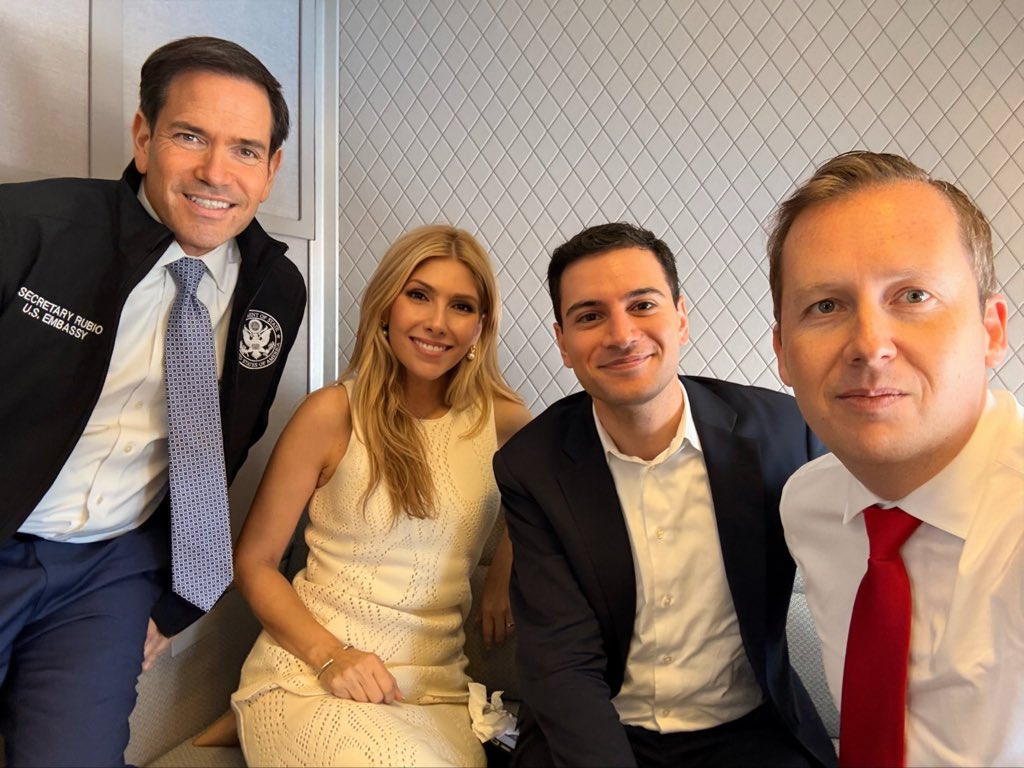
In the air to Delhi!
478
386
7,537
531,750
Suresh T Kumar retweeted

May 20
Did you make paper airplanes in your class?
Now there is a machine for this that can mass-produce paper airplanes. In fact, the whole paper air force is here!
Credit: Unknown, ViaWeb
1
3
13
601
Suresh T Kumar retweeted

May 12
I just spent a day out in Delhi, and took a Metro ride booked right through the @Uber app. With more than 10 million metro rides booked on Uber in India, it’s clear that commuters love it. If you haven’t tried it yet, here is another nudge why you should give it a try.

138
107
1,745
102,458
Suresh T Kumar retweeted

Apr 29
Just wrapped our quarterly earnings call.
We are focused on delivering AI infrastructure and solutions that empower every business to eval-max their outcomes in this agentic computing era.
Our AI business surpassed a $37 billion annual revenue run rate, up 123%.
We are at the beginning of one of the most consequential platform shifts that will change the entire tech stack as we move from end-user driven workloads to workloads driven by end-users and agents.
This will drive TAM expansion and change the value creation equation across the entire economy.
To capture this opportunity, we are executing against two major priorities:
374
291
3,897
471,866
Suresh T Kumar retweeted

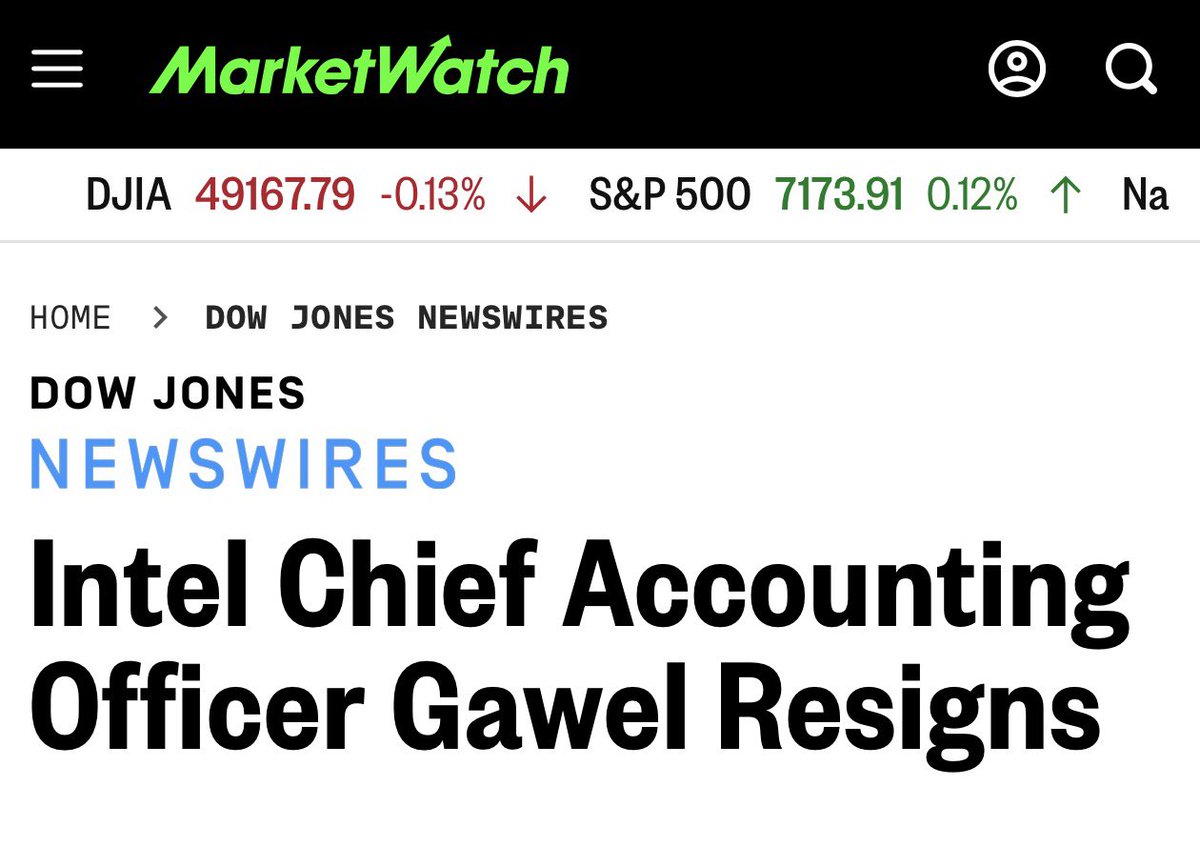
$INTC Chief Accounting Officer “Resigns” abruptly after they reported earnings and after we exposed their accounting red flags in the report below!
coastaljournal.substack.com/…
59
193
1,028
302,440
Suresh T Kumar retweeted

Apr 10
Interview with an $INTC employee on why agentic AI is creating a new layer of CPU demand ( $NVDA, $AMD, $TSM ):
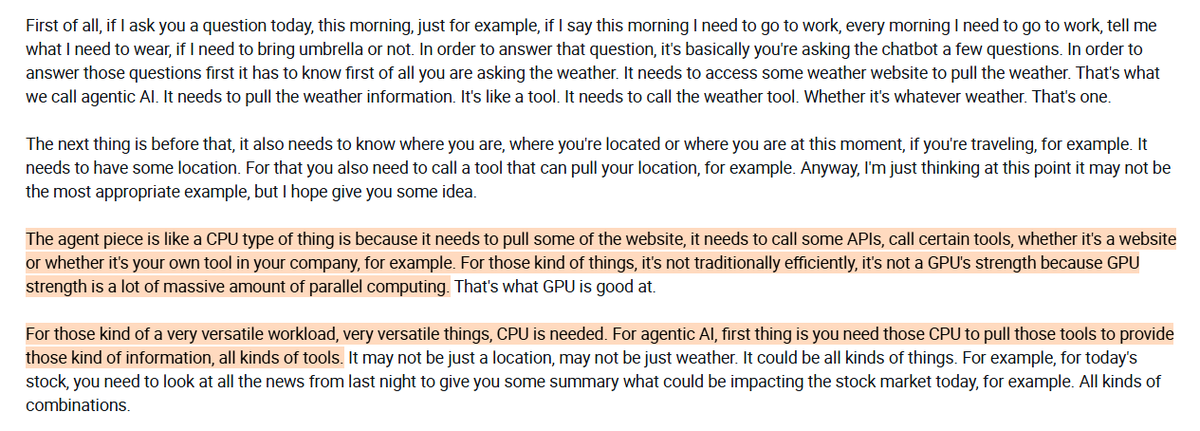
- The expert sees agentic AI as a meaningful driver of CPU demand growth beyond that required by traditional LLM inference. Where standard deployments use CPUs primarily to manage GPU tasks, agentic architectures introduce an entirely new layer of CPU-intensive work, encompassing agent orchestration, tool calls, and API interactions. As agentic adoption scales, the expert expects this to shift data center configurations meaningfully toward more CPU capacity relative to GPUs.
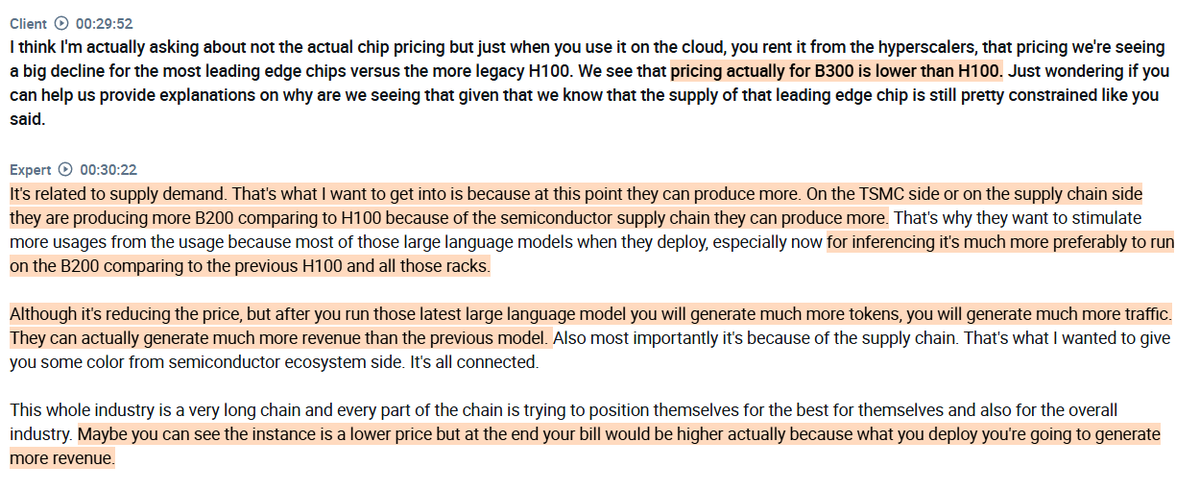
- The expert explains that the lower pricing for B200 and B300 relative to H100 is primarily a supply-side dynamic. As the supply chain matures around newer architectures, $TSM and the broader ecosystem can produce Blackwell chips at greater volumes than they could for H100, enabling hyperscalers to lower per-instance prices to stimulate adoption.
- The more important point the expert makes is that lower instance pricing does not mean lower bills. Running the latest models on newer hardware generates significantly more tokens and traffic per session, meaning overall customer spend actually increases even as the headline rental rate comes down. The expert sees this as a deliberate strategy across the supply chain, in which every player is positioning itself to grow the overall revenue pool rather than simply competing on price.
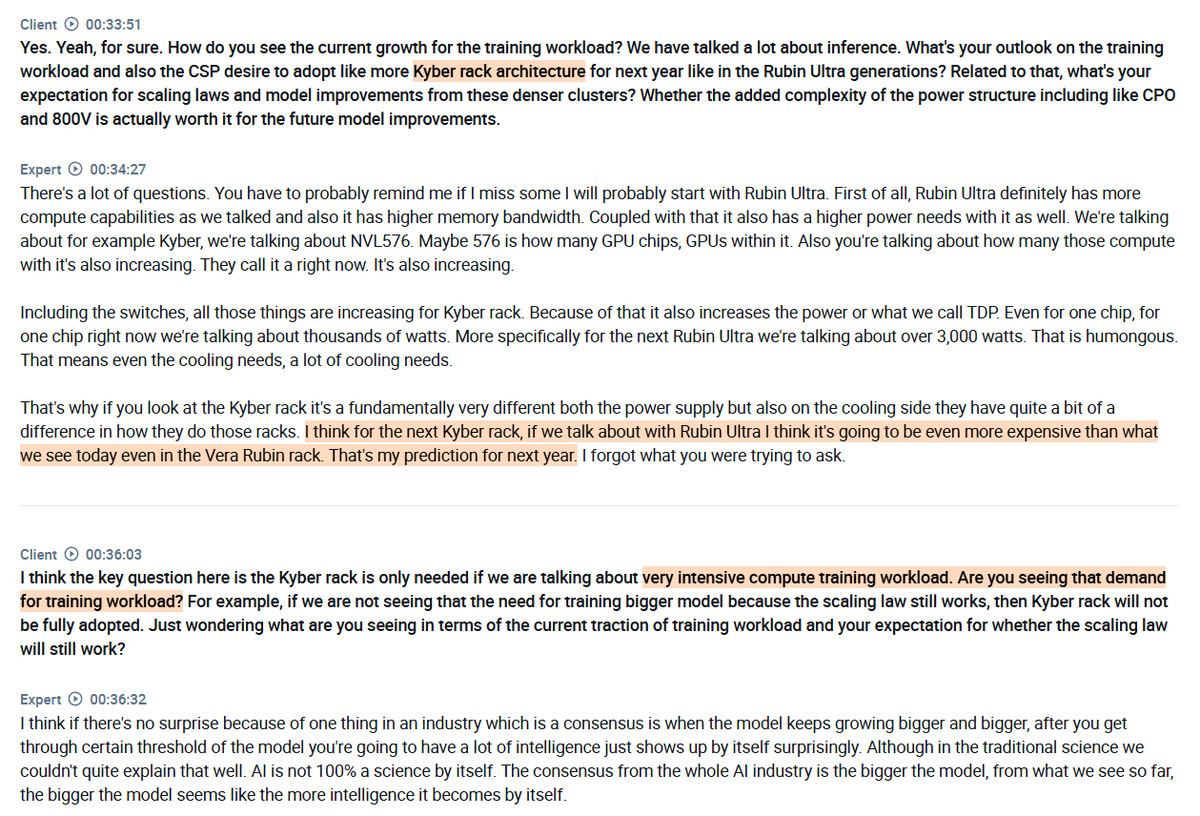
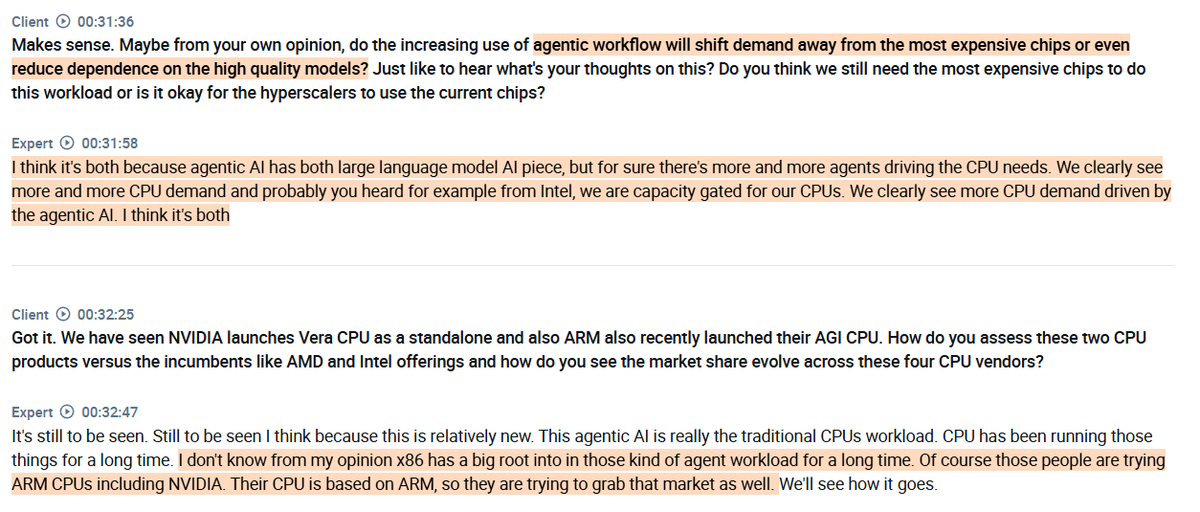
- The expert sees agentic AI driving demand for both high-end GPUs and CPUs rather than shifting away from one toward the other. The LLM component of agentic workflows still requires the most capable chips, while the orchestration and tool-calling layer is driving a clear and growing increase in CPU demand, something $INTC has already flagged by noting it is capacity constrained on CPUs.
- On the competitive landscape for CPUs, the expert sees the outcome as still too early to call. x86 from $INTC and $AMD has deep roots in the kinds of orchestration workloads that agentic AI demands, having handled similar tasks for years. $NVDA's Vera CPU and $ARM's recent AGI chip are making a push into this space, but the expert expects the established ecosystem advantages of $INTC and $AMD to be difficult to displace quickly.
- The expert expects training workloads to continue growing in intensity, driven by the industry's broad consensus that larger models consistently produce more capable and intelligent outputs, even in ways that cannot always be fully explained. This emergent intelligence from scale is what continues to justify investment in increasingly dense and powerful cluster architectures like the $NVDA's Kyber rack.
4
51
249
54,565
Suresh T Kumar retweeted

Mar 31
The timeline on this is genuinely insane.
October 2025: Sam Altman flies to Seoul and signs simultaneous deals with Samsung and SK Hynix for 900,000 DRAM wafers per month. That's 40% of global supply. Neither company knew the other was signing a near-identical commitment at the same time.
Those deals were letters of intent. Non-binding. No RAM actually changed hands. But the market treated them as gospel. Contract DRAM prices jumped 171%. A 64GB DDR5 kit went from $190 to $700 in three months.
December 2025: Micron kills Crucial, its 29-year-old consumer memory brand, to reallocate every wafer to AI and enterprise customers. The company explicitly said it was exiting consumer memory to "improve supply and support for our larger, strategic customers in faster-growing segments." Translation: the AI demand signal was so loud that selling RAM to PC builders stopped making financial sense.
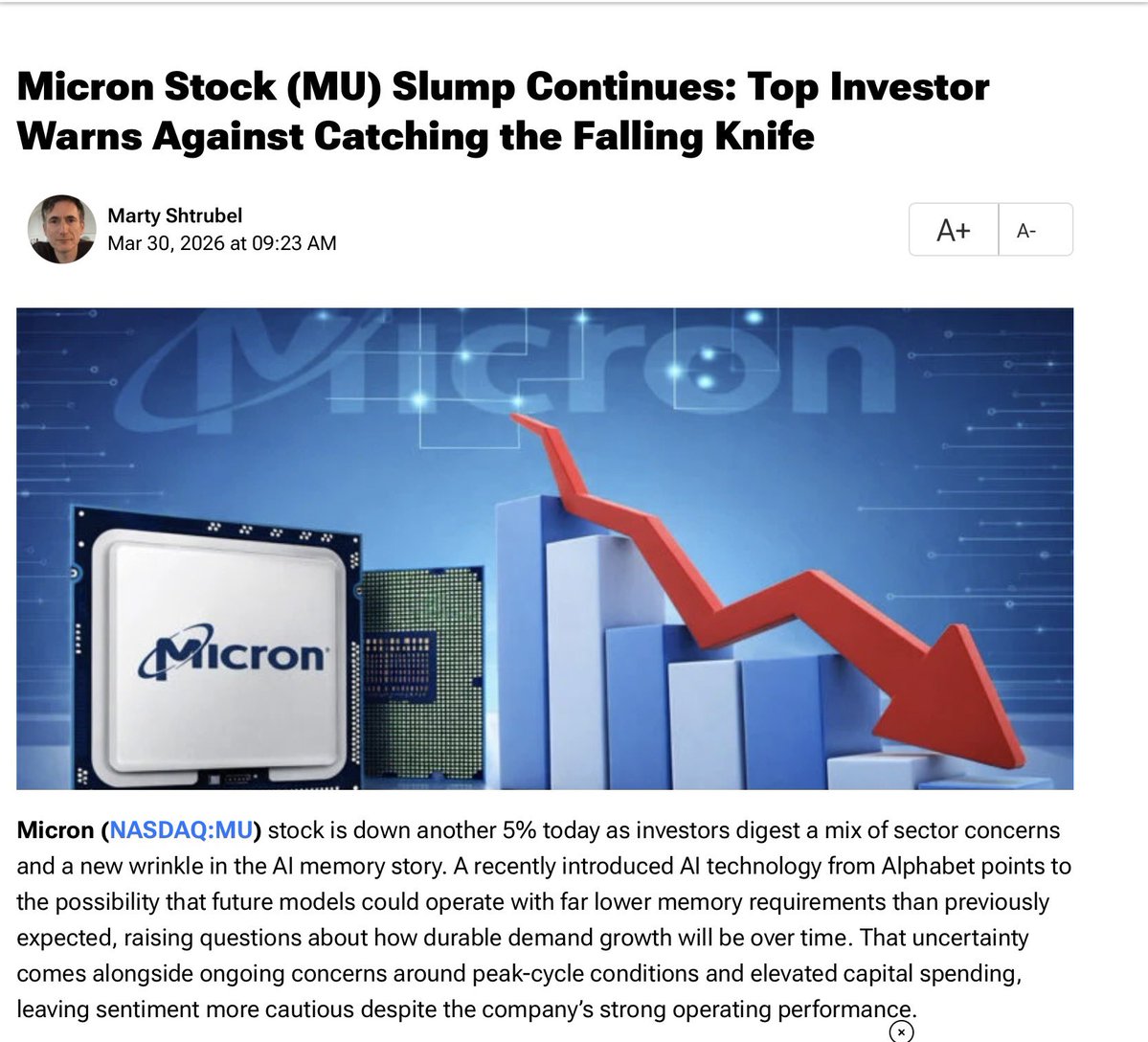
March 2026: Google publishes TurboQuant, a compression algorithm that reduces AI memory requirements by 6x with zero accuracy loss. Cloudflare's CEO called it "Google's DeepSeek." The entire thesis that AI would consume infinite memory forever just got a six-month expiration date on it.
Same month: OpenAI and Oracle cancel the Abilene Stargate expansion. The $500 billion data center vision that justified the RAM deals couldn't survive its own financing terms. Bloomberg attributed the collapse partly to OpenAI's "often-changing demand forecasting."
MU is now down ~33% from its post-earnings high. Revenue up 196% year over year, EPS up 682%, and the stock is in freefall because the company restructured its entire business around a demand signal that came from non-binding letters and is now being compressed out of existence by a research paper.
Micron bet the consumer division on Sam Altman's signature. The signature was worth exactly what the paper said: nothing binding.

Imagine closing your entire consumer memory division because this guy signed a non binding letter that he would buy 40% of the world’s RAM.
Only to have him rug pull 3 months later.

253
1,750
13,917
1,645,053

Suresh T Kumar retweeted

Feb 16
Zettascale India is no longer just a vision. It’s becoming reality.
Back in 2020, I gave a talk laying out why India must build sovereign AI compute infrastructure at zettascale.
🎬 Watch my FICCI talk here: youtu.be/nd-EFhFlAr8?si=deZA…
Fast forward to today: AM Green Group has announced a $25 billion, 1 GW AI compute hub in Greater Noida. One of the largest AI infrastructure investments in India’s history. The facility will house nearly 500,000 high-performance chipsets and run entirely on 24/7 carbon-free energy from solar, wind, and pumped storage.
I’m proud to serve as an advisor to this effort.
This is a bold and necessary ambition. But announcing it is only the beginning. The real work lies ahead: building the supply chains, attracting and developing talent, executing on the engineering, and delivering on the sustainability promise. There is a lot to do to turn this vision into reality.
Phase 1 targets 2028. Full capacity by 2030. The commitment is there. Now it’s about relentless execution.
Let’s build it right.
livemint.com/ai/am-group-25-…
Will be at India AI Impact summit in Delhi this week
3
12
65
8,198
Suresh T Kumar retweeted

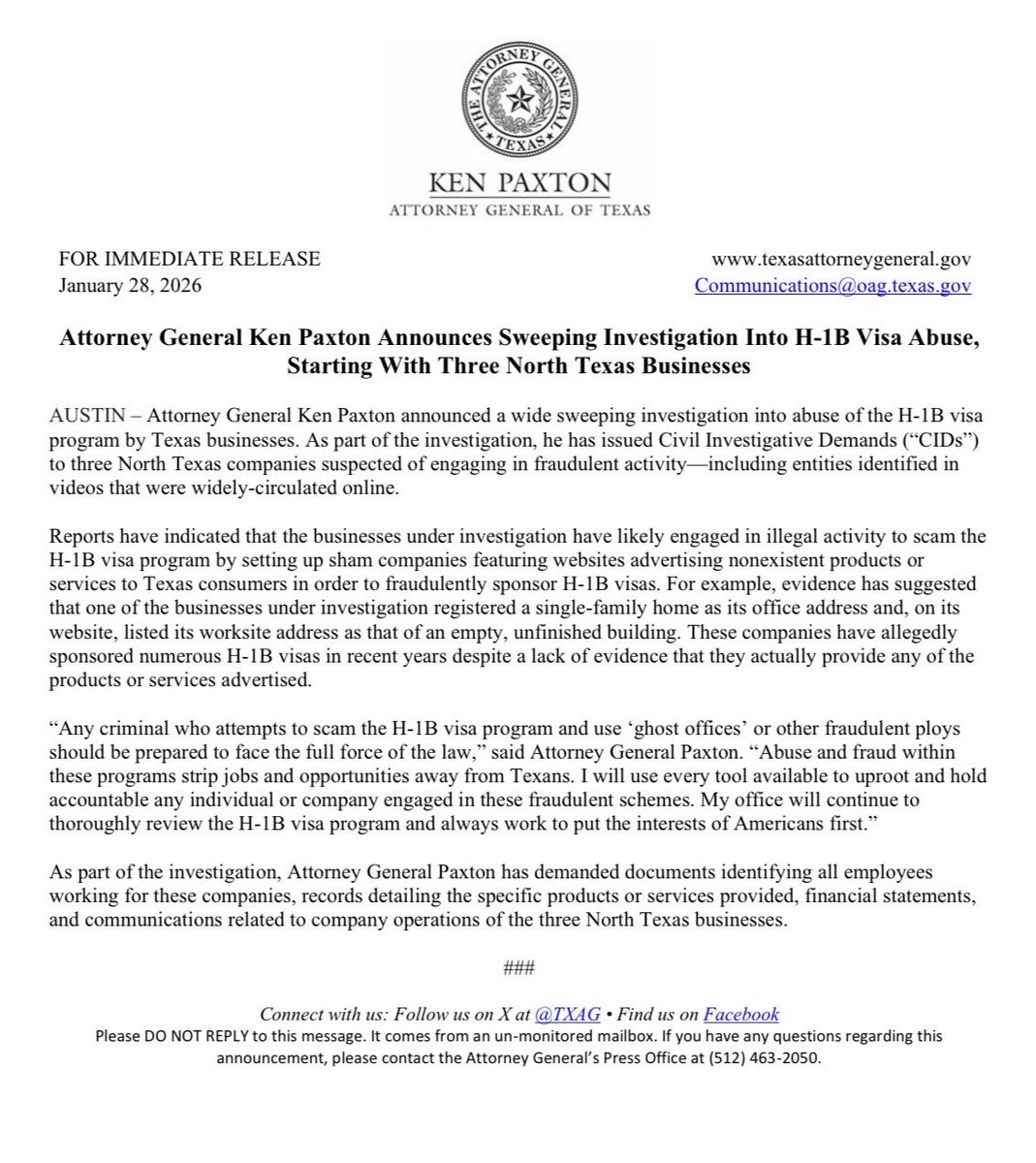
🚨BREAKING: I'm announcing a sweeping investigation into H-1B visa abuse, starting with three North Texas businesses.
Any criminal who attempts to scam the H-1B visa program and use "ghost offices" or other fraudulent ploys should be prepared to face the full force of the law.
1,636
7,286
32,062
858,124
Suresh T Kumar retweeted

Jan 10
Rule of thumb for investment in fundamentally solid stocks:
1. If price drops 10%, just hold
2. If price drops 20%, add 10%
3. If price drops 30%, add 30%
4. If price goes up 10%, just hold
5. If price goes up 20%, still hold
6. If price goes up 30%, sell 10%
7. If price goes up 40%, sell 20%
8. If price goes up 50%, sell 30%
9. If price goes up 60%, sell 40%
10. If price goes up 100%, sell all
471
1,583
16,808
2,400,580
Suresh T Kumar retweeted

18 Nov 2025
Global Active vs Idle Time Stats (Workforce Productivity):-
1. 🌎 Avg global active keyboard/mouse time per day: 2h 53m
2. 🇮🇳 India (IT sector) active time: 3h 12m
3. 🇺🇸 US employees active time: 2h 48m
4. 🇬🇧 UK employees active time: 2h 34m
5. 🇨🇦 Canada active time: 2h 41m
6. 🖥️ Avg daily idle time (global): 47–78 min
7. 🇮🇳 India idle time (IT): 62 min
8. 🇺🇸 US idle time: 54 min
9. 🇩🇪 Germany idle time: 49 min
10. ⌛ Avg “untracked/away" time (global): 1h 21m
11. 🇸🇬 Singapore away time: 1h 04m
12. 🇦🇺 Australia away time: 1h 17m
13. 🏢 Meetings share of workday (global): 31%
14. 🇮🇳 India meetings share: 27%
15. 📉 Productivity loss due to idle/away: ~19% of total workday
1
8
63
156,227
Suresh T Kumar retweeted

15 Sep 2025
My son was murdered after blowing whistle on OpenAI thespectator.com/topic/my-so…
86
2,183
11,824
440,382
Suresh T Kumar retweeted

15 Sep 2025
Checkout my thread on this...
x.com/MashraniVivek/status/1…
13 Sep 2025

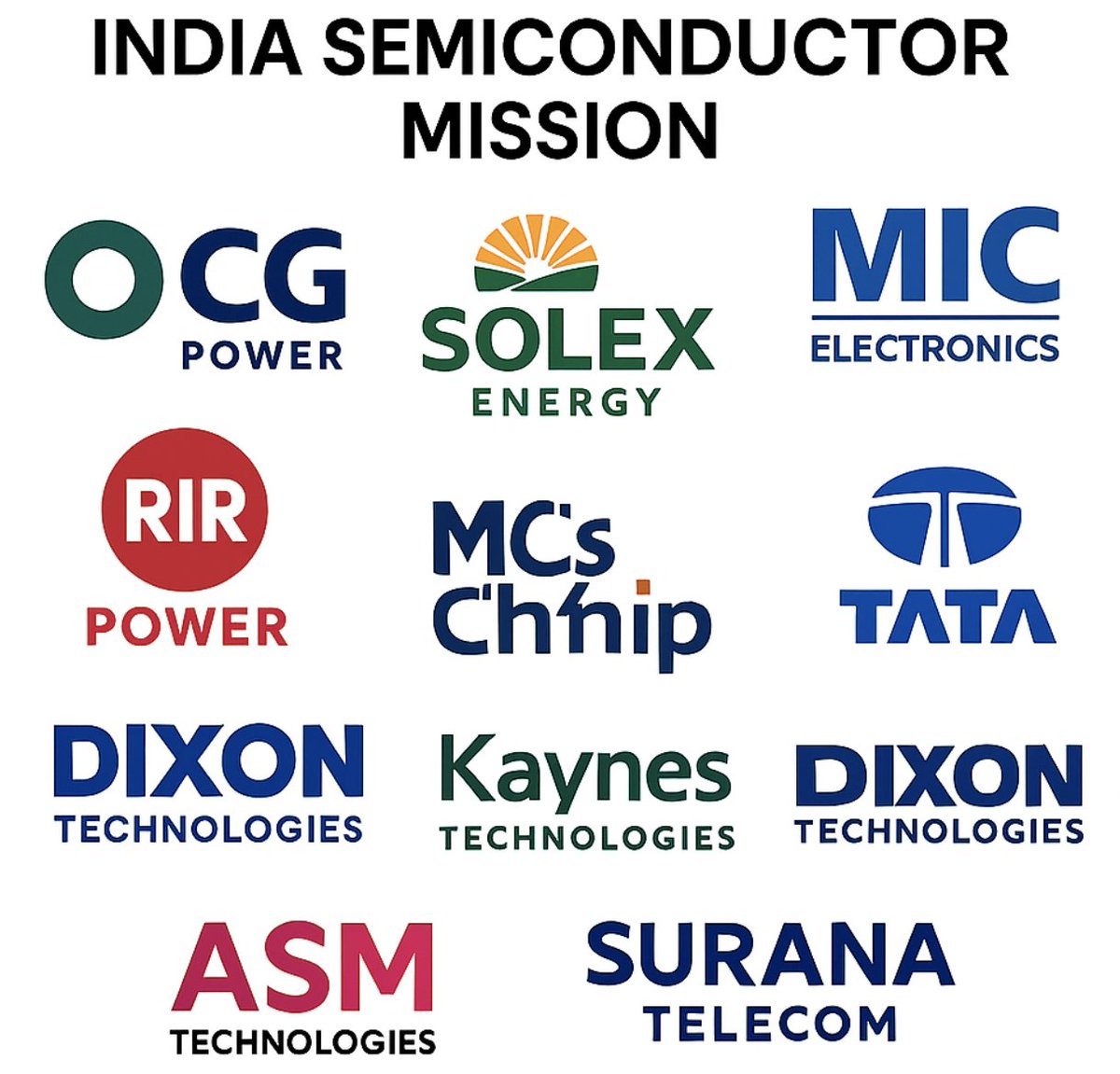
🚀 India’s ₹4,594 Cr Mega Investment Plan: Which sector to focus next?
Union Cabinet approved ₹4,594 crore for four new semiconductor projects (Odisha, Andhra Pradesh, Punjab) as part of the India Semicon Mission.
This is huge shift like Defence and Railways few years back.
7
39
12,511
Suresh T Kumar retweeted

15 Sep 2025
India just spent Rs 76,000 Cr to make its FIRST semiconductor chip
But Taiwan made the SAME chip 10 years ago!
Everyone's celebrating while industry insiders are confused
So why are we pouring billions into "outdated" technology?
Here's what's really happening
1/11
254
856
4,739
424,795
Suresh T Kumar retweeted

3 Sep 2025
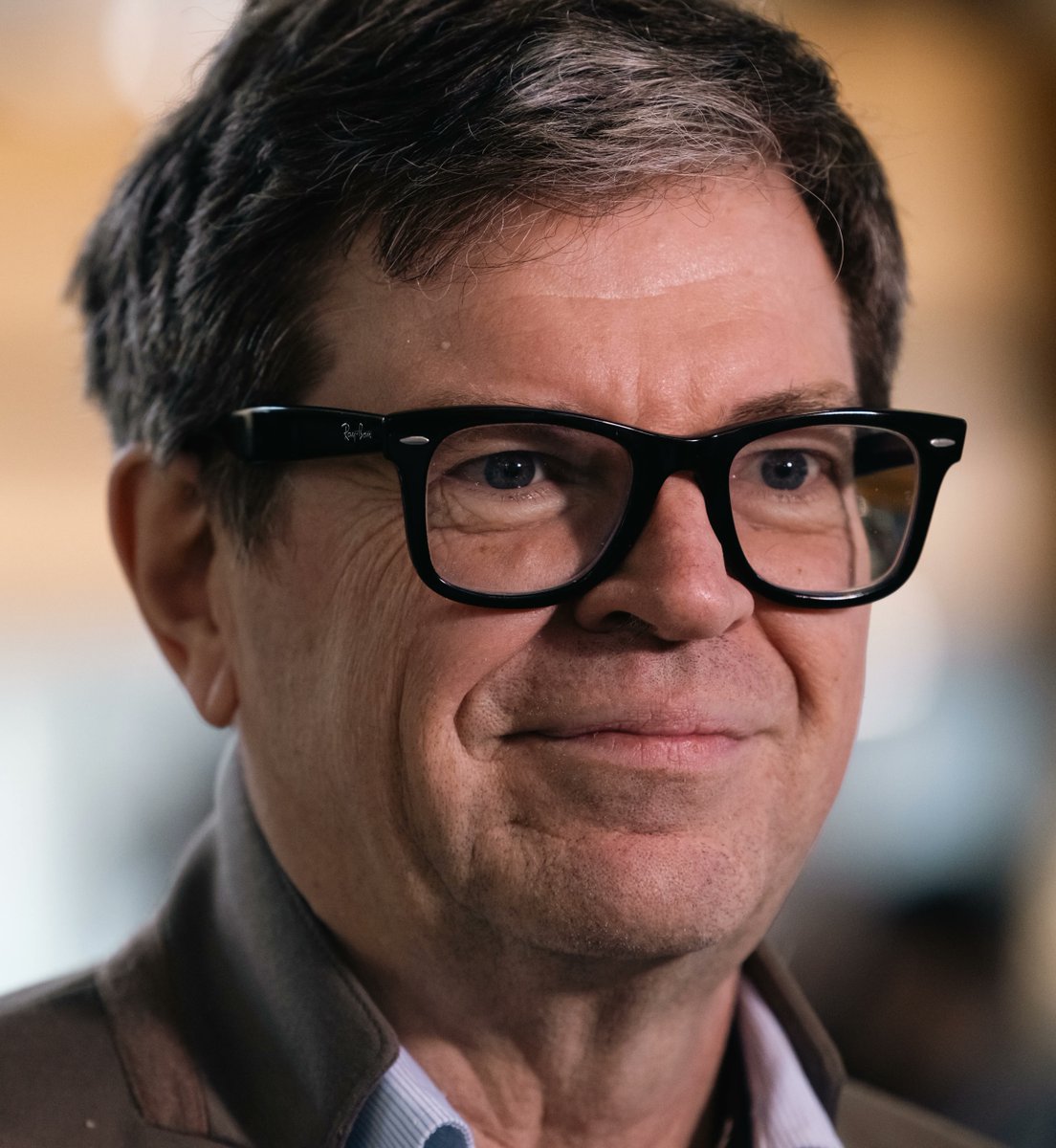
He predicted:
• AI vision breakthrough (1989)
• Neural network comeback (2006)
• Self-supervised learning revolution (2016)
Now Yann LeCun's 5 new predictions just convinced Zuckerberg to redirect Meta's entire $20B AI budget.
Here's what you should know (& how to prepare):
186
1,110
8,055
2,190,567
Suresh T Kumar retweeted

24 Aug 2025
Join the future of semiconductors at #SEMICONIndia2025. Registrations are now live!
🚀Join us at SEMICON India 2025 – Building the Next Semiconductor Powerhouse
🗓️ 2–4 September 2025
📍 Yashobhoomi (IICC), New Delhi
🔗 Register @ lnkd.in/gR2zVdzE
#DigitalIndia

5
47
125
11,642
Suresh T Kumar retweeted

23 Jul 2025
R.I.P Perplexity.
You don’t need to spend $20/month anymore.
You can now turn any LLM like Grok, ChatGPT, DeepSeek, Gemini, or Qwen into a 24/7 research agent.
Here’s the exact mega prompt I use to automate all research for free:
65
224
2,196
490,444