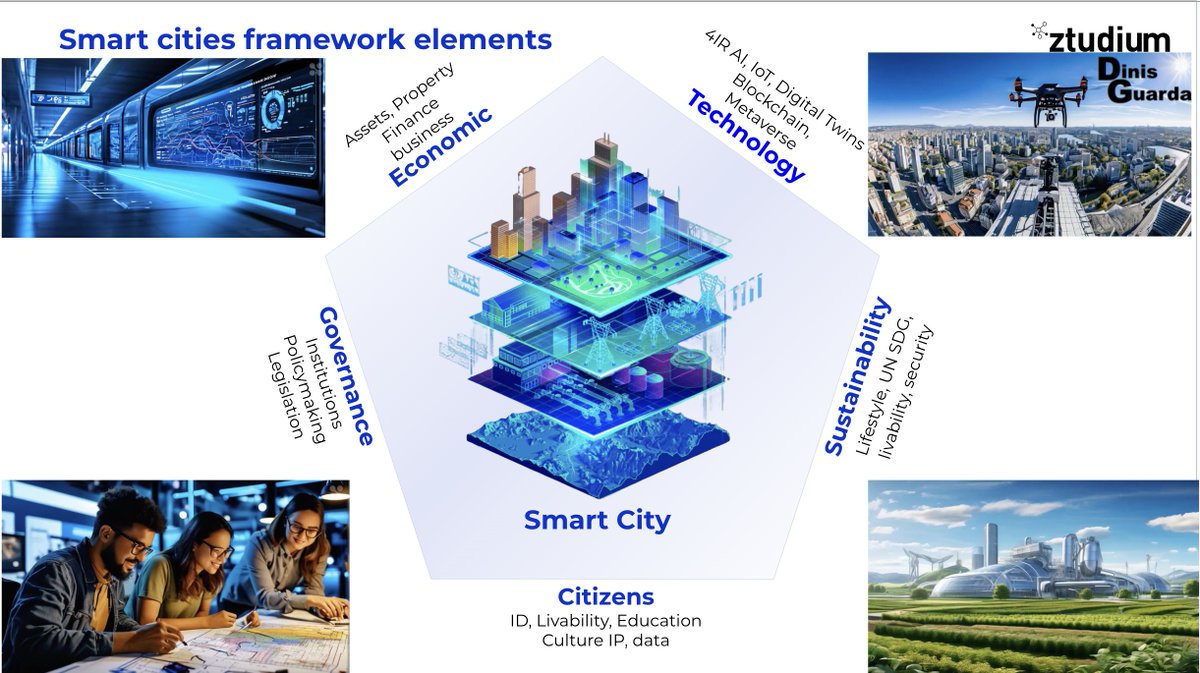
#smartcities
framework elements
The roots of the
#smartcity concept can be traced back to 1970, when the first urban
#bigdata project, titled "Cluster Analysis of Los Angeles," laid the groundwork for data-driven urban planning. Since then, the idea has evolved and gained momentum, with architects, city strategists, political leaders, and tech CEOs recognising the immense potential of smart cities.
British architect
#NormanFoster has been a vocal advocate for smart cities, stating, "The future of the city is not about buildings, it's about the spaces between them and the life that goes on in those spaces. The smart city is one that uses technology to enhance the quality of life for its citizens, to improve the efficiency of its services, and to create a more sustainable environment."
Despite the lack of one universally accepted definition of a smart city, both institutional and academic global researchers and policymakers still use the term Smart City that partly was coined by
@IBM and
@Cisco in 2007.
The term "Smart City" became popular in the late 2000s, particularly as major technology companies like IBM and Cisco launched initiatives to integrate information and communication technologies (
#ICT) into urban infrastructure, effectively making cities more interconnected and efficient.
These initiatives were part of broader strategies to address urban challenges such as
#sustainability,
#governance, and service delivery through
#technology.
my
#research #infographic integrating
#4IR #AI #IoT #DigitalTwins #Blockchain #Metaverse
with
@ztudium teams
#smartcitiesdna @metaverseabc @blocksdna @citiesabc_
CC
@dilippungliya @YuHelenYu @AkwyZ @arlenenewbigg @EliseQuevedo @efipm @enricomolinari @kuriharan @jblefevre60 @thomaspower @enilev @Khulood_Almani @SpirosMargaris @mvollmer1 @Xbond49 @antgrasso @EstelaMandela @sallyeaves @alvinfoo @UrsBolt @albertogaruccio @BetaMoroney @globaliqx @psb_dc @Shi4Tech @FrRonconi @thinkers360 @Ronald_vanLoon @ipfconline1
#tech #digitaltransformation #AI #fintech #AR #VR #MR #web3.0
#innovation #entrepreneur
ALT #smartcities
framework elements
The roots of the #smartcity concept can be traced back to 1970, when the first urban #bigdata project, titled "Cluster Analysis of Los Angeles," laid the groundwork for data-driven urban planning. Since then, the idea has evolved and gained momentum, with architects, city strategists, political leaders, and tech CEOs recognising the immense potential of smart cities.
British architect #NormanFoster has been a vocal advocate for smart cities, stating, "The future of the city is not about buildings, it's about the spaces between them and the life that goes on in those spaces. The smart city is one that uses technology to enhance the quality of life for its citizens, to improve the efficiency of its services, and to create a more sustainable environment."
Despite the lack of one universally accepted definition of a smart city, both institutional and academic global researchers and policymakers still use the term Smart City that partly was coined by @IBM