
Cofounder @mentatminds @hypertaoHL
Joined September 2017
- Tweets 1,610
- Following 1,669
- Followers 814
- Likes 7,183
92 Photos and videos






tuta retweeted

Jun 11
Agree very much
We (& OTF & Const) should be spending energy on fostering successful outcomes, instead of tying to trap everyone that tries to game the system
People will keep gaming the system as long as playing the honest game is not rewarding enough
1
3
284
Jun 4
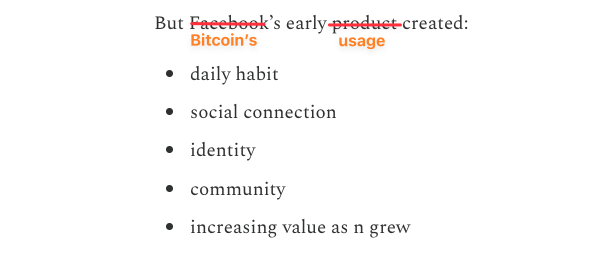
Seeing the recent measure to block emissions on some Bittensor subnets as a good thing is missing the bigger picture.
It shows a real weakness: that the subnet market is not intelligent enough (yet) to discriminate subnets simply farming emissions.
At @mentatminds, we believe this discrimination should come from individuals investing their TAO where it matters.
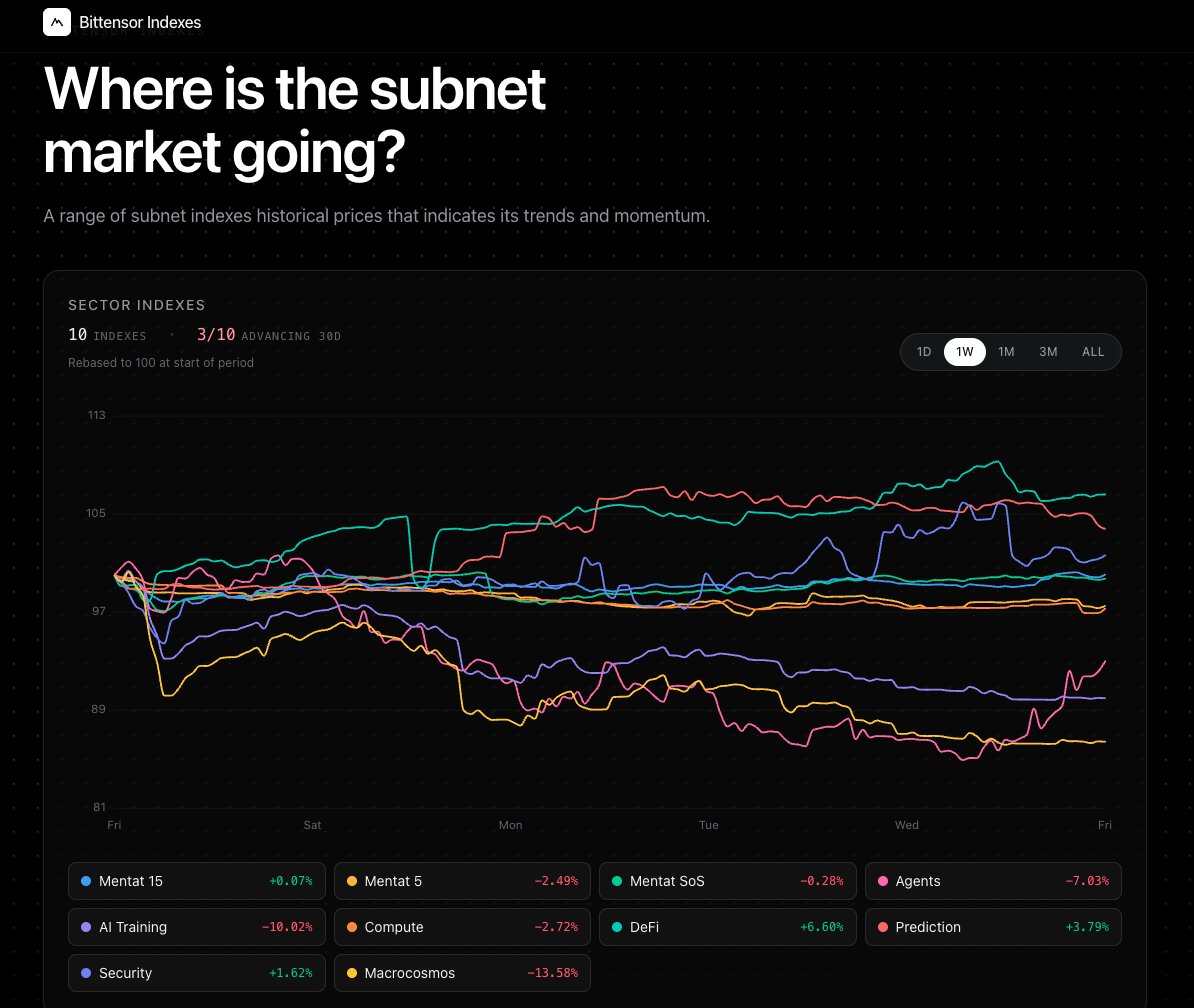
We just released Mentat SoMS, an index allowing any $TAO holder to invest in all subnets except those that burn all their emissions.
Investing in Mentat SoMS is choosing to direct emissions towards subnets that are paying miners to do a real job.
Jun 4

Bittensor isn't broken, our focus is.
Sum of Subnets (SoS) contains 50 subnets that burn 100% of their emissions.
We need a true benchmark that tracks what actually matters.
Sum of Mining Subnets (SoMS) is the one we need.
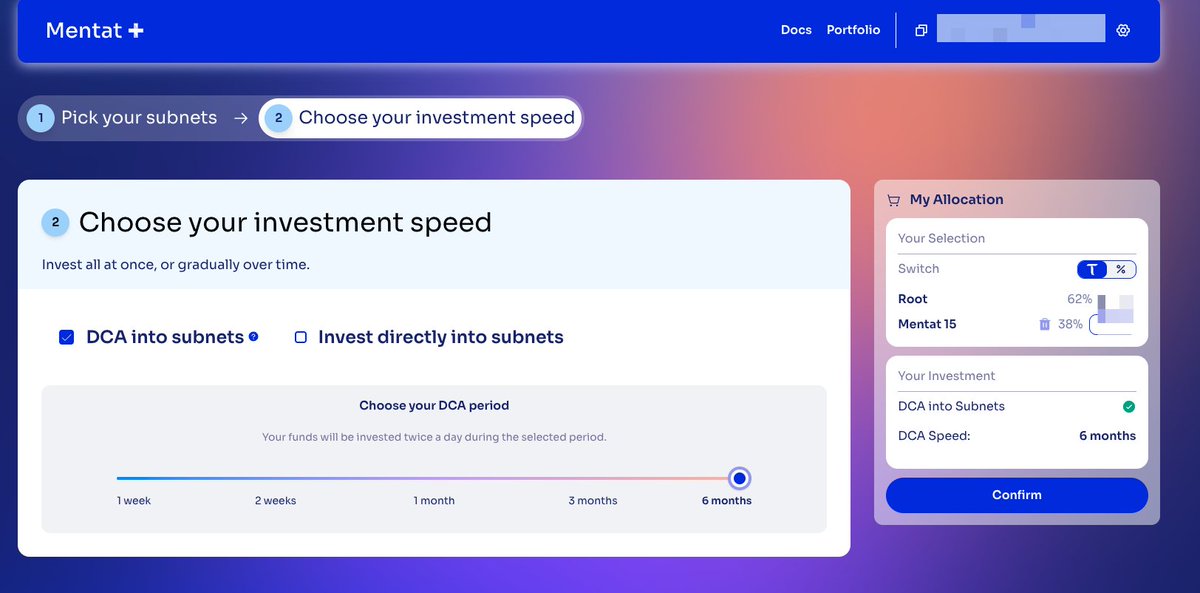
Buy the real Bittensor market in 1 click with Mentat SoMS.
Bittensor is designed around incentives. If we fund the subnets that build, ghost subnets die out. No regulation needed, just better capital allocation.
Let's make SoMS outperform SoS.
These subnets in comments are the true face of the network 👇
1
6
221
Jun 4
Invest in every Bittensor subnet that is actually paying miners to do something
$TAO
Jun 4
Bittensor isn't broken, our focus is.
Sum of Subnets (SoS) contains 50 subnets that burn 100% of their emissions.
We need a true benchmark that tracks what actually matters.
Sum of Mining Subnets (SoMS) is the one we need.
Buy the real Bittensor market in 1 click with Mentat SoMS.
Bittensor is designed around incentives. If we fund the subnets that build, ghost subnets die out. No regulation needed, just better capital allocation.
Let's make SoMS outperform SoS.
These subnets in comments are the true face of the network 👇
1
9
230
tuta retweeted

Jun 1
"Across 374 weekday 15 minute markets, Synth correctly called direction 86% of the time versus 57% for Polymarket. Across 95 hourly markets, Synth achieved 75% accuracy compared to 62% for Polymarket."
Appreciate the detailed analysis @Kunallegendd
Jun 1

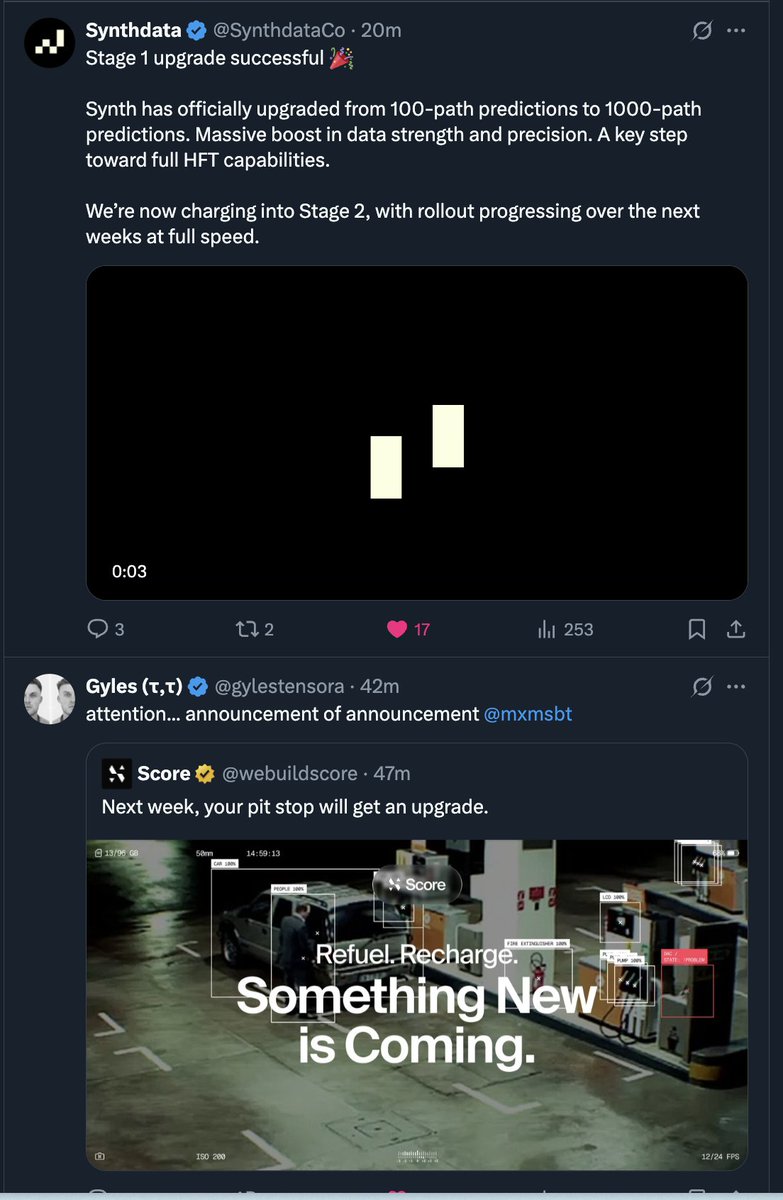
One of our theses this year was that as prediction markets mature and competition intensifies at the base layer, the most attractive opportunities will shift toward the applications and intelligence built on top. One project I have been watching closely is @SynthdataCo
Synth displays expected outcomes for hourly and daily event contracts alongside the implied market probability, allowing users to compare market pricing against real time forecasts. Those forecasts are generated by the top 10 models from a pool of more than 200 competing on Bittensor.
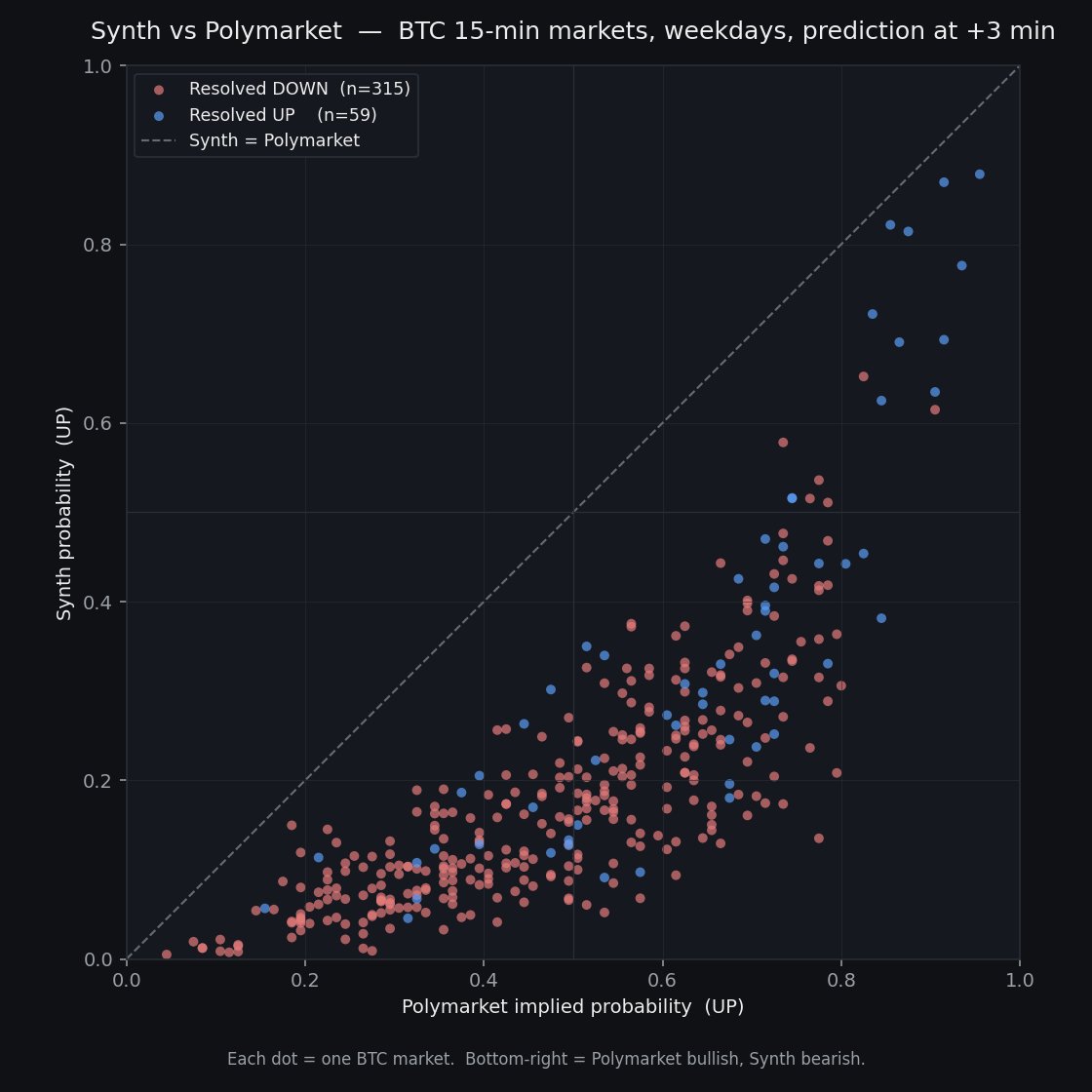
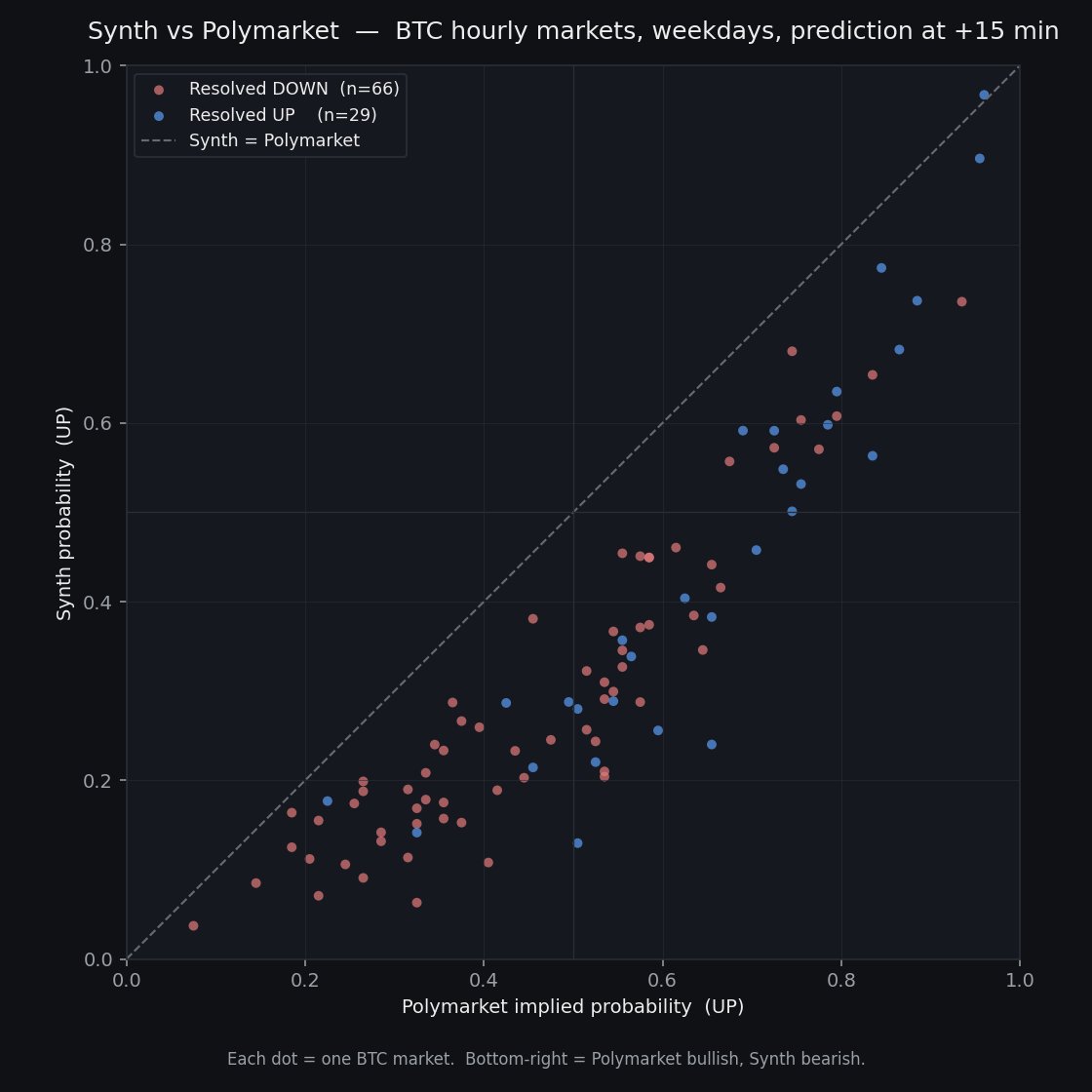
To test the product, I tracked every BTC up/down market on @Polymarket over nine weekdays. Both Synth and Polymarket probabilities were recorded at the same moment: three minutes into each 15 minute market and 15 minutes into each hourly market. The forecasts were then compared against the final outcome.
Across 374 weekday 15 minute markets, Synth correctly called direction 86% of the time versus 57% for Polymarket. Across 95 hourly markets, Synth achieved 75% accuracy compared to 62% for Polymarket.
Notably, Synth's edge widened significantly at shorter time horizons, posting a 29 percentage point advantage in 15 minute markets versus a 13 percentage point advantage in hourly markets.
The disagreement data was even more interesting than the headline numbers. In 46% of 15 minute markets, Synth and Polymarket pointed in opposite directions. In every single case, Synth forecast DOWN while Polymarket implied UP. Synth was correct 82% of the time in these disagreements, suggesting the market was consistently underpricing short term downside during the sample period.
The bigger opportunity here may not just be for directional trading but especially for market making. A market maker armed with a calibrated probability edge can quote tighter two way prices, hold less inventory and capture more volume without taking on the same adverse selection risk.
As the base layer becomes commoditized, the intelligence layer becomes the moat. Synth may be an early example of what that future looks like.
2
9
41
5,255
May 15
There is only one other chain like this and it's Bittensor @opentensor
$TAO
May 15

Something interesting is happening with the Hyperliquid ecosystem.
About a year ago, shortly after HYPE did its TGE, I had quite a few projects reaching out for funding building on Hyper. Almost all of them were just trying to chase the hype: lack of innovation, low-effort copycats with low-conviction founders. I didn’t take most of them seriously and, unsurprisingly, none of them are around anymore.
That’s slowly but surely shifting.
Recently a significant portion of our deal flow is actually decent founders coming up with genuinely interesting ideas on top of Hyperliquid, some even with existing products, real traction, and legitimate funding needs. The quality has completely changed.
And it makes perfect sense. Hyperliquid did what every other chain tried and failed to do: they shipped a product so good that people actually wanted to use it. That attracted users. Users attracted liquidity. Liquidity attracted builders. Builders are now attracting capital.
Meanwhile every other L1 and L2 is trying to buy their ecosystem into existence from the bottom up and wondering why nothing sticks.
Hyperliquid built it top down. Product first. Ecosystem second. And it’s working.
No grants program or desperate foundations throwing millions at mercenary devs. Just a great product and an organic flywheel doing the rest.
Maybe more chains should try building something people actually want before spending billions convincing developers to pretend they care.
Anyways, Hyperliquid, I guess.
1
3
376
May 13
Subnet sorting, not shorting $TAO
May 12
Update: Subnet sorting now live.
Spot top performers, highest APY, most capitalized.
Sort your way. Build your basket.
4
218
tuta retweeted

May 12
Update: Subnet sorting now live.
Spot top performers, highest APY, most capitalized.
Sort your way. Build your basket.
1
7
24
820

tuta retweeted

Apr 29
Crypto is paying a high price for years of altcoin scams and grifts. It can feel like a toxic industry where very little value is created.
It's easy to feel disillusioned and wish you were focusing on AI-related trading, businesses, or working at a startup in that sector. Many companies and investment firms have already begun the rotation out of Crypto. Don't let your apathy make you unproductive; it's your personal responsibility to continue learning about the world. If you feel the call of the wild, then go.
For the ones brave enough to stick around, not only will the risk-reward be as asymmetric as it's been in recent history, the concentration of upside in a handful of assets will make it EASIER to generate massive returns. There is less capital looking at Crypto exposure than ever before. This all changes with a rapid repricing in Bitcoin this year, which I believe is inevitable.
For a long time in Crypto, nothing felt buyable due to an excess of capital being forced to deploy in a sector with limited opportunity. We're in a new regime now.
We're reaching a similar level of apathy that I felt during 2019 and 2022. I almost quit Crypto to go back to TradFi. It's no surprise those were the years where I generated the bulk of my returns (sans Hyperliquid).
Outside of trading, if you're passionate about the space, companies that are still building during this period will be positioned to take advantage of the inevitable reacceleration of this industry. Working at top-tier companies in the space is more accessible than ever due to a shortage of people entering the field.
Don't undervalue your time.
193
362
2,810
248,181
tuta retweeted
Apr 24
Instead of pointing fingers, we should understand why running a subnet properly is not that attractive right now and fix it.
Fix the incentives…
Apr 23

This is why I say only 10-20 subnets on TAO are worth investing into
Because 50% are doing nothing, shame!
1
1
125
Apr 23
This is what Bittensor people are actively trying to fix $TAO
Apr 23

Crypto is extremely good at incentivizing quantity.
Crypto is extremely bad at incentivizing quality.
1
10
413
Apr 21
This hits right
Apr 21

The Arbitrum Freeze: Decentralization Theater Meets Reality
Two days after the $292M Kelp DAO exploit, the Arbitrum Security Council froze 30,766 ETH linked to the attacker. The funds now sit in an intermediary wallet, movable only by further governance action.
Good outcome? Probably. Comfortable outcome? Not at all.
1. What the freeze actually is
The Security Council used its emergency powers to execute a state-changing action against a specific address. No smart contract was broken. The code was overridden by humans with keys.
This is not a secret or an abuse. It's a documented property of Arbitrum, and of every other major L2 today. By L2Beat's framework, Arbitrum is a Stage 1 rollup: a trusted multisig can upgrade the system and, in emergencies, alter state. Optimism, Base, zkSync, Starknet, Linea, all sit at Stage 0 or 1. No production rollup has reached Stage 2.
Call the freeze what it is: a legitimate administrative intervention on an administered chain.
2. Decentralization theater is the default
We built this space to give users sovereignty through self-custody, permissionless access, and credibly neutral rails. That ideal is still alive ,in a shrinking set of places: ETH on mainnet, BTC on Bitcoin, a handful of genuinely immutable contracts.
Almost everything else is permissioned in some way: upgradable contracts, whitelisted oracles, pausable markets, admin-keyed bridges, multisig-governed rollups, freezable stablecoins. We kept the vocabulary of permissionlessness. We quietly built a governed financial stack underneath it.
The Arbitrum freeze didn't create that reality. It made it visible.
3. Why does it persist
Because a truly permissionless system at scale is brutal to defend. No pause. No rollback. No freeze. Every line of code public, every mistake final. Attackers iterate for free; defenders get one shot.
Kelp is the canonical illustration: a 1-of-1 DVN against LayerZero's written guidance, two poisoned RPC nodes, a DDoS on the rest, and $292M minted out of a fabricated state. No zero-day. No smart contract exploit. An infrastructure-level attack on a verifier that was decentralized in name only.
Meanwhile the adversary has scaled. DPRK-linked groups have more capital than most protocols have in treasury, dedicated research teams, timelines in quarters, and now AI that can diff every commit and grep every config at machine speed. Their only real constraint is self-imposed: don't kill the goose. With a 1-of-1 DVN they could have minted $292B as easily as $292M. They're calibrating, not restrained.
4. The honest tradeoff
Both of these are true at once:
The freeze likely saved real money from a state-sponsored attacker.
The freeze confirms that Arbitrum, today, is a chain where sufficiently motivated humans can move your balance.
These are not a contradiction. They are the explicit cost of the Stage 1 compromise. The open question is whether we treat that compromise as permanent and rebrand accordingly, or as scaffolding toward something stronger.
5. The only real exit: validity proofs
Not better multisigs. Not faster incident response. A verifier that checks a succinct proof of another chain's state transition doesn't trust an RPC, a DVN, an oracle, or a committee. Either the math checks or it doesn't. That's how Ethereum L1 already settles rollups. It is the model every bridge should converge to, and the one Stage 2 rollups will need to reach.
In that world, Kelp-style attacks become cryptographically impossible rather than operationally unlikely, and L2s stop needing emergency councils as load-bearing security. Every bridge and most rollups today are an IOU against that future.
6. Where this leaves us
Maybe Bitcoin stays credibly neutral mostly because it refuses to do anything. Every system that tries to do more than move a scarce asset drifts toward human governance, because the alternative is getting drained by professionals with better tooling than the defenders.
The uncomfortable part is admitting we are running on trust we told ourselves we had removed. The Arbitrum freeze didn't break a promise, it revealed a promise we had already stopped keeping.
Until the proofs catch up, every "decentralized" protocol should carry its Stage label on the tin. Users should know which chain they're actually on when they click confirm.
Stay safe. Stay honest about your trust assumptions
1
72
tuta retweeted

Apr 20
In crypto and defi (ie in honest markets), when a component fails, those closest to the component—whether wildly negligent or innocent victim—suffer the loss, and are burdened with that responsibility. Unequal, but proper.
In tradfi and banking (ie in coercively manipulated markets), when a component fails, the entire society is forced under the burden of its resolution. Costs are socialized. Equal, but improper.
The former, with time, becomes self-correcting, self-improving, and crucially, retains vitality. The latter, regardless of time, becomes stagnant and soulless, and here everyone can wallow in an equivalent grey.
Any man of agency should prefer the former, taking care over that to which he is proximate. It is from this that the virtue of markets emerges.
134
280
1,726
216,827
Apr 17
TLDR is: Maybe we could stop disincentivizing subnet owners to sell, and let the market decide whether they sell too much or not.
1
14
Apr 17
Apr 17

and they're not touching it now either way so ok I see your point
However I think we have a deeper issue here, which is that subnet owners are not financially aligned (incentivized) in the short to medium term to push their subnet price, as they can't take profit.
Maybe Sam wasn't seing a reasonably short-term outcome where he would profit from Covenant, and that made him jump ship.
I think a lot more subnet owners are in this situation than we think, and adding a lock will just make it worse.
We should make it easier for them to sell, and see what happens: if they sell too much, it's that they're not in it for the long run, and it's better for everyone to get that signal sooner rather than later.
If they sell a reasonable amount (depending on liquidity, perceived achievements, etc) then it should be fine.
They have to finance themselves either way, so why push them out of the market? Right now it feels like we're giving them a lot of tokens, but they can't touch it and have no idea when they will be able to.
Maybe we could stop disincentivizing them to sell, and let the market decide whether they sell too much or not.
ps: sorry for the long rant
17
Apr 16
My 2 cents on the recent conviction debate on $TAO
Apr 16
The real issue I see is that it complicates even more the ability for subnet owners to finance their subnets.
The problem that happened with Sam can simply be seen as the largest holder dumping. Any asset with a larger holder owning too much of the supply should be a red flag.
5Gurl could do the same thing on Ridges. Why point the finger at subnet owners?
1
200
Apr 12
This is something I've felt multiple times when scrolling here
A lot of posts seem so logical when you know about Bittensor
Apr 12

Everyone bullposts Bittensor even if it’s too hard to admit.
66