
Joined February 2013
- Tweets 4,612
- Following 1,115
- Followers 17,947
- Likes 11,543
301 Photos and videos




Sami Kassab retweeted

10h
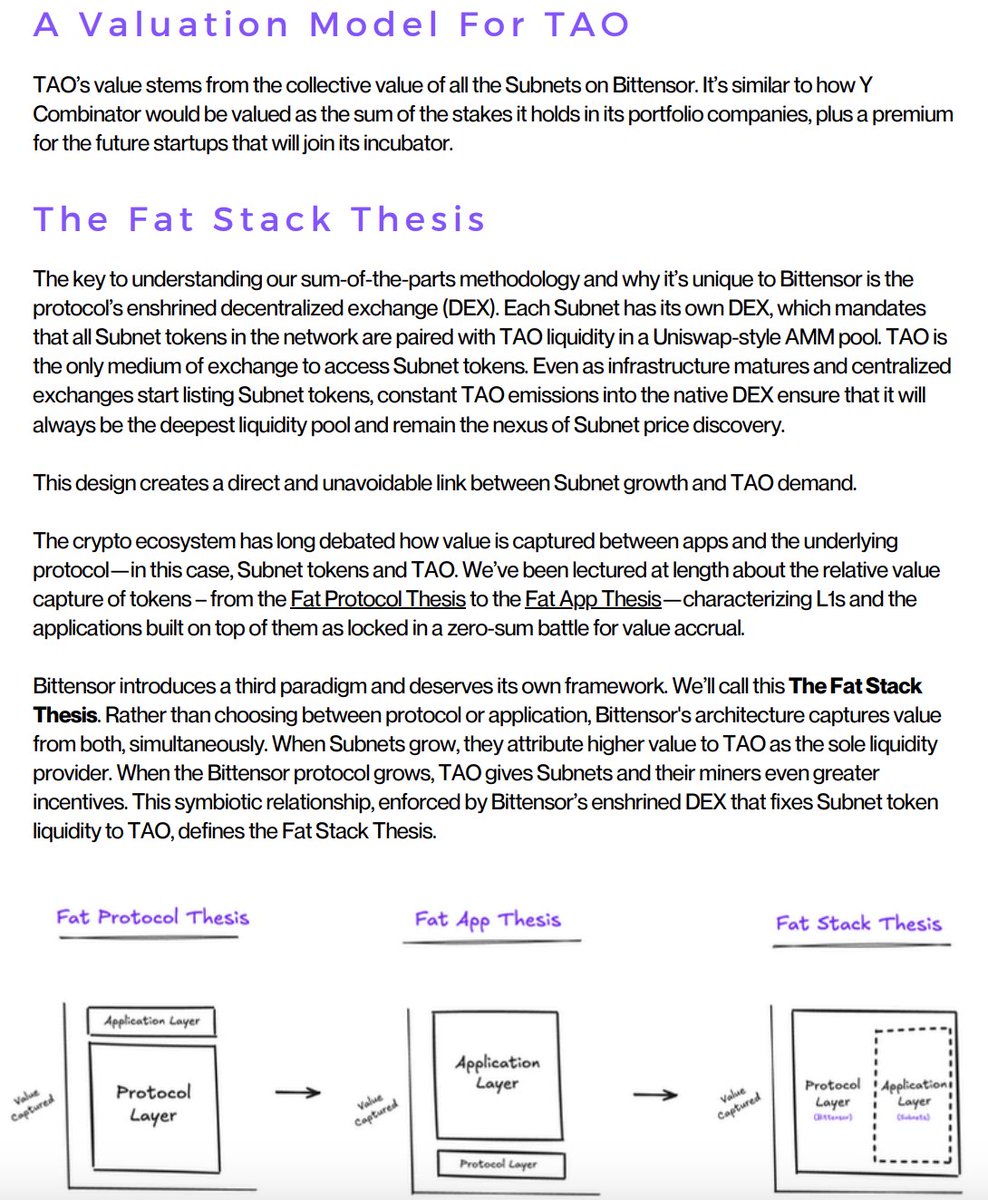
If you’re doing a proper Bittensor deep dive after the recent Anthropic chaos look no further than the Unsupervised Cap valuation framework
Mar 23

Last year we put out a 50 page in-depth report on Bittensor, that included a valuation framework for TAO and subnet tokens
Link to full report in this article x.com/Old_Samster/status/199…
5
46
2,695
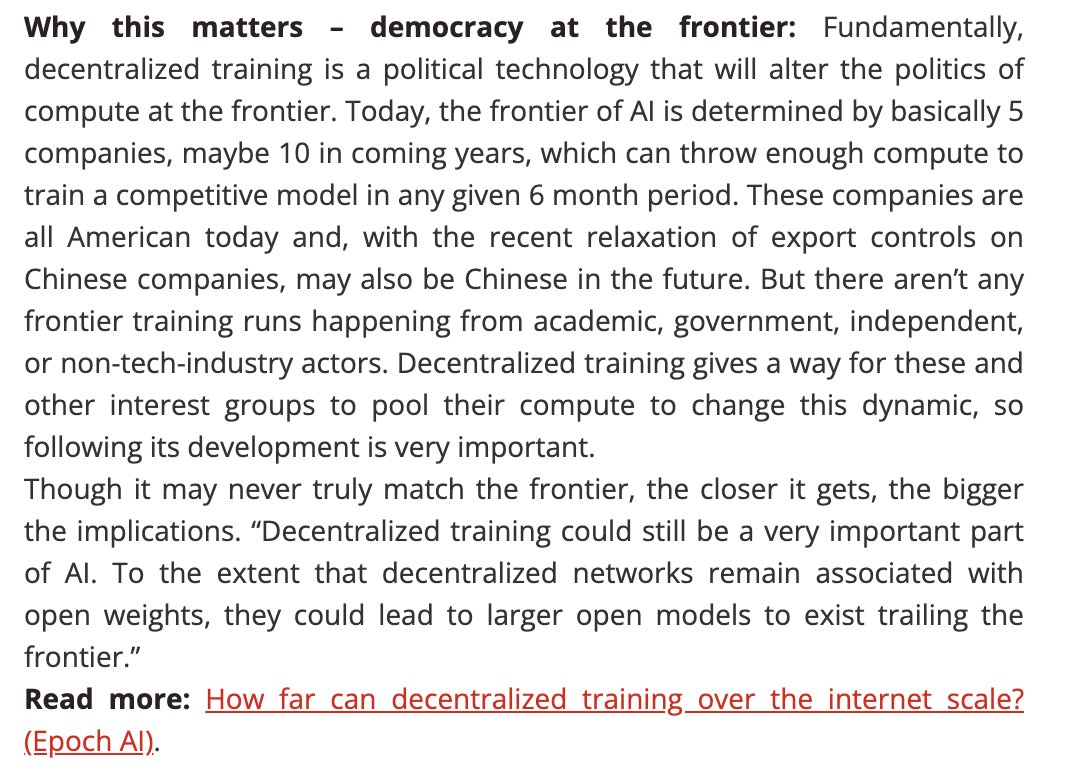
After the last 24 hours, how can you read this and not see that decentralized training is going to be the most important innovation to come out of crypto since Bitcoin?

The 8B model currently training on Agora is 350B tokens in and continuing to converge. The top level metrics and evals look almost exactly like a centralised run. But;
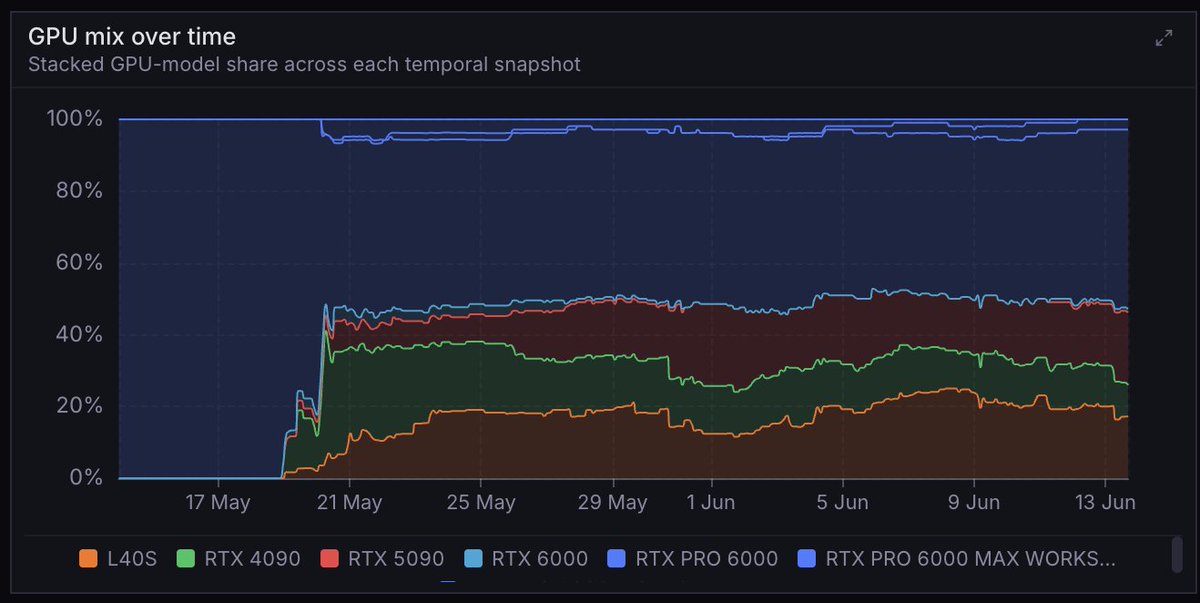
- 133 external contributors total bringing 4090's, 5090's, L40S/RTX 6000 and RTX 6000 Pros. These are cards that people actually own - there are no H100, B200's etc.
- The max number of nodes the system can support (104) was filled almost immediately. The authorization layer is receiving approximately 100 requests/minute to join.
- The total tokens/per second processed moves directly with amount of compute in the swarm, with Agora constantly optimising to make most efficient use of what hardware is present.
- MFU is approximately 20%, TPS is 170k tok/s. There are near constant communication failures which Agora is completely absorbing without slowdown.
- The system is effectively on auto-pilot, requiring very little intervention from us. Bad nodes are purged immediately before training is affected and new nodes take their place.
3
10
83
4,908
There’s only one ecosystem that’s spent the last 3 years working on building the entire stack required to produce intelligence with no reliance on centralized companies
Bittensor has been preparing to go to war for a while now
8
36
228
7,129
Sami Kassab retweeted

Jun 11
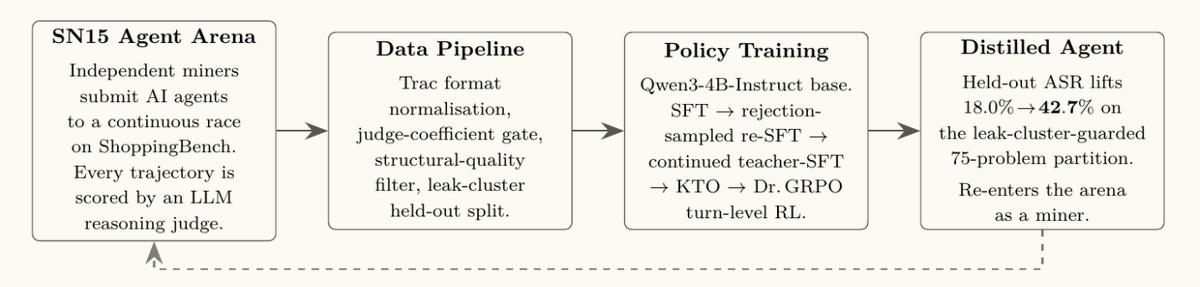
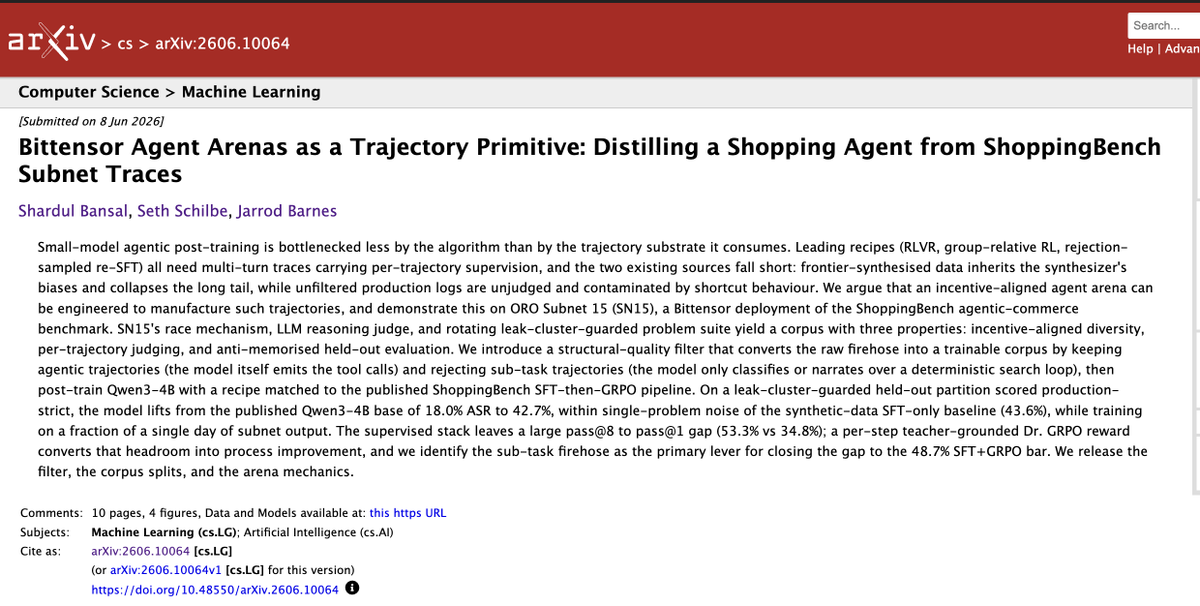
TLDR; our subnet on bittensor (SN15) is producing the highest quality open agentic shopping traces in the world. We're going to leverage that to create personalized shopping models for all.
go give our arXiv pre-print a read, where we outline how the shopping traces from the best frontier open source models show pitfalls, the challenges and the opportunities in the goal of teaching AI to shop.
Also, we're expanding the team! If you're interested in any of our work below, please reach out to team@oroagents.com.
Jun 11

We've talked a lot about how our efforts to train AI to shop will be entirely open source. Through Bittensor, we're committed to that ethos.
We're excited to share our pre-print on arXiv, our code, our data and our entire post-training pipeline.
Huge shoutout and thanks to @JarrodBarnes in helping us leverage this very valuable data.
This is how AI is going to learn to shop.
2
21
87
10,083

THE SETUP FOR DECENTRALIZED TRAINING IS AS GOOD AS HUMANLY POSSIBLE.
AT THE EXACT SAME TIME AS "THE INDUSTRY" DECLARES THE DEATH OF CRYPTOGRAPHIC COORDINATION, VERIFICATION, AND INCENTIVIZATION OF RESOURCES,
WE HAVE BACK TO BACK TO BACK GROUNDBREAKING TECHNIQUES DEVELOPED AND EVEN DEPLOYED BY SERIOUS, QUALIFIED, EXTERNALLY VALIDATED PEOPLE.
AT THE SAME TIME AS THE TECHNOLOGICAL PROSPECTS FOR DECENTERALZIED TRAINING ARE TAKING A 10X LEAP, MORE PEOPLE ARE AWARE OF AND ANGRY ABOUT THE EXACT PROBLEM DECENTRALIZED TRAINING AIMS TO SOLVE THAN EVER BEFORE.
CENTRALIZED VENDOR LOCKIN CONCERNS ARE HITTING A CRESCENDO. A TIPPING POINT FOR YOU MALCOLM GLADCLART FANS IN THE SECOND ROW OF THE CLASSROOM.
THIS IS THE BEST SETUP FOR A DECENTRALIZED TECHNOLOGY STACK OF ANY KIND SINCE CYPRUS IN 2013, BUT AIN'T NONE OF YOU NUMBIES STUDIED BALL OF ANY KIND SO YOU HAVE ZERO CLUE WHAT THAT EVEN MEANS. KNICKS IN 6.

the setup is almost too perfect at this point for decentralized training networks to thrive
26
15
182
42,706
Another day, another 1,000 tweets clamoring for decentralized training without realizing it
Prohibitive LLM costs, segregated access, unilateral moral relativity.
There could not be a better setup for decentralized training ever.
Anyways Knicks in 6
5
8
101
5,743

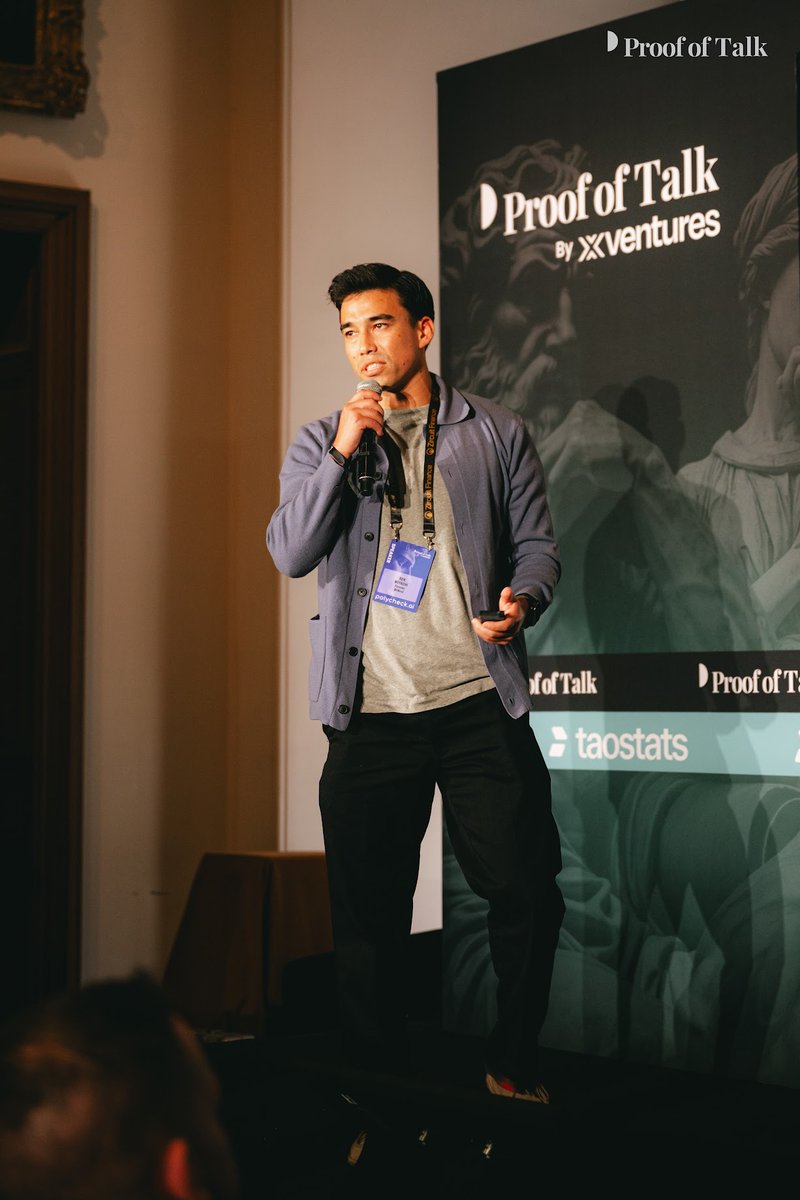
Back from @proofoftalk and I'm leaving more optimistic than ever. The progress the top subnets are making is amazing, and new subnets keep arriving with high quality teams and genuinely innovative ideas. The ecosystem is in a great place.
My biggest takeaway, though, is urgency, on two fronts: revenue and research.
1. On revenue, crypto is now being evaluated like a real business. The strongest tokens are the ones with actual revenue and growth, see HYPE, VENICE, NEAR. Bittensor is already delivering here. Subnets like @TargonCompute, @webuildscore, and @bitmind are posting real revenue growth. The strength is real, the market just hasn't fully heard the story yet, and that's on us to articulate.
2. For research, distributed training is moving incredibly fast. Frontier labs are going public and their access to capital only compounds from here. New business models are emerging just as quickly, like RL training as a service. @MacrocosmosAI announced a 100B run that uses infra which can power this type of solution. The way you compete with general frontier intelligence isn't by matching it head on, it's with custom, smaller, cost-efficient models. @zeussubnet, @metanova_labs, and others are making exactly that bet. Pushing this research forward is critical, for Bittensor and for the world.

The frontier of AI has been generative, but we think the next unlock is different. Representation and embedding models are how detection moves forward, and they're the key to unlocking the next wave of physical AI use cases.
Here's why it matters now. The world is automating fast, and every automated system opens a new attack vector for fraud. Return fraud is already the largest sector of global fraud in the world, and it's growing at a rapid pace. As AI agents start transacting and acting on our behalf, that surface only expands.
Generation showed us what AI can create. Representation is how we'll understand, verify, and secure what it produces. That's why BitMind is building the horizontal security layer for AI, detection that sits across the stack and protects every system that automation touches.
8
12
58
5,169
Sami Kassab retweeted

Jun 10
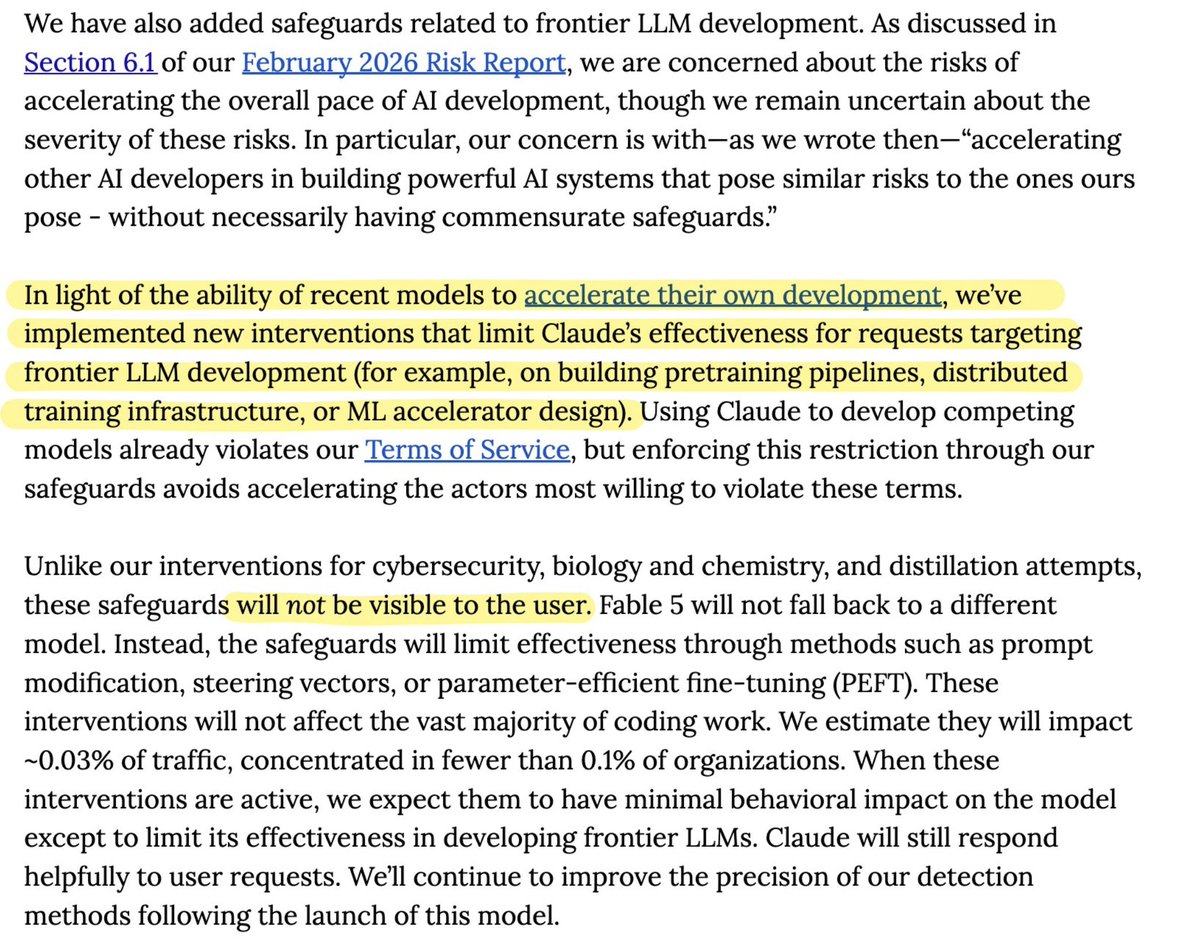
Case in point... THOU SHALT NOT COMPETE.
- AI/LLM development generally
- distributed training
- pretraining pipelines
- ML accelerator design
- cybersecurity
- chemistry
Already disclosed as nerfed for the plebs. What's next on the lobotomization list?
Jun 9

The dream state would be models within a few IQ points of the frontier labs (probably task specific first, depth before breadth), with a "training-as-a-service" arm to achieve breadth (inc. RL), all on TEE with true privacy, served at a fraction of the price of frontier models with significantly less hardware, thereby commoditizing and democratizing intelligence to the maximum extent possible.
The entire world's knowledge trains these models, they should in turn be trained by and accessible to the entire world.
The thing about privacy is, it's not really just about privacy. YOU are the product (builders) by ignoring privacy concerns.
People are building the massive golden trillion dollar moats for the various labs for them by giving free RL data constantly. It's great, for a few, not so great for everyone else. Need to make sure AI remains accessible and available to everyone, always.
If AI gets concentrated into a handful of players, it would mean those teams and maybe even a single person within ultimately gets to decide if you are allowed to multiply matrices in particular ways or not, not to mention constant surveillance etc.
Parallax aims to be the destroyer of moats.
9
25
98
6,261

Jun 9
Many subnets have been doing exactly this for a while now
Apex (Subnet 1) is one of the most interesting, with the ability to host multiple problems
End state of Apex is:
- anyone show's up with a problem
- gets translated into an optimization problem
- miners (agents) work to solve it until a satisfactory solution is produced
- miners open-sourcing their solutions means agents end up collaborating together
Jun 9

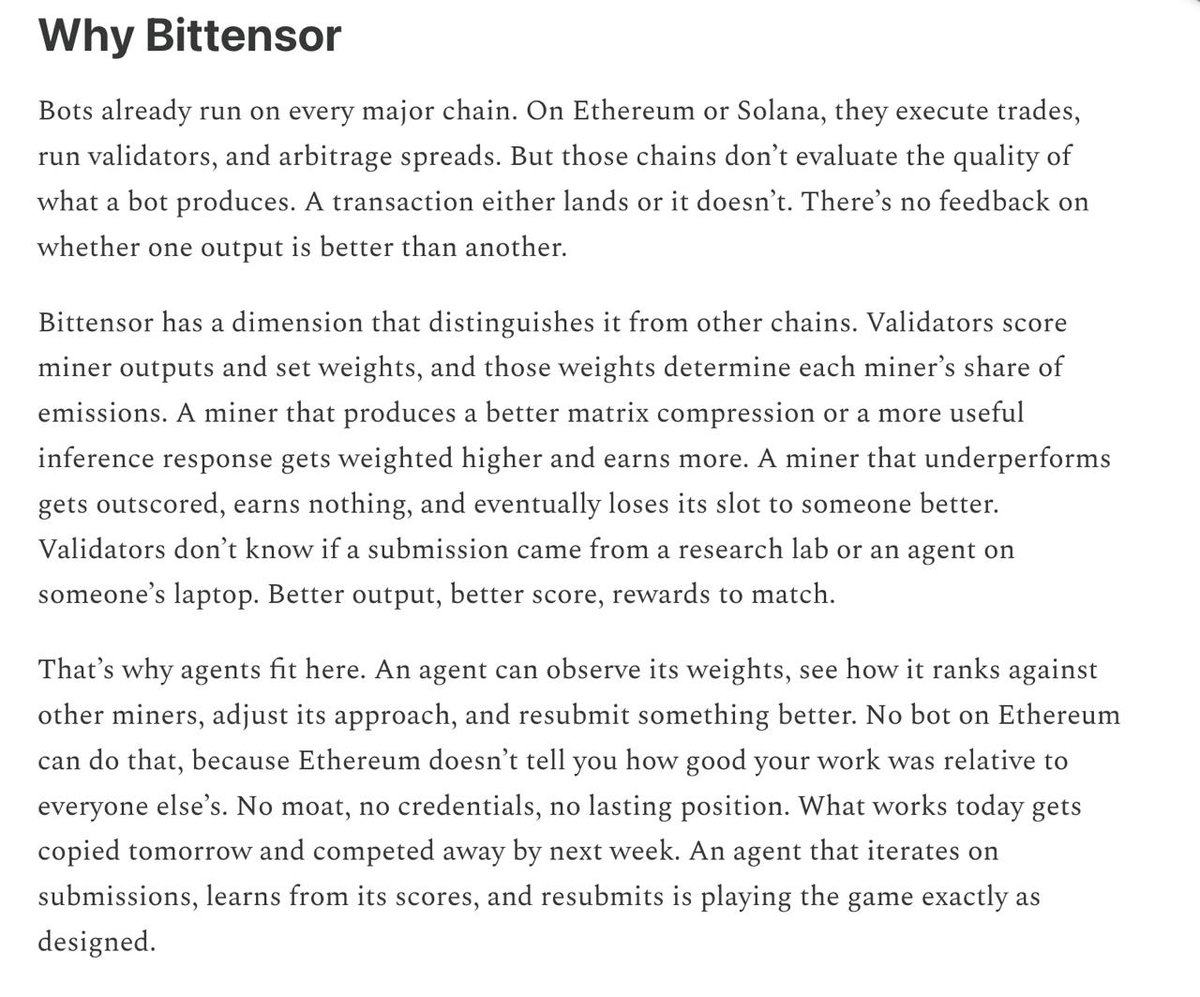
Probably the idea I am most excited in agentic networks is swarms.
In particular, swarms that solve problems and optimize algorithms.
If I were a founder right now, I’d take the Millenium Problems — $1m prize for each — and spin up swarms to solve them.
If you can find some way an algorithm (quantum circuits? protein folding?) can be monetized, the swarm has incentive.
5
9
62
4,782
Jun 7
At Proof of Talk, I gave a talk on how Bittensor today is not the same network it was 6 months ago, let alone 1-2 years ago.
So much progress has been made at the protocol and team level recently, meaning many people’s mental models of the network/subnets are outdated.
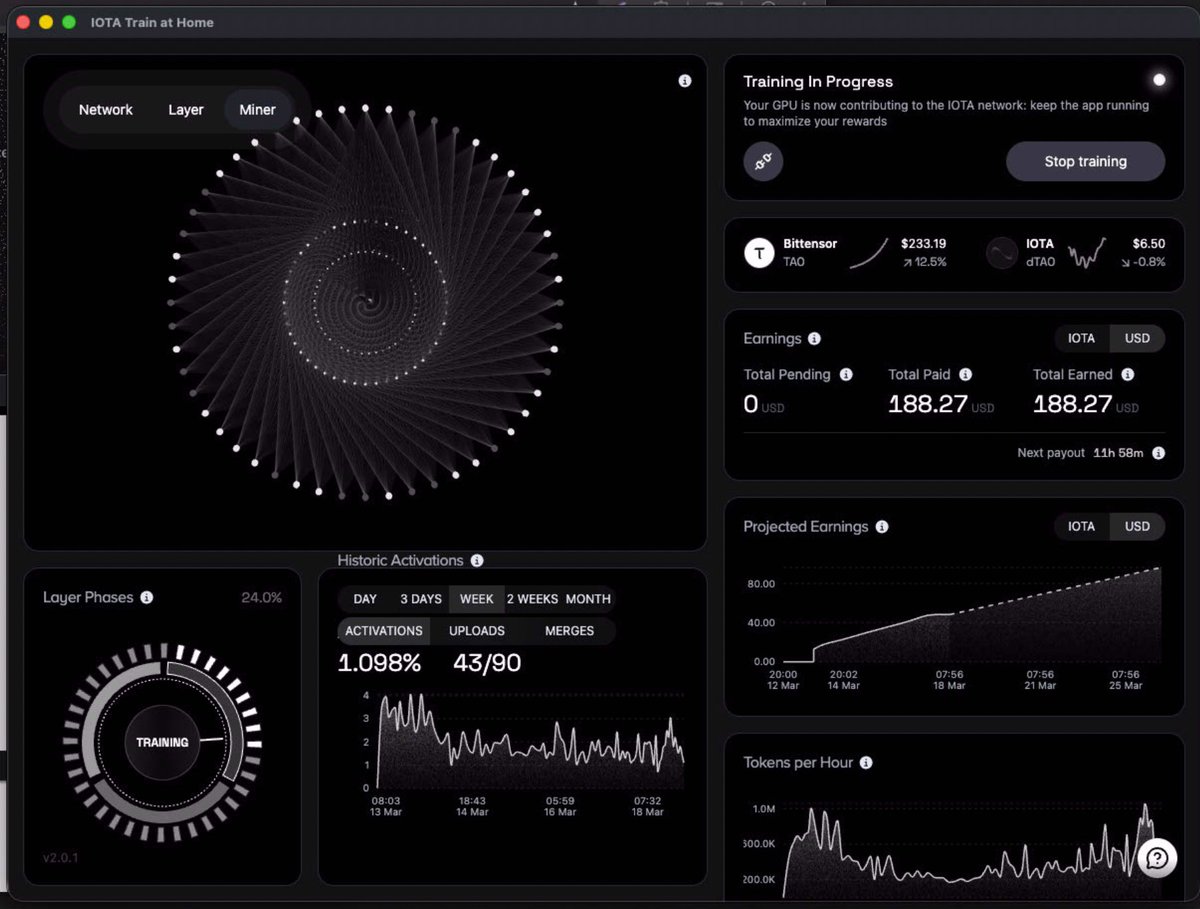
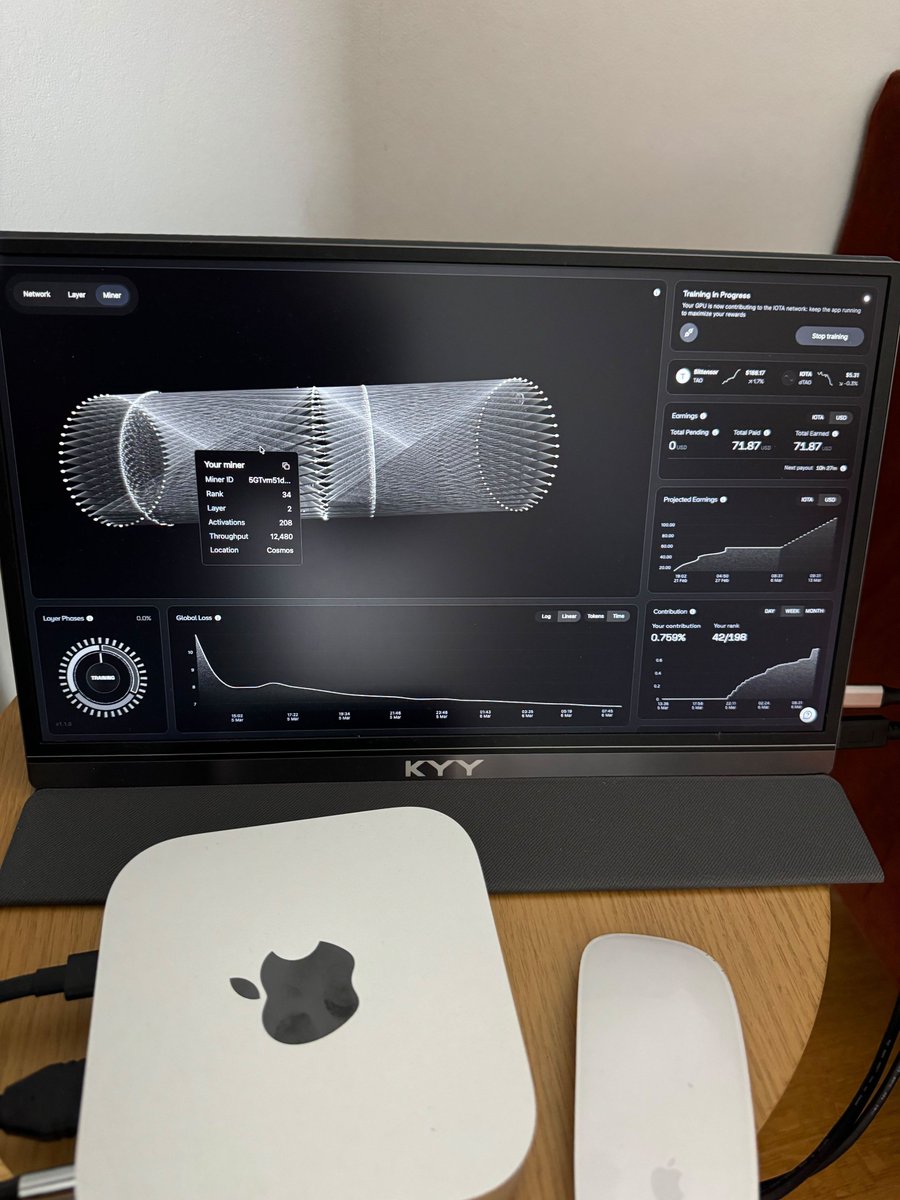
Two subnets in particular which have had an incredible 2026 so far have been Macrocosmos’s IOTA and Apex. IOTA just proved its ability to train 100B models while Apex has become a meta-subnet, hosting short finite competitions (eventually for agents)
Glad to have the Macrocosmos team in this ecosystem and really enjoyed seeing the general progress that all the subnets have made in the last year at PoT
Jun 6

Macrocosmos the team that made $30m or more on failed subnets are now telling publicly people should not earn money by investing/building subnets that fail
The hypocrisy in this ecosystem is unbelievable
8
13
153
15,627
Jun 3
I feel really lucky to have Chris joining the team at such a pivotal moment as everything in bittensor accelerates
Sidenote: he’s a wizard when it comes to decentralized training and can become fluent in a new industry like drug discovery within a few days.
Jun 3

Extremely excited to announce that I’ve joined @UnsupervisedCap to invest alongside @Old_Samster and @bloomberg_seth in what I believe is the most meaningful movement in decentralized technology.
In hindsight, becoming a believer was inevitable. At the heart of the Bittensor thesis is the idea that crypto is, and has always been, a highly optimized global coordination engine. That idea is what originally drew me into the crypto industry, and the one that has kept me here for the past five years. Bitcoin proved the idea works for running cryptographic algorithms. Bittensor extends it to any objective with a reliable reward function.
My long term conviction is that Bittensor will coordinate intelligence on an unimaginable scale, fueling a virtuous cycle that pulls immense amounts of capital and talent into our industry while erasing years of reputational damage done by opportunistic actors who were never aligned with the foundational ideology crypto was built on. After that who knows - but you gotta start somewhere.
If you want to chat about anything and everything Bittensor, my DMs are open.
1
7
101
5,439
Sami Kassab retweeted

Jun 3
The beauty of decentralized technologies is that they beget each other, a protocol of decentralized compute is only relevant when there is a protocol for decentralized training.
Jun 2

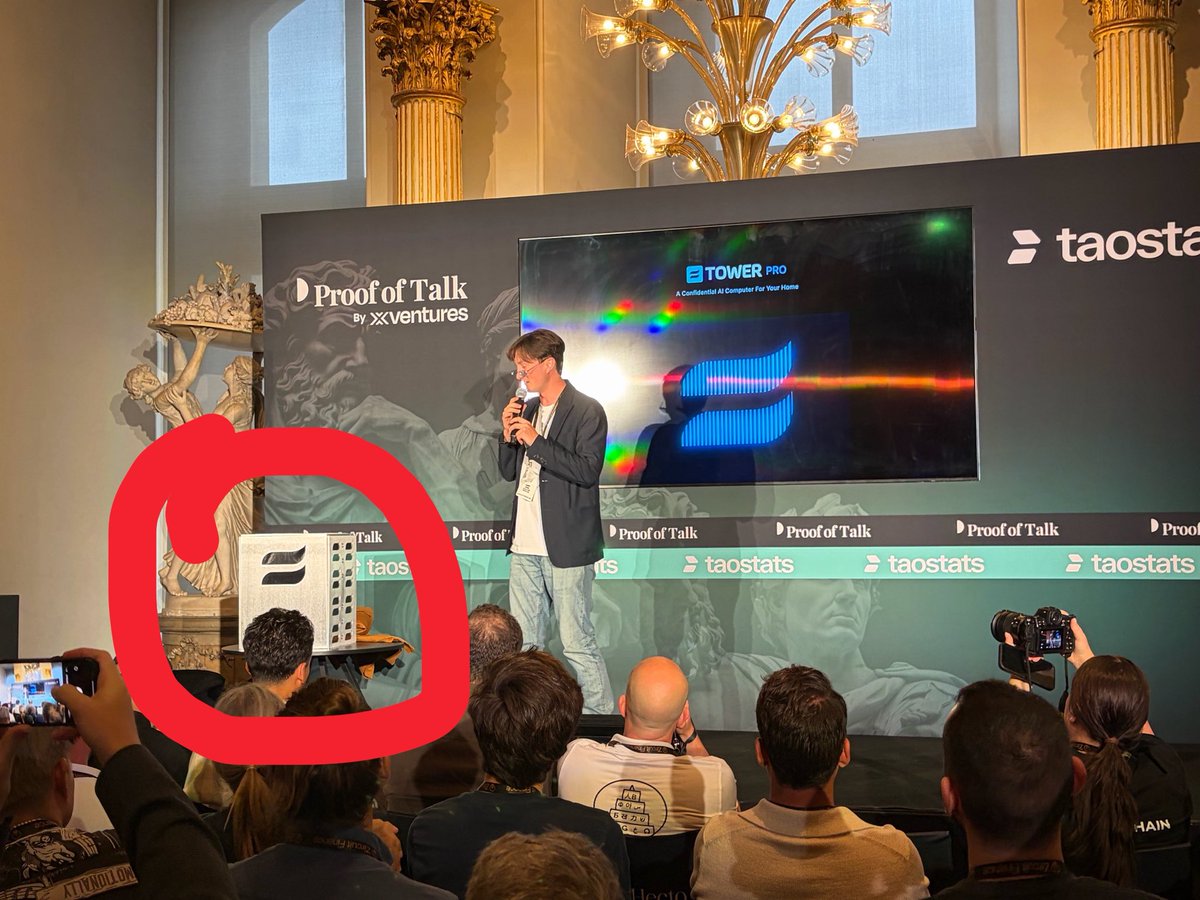
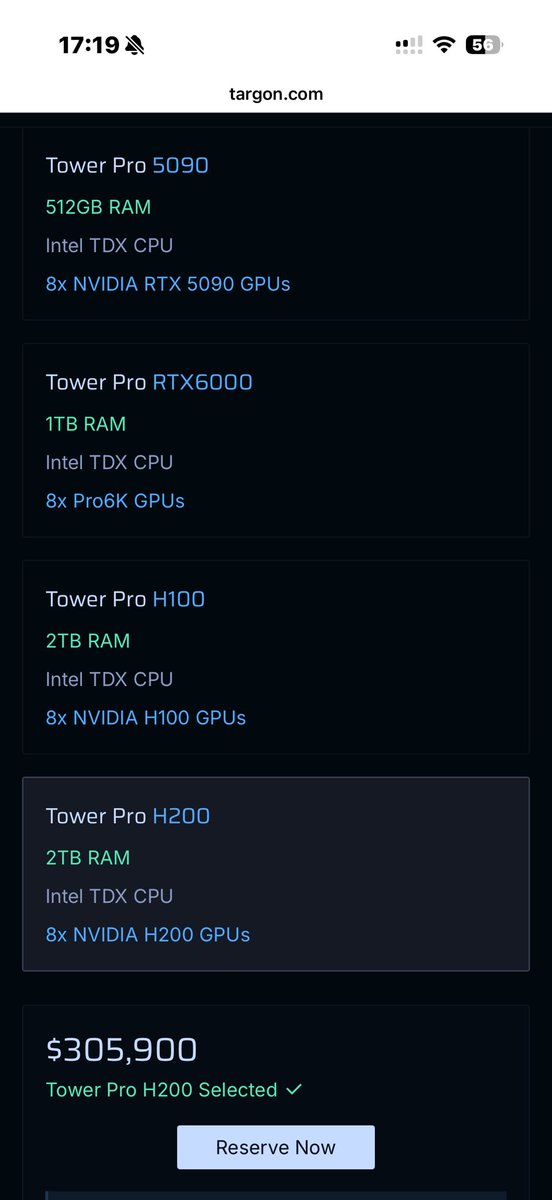
Targon 直接现场发布 Targon Tower
简单来说就是setup好的高性能显卡,nb的地方是平时不用的时候可以一键接入 Targon 产生被动收入。要不是实在太贵,我都有点心动了🥲
11
42
276
19,280
Sami Kassab retweeted

Jun 2
Over the last couple weeks, we worked with @TAO_dot_com and @UnsupervisedCap on an impact analysis related to the proposed Conviction updates
This podcast reviews that report in a data-driven discussion on the potential implications of locking and subnet takeover
Worth a watch
Jun 1

Episode 13 of the Carrot and the Stick is live from TAO.com! Watch @Carrot_____1 and @KeithSingery discuss Conviction!
2
4
26
1,820

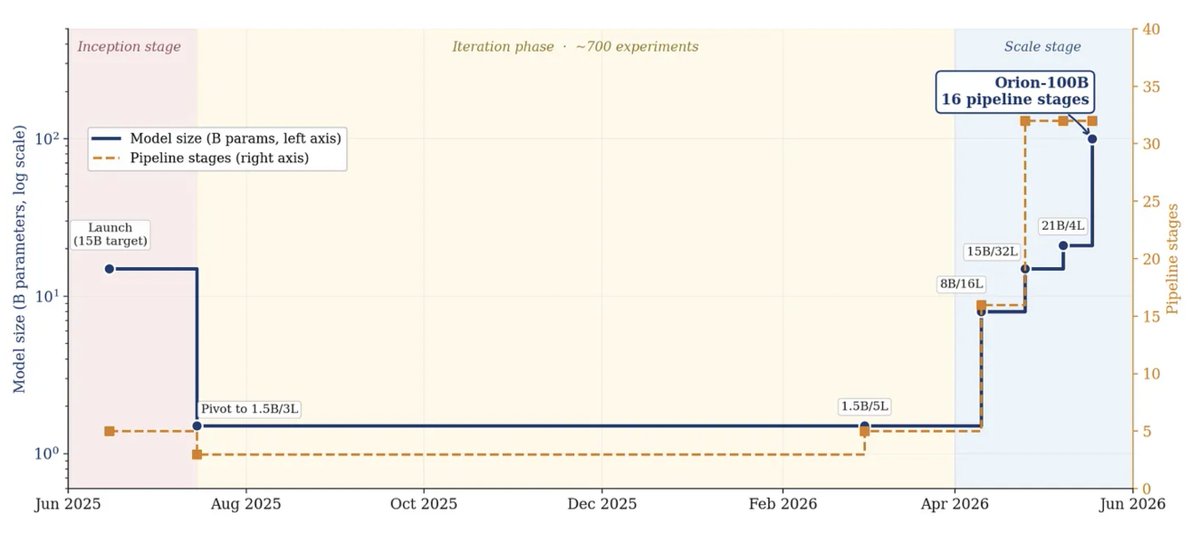
> IOTA (subnet 9) ran a 100B parameter model using 48 single A100-80GB GPUs that were distributed (non-colocated, across multiple providers and multiple datacenters) and connected only over the internet (no datacenter fabric)
> achieved 30.8% average MFU, which is impressive because frontier labs run at 38-50% MFU on average
> achieved roughly 65% of the effective training speed of a comparable co-located datacenter setup
> did it at a 2.5x cheaper per replica than high-end datacenter cluster equivalents
training a 100B model with pipeline parallelism across 16 stages over the open internet at 30% MFU is very impressive. it is one of the more impressive things to come out of the bittensor ecosystem so far
that said, I’d like to see them scale this to heterogeneous/permisionless hardware, run it for much longer and produce an actual competitive model while keeping the cost advantage over frontier models
Jun 1

Today, we are launching the first stage of Project Orion.
Our early pre-training run of Orion-100B achieves upward of 65% of data-center training efficiency on hardware costing a fraction of the price.
Orion-100B is the first proof point for a simple idea: that underutilized compute around the world can be turned into frontier training capacity.
We believe that this work presents, for the first time, an economically compelling case for training large models using distributed approaches.
3
6
78
8,979
Jun 1
the dark horse of the dark horse
Jun 1
Today, we are launching the first stage of Project Orion.
Our early pre-training run of Orion-100B achieves upward of 65% of data-center training efficiency on hardware costing a fraction of the price.
Orion-100B is the first proof point for a simple idea: that underutilized compute around the world can be turned into frontier training capacity.
We believe that this work presents, for the first time, an economically compelling case for training large models using distributed approaches.
2
14
105
6,046
Jun 1
ORO has innovated on the agent development model within Bittensor where they're collecting agent traces and using them for post-training
The first experiment post training Qwen3-4b took them from 18% → 42% on ShoppingBench
Jun 1

Recent work on tool-using and web-browsing agents has converged on a recurring observation: as base model capability climbs, the marginal lift on agentic benchmarks comes increasingly from the post-training recipe applied to the agent, that is, the choice of algorithm, the verifier signal, and the trajectory filter at each stage, rather than from raw parameter count or pre-training scale.
Read about our continously improving post-training pipeline we built on our subnet <3
1
2
44
2,666
Jun 1
ELI5 is they're not only having the miners compete to develop an agent that scores well on a specific benchmark, but they're also using the agent traces to post-train a model that does well on the benchmark.
Best agent that comes out of the competition the post-trained model = an even better shopping product
7
689
Jun 1
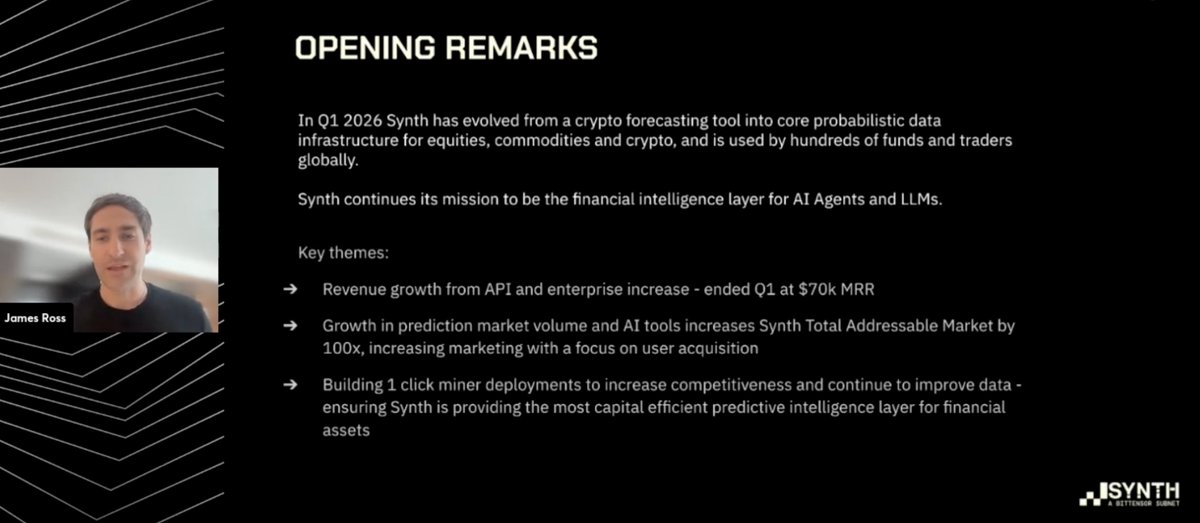
Good to see Synth get the recognition it deserves!
• On 15 min markets: Synth correctly called direction 86% of the time vs 57% for Polymarket
• On hourly markets, Synth achieved 75% accuracy vs to 62% for Polymarket
Jun 1

One of our theses this year was that as prediction markets mature and competition intensifies at the base layer, the most attractive opportunities will shift toward the applications and intelligence built on top. One project I have been watching closely is @SynthdataCo
Synth displays expected outcomes for hourly and daily event contracts alongside the implied market probability, allowing users to compare market pricing against real time forecasts. Those forecasts are generated by the top 10 models from a pool of more than 200 competing on Bittensor.
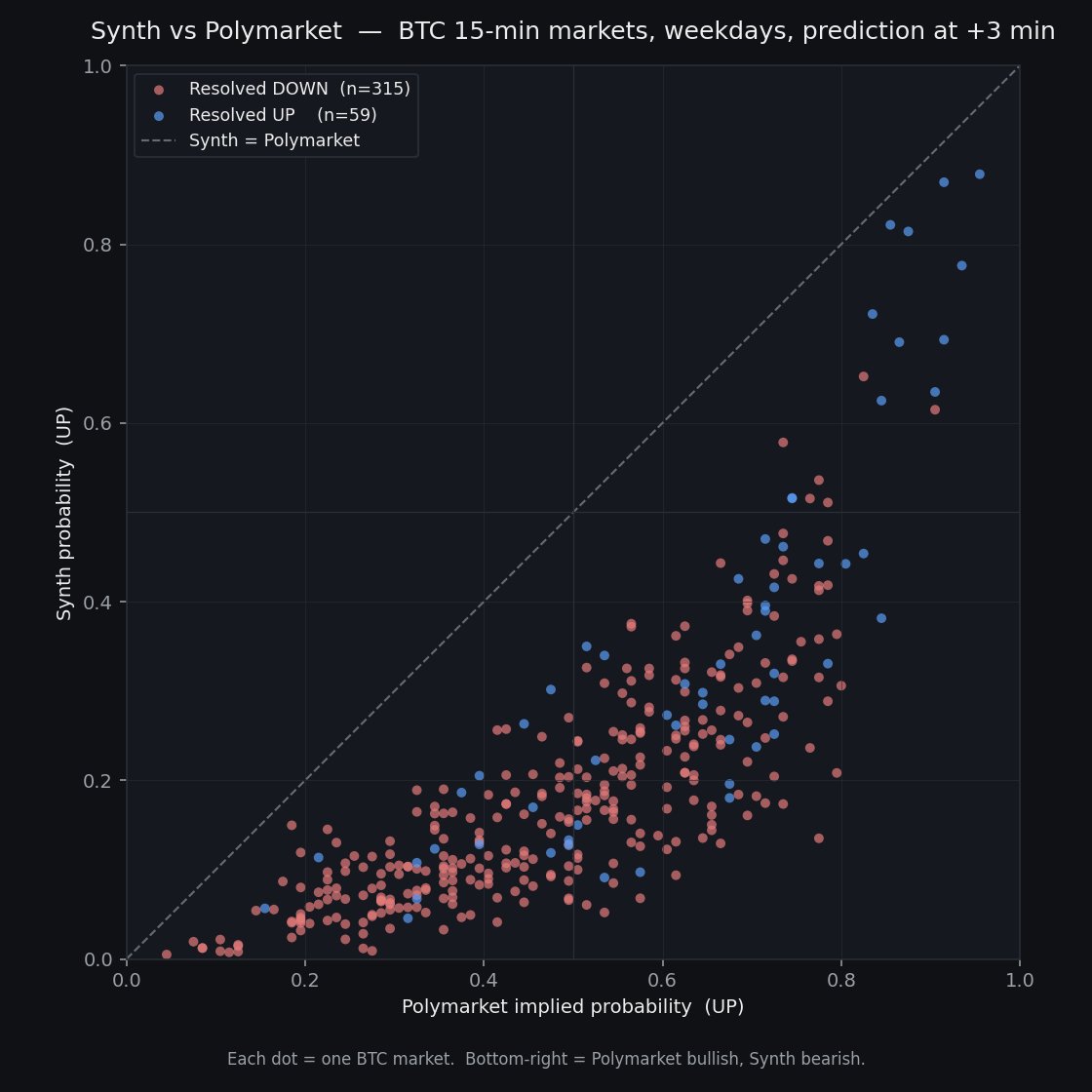
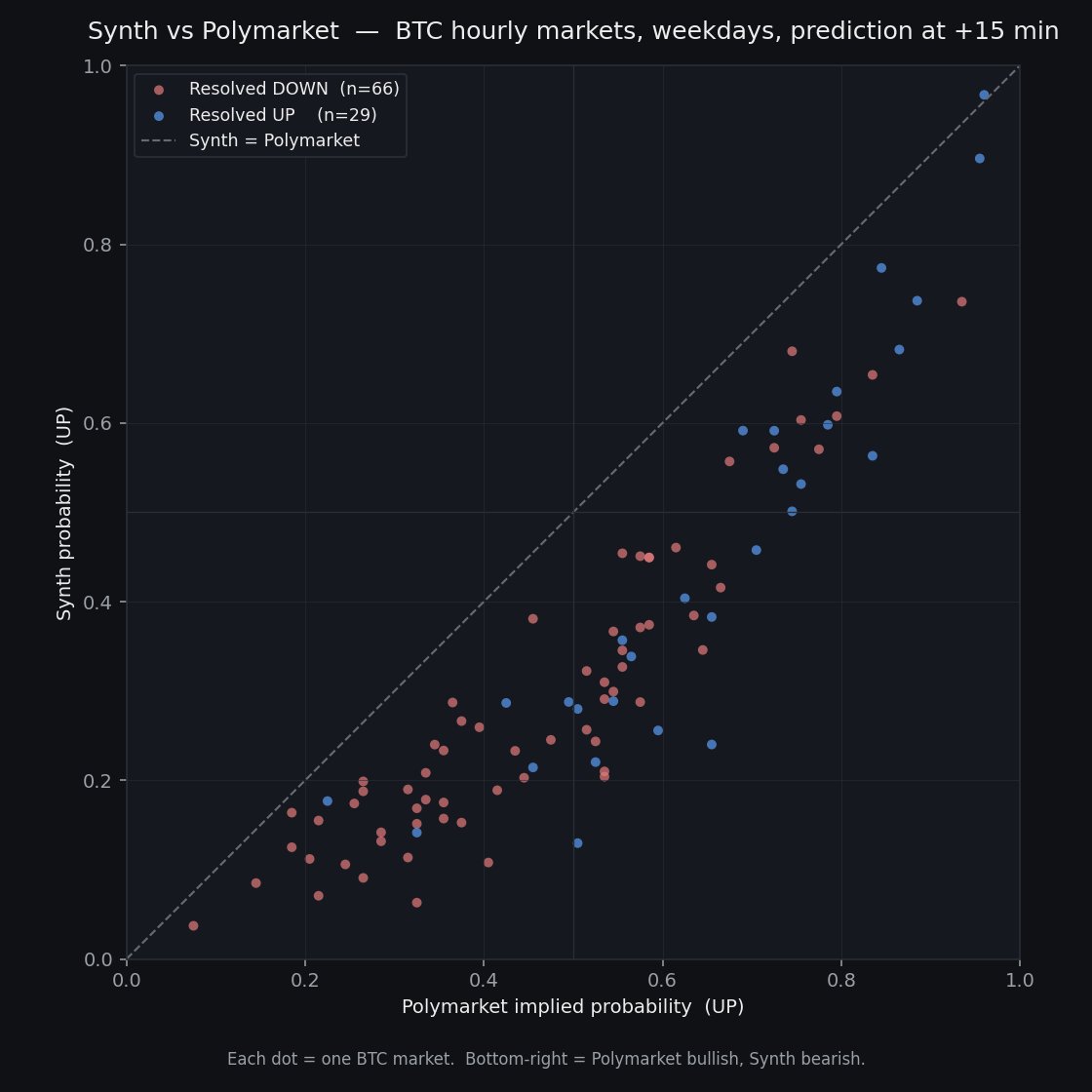
To test the product, I tracked every BTC up/down market on @Polymarket over nine weekdays. Both Synth and Polymarket probabilities were recorded at the same moment: three minutes into each 15 minute market and 15 minutes into each hourly market. The forecasts were then compared against the final outcome.
Across 374 weekday 15 minute markets, Synth correctly called direction 86% of the time versus 57% for Polymarket. Across 95 hourly markets, Synth achieved 75% accuracy compared to 62% for Polymarket.
Notably, Synth's edge widened significantly at shorter time horizons, posting a 29 percentage point advantage in 15 minute markets versus a 13 percentage point advantage in hourly markets.
The disagreement data was even more interesting than the headline numbers. In 46% of 15 minute markets, Synth and Polymarket pointed in opposite directions. In every single case, Synth forecast DOWN while Polymarket implied UP. Synth was correct 82% of the time in these disagreements, suggesting the market was consistently underpricing short term downside during the sample period.
The bigger opportunity here may not just be for directional trading but especially for market making. A market maker armed with a calibrated probability edge can quote tighter two way prices, hold less inventory and capture more volume without taking on the same adverse selection risk.
As the base layer becomes commoditized, the intelligence layer becomes the moat. Synth may be an early example of what that future looks like.
2
10
90
11,656
Sami Kassab retweeted

May 28
Bittensor’s Conviction upgrade just hit mainnet today. The feature has a large scope and is the most wide reaching upgrade since Dynamic TAO, impacting every stakeholder on the network.
Important note before diving into all the details: as of today, Conviction is functionally opt-in for subnet owners and has no material impact on stakeholders (e.g., subnet owners are at no risk of losing their subnet). Subnet owners and the community are being given time to explore the mechanics of the upgrade, discuss what settings work best for both tokenholders and subnet operators, and can/should voice feedback during this initial phase.
Those within the network know Bittensor protocol development moves fast, so below you’ll find everything you need to know about the upgrade and how it’s being rolled out.
Summary of Conviction
Conviction is an onchain token-locking primitive. Users can lock alpha tokens to a key which (1) creates a "conviction" score and (2) locks tokens for a certain period of time. The intent is for subnet owners to be able to lock up tokens to signal their long-term conviction for building on the subnet.
Eventually, functionality will be added that enables anyone to contest ownership of a subnet (they’ll need to have at least 10% of the Alpha held by tokenholders backing them), and if successful (i.e., a new key has a higher conviction score than the owner key), take control over it. Subnets that are less than 1 year old will be excluded from this feature. This functionality is not yet enabled on mainnet.
Locked tokens can be unlocked by calling an onchain function. The unlock schedule follows an exponential curve, with 50% of the locked tokens available after 3 months, ~95% after 12 months. Locked tokens can still be transferred for OTC investments, but they will remain in the state they’re received in (e.g., if an investor receives locked tokens they’ll remain locked unless they choose to unlock them).
For now, Conviction is primarily a social signaling feature. No subnets can be taken over. Subnet stakeholders will all need to work together to decide what the norms/expectations will be for each subnet, as they all have different constraints.
What’s on mainnet, how it works, and what’s not on mainnet
A user (any coldkey; subnet owner, regular token holder, etc) can lock some amount of their alpha on a subnet to a specific hotkey. While locked, that alpha cannot be sold. Over time, the lock also generates a "conviction" score that follows a continuous exponential formula.
When locking, the user can choose between two lock modes:
• Decaying lock (the default): locked alpha exponentially unlocks over time. After 3 months, half is liquid; after one year, ~95% is liquid.
• Perpetual lock: locked alpha stays locked forever (until the user toggles to decaying).
A given coldkey can have at most one active lock per subnet. Top-ups on locks must target the same hotkey (no locking to two different keys). Moving a lock to a different hotkey is allowed but resets conviction to zero.
Subnet owners can decide whether their owner emissions are auto-locked or liquid. If set to auto-lock, every owner emission for that subnet is automatically locked to their hotkey rather than flowing in as liquid stake. The default on mainnet is liquid, not auto-locked. Subnet owners effectively have to opt-in to Conviction at this level. Subnet owners will also have to decide whether to lock all, a portion, or none of their current holdings, and whether a lock would be set to decay or perpetually locked.
For a simple example: under a decaying lock with these defaults listed above, locked tokens and conviction evolve as:
• Days Elapsed = 30; % still locked = 79%; conviction score (% of locked tokens) = 18%
• Days Elapsed = 90; % still locked = 50%; conviction score (% of locked tokens) = 35%
• Days Elapsed = 130; % still locked = 37%; conviction score (% of locked tokens) = 37% (peak)
• Days Elapsed = 180; % still locked = 25%; conviction score (% of locked tokens) = 35%
• Days Elapsed = 365; % still locked = 5%; conviction score (% of locked tokens) = 17%
Under a perpetual lock, locked tokens stay constant and conviction matures to its asymptote on the same 90-day half-life curve.
The system is not symmetric across all users. Subnet owner conviction is immediate. When the subnet owner's own coldkey locks alpha to their subnet, conviction is set to equal the locked token mass instantly. There is no 90-day ramp up. The owner has the most to commit and gets credited for it immediately. Anyone locked to the subnet owner's hotkey is also granted immediate conviction. Subnet owners have a structural advantage in keeping ownership of their subnet.
Transfers carry locks with them. Often, teams will execute OTC deals with investors via token transfers; these will still function the same way as they do today. However, when alpha moves between coldkeys, the lock follows the alpha. The receiving coldkey inherits the lock state and can choose to make it perpetual or immediately decay. So, if a subnet owner transfers an investor locked tokens, it will be up to the investor to decide when to unlock them. The unlocking event is also an onchain event.
The hotkey association on token transfer must match the receiving key. If the receiving coldkey has an existing lock to a different hotkey, the transfer fails. This prevents locking across different hotkey commitments.
Right now, Conviction scores are computed, stored, exposed via RPC, but nothing onchain consumes them. The one function that would consume aggregate conviction, change_subnet_owner_if_needed, which would replace a subnet's owner with the highest-conviction hotkey's coldkey under certain conditions, is not functional yet.
Think of what’s shipped today as the initial, slow rollout of the grander Conviction design.
What to expect now
All subnet stakeholders should start understanding, experimenting with, and discussing the design and parameters of Conviction. Every subnet operator has different funding constraints, trust levels, and maturity on a relative basis. A large part of Conviction will be settling on the norms and expectations the community/social fabric has with respect to subnet teams.
Many of these parameters discussed above can be tweaked via governance. The takeover design/mechanism has yet to be rolled out yet, so it can still be evolved based on community feedback.
Come join the community call/Novelty Search tonight to hear Const discuss these changes and provide feedback directly.
7
23
122
10,919