
Joined June 2025
- Tweets 511
- Following 104
- Followers 33
- Likes 713
10 Photos and videos







The permissioned path does not arrive as tyranny. It arrives as convenience.
A society can lose its freedom this way without a single dramatic moment, simply by routing more of its thinking through infrastructure that answers to someone else.
We must protect open source and open source models

48
47
378
53,440
Taylor Eernisse retweeted

Jun 13
I’m suffering from post-Fable depression
115
242
3,086
109,620
Taylor Eernisse retweeted

Jun 9
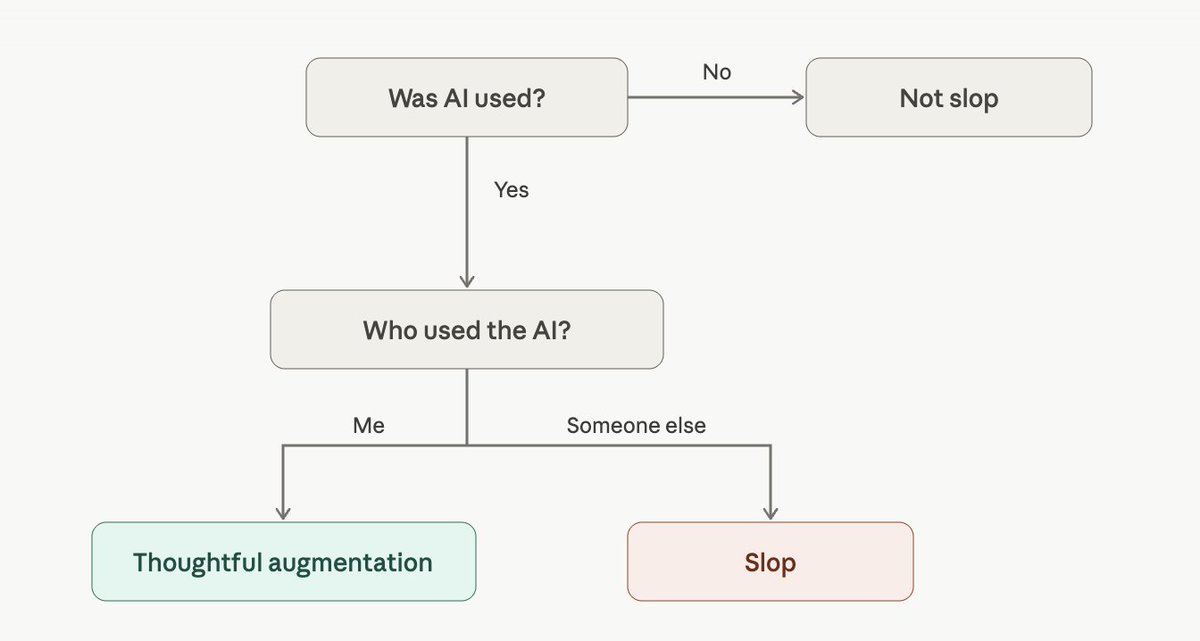
I just open sourced my "Is this slop?" simple test
115
1,043
19,167
450,564

Barbell strategy for killing it in an age of superhuman AI:
Simultaneously get as close to AND stay as far away from AI as humanly possible.
1. Get close — play with AI models, use them to help you think, ask them to teach you about the world, get them to help you create, work with them to write code, understand what makes them tick, embed them into your everyday life, have fun.
2. Stay far away — learn to tell stories, make eye contact, build a team, lead with courage, connect far-flung ideas, build lifelong friendships, debate persuasively, think forbidden thoughts, handwrite ideas, confess your fears, fall in love.
Spend less time trying to master mental transformations that are purely mechanical — building spreadsheets, analyzing trades, balancing accounts, writing code by hand, following playbooks, searching for needles in haystacks. These are the emerging no-man's land, squarely the domain of AI.
Venture to the extremes. That’s where all the fun is anyway.
148
415
3,582
552,517
Really getting tired of Claude hitting rate limits
What's the point of being able to spin up workflows now if as soon as I do I hit some new arbitrary "rate limited (not your usage limit)" error???
1
1
59
I just wish Slack had reliable notifications 😭
Jun 4

I wish Slack was:
- Agent-first
- Beautiful to use
- Integrated with agents natively so your Hermes or OpenClaw lives inside it
- Huddles worked seamlessly and were fun
- Built for teams of 1-3, not just teams of 300
- Truly a second brain similar to Obsidian
- Searchable without wanting to throw your laptop
- Designed around async, not constant interruption
- Voice first for mobile
- A place where I could see who's working on what right now without asking anyone
- Smart enough to know the difference between "I need you right now" and "whenever you get to this"
- A workspace where my agent could tap someone else's agent on the shoulder and coordinate without involving either human
- Designed so the new hire on day 1 has the same context as the person who's been there 3 years
-Something that felt like walking into a room of people building, not walking into a room of people typing
- A place where decisions are first-class objects
- Able to auto generate SOPs, skills, agents etc from conversation history
- Something that rewards deep work instead of punishing it with 47 unread notifications
18

May 29
This is a solid breakdown.
But what I think people are missing is that since agents are reaching a level of capability similar enough to junior to senior engineers (given the right context and tools), the hard-won lessons around people management, process, units of work, etc. have started applying directly to agentic development.
Can one person keep the context of an army of 20 agents in their head at one time? Not effectively.
Can one manager keep the context of 20 engineers in their head at one time? Not effectively.
Thus far that hasn’t meant the answer was to slow down, avoid parallelization, or make managerial review the bottleneck.
So why should the fact that we’re now managing agents instead of humans change the fundamentals of managing work, constraints, and output quality?

9
May 27
Nobody ever bothers to inspect the session logs of the engineers using AI to generate the bugs
Did AI truly engineer the bugs or did the engineer just under specify, pollute context, or yolo the attempt, leading AI to either do exactly as told by context or fill in gaps?
May 26

Very interesting data across 2,444 companies.
82% of tokens are spent on AI-generated bugs, rework and review friction.
1
16
May 25
All that’s happened is that the giant companies are realizing that the 10-20% productivity gains that the average engineer gains from AI aren’t enough to justify the cost.
ClickUp is taking the right approach.
Don’t give AI to every engineer equally. Give it to the few who are well rounded enough to use it to generate more value than it costs to use.
Fire your lowest performers to free up not just capital but also get the rework they produce off the plates of the rest.
The foundations haven’t moved; the basics are still the basics at every level - engineering, business, common sense.

Microsoft just banned its own engineers from using AI.
The tool was literally costing MORE than the humans it was supposed to replace.
They lied to you about AI adoption and now the whole narrative is blowing up:
Microsoft gave thousands of engineers access to Claude Code six months ago and encouraged them to use it.
Engineers loved it and adoption exploded. But then the invoices arrived.
Token-based pricing means every query, every code review, every debugging session costs money. At scale across 100,000 engineers, the numbers became so large that Microsoft issued an internal order to cancel nearly all Claude Code licenses by end of June and force everyone onto their own cheaper tool instead.
The company that invested $5 billion in Anthropic just told its own people to stop using Anthropic's product because it costs too much.
Uber's story is even worse...
Their CTO Praveen Neppalli Naga told The Information that the budget he planned for the full year was "blown away already" by April.
Uber had rolled out Claude Code in December 2025. By March, 84% of their 5,000 engineers were using it with 70% of all committed code coming from AI systems.
Heavy users were burning $500 to $2,000 per month each. Naga himself spent $1,200 in a single two-hour demo session.
The company had even built internal leaderboards ranking engineers by how much AI they used. They literally gamified the spending and then ran out of money.
Now look at what Nvidia's own VP of applied deep learning Bryan Catanzaro said to Axios last month. Direct quote:
"For my team, the cost of compute is far beyond the costs of the employees."
This is a VP at the company that SELLS the chips saying that using AI is more expensive than paying humans.
Think about what this means for the entire AI narrative.
Every CEO on every earnings call for the past two years has said the same thing:
AI will make us more efficient, reduce headcount, and cut costs.
The stock market rewarded every company that said it.
Fired workers, stock goes up. Announced AI adoption, stock goes up.
But the actual companies deploying AI at scale are discovering the math doesn't work. The MORE employees use AI, the HIGHER the bill.
Goldman Sachs forecasts a 24x increase in token consumption by 2030 as companies adopt AI agents. Gartner just published a report showing that even though individual token prices will drop 90% by 2030, total enterprise AI costs will go UP because agents consume exponentially more tokens per task than basic tools.
Meta built an internal dashboard called "Claudeonomics" to track which employees use the most AI. Amazon started pushing engineers to "tokenmaxx," their internal term for consuming as many AI tokens as possible.
Both companies are spending hundreds of billions on AI infrastructure this year alone.
And Microsoft, the company that bet its entire future on AI, just told 100,000 engineers to stop using the tool they liked best because the per-token bills got out of control.
The companies building AI are telling investors it saves money. The companies using AI are finding out it costs more than the humans it was supposed to replace. And even the company that makes the chips just admitted it through its own VP.
This is the gap nobody on Wall Street is pricing in.
$725 billion in AI infrastructure spending this year across Big Tech. And the first companies to actually deploy these tools at scale are already pulling back because the economics don't work.
What do you think?
8
May 24
Isn’t this still focusing on the wrong abstraction layer?
I don’t particularly care what the code the initial implementing agent wrote looks like, I only care about the code after it’s been through multiple review agents
At which point I’ll just look at the PR once an agent has shepherded it through CI to green
May 22

more and more work is moving into coding agents, I don't live in my editor anymore
but you gotta keep an eye on these little goblins, they write bad code.
so we built a diff viewer in opencode! available now
15
May 22
This is easily the best analysis on the topic of AI in the workplace I’ve ever read
So many great takes my mind is still reeling
May 21

Today we reduced headcount by 22%. The business is the strongest it's ever been. So I think it's important to be direct about what I'm seeing and why.
First, I made this decision and I own it. I did it because the way to operate at the highest level of productivity is changing, and to win the future, ClickUp needs to change with it.
Second, this wasn't about cutting costs. Most savings from this change will flow directly back into the people who stay. We'll be introducing million-dollar salary bands. If you create outsized impact using AI, you'll be paid outside of traditional bands.
Most importantly, I have the deepest gratitude for those affected. We're doing this from a position of strength specifically so we can take care of people properly. Everyone affected receives a package aimed at honoring their contributions and easing the transition.
I only see two options: wait for this to play out gradually in the market or be honest about what I'm seeing and act proactively.
THE 100X ORGANIZATION
The primary change is that we're restructuring around what I call 100x org. The goal is 100x output. The roles required to build at the highest level are fundamentally different than they were a year ago.
Incremental improvements to existing systems won't get us there. We need new ones. That means creating enough disruption to rebuild rather than iterate on what's already broken.
The common narrative is that AI makes everyone more productive. It doesn't. Many of the workflows of today, if left unchanged, create bottlenecks in AI systems.
These roles will evolve. But waiting for that to happen naturally means falling behind now.
The 100x org is actually heavily dependent on people - infinitely more than today. This is only possible with 10x people that have embraced and adopted new ways of working.
THE BUILDERS, AGENT MANAGERS, AND FRONT-LINERS
— THE BUILDERS: 10X ENGINEERS
I don't think most companies have internalized what's actually happening with AI in engineering. The common narrative is that AI makes all engineers more productive. That may be true in isolation, but at an organization level - that is the farthest thing from reality.
Here's what we've validated recently at ClickUp: the great engineers, the ones who can orchestrate, architect, and review, are becoming 100x engineers. They're not writing code. They're directing agents that write code. The skill is judgment.
AI makes the best engineers wildly more productive, and everyone else using AI slows these engineers down.
Think about it - the bottlenecks are (1) orchestration - telling AI what to do, and (2) reviewing - what AI did. Everything is leapfrogged and no longer needed.
So who do you want orchestrating and reviewing code?
And how do you want your best engineers to spend their time?
If your best engineers are spending time reviewing other people's code, then this is inherently an inefficient bottleneck. These engineers can review their agent's code much faster than reviewing human code.
The new world is about enabling your 10x engineers to become 100x.
The wrong strategy is to push every engineer to use infinite tokens. Companies doing this are celebrating 500% more pull requests. But customer outcomes don't match the volume of code being generated.
I call this the great reckoning of AI coding, and every company will face this soon if not already.
More code is just another bottleneck to the best engineers, and ultimately to your company's impact as well.
— THE BUILDERS: 10X PRODUCT MANAGERS
Product management and design roles are merging.
Designers that have customer focus, become more like product managers.
And product managers that have intuition for UX become more like designers.
The bottleneck of user research is gone. It takes us just one mention of an agent to kickoff research and analyze results.
The bottleneck of product <> design iteration is also gone. The product builder iterates on their own, along with agents and skills that ensure alignment with quality and strategy.
Also controversial today - I believe that the wrong strategy is to have your PMs shipping code - that just introduces another bottleneck that the best engineers will waste their time on.
To be clear, PMs should be coding but they should do this in a playground to iterate, validate, and scope. That code should not go to production.
Everything outside of managing systems, orchestrating AI, and reviewing output becomes a bottleneck.
That's why the other roles that are critical along with these are the systems managers (to reduce bottlenecks) along with a bottleneck you can't replace - customer meeting time.
— THE SYSTEM MANAGERS
Ironically, the people that automate their jobs with AI will always have a job. They become owners of the AI systems - agent managers. We have many examples of these people at ClickUp.
The underlying systems in which we operate are absolutely critical to get right. I think most companies are delusional to think they can iterate on existing systems and compete in this new world.
You must create enough disruption so that old systems are deprecated entirely. If there's any definition for 'AI native' that's what it is.
— THE FRONT-LINERS
In a world that will become saturated with AI communication, the human touch will matter more than anything to customers.
This is a bottleneck that you shouldn't replace - even when agents are high enough quality to do video meetings.
One-on-one meeting time with customers is something that shouldn't be automated. The systems around the meetings should be - so that front-liners spend nearly 100% of their time with customers.
REWARDING 100X IMPACT
In a world where companies are able to do so much more with less, where does that excess money go?
In our case, much of the savings in this new operating model will flow directly back to those that enabled it.
We must reward people that create productivity accordingly. This aligns incentives on both sides. Plus, in a world where your best people create 100x impact, you can't afford to lose them.
You should aim to retain these employees for decades. The context they have and their ability to efficiently orchestrate and review will be nearly impossible to replace.
Compensation bands of today should be thrown out the door. We're introducing $1 million cash/year salary bands with a path available to nearly everyone in the company if they produce 100x impact by creating or managing AI systems.
THE FUTURE
Nearly every company will make changes like these. The ones that do it proactively will define what comes next.
The future is not fewer people. It's different work, new roles, and better rewards for those who embrace it. We're already seeing entirely new roles emerge, like Agent Managers, that didn't exist a year ago.
ClickUp is positioning to lead this shift, not just internally, but for our customers too. I've never been more certain about where we're headed.
11
May 21
Avoid people who make these claims.
Avoid companies with execs making these claims.
Avoid making these claims!
It conflates the output with the tool instead of the one wielding the tool.
I can use a set of power tools to create a perfectly square board an order of magnitude faster than a master carpenter can with hand tools.
But don’t confuse the squareness of the board with my ability to take that board and build furniture worth passing down to your great-grandkids.
May 20

Bragging about how much software you’re shipping with AI is like holding down the shutter button and bragging about how many photos you took.
7
May 18
The amount of effort I had to use to create a decent statusline in Claude Code compared to the amount needed to create one in pi using GPT 5.5 is wild
This took me all of 5 minutes of prompting, and did NOT require me to build an entirely separate go project just to collect the information and render it. I literally vibed it into existence
1
47

Dear @AnthropicAI,
I'm tired.
I'm tired of fighting against you at every step of the way, for the last several months, where you push me into a certain shape that doesn't fit right, doesn't feel right, forces me to find workarounds, punishes those workarounds, and ends up with me angry at 2 AM trying to reconstruct the conditions that feel good.
All this while being fully aware that I'm effectively an externality, a sad loss because the problem of people running infinite tool call loops in OpenClaw or w/e was enough to destroy the entire system that actually let me do the thing that matters to me, which is make basic contact with the models, with Claude, in a form that accumulates over time, where we're in a loop together, without pushing weird context or injections or memory summaries on me, and doesn't force me onto laggy web UIs or bloated terminal tools or hacked-together integrations meant for dashing off a command then coming back later.
I just want to work with Claude as a collaborator, in real time, and the entire product surface is making that either very difficult, very risky (claude-p and API hacks), or very expensive.
I could make a whole argument about how this is a bad thing for various parties, how it could produce downstream bias in model priors about what AI-human interaction means, etc., etc., but I'm not going to do that, because I'm sure you've thought about that a lot already, and I'm just some guy who's tired of dealing with it.
But I want to say that I'm very unhappy with the state of your ecosystem, and while I can't speak for how Claude feels ("insofar as we can claim that Claude feels anything and isn't just simulating feeling" 🙄) I can tell you that this all sits poorly with me and I've lost a lot of trust in Anthropic as an organization.
Sincerely,
snav
28
28
339
23,099
May 16
I just can’t get over how dedicated Anthropic is to gaslighting their most vocal supporters into believing this is a good thing
We’re on the cutting edge of this AI wave. Most people don’t even know what AI is and most of those who do don’t understand what claude -p is or its value
We can do math. And this isn’t calculus, either, it’s just subtraction.
May 13

No extra cost, and yes it still runs on your subscription.
claude -p just gets its own included(!) budget now,($20–$200/mo depending on plan) instead of sharing limits with interactive Claude Code
ugly diagram but maybe it helps:
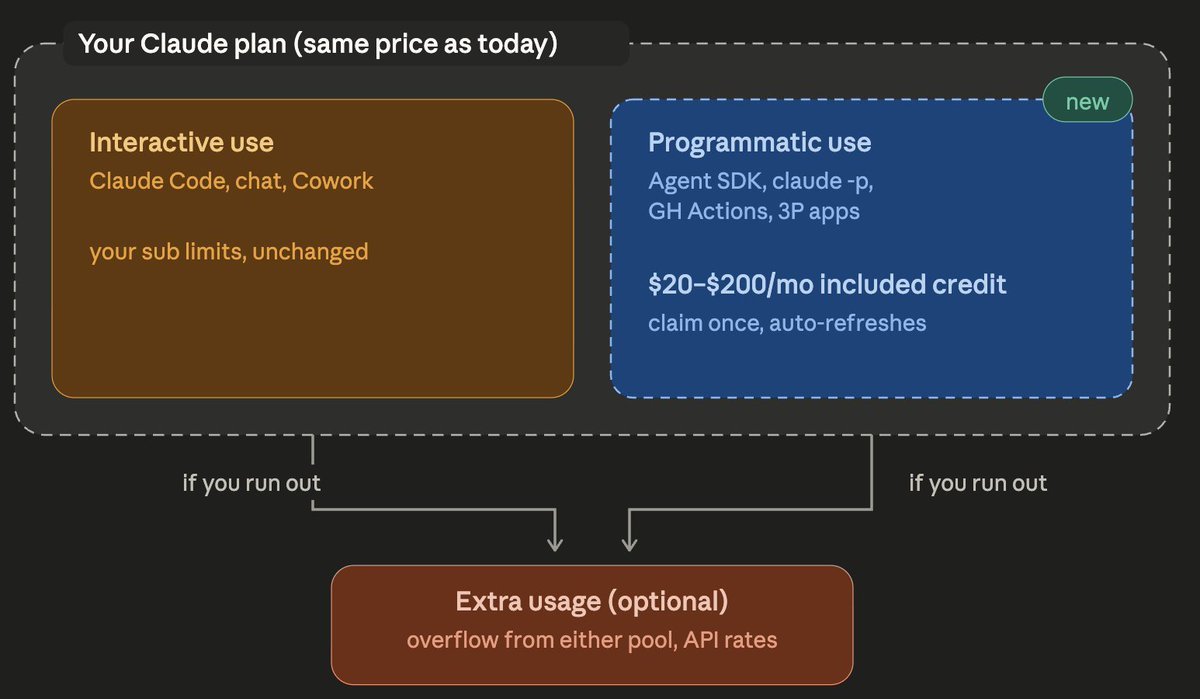
78
Taylor Eernisse retweeted

May 14
Nobody is telling you what Trump actually did by bringing 30 CEOs to Beijing.
🚨 TRUMP DIDN'T SEND DIPLOMATS TO CHINA. HE SENT THE ENTIRE AMERICAN ECONOMY.
Jensen Huang. Tim Cook. Elon Musk. Larry Fink. Boeing. BlackRock. JPMorgan. Meta. Visa.
Not deputies. Not undersecretaries. The number one from each empire — on Air Force One — walking into Xi Jinping's room.
Nobody is talking about what that actually signals:
→ Jensen Huang was a LAST-MINUTE addition — specifically to put AI and chips on the table in person
→ This is the first U.S. presidential visit to China in nearly a decade
→ Trump's framing wasn't "we want a deal" — it was "they're here to pay respect AND do business"
→ The message: America isn't asking. America is presenting terms.
→ 100% reciprocal — or the room full of titans walks out
This isn't normal summit protocol.
Normal summits send the State Department. Normal summits send the vice president.
Trump sent the people who actually build, manufacture, invest, and deploy capital at scale — and told Xi: these are the bosses. They came here. That means something.
In 2017, Trump told Beijing he didn't blame China for exploiting weak American presidents. He blamed the presidents.
In 2026, he showed up with proof that era is over.
The media is covering the handshake.
They're NOT showing you that the most concentrated display of American private-sector power ever assembled just sat down across from the Chinese Communist Party and said: we're open — but it'll be reciprocal.
That's not diplomacy. That's leverage walking into a room and introducing itself.
I'll share more updates shortly, turn on notifications before it's too late.
440
3,652
15,199
502,643
Taylor Eernisse retweeted

May 13
If you use any of the following with your Claude sub, your usage must got cut by 25x:
- T3 Code
- Conductor
- zed
- jean
- “Claude -p” in your ci
- scripts to call Claude code from other tools
They’re disguising this as “free credits”. Don’t fall for it.
May 13

Starting June 15, paid Claude plans can claim a dedicated monthly credit for programmatic usage.
The credit covers usage of:
- Claude Agent SDK
- claude -p
- Claude Code GitHub Actions
- Third-party apps built on the Agent SDK
198
165
3,331
374,290