
Joined May 2015
- Tweets 2,470
- Following 182
- Followers 1,799
- Likes 6,278
11 Photos and videos








Tim Benbow retweeted

100% this👇
It's easy to talk, as the Prime Minister did at Munich bigging up the deployment of HMS PoW at the heart of an ASW task group, but when our Allies see that this resulted in an airwing of just 4 helicopters and 1 DDG escort, the credibility gap widens ever more...

HMG is lining itself up for a punishing month with its allies. The UK has been at the heart of designing NATO's defence plans. Those plans specify what allies agreed was necessary to ensure deterrence. Allies made commitments as to what part of the plan they would resource. 1/9
1
7
30
2,337
Tim Benbow retweeted

HMG is lining itself up for a punishing month with its allies. The UK has been at the heart of designing NATO's defence plans. Those plans specify what allies agreed was necessary to ensure deterrence. Allies made commitments as to what part of the plan they would resource. 1/9
7
111
401
84,769
Tim Benbow retweeted
Indeed. The Treasury absolutely has its own view & strategic framework, based on its own parochial interests (as with any other department), that it pushes extremely hard, but @BenZaranko is correct - ultimately if Cabinet directs it to finance defence the Treasury *will* respond
Jun 11

It's easy to bash the Treasury here. But it's the Treasury's job to make the sums add up, so that we meet the fiscal rules, etc. The core problem is the government *as a whole* has committed to spend 3%, then 3.5%, of GDP on defence but doesn't want to pay for it.
3
2
10
809
Tim Benbow retweeted

Jun 13
Je vais partir du principe que tu es de bonne foi, parce que ton raisonnement est intuitif et que 90% des gens le partagent. Mais il repose sur trois erreurs factuelles, et ça vaut le coup de les regarder calmement.
Erreur 1 : la fortune d'Elon n'est pas un tas d'argent. C'est de la propriété d'usines, de fusées et de satellites. "Prendre la moitié de sa tune", concrètement, ça veut dire forcer la vente de la moitié de SpaceX et Tesla. L'argent ne sort pas d'un coffre, il sort des entreprises elles-mêmes, qui passent sous contrôle de fonds étrangers ou d'États. Tu ne redistribues pas du cash, tu démantèles un outil de production. C'est la différence entre récolter des pommes et découper le pommier.
Erreur 2 : "ça résout énormément de problèmes dans le monde". Cette expérience a déjà été tentée, en vrai. En 2021, le directeur du Programme Alimentaire Mondial de l'ONU a affirmé que 6 milliards de Musk pouvaient "résoudre la faim dans le monde". Réponse d'Elon : décrivez-moi exactement comment, comptabilité publique à l'appui, et je vends mes actions Tesla immédiatement. Le PAM a publié son plan. Verdict : ce n'était pas "résoudre la faim", c'était nourrir 42 millions de personnes pendant un an. Un an. Puis il faut re-payer, pour toujours. Le PAM avait d'ailleurs levé 8,4 milliards l'année précédente, et la faim était toujours là. Les ONG traitent les symptômes en boucle, jamais les causes, parce que leur financement dépend de l'existence du problème.
Erreur 3, la plus importante : tu cherches ce qui sort vraiment les gens de la pauvreté. Bonne nouvelle, on a la réponse, et elle est massive. En 1990, 36% de l'humanité vivait dans l'extrême pauvreté. Aujourd'hui, moins de 9%. Plus d'un milliard de personnes sorties de la misère en 30 ans. Par quoi ? Pas par la charité ni par l'aide internationale (plus de 1 000 milliards versés à l'Afrique en 60 ans pour un résultat à peu près nul). Par l'ouverture des marchés, l'industrialisation, le commerce. La Chine seule a sorti 800 millions de personnes de la pauvreté en abandonnant le collectivisme, pas en taxant ses entrepreneurs.
Donc fais le calcul complet. Option A : tu confisques 500 milliards, tu finances quelques années de programmes, l'argent est consommé, et tu as détruit la machine qui produisait les fusées, les voitures électriques et l'internet des zones rurales. Option B : tu laisses le meilleur allocateur de capital de sa génération réinvestir 100% de sa fortune dans des industries qui baissent les coûts pour tout le monde et emploient des centaines de milliers de personnes. L'option A soulage ta morale pendant 18 mois. L'option B sort des populations entières de la pauvreté pour toujours.
La pauvreté ne se redistribue pas. Elle se résout par la création. C'est contre-intuitif, c'est frustrant, mais c'est ce que disent 200 ans de données.
Jun 12

tu lui prends la moitié de sa tune ça résout énormément de problèmes dans le monde et ça ne change strictement rien à son train de vie
715
5,643
19,357
569,553
Tim Benbow retweeted

Jun 12
JD Vance went to Ohio State then Yale. But clearly not to study history. WW2 did not end ‘with some kind of negotiation’.
Jun 12

JD Vance:
If you go back to WW2 or every major conflict in human history, they all ended with some kind of negotiation.
Community note
World War II ended with unconditional surrenders by Germany on May 8, 1945, and Japan on September 2, 1945, rather than negotiation. en.wikipedia.org/wiki/Unconditi… archives.gov/milestone-docu… nationalww2museum.org/war/topics/end…
268
658
3,199
238,094
Tim Benbow retweeted

Jun 11
💥A senior military source tells @thetimes that Starmer's defence funding offer will “undermine our ability to lead in any alliance from Nato to the JEF [Joint Expeditionary Force]”.
The source said of the chaos over defence spending: “It does considerable damage. We are now one of the lowest defence spenders in Nato, a 180 [degree-turn] from the historic trend to the UK being the highest per capita European defence spender. The influence we once had with nations looking to us as the example is over.”
thetimes.com/uk/defence/arti…
18
77
271
93,365
Tim Benbow retweeted

Jun 11
Perhaps I am old fashioned, but if the SoS for Defence and the Armed Forces Minister resign on the basis that No. 10 and the Treasury are either unwilling or unable to fund the defence of the state appropriately, then that should be a resignation for both the PM and Chancellor.
35
383
2,418
29,779
Tim Benbow retweeted

Jun 11
I am a big fan of the Treasury who are so often the (much needed) grown up in the room. But whoever this source is demeans the great office. We spend £335bn/year on welfare, less than 1% of that bridges the gap to the DIP ask from MoD. The choice is not as presented.
Jun 11

🚨 NEW: A Treasury source attacks John Healey for resigning as Defence Secretary
"Let's be clear on what John is asking for: cuts to schools and hospitals"
h/t @e_casalicchio
48
145
1,575
125,409
Tim Benbow retweeted

Jun 11
A defence secretary has never resigned in this way. Fox, Heseltine, Profumo - all resigned over scandals. To resign because the PM would not pay enough to keep the country secure - unprecedented.
89
1,649
10,620
168,264
Tim Benbow retweeted

Jun 11
We have grown used to saying that ministers never resign on a point of principle anymore. But that’s what John Healey has done, and I admire him for it
36
123
1,408
22,421
Tim Benbow retweeted

Jun 11
I think the best response I've seen to AI has been "why should I bother reading something that nobody could be bothered to write" and yep... 😶


8
11
100
3,159
Tim Benbow retweeted

The primary difference between the Defence plans announced in the rest of Europe and the "Defence Investment Plan" is fundamental: the former add things; the latter will effectively be a list of survivors.
We are waiting to discover how many programs have become DIP-aparecidos

2
24
1,628
Tim Benbow retweeted
Jun 10
While we still wait on Labour government defence spending plans (the Defence Investment Plan — DIP) to finance last year’s Strategic Defence Review (SDR), let’s keep in mind these salient points when it eventually appears:
1. The current £28 billion shortfall in defence spending over the next four years has nothing to do with implementing the SDR. The £28 billion is simply what’s needed to meet current defence commitments/plans.
2. So funding for SDR would have to be on top of the £28 billion — which would mean tens of billions more over the next five or so years into the early 2030s.
3. The extra money now being floated as what the government is likely to announce — £13.5 billion over four years — wouldn’t even cover half the shortfall never mind produce a penny for the SDR. It’s a pittance compared with what’s required.
4. We currently spend 2.4% GDP on defence (and even that is boosted by some statistical sleights of hand). The only current concrete plan is to go to 2.5/6% in the next financial year. Now the Treasury is saying it doesn’t even want to set 3% as a target before 2034/35 — by which time if Reeves-Starmer-Treasury have their way we will be a minor player in military matters.
5 This government is dishonest the best of times. I fear we’re about to discover that when it comes to the defence of the realm — its primary duty as a government — it is a serial liar.
96
816
2,580
76,109

The T45s will become the next T23s, delay the replacement and then we'll have a destroyer gap in a few years.
Jun 10

.@TomCotterillX reports in the Telegraph that the Type 83 Destroyer programme (Type 45 replacement) will be deferred in the DIP as the Treasury [rightly] says the plan for them to enter service from 2035 is unrealistic.
2035 was never likely to be achieved due to industrial capacity and timelines to develop such a complex vessel. (As we predicted more than 2 years ago). Fortunately, the Type 45s are relatively 'low mileage' and are benefiting from 3 separate upgrade programmes.
However, funding for the wider FADS project and design work is still needed to ensure T45 replacement in the early 2040s.
navylookout.com/when-will-th…

15
20
281
19,465
Tim Benbow retweeted

Jun 10
Well, just to do the maths & give the small figures (& they are small), "less than" £13.5bn - let's round down to £13bn, you know they'd like to - spread over four years is an extra £3.25bn per year, or an extra 0.1083% of GDP on a defence budget that was circa 2.4% GDP in 2025.
Jun 10

Defence Investment Plan update (yes, another one):
I’m hearing that the dispute over the size of extra money appears to have been settled (or as good as) between the Ministry of Defence and Treasury. It looks set to be the around figure already reported by @EllenAMilligan, @LOS_Fisher, @larisamlbrown and others of something like 13.5bn or a bit lower over four years - much less than military chiefs want. But there is still the commitment to get to 3% of GDP for defence spending in the next parliament.
This all means the Prime Minister is expected to speak about his defence plan *this Friday* with some top line numbers.
But the actual final Defence Investment Plan is set to be released on Monday - in keeping with John Healey’s pledge to respect parliament.
Now, given all the delays and changes and friction I guess things may yet change and it’s a case of believe it when you see it.
But this sounds like where we are as of Wednesday evening.
2
6
1,186
Tim Benbow retweeted

Jun 9
Anyone else hearing mutterings of the potential need for a... (and I am attempting to stifle hysterical laughter here) "Strategic Defence Review Refresh"?
This is not something that's being talked about officially as far as I can tell. But the mere fact it is even being rumoured in the margins is enough to make me want to scream or weep or both!
Apparently, the thinking is that a refresh might be needed because so much time has passed since the SDR came out the chronic delay in the Defence Investment Plan. And then there is the whole possible change of PM.
Hmmmmm. Good job defence is completely sorted already. Oh wait. No. You're right. It is not...
55
82
509
220,763
Tim Benbow retweeted

Jun 7
Mao Ning says commemorating June 4 is "distorting historical facts" and interfering in China's internal affairs under the pretext of democracy and human rights.
An interesting standard: remembering history linked to the US or Japan is a duty. Remembering Tiananmen is a problem.
102
227
1,246
73,966
Tim Benbow retweeted

I'm not sure the Irish understand the damage the recent story of their pumping economic support into Putin's war machine is doing to their reputation in Central/East Europe. The idea of Ireland standing on the side of the oppressed against imperialists is gone, probably forever.
529
2,119
11,013
306,157
Tim Benbow retweeted

Jun 7
37 years after the Tiananmen Square massacre, the Chinese Communist Party still fears the memory of that night, because it reveals who they truly are.
On June 4 at the Tiananmen Memorial in Washington, DC, I spoke about the slaughter that should have changed everything, the decades of quiet accommodation that followed, and why standing with those who still resist the regime’s demand for total (actual or performative) submission is more urgent than ever.
I also highlighted a remarkable new series of never-before-seen photographs from June 4, 1989, published today on the front page of The Epoch Times. Please take a moment to view them (the link is in the thread below!)
Here are my full remarks 37 years after the Tiananmen Square massacre, at the Victims of Communism (@VoCommunism) Memorial, Washington, DC, June 4, 2026:
Good evening, everybody.
My name is Jan Jekielek. I'm the senior editor at the @EpochTimes and author of a book titled Killed to Order: China's Organ Harvesting Industry and the True Nature of America's Biggest Adversary. And this nature is something that we haven't gotten right, and we should have when Tiananmen Square happened, when the massacre happened.
So, tonight we remember the victims of the Tiananmen Square massacre, the students, the workers, and the ordinary citizens murdered on June 4, 1989 for daring to imagine a freer China.
On the front page of The Epoch Times today we are publishing a whole series of never-before-seen photos that were contributed to us recently. They were taken by a state media photographer 37 years ago. These are very powerful images. I encourage you to check it out. The person who put these together, Eva Fu (@EvaSailEast), she's actually here doing an article on this event, so I hope you get a chance to speak with her later today.
It's a striking historical fact that the same day, June 4, 1989, Poland held its first semi-free parliamentary election since the communist era. Solidarity won a landslide victory, and hope began to spread across Eastern Europe, and the Berlin Wall fell. In Poland, people chose freedom, but in China, the regime chose slaughter.
The massacre itself was monstrous, but hope died twice that year, first in the blood of the streets of Beijing, and again when the United States responded not with sustained accountability but with quiet accommodation.
Just weeks after the killings, the administration at the time secretly dispatched the National Security Advisor and the Deputy Secretary of State to Beijing. Their mission was to signal to the Chinese leadership that America would ride out the storm of public outrage and work to restore the strategic relationship. Most Americans never knew about this back-channel.
For decades, we pursued a policy of engagement, telling ourselves the comforting story that trade and money would change China, that economic integration would liberalize the regime and make it a responsible stakeholder. The opposite happened: The Chinese Communist Party changed us.
It turned us, it turned our openness into vulnerability. It captured influence in our institutions. It made us economically dependent on a system built on lies, on repression, and on brutality.
And then, in the year 2000 the regime launched something even darker, a large-scale industrialized forced organ harvesting industry built on the bodies of Falun Gong practitioners, which they had started persecuting the year before.
The crime rested on two pillars, very vicious dehumanizing propaganda, and also a vast system of mass arbitrary detention that eventually ended up serving as the source of the organs.
For 14 or 15 years, the world largely turned away, and emboldened by this, the regime expanded the same machinery of dehumanization and mass incarceration to the Uyghur people, and perhaps even to others.
This is why the memory of Tiananmen remains so urgent. The Chinese Communist Party has never abandoned its core demand, total submission, or at least the appearance of it. Anyone who refuses, whether through faith, through conscience, or simple human dignity, becomes a target.
That is why we must stand with those who still resist:
• Falun Gong practitioners who continue to practice and speak the truth,
• and the millions who have joined the Quit the CCP or the @TuidangMovement to renounce their ties to the communist party, the youth league and the young pioneers,
• the white paper protesters of 2022 including brave young people like Zhang Junjie who stood alone in Beijing holding a blank sheet of paper a silent indictment of censorship and tyranny and paid a terrible price,
• Christians worshiping in underground churches,
• Tibetans demanding their culture and faith,
• and of course Uyghurs and Kazakhs enduring camps and surveillance,
• and every individual across China who chooses conscience over performative or actual loyalty.
Their courage is living proof that the spirit the regime tried to crush in 1989 is not dead today.
We are finally beginning to move in the right direction, I think, recognizing the true nature of the threat and starting to correct the mistakes of all-out engagement, but we must go further by remembering Tiananmen and standing firmly with all those who resist. We honor the dead and keep the flame of hope alive.
Thank you.
@FalunInfoCtr @TuidangMovement @hrichina @ZhouFengSuo @chinaaid @TibetPeople @UyghurCongress @UyghurProject
97
413
1,140
34,096
Tim Benbow retweeted

Jun 7
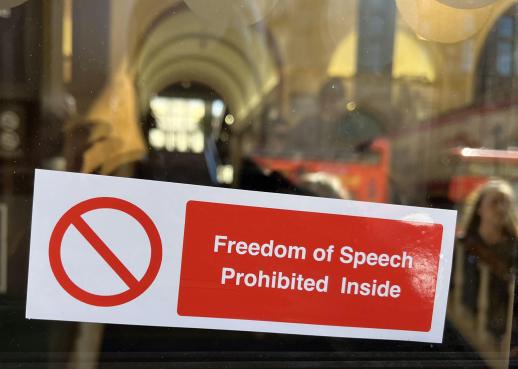
Dear God - how can university authorities allow this to happen?
Disruption, bullying and harassment at a place of learning - is simply not acceptable

1
41
285
3,718