
AI agents that learn and automate your workflows
Joined June 2025
- Tweets 11
- Following 4
- Followers 195
- Likes 17
Photos and videos
Browzer retweeted

Mar 26
Re-launching @TryBrowzer when we're at $160,000 in ARR.
We are building THE workflow automation and documentation tool that people have always wanted.
Record a workflow once, and Browzer automatically generates documentation and stores the documentation as a reusable automation that can be run on-demand or on a schedule.
The documentation itself proves super helpful for capturing knowledge gaps left in teams when key hires depart, setting best practices across teams and on-boarding new hires.
But additionally, when it's used as context for automations, it drastically improves reliability.
We believe knowledge work cannot be automated unless we understand how people work.
Today's automation tools are great for generic, trivial workflows, but they are not reliable for workflows where the stakes are high.
Coding agents succeeded from day 1 because they had open source codebases to be trained, but browser agents have no comparable system.
Before we can reliably automate repetitive browser tasks for knowledge workers, we first need to understand how work is done today and how different workflows connect to each other.
Browzer is a play in that layer. We not only make ourselves better, but we also make other browser infra tools like browser-use, browserbase, tinyfish highly accurate (yes, we ran some internal tests).
Over the next few days, I'm gonna be sharing multiple demos and results. But until then, here's a demo which is also my application for phase 2 of the @Tiny_Fish accelerator program (cc: @Skyzzzzzd @sudheenair ) !
If you'd like to collab, like me to demo the product to your team, or onboard Browzer to your org, my DMs are open but you can also reach me @ rahul[at]trybrowzer[dot]com
trybrowzer.com
#BuildInPublic
3
2
8
3,547

Mar 23
We will soon be publishing some insights from our approach. But for now, we enjoy the speed & accuracy of execution.
Mar 23

Most AI automation breaks when a button moves 2px left
@TryBrowzer, we switched from DOM selectors to the accessibility tree. 73% fewer failures in production
Turns out targeting what something *is* beats targeting where it sits on the page
PS: The video is NOT sped up
1
1
407
Browzer retweeted
Jan 30
Just automated posting on LinkedIn with @TryBrowzer and now I never need to procrastinate ever again to post content.
Can ask Browzer to post content, while I work on something else. DM me if you’d like to try it out
1
2
7
614
Browzer retweeted
Jan 29
Today we're launching @TryBrowzer - a tool that lets you build automations with a single click.
Browzer is like n8n but without the learning curve, complexity, building and management.
Record your workflows once, and automate it forever.
There are ~100M knowledge workers in the US alone, and ~1.2B globally. On average, knowledge workers spend ~1hr everyday on repetitive tasks.
We want to give each knowledge worker the ability to create their own personal agents that learn to work like them, and give time back on their hands to work on the things that matter.
At the same time, we want to make sure that building these agents isn't complex and time-consuming.
Our record and automate system is a perfect balance of that. Just show Browzer how you do your repetitive task once, and Browzer learns it and automates it for you from the next time.
No need to "learn a new tool" or spend time breaking your heads to "figure it out."
Show what you do once to Browzer, so that you never have to do it again!
Thanks to @koomen's YC S25 RFS - it's something that stuck with me and acts as a guiding light as I build Browzer out.
Also, thanks to @fdotinc, @joinodf and every community that's believed in me since the very early stages and presented me with opportunities.
We also launched on ProductHunt today - would love your support. Link in thread.
9
5
31
2,995
Jan 28
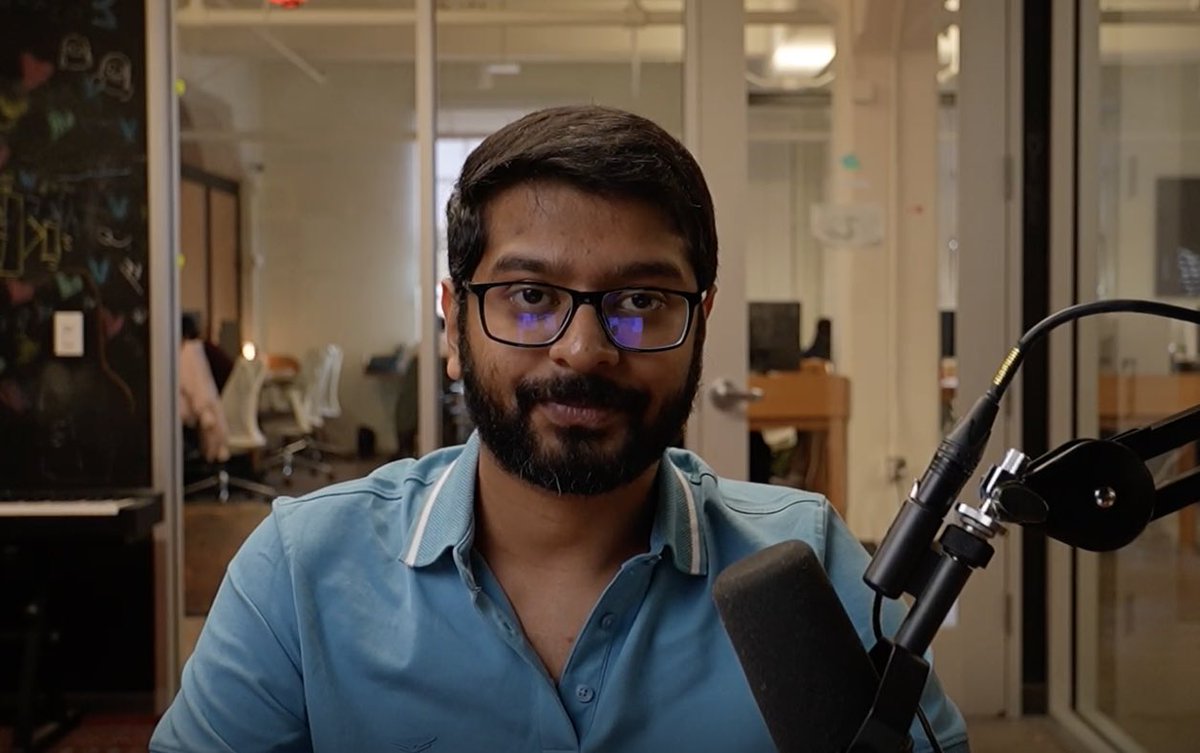
This guy is visibly pissed all the time
Jan 28
What I’ve really liked about @fdotinc is that, speaking with the team & other founders there has completely changed my perspective about content (in a good way).
I now think about content very differently than I did about 2 weeks ago. I’m visibly piss*d with meh content now
1
4
235
Browzer retweeted
28 Dec 2025
I guess I’m coming back to the $TAO ecosystem.
Having worked in the $TAO ecosystem for close to 2 years through Foundry & Yuma, and the last 6 months away building a core AI product, I think it’s time to come back.
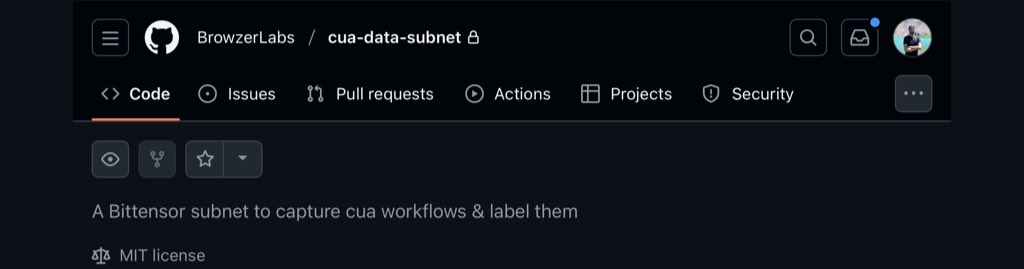
This time as a subnet builder to build the “Mercor for computer-use agents”…..PROVIDED I can find a good incentive mechanism for this.
After having been in Bittensor for a long time, I always told myself that I wouldn’t build a subnet for the fuck of it, but build one if and only if there could be a true value unlock for my product.
We are not thinking of building a subnet because we can. We built a product first, and it just so happens that there is an avenue where Bittensor could help us build a better product.
Over the last 6 months I’ve been working on @TryBrowzer
Initially it started as an agentic browser, but later I realized my goal wasn’t to add AI to a browser. It was to build a better, content-aware automation system for meaningful workflows.
Building automation systems is easy if you have good underlying models, and to get good underlying models you need good and relevant data.
Browzer has a functional product that’s being used by people & generates revenue.
Today we’re at $3,500 in MRR.
The last few days I’ve been brainstorming how we could tie the product with a subnet to (1) get better training data (2) increase our revenue (3) bring $TAO to the limelight (4) increase $TAO/alpha distribution.
While a lot of the details are in the works and I’m still figuring out the best incentive mechanism for this (everything so far has been experimentation), if anyone has ideas I’d love I chat.
I believe Bittensor’s economic system, combined with a robust incentive mechanism could help unlock and financially incentivize people to provide solid workflows to build better computer use agents by improving the base foundational model capabilities.
*THE CORE PROBLEM I’M TRYING TO ADDRESS*
If I used Comet or other Agentic browsers or any AI based automation system, I couldn’t automate the work that mattered because it had no data to do so.
The difference between coding agents vs computer-use agents is that coding agents had readily available context - codebases.
But computer use agents have nothing - other than browsing history. History never paints a full picture, you can only understand the user journey.
What never gets captured, but is super critical context is -
- how a user interacts within a website
- what info they fill in forms
- how they fill it
Computer use agents today are okay, but there’s a long way to go before they’re used for meaningful business process automation.
And that’s what Browzer tries to solve. We allow users to record their critical workflows and we capture a bunch of info (videos dom) and then use that context to automate any similar workflows.
But this is where the problem is - computer-use agents aren’t inherently great. We need more data to train and build better foundational computer-use capabilities.
A lot of frontier labs are looking for high quality labeled computer-use datasets.
And that’s something that’s not very easy…but, I believe, is an amazing use case where Bittensor can shine.
Would love your thoughts @const_reborn @JosephJacks_ @badenglishtea @DreadBong0 @EvanMalanga @Old_Samster @CryptoZPunisher
39
41
347
20,018
19 Nov 2025
Before solving CUA, context aggregation needs to be solved.
Generic CUA is not very helpful for specific processes.
Learn the process & automate it following the process.
That’s what Browzer solves.
19 Nov 2025
Computer use agents won’t work until there’s a context aggregation layer. Today’s agentic browsers and automation tools “assume” your processes or require you to “build workflows” and BOTH SUCK!
As cool as agentic browsers look, there’s no long term viability unless these browsers understand processes. NOT JUST WEBPAGES.
The difference between coding agents & CUA is that coding agents had readily available context. CUA doesn’t.
We need a frictionless context aggregation layer before we even think about reliable browser automation, and that’s what @TryBrowzer is building
4
691
Browzer retweeted
8 Nov 2025
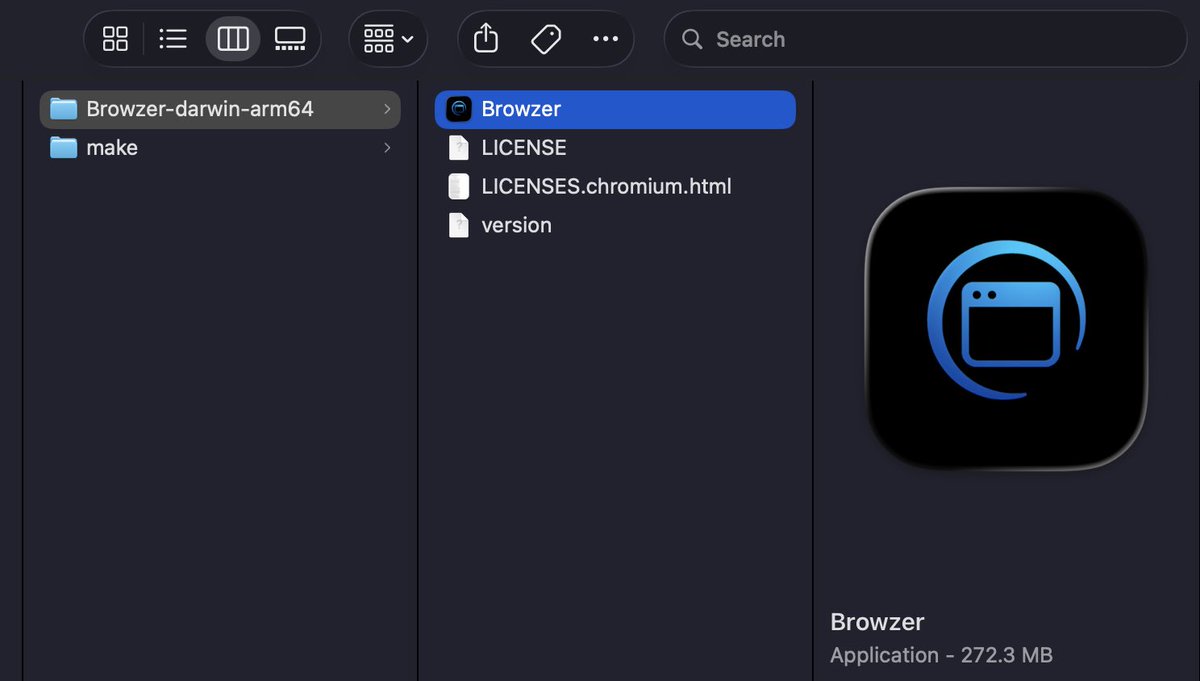
Launching @TryBrowzer next week for the next 1000 people
If you’re interested to try it out at launch, drop me a DM
2
7
1,054
Browzer retweeted
14 Oct 2025
Lfggg @brycent reviewed @TryBrowzer on his Twitch stream today. Dropping a crazy demo soon. Everyone’s gonna fucking love it
4
3
23
3,404
Browzer retweeted
26 Jul 2025
I used @trybrowzer to assist with the 1st week's task for @theresidency's Delta program.
This was my "Oh wow" moment! Probably the first real use case for which I used the agentic browser I built rather than using something else for a certain use case.
The task was to come up with a one-liner for our projects & @nick_linck and the Residency team shared some resources. Documented the whole workflow in the video below!
Initially Browzer Assistant came up with this
"Browzer: The model-agnostic platform where agents collaborate through natural language to accomplish any task, with enterprise-grade security and minimal data sharing."
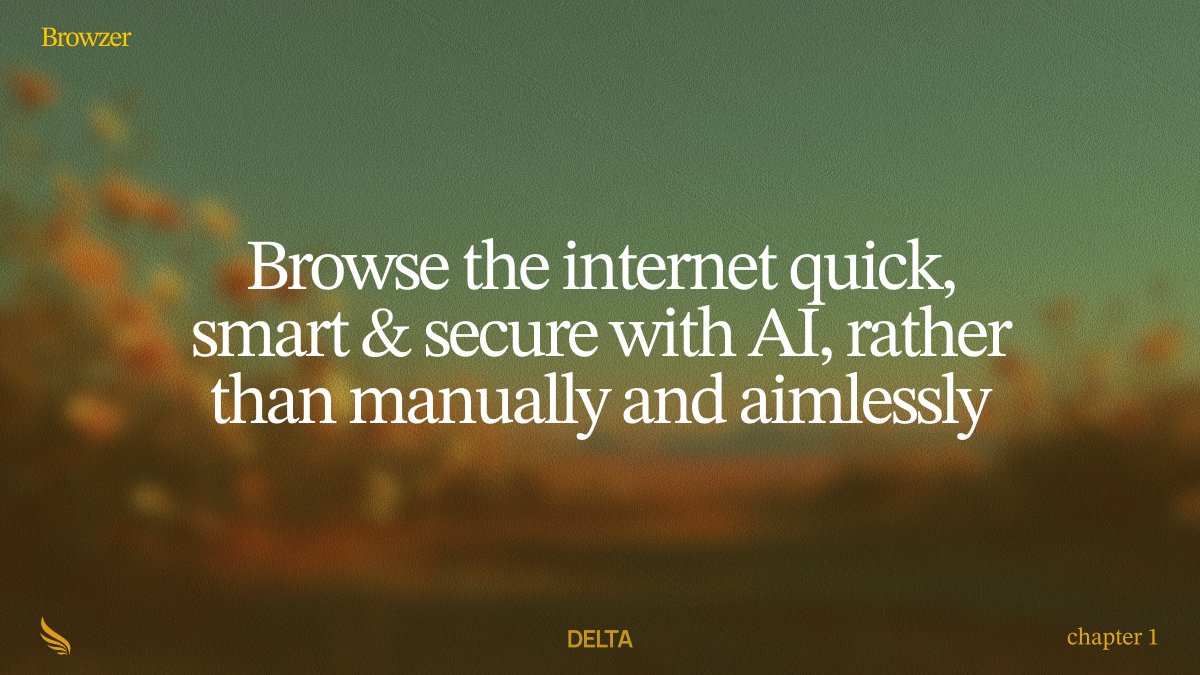
Then I asked if "Browzer: Browse the internet quick, smart & secure with AI, rather than manually and aimlessly" made more sense! And it said it was pretty effective! So I'm going with that.
I like it because I think tells people AI based browsing is better than manual browsing and Browzer specifically focuses on secure and private browsing! Also, it feels like it appeals to human emotion in a slightly negative connotation to get people to "take action"!
2
12
3,250