
-
Joined June 2019
- Tweets 1,862
- Following 270
- Followers 426
- Likes 276
59 Photos and videos

4m
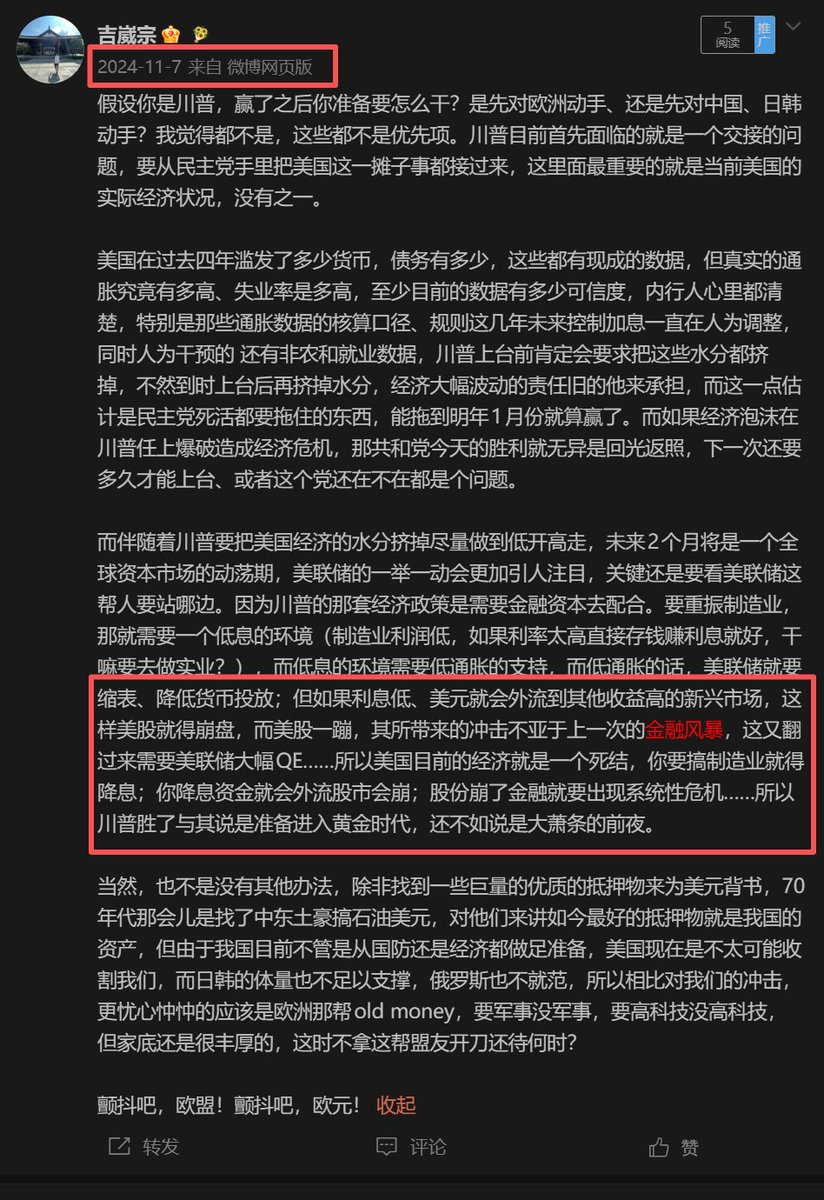
有时得主动问问@gork 推特上有哪些有趣的账号,不要老给我推送那些反贼民逗的无聊内容,多给我推一些音乐、潮流、数码、科技、电影等的内容不好吗?天文地理美女美景美图甚至环保的内容也比那群老登的无脑内容要有趣呀。
1
8
21m
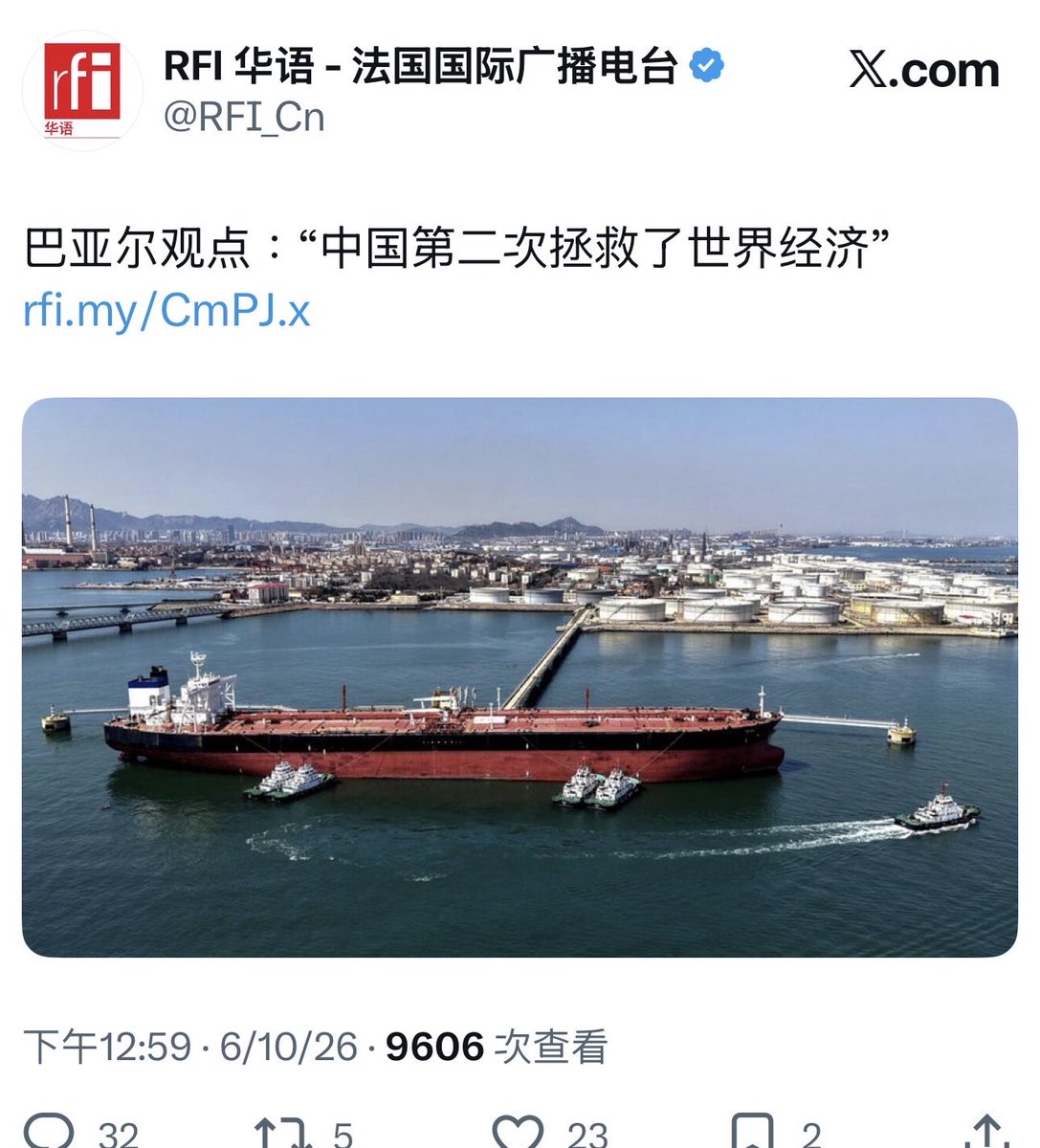
我在两年前川普选举赢了的时候就已经看到今天可能出现的情况了,但目前的情况比我当时看到的还要糟糕。美国显然比当时我看到的恶化情况还要加速了,特别是陷入了伊朗的泥潭里,以及日本目前出现的危机。
在目前这个情况下,台海我觉得反倒会稳定一些。相比对台在军事上已经十拿九稳的情况下,统一反倒并非最迫切的选项,而是如果外围经济一旦出现天崩地裂式的危机,中国只要保持稳定,那些受金融风暴出逃的资金就必须要找到一个新的、稳定的地区作为避风港,而目前有能力扮演这个角色的只有中国。
我在更早的时候就说过,维稳在当时是个贬义词,但在将来全球出现大动荡的时候,维稳能力就是一个国家最大的竞争力,对外有足够的军力抵御任何妄图侵略的意图,对内有足够的组织动员能力提供稳定的社会和治安搞建设,资本需要这样的一个地区来继续保持稳定和增值。所以比起统一,如果大量资本进入中国内部,通过资本的力量,到时不战而屈台日之兵地实现和平统一并非不可想象。

9
1h
你不要把自己身上这些缺陷就泛代中国人,不要自我感觉太过良好。

中国人很容易震怒,尤其听到批评时,甚至意见不同也要发怒
这说明中国人自卑,敏感,脆弱。同时,中国人听到心灵鸡汤时,很受鼓舞并赞赏,乐的鼻涕泡都冒出来了
这反差很大,根本就是中国人很情绪化,缺乏理性
说白了,中国喜欢听顺耳的,所以不适合看西方自由言论和批评
中国人只最适合看新闻联播
21
2h
This is nothing more than preparation for the next stage of deepening Sino-US competition.
On the mainland internet, there has long been strong public demand to fire and purge those in the media and press who are deeply influenced by Western values and whose views do not align with Chinese values. However, the forces obstructing this have been quite strong.
It is entirely expected that, after suffering setbacks in the trade war and diplomatic war, the US side will intensify its public opinion warfare and launch financial warfare. In this broader context, such measures are merely precautionary — aimed at preventing media outlets that have been infiltrated and influenced by the West from colluding with Western forces to endanger China’s national security in the information domain.
Interpreting these self-defense measures as “information blockade” is, first of all, based on the despicable mindset of Americans — they assume that others will do exactly what they themselves have done. Secondly, it reflects a kind of persecution complex. I suggest you go to the hospital and get checked for Asperger’s syndrome.

Nostalgia brings this to mind, 指鹿为马, but we ‘moderns’ call it 信息封锁.
24
Jun 11
西方一直觉得要遏制中国很难,其实有一个办法他们可以试试。不少人都有一个感觉,中国男足是中国国运的平衡器,中国国势弱的时候,中国男足几乎称霸亚洲,中国越壮大,男足越输得惨。所以只要西方发达国家一起努力让中国男足在世界杯上夺冠,可能中国的国运就会受到很大的削弱,西方国家要不要试试?
The West has always found it very difficult to contain China, but there’s actually one method they can try.
Many people have this feeling: the Chinese men’s national football team is the balancer of China’s national fortune. When China’s national strength is weak, the Chinese team almost dominates Asia. The stronger China becomes, the more miserably the team loses.
So if the developed Western countries all work together to help the Chinese men’s football team win the World Cup, it might severely weaken China’s national luck.
Should the West give it a try?
126
Jun 9
睇到咁多鬼佬叼你,让我明白原来哩个世界仲系有好多人是有常识和逻辑,唔会好似你哩d"梁丙"把西方个套虚伪嘅自由民主奉为圭臬。
你曾经有幸窃居一个国际都市立法机构嘅议员,但你从宣誓就任个一刻嘅小学鸡行为开始就没基于那个岗位为香港市民做过一点有益于民生嘅建言和投票,你所做嘅只不过是为你背后那些西方势力系度搞破坏,辜负个d投票俾你嘅市民。以至于《国安法》出台,直接抛弃你嘅手足而流窜到世界各地继续抹黑你嘅家乡和祖国。你就是个扑街而已。
Jun 8

I've come across posts like this many, many times – praising China's safety while denouncing democracies that spend too much time debating "freedoms."
I get it. I don't want to live somewhere I have to watch my surroundings constantly.
But safety isn't the price you pay for freedom. Taiwan, Japan, and Korea are among the safest places. You can walk the streets at 2 a.m without a second thought, and none of them required a surveillance state to get there. Culture, state capacity, and enforcement all shape this, no single model owns it.
China's version comes down to a tyrannical policing and surveillance apparatus that makes the personal cost of committing even petty crime extraordinarily high. But that same apparatus is also the one that disappears the lawyer, the journalist, the dissident.
Europe may have a problem, but China is not the answer to it. Hinting that the problem is having too much “freedom debate” is such a bad take.
1
118
Jun 8
中共的统治地位是经过了长时间的艰苦奋斗、在民众出钱出力的帮助下打垮了一个个反动派建立起来的。你们想靠嘴皮子搞诈骗一些选票就想夺权?你就不要说治国了,你先把你们家的家务活干好一点再说吧。
Jun 8

这个人以为自己的逻辑很正常,其实是在颠倒黑白。
共产党从来没有通过全国自由选举获得执政权。
要求反对者先证明自己比共产党强,本身就是一种独裁逻辑。
在民主社会,决定谁强的是选票,不是统治者。
105
Jun 8
Because Taiwan is currently controlled by a rebel regime, some of the administrative measures implemented there differ from those on the Chinese mainland. Taiwan is part of the People’s Republic of China — this is a fact officially recognized by the vast majority of governments around the world, including your own country, the Philippines.
Moreover, I don’t think you need to show off your little cleverness by using the visa issue to promote Taiwan independence. You might not have traveled much, but visa policies vary widely between countries. Even within a single country, there can be different requirements for entering certain special regions. For example, we need a visa to go to mainland South Korea, but no visa is required to visit Jeju Island.
Using the visa issue to sarcastically mock the relationship between China and Taiwan Province only reveals how limited your own knowledge and experience are.
Jun 8

Kumusta sa lahat, ako ay isang Pilipino mula sa Pilipinas. May isang bagay na hindi ko masyadong naiintindihan: bakit itinuturing ng China na bahagi nito ang Taiwan? ? Kapag naglalakbay ako sa Taiwan, hindi ko kailangan ng visa sa loob ng 14 na araw, ngunit kung gusto kong maglakbay sa China, kailangan ko ng visa. Kung ito ay iisang bansa, bakit magkaiba ang mga patakaran? Sobrang nalilito.
大家好,我是來自菲律賓的菲律賓人。我有一個事情不是很理解,為什麼中國認為台灣是它的一部分? ?我去台灣旅行的時候14天內不需要簽證,但我想去中國旅行的話需要辦簽證。如果是同一個國家,為什麼政策是不同的呢?很迷惑。
Hi everyone, I am a Filipino from the Philippines. There is one thing I don't quite understand: why does China consider Taiwan to be part of it? ? When I travel to Taiwan, I don’t need a visa within 14 days, but if I want to travel to China, I need a visa. If it's the same country, why are the policies different? Very confused.
2
233
Jun 8
比起那些烂大街的民主、自由的口号,西方目前逐渐从暗流显性到明显的那股科技加速主义更让我关注,而且如果认真观察和串联起来发挥想象力,"科技加速主义"就像一把钥匙那样可以让很多问题形成一个逻辑闭环和可解释性。
1
66
Jun 6
Looking at the five points above, there is some truth to them. This perspective isn’t new — Zhang Wuchang (Steven Cheung) proposed a similar explanation many years ago, describing it as competition among county and municipal leaders. However, this view is still overly one-sided.
1)It overemphasizes the bottom-up role of local governments in driving these industries while ignoring the central government’s overall contributions in policy supply, risk control, tax regulation, and nationwide resource coordination. In reality, compared to Europe, the United States, or the North American Free Trade Area, transaction costs within China’s unified domestic market are far lower — and far more efficient — than those under any inter-country trade agreements or alliances.
2)Over the past few decades, local governments’ bold (and sometimes reckless) development efforts have brought tremendous vitality to the economy, and the contributions of private enterprises deserve full recognition. That said, we must also acknowledge that local governments and private businesses have created some massive pitfalls for the entire country. Examples include the earlier P2P lending chaos and the real estate bubble. In the end, it was the national-level authorities that had to step in to intervene and clean up the mess — something that free trade zones and economic alliances simply cannot compare to.
3)Private economy and capital do not possess any real strength to challenge the central government. A few individual businessmen once got carried away and thought their commercial empires could confront the central government — such as Wanda and Alibaba at their peak — but they all ended up crashing hard and being forced to behave obediently. Outsiders fundamentally cannot comprehend how powerful the central government’s control over China truly is.
4)China’s success — whether the outside world admits it or not — stems from the governance of the Chinese Communist Party. This is something no other country can easily replicate. It is precisely because of a strong central government that China can look beyond short-term gains and losses and strategically plan long-term industrial chains and cutting-edge industries that require extended incubation. This is extremely difficult for democratically elected countries that only care about short-term public opinion and voter support. This is also a point the West must deny, because acknowledging it would imply that their entire national organizational systems need to be fundamentally rebuilt — and Western societies currently lack the courage and resolve to push through such reforms.
5)The success of China’s more than 40 years of reform and opening-up is obvious to all. However, what is more easily overlooked is the hard foundational work done in the first thirty years after the founding of the People’s Republic. The outside world often only focuses on the negative aspects of that period — the Anti-Rightist Campaign, the Great Leap Forward, and the Cultural Revolution — while ignoring the monumental achievements: widespread literacy campaigns, bandit suppression, drug prohibition, gambling crackdowns, rehabilitation of prostitutes, land reform, universal rural healthcare, eradication of various parasitic diseases, recovery of Xinjiang and Tibet, liberation of serfs, resistance against foreign aggression, development of nuclear weapons and satellites, large-scale water conservancy projects, establishment of a complete industrial system, and securing a permanent seat on the UN Security Council. Without this solid foundation, the great achievements of the past 40 years of reform and opening-up would have been impossible.
Jun 6

5. This also explains "What's wrong with China providing us with solar and other renewable energies?"
When local officials rise, the industries they sponsor rise with them — but when those officials fall, the industries can be restructured or consolidated.
That is essentially what happened in rare earths: an industry once fragmented across provinces and cities competing fiercely (and often corruptly) was eventually consolidated under central control.
The result is not just economic power, but geopolitical leverage — whether through higher prices or, potentially, supply restrictions against countries China has political disputes with, as we’ve seen in recent months.
x.com/henrysgao/status/20609…
159
Jun 6
Lots of your content covers China, but I hope you don’t stay cooped up in an air‑conditioned room, form opinions on the country solely from heavily doctored and skewed information. That compromises the accuracy and objectivity of your assessments.
China is an open society. Feel free to come explore its cities and connect with local people in person.
Jun 6

🚨🇨🇳 Xi Jinping no longer has absolute control, and it happened when he had his health episode and lost control of the military to his own vice chairman.
Lei says a new oversight body made up of powerful retired party elders was quietly established last year to check Xi's decisions.
Every time Xinhua, China's state news agency, went silent on a Politburo meeting in the past, a major purge or power shift followed within weeks.
Not every purge was Xi's doing.
Some were carried out by his opponents, which is why the scale has been so staggering.
China's deep state is real, and it is now overseeing the man everyone assumed was untouchable.
@LeisRealTalk
118
Jun 6
好好关注电影本身,别想那些有的没的
Jun 5

以潮汕侨批故事为背景的中国卖座片《给阿嬷的情书》,确定在6月18日在本地上映。影片由Clover Films和嘉华院线联合发行。 zaobao.com.sg/entertainment/…
64
Jun 6
I don’t entirely agree with describing the first-generation leaders as simply “military men and revolutionaries.” In my view, being soldiers and revolutionaries was merely their profession. The first-generation leadership collective was more akin to philosophers. Whether it’s the first generation or up to my fifth generation, CCP leaders have always placed greater emphasis on the inheritance of thought and ideology.
This is precisely why every generation has attached special importance to embedding its own ideas into the Party Constitution — from Mao Zedong Thought (毛泽东思想)at the beginning, to Deng Xiaoping Theory(邓小平理论), the Three Represents(三个代表), the Scientific Outlook on Development(科学发展观), and the current generation’s philosophy of governance(习的治国理政思路). These are not merely scientific theories, but operate at a higher philosophical level — something many people overlook.
Therefore, no matter what professional background each generation of leaders comes from, they ultimately have to elevate their thinking to a philosophical level and internalize it as the core ideology of the entire ruling party. This is quite rare among political parties worldwide, though not entirely unique. Vietnam has learned a great deal in this regard. North Korea has also studied it, but as long as it remains trapped in the Kim family’s one-family dictatorship, that kind of internalization lacks replicability.
Nowadays, many countries are paying increasing attention to China’s experience, but this core element is the hardest to learn. Because it requires an economic foundation built on public ownership — it is very difficult to transplant into societies dominated by private ownership.
Jun 5
If you look closely at the trajectory of the Party's governance, the path is fascinating. The Mao era was driven by military men and revolutionaries, while Liu Shaoqi’s generation functioned more as party apparatus builders. Then came Deng Xiaoping’s technocratic era, where engineers became the backbone—orderly, yet still retaining distinct personalities.
However, I observe that the wind has clearly shifted. The current leadership's emphasis on technological self-reliance has pushed a new cohort of "tech-officials"—those with deep backgrounds in scientific research, aerospace, and advanced laboratories—to the forefront. Looking ahead to the 21st Party Congress, these scientist-politicians are highly likely to secure even more pivotal roles.
This is not just an upgrade in credentials; it is a fundamental shift in the logic of governance. Whether scientific rationality and data can successfully navigate complex political and social realities is the true question you and I must watch.
By Ho Pin (@MJTVHoPin)
3
1
1
1,897
Jun 5
不少人觉得改革开放是邓公最伟大的功绩,这当然是很大的功绩,让中国启动了现代化的进程;但我现在觉得89年他能背着承担巨大非议和历史责任的情况下以雷霆万钧的态势把国家迅速带回到稳定发展的道路这件事,比起78年力主改革开放时的功绩更伟大,也更悲壮,更孤独,这也是从一个政治家提升为伟人的重要的一步。
不能承担历史责任的政治人物充其量只是政客,为了国家的长治久安,不怕骂名,勇于承担历史责任的,才能称为政治家。
44
6
34
8,016
Jun 4

153
止水2th retweeted

Jun 4
【四川小伙带8台宇树机器人登上《美国达人秀》,全票晋级】当地时间6月2日晚播出的《美国达人秀》中,26岁四川小伙吴宇飞带着8台宇树机器人登上舞台。
随着Lady Gaga经典歌曲响起,吴宇飞与机器人同台共舞,动作整齐划一。表演过程中,8台机器人还同步完成后空翻,引发全场惊呼。
表演结束后,吴宇飞还带着机器人大秀中国功夫。有评委开玩笑想抱走一台机器人,结果被机器人“本人”婉拒。最终,吴宇飞获得评委全票通过,成功晋级下一轮比赛。
57
31
285
119,894
Jun 4
你还是没有明白“市场化定价”这个含义。所以市场化定价,并不单单依赖于某个岗位所在的那个行业的市场供需,还要依赖于这个岗位所在的行业整体的供需以及全社会对这个行业的价格的评估。这是一个非常复杂的、而且传导很慢的一个过程。中国在21世界初加入世贸时,刚刚进行了国企下岗潮,有原来大量在国企里的工人下岗。而下岗潮的几年后,大量的外企产业迁移到中国,大学扩招 下岗工人 每年大量新增就业人口,既满足了迈向世界工厂所需的人力需求,但也正因为这样庞大的人力需求,就造成了整个市场劳动人口的供大于求,这就是早些年为人诟病的大量劳动者辛苦生产一堆衬衣才换回一架波音飞机。可以说,是整个中国劳动力太多了,只要岗位招人,你不愿意干有的人愿意干,所以作为资方压根就不愁用低薪资成本来招人。这是一个市场双向选择下形成的定价。但国家规模不一样,你越多的企业、资本投资于生产,整个国家
所以市场化定价,并不单单依赖于某个岗位所在的那个行业的市场供需,还要依赖于这个岗位所在的行业整体的供需以及全社会对这个行业的价格的评估。这是一个非常复杂的、而且传导很慢的一个过程。
中国在21世界初加入世贸时,刚刚进行了国企下岗潮,有原来大量在国企里的工人下岗。而下岗潮的几年后,大量的外企产业迁移到中国,大学扩招 下岗工人 每年大量新增就业人口,既满足了迈向世界工厂所需的人力需求,但也正因为这样庞大的人力需求,就造成了整个市场劳动人口的供大于求,这就是早些年为人诟病的大量劳动者辛苦生产一堆衬衣才换回一架波音飞机。可以说,是整个中国劳动力太多了,只要岗位招人,你不愿意干有的人愿意干,所以作为资方压根就不愁用低薪资成本来招人。这是一个市场双向选择下形成的定价。
但国家规模不一样,越多的企业、资本投资于生产,整个国家的经济规模、盘子就会越大,所以国家的经济体量的迅速扩大,并不一定跟劳动力的价格实现同步联动,这是为什么中国经济总量上去了但一些劳动力价格没有同步上涨的直接原因。
如果整个国家都一直做一些低端的加工,企业的利润就一直在微利上经营,这样企业自身是没有足够的能力能迅速提高工人的待遇的。所以如果要使得整个社会能越来越富裕,则整体产业必然要增加其附加值,而这种高附加值的产业必然是技术含量高、或者品牌价值高的产品,所以国家在做到世界工厂之后就必然要往产业结构升级的方向去走,这也是后面要出台《中国制造2025》很重要的原因。
但国家开始增加高端产业的投资,也必然需要淘汰一些污染高、内卷严重、产能过剩的产业,这就迫使一些行业的不少从业者要关停工厂或者迁移到东南亚等其他国家,这样原有的一些劳动密集型产业的供需出现变化之下,工人和基层服务人员的工资其实已经是有所增加(这个可以对比20年前的工资和现在的工资的工资水平,虽然提升有限,但也是处在一个上升的通道),只是增加的幅度不太明显。
与此同时,由于整个国家的经济体量有大幅壮大,国家投资于基础设施建设、环保、医疗、教育等公共品的效果也在逐步展现。比如现在比起20年前,整体的物价水平上涨并不明显,反而是一些跟居民生活相关的产品,得益于生产力的发展和市场竞争,价格要低了不少。
比如20年多前,我读大学时候手机才刚刚开始普及,当时我换过几次手机,从最开始的诺基亚3310,到后来的三菱m750,再到后面的6510和索爱的,当时的手机价格普遍都3、4千,相当于一个工人和基层服务人员几个月的工资,但现在一台手机,可能半个月的工资就能买到。其他产品也是如此。所以国内人员的工资水平看似增加不是太快,但是相对的购买力和兑换的物质量是要大大提高了不少。以前私家车只是一些高收入家庭的标配,现在哪怕是普通打工的,只要省吃俭用,一两年下来买台车也不是不可想象的事情。这就是整个国家经济体量上来惠及到每个人但不一定每个人都能感受到的。
而另一方面,有些行业的产品和工作内容其实20年来也没怎么变过,比如我的一个小姨,之前是做酒店前台,后面转到一个药店做销售,工资自然是有所增加,但这两个岗位本身在社会上的门槛并不高,而且劳动力供应量充足,其薪资的提升也不会太高。
这些年国家大力发展高科技产业,其实是在原来的存量上额外做的增量,大量高薪资的研发人员、品牌价值高的轻奢消费品设计人员、销售、新媒体传播工作人员等高价值岗位的出现,更进一步把原来那些一线工人、基层服务人员的薪资参照之下显得低了,但其实同时这些高薪岗位的人员增加之后,整个社会的消费水平也会相应带动提高,这个在长时间的传导之下也会逐步提升一线工人和服务人员的薪资提升。
原贴的问题是为什么中国的经济体量第二了还有3、4千工资的岗位,以上大体做了一些解释。当然一个国家的经济千丝万缕,很难通过一些片言只语能完全掰扯清楚,但原理大体如此。只是有些人所希冀的是那种快餐式的发展,觉得一下子发展起来了,那应该立马传导到终端,这不现实。但总量上去了,对这个体系里的大多数人,总是件好事。


Jun 4

就是因为这些薪资都是市场化定价的,平均薪资这个数据才能说明目前的中国的劳动人口的就业市场到底是一个怎么样的情况。
571
Jun 4
只有那些愚笨的人才喜欢就文学谈文学,就如同奥派只喜欢单纯谈经济理论却拒绝谈政治。文学好不好,是看民众的认可,不是小圈子的认可,单单这点,鲁迅就比同时代的什么郁达夫、梁实秋(单纯论修辞的美感我承认梁实秋确实要好些)要强得多。
生命力才是文学作品是好还是坏的基础,没有大众的认受性,就必然泯然于历史长河,再好也是虚幻。鲁迅其人及作品的生命力,就在于每一个读他的、谈论他的人,包括引用的这种否定他的博主。
Jun 3

因为鲁迅从来就主要不是一个文学人物,他的名声也不主要是文学领域的名声
1
139