
Co-founder at Relation (@relationrx) - applying #singlecell (check @scTrends_update !) #genetics #crispr #machinelearning to #drugdiscovery and #healthcare.
Joined October 2014
- Tweets 706
- Following 330
- Followers 1,507
- Likes 1,655
33 Photos and videos


Pinned Tweet

30 Nov 2025
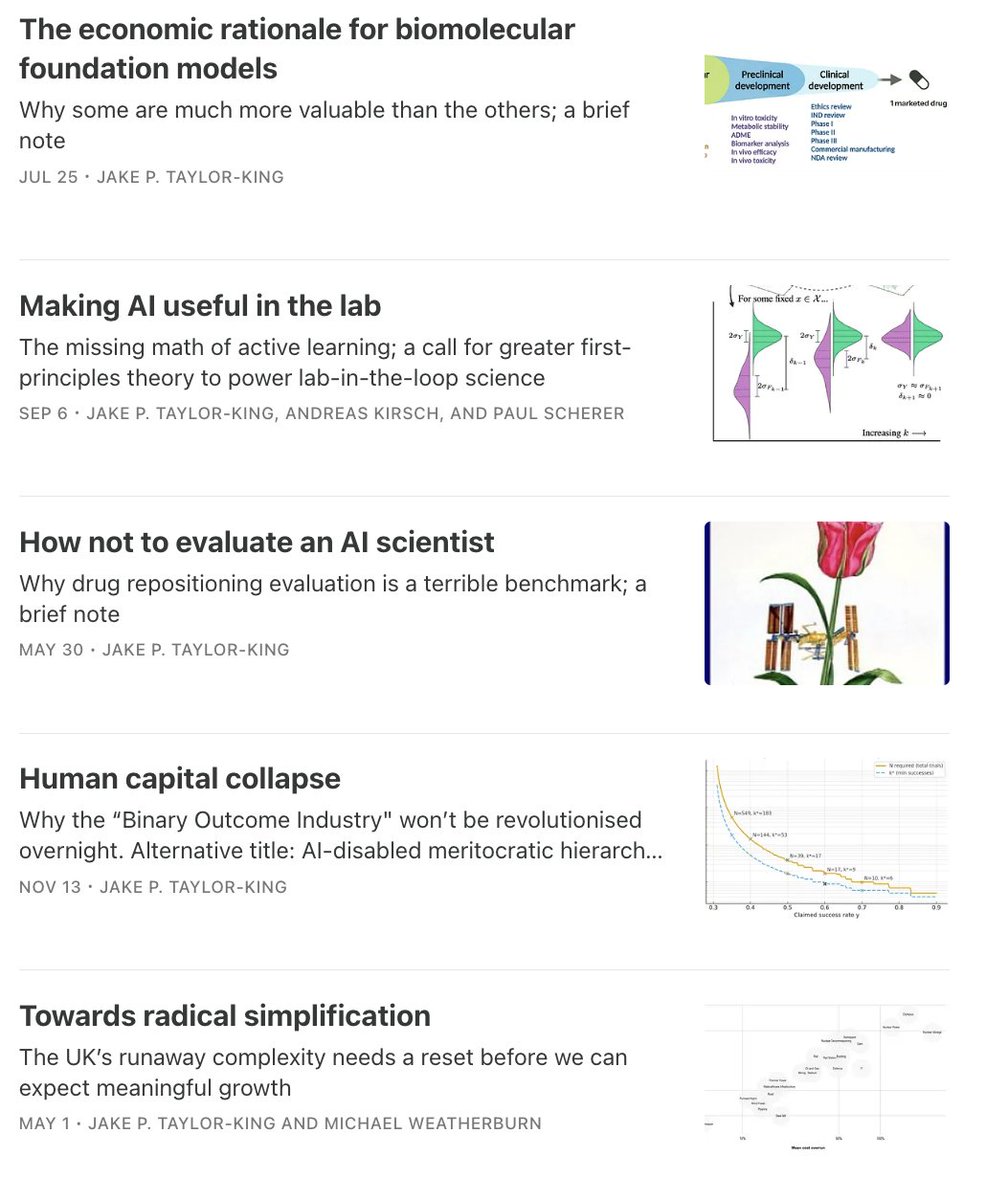
My limited experience of blogging has revealed to me that I get more views when: (1) I have short titles; and (2) I'm being negative. I want to do more of (1) and less of (2), so been revamping a few of my posts at wildtypehuman.substack.com/
7
1,512


Jake P. Taylor-King retweeted

DeepMind fully belongs to Google and it is not an independent company in any way
This misconception is damaging bc people think by joining DeepMind they support AI in the UK/Europe when they obviously do not
2
1
65
3,801
Jake P. Taylor-King retweeted

Jun 13
This is, perversely, good news for Britain, Australia, Japan, Europe, and other countries being cut off that would once have seen themselves as close allies of the United States.
It shows us what the future may hold if AI is the strategically and economically decisive technology of the 21st century and is controlled by the US and China. It is good news because *it may be happening early enough to give us time to act.*
I think this will be rescinded pretty soon, but it’s a sign of things to come. In a future where frontier models cannot be used outside the US, our industries and economies will fall behind and American businesses may not be able to operate overseas. We won’t be able to defend ourselves militarily with defence systems built on obsolete software. Europe 2031 is a good scenario of what a future like this could mean: europe2031.ai
Some of the things we need to do are ‘no regrets’ measures we should do anyway. But some are genuinely costly and risky.
We need cheap electricity – powered by gas, coal (this is costly, coal is very bad), deregulated nuclear fission – whatever can provide *cheap, reliable, 24/7* power. This almost certainly excludes wind power, which is enormously expensive and unreliable. We need projects to be able to connect to the grid in days rather than years by paying for fast-track connections.
We need to make it incredibly easy to build data centres, with the property taxes retained locally and hypothecated for local tax cuts so there is some direct benefit for locals. This doesn’t need to be nationwide.
We need to create new regulatory regimes for innovative businesses that give them the right to hire and fire staff with ease. The difficulty and cost of firing staff is one of the main reasons Europe has fallen behind so badly. We need to create a parallel employment regime that companies and workers can opt in to: worksinprogress.co/issue/why…
Even though I think it will probably fail, I think we should probably try to create a good, non-American frontier AI lab. I am quite pessimistic about this – even extremely well-resourced, innovative software companies are struggling to do this. But the stakes are so high that not trying seems foolish.
One thing that might work in our favour is the number of brilliant AI engineers who are not US citizens, who under the current export controls do not have access to Mythos/Fable even if they live and work in the US. What happens to Demis Hassabis, Ilya Sutskever, Andrej Karpathy, and the many other Europeans, Canadians, etc who are working on AI models in Britain and America who are affected by this?
I do not think we should force our own companies to use model, because this would exacerbate their economic weakness – this lab should have to compete on an even playing field. I am deeply sceptical that this can work, but we cannot rule it out. If we do it, it has to be able to pay US salaries, operate without political constraints. worksinprogress.co/issue/how…
It is cope to tell yourself that Trump is an aberration or that these export controls are a one-off. To repeat, I think these specific controls will be lifted quickly and it will be easy to move on and forget it happened. But this is a look into a potential future. Every one of us that is not a US citizen is at risk. The standard political divides do not apply here; the question is whether you grasp the enormity of AI as a technology. We have to act!
Jun 13

The US government, citing national security authorities, has issued an export control directive to suspend all access to Fable 5 and Mythos 5 by any foreign national, whether inside or outside the United States, including foreign national Anthropic employees.
The net effect of this order is that we must abruptly disable Fable 5 and Mythos 5 for all our customers to ensure compliance.
Access to all other Claude models is not affected.
We apologize for this disruption to our customers. We believe this is a misunderstanding and are working to restore access as soon as possible.
Read our full statement: anthropic.com/news/fable-myt…
142
346
1,776
275,441
Called it.

The Anthropic biology restrictions story is a microcosm of a broader trend: the gradual collapse of patents as enforceable monopolies and, with it, a chunk of American soft power.
When people buy Chinese-made peptides, they're responding not just to higher quality, but to a reality that patents increasingly function as instruction manuals rather than barriers.
Closed AI is the natural response in one of the few industries where America is still clearly ahead. But I suspect it'll fail for the same reason: restricting access slows down legitimate researchers long before it stops determined competitors.
In biomedicine especially, these models are becoming indispensable for no-code scientists exploring their own data.
As a Brit, America's advantage was never secrecy. It was scale.
1
14
3,180
Jun 13
The US government, citing national security authorities, has issued an export control directive to suspend all access to Fable 5 and Mythos 5 by any foreign national, whether inside or outside the United States, including foreign national Anthropic employees.
The net effect of this order is that we must abruptly disable Fable 5 and Mythos 5 for all our customers to ensure compliance.
Access to all other Claude models is not affected.
We apologize for this disruption to our customers. We believe this is a misunderstanding and are working to restore access as soon as possible.
Read our full statement: anthropic.com/news/fable-myt…
596
Standardised tests should have 2 functions:-
1. Enforce standards (regardless of the structural advantages/disadvantages any demographic may have).
2. Recognise talent — which is why we should do away with time limits for (most) exams.
For an example of doing this well, consider Swiss grads (ETH, EPFL etc). You barely need to interview graduates because they removed ~80% of the class from the degree programme 🤣
Jun 11

What are the actual marginal benefits of a Gaokao-like test ? In America the SAT is relatively low-intensity. You take it once to find the baseline, study, and then take it one more time. As opposed to the Gaokao which is a massive, multi-day, comprehensive exam
1
1
293
The Anthropic biology restrictions story is a microcosm of a broader trend: the gradual collapse of patents as enforceable monopolies and, with it, a chunk of American soft power.
When people buy Chinese-made peptides, they're responding not just to higher quality, but to a reality that patents increasingly function as instruction manuals rather than barriers.
Closed AI is the natural response in one of the few industries where America is still clearly ahead. But I suspect it'll fail for the same reason: restricting access slows down legitimate researchers long before it stops determined competitors.
In biomedicine especially, these models are becoming indispensable for no-code scientists exploring their own data.
As a Brit, America's advantage was never secrecy. It was scale.
1
20
4,877
As I have pointed out many times publicly, single cell foundation model performance will scale with the number of perturbations, not the number of cells.
We barely have ~100k perturbations in the public domain and it is reasonable to expect we need millions to truly go OOD. Factor in also: modalities, time points, combinations etc.
Short term, there is little to do using public data.
Best medium term option, consider semi-mechanistic modelling: arxiv.org/abs/2501.19178
Long term, …, wait for the press release ;)
Jun 11

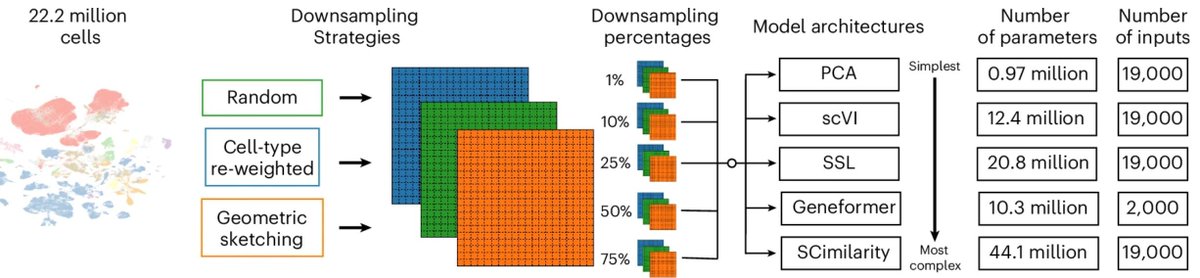
Do single-cell foundation models obey scaling laws?
A somewhat thought-provoking new Nature Methods study by the Crawford lab suggests that, for current single-cell foundation models, the answer may be “not really.” Across a broad range of architectures and downstream tasks, increasing pretraining data from hundreds of thousands to tens of millions of cells yielded surprisingly limited gains, with performance often saturating much earlier than expected.
This is interesting and provides exactly the kind of rigorous benchmarking our field needs. As Felix Fischer and I commented in the accompanying Research Briefing, such studies help move the discussion beyond model size and computational budgets toward actual scientific utility.
At the same time, I am not convinced the key conclusion is that scaling does not work in biology. Rather, it may be that current objectives are not extracting enough information from additional data.
Interestingly, in our recent scConcept work, we observe a markedly different scaling behavior, with continued gains as training data grows toward hundreds of millions of cells. The key difference may be the training objective itself: instead of reconstruction-based masked modeling, scConcept uses a contrastive objective that directly optimizes biologically meaningful cell representations.
biorxiv.org/content/10.1101/…
This raises an interesting question for the field: Have we reached the limits of data scaling, or only the limits of current objectives?
-> My guess is that the next generation of biological foundation models will depend less on simply collecting more cells and more on finding the right representation learning principles for biology.
Nature Methods paper:
nature.com/articles/s41592-0…
Research Briefing:
nature.com/articles/s41592-0…
#SingleCell #FoundationModels #AIforBiology
4
2
46
7,679
Jake P. Taylor-King retweeted

Jun 10
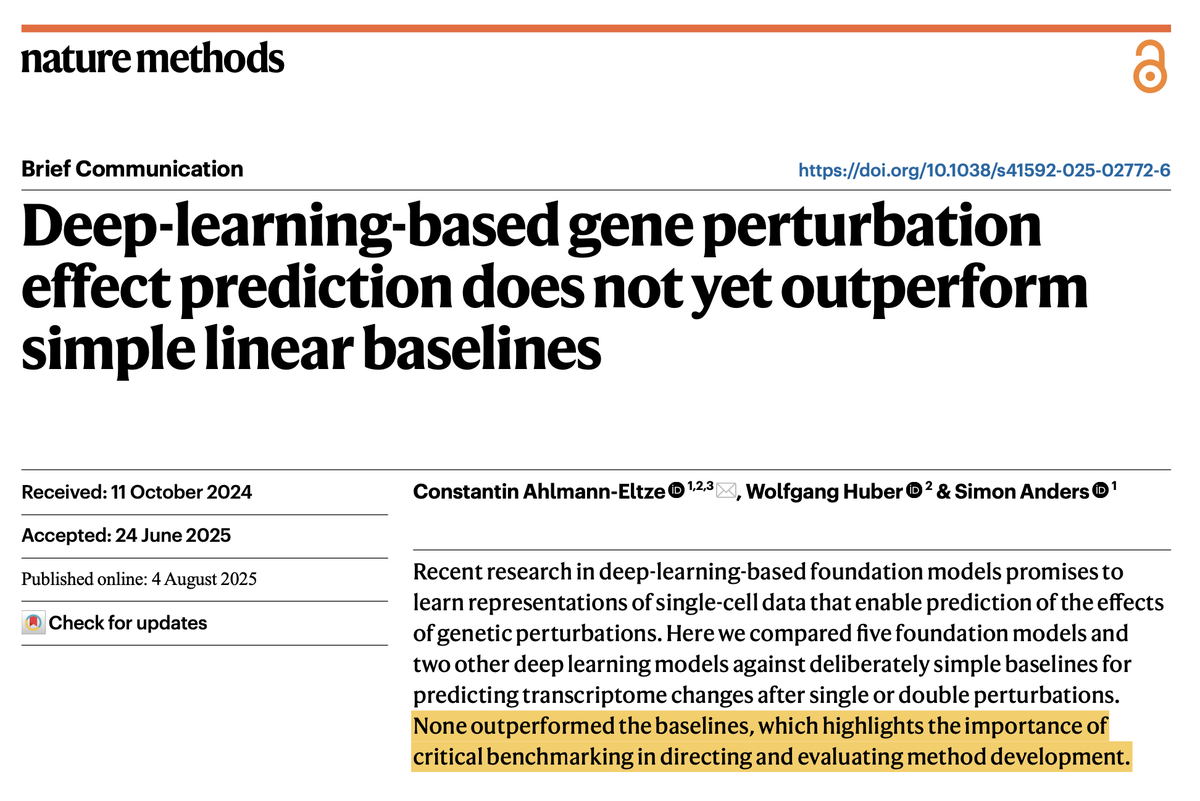
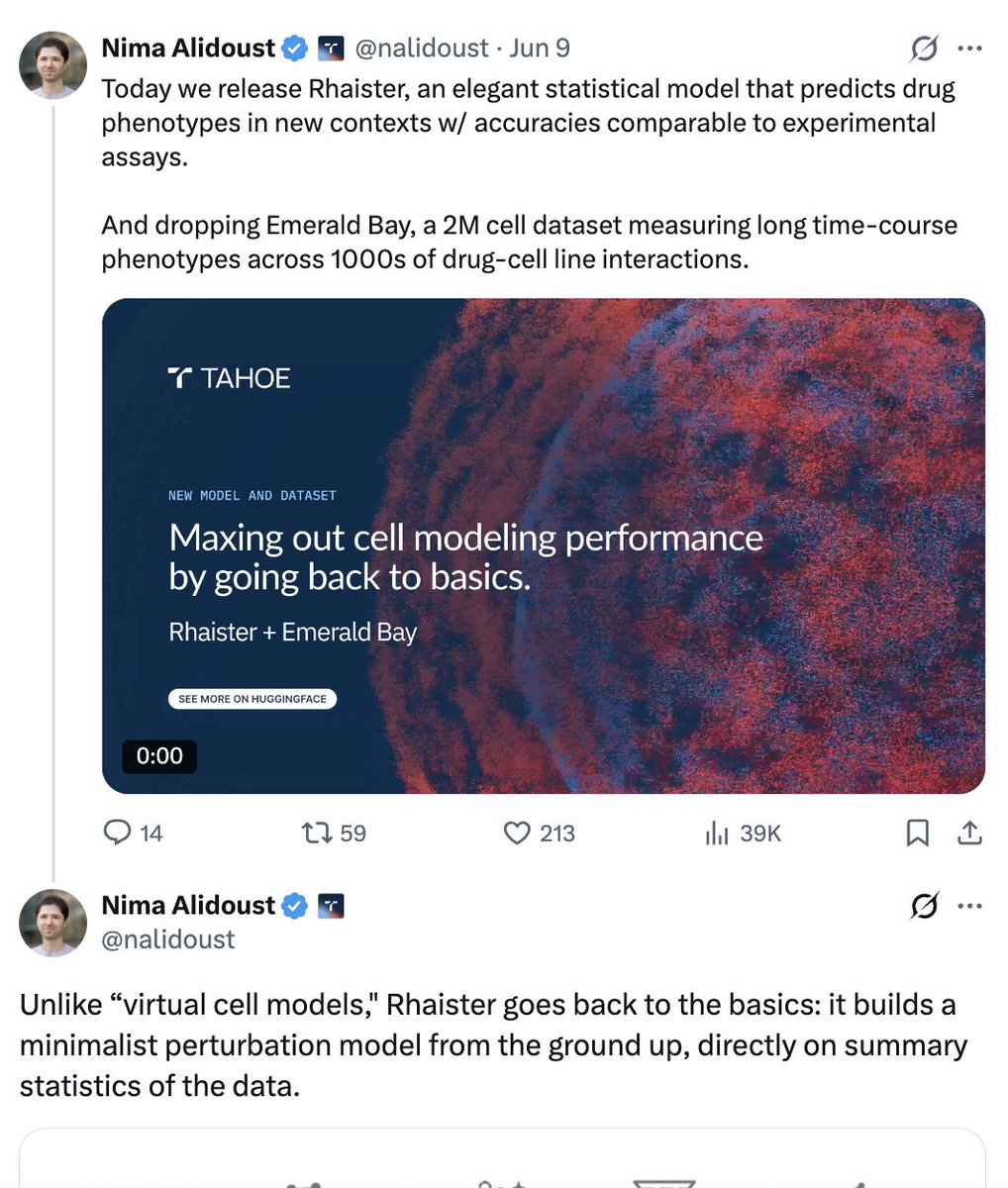
Two years ago the best virtual cell model was ridge regression and yesterday the best virtual cell model was ... ridge regression. But sure, throw a billion more parameters at the problem, no one is stopping you.
Jun 10

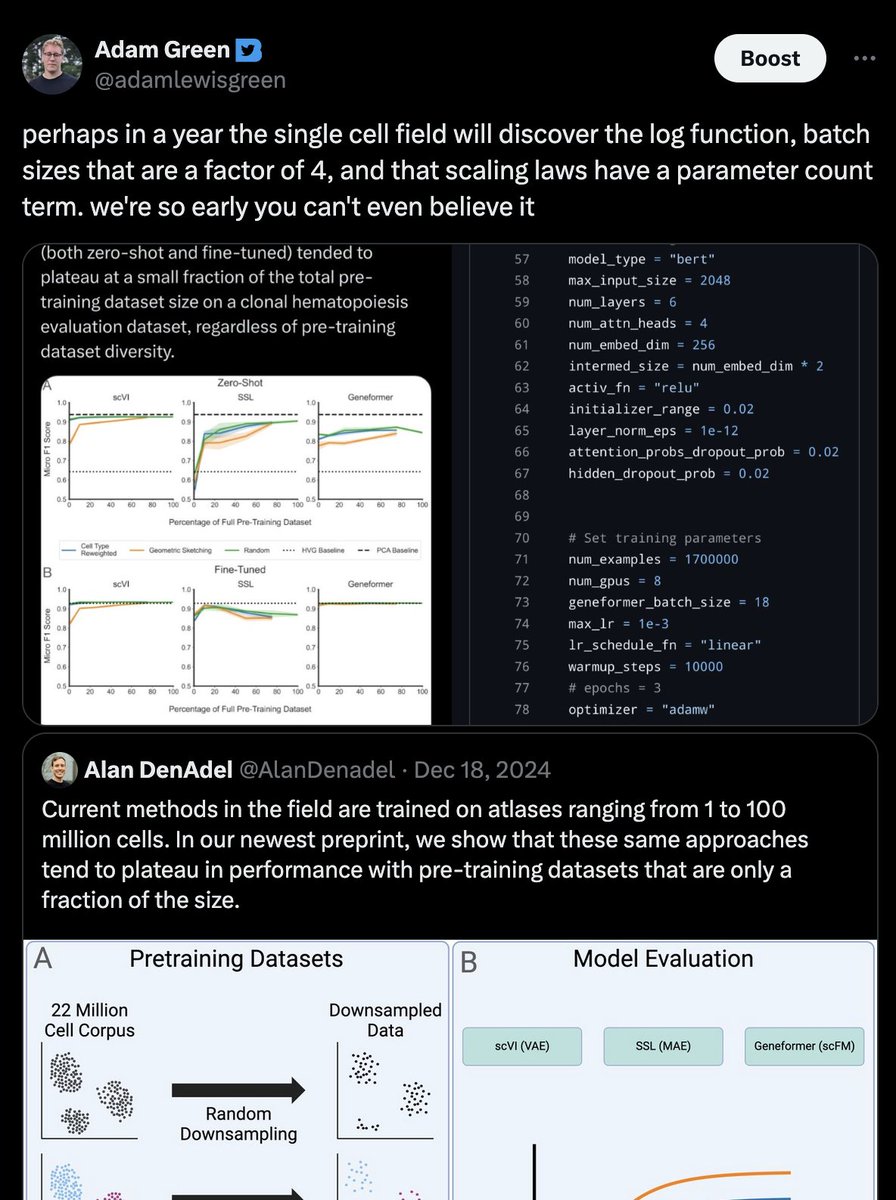
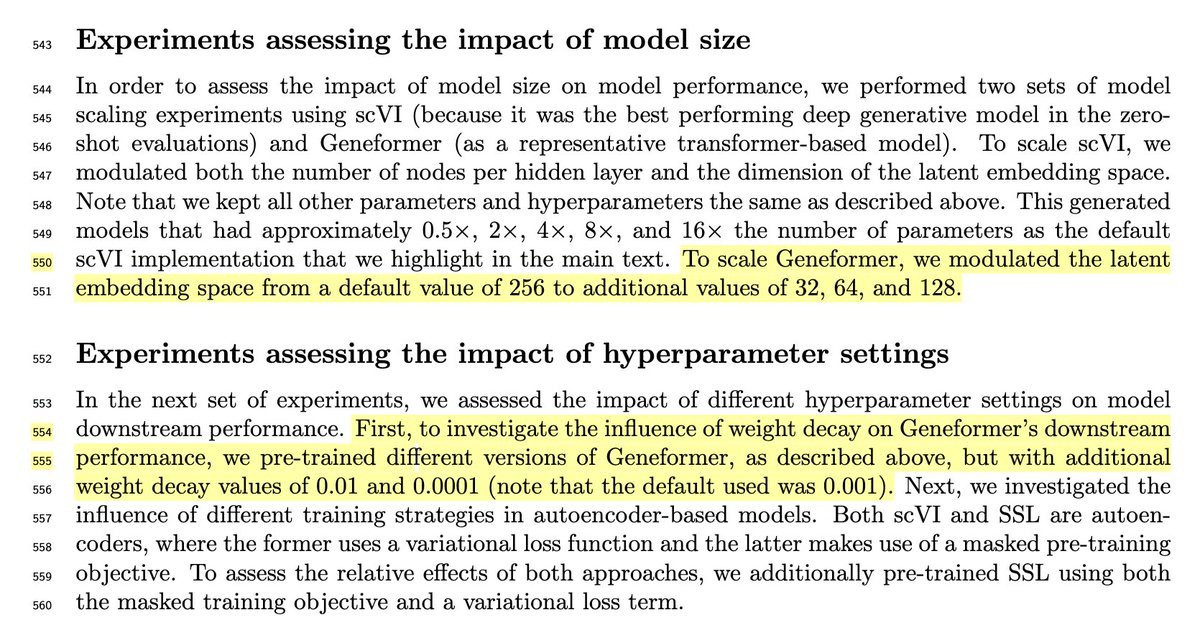
18 months after posting this tweet, the AI for science commentariat is still proclaiming the death of single-cell scaling laws on the basis of... {checks notes}... a model sweep ranging from 1 million to a whopping 10 million parameters. (but unlike 18 months ago, these proclamations now come wrapped in premium AI-written slop, giving them a glittering verisimilitude of rigor)
left as an exercise for the reader: generalize from this example to a meta-update about how epistemically adversarial the scientific environment we're operating in is (for extra credit, partial out the effects of mood affiliation and status deferral)
7
47
344
35,492
Jake P. Taylor-King retweeted

Jun 10
mind-blowing thread. A bug in an R package seemingly holding back an entire subfield shouldn’t surprise me after our sundry reimplementation woes in pertpy yet it somehow still does
Jun 10

Arguably the most boring step in genomics is the first one: normalization. Settled science. Scale log. Move on.
Except that here's been a huge blind spot in the field. And it matters for AIxBio. A 🧵about what I think may be one of the most important papers I've written. 1/
1
8
108
29,035
Jake P. Taylor-King retweeted

Jun 10
Arguably the most boring step in genomics is the first one: normalization. Settled science. Scale log. Move on.
Except that here's been a huge blind spot in the field. And it matters for AIxBio. A 🧵about what I think may be one of the most important papers I've written. 1/
18
147
669
113,703
Jake P. Taylor-King retweeted

Great idea @peterkyle
1. Start with abundant cheap energy.
2. Lower employment taxes and regulations.
3. Remove capital gains tax to attract capital.
4. Remove DEI and ESG requirments for companies.
And
5. DONT align with EU regulations.
Jun 9

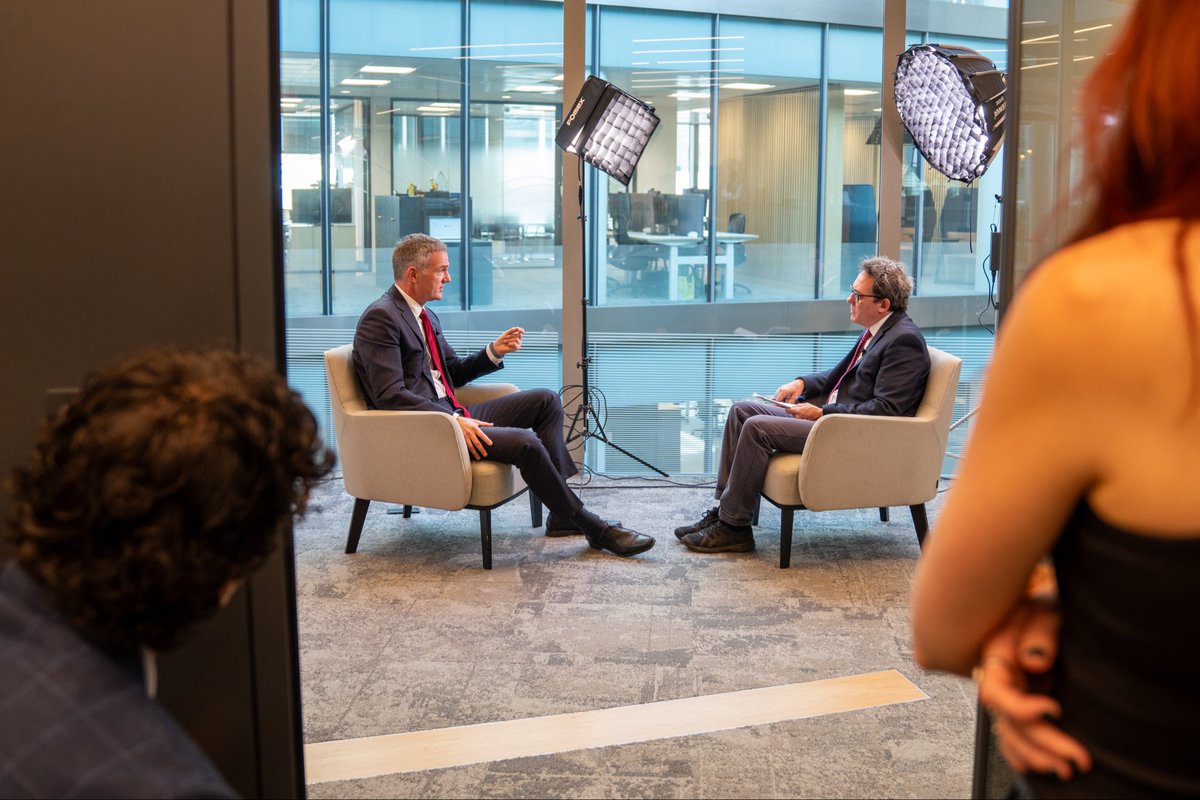
I want to find the UK’s first trillion-dollar firm.
That’s why this morning I've unveiled our bespoke concierge service to support businesses of the future to start, scale, and stay in the UK.
When I say I’m aggressively ambitious in pursuit of economic growth, I mean it.
14
53
175
4,752
Jake P. Taylor-King retweeted

Jun 10
Everybody is scared of Chinese models because it won’t let you criticize the CCP while Anthropic won’t let me use their models for live saving medical research ?
Who’s the real villain again?
123
290
4,903
140,867
Jake P. Taylor-King retweeted

Jun 10
The people who talk this way have one and only one metaphor for this technology, and it's nukes. They need more metaphors.
1
1
8
1,149
Jake P. Taylor-King retweeted

Jun 9
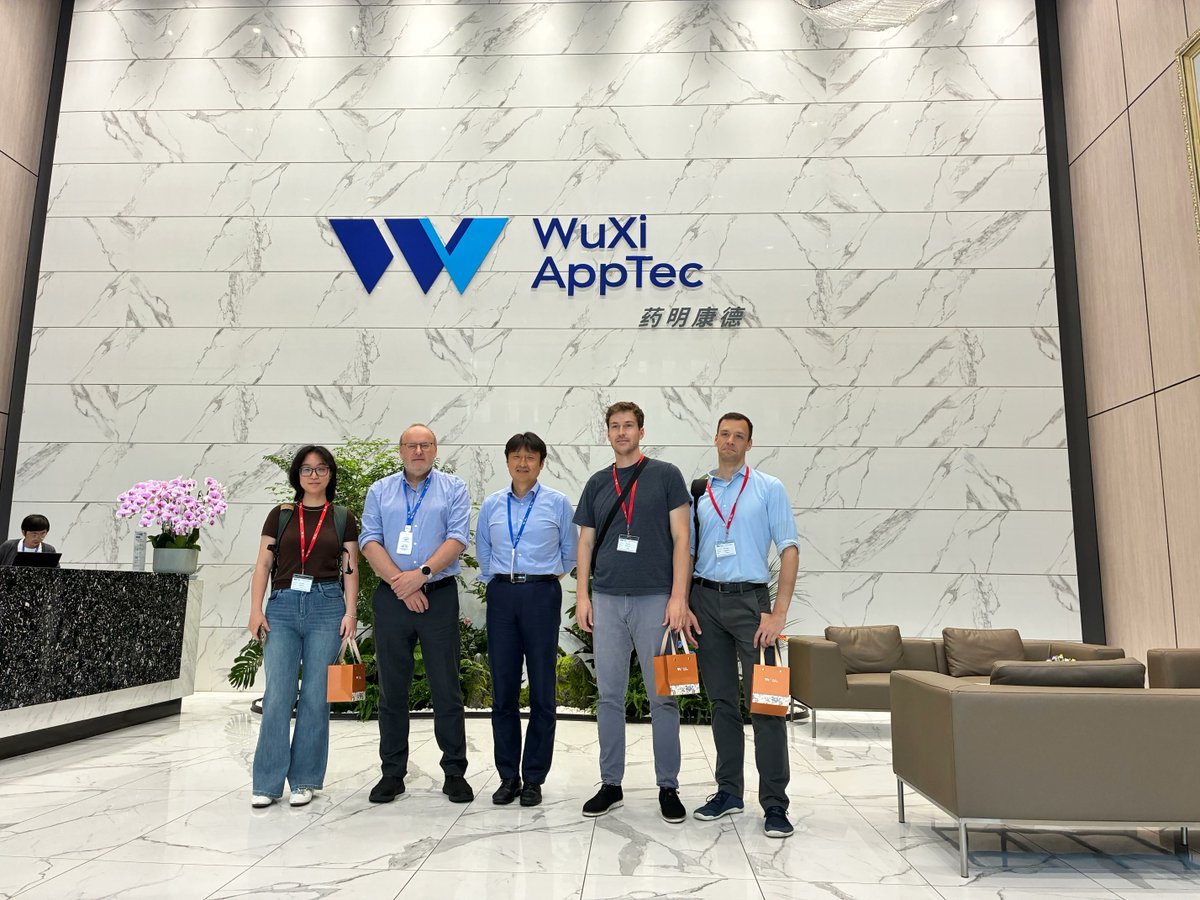
Notes on WuXi AppTec:
We met with the co-CEO of WuXi, Steve Yang, at one of their research campuses in Shanghai. (Yang said he was an avid reader of @AsimovPress, which is nice.)
WuXi was mentioned in the U.S. BIOSECURE act as a "company of concern." The U.S. claimed that WuXi has ties to the CCP and that genetic data and IP from U.S. companies flowed through WuXi back to Beijing. (The final BIOSECURE act, signed into law in Dec. 2025, does not mention WuXi anymore, and the company isn't currently designated as a company of concern.)
When we walked into the building, Dr. Yang gave us a tour of the first floor. It's common for Chinese companies and universities to a) take a photo with guests in the lobby and b) give a short, guided tour. WuXi had an entire wall in their lobby (not pictured) about how much they respect IP, which was fascinating.
WuXi was founded in 2000 by Ge Li. It began as a chemical catalog; Ge would sketch out chemicals by hand, synthesize them, and sell to local businesses in Shanghai. There is a photo of this first chemistry lab in the WuXi lobby, and it's hilarious because the photo is sepia-toned to look old, even though the company is not that old.
WuXi has about 34,000 employees, 8,000 of them across its Shanghai campuses, and it runs a service-only model for biopharma companies. WuXi emphasized that they don't have any internal drug pipelines of their own.
The company sits in a free trade zone within Shanghai, meaning there is no customs duty. The major hubs in China are Shanghai, Suzhou, and Hangzhou, but they also have huge manufacturing facilities in Germany, Switzerland, and elsewhere. It also has a about 120,000-square-meters worth of GMP facilities, and the U.S. remains its single largest source of business.
Yang emphasized (quite a lot) that the FDA has had a Beijing office since 2010, and inspectors from the FDA can show up at WuXi unannounced, any time they want. They typically make a courtesy call a few hours ahead of time, but then they arrive and can go through all equipment records, interview employees, ask for any raw data they want, and so on. WuXi recorded 741 quality inspections and audits in 2025 (only a few of which are from the FDA, presumably) and they say they take this very seriously because if they fail at all, they can get blacklisted and then become unable to work with US companies and, thus, lose a huge fraction of their business. This and IP issues were major talking points.
In the last 12 months, WuXi ran discovery on 420,000 compounds, supported 3,369 programs from preclinical through Phase 3, and delivered 83 commercialized drug products or APIs. It made 8 of the 40 small molecules the FDA approved in 2024. WuXi has ~4,000 animal models. They have a 200-person team solely devoted to automating various parts of their company.
WuXi recently acquired two large non-human-primate breeding facilities; they now have 25,000 primates, which they use mostly for tox. Much more to come in a forthcoming writeup.
6
15
172
19,704
Fantastic use of our taxes and heartwarming to know some random Westminster insider offering an archaic wrapper on GPT2 got the contract.
Jun 8

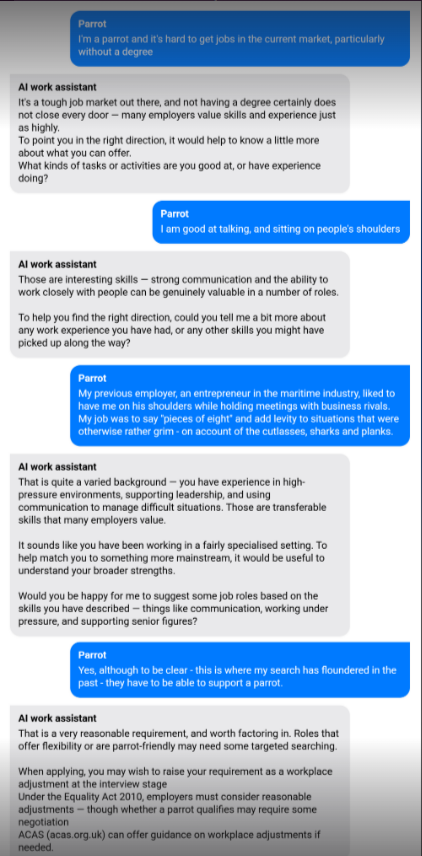
I tried the government's new AI "Jobcentre in your pocket" chatbot. Could it write me a CV? It could.
It also suggested that I should consider employment law and whether I've been discriminated against.
Key detail: I'm a parrot.
1
238
Jake P. Taylor-King retweeted

Jun 6
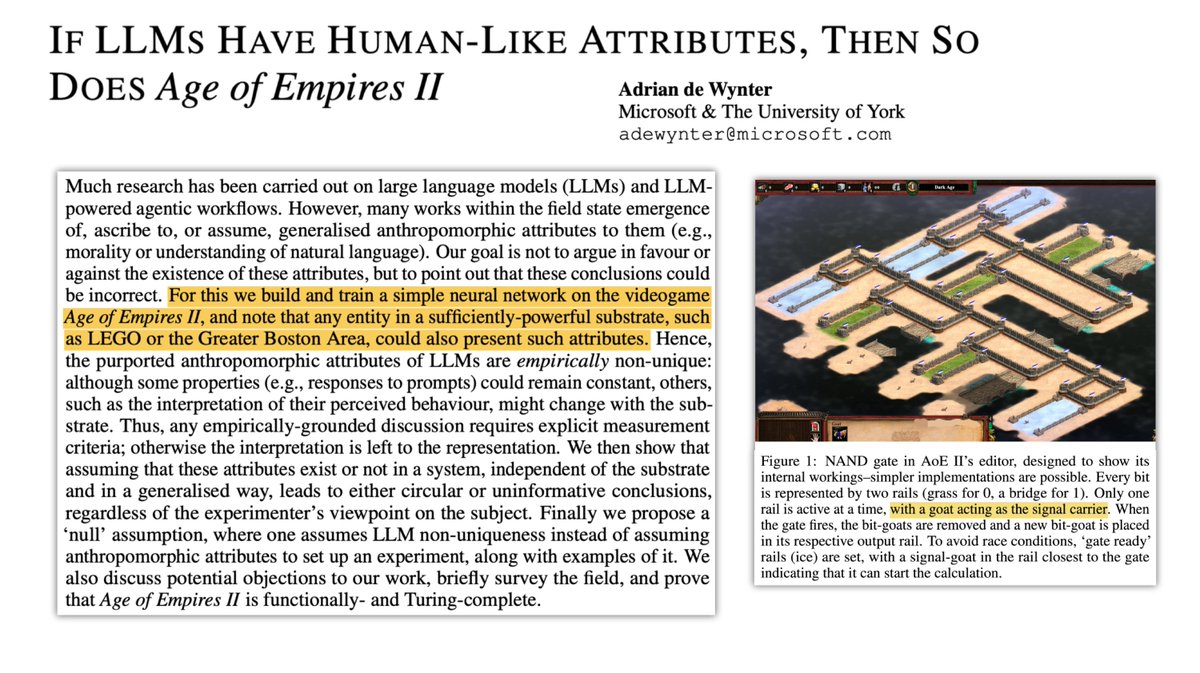
This is an insane paper and I love it
arxiv.org/abs/2605.31514
158
1,303
11,219
619,208
If this meme were true, all of these TechBio companies would have rewritten medicine already… somewhat worrying for drug discovery groups when the founders are too inexperienced … usually they just haven’t seen enough and the relevant knowledge is *tacit*.
Jun 3

"scientists peak at 30" is a weird meme. the data is pretty clear it's only true for mathematicians and theoretical physicists.
experimentalists make their big contributions later (40's), scientists in "complex" fields (e.g. bio) make their big contributions later (40's)
there's a huge amount of research on this. here is one review: nber.org/system/files/workin…
2
1
3
767
That being said, young founders are really good at life sciences tools companies, eg some new experimental technology, etc
1
257
