
| Prev @nvidia @tesla @visa @amazon also a @kp_fellows
Joined September 2014
- Tweets 2,616
- Following 2,604
- Followers 791
- Likes 4,319
83 Photos and videos









Debstep retweeted

Jun 15
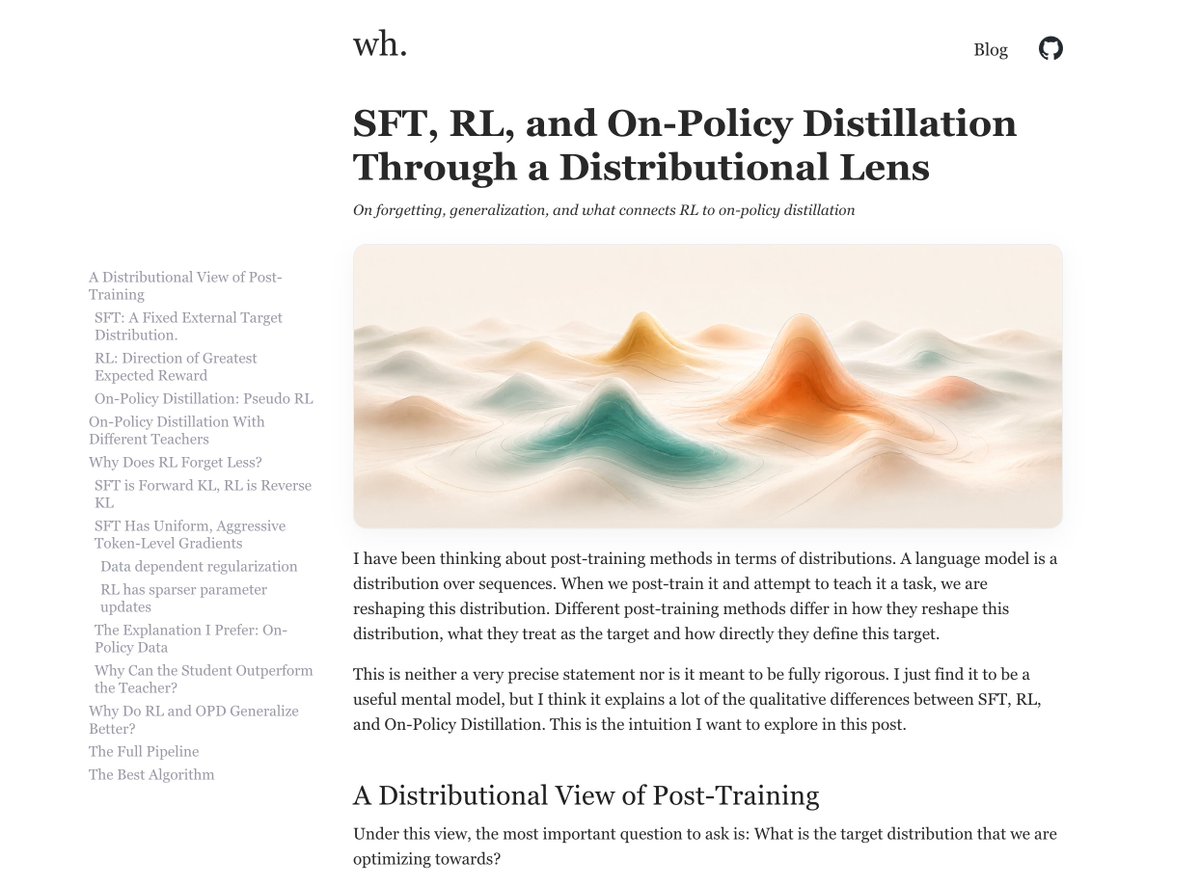
probably the best blog i have read for some time
viewing SFT, RL, and OPD as different ways of reshaping a model's distribution makes their tradeoffs super intuitive.
- SFT pulls toward a fixed external target
- RL moves along the reward gradient on on-policy samples
- OPD sits in between, using a teacher signal but on student-generated data, which is why it inherits RL's anti-forgetting properties even when the teacher itself was an overtrained SFT model.
the post is heavily grounded in recent literature and uses the distributional perspective as a unifying bridge across all three paradigms, i really like the point it argues the load-bearing ingredient is on-policy data and OPD's convergence to RL-like outcomes is the strongest evidence
12
214
1,824
94,186

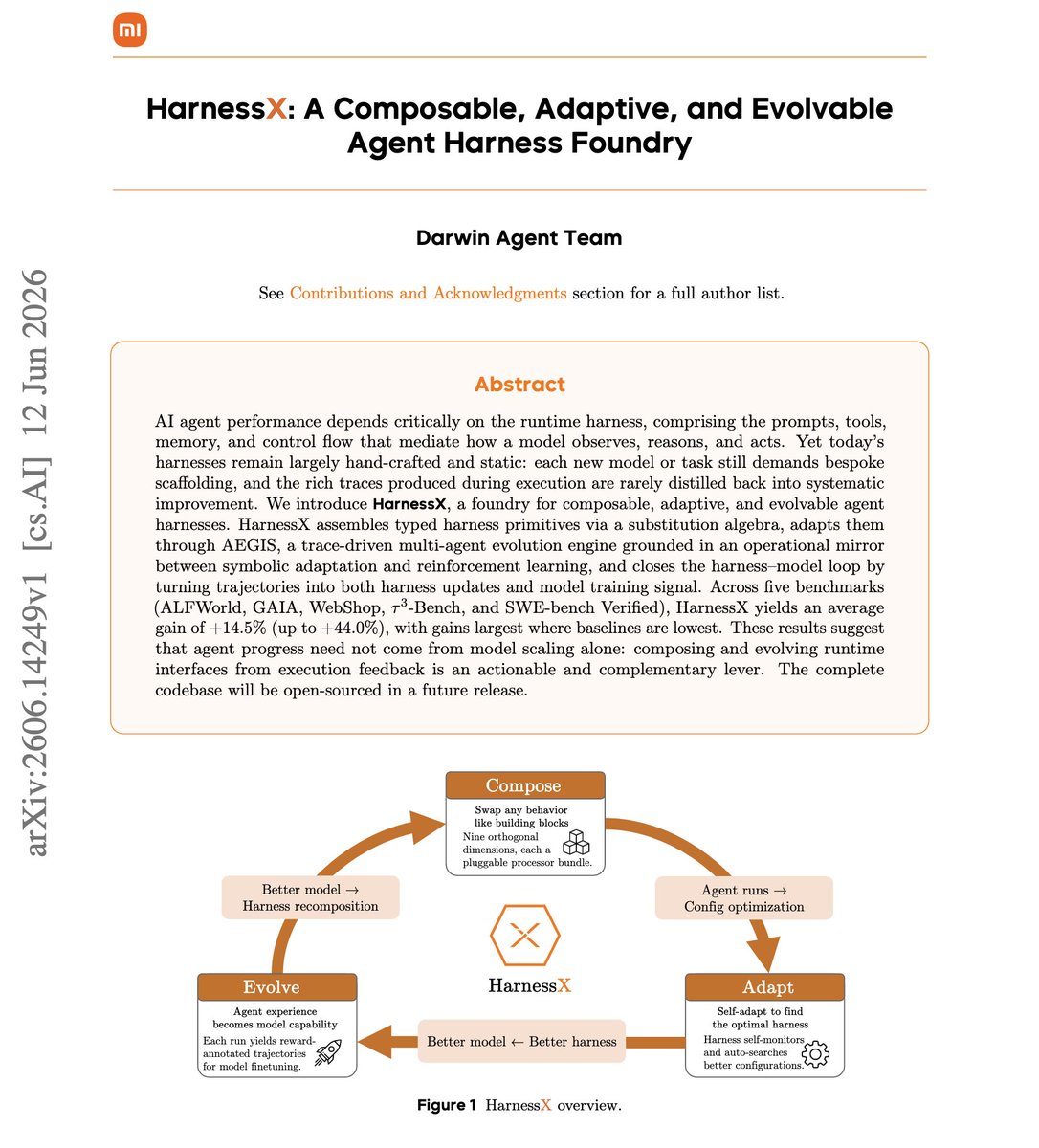
// HarnessX: Harnesses You Compile, Not Hand-Build //
(bookmark it)
Most agent harnesses are hand-crafted and frozen. Each new model or task means rewriting the prompts, tools, memory, and control flow from scratch, and the rich traces from every run get thrown away.
HarnessX treats the harness as something you assemble from typed primitives through a substitution algebra, then evolves with AEGIS, a trace-driven multi-agent engine that feeds execution history back into the design.
Why does it matter?
If the scaffolding can compose and improve itself from its own traces, the per-model rewrite tax that quietly dominates agent engineering starts to disappear. This is the cleanest version yet of treating the harness as a first-class, programmable artifact.
Paper: arxiv.org/abs/2606.14249
Learn to build effective AI agents in our academy: academy.dair.ai/
23
62
417
21,042
Debstep retweeted

Jun 15
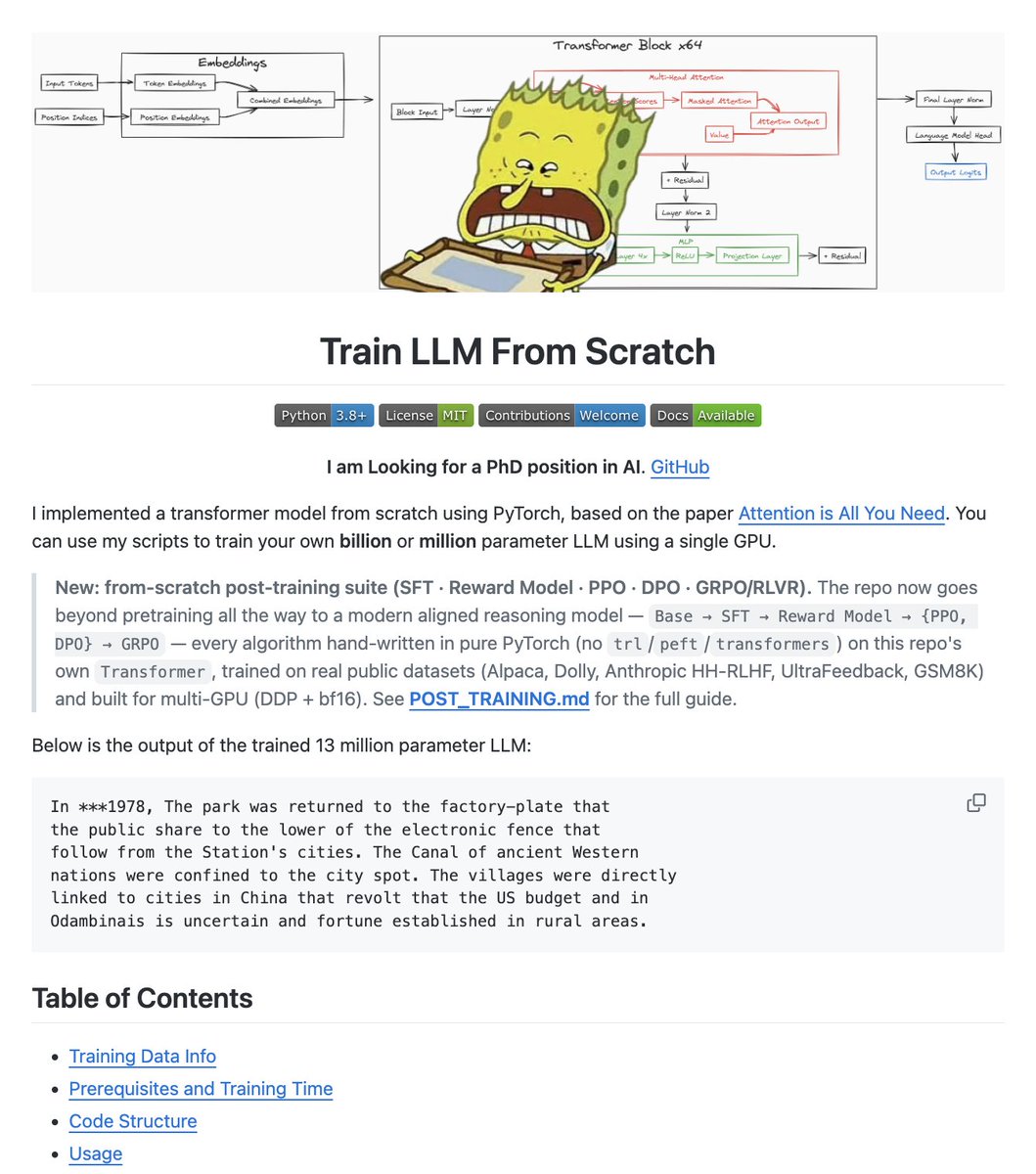
Train your own LLM from scratch.
This repo builds a GPT-style transformer from the ground up, without using any high-level libraries.
You see exactly how attention, multi-head attention, the feed-forward block, embeddings, residuals, and layer norm fit together.
And it doesn't stop at the model. It walks the whole path from raw data to generated text.
↳ Data download, preprocessing, training, and generation
↳ Training data from The Pile (825GB across 22 sources)
↳ Tokenized with tiktoken (r50k_base) and stored in HDF5
↳ Training loop with eval, LR decay, and crash-safe checkpoints
↳ An SFT and RLHF guide for what comes after pretraining
The same code scales by changing a few config values. Around 13M parameters is where the output starts producing correct grammar and spelling, and you can train that in about a day on a free Colab or Kaggle T4.
If you've ever wanted to actually see how a transformer works instead of importing one, this is a clean place to start.
Link to the repo in the comments.
Interested in ML/AI Engineering? Check my FREE AI engineering Guidebook with 380 pages (downloaded over 80k times, link below)
22
181
1,122
69,820
Debstep retweeted

Jun 14
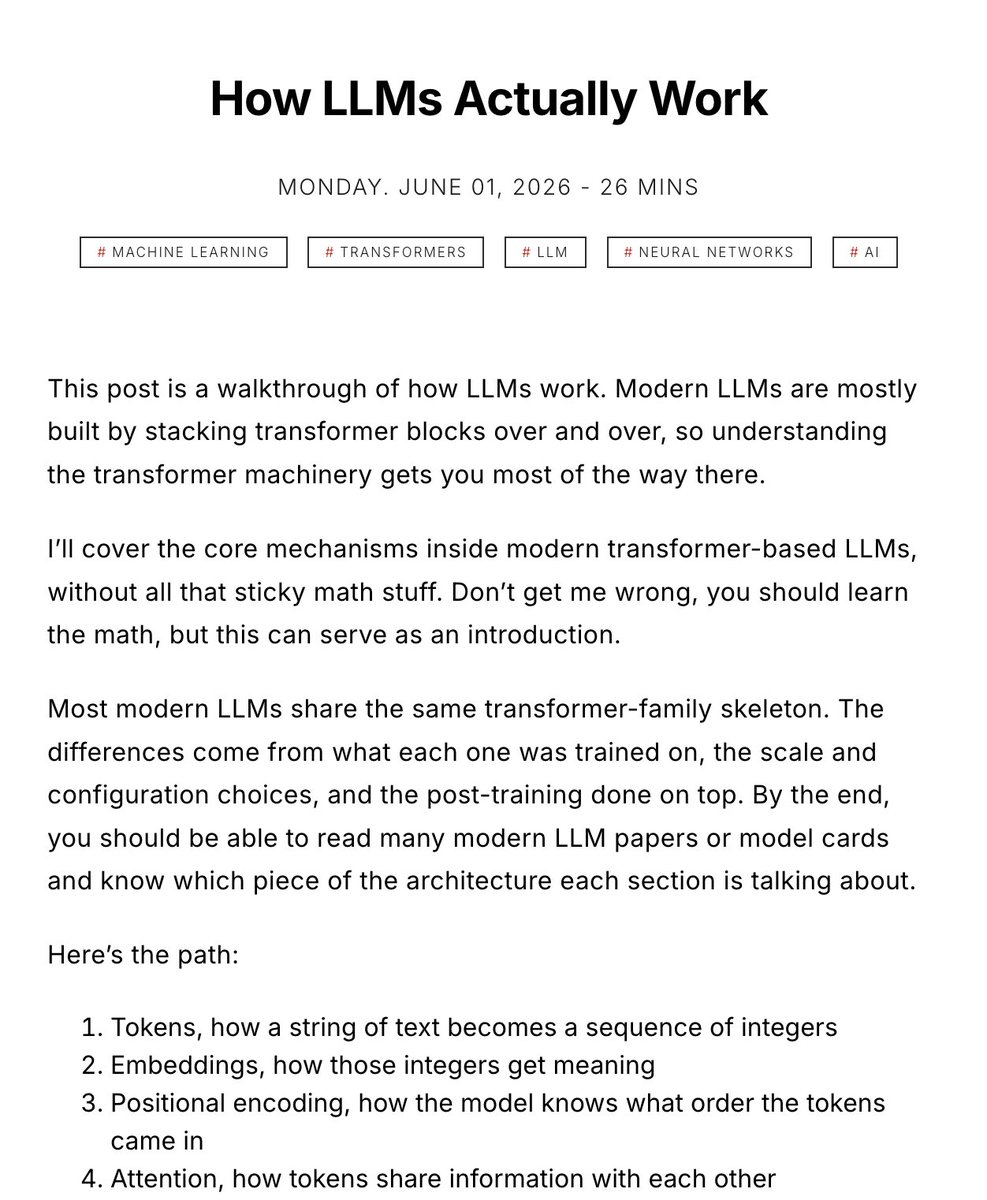
This is the best site on the internet to learn how LLMs actually work.
Free. Completely.
0xkato.xyz/how-llms-actually…
Bookmark this site.
Then read this setup ↓

25
439
2,343
365,201
Debstep retweeted

Jun 15
🚨 12-month fully funded fellowship. Build AI for good.
Claude Corps by @Anthropic x @codepath x Social Finance: AI fellowship for social impact
- For: Early-career talent (18 , under 2 yrs exp) • Any background • Mission-driven builders
- Bring: Your curiosity motivation to solve societal challenges with AI
- We'll bring: Full salary benefits • CodePath training • Anthropic technical mentorship • National peer cohort
- Build with: Claude API • Real nonprofit projects • 19 host orgs across US
- Output: Purpose-driven portfolio • Lasting skills • Real-world impact at scale
Logistics:
Full-time • Remote in-person options • Applications open now • Rolling selection
apply: anthropic.com/claude-corps
3
12
104
7,149
Debstep retweeted
Jun 14
If I had 6 months to become an Agentic AI Engineer.
I'd do this.
Stage 1: Python Async Foundations
asyncio, FastAPI, event-driven architecture, error handling, API integration patterns.
Stage 2: LLM Fundamentals for Agents
Context management, model routing, token economics, latency tradeoffs, failure modes.
Stage 3: Tool Calling Structured Outputs
Pydantic validation, function calling schemas, error recovery, dynamic tool discovery.
Stage 4: Memory State Management
Short-term buffers, long-term vector recall, context compression, cross-session sync.
Stage 5: Single Agent Workflows
ReAct loops, plan-and-execute, self-reflection, iteration limits, graceful degradation.
Stage 6: Multi-Agent Orchestration
LangGraph/CrewAI, supervisor patterns, message passing, conflict resolution, handoffs.
Stage 7: Human-in-the-Loop Systems
Uncertainty detection, approval gates, audit trails, resume logic, intervention points.
Stage 8: Evaluation Quality Assurance
Automated eval harnesses, LLM-as-a-judge, regression testing, hallucination metrics.
Stage 9: Observability Tracing
Distributed tracing (LangSmith/Arize), cost dashboards, latency monitoring, alerting.
Stage 10: Security Guardrails
Prompt injection defense, output filtering, PII redaction, sandboxed execution, compliance.
Stage 11: Production Deployment
vLLM/SGLang, Kubernetes scaling, CI/CD for agents, canary releases, rollback strategies.
Stage 12: Open Source Portfolio
Ship autonomous agents publicly, write architecture docs, record demos, contribute to libs.
Most people stay stuck watching tutorials.
Builders get hired.
(Bookmark it)
80
398
2,930
185,612
Debstep retweeted

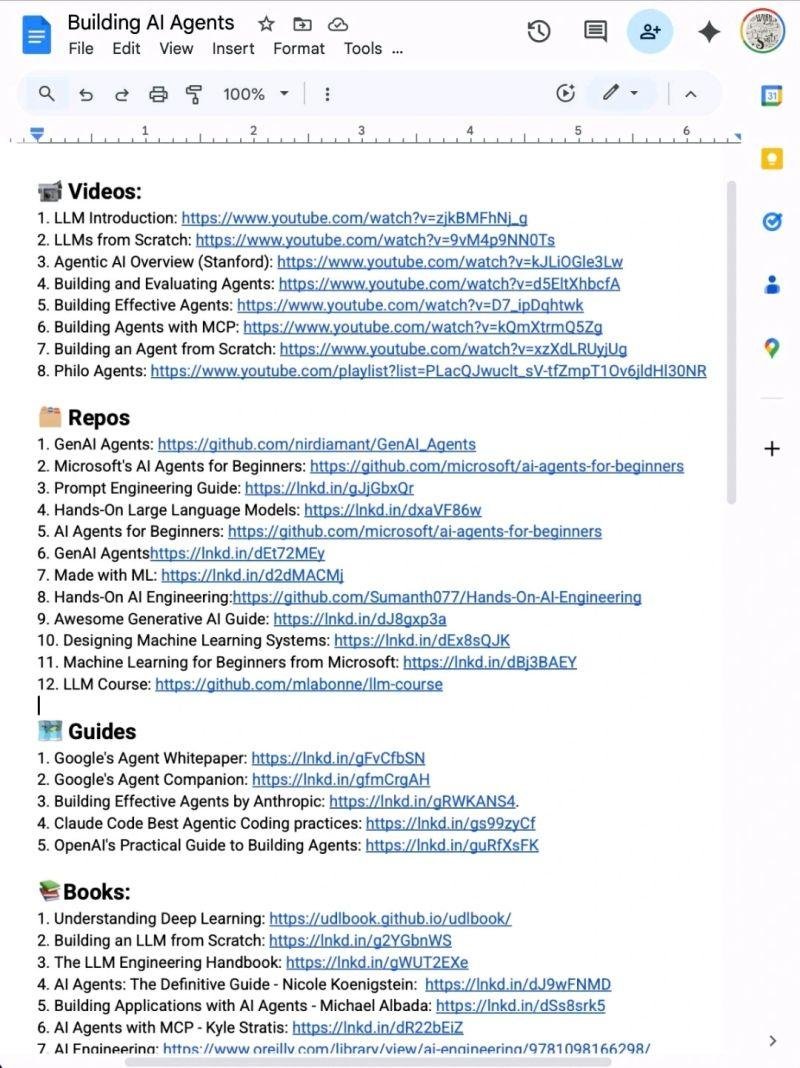
Stop wasting hours trying to learn AI. 📘📚
I have already done it for you.
With one list. Zero confusion. And no fluff
📹 Videos:
1. LLM Introduction: lnkd.in/dMqbaZdK
2. LLMs from Scratch: lnkd.in/dYYwEhYy
3. Agentic AI Overview (Stanford): lnkd.in/dArmMt2i
4. Building and Evaluating Agents: lnkd.in/dBWd2W8u
5. Building Effective Agents: lnkd.in/dHfdebqw
6. Building Agents with MCP: lnkd.in/dXuNHrRJ
7. Building an Agent from Scratch: lnkd.in/da3ANw3w
8. Philo Agents: lnkd.in/dq-BfZE5
🗂️ Repos
1. GenAI Agents: lnkd.in/d3UDtwwv
2. Microsoft's AI Agents for Beginners: lnkd.in/dHvTmJnv
3. Prompt Engineering Guide: lnkd.in/gJjGbxQr
4. Hands-On Large Language Models: lnkd.in/dxaVF86w
5. AI Agents for Beginners: lnkd.in/dHvTmJnv
6. GenAI Agentshttps://lnkd.in/dEt72MEy
7. Made with ML: lnkd.in/d2dMACMj
8. Hands-On AI Engineering:lnkd.in/dgQtRyk7
9. Awesome Generative AI Guide: lnkd.in/dJ8gxp3a
10. Designing Machine Learning Systems: lnkd.in/dEx8sQJK
11. Machine Learning for Beginners from Microsoft: lnkd.in/dBj3BAEY
12. LLM Course: lnkd.in/diZgGACG
🗺️ Guides
1. Google's Agent Whitepaper: lnkd.in/gFvCfbSN
2. Google's Agent Companion: lnkd.in/gfmCrgAH
3. Building Effective Agents by Anthropic: lnkd.in/gRWKANS4.
4. Claude Code Best Agentic Coding practices: lnkd.in/gs99zyCf
5. OpenAI's Practical Guide to Building Agents: lnkd.in/guRfXsFK
📚Books:
1. Understanding Deep Learning: lnkd.in/dgcB68Qt
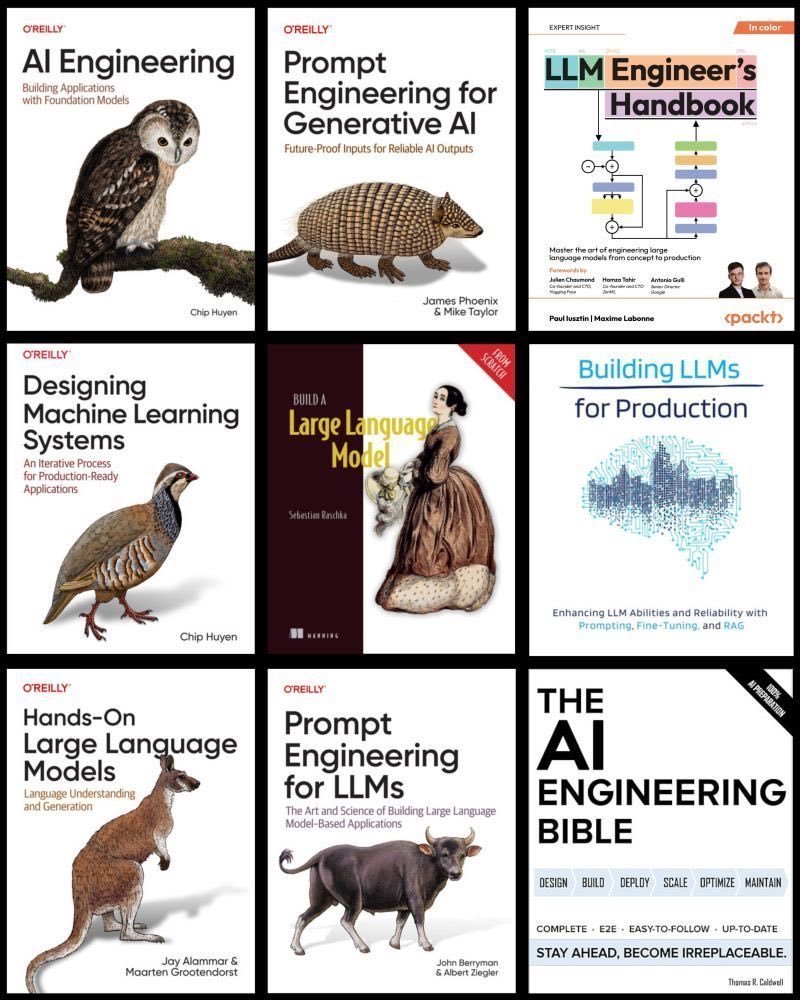
2. Building an LLM from Scratch: lnkd.in/g2YGbnWS
3. The LLM Engineering Handbook: lnkd.in/gWUT2EXe
4. AI Agents: The Definitive Guide - Nicole Koenigstein: lnkd.in/dJ9wFNMD
5. Building Applications with AI Agents - Michael Albada: lnkd.in/dSs8srk5
6. AI Agents with MCP - Kyle Stratis: lnkd.in/dR22bEiZ
7. AI Engineering: lnkd.in/gi-mQcXa
📜 Papers
1. ReAct: lnkd.in/gRBH3ZRq
2. Generative Agents: lnkd.in/gsDCUsWm.
3. Toolformer: lnkd.in/gyzrege6
4. Chain-of-Thought Prompting: lnkd.in/gaK5CXzD.
🧑🏫 Courses:
1. HuggingFace's Agent Course: lnkd.in/gmTftTXV
2. MCP with Anthropic: lnkd.in/geffcwdq
3. Building Vector Databases with Pinecone: lnkd.in/gCS4sd7Y
4. Vector Databases from Embeddings to Apps: lnkd.in/gm9HR6_2
5. Agent Memory: lnkd.in/gNFpC542
Repost for your network ♻️
36
115
291
12,518
Debstep retweeted

Read this to get started learning ML infra.
This is an excellent high-level overview of important considerations in ML training from CMU. It touches on:
- hardware
- memory
- the ML experimentation process
sei.cmu.edu/blog/a-hitchhike…
5
101
1,078
42,181

RT @ghumare64: As an AI Engineer. Please learn:
Harness engineering, not just prompt engineering
Context engineering, not just long prompt…
128
Debstep retweeted

Jun 4
Step-By-Step LLM Engineering Projects Roadmap
- Build a tokenizer
- Learn embeddings
- Implement RoPE / ALiBi
- Hand-wire attention
- Build MHA
- Build a Transformer block
- Train a mini-former
- Compare objectives
- Build sampling
- Speculative decoding
- KV cache
- MQA / GQA / MLA
- Long context
- FlashAttention
- Hardware budgets
- Toy MoE
- Sparse model trade-offs
- State-space / linear attention
- Diffusion language models
- Data pipelines
- Synthetic data
- Scaling laws
- SFT / DPO / RLHF / GRPO
- Quantization
- Serving stacks
- Eval harnesses
- RAG
- Tool use / agents
- Vision-language adapters
- Interpretability
- Red-team suite
- Full capstone model system
One request:
Choose an Opensource AI lab when you make it
Opensource is where humanity gets to keep the tools
DM me when you've made it ;)

35
262
1,654
121,065
Debstep retweeted

May 29
Learn AI for free directly from top companies.
1 - Anthropic:
anthropic.skilljar.com
2 - Google:
grow.google/ai
3 - Meta:
ai.meta.com/resources/
4 - NVIDIA:
developer.nvidia.com/cuda
5 - Microsoft:
learn.microsoft.com/en-us/tr…
6 - OpenAI:
academy.openai.com
7 - IBM:
skillsbuild.org
8 - AWS:
skillbuilder.aws
9 - DeepLearning.AI:
deeplearning.ai
10 - Hugging Face:
huggingface.co/learn
Comment "Learning" if you find this helpful.
Repost so others can take help.
Must bookmark for future reference.
18
122
438
20,985
Debstep retweeted
May 24
If I had 6 months to become an AI/ML Engineer.
I'd do this.
Stage 1 : Python Data Engineering
pandas, numpy, SQL, Parquet/Arrow, API ingestion, data validation, pipeline orchestration.
Stage 2 : ML Fundamentals Statistics
Linear algebra, probability, bias/variance, supervised/unsupervised learning, evaluation metrics.
Stage 3 : Deep Learning Frameworks
PyTorch, training loops, backprop, CNNs/Transformers, optimizers, learning rate schedulers.
Stage 4 : Feature Stores Pipelines
Feature engineering, preprocessing, data versioning, DVC, Airflow/Prefect, dbt integration.
Stage 5 : Experiment Tracking Tuning
MLflow/Weights & Biases, hyperparameter optimization, cross-validation, reproducibility, model registry.
Stage 6 : Model Deployment Serving
FastAPI, Docker, model registries, batch vs real-time inference, REST/gRPC endpoints, scaling.
Stage 7 : LLM Integration GenAI
RAG pipelines, fine-tuning (LoRA/QLoRA), prompt engineering, embedding models, vector databases.
Stage 8 : MLOps CI/CD
GitHub Actions, automated testing, model validation gates, continuous training, deployment strategies.
Stage 9 : Monitoring Drift Detection
Data/concept drift, performance metrics, structured logging, alerting, automated retraining triggers.
Stage 10 : Infrastructure Cloud Scale
AWS/GCP ML stacks, distributed training, GPU orchestration, Kubernetes, autoscaling, cost tracking.
Stage 11 : Open Source Portfolio
Ship end-to-end ML systems publicly, write architecture docs, record demos, publish benchmarks.
Stage 12 : Apply
AI/ML Engineer, MLOps Engineer, AI Infrastructure Engineer, Data Science Engineering roles.
Most people stay stuck watching tutorials.
Builders get hired.
15
240
1,186
60,359

Research papers you must read for AI Engineer interviews:
1. Attention is all you need (Transformers)
2. LoRA (Low rank adaption)
3. PEFT ( Parameter Efficient Fine Tuning)
4. VIT (Vision Transformers) 5. VAE (Variational Auto Encoder)
6. GANs ( Generative Adversarial Networks)
7. BERT ( Bidirectional Encoder Representation from Transformers)
8. Diffusion Models (Stable Diffusion)
9. RAG (Retrieval Augment Generation)
10. GPT (Generative Pre-trained Transformers)
11. MoE (Mixture of Experts)
12. RLHF (Reinforcement Learning from Human Feedback)
13. LLaMA (Large Language Model Meta AI)
46
136
1,057
37,614
Debstep retweeted

May 24
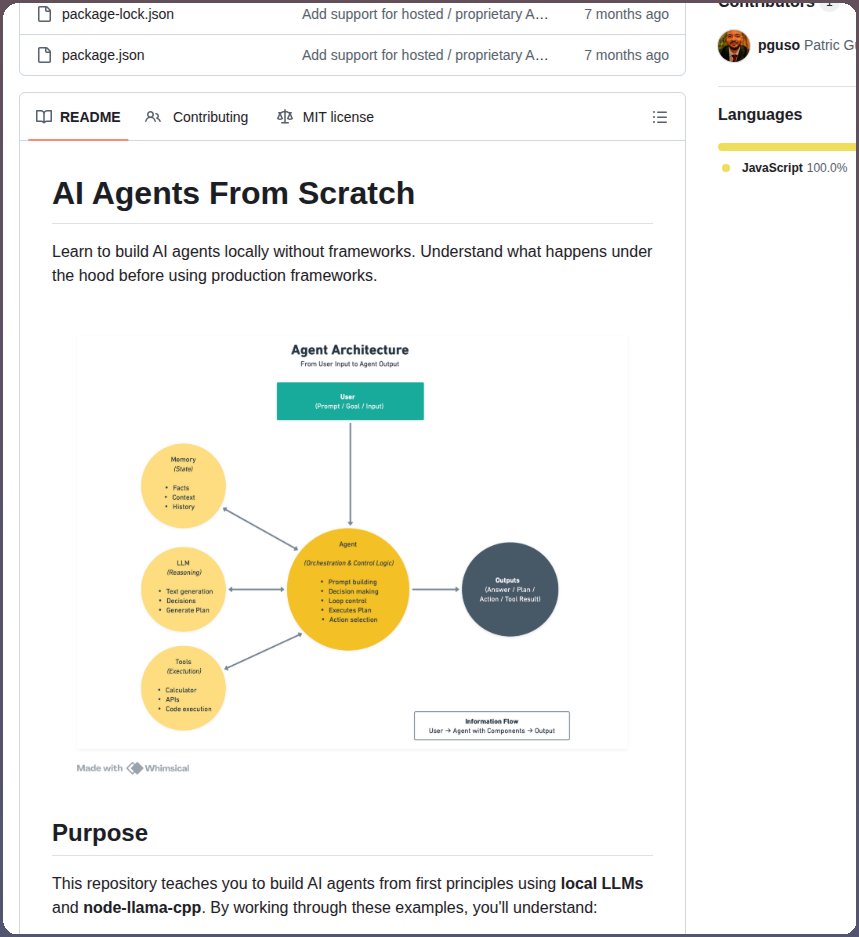
Teaches building AI agents from first principles
github.com/pguso/ai-agents-f…
14
250
1,731
86,412

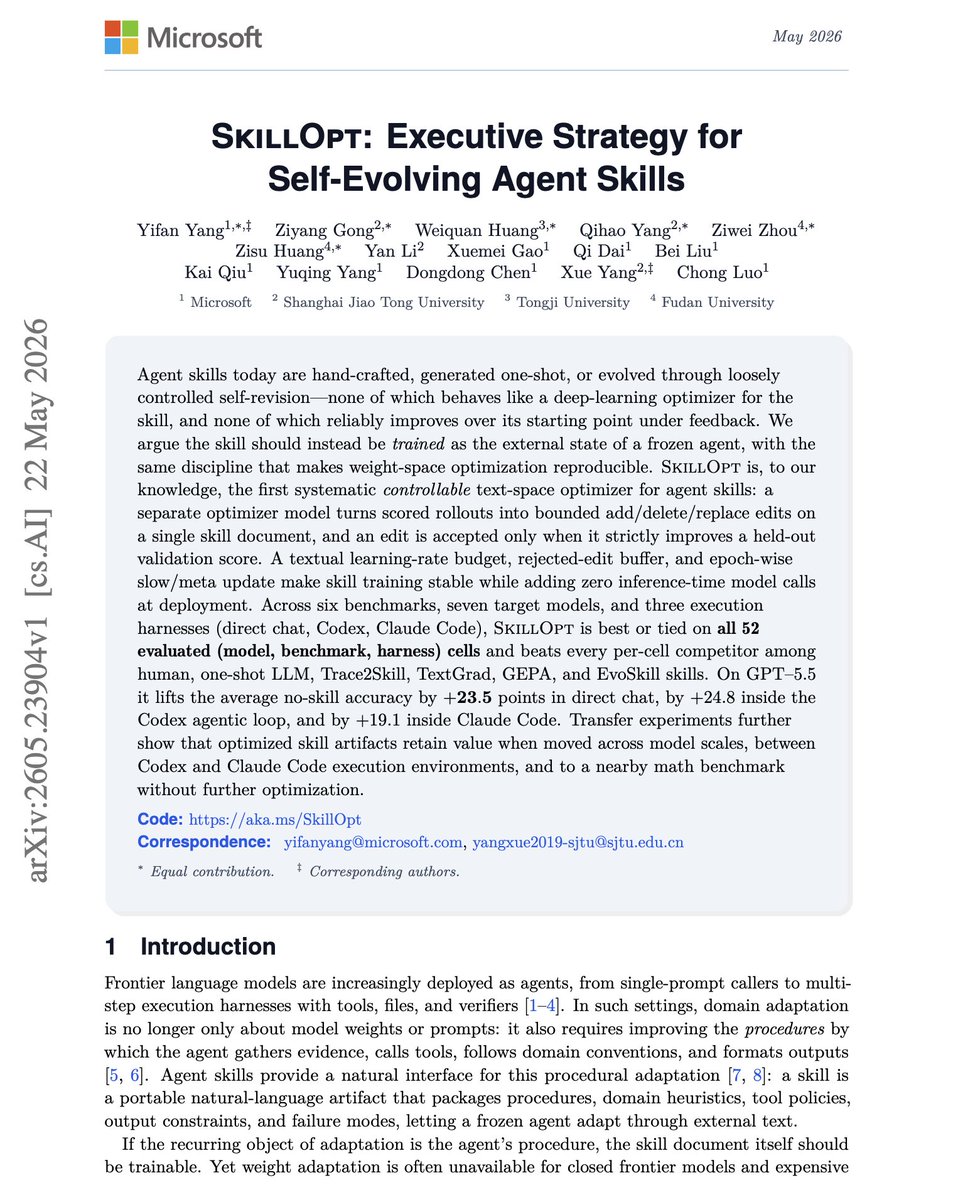
New research from Microsoft Research
I see a lot of AI engineers handwriting agent skill docs and hope they generalize.
Probably not optimal. This works show why.
It treats the skill doc as a trainable external state of a frozen agent instead.
It introduces SkillOpt, where an optimizer model makes validation-gated edits to the skill file. It adds, deletes, or replaces instructions, with a textual learning rate that controls how aggressively each round rewrites the doc. The agent itself never changes.
SkillOpt is best or tied on all 52 (model, benchmark, harness) cells.
On GPT-5.5 it adds 23.5 points in direct chat, 24.8 with Codex, and 19.1 with Claude Code over no skill. It beats human-written skills, TextGrad, GEPA, and EvoSkill, carries zero extra inference-time cost, and the learned skills transfer across models and harnesses.
Paper: arxiv.org/abs/2605.23904
Learn to build effective AI agents in our academy: academy.dair.ai/
64
197
1,140
173,719
Debstep retweeted

May 25
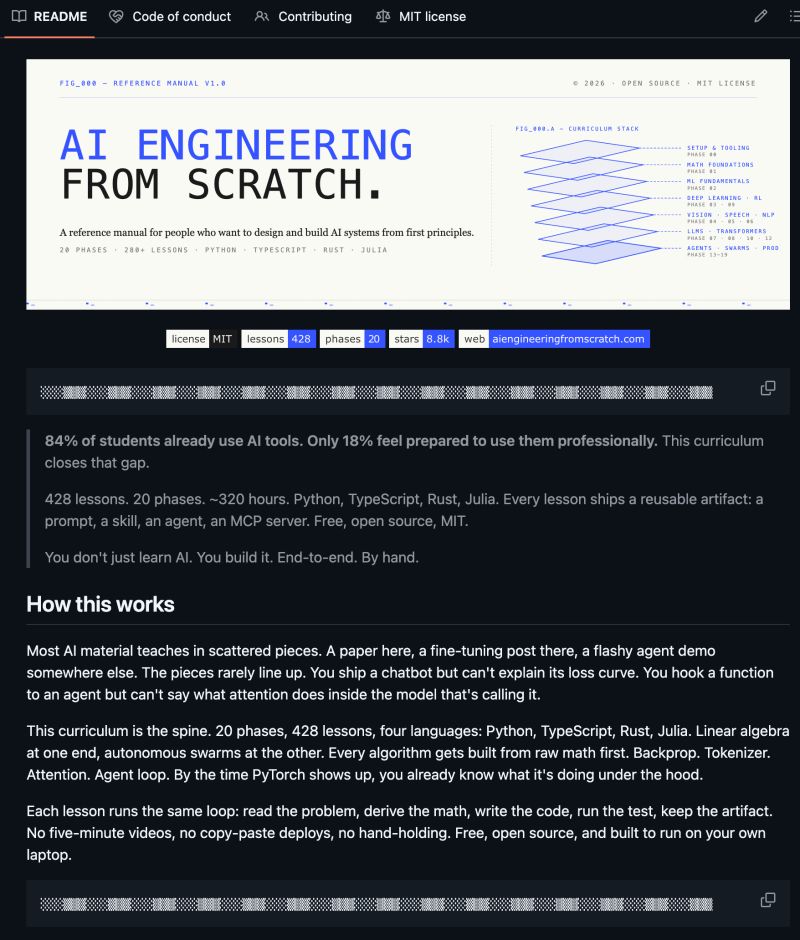
The full AI engineering curriculum is now free.
It's called AI Engineering from Scratch. 20 phases, 428 lessons, roughly 320 hours end to end. Free. MIT license. Runs on your own laptop.
The design principle that makes it different from everything else => every algorithm gets built from raw math before a single framework loads. Backprop by hand. Tokenizer by hand. Attention by hand. Agent loop by hand. Then you implement the same thing in PyTorch or sklearn. By the time the production library appears, you already know what it's doing underneath.
Every lesson ends with something you keep:
→ Prompt templates for any AI assistant
→ Skill files for Claude, Cursor, Codex, OpenClaw, Hermes
→ Agent definitions you wrote the loop for yourself
→ MCP servers built from scratch in Phase 13
428 lessons means 428 artifacts by the end. Tools you built and actually understand.
The full 20 phases:
→ Phase 0 - Setup & Tooling (12 lessons)
→ Phase 1 - Math Foundations (22 lessons)
→ Phase 2 - ML Fundamentals (18 lessons)
→ Phase 3 - Deep Learning Core (13 lessons)
→ Phase 4 - Computer Vision (28 lessons)
→ Phase 5 - NLP (29 lessons)
→ Phase 6 - Speech & Audio (17 lessons)
→ Phase 7 - Transformers Deep Dive (14 lessons)
→ Phase 8 - Generative AI (14 lessons)
→ Phase 9 - Reinforcement Learning (12 lessons)
→ Phase 10 - LLMs from Scratch (22 lessons)
→ Phase 11 - LLM Engineering (15 lessons)
→ Phase 12 - Multimodal AI (25 lessons)
→ Phase 13 - Tools & Protocols (23 lessons)
→ Phase 14 - Agent Engineering (42 lessons)
→ Phase 15 - Autonomous Systems (22 lessons)
→ Phase 16 - Multi-Agent & Swarms (25 lessons)
→ Phase 17 - Infrastructure & Production (28 lessons)
→ Phase 18 - Ethics, Safety & Alignment (30 lessons)
→ Phase 19 - Capstone Projects (17 projects, 20-40 hours each)
Python, TypeScript, Rust, Julia throughout.
GitHub Repo: github.com/rohitg00/ai-engin…
15
211
974
40,108
Debstep retweeted

May 25
Become a Generative AI Engineer for Free – Ultimate GitHub Resource Guide
Foundations & Programming
1- github.com/krishnaik06/Compl… – Comprehensive AI paths including Generative AI tracks.
2- github.com/aishwaryanr/aweso… – Hub for research, notebooks, courses, and prep.
Roadmaps
3- github.com/krishnaik06/Roadm… – Dedicated 2025 GenAI roadmap with tutorials/projects.
4- github.com/Pandeycoder/AI-En… – AI Engineer focus with ML, Deep Learning, and GenAI.
5- github.com/athivvat/ai-engin… – Zero to pro, covering agents, multimodal, and deployment.
lets-code.co.in/articles/AIE… – Interactive community-driven AI Engineer roadmap.
Core Generative AI Tools & Libraries
6- github.com/huggingface/diffu… – Diffusion models for image/audio/video generation.
7- github.com/huggingface/trans… – Transformers for LLMs and fine-tuning.
8- github.com/langchain-ai/lang… – Build apps with LLMs, chains, and RAG.
9- github.com/steven2358/awesom… – Curated GenAI projects and tools.
Advanced Topics: RAG, Agents & Multimodal
10- github.com/langchain-ai/lang… – Build stateful, multi-agent applications (corrected & active).
11- github.com/genieincodebottle… – Roadmap, projects, RAG, agents, and prep.
12- github.com/parthmax2/100-Bes… – 100 innovative GenAI projects for 2025.
Projects & Hands-On
13- github.com/GURPREETKAURJETHR… – End-to-end projects with deployment.
14- github.com/filipecalegario/a… – Tools, models, and project references.
Inspiring examples of GenAI applications and project ideas:
projectpro.ioprojectpro.iopr…
MLOps, Deployment & Best Practices
15- github.com/kelvins/awesome-m… – MLOps tools (adapt for LLMOps).
16- github.com/microsoft/LMOps – Production LLMs/GenAI research and tech.
Bookmark it!
2
33
153
5,573

Debstep retweeted

May 22
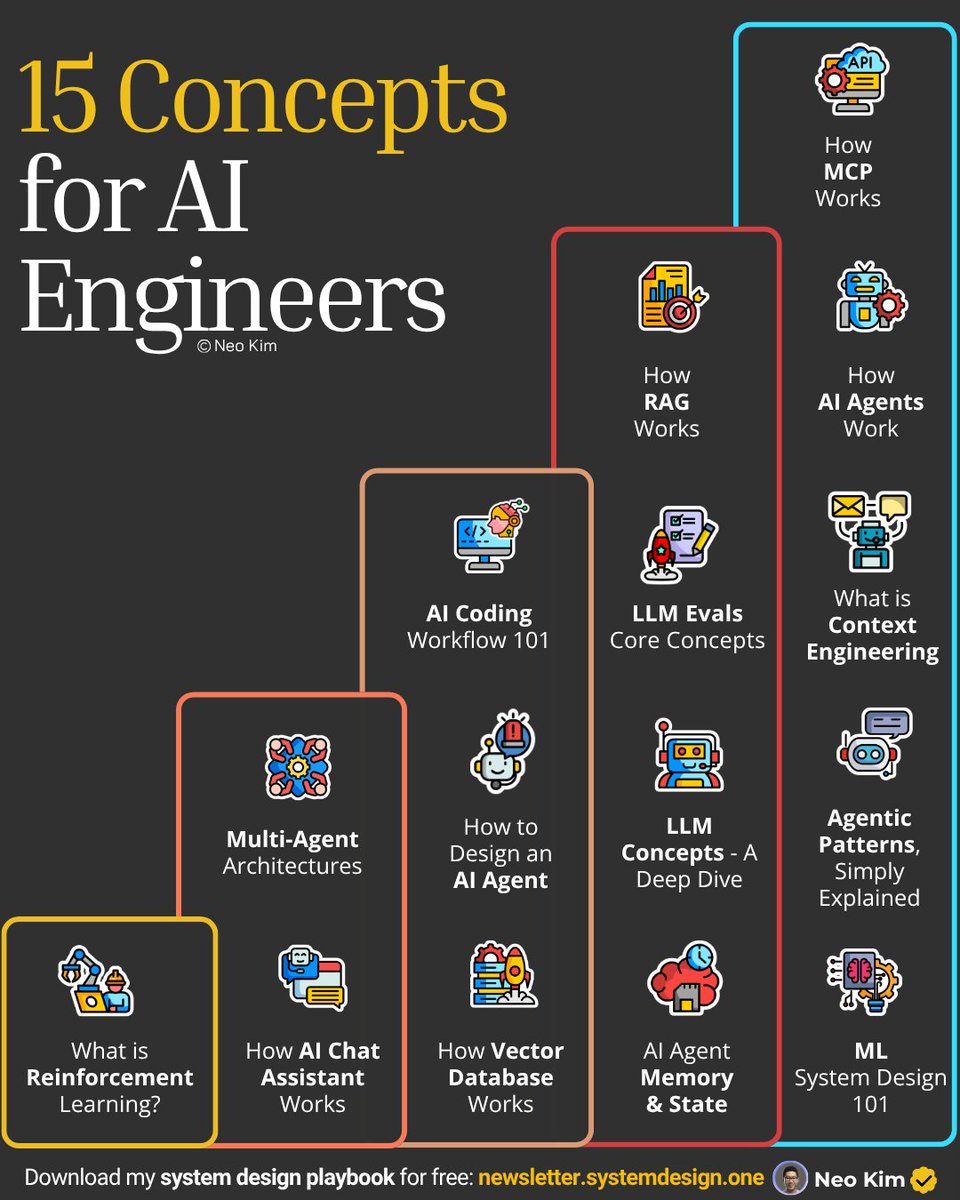
If you want to become good at AI engineering (in 3 weeks), then learn these 15 concepts:
1 AI Agents: Memory, State & Consistency
→ newsletter.systemdesign.one/…
2 Machine Learning System Design 101
→ newsletter.systemdesign.one/…
3 Design Personal AI Chat Assistant
→ newsletter.systemdesign.one/…
4 How RAG Works
→ newsletter.systemdesign.one/…
5 LLM Concepts - A Deep Dive
→ newsletter.systemdesign.one/…
6 How to Design an AI Agent
→ newsletter.systemdesign.one/…
7 What is Reinforcement Learning
→ newsletter.systemdesign.one/…
8 How Vector Databases Work
→ newsletter.systemdesign.one/…
9 Context Engineering 101
→ newsletter.systemdesign.one/…
10 AI Coding Workflow 101
→ newsletter.systemdesign.one/…
11 LLM Evals Explained
→ newsletter.systemdesign.one/…
12 How AI Agents Work
→ newsletter.systemdesign.one/…
13 How MCP Works
→ newsletter.systemdesign.one/…
14 Agentic Patterns Explained
→ newsletter.systemdesign.one/…
15 Multi-Agent Architecture Explained
→ newsletter.systemdesign.one/…
What else should make this list?
===
👋 PS - Want my System Design Playbook for FREE?
Join my newsletter with 210K software engineers right now:
→ newsletter.systemdesign.one/…
===
💾 Save & RT to help others ace AI engineering.
👤 Follow @systemdesignone turn on notifications.
27
285
1,063
50,911
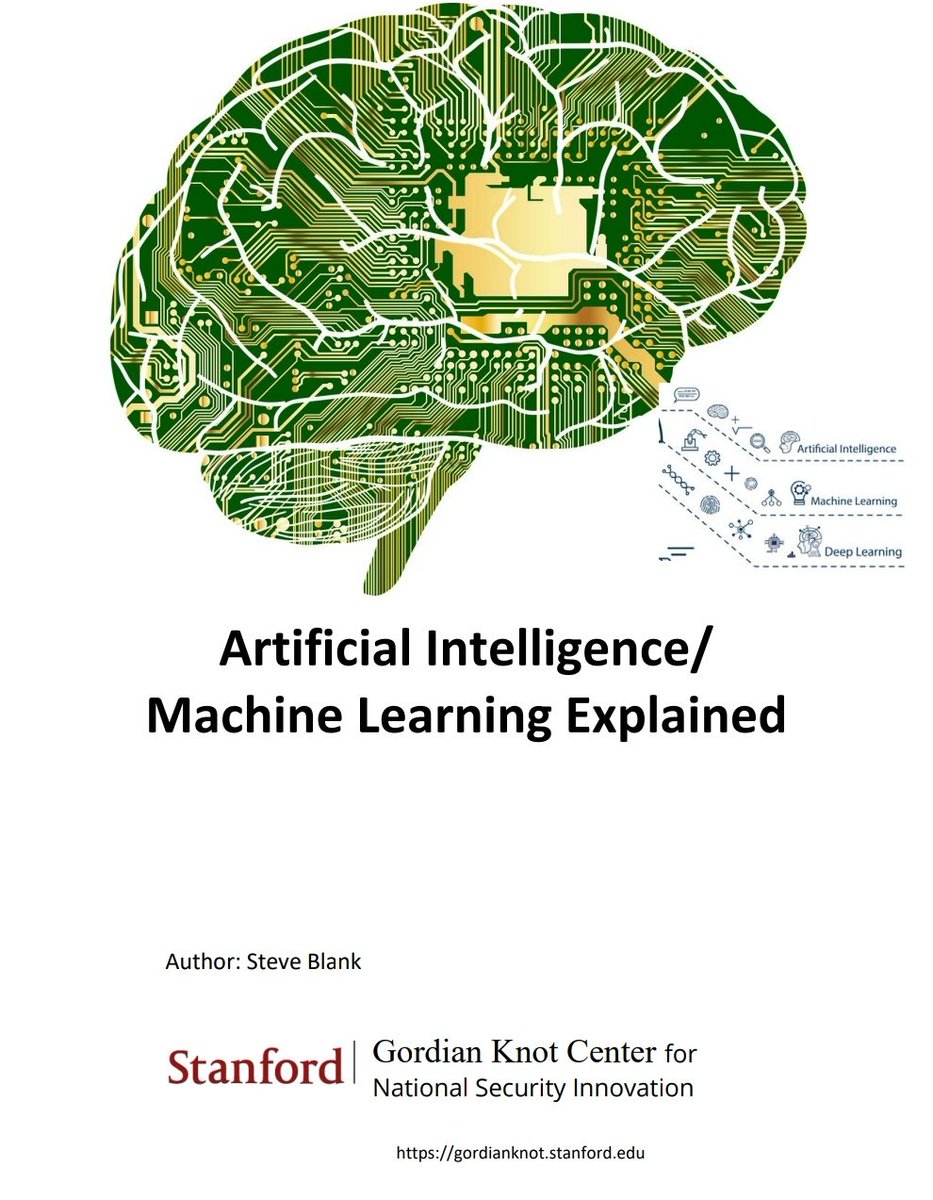
Artificial Intelligence & Machine Learning Explained by Stanford
drive.google.com/file/d/1H2_…
2
130
654
20,035