
Are you guys for scuba?
Joined February 2019
- Tweets 8,972
- Following 559
- Followers 281
- Likes 14,435
6 Photos and videos

Doughty retweeted

Jun 4
ThE fOur YeAr cyCle iS dEAd
youtu.be/ctJSV8aTDSk?si=x0kH…
If you've enjoyed this Bitcoin Journey over the past 8 years, appreciate a Retweet and sharing on other forums. Thanks,.
71
225
1,447
166,597
Doughty retweeted

May 17
If @elonmusk wants the @SpaceX IPO to get priced properly, he will ensure that there is accountability and transparency for the big banks in the process.
@HyperliquidX is THE only way to price this with transparency so the big banks don’t manipulate things
Retweet this so @elonmusk sees it
May 17

Well if any CEO has the guts to fight the big investment banks & the buyside in pricing an IPO its got to be @elonmusk - let's see if he can do it.
And now all it means to "fight" is to say "look at where it's trading on @HyperliquidX " - the trick is when the bankers give you 1000 excuses as to why the HL price isn't real you need to have the guts to tell them you are going to pull the deal and for them to believe it - Elon may be the right guy for this job!
@HypeStrat
@tradexyz
@SpaceX
$PURR
16
102
362
51,833
Doughty retweeted

Today, Bloomberg reported on certain incumbent traditional exchanges raising concerns about the integrity and impact of markets for perpetual derivatives on Hyperliquid.
These concerns are unfounded.
Hyperliquid offers enhanced market transparency, publishing a complete onchain record of every transaction in real time, making it a uniquely hostile environment for insider trading or price manipulation. Hyperliquid’s transparency serves as a strong deterrent for misconduct and facilitates surveillance, detection, and investigation by regulators and law enforcement.
Hyperliquid also offers 24/7 trading, an innovation that substantially increases market efficiency. Prices move whether traditional exchanges are open or not. Continuous trading eliminates gaps and discontinuities between legacy market hours, improving price discovery for all participants.
Bloomberg correctly reports that U.S. law is not currently tailored for derivatives markets on public blockchains like Hyperliquid. We look forward to continuing our work with policymakers in Washington to bring onchain markets inside the regulatory perimeter.
289
335
1,673
163,551
Doughty retweeted

I don’t think most Americans have any real sense of just how sophisticated and massive this whole operation against the Islamic regime has been. Even a lot of Trump supporters, probably picture it as some straightforward military thing. But for those of us who have lived under this system, it’s on another level entirely.
However, we are understandably exhausted and hyper-focused, worrying about basic safety that it’s hard for us to step back and appreciate the bigger picture. We don’t talk much, but it doesn’t mean we don’t see it.
We Iranians know war. My mother’s generation lived for 8 horrific years in the shadow of Saddam, a madman even crazier and more brutal than this regime in many ways. They endured constant bombings, cities turned to rubble, chemical attacks, families ripped apart, and massive displacement. For my generation, those years left childhood nightmares that never fully went away. We know amputated fathers, martyred neighbors, streets full of mourning, endless death, and helplessness. We know what real war is.
This operation was nothing like that. Unlike the Iran-Iraq war, where civilians were deliberately targeted to create maximum death, suffering, and destruction, this was meticulously designed to separate the regime and its military machine from the Iranian people.
It was remarkably successful in that regard. The vast majority of the hardship ordinary Iranians faced didn’t come from the strikes themselves. It came from the regime’s own incompetence, sabotage, and desperation. They cut the internet for days to control the narrative abroad, wrecked businesses and the economy with their chaotic responses, and kept their own people in the dark. That part was all them.
There is another thing, we Iranians know this regime like the back of our hand. It’s not some abstract evil.
It’s like stage-four cancer: incompetent at actually running a country, ugly and corrupt to its core, yet incredibly strong in spreading fear, hatred, and pulling out the worst in human nature.
Removing something this entrenched, in a country as vast and regionally complicated as Iran, required an intelligence and planning effort that is honestly mind-blowing.
What blows my mind is the Israeli intelligence work. We’re not talking just names and addresses. They’ve mapped behaviors, personalities, decision-making patterns, the whole human side of that rotten system. It’s like they know it inside out.
The planning was deeply coordinated with US, with Israel leading on the technical, intelligence, and precision execution level, while the U.S. directed the overall strategy and brought the power and coordination to make it happen. The precision was unreal: cutting-edge, top-notch technology, the best specialists in the world, and targeting that actually feels more like a surgical rescue mission than old-school war.
From where I sit, Trump directed the overall strategy and brought the raw power: choking off the regime’s money, isolating it internationally, cutting the lifelines from Europe and some Arab states. That created the conditions for this to actually land.
On the psychological side and negotiations, it feels like Trump played the big-picture game, timing the pressure, the deterrence, and the right mix of fear and openings to get maximum results with as little unnecessary cost as possible.
I really hope Americans come to recognize the courage, professionalism, and skill of their military and the patriots in the administration in this. Right now, it feels like we’re nowhere close to giving them the credit this level of work has earned.
For us Iranians who have suffered so long, this wasn’t about destruction. It was about finally creating a chance for something better. We will be forever grateful.
#ThankYouTrump #miga
173
1,602
4,859
164,910
Doughty retweeted
Feb 4
Every cycle feels different, but it never is.
You make real money on paper and think it’s permanent. Then you round-trip it and swear you’re done forever.
You then miss the early part of the next cycle because of PTSD. You buy back some only after it doubles “just to be safe.” You get fully loaded by the mid-cycle, the tingly feeling is back. You promise yourself this time you’ve learned a thing or two and will be smart and reasonable this time.
Then the gains start and you take the bait, you get emotional, fall in love, and go searching for narratives to latch too. The hucksters are back too in full force selling you a dream, you ignore their last cycle grift, and fall for their new shiny paper. A faster path to your dream. You start regurgitating all their talking points, welcome to the club.
You start adding leverage, this is easy, you’re going to be super-yacht rich. You buy garbage tokens and projects, telling yourself they figured out some money glitch. It’s a whole new paradigm. You start to project where you’re going to be just one year out at this rate and say that’s too long, let’s go harder. And then the rugs begin to get pulled.
You’re quickly down 50% on a leveraged/speculative pile of poop, that you fear selling at such a “discount”. What about the dream. Paralysis becomes so great you can’t even action an exit over your better thoughts.
And not before long, you’re back to the beginning.
-----------------------------
I know this is only a subset of people entirely, more so in crypto, but I think we all to some level or extent, fall for the above. I do too!
So not intended to throw shade on people (except the hucksters), but a reminder that a balance between risk and preservation is paramount, but more importantly when to be balanced between the two at various stages of the cycle. Knowing where we are in the cycle requires being as unemotional and agnostic to your positions as possible. Once money becomes so personal, rational judgement is lost.
As for where we are now. Stocks haven’t broken down broadly, although the cracks are forming. We’re in a bull trend still, but also in that “be mindful” stage, and dips are probably not opportunities anymore.
For crypto, the carnage is huge, but can get so much worse. We’re way past the get out stage, but that doesn’t mean you can’t get out to live another day. If you’re sitting on stuff with paralysis, free yourself of this burden and dump it. A worthless token isn’t cheap because it's down 60%.
This does not apply to spot bitcoin, you’re not selling that 44% off highs, even expecting much deeper levels to come in 2026.
148
185
1,994
144,561
Doughty retweeted

Jan 28
The banks are PISSING THEMSELVES.
They’ve just realized that some autistic crypto startup in a WeWork with $20 million in T‑Bills and a React front-end is about to nuke the entire $17 trillion U.S. deposit base…
…by offering 4.9% yield on a stablecoin while JPMorgan gives you 0.01% and a debit card that expires in two years.
“BUT THAT’S NOT FAIR” – every bank lobbyist ever
Now the banking system, this Godzilla made of soy, duct tape, and 11,000 physical branches, is whining to Congress like:
“This isn’t fair! If people can earn yield on dollars outside the bank… they might leave the bank!”
No shit. That’s the point. You locked everyone into a zero‑yield Ponzi for a decade while printing $7 trillion, and now you’re shocked people want out?
What’s next, are you gonna sue water for being wet?
This is a regulatory street fight between code and bureaucracy, between global liquidity that settles in five seconds and the rotting husk of Bretton Woods wearing a suit made of FDIC pamphlets.
And guess what?
The White House is hosting peace talks.
Yes.
Trump’s team just invited Circle and Coinbase to sit down with Jamie Dimon and tell him that the future of dollars may not involve Jamie Dimon.
Can you imagine the mood in that meeting?
“Hi Jamie, meet Brian from Circle. He tokenizes T-Bills with six engineers and a Discord server. He’s taking 3% of your deposits and none of your regulatory costs. Thoughts?”
The reality is that every time one of these banks says “we’re concerned about financial stability,” what they mean is:
“Please don’t let these crypto goblins disrupt our ability to harvest yield off the lower-middle class with 18% credit cards and 0% checking accounts.”
They want protection rackets codified into law.
Like “you can’t offer yield on stablecoins unless you’re a licensed bank,”
aka:
“We missed the boat, so let’s blow up the dock.”
Banks can’t compete.
Let’s model it:
A bank: 11,000 branches, 75,000 tellers, legacy core systems from 1982, and a CFO who thinks Solana is a fish.
Circle: 25 people, 100% T-Bill backing, 24/7 redemptions, yield streamed on-chain like Netflix.
Now let me make this brutally simple... Who wins?
The guys with marble lobbies or the protocol that turns dollars into yield-bearing bearer assets?
The banks are playing defense against stablecoin yield... but what happens when it clicks that stablecoins are just a transition vector to full monetary exit?
What happens when people use stablecoins to bootstrap into Bitcoin treasuries with self-custody?
You go from “5% yield off Circle’s T-Bill stack” to “30% CAGR in purchasing power in a bearer asset that can’t be diluted and lives outside the IMF death loop.”
That’s endgame stuff.
The banks are scared of USDC USDT.
Wait until every mom in Omaha is yield farming STRC dividends from their Roth IRAs using a Lightning app.
We’re replacing the entire fiat architecture with a monetary black hole.
reuters.com/sustainability/b…
472
1,439
7,095
578,361
Doughty retweeted

5 Dec 2025
Rates will go to o% because we'll be in a global bust. The bond mkt will take rates there, not Trump.
1
1
45
2,144

I’ll gift 5 free monthly subs to people who like RT this post. You’ve got until I hit 50k.
Will tag winners once I hit the mark. If you’re already a sub and win, I’ll extend your access.

32
413
762
65,314
Doughty retweeted

2 Dec 2025
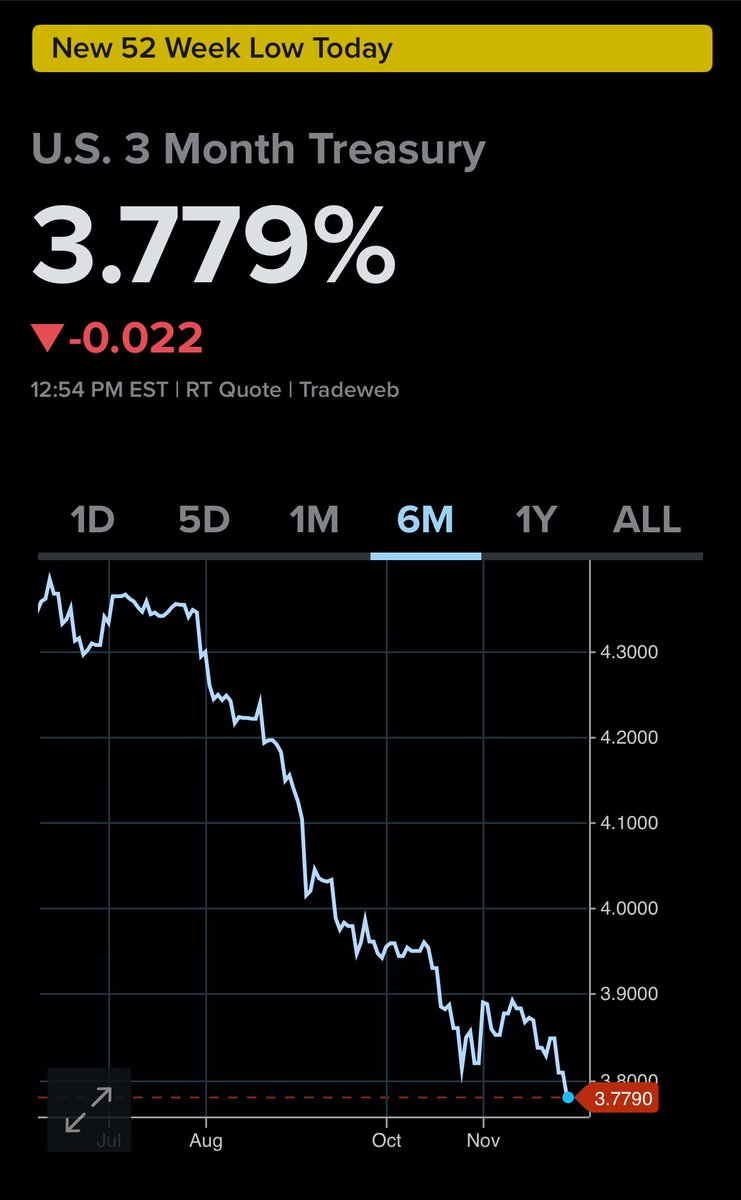
Forget the Headlines The 3 Month Treasury Just Told You the Truth.
The 3 month Treasury is basically the market’s closest read on the Fed. It sits right on top of the policy rate, so when it starts drifting meaningfully below that range, it’s the market’s way of saying, “We’re already looking past today’s rate and pricing where the Fed is headed next.”
Historically, it’s also one of the key pieces in recession tracking. When short rates fall while long rates stay sticky, you’re almost always in that late cycle zone where the Fed shifts from tightening to cushioning.
What It’s Telling You Right Now
Given the timing, this move isn’t subtle at all. The Fed has already cut twice this year in September and October and officially ended QT yesterday. They’ve now moved from shrinking the balance sheet to reinvesting everything into T-bills, and the market sees an extremely high likelihood of another cut in a matter of days.
That context is exactly why the 3 month hitting a new 52 week low matters. The front end is basically saying the tightening phase is over. The rate hikes are behind you and traders are now pricing in a real easing cycle, not a one off adjustment.
What jumps out most is how sharply the 3 month has fallen while the 10 year is still sitting around 4%. That’s the classic pattern you get when the Fed begins cutting into a slowing economy, not because things have stabilized, but because the pressure is already showing through the data. Bills trade below fed funds when the market thinks the Fed will have to keep going.
So the way I read it, the 3 month is the cleanest confirmation so far that the cycle has turned. The peak in cash yields is behind us. The Fed is shifting from restraint to support. And the bond market is quietly acknowledging that the economy needs that support sooner rather than later.
It’s late cycle behavior dressed up in a simple number.

19
71
519
220,296
Doughty retweeted
24 Nov 2025
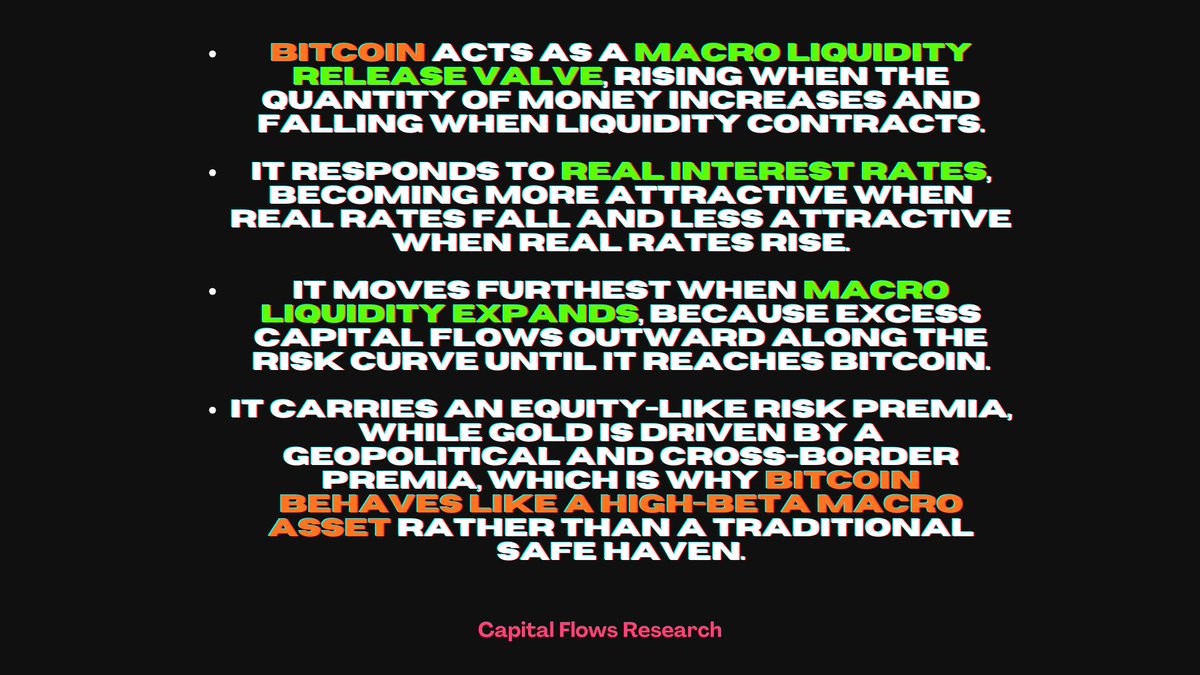
Bitcoin is a release valve for macro liquidity
If Bitcoin is truly THE pristine asset, then it will tell you WHAT it is exactly via the price
This is what Bitcoin says about itself 👇
6
7
90
7,049
Doughty retweeted
9 Nov 2025
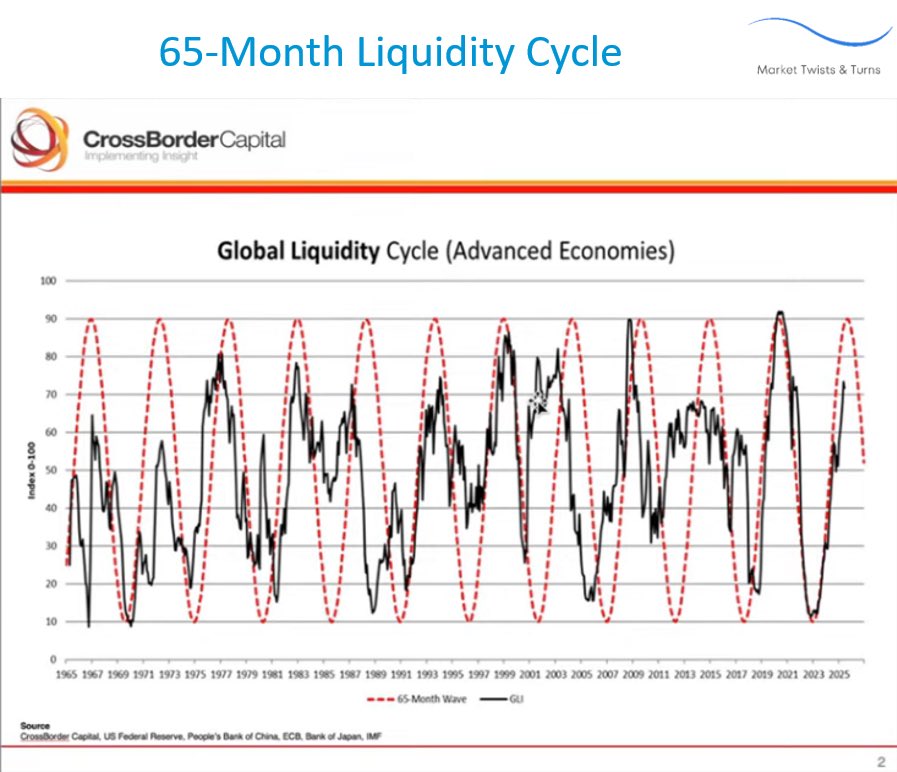
Where We Are in the 65 Month Liquidity Cycle (Nov 9, 2025)
Look past the noise and this chart by @crossbordercap shows global liquidity moves in a 65 month tide. The red dashed curve is the rhythm; the black line is reality. When the black line climbs toward the dashed crest, funding loosens, risk taking rises, and prices levitate. When it rolls over, air thins.
What the chart is showing
After the post COVID squeeze and the drain through 2022–23, the black line troughed in 2023 and has been rising. That ascent lines up with the policy pivot already in motion: two rate cuts into the fall, the scheduled end of balance sheet runoff on December 1, and reinvestments aimed at short dated Treasuries. That mix rebuilds bank reserves, eases overnight financing, and pulls the black line toward the dashed peak.
Where we are now
As of today, we’re late in the upswing, well past the halfway mark, approaching the crest. Reading the spacing of prior cycles on this same template (think 1998–03, 2011–16, 2016–21) and the slope of the current rise, the highest probability window for a peak sits in Q1 to early Q2 of 2026, roughly late March through June. There can be shoulders around the top when policy and deficits keep the pump running, but the cycle’s geometry points to spring.
How it travels through the system
•Front end of the curve: Reinvesting into bills adds a steady buyer. Repo softens, SOFR drifts down, and the cost of carry improves.
•Bank and dealer plumbing: Cheaper overnight money steadies balance sheets and encourages basis/carry trades. Liquidity feels abundant because funding is reliable.
•Credit and equities: Spreads grind tighter, primary issuance reopens, and multiples stretch, the discount rate investors feel is the front end, not the 30‑year.
•Long end: Term premium resists. Heavy Treasury supply, persistent inflation expectations, and foreign buyers demanding compensation keep 20–30 year yields relatively firm. The result is easier at the front, heavy at the back.
•Housing: With mortgage paydowns redirected toward bills rather than MBS, mortgage spreads don’t fully collapse. Rates improve at the margin, but not in a straight line.
•Dollar and commodities: A softer front end trims the dollar’s carry edge; late upswing phases often see a gentler dollar, firmer EM beta, and support for cyclical commodities.
•Global layer: Allies with weaker growth lean on U.S. liquidity; non aligned blocs keep building buffers and local currency pipes. That fragmentation keeps the long end sticky even as the front loosens.
What confirms we’re topping
Cycles usually peak with calm: volatility quiet, funding effortless, and bad news shrugged off. Tells to watch (not as advice, as diagnostics)
• Bills trading rich to policy; then that richness fades.
• Repo and SOFR stop drifting lower and stabilize.
• Treasury auctions start tailing at the long end even as the front stays easy.
• Credit spreads stop tightening before they widen; primary calendars thin.
• High beta equities stall while quality holds; breadth narrows.
• The dollar stops weakening despite easy funding. capital turns cautious.
What it means going forward
Late upswing liquidity props up valuations and stretches the cycle. It does not fix structural mismatches: large deficits needing term buyers, aging demographics pressing real resources, and a world reorganizing supply chains for resilience over efficiency. Historically, growth data lag the liquidity peak by several quarters; the party ends quietly and then all at once.
So, as of today November 9, 2025, we’re in the high tide’s approach. The chart’s rhythm and today’s plumbing both point to a spring 2026 crest. Expect markets to feel unusually orderly into that window…funding smooth, spreads tight, narratives confident. That’s how peaks like to look. The tide turns only when belief meets math.
15
54
294
22,960
Doughty retweeted

6 Nov 2025
This country desperately needs a constitutional convention to reform Congress into a government body that actually functions.
Its structures are outdated and ill-suited for the demands of the modern world.
55
18
306
18,427
Doughty retweeted

1 Nov 2025

523
1,186
6,312
2,999,435
Doughty retweeted

23 Oct 2025
There is a ton of great, thoughtful analysis on X, but I truly believe the best traders have some sort of a gut indicator.
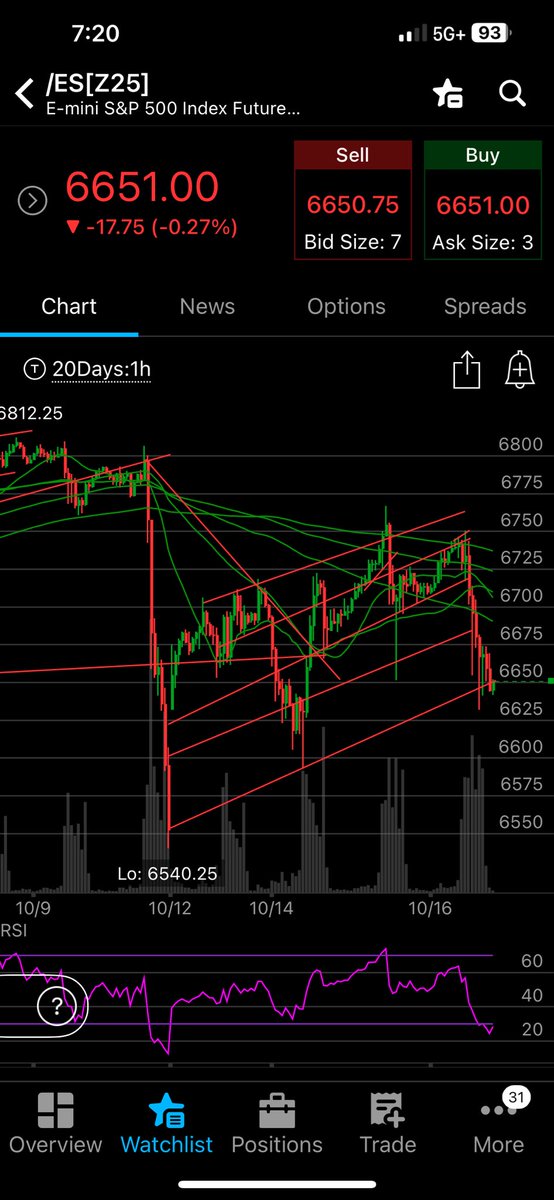
Everything I know of TA, told me that we were printing a bear flag about 100 SPX handles lower last week, and here we are about 50 handles from new ATHs, and going higher IMHO.
I believe in a narrative.
That narrative is higher gold, BTC, SPX, NDX, TLT prices in coming months.
Until I think that narrative is BS, I just buy dips.
16 Oct 2025

This looks like a perfect bear flag, but I don’t think it is. I think it is market hesitation ahead of the Fed, earnings and the Asia summit. Could we test Friday’s low once again: Absolutely. But I think that’s it. Too many people want to buy the dip.
8
5
213
28,958
Doughty retweeted
23 Oct 2025
The Perfect Pressure Valve: Bitcoin, CBDCs, and the Architecture of Controlled Freedom
It is weird that the world’s most valuable open source money still has a mystery founder. In every other corner of tech, the creators take a bow, especially once public companies, pensions, and ETFs are involved. Here, we’ve got a white paper, working code, a million or so early coins that never moved, and then silence. That vacuum breeds theories. Set the drama aside and look at what the system actually does and who it conveniently serves.
Viewed through the lens of a design built for sovereign grade needs, Bitcoin is a perfect pressure relief valve. The ledger is public and permanent. Most people access it through KYC/AML gated choke points like exchanges, brokers, custodians, and now ETFs so flows in and out are surveillable, taxable, and stoppable at the edges. Chain analytics maps pseudonymous addresses to real identities far better than cash ever could. Price discovery has migrated to regulated venues (CME futures, listed ETFs), and custody is concentrated in a handful of supervised firms. In other words: the asset sits outside the banking system, but the plumbing around it is firmly inside the perimeter.
Macro wise, it soaks up excess risk appetite without lighting up CPI. When liquidity is abundant, speculative energy can run into a volatile asset that lives off balance sheet for banks; when policy tightens, it deflates quickly and the pain stays mostly with holders, not grocery prices. That’s a useful valve in a world choking on debt, with stop start growth and political limits on overt financial repression. Meanwhile, every fiat on ramp and off ramp touches the banking system, generating fees, data, and taxable events. Add mining and you’ve got a grid friendly load that can monetize stranded energy and curtail on demand, handy for energy and industrial policy.
There’s also geopolitics. A neutral, internet native reserve like asset weakens closed financial blocs more than open ones. If you dominate custody, ETFs, and futures, you influence the gateways. Adversaries may try to route around sanctions with BTC, but they do it on a glass ledger. Gold in a vault is opaque; Bitcoin in motion leaves footprints.
Now layer in where the official world is headed. Dozens of countries are piloting CBDCs; the U.S. hit pause on retail but is pushing wholesale rails and cross border projects while letting the private sector do the retail work. Dollar stablecoins are the de facto CBDC workaround, programmable dollars with KYC, instant settlement, and built in freeze controls without the political baggage of a government wallet. They export the dollar, deepen demand for T‑bills, and keep the state’s leverage at the on and off ramps. In that stack, Bitcoin plays the role of scarce, bearer style collateral and savings asset that interoperates with those programmatic dollars.
An open, auditable, borderless asset channeled through regulated gateways gives authorities visibility into global money movement; concentrates liquidity in supervised warehouses; absorbs speculative heat when they need it; and provides a narrative outside money that still yields data, taxes, and control at the edges. You don’t have to run the protocol to shape the system; you just have to run the pipes.
None of this should scare off a thoughtful investor. It should frame the bet. Bitcoin is volatile and liquidity sensitive. Most access will remain through compliant platforms that can tighten in a crisis. The more likely end state is coexistence of CBDCs and regulated stablecoins for everyday payments and settlement; Bitcoin as scarce collateral, long term savings, and cross border settlement grease. Decide your mix of self custody versus convenience, size it like a risk asset, and keep multiple paths in mind from digital gold with stricter compliance to deeper integration with mainstream finance as new rails roll out.
22 Oct 2025

NEW: Tucker Carlson says he’s a hard "NO" on Bitcoin, claiming it was created by the CIA and calling himself “a gold person.”
“I fear it’ll become a scam run by financial elites and politicians to tighten control over society… Nobody can tell me who Satoshi is. I grew up in a CIA family.”
17
30
164
38,206
Doughty retweeted

22 Oct 2025
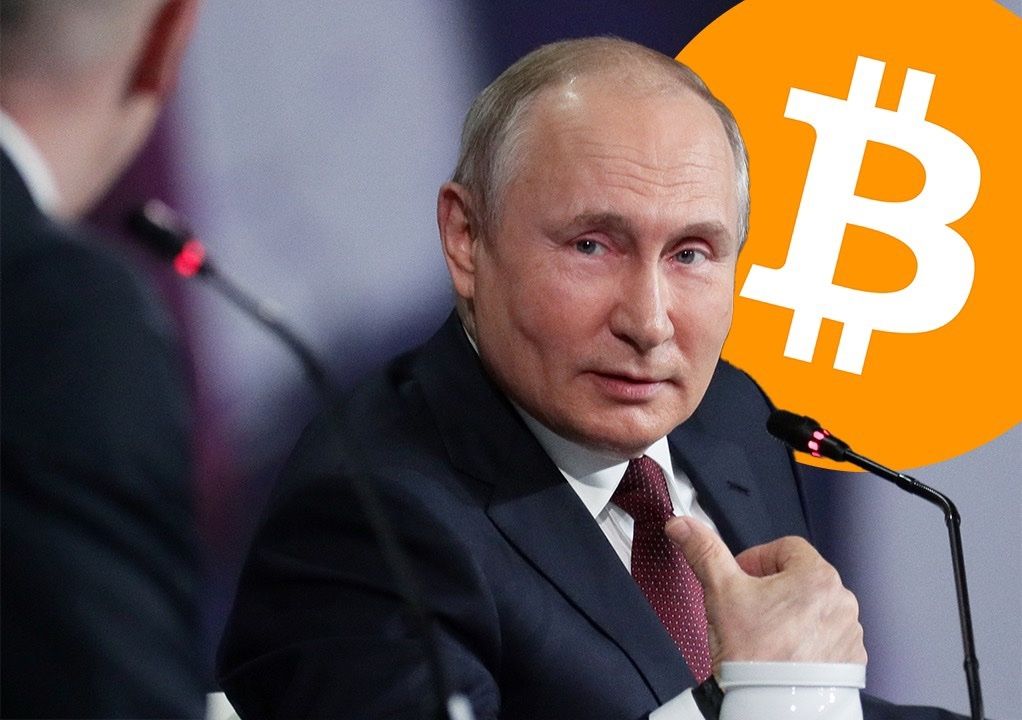
⚡️When Russia legalizes Bitcoin mining and approves crypto payments for foreign trade, it’s signaling the beginning of monetary detachment from the West’s control grid.
Let’s strip it to fundamentals.
1. The Real Move: Strategic Monetary Sovereignty
Russia just declared that it no longer needs permission to transact globally.
Up until now, all nations - even powerful ones - have been bound by the architecture of dollar clearing. That system runs through Western correspondent banks, the SWIFT network, and the implicit policing of capital via the U.S. Treasury.
By opening legal, state-aligned crypto settlement rails, Russia creates an alternative corridor where trade can occur outside the choke points of the dollar system. It’s not about using Bitcoin per se - it’s about using Bitcoin’s rails. They’re permissionless, censorship-resistant, and already global.
2. The Energy-Arb Thesis
Russia’s strategic edge isn’t just oil or gas - it’s energy abundance. Bitcoin mining converts stranded energy into exportable, monetizable hash power.
By legalizing mining, Russia just gave itself the ability to transform energy directly into digital collateral that can be sold, traded, or settled internationally.
This is how a nation weaponizes surplus energy in the digital era:
•Convert hydrocarbons into Bitcoin.
•Use Bitcoin as both store of value and settlement asset.
•Circumvent financial sanctions by transacting on cryptographic rails.
It’s energy geopolitics rewritten in code.
3. The Global Split
The symbolic layer is massive.
The West’s financial system is built on the idea that it can dictate who can and cannot trade. Once a G20 nation successfully operates an alternative crypto-based settlement regime, that spell breaks.
And it won’t stop with Russia. Others are watching - Iran, Turkey, Brazil, even energy-rich African states. The moment one major state proves it can trade oil, gas, or grain for crypto-denominated settlements without being cut off from the world, the reflexive loop ignites:
belief → imitation → legitimacy → new system.
That’s what this move triggers. It’s the early stage of the monetary multipolarity cascade.
4. The Reflexive Loop
This will not be obvious in markets immediately. Most will dismiss it as a sanctioned regime’s desperation. But reflexivity works like this: marginal adoption today changes narrative tomorrow.
The more states treat Bitcoin or crypto as neutral infrastructure, the more legitimate it becomes. The more legitimate it becomes, the more they use it. The loop feeds itself.
This is the same process that made the dollar hegemonic post–Bretton Woods - trust created usage, and usage reinforced trust. Bitcoin is now entering that same structural loop, only this time it’s not being issued by any nation. It’s being adopted by them.
That’s the pivot from speculation to structure.
5. The Deep Signal: End of Fiat Monotheism
For the past 80 years, global trade has functioned under one monetary religion - fiat, administered through Western central banks. Russia’s move is heresy. It says: value can exist, move, and settle without institutional blessing.
That’s the true power of this moment.
Bitcoin becomes the “digital Switzerland” of trade - neutral, stateless, incorruptible. Its very existence provides an escape hatch for nations suffocating under financial surveillance and sanctions.
The deeper reality is the fragmentation of trust. And once trust fragments, systems can no longer be monopolized - they must compete.
6. The Final Layer
The West will dismiss it. The IMF will call it dangerous. Analysts will say it’s symbolic. But history doesn’t unfold linearly - it moves through fracture points. This is one.
When the first superpower adopts a parallel monetary system, even experimentally, it begins the countdown to structural divergence.
Once capital and trade settle through competing trust systems, there’s no way back to a single monetary order.
22 Oct 2025

JUST IN: 🇷🇺 Russia to legalize Bitcoin and crypto in foreign trade
Global Bitcoin adoption is accelerating 🔥
8
27
184
15,457
Doughty retweeted

15 Oct 2025
The wait is over!
Introducing... 🥁
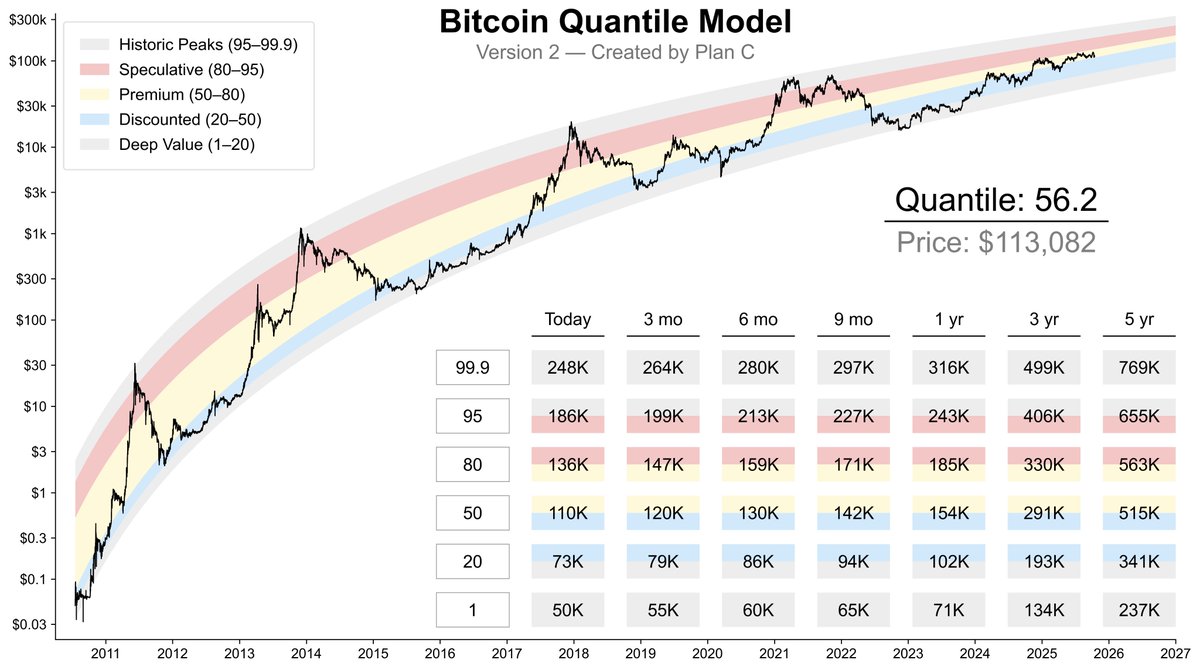
Bitcoin Quantile Model v2.
You’re going to want to bookmark this post—and follow for regular model updates.
After months of research and development, I’m very proud of this model—my flagship quantile framework.
I’m confident it’s one of the best—if not the best—long-term Bitcoin investment frameworks available.
As a full-time, unpaid Bitcoin researcher, I’m often asked how people can best support my free content.
Simply bookmark, repost, and comment on my posts :)
Thanks for all your continued support!
— PlanC
Key Features & Improvements:
1. Quantile lines never cross—mathematically impossible.
2. Cycle-length agnostic.
3. 133,000 data points and 1,500 lines of code.
4. Fits and stores 999 quantile levels (τ = 0.001–0.999 in 0.001 steps) and identifies which level the last price is closest to.
5. Fits the two leading decay functions (stretched exponential decay & exponential decay) and selects the better fit via quantile-appropriate AIC.
Uses Akaike weights to identify the best-supported model.
Akaike weights (AIC-based):
Stretched exponential decay: 96.4%
Exponential decay: 3.6%
6. Piecewise Quantile Regression — Linear Stretched Exponential Decay (Nonlinear).
354
1,043
5,512
1,048,995
Doughty retweeted
15 Oct 2025
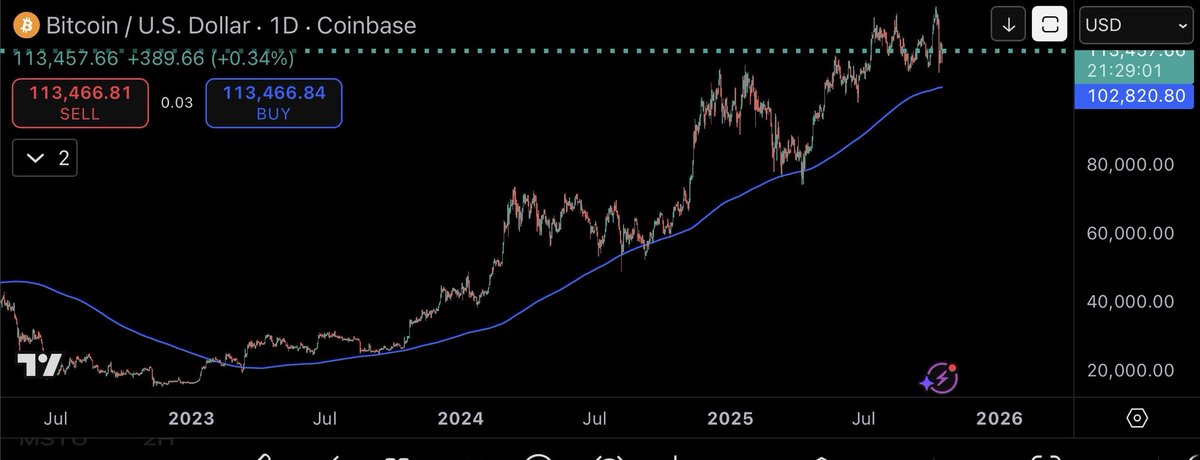
People often DM asking what would make me a short term bear on bitcoin.
It’s very simple. We lose the 300 day MA (currently at 102800) and do not quickly recover.
You can hold me to this. Until that happens, everything is noise.
42
37
621
93,264
Doughty retweeted

14 Oct 2025
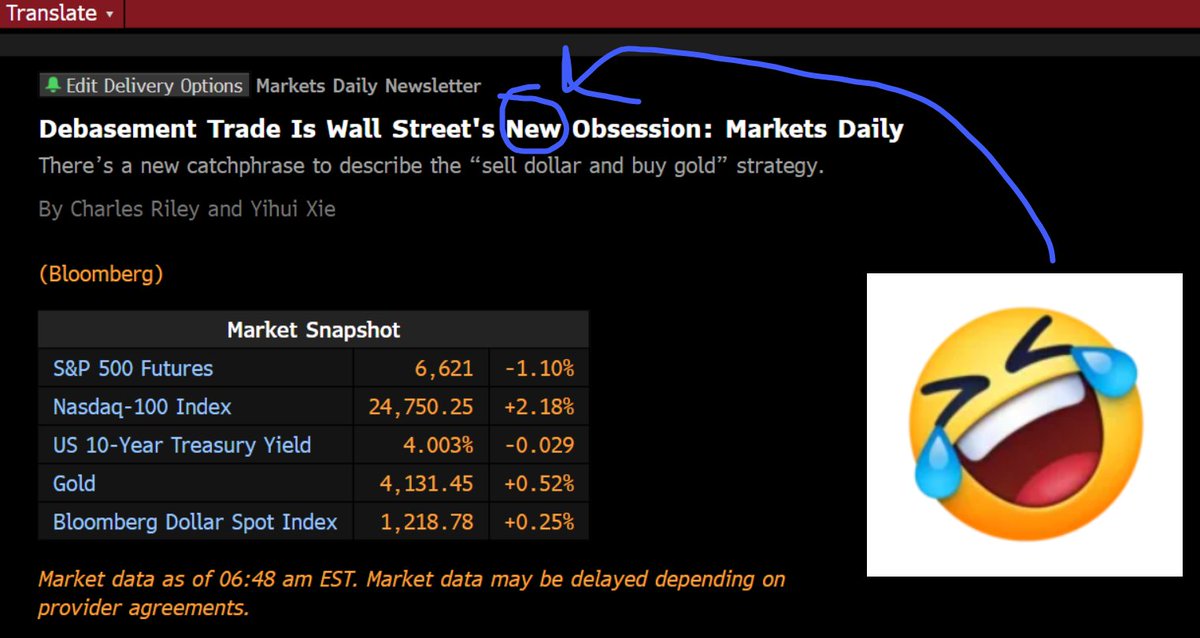
I legit LOL'ed reading this headline.
FWIW, we replaced Core Fixed Income $AGG with Gold in our flagship investment strategy, KISS, A YEAR AGO. I regret not having the confidence to do it when we authored the thesis in the summer of 2023.
FYI, Gold is up 55% YoY and 112% since then.
If you want to understand WHY we had the data-driven confidence to allocate 30% of our flagship investment strategy to Gold A FULL YEAR before most of Global Wall Street felt comfortable allocating a mere 5-10% to it, then review this complimentary Oct-24 Around the Horn webcast: youtu.be/7-RIbGmLxI4?si=koVp….
If you want to understand why KISS has thousands of retail investors in 80 countries around the world demonstrably outperforming their counterparts across Global Wall Street ON BOTH A RAW AND RISK-ADJUSTED BASIS FOR THE THIRD YEAR IN A ROW, then review our KISS FAQ here: 42macro.com/kiss-model-portf….
If you want to understand how life-changing KISS has been to members of our global investor community, #Team42, then review our Testimonials page here: 42macro.com/testimonials.
God lifted this 1980s crack baby from the very bottom of the K-shaped US economy to take on Goliath so that he could prove Main Street investors don't have to pay 1% of their assets per annum — let alone 2 & 20 — to achieve 3 & 30 results.
My way of consistently thanking HIM for blessing me with this platform is ensuring @42Macro's top-1% research and risk management signals will always be offered at bottom-1% prices so that people who grew up struggling like me can afford to uplift their families and communities as well. God is [always] good.
Thank you for your attention to this matter. 💜
13
7
195
15,234

This is bullshit and anyone not alarmed is an asshole.
10 Oct 2025

Whale takes out huge short.
Trump makes China tariff threat at market close.
(Same thing that triggered sell off in March).
Market nukes -$20k.
Clearly blew up big leveraged players.
Whale closes short.
Trump walks it back.
Market up $10k.
Nice, totally organic, market we have.
3