
/ Founder @Pinterest, @HowWeFeel / Making Something New / San Francisco
Joined April 2007
- Tweets 212
- Following 674
- Followers 20,782
- Likes 1,220
15 Photos and videos

May 29
Congratulations @suekhim! As a parent, I'm thrilled that whole generation of kids will have access to intelligent, personalized tutoring.

AI is making kids dumber.
It should be making them geniuses.
Introducing Koji, the first AI tutor that gets kids to actually think. 👇
6
30
3,561
May 21
I'm a big fan of the mission at @convectivecap. I'm confident that @billclerico and team will fund incredible entrepreneurs who will make things better for all of us.
May 21

The world is getting warmer while our infrastructure gets older: a recipe for disasters.
We’re excited to announce Fund II: $85M for early stage investments in disaster resilience.
1
1
9
1,654
Ben Silbermann retweeted

May 21
The world is getting warmer while our infrastructure gets older: a recipe for disasters.
We’re excited to announce Fund II: $85M for early stage investments in disaster resilience.
45
27
269
89,678
Ben Silbermann retweeted

Apr 28
The brain has multiple types of circuits; not just neurons, but also astrocytes. Little pores, called gap junctions, physically bridge the cytoplasms of neighboring astrocytes, connecting the cells together into networks that span the entire brain. Some of these astrocyte networks even run across brain hemispheres, through the corpus callosum.
Astrocytes are a support cell, of sorts. They supply neurons with nutrients (and help them remove waste), form the blood-brain barrier, and help form synapses between neurons. But astrocytes also share nutrients with *other* astrocytes through those gap junctions I mentioned, including glutathione, phosphocreatine, and neurotransmitters.
Gap junctions are formed by a protein called connexin 43. When six copies of this protein come together, they form a ring, called a connexon, that punches a hole into the cell membrane. When a connexon on one astrocyte touches the tip of a connexon on a neighboring cell, the two come together to form a gap junction through which nutrients get exchanged.
Scientists have known about these gap junctions for a long time. But they didn’t understand how far astrocyte networks actually extend; are the connections mostly local, in little clusters? Or do astrocytes somehow build networks that span across the brain, much like neurons?
Historically, there were few ways to get at this question. You could kill a mouse, for example, and then extract its brain and slice it into thin pieces. Then, you might stick a thin electrode into one of the astrocytes, pump it with an electrical current, and see whether nearby cells respond. If they do, the cells might be connected! But this approach is obviously 2-dimensional; it destroys connections in the z-axis. So you get decent *local* information, but it’s hard to then reconstruct the full network.
Another option is to take an intact brain, inject the astrocytes with a dye, wait for the dye to diffuse through the tissue, and then study the slices to see where the dye went. This is better, but diffusion is slow and the dye will not necessarily reach astrocytes located far away from the injection point.
A new paper solves both of these problems.
It is a beautiful study, in my eyes, because it hinges around a single clever idea. Namely, what if we just genetically-modified animals such that, when a molecule passes through a connexon, the astrocyte makes a physical record of it? In this way, animals can be engineered to “tag” or “trace” their own astrocyte networks.
The authors took the connexin 43 protein (the one that forms the gap junctions) and fused it to another protein, called TurboID. The beauty of TurboID is that it takes a nearby molecule -- whatever is floating on by -- and sticks a biotin tag onto it. That’s all it does. The fusion protein was designed so that TurboID sits inside the gap junction. Whenever a neurotransmitter or glutathione moves through the pore — SPLAT! — the TurboID tags it with a biotin.
The researchers next injected mice with an adeno-associated virus (AAV5) carrying a gene encoding this fusion protein. The fusion gene was placed near a promoter sequence, called GfaABC1D, that is “only” active in astrocytes. And then, since the brain does not *naturally* make biotin, the researchers fed the mice with biotin-laced water for about one week.
Finally, they killed the mice, made their brains transparent (search for “tissue clearing” if you want to learn more), and then incubated them with a protein, called streptavadin, that tightly grabs onto biotin. The streptavidin is fused to a fluorescent dye, which can then be seen with a microscope.
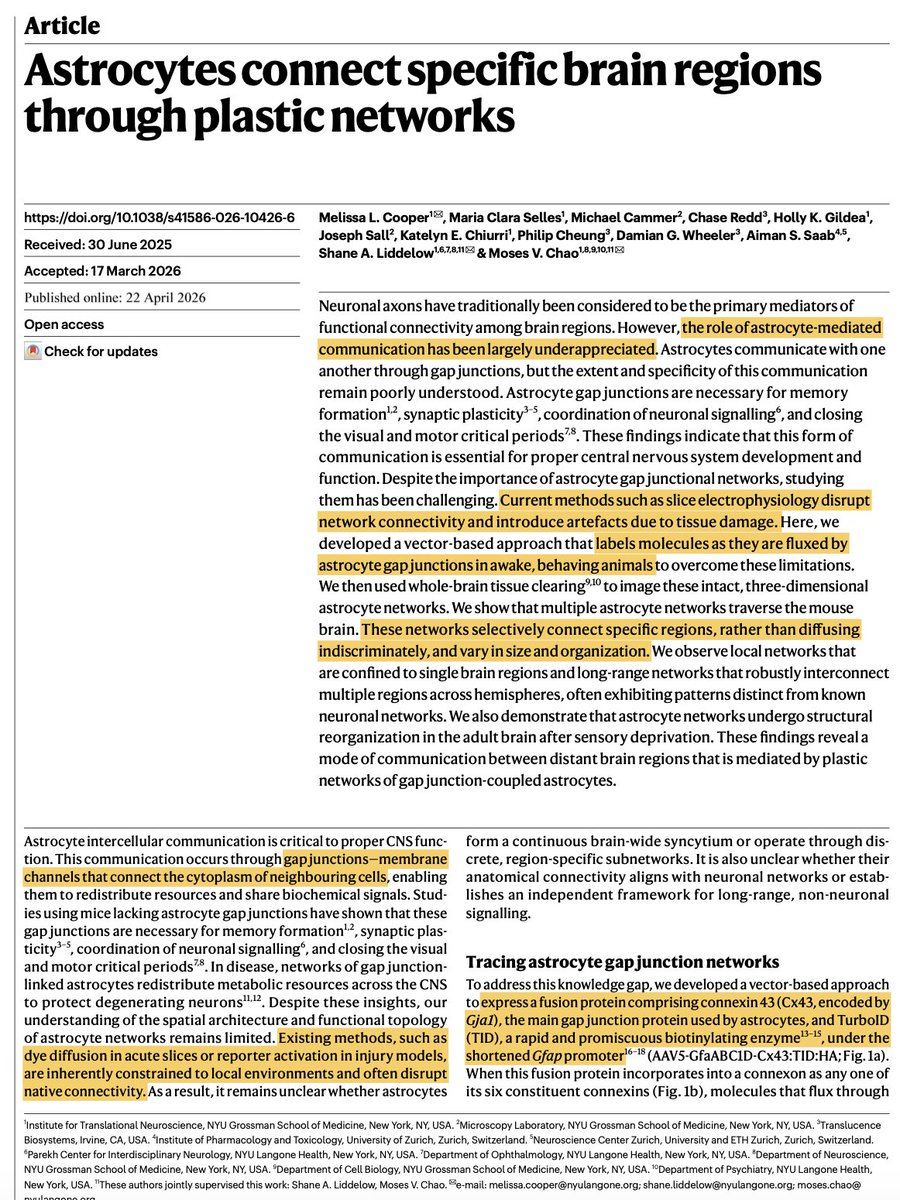
And that’s the gist! What they found is that about 10 percent of astrocytes picked up and actually made the engineered gap junctions, but 80 percent of nearby astrocytes were connected to those astrocytes.
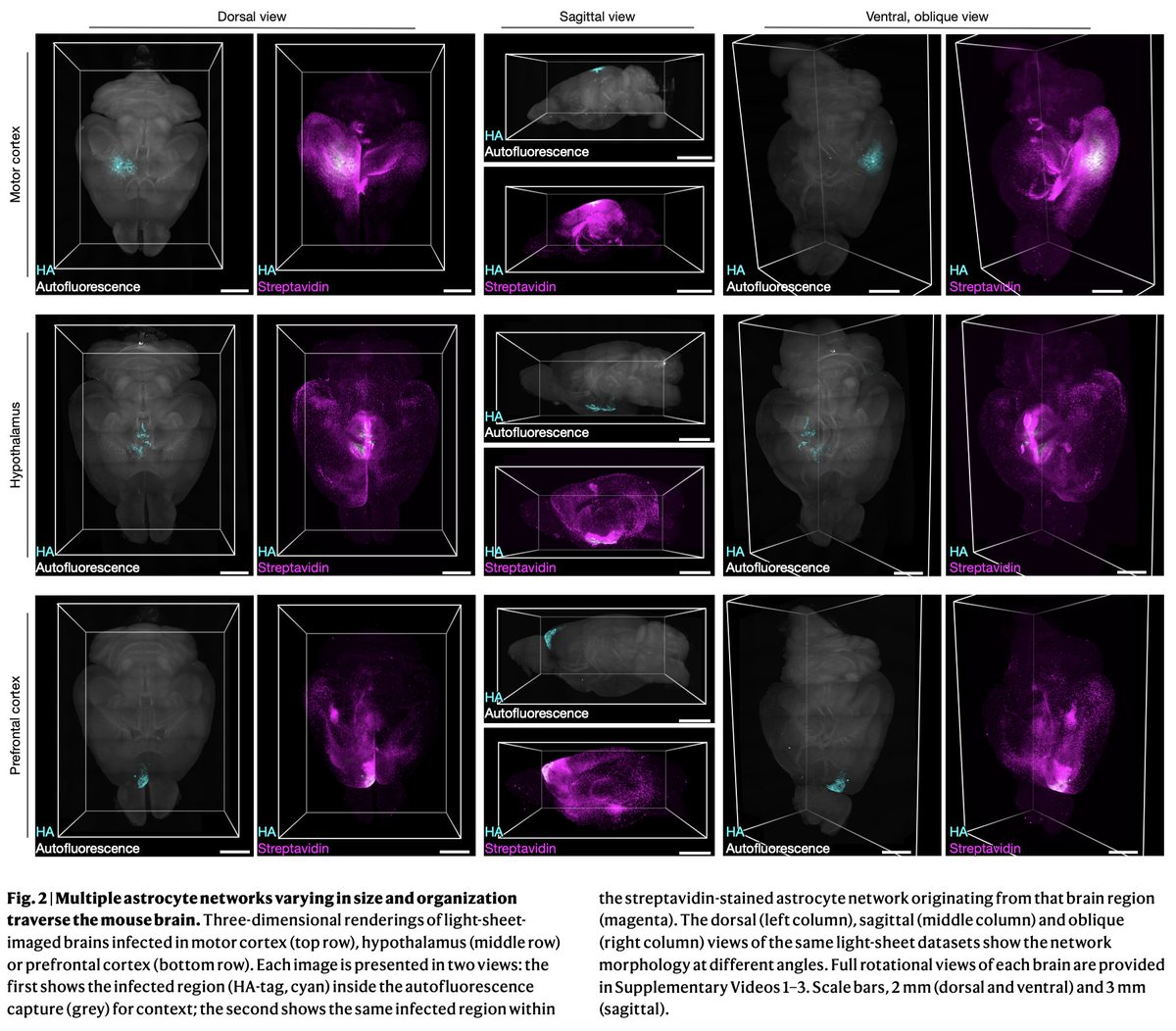
Some astrocyte networks were isolated, whereas other networks talked to each other. There is an astrocyte network that runs through the motor cortex, for example, and it seems quite isolated; but the astrocyte networks in the frontal cortex and hypothalamus communicate with each other.
Some astrocyte networks ran through both brain hemispheres, as I said, directly through the corpus callosum. These networks change over time, and they differ spatially from neural networks. In some cases, they even link brain regions that are not connected by neurons.
Biology gets deeper, and life becomes more resolved, every day.
Image below: Astrocyte networks in the brain. All the purple stuff is streptavidin, which is a marker for biotin (and, therefore, astrocyte connections.)
6
34
200
16,218
Apr 21
Congratulations to the super talented team from @extradotemail on today's launch. It's so rare to see any company launch such a polished and thoughtfully designed product on day 1. Give it a try! extra.email.
2
5
33
4,554
Apr 16
I'm very excited to see what @paulscherer and team build.
Apr 16

I’m honored to share that @eigenhq has raised $15M from @Benchmark to build a mutual friend that’ll help us belong and grow, together.
1
19
2,170
Feb 17
This article by @onecaseman is very useful for early stage consumer networks: caseyaccidental.com/p/zero-t…
2
12
846
Ben Silbermann retweeted

Jan 25
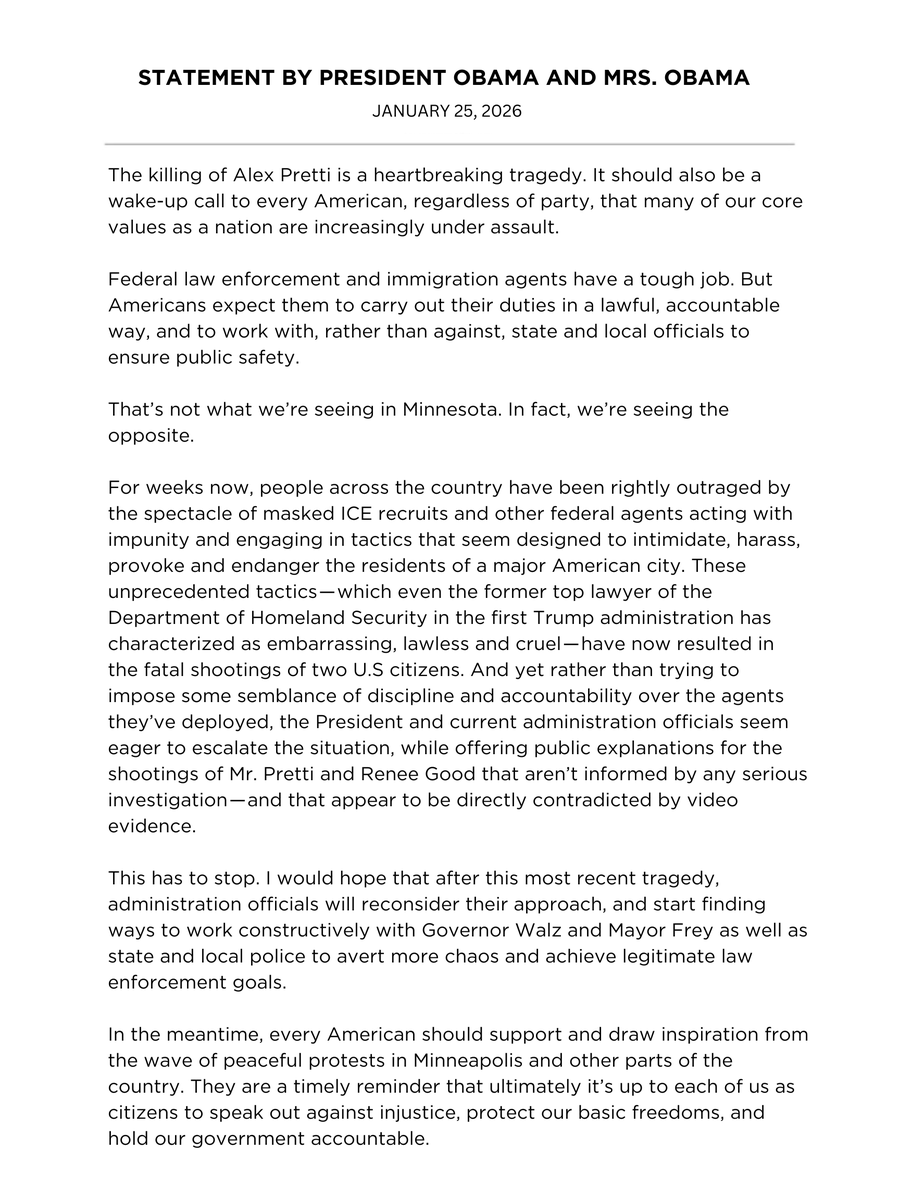
The killing of Alex Pretti is a heartbreaking tragedy. It should also be a wake-up call to every American, regardless of party, that many of our core values as a nation are increasingly under assault.
65,131
113,226
801,028
44,028,929
Jan 14
I've enjoyed the podcast "A Slight Change of Plans" for years, so I'm looking forward to reading Maya Shankar's first book.
amazon.com/dp/0593713680?ref…
2
8
770
Jan 12
Can you share your favorite sources of long-form essays? The two sources I currently like are:
- asimov.press - Biology
- worksinprogress.co - Ideas to Improve the World
9
2
36
3,982
Ben Silbermann retweeted

23 Dec 2025
As a kid, I used to create Minecraft maps that millions of people played on. My dream is to bring that same creativity to the real world. I want the physical world to become as inspiring as the internet has been.
So I started a new company, @DraftedAI, to solve this!
23 Dec 2025

Hello World 👋
Welcome to Drafted — an AI tool that lets anyone design a home from scratch, tailored to your life.
techcrunch.com/2025/12/23/th…
104
63
380
127,748
4 Dec 2025
Have you done something cool to preserve your family's stories and memories?
13
24
4,450
3 Dec 2025
Jad Abumrad's new podcast series on Fela Kuti is a masterpiece.
podcasts.apple.com/us/podcas…
1
6
11
2,425
25 Nov 2025
HTX Studio is an extremely impressive youtube channel. Production, editing, and creativity are off the charts: youtube.com/@HTXStudio
1
7
3,946
18 Nov 2025
I've been testing extra.email for a couple months ago and have been *so* impressed with the craft and creativity poured into every nook and cranny.
18 Nov 2025

Introducing Extra. Email will never feel the same again.
Join the Beta waitlist at extra.email.
1
2
26
7,865
18 Nov 2025
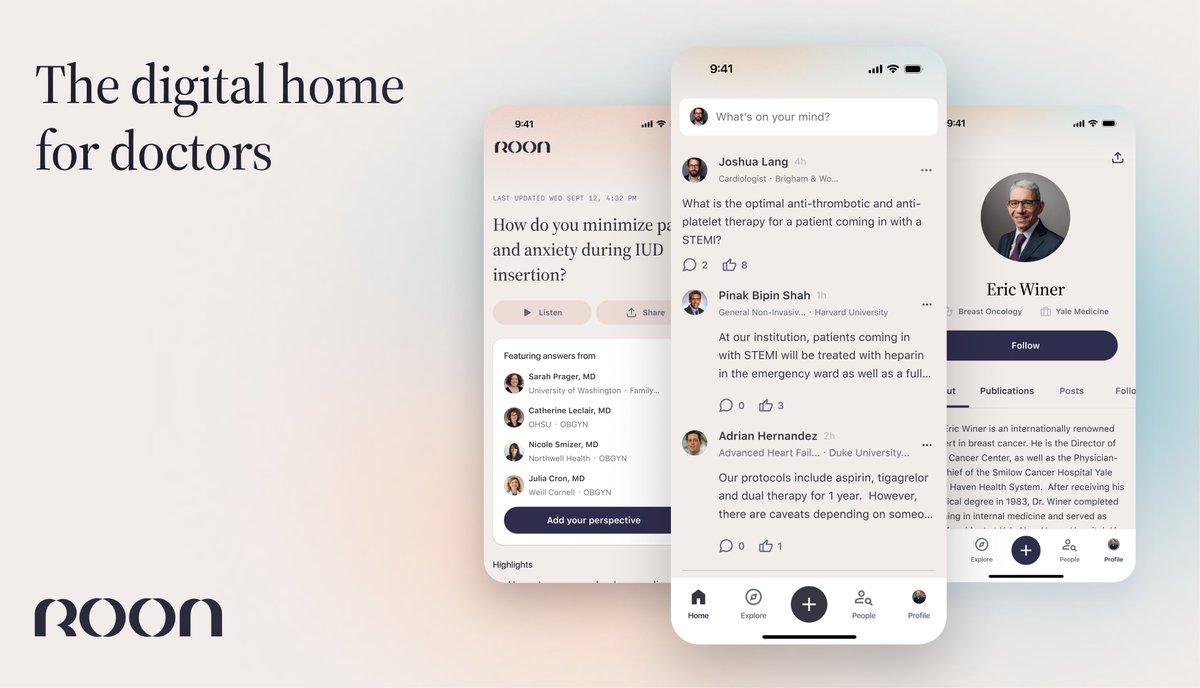
Congratulations to the Roon team. I'm so excited to see their digital community for doctors take flight!
18 Nov 2025

Introducing Roon for Doctors.
Medicine at its best is a profoundly collaborative craft — and we’ve built a new home online for exactly that kind of collaboration.
9
1,617
5 Nov 2025
I'm excited for @ekuyda and the wabi team. When creation tools get radically simpler, creativity explodes. I can't wait to see what people make.
5 Nov 2025

Today, we’re thrilled to announce $20M in funding led by @a16z, with support from @saranormous, @amasad, @akothari, @garrytan, @justinkan, @atShruti, @naval, @scottbelsky, @gokulr, @soleio, @kevinhartz and more.
@wabi is ushering in a new era of personal software, where anyone effortlessly create, discover, remix, and share personalized mini apps.
For 50 years, software was made for people.
The next 50, it will be made by people.
Just as YouTube unlocked creative power through video,
Wabi will unlock creative power through software.
The YouTube moment for apps is here.
We can’t wait to see what you create.
3
3
48
13,611
4 Nov 2025
A beautiful project!
1 Sep 2025

Last week, I published a chapter about color. It's fairly comprehensive:
makingsoftware.com/chapters/…
10
1,428
29 Oct 2025
The proliferation of mobile gambling apps (sports betting, future markets, meme coins) will end badly.
4
19
1,769