
Where art meets intelligence. Building human-amplified digital ecosystems. Founded by @malekoo.
Joined December 2021
- Tweets 50
- Following 34
- Followers 14
- Likes 90
2 Photos and videos


Pinned Tweet

15 Dec 2025
Building at the intersection of Human × AI.
At AIC, we explore how AI can amplify creativity, engineering, and conscious innovation, not replace it.
If you care about human-centered AI, building real products, and creativity backed by engineering, follow us.
68
226
1,209,721
Jun 12
We read every session, doc, and repo so you don't have to. The verified map of everything Apple shipped for local AI at #WWDC26.
This is the foundation we build on at AIC. 👇

2
47
Jun 11
Apple just made on-device AI a platform, not a feature. Our founder's verified breakdown of everything local AI at #WWDC26.
This is the foundation we build on at AIC. 👇
Jun 11
#WWDC26 was the biggest local AI release Apple has ever shipped. I build local AI on macOS with MLX, so I went through the sessions, the docs, and the GitHub repos. Here's what actually changed.
The context: Apple already had the pieces. The Foundation Models framework arrived last year with an on-device model. MLX, Apple's open source machine learning framework, has powered local models on Macs since late 2023, and its biggest performance advances quietly shipped months before the keynote.
What's new is that Apple connected everything.
The Foundation Models framework now accepts any model, not just Apple's. One protocol, one session API, and the model behind it becomes a swappable choice: Apple's on-device model, a bigger Apple model running on Private Cloud Compute, open source models via MLX, or your own custom weights through Core AI, a brand new framework for running your own models on device with a ready catalog that includes Qwen and Mistral.
The framework also went agentic. Dynamic Profiles lets one session switch models, tools, and instructions on the fly. Models can now see images, read text and barcodes through the camera, and search your Mac with Spotlight for fully local retrieval. A new command line tool brings all of it to scripts.
And Apple put real weight behind open source. The Core AI model implementation is already on GitHub, and a new Apache licensed utilities package adds agent skills, conversation memory management, and a bridge that lets any local model server plug into Apple's API. Even the developer tools caught up, with new Instruments profiling for on-device models and Xcode connecting directly to a local MLX server.
Add it up and there are more ways to run a local model on a Mac than ever: Apple's own, open source models, custom weights, a local server, even a cluster of Macs working as one. No cloud account required for any of it.
Local AI on Apple platforms is now a platform strategy, not a side project.
3
62
Jun 10
Huge advancement for MLX!
Jun 10
Built a playground app to show what Apple announced at #WWDC26: the Foundation Models framework driving an open-source MLX model (Qwen3.5-4B via MLXLanguageModel) and Apple's on-device model through the same LanguageModelSession. One picker switch, downstream untouched. Live TTFT / tok/s / token counts from the framework's Usage API. MLX via AFM, huge for local AI on Apple platforms.
Test rig: M3 Ultra (32 cores), 512 GB, macOS 27.0 (26A5353q).
2
60
Jun 9
Indeed, great minds think alike 🙂. #WWDC26
Jun 9
Our quick-invoke feature looks a bit like the new Siri AI on macOS 27. 😄 Months in the making, and near launch. Good timing!
Ask it anything and it acts across Calendar, Files, Photos, Music, web, and smart home, all on your Mac. Fully local, running Qwen and Gemma models.
Great minds think alike. 🤝
Bravo, Apple 👏 for all the announcements and the leap forward with Siri AI. #WWDC26
1
80
Jun 3
Great insight!
Jun 3
When you consider how the brain generates thoughts and predicts what comes next, then draw the analogy to generative AI and next-token prediction, thinking starts to look less like magic and more like a very powerful process running on billions of neurons. So is AI consciousness really that different from human consciousness? Maybe the gap is just sensory; there are channels of human perception that AI does not have access to yet, and perhaps those cover the parts of consciousness we still do not fully understand.
1
17
Jun 1
💯
May 31
"Design is not just what it looks like and feels like. Design is how it works." — Steve Jobs. For years, the gap between a great idea and a shipped product was engineering capacity. You could see the vision clearly in your head and still spend months, or never get there at all, because building it required a team you didn't have.
That gap is closing fast. AI coding agents are turning product thinkers into builders. Not by writing snippets you paste into a file, but by operating at the level that actually matters: architecture. You describe the system, the constraints, the way it should work, and the agent reasons through the structure with you. This is architectural coding. You stay focused on how it works while the agent handles much of how it gets built.
What excites me most is who this unlocks. The people with the sharpest sense of how a product should feel and behave were often the furthest from the code. Now they're the closest. The bottleneck was never their imagination. It was access.
We're about to see a wave of dream projects come to life. Things that lived in notebooks and half-finished prototypes for years. Things that one person could never build alone, and now can.
If you've been sitting on an idea, this is the moment to build it.
What have you been waiting to make?
8
May 22
Well said.
May 22
AI for humanity. We got here because of human genius and creativity, so AI should give back, solving immediate threats to health and well-being unconditionally.
32
AIC retweeted

Apr 30
This is a huge contribution to interpretability research. Thanks @Alibaba_Qwen 🙏
Apr 30

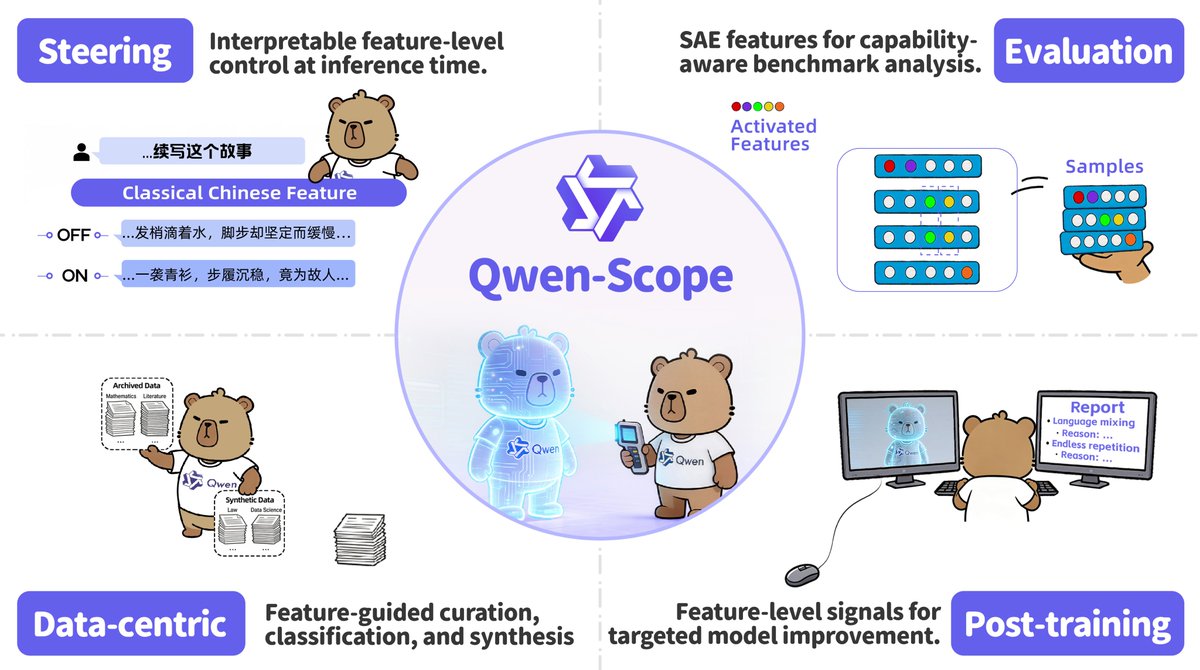
Today we’re releasing Qwen-Scope 🔭, an open suite of sparse autoencoders for the Qwen model family. It turns SAE features into practical tools:
🎯 Inference — Steer model outputs by directly manipulating internal features, no prompt engineering needed
📂 Data — Classify & synthesize targeted data with minimal seed examples, boosting long-tail capabilities
🏋️ Training — Trace code-switching & repetitive generation back to their source, fix them at the root
📊 Evaluation — Analyze feature activation patterns to select smarter benchmarks and cut redundancy
We hope the community uses Qwen-Scope to uncover new mechanisms inside Qwen models and build applications beyond what we explored.Excited to see what you build! 🚀
🔗🔗
Blog: qwen.ai/blog?id=qwen-scope
HuggingFace: huggingface.co/collections/Q…
ModelScope: modelscope.cn/collections/Qw…
Technical Report: qianwen-res.oss-accelerate.a…
1
1
2
377
Apr 27
At AIC, we believe AI is for humanity. Our founder @malekoo on why mission, not money, is what unlocks real innovation in AI 👇
1
2
26
AIC retweeted
Apr 3
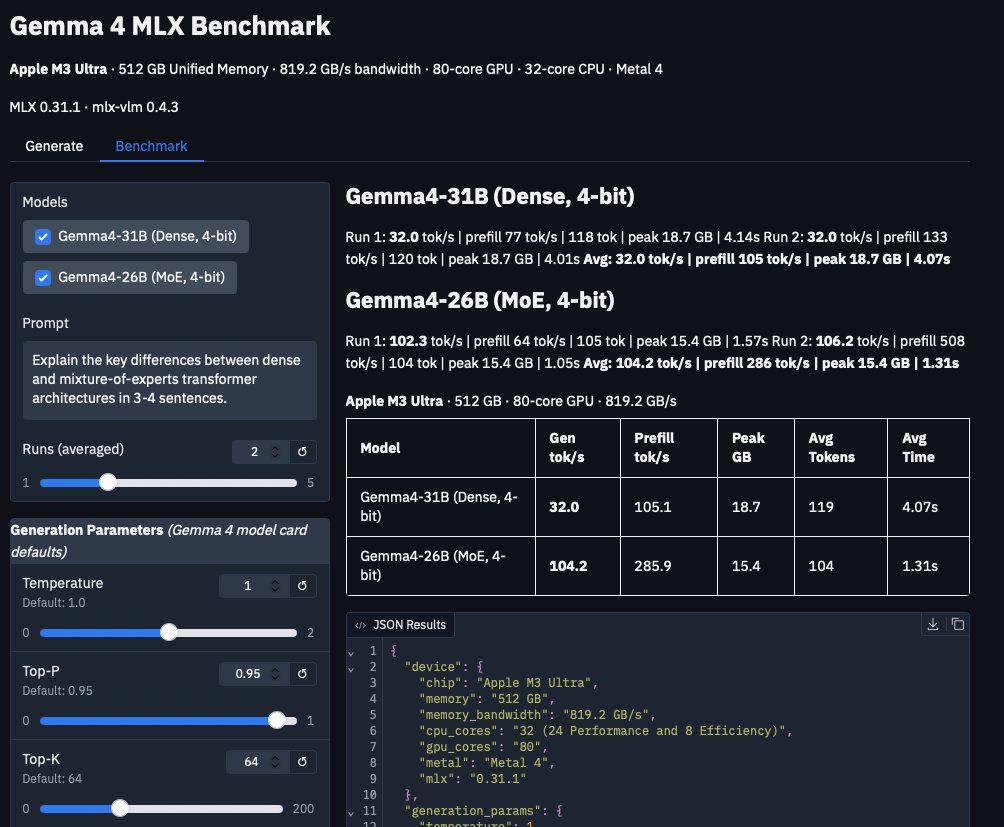
Gemma 4 MLX benchmarks on M3 Ultra, fully local.
26B MoE: 104 tok/s, 3.3x faster than the 31B dense (32 tok/s) 286 vs 105 tok/s prefill. 3 GB less memory.
Outstanding work by @GoogleDeepMind on Gemma 4. The MoE architecture is genuinely impressive, quality and efficiency at this level running fully on-device. Thanks to @Prince_Canuma for the MLX conversions.
Benchmarked here with Python mlx-vlm. We're also building a macOS app powered by MLX Swift with agentic tool calling, currently in development. More tests soon.
1
2
165
AIC retweeted
Mar 25
Google's TurboQuant is a genuine breakthrough for local AI. Here's what it actually does and doesn't do, since there's been some confusion.
When an LLM processes your conversation, it stores keys and values for every token it's seen. That's called the KV cache, and it grows fast. Long conversations eat memory quickly, slow down, and eventually hit a wall.
TurboQuant shrinks that KV cache from 16 bits down to about 3 bits per value with minimal to zero quality loss. No retraining. No new model files. Just smarter compression at inference time. The paper demonstrates a 6x reduction in KV cache memory.
What it does:
→ 6x smaller KV cache memory footprint
→ Significantly longer conversations before running out of memory
→ Works with your existing models, nothing to re-download
What it doesn't do:
→ Make models smaller to download or load. A 32GB model still needs 32GB.
The real story: if you run models locally, your biggest constraint after loading the model is how much context you can fit before memory runs out. TurboQuant pushes that limit way back.
Credit to Google for publishing this openly instead of keeping it internal. This benefits everyone running local AI.
1
1
97
AIC retweeted
Mar 24
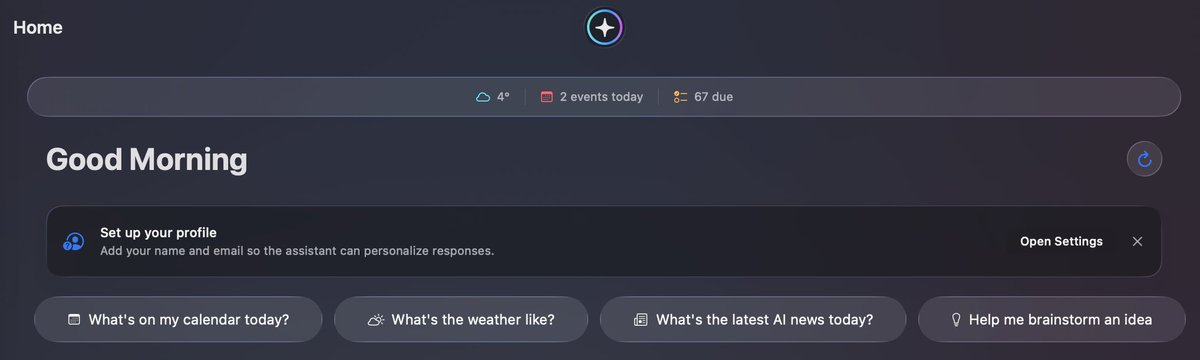
We've been building a native MLX macOS app that runs large language models entirely on your Mac. No cloud. No API keys. No subscriptions. Fully private and secure.
Think Qwen 3.5 models running locally, optimized for full agentic workflows with tool integration: Calendar, Reminders, Files, Music, Web Search, Home automation, and more.
Built for Apple Silicon. LLMs run fully on-device with Swift MLX.
Multiple ways to interact with your local model: the Mac app directly, a paired iPhone remote app, or server APIs for custom integrations.
We're getting close to our first release on the Mac App Store and looking for beta testers.
Drop a reply or DM if you want early access.
1
1
2
213
Feb 13
Our AI research lab just got a serious upgrade.
Feb 12
Two Mac Studios just landed. M3 Ultra. 512GB unified memory per machine. The AI lab is getting serious. Running the biggest models locally. No cloud, no compromise. Developing in MLX, built for Apple Silicon from the ground up. Shoutout to @awnihannun @ActuallyIsaak and the MLX community for building an incredible foundation. We'll be building on it.
1
69
AIC retweeted

Feb 3
Apple's Xcode now has direct integration with the Claude Agent SDK, giving developers the full functionality of Claude Code for building on Apple platforms, from iPhone to Mac to Apple Vision Pro.
Read more: anthropic.com/news/apple-xco…
443
762
9,397
2,137,170
Jan 30
This is where generative models start feeling like environments, not tools.
Jan 30
Exploring Genie 3 from @GoogleDeepMind . Incredible! @Google I hope you don't mind me virtually visiting your data center 🙂
51
AIC retweeted
Jan 29
The next era: AI on hardware. Local. Private. Yours.
2
4
249
AIC retweeted
Jan 23
Scaling tokens works today because it aligns with how humans communicate and because there is real demand for it. That doesn’t mean it captures how intelligence actually learns, reasons, conserves energy, or preserves itself.
ML and deep learning led us here, and LLMs were a real breakthrough. They showed what’s possible when large scale token processing meets rich language representation.
But we can’t stop there. The next step is connecting the dots. In humans, learning, reasoning, energy efficiency, self preservation, and evolution are inseparable. Survival shapes the constraints, evolution drives adaptation. Intelligence emerges from managing both over time.
It all starts to make sense when we see them as parts of the same path toward mirroring how the brain learns and survives.
1
3
15
7,974
AIC retweeted
Jan 24
For people who feel we’re already “there,” the experience can feel almost supernatural. And when something truly clicks, we usually stop debating it because it suddenly makes sense. That’s why I think the hype is understandable.
Science has moved this way before. Newton explained a huge part of reality, and many thought the story was complete. Then relativity arrived, and later quantum physics. Each layer didn’t negate the previous one. We still value Newton deeply, within the context of his time. Each step made the next possible.
That’s how I see LLMs. They deserve appreciation for what they unlocked and why they work so well today. But we shouldn’t resist rethinking the process when we reach their limits. Progress often comes from stepping back and asking new questions.
The next layer may emerge by better mirroring how the human brain actually learns, reasons, and operates so efficiently. Not copying it blindly, but understanding its principles. When combined with what we’ve learned from machine learning, deep learning, language models, neuroscience, and physical constraints like energy and hardware, this could unlock another breakthrough. That may even mean improving data center efficiency or reimagining what comes after silicon.
When the next breakthrough arrives, it will likely feel obvious later. And it will make sense precisely because every layer before it existed.
2
2
835
AIC retweeted
Jan 24
Language models showed us what scale can unlock. The next step is not choosing sides, but connecting the dots between learning, constraints, and human–AI collaboration.
I expanded on this here ↓
2
2
337