
Joined May 2022
- Tweets 563
- Following 98
- Followers 241
- Likes 599
28 Photos and videos
Alt Explainer retweeted

29 May 2025
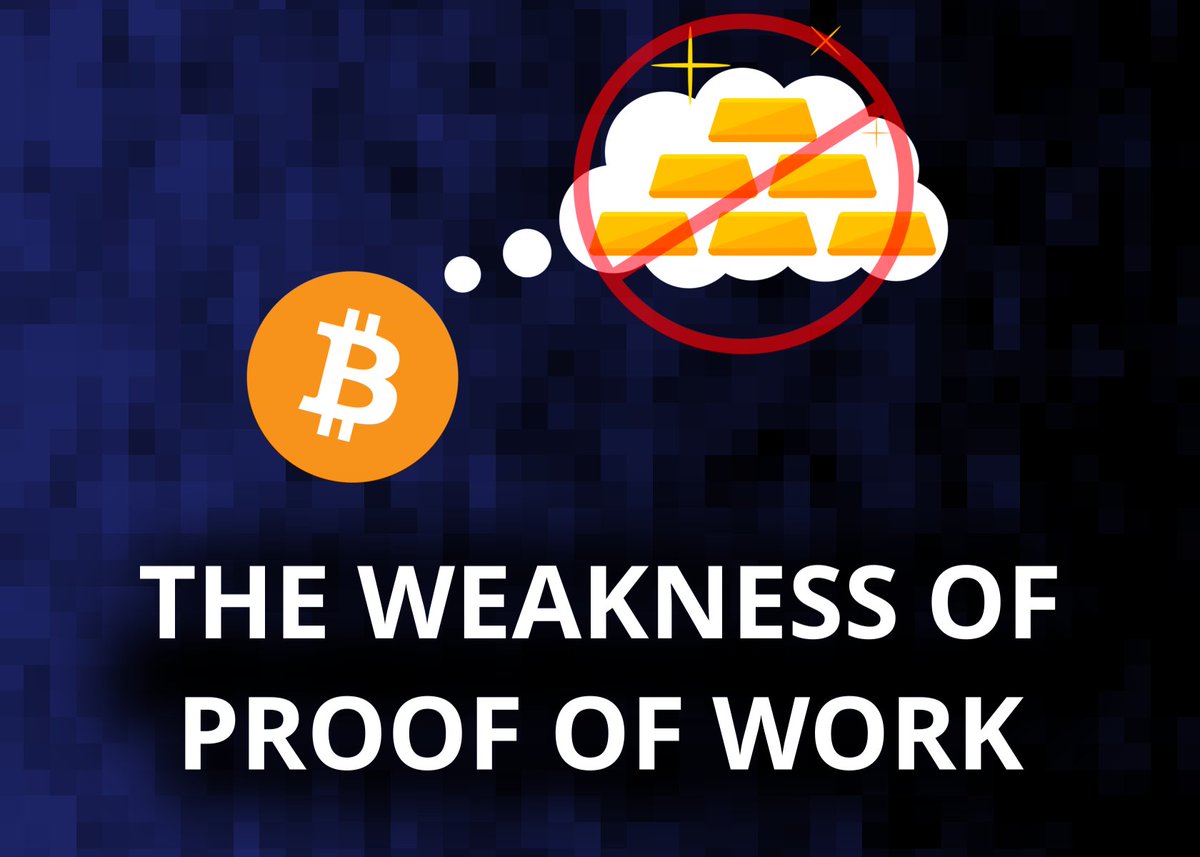
The security of Bitcoin PoW is a ticking time bomb.
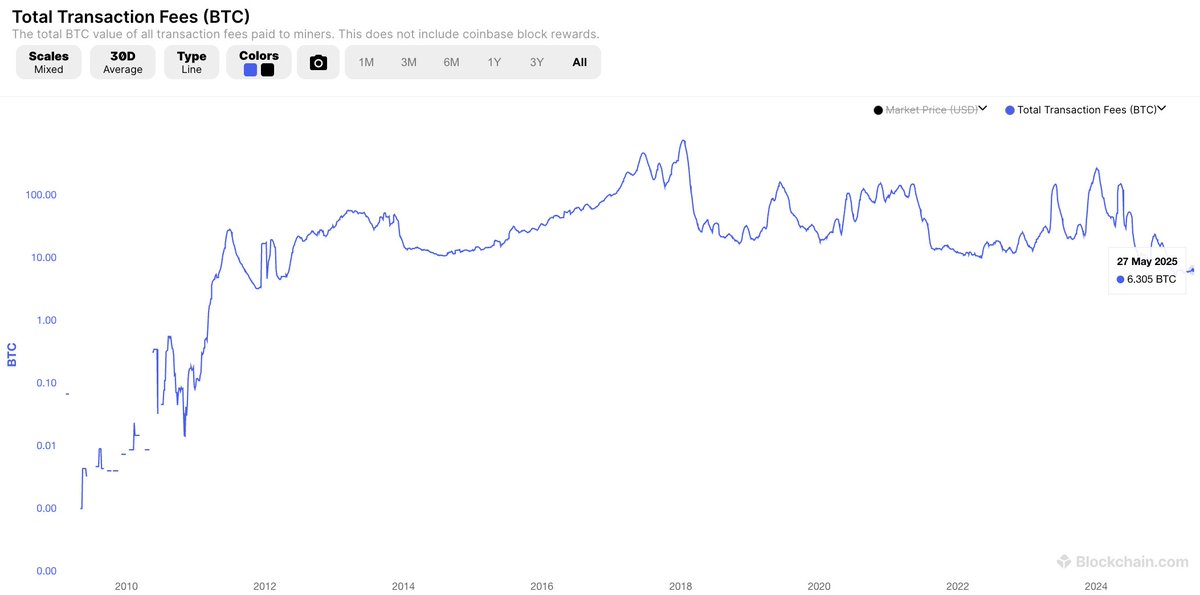
Bitcoin fees are at a 13-year low—less than 10 BTC/day. Despite 2016, 2020, 2024 halvings, miner revenue from fees is at a 9-year low—just 1%.
low fees → low security budget → low security
Bitcoin's security model is broken. If Bitcoin gets taken over, the fallout could take the entire crypto ecosystem with it. The systemic risks can't be ignored.
Below is the 30d moving average of daily transaction volume: now at 6.5 BTC/day, less than the past 13 years.
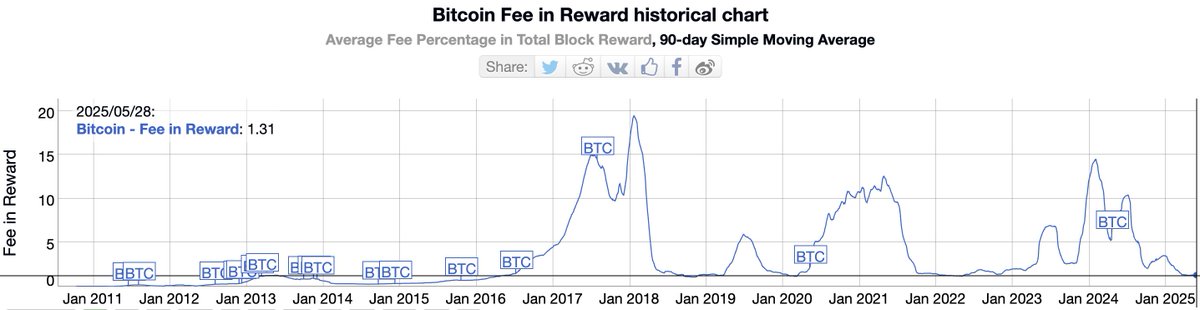
The story that fees will increase as a fraction of the security budget is not holding up. For a decade now BTC fees have decreased faster than issuance.
Below is the 90d moving average of the security budget contribution from fees. Fees halvened alongside issuance:
→ Mar 2016: 25 BTC/block, 1% from fees
→ Mar 2020: 12.5 BTC/block, 1% from fees
→ Apr 2022: 6.25 BTC/block, 1% from fees
→ Apr 2025: 3.125 BTC/block, still 1% from fees
Imagine fees were the only source of miner revenue today:
→ revenue drops 100x
→ hashing infra decreases 100x
→ 1% of today's infra (1 large farm) can 51% attack Bitcoin
That's the trajectory we're on. The 21M cap breaks security, it's self-destructive. It should be clear now Satoshi made an ooopsie.
As BTC price rises it gets harder to sustain high BTC-denominated fees. Today's 6.5 BTC/day may become 1 BTC/day if BTC goes to $1M or $10M.
Let's be optimistic and say BTC rises to $1M and today's 6.5 BTC/day in fees is maintained:
→ $6.5M/day in fees
→ 10% of today's security budget
Bitcoin would be a $20T asset secured by 1/10th of today's hashing infrastructure.
Today Bitcoin is secured by 20 GW—the equivalent of 10M space heaters. A 90% cut in miner revenue would bring that down to 2 GW of security—1M space heaters. For context, Texas alone produces 80 GW. There's no way a $20T asset can be secured by 2 GW.
Let's dream big and assume BTC goes to $10M per coin. Bitcoin would be a $200T asset—all fiat, all stocks, all gold; combined. Is it secure then?
→ 6.5 BTC/day is $65M/day
→ same security budget as today
→ same 20 GW of security as today
Sounds secure until you calculate the cost of attack. 1 GW of hashing infrastructure costs $1B:
→ $500M for datacenters (land, power, cooling)
→ $500M for rigs (e.g. 50M TH/s; $10 per TH/s; 20J/TH)
So what would a permanent 51% attack cost?
→ $20B for 20GW of hashing infra
→ 0.01% of BTC's hypothetical $200T marketcap
Meanwhile today there's $43B of BTC perp open interest, which is 2% of BTC's marketcap. Getting 0.01% marketcap short exposure is trivial today, and will only get easier as BTC financialises. $10M per BTC won't secure Bitcoin either.
Bottom line: Bitcoin's PoW model is not sustainable. The maths is against it. Without a fix someone will break it.
Can fees magically grow 100x? Maybe. But so far every attempt to produce transactional utility on Bitcoin has failed to drive sustained fee volume. Counterparty, Rootstock, Liquid, Lightning, Omni, Stacks, Ordinals, Babylon—you name it—only produced short-lived fee spikes.
Is BitVM a solution? Bridges relying on it can be drained by 51% attacks. One step forward, two steps back. Covenants or OP_CAT? Maybe, but highly speculative. I witnessed a STARK verified on an OP_CAT testnet—a multi-block monstrosity.
If fees don't magically grow orders of magnitude there are two candidate solutions:
1) add tail issuance, remove the 21M limit
2) switch to proof-of-stake
Both "solutions" seem to be cultural non-starters. Also tail issuance only works proactively, not after a 51% takeover.
Some suggest that Proof-of-authority (PoA) with mining pools could secure Bitcoin. What does that even mean? A multisig controlled by Foundry, AntPool, P2Pool? If you believe PoA could secure the future of money, the burden is on you to explain in detail how that would work.
Bitcoin is meant to be antifragile. Yet the elephant in the room in the room is not being addressed. We can burry our in heads in the sand. But the fundamentals are getting louder. Tick tock, next block—boom.

405
355
2,042
412,188

14 Mar 2025
Honestly it's probably a good thing for Solana in the long term for SIMD 0228 to have failed. It shows there is at least some decentralisation in the decision making.
11 Mar 2025

Wait the SIMD 0228 vote for Solana is happening already? This whole thing is way too rushed for an actual decentralised protocol.
Issuance changes should take a long time to go through if you actually have a decentralised cryptocurrency.
1
7
131
11 Mar 2025
Wait the SIMD 0228 vote for Solana is happening already? This whole thing is way too rushed for an actual decentralised protocol.
Issuance changes should take a long time to go through if you actually have a decentralised cryptocurrency.
3
330
Alt Explainer retweeted

24 Jan 2025
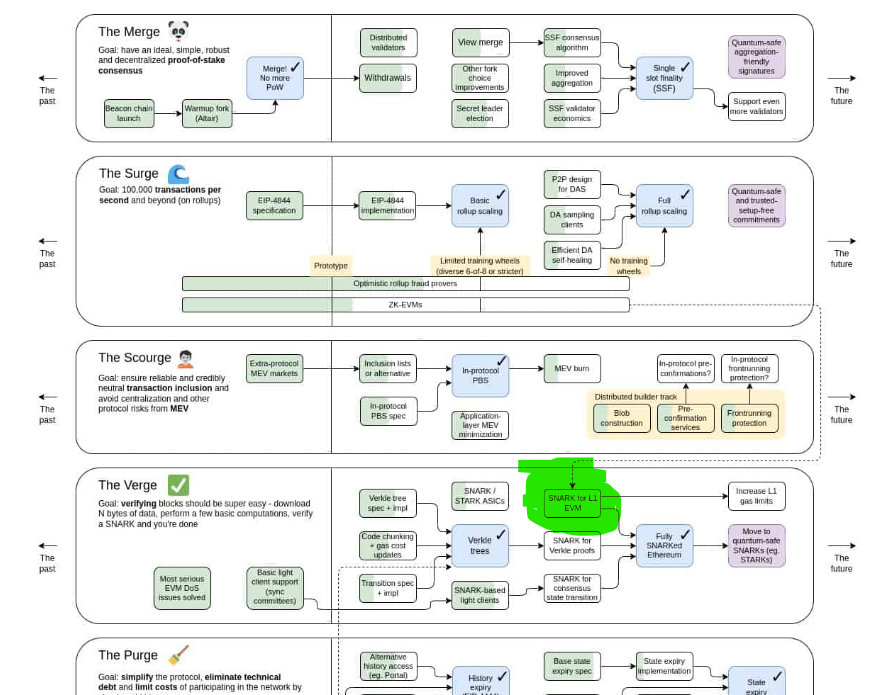
Scaling Ethereum L1 and L2s in 2025 and beyond
vitalik.eth.limo/general/202…
979
2,116
10,808
2,780,851
13 Dec 2024
Two big issues for Bitcoin in the medium/long term
youtube.com/clip/UgkxI_t32m3…
Good interview with Vitalik here
13 Dec 2024

It happened! The Lads are joined by none other than @VitalikButerin for Episode #73 🫡
🚨 OUT NOW on @YouTube & @Spotify!
In this episode we cover:
🛣️ Crypto & A.I. Intersections
🌟 @ethereum's North Star
🪙 $ETH: The Asset
🤖 The Quantum Risk To Crypto
🍝 Pasta of the Week & More!
Full links below!👇

2
154
Alt Explainer retweeted

27 Sep 2024
I respect you a great deal, so when I read your praise of Kyle's talk, I immediately watched the video.
I tried to keep my feedback short but Kyle is an absolute fountain of misinformation and marketing spin, and I just kept writing, so here we go:
Kyle's sensationalist rewriting of Ethereum history is shameful and unfactual. As just one example, Kyle suggested that the rollup-centric roadmap was adopted in Oct 2020 two months after defi got started - he implies it as if the rollup roadmap was a knee-jerk response to defi-induced congestion - but the actual founding of defi might likely be traced to Dec 2017 when DAI first launched, three years before the community aligned around rollups.
Kyle says a lot of other garbage about Eth's history and roadmap, but by far the most nonsense thing he said in this segment is that "the Eth community is now questioning the rollup-centric roadmap". The fact that one guy named Max had a couple good ideas followed by terrible theses on the L1 economics and roadmap does not constitute the community questioning the L2 model. The L2 model is working. We're tripling down on it.
The second most nonsense thing Kyle said during this "eth history lesson" segment is that "ETH is not accruing value because it surrendered fees to L2s". What a convenient time for Kyle to take a temporary fee situation and project it as something surely to continue in perpetuity. In reality, Dencun's massive L2 capacity increase coincided with a bear selloff to produce specularly low L1 fees, a situation that is virtually impossible to persist. I have argued that L1 total execution and blob fees will remain very high on average over the medium to long term. L1 fees are already steadily recovering. Blobspace is on track to saturate in ~Q1.
Kyle's suggestion that L2 fragmentation is bad for defi and thus the L2 model is a bad strategy misses the broader point that fragmentation is unavoidable because humans want to control and specialize their chains and no one chain can hope to serve even a fraction of the coming global demand. Solana is now learning this with their "network extension" L2s.
He says "the idea that ETH is money is nonsense and non falsifiable. The litmus test is you can go to the coffee shop and prices are in ETH". For one thing, ETH is often the quote currency for many DEX pairs, NFT sales, gas fees, etc. For another, I'd argue that in this era when any token can possess many of the classically defining characteristics of money, money has instead primarily become about monetary premium aka confidence premium for people to prefer holding the money. Confidence can come from many sources. The main source of confidence in ETH is that Ethereum is the hub of the next-gen global economy.
Kyle talks about how L2s are "anti aligned". This concept of alignment has gotten way out of hand. The only entity in the entire world that isn't aligned with Ethereum is Lido and that's because they threaten to destabilize the base layer. The very concept of "eth alignment" was created by Lido proponents to negatively emotionally conjugate our publicity campaign against Lido dominance. L2s are aligned with Eth in the sense that they help build Ethereum's network effects as a global hub and a distribution mechanism for ETH as money, and, in the future, L2s will pay high fees in aggregate to the L1.
Kyle argues that Ethereum has an identity crisis. It's true that the Ethereum community itself has struggled to settle on a crisp one-sentence value prop for Ethereum or ETH. But a chunk of this identity "crisis" comes from Ethereum evolving over the years, including changing its mind when the facts changed, and from having a broad community base of diverse supporters with opinions that conflict in a healthy way. Solana is experiencing a similar identity crisis now - Anatoly often says they are focused on being the best trading venue (NASDAQ vision), and yet Sol has a diverse app layer that speaks to many stakeholders' needs, not just trading. Sol will soon feel this divergent stakeholder tension more strongly, such as with some of their teams starting to prefer L2s.
Kyle says "Eth can't tell us what they want to optimize for because they don't know" which is an outright fabrication. Eth optimizes for credible neutrality and being the global economic hub. Nobody in ethereum, except like Max, thinks credible neutrality is a bad overarching mandate.
Kyle tries to show that DA is worthless. But really all he can show is what we can all see, which is that today's L1 DA fees are de minimis and the L1 has a lot of would-be DA competitors. DA competitors are not identical products to L1 DA and the actual equilibrium pricing premium of blobs remains to be seen. I think blob fees will be high and argued that this week.
Much of Kyle's "SOL will flip ETH" thesis in this talk turns around his metrics. He suggests his metrics show that SOL is already starting to flip ETH and so it'll become a self-fulfilling prophecy. But will it?
On DEX volume, Kyle excludes L2s from his Eth comparison chart which fits nicely with his supposition that L2s are separate chains and don't accrue any value to ETH. There has also been reporting (eg by Wazz) on the high level of wash volume included in some Sol metrics.
Personally, I question the value of volume as the top metric because volumes are naturally higher on lower-fee chains with lower blocktimes (for sol, this is achieved via centralization) due to increased opportunity for bots and small arbs.
Kyle says "in our view onchain trading DEX volume is the most important metric for a blockchain". I prefer the metric of capital that people trust on your chain.
Solana has 12x less app capital than Ethereum and 3.2x less after normalizing by native token market cap. Sol also has 4x more memecoins per dollar of app capital and 25x less stablecoins per dollar of app capital. Data from Aug 31st.
Kyle shows a nice chart of MEV tips on Sol vs Eth. This chart is misleading for two reasons. One, Kyle probably picked just MEV tips instead of total fees because total fees makes Eth look better. Last 30d gas fees (excluding mev payments) on eth L1 are 6x sol... this is during a time of L1 fee collapse. The other and more important reason that this chart is misleading is because the Eth community is deep into a multi-year effort to protect users from being fleeced by unnecessary MEV, whereas Sol is only starting this journey.
In mid 2021, when Eth was terrible at protecting users from MEV, our "best" fee day ever was $118M in one day.
So, Sol's MEV numbers do not help show at all that Sol is going to flip Eth, it shows that Sol is fleecing the F out of retail memecoin traders.
Kyle's next chart shows that Solana stablecoin transfer volume is increasing on a relative basis vs Eth. However, keep in mind that Sol stablecoin transfer stats have been subject to huge wash volume, see Wazz's reporting on this. And, Kyle shows only the stablecoin transfer comparison vs the L1. He's happy to ignore all L2s, again based on his (bad) view that the L2 model is destructive to ETH. Kyle also picked transfer volume for his chart and not stablecoin market cap because, as I already mentioned, Sol has 25x less stablecoin market cap than Eth L1 L2s (drops slightly to ~22x if one insists on omitting L2s).
Kyle ends on three "structural advantages" of Solana vs Ethereum: token extensions, firedancer, and scaling with hardware.
Token extensions are effectively already being done (pioneered) on Ethereum via many custom tokens and L2s.
Firedancer is not close to delivering on its promised tps. First it must be fully implemented (vs frankendancer that is part rust client, part C codebase), and then firedancer must be trusted to run the entire network because the rust client won't be able to keep up. Plus, firedancer's "handcoded C modules" open up a ton of new security risk, as well as key person risk due to the relatively small number of individuals qualified to maintain such a low-level codebase.
Scaling with hardware is something Eth is doing, too. See ongoing gas limit increases on Base and Linea, MegaETH taking L2 hardware specialization to the limit, and parallel EVM implementations (not just monad).
Kyle's "unique" structural advantages of sol reminds me of the "Only Possible On Solana" campaign where pretty much every example they gave is actually possible on many L2s.
imo, Solana's true structural advantages are leveraging centralization and vertical integration to accelerate growth, and, for now at least, a higher level of curiosity and aggression in the app layer than is usually seen in Ethereum, such as with depin and consumer crypto.
In short, Kyle's stories about Solana's advantages and progress are over-embellished or total fiction. He omits any detail on Solana's structural disadvantages, such as that they sell the same 50k tps to every customer and that 50k tps is really more like 1.1k tps tops today.
SOL will never flip ETH. Solana is having its heyday this cycle. In the future, the fastest L2s will be faster than Solana. Solana's speed cost advantages will narrow to zero. It will become obvious to everyone that the L2 model was a genius move and scales the way the world actually works, while providing excellent value accrual to ETH.
48
82
481
226,878
1 Aug 2024
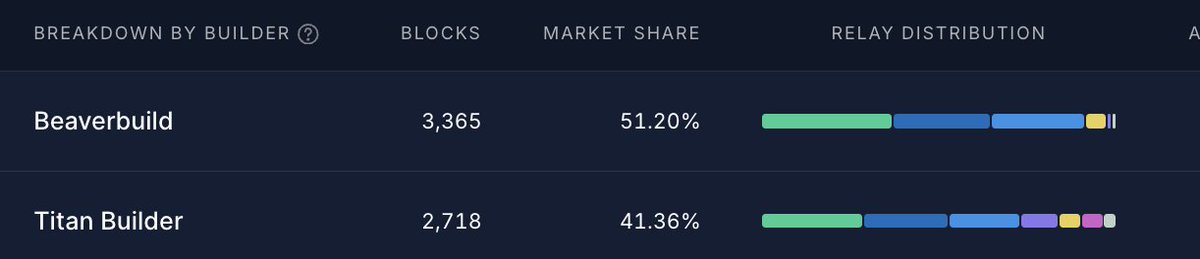
An example of dishonesty from Solana kol's. Clearly making a bad comparison to push a narrative.
Builders != validators
Do not trust them, they are lying to you.

uhh
2 entities control 93% of eth block production lmao
3 entities control 97%
i dont get the obsession with trying to take shots at bitcoin when your situation is much worse
2
2
168
Alt Explainer retweeted

30 Jul 2024
162
324
1,630
807,234

Exposing Solana: Everything they don't want you to know!
Shoutout to many for help with the content shown in video!
@Justin_Bons @WazzCrypto @ViktorBunin @invalid_eutxo @SolanaFloor @StakeWithPride @tokenterminal @Cointelegraph @EdnStuff @JaromirTesar
youtu.be/SlPgee7dpO0

237
524
1,330
341,176
25 Jul 2024
I've been playing @influenceth on @Starknet for a month now and made 474 transactions on chain. The total transaction fees for all 474 txns has been $0.064. The L2 roadmap is working!
Influence is very close to a web2 gaming experience. Faster txn times will do it
6
108
Alt Explainer retweeted

2 Jul 2024
New Bell Curve with @hasufl and @drakefjustin is LIVE.
In this episode, we discuss:
- Minimum viable issuance
- Real yield on Ethereum
- Restaking and preconfs
- Attester proposer separation
- Vertical integration btw liquid and restaking
Full episode below, enjoy!
2
10
74
16,041
23 Jun 2024
I'm not sure if ZK compression is an L2 or not but it is modular.
Solana validators would be outsourcing storing state so it's not monolithic.
Also it should just be called stateless tokens/NFT's.
1
2
171
20 Jun 2024
After looking into Ouroboros Leios, I won't be making a video on it yet. There are still too many unanswered questions on the actual implementation.
There's still probably 1-2 years for a research paper on the implementation and then 1-2 years to actually implement it.
1
68
Alt Explainer retweeted

19 Jun 2024
ETHEREUM SURVIVES THE SEC.
Today we’re happy to announce a major win for Ethereum developers, technology providers, and industry participants: the Enforcement Division of the SEC has notified us that it is closing its investigation into Ethereum 2.0.
This means that the SEC will not bring charges alleging that sales of ETH are securities transactions.
1,188
4,775
16,304
7,092,159
5 Jun 2024
Just finished my first read through of the $ADA Leios paper. It will probably take a few reads to fully understand but I can tell already that this is far away from main-net. Many implementation details are still to be decided.
This is probably something for the next bull market
2
67
1 Jun 2024
Maybe this will get me to make videos again. Will read later
31 May 2024

2/ The Ouroboros Leios paper is also available for you to read here: iohk.io/en/research/library/…
A future video will help outline how fundamental research informs IO’s work and feeds into its prototyping and development work, so stay tuned for that in the near future.
2
3
120
22 Mar 2024
Really excellent podcast. I was sceptical of the new issuance curve before and wondering what's wrong with the current one but now I'm much more convinced it's better for Ethereum.
Normal holders shouldn't have to think about staking pools. Making staking specialised is better
22 Mar 2024

ETHEREUM STAKING ENDGAME
@hasufl & @jon_charb brought on @adietrichs & @casparschwa from the EF following their latest research & proposal to change ETH issuance
2.5 hours going deep on PoS economics, LSTs, restaking, economic security & more
Links below 👇

2
204
14 Mar 2024
Using $ETH L2's right now is amazing. The rollup centric vision is slowly coming into place
6
168