I like pasta, macro and BTP.
Joined July 2024
- Tweets 146
- Following 208
- Followers 70
- Likes 191
16 Photos and videos








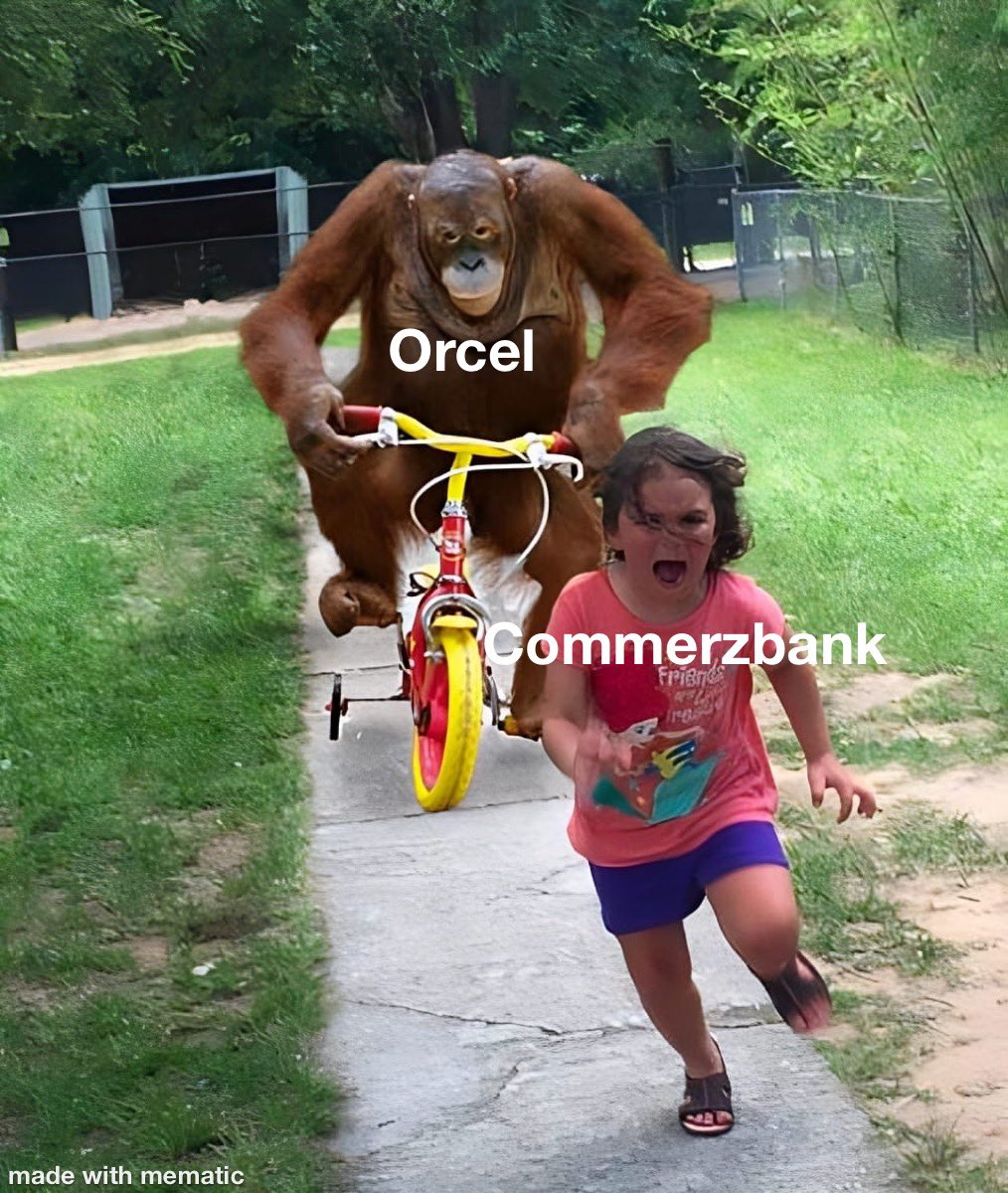

The violent V-shaped recovery is now burned into the psyche of investors. At least for the remainder of Trump’s presidency, even a genuine, undeniable catastrophe won’t get sold off.
Nuclear war? Just waiting in the fallout for the rip back to all time highs.
136
159
2,894
213,638
Big Twirling Prick retweeted

The U.S. Faces a Strategic Deadlock with Iran
The failure of the recent talks in #Islamabadtalks drives from the fact that Iran did not arrive at the negotiating table weakened or desperate. On the contrary, Tehran came with a sense of resilience, and even advantage and behaved accordingly.
For weeks, the U.S. policy appears to have been guided by the assumption that sustained kinetic pressure had eroded Iran’s position enough to force meaningful concessions, particularly on uranium enrichment and freedom of navigation in the Strait of Hormuz.
But negotiations are not shaped by objective reality alone, they are driven by perception. And Iran’s perception is fundamentally different.
From Tehran’s perspective, it has withstood pressure, absorbed blows, and demonstrated its capacity to retaliate across multiple arenas. That is not the mindset of a regime preparing to compromise.
This gap between American expectations and Iranian self-perception now lies at the heart of a growing strategic deadlock.
The options facing Washington are all "problematic":
A. Renewed negotiations may simply reproduce the same dynamics, with Iran unwilling to concede and the U.S. unwilling to settle for less.
B. Ending the confrontation without an agreement risks signaling weakness and undermining deterrence. Escalation, meanwhile, carries the most significant risks of all.
C. A return to high-intensity conflict is unlikely to produce decisive results. While strikes on Iranian infrastructure, or even more ambitious military moves, could impose real costs on the regime, they would almost certainly trigger a broader response. Iran has both the capability and the willingness to expand the conflict horizontally, targeting U.S. interests, Israel, and regional partners. The result would not be a quick resolution, but a wider war with direct implications for global energy markets and economic stability.
In other words, military escalation may satisfy the desire to reassert leverage, but it is unlikely to deliver a strategic breakthrough.
This leaves Washington with a difficult but unavoidable conclusion: the burden of recalibrating strategy rests primarily on the United States.
That does not mean conceding to Iranian demands. But it does require a more sober assessment of what pressure alone can achieve, and a clearer understanding of the risks embedded in escalation.
The alternative is to continue operating under an illusion of leverage, one that recent events have already begun to expose.
Complicating matters further are the mounting political and strategic constraints facing Washington. With a high-stakes meeting between President Trump and China’s Xi Jinping on the horizon, a global spotlight event like the Soccer World Cup approaching, and midterm elections looming, the U.S. has limited appetite, and even less time, for a prolonged military campaign.
Large-scale options such as a ground invasion would require months to execute and sustain, with no guarantee of decisive results. Even extensive strikes on Iranian infrastructure, while painful, are unlikely to deliver a knockout blow. Instead, they risk entrenching the conflict and inviting retaliation across multiple fronts.
Taken together, these constraints underscore a deeper reality: the United States is not just facing a tactical dilemma, but a strategic entanglement, one in which its military options are costly, its diplomatic leverage is limited, and time is increasingly working against it.
Meanwhile, Iran remains defiant. The regime shows no indication that it is prepared to yield, certainly not under pressure, and not at this stage.
Strategy deadlock.
#IranWar

I hope those advising the U.S. President are making the following points clear:
1. Iran sees itself as having achieved a significant strategic gain. From its perspective, if its terms are not met, there will be no meeting in Islamabad, even at the cost of renewed escalation.
2. Iran is unlikely to reopen the straits without a full ceasefire, which it believes was promised, even under pressure or threats.
3. Tehran has no intention of offering new concessions beyond what has already been discussed with the U.S. It views itself as negotiating from a position of strength, so why concede more?
4. The “Axis of Resistance” operates as an interconnected system. As long as fighting continues in Lebanon, Shiite militias in Iraq and potentially the Houthis, are likely to remain engaged.
Iran does not see itself as having been defeated. It did not seek these negotiations, and it is unrealistic to expect concessions at the table if, in its own assessment, it has not conceded on the battlefield.
85
379
934
371,283
Big Twirling Prick retweeted

Apr 6
How people who have no idea that the Strait of Hormuz even exists are living right now
47
569
9,802
382,241
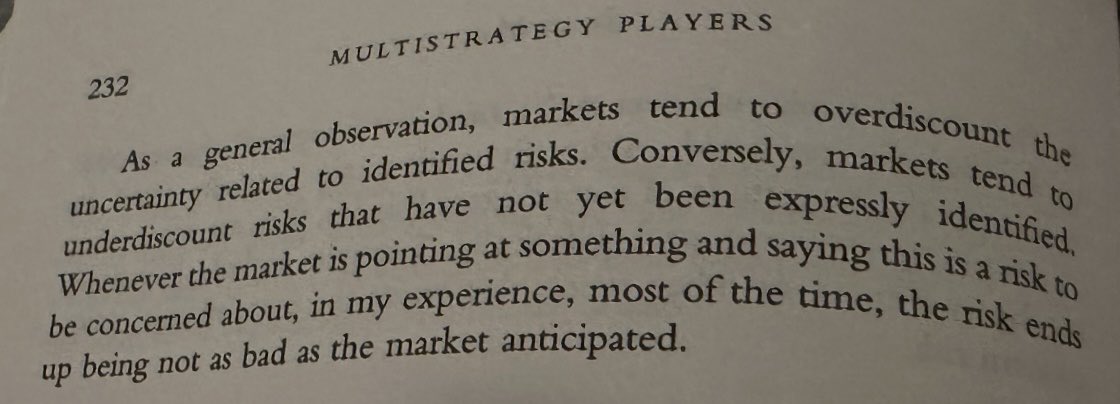
Not sure if risk will continue to trade well, but current market reminds me about this quote of Jamie Mai from Market Wizards.
1
1
318
Big Twirling Prick retweeted

11 Nov 2013
Remember that I predicted a long time ago that President Obama will attack Iran because of his inability to negotiate properly-not skilled!
7,392
74,556
156,174
Big Twirling Prick retweeted

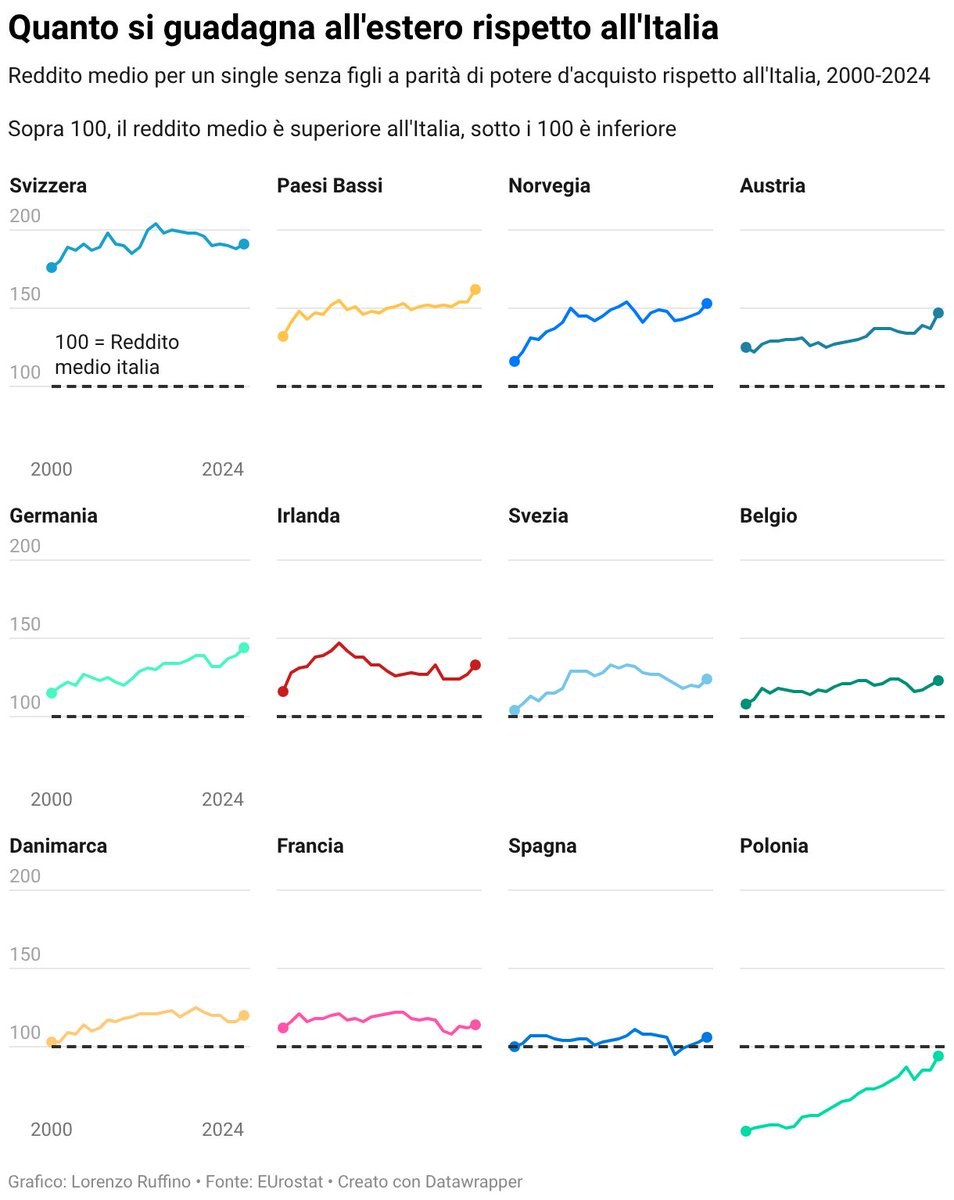
Come sono cambiati gli stipenti netti a parità di potere d'acquisto in Europa rispetto all'Italia? Negli ultimi vent'anni sono cresciuti quasi in tutti i principali paesi europei, conn forti crescite in particolar modo in Polonia, Norvegia e Paesi Bassi.
10
22
108
7,497
Big Twirling Prick retweeted

Jan 14
i never want to read any other way again.
1,028
6,064
61,790
3,269,164
Big Twirling Prick retweeted

29 Nov 2025
Birth Rate Collapse & Economic Utility of a Birth
This is really weird, but I suspect it’s overlooked in socio-economic research literature.
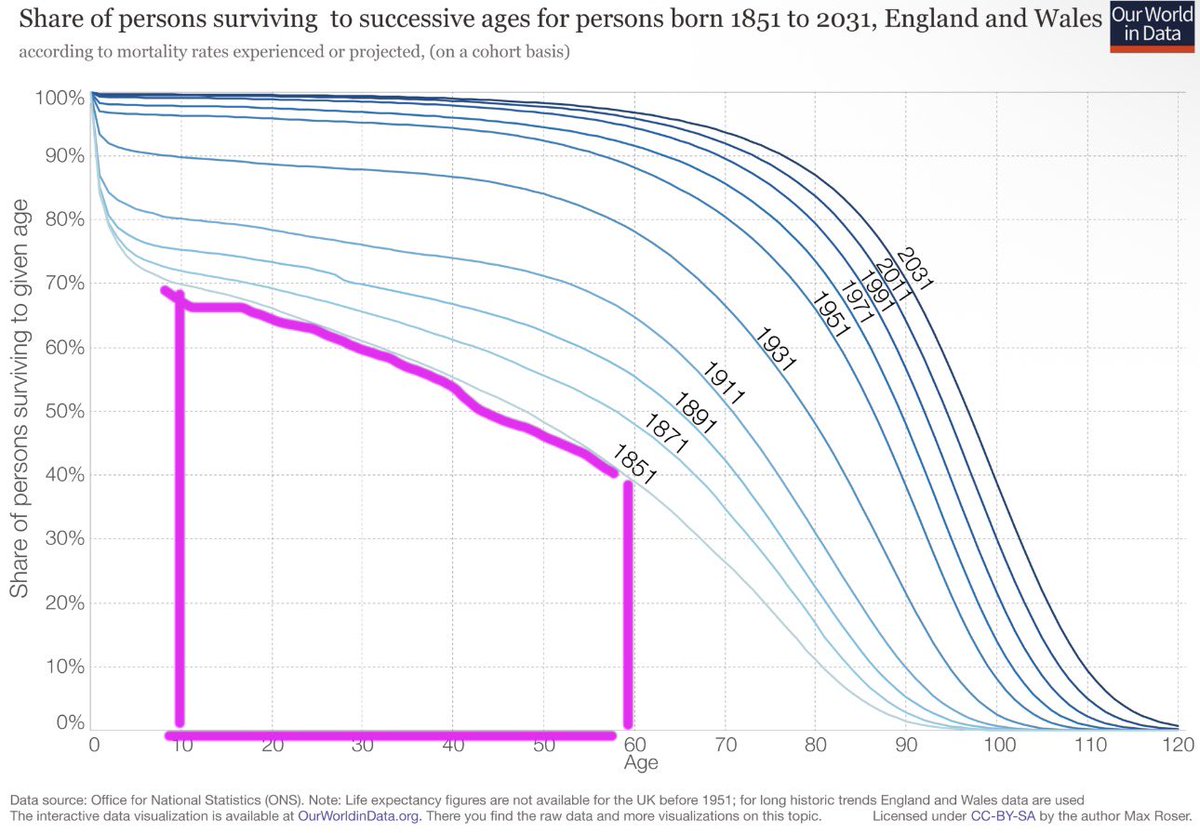
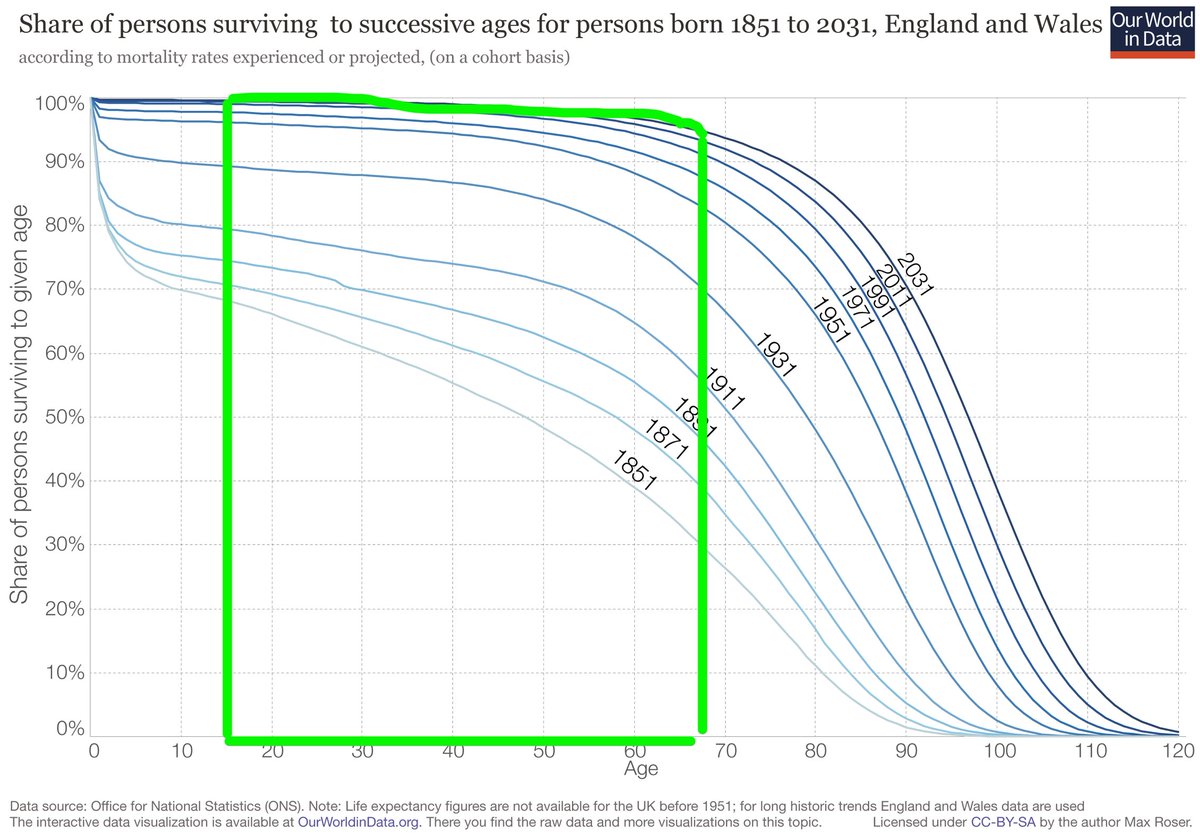
Below I present 2 zones on the same chart.
The pink zone on the left chart shows the useful economic life of 1 human birth in the year 1851.
The green zone on the right chart shows the useful economic life of 1 human birth in 2011.
Now because of medical advances, sanitation, public health, etc, etc we have significantly improved life expectancy and reduced infant mortality. This means that a birth in 2011 has vastly more hours of economic output than a birth in 1851. Historic mortality rates really cut down the expected economic lifespan of a birth, but how much?
The pink area on left = 40 years * 40% ( 40 years * 30% )/2
= 22 years of economic work per birth (yikes!)
The green area on the right = 51 years * 98%
= 50 years of economic work per birth.
These numbers are massively different.
The expected working lifespan of a human at birth has increased by 127% over 160 years. Even though we work to approximately the same age.
This means that in economic terms 1 birth in 2011 is worth 2.27 births in 1851. How does that gain in economic utility per birth compare to the collapse in volume of births?
Today there are 2.31 births per woman worldwide.
In 1850 there were 5.82 births per woman.
5.82/2.31=2.52
So we have 2.27x gain in utility per birth and a 2.52x fall in the volume of births? These ratios are within 10% of one another, they almost perfectly track inversely to give a fixed amount of ‘human economic utility birthed per woman’.
I find this to be a staggering coincidence.
Is the collapsing birth rate just supply and demand? Did longevity gains simply create a temporary oversupply of units of human utility?
The population crisis might just be market forces. Or rather, it’s just macro-ecology.
189
453
6,445
948,813

75
811
7,229
364,144
Big Twirling Prick retweeted

3 Sep 2025
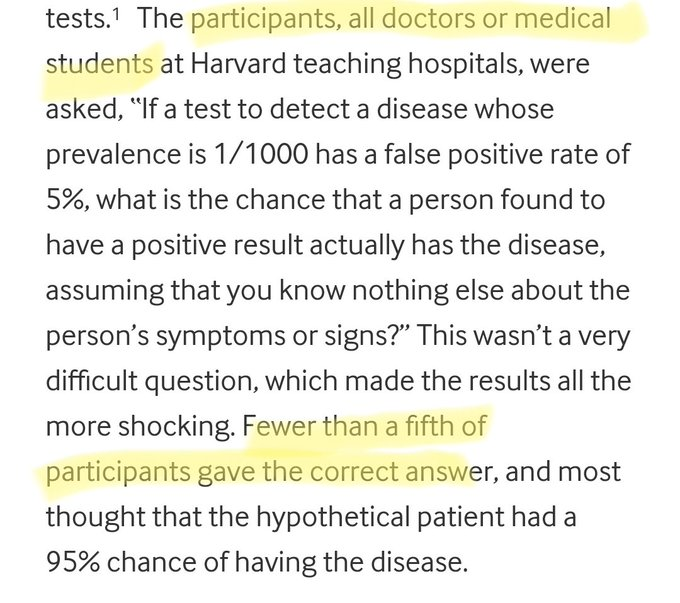
4 out of 5 Harvard doctors fail an introductory statistics question
Expertise is real, but most "experts" are shockingly innumerate
575
768
11,653
2,772,858

1 Sep 2025
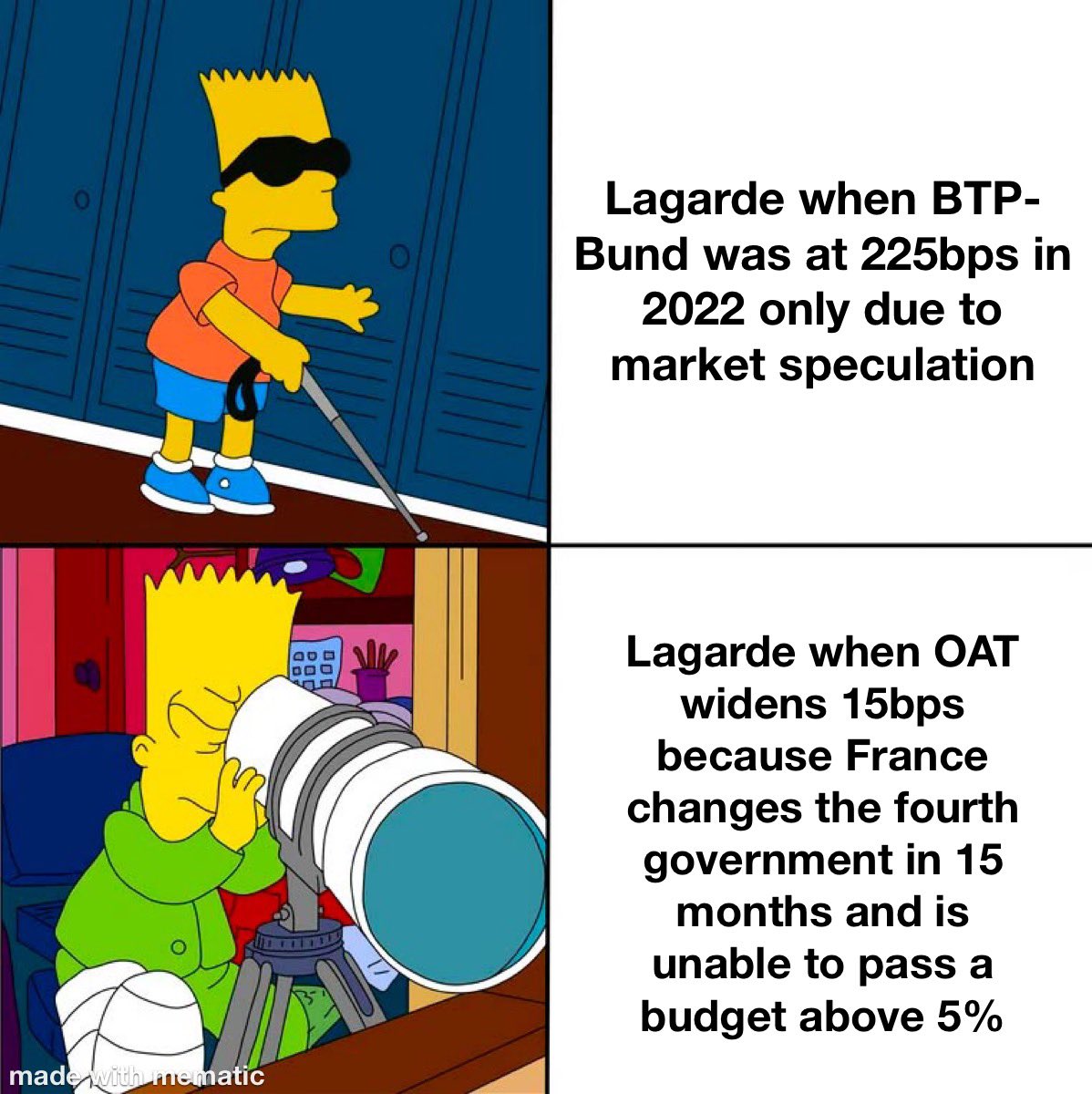
Lol wasn’t she the one “not here to close spreads”. Took them 180bps of widening in BTP Bund to say something in 2022, now 15bps of Baguette spread makes her very attentive.
Joke
1 Sep 2025

ECB'S LAGARDE SAYS I AM LOOKING VERY ATTENTIVELY AT FRENCH BOND SPREADS SITUATION
2
3
5
1,448
25 Aug 2025
2 Dec 2024

1
78
Big Twirling Prick retweeted

28 Jul 2025
friend: i heard bitcoin has gone up a lot, you still into it?
me:
63
334
3,238
230,282
27 Jul 2025
Agree w/ Cluseau. As much as the US is a circus, the clown played most of the world in the end: all the deals look good for US (maybe not as much as advertised by Trump, but still good), and bad for ROW. US exceptionalism will persist, and ROW YTD outperformance possibly reverse.
27 Jul 2025

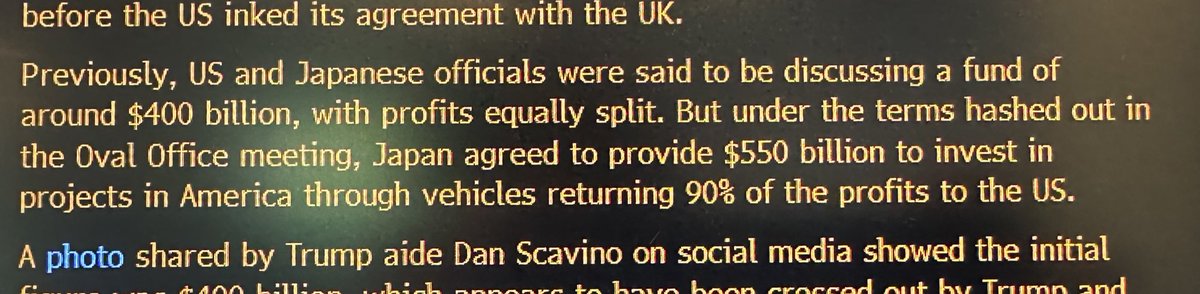
He keeps getting away with it. 15-20% tariffs with zero retaliation, forced purchases of US energy and military equipment, and commitments to invest hundreds of billions in the US with no action on our part. Lmao.
123
26 Jul 2025
Hey @grok who was the most famous person to visit my profile? doesn’t need to be a mutual, don’t tag them, just say who it was
1
39
23 Jul 2025
If I was kidnapped I hope my release was not negotiated by the Japanese
44
8 Jul 2025
Entire financial system to slow down 5/10m compared to usual
8 Jul 2025
Hey everyone! I'm on holiday. I'll still be posting, but expect me to be a bit less active than usual. Catch you all soon!
1
62
Big Twirling Prick retweeted

3 Jul 2025
Fellas, as we wrap up what has been another wonderful market week, it's important to remember life is more than your brokerage account.
If you're ahead of the S&P, great, and if you're not or perhaps even down, that's ok, as long as you are still kicking it's fine.
A lot of times I get so obsessed I begin basing my self worth, and also what I do in real life, off how I am doing in the market.
It's a big mistake, and I know it. 5 or 10 years from now you will almost certainly wish you were back where you are today, and that you lived the life you promised yourself you would live instead of living your life behind some pixels.
Even if you are killing the market, I'd bet most you arent even spending any of the money you make. There's a balance to everything.
Live a little this weekend. You all deserve it.
Happy fourth! 🇺🇸
35
27
740
45,276
3 Jul 2025
What would you do if you were to quit trading and start from zero? Assume some small capital set aside.
So many interesting jobs/paths out there which I think are nice to explore.
20
Big Twirling Prick retweeted

1 Jul 2025
Oh you’re confused because this guy turned not to be fiscally responsible?

162
685
7,425
177,628