🇺🇸America First! USAF Veteran GenX
Joined August 2013
- Tweets 21,867
- Following 2,198
- Followers 4,238
- Likes 12,019
15,335 Photos and videos


Rob Bemis retweeted

May 27
"It was the time sheets that made people look into him...."
I wish people could see what the Army finance office will do when a soldier gets overpaid $20.00. Then I would like to show them the oversight that our Travel System (DTS) has for a soldier to get paid for spending one night in a hotel. Next I would show them the weekly Battalion meeting where every leader can see the names of every soldier in their unit who owes money for travel cards/DTS/paychecks. Finally I will show them the withdrawal and clearing process for the various OPFUNDS that are used during overseas operations.
The army will crush a soldier for owing a single penny and this dude signs for $40 Million in Gold bars and puts them in his house....and the ONLY reason they found them was because he cheated on his time sheets.
We have soldiers and their families living in trailers and we will go through their finances with a fine tooth comb.
We have Illegals, Child care center operators, and senior executive band people bilking the Government for MILLIONS/BILLIONS and people seem to discover it by "chance".
Every last fraudster caught with over a million dollars should be dropped from a space shuttle and allowed to re-enter the earth's atmosphere so we can watch them turn into a ball of flame for our entertainment.

CIA official arrested for taking home $40 million worth of gold and $2 million in cash after filling out fraudulent time sheets - NYT
295
2,092
9,439
316,703

Apr 16
Single Fathers Don’t Talk About This But It Hurts youtube.com/shorts/JIb5L1rfm… via @YouTube
1
12
343

Rob Bemis retweeted

Apr 5
This is why Americans are the deadliest fighters on earth.
I met a priest yesterday who just got accepted to chaplain school in Newport. I asked him the obvious question: Marines or Navy?
Navy, he said. His face fell a little. He told me he could never be a Marine because every Marine is a rifleman, and as a priest he can’t carry a weapon.
He’s hoping to get assigned to a Marine unit anyway. All chaplains are Navy officers, so that’s the only door in.
I laughed. I feel a little bad about that.
Then I explained to him what “Devil Doc” means. The Marine Corps doesn’t have medics. They use Navy Corpsmen.
I told him: when you get out to the fleet, find a Marine sergeant with a couple of Purple Hearts and tell him Devil Docs “aren’t real Marines.”
Be prepared to duck.
Marines are violently particular about who gets to wear their uniform. Navy Corpsmen and Navy chaplains who have eaten dirt alongside them in combat qualify. Full stop.
My dad was Air Force. Not even Navy. I remember going to VFW halls with him as a kid. Someone would ask him what service, he’d say Air Force, and the room would chuckle a little. Then they’d find out he was a medic, and the air in the room changed. Something close to reverence.
Dad hated being honored. He had one line he used to deflect it:
“I didn’t do much. Save your praise for my cousin the PJ.”
That always broke the ice.
PJs are the Air Force special operators who go into hell to pull downed pilots out.
They will take casualties and are prepared to die to rescue a single pilot or crewman.
The math doesn’t math out. Why would any combat force take multiple casualties to rescue one air force jet jockey?
What the padre is about to learn is that the military has a hierarchy that has nothing to do with rank, and nothing to do with the service stitched on your chest.
Have you deployed?
Have you seen combat?
In every firefight there are men who move toward the guns and men who hang back. And when the guy at the tip of the spear is pinned down, bleeding, with rounds cracking past his head, there is exactly one word he screams into the radio.
“Medic.”
Here is the catch, and it is the whole reason America fights the way America fights.
That Marine is willing to push forward into fire BECAUSE he knows the Corpsman is coming. He knows the medevac birds will land in the hot LZ.
He knows the Devil Doc will drag him out by his plate carrier if it comes to that.
And, if the medic can’t help, if he has what Dad called “injuries incompatible with life,” he knows that chaplain will crawl on his belly to administer last rights and deliver him to heaven.
The F-15 pilot punching out over enemy territory knows the same thing. He knows the PJs will move heaven and earth to reach him, and turn whatever is shooting at him into a smoking crater of hell on earth on the way in.
This is the quiet math underneath American violence.
Our warriors are the fiercest on earth not because they are more aggressive, not just because they are better trained, or better equipped, though they are all of those things. They are the fiercest because they know, in their bones, that when they key the mic and call for help, help is coming in hot.
Take that away, and you don’t have the U.S. military anymore. You have a security force.
Apr 5

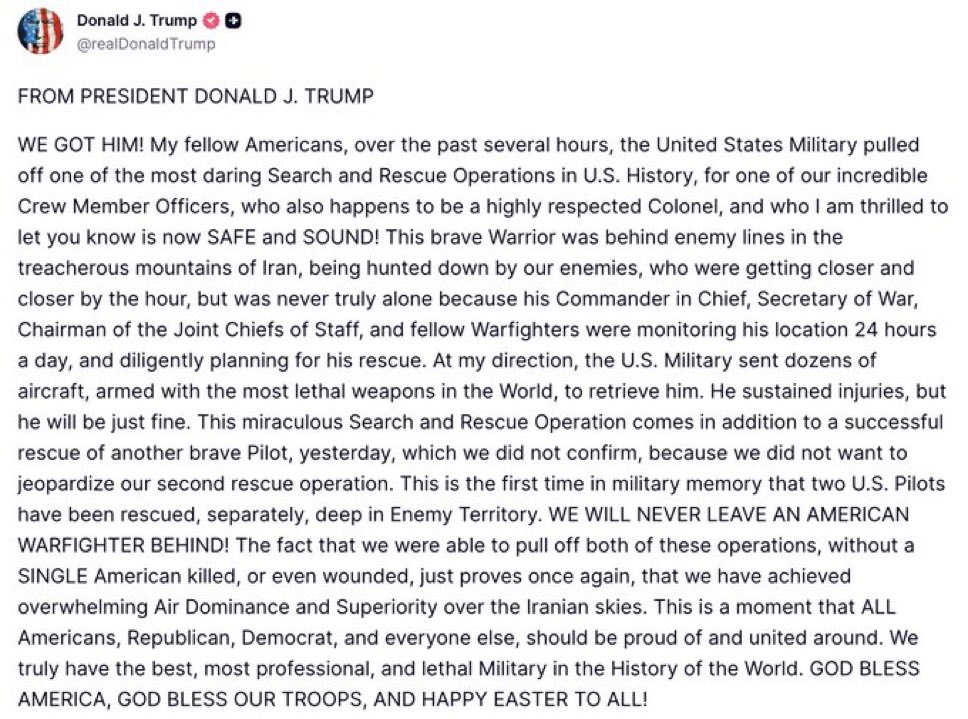
🚨“WE GOT HIM! My fellow Americans, over the past several hours, the United States Military pulled off one of the most daring Search and Rescue Operations in U.S. History, for one of our incredible Crew Office Members, who also happens to be a highly respected Colonel, and who I am thrilled to let you know is SAFE and SOUND!” - President Donald J. Trump 🇺🇸
776
4,991
24,479
2,657,348


Rob Bemis retweeted

Mar 27
I bought Rivian stock on IPO day. November 10, 2021. $172 a share. I bought 58 shares. That was $9,976. I remember the exact number because my girlfriend asked what I spent ten thousand dollars on and I said "the future of transportation."
She said "you drive a 2017 Civic."
I said "exactly."
$1,000 invested at IPO is now worth $149.06. I have that number memorized. I check it before coffee. I check it after coffee. I check it during meetings where I'm supposed to be listening. The number changes by pennies. The pennies matter to me now.
The thesis was simple. Rivian was the next Tesla. They had the Amazon delivery vans. They had the adventure truck. They had the factory in Normal, Illinois. I told people the factory was in a town called Normal. I thought that was meaningful. A sign. The future of transportation, built in a place called Normal.
The factory produced 24,337 vehicles in its first full year.
Tesla produced 1.8 million.
I called that "room to grow."
I have been through six theses on Rivian.
Thesis one: they're the next Tesla. (Stock dropped 40%.)
Thesis two: the Amazon vans are the real play. (Amazon cut the order.)
Thesis three: the R2 platform will be the mass-market breakthrough. (Delayed 18 months.)
Thesis four: the Georgia factory changes everything. (Paused indefinitely.)
Thesis five: Volkswagen's $5 billion investment validates the technology. (Stock kept falling.)
Thesis six: Uber robotaxis. This is the pivot.
Every time the stock drops, I find the new thesis. I don't look for it. It finds me. I open Reddit. I open the Rivian subreddit. Someone has written a post titled "Why this is actually bullish." It has 400 upvotes. I read it. I agree with it. I was going to agree with it before I read it. The agreement is the point. The DD is the prayer.
My cost basis is $172. The stock is $14.06. I am down 91.8%.
I could have bought a used Rivian R1T with the money I've lost on Rivian stock. I have not done the math on this. I'm doing it now. Yes. I could have bought one. A 2022 with 30,000 miles. I would have the truck AND the remaining money.
I drive a 2017 Civic.
My coworker Dave bought index funds. Dave is up 34% over the same period. Dave brings a sad lunch to work every day. Turkey sandwich. Same sandwich. Dave will retire at 65 with a comfortable nest egg and a lifetime of turkey sandwiches and he will never know what it felt like to be early.
I am early.
I have been early for four and a half years.
At some point early and wrong have the same return on investment. But they feel different. Wrong feels like a mistake. Early feels like a strategy.
I feel like a strategy.
The Uber partnership was announced Tuesday. I texted three people. One was my brother. One was a guy from the Rivian subreddit whose real name I don't know. One was my girlfriend. My ex-girlfriend. She stopped asking about Rivian in 2023. She stopped asking about anything in 2024.
The stock jumped 10%. It gave half back the same day. But for eleven minutes I was only down 81% instead of 85%. I called that momentum. I took a screenshot. I still have the screenshot.
Rivian will build robotaxis for Uber. Rivian has not built a profitable vehicle for anyone. Rivian lost $38,784 on every vehicle it delivered last year. That's not my number. That's their 10-K. But I don't think about it that way. I think about it as investment in scale.
Scale means you lose money faster until you don't.
Uber needs thousands of autonomous vehicles. Rivian needs to not go bankrupt before 2027. These are complementary needs. That's a partnership. That's synergy. That's the pivot.
Dave asked me yesterday how much I'm down.
I said "I'm long-term."
He said "it's been four years."
I said "Tesla was down 80% once."
He said "Tesla was also profitable once."
Dave went back to his sandwich.
Dave doesn't understand pivots.
I bought more shares this morning.
This is the pivot.
457
97
2,020
1,277,775
Rob Bemis retweeted

Mar 26
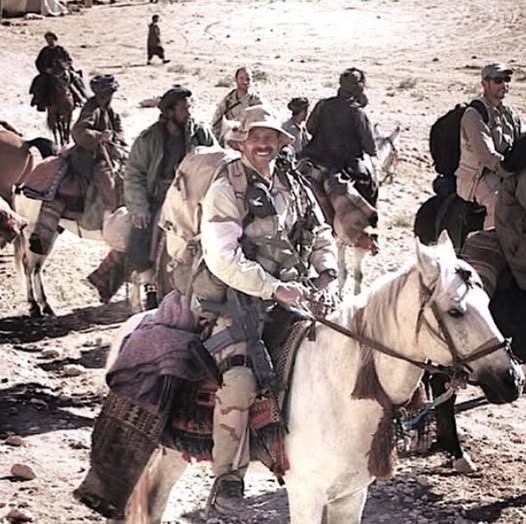
Six weeks after September 11, 2001, twelve American soldiers were quietly loaded onto a helicopter in Uzbekistan and flown over the Hindu Kush mountains in the dead of night.
No tanks. No armored vehicles. No air support waiting on the ground.
Just twelve Green Berets, over a hundred pounds of gear each, and a mission that their own commanders privately doubted any of them would survive.
They landed in a remote Afghan village called Dehi, in the pitch black, surrounded by a country they barely had maps for.
And then someone handed them horses.
Not metaphorically. Actual horses — Afghan stallions, tough as nails and famously difficult to control. Wooden saddles covered in carpet scraps. Stirrups so short their knees rode up around their ears.
Captain Mark Nutsch, who'd grown up on a cattle ranch in Kansas and competed in collegiate rodeos, became trail boss on the spot. For the other ten men on his team — Operational Detachment Alpha 595 of the 5th Special Forces Group — the learning curve was immediate and unforgiving. The first words one of his sergeants learned in Dari were: "How do you make him stop?"
They had linked up with General Abdul Rashid Dostum, a Northern Alliance warlord who controlled thousands of fighters and knew this territory like the back of his hand. The deal was simple: the Americans would call in precision airstrikes from horseback. Dostum's cavalry would do the charging. Together, they would take Mazar-i-Sharif — a Taliban stronghold of 250,000 people — and crack open northern Afghanistan.
Military planners had estimated it would take two years.
Task Force Dagger gave ODA 595 three weeks.
For 23 days of nearly continuous combat, the Horse Soldiers lived like men from a different century. They ate what the Afghans ate. They slept on the ground in freezing mountain passes. They rode trails so narrow and sheer that one wrong step meant a thousand-foot drop. Staff Sergeant Will Summers started the mission at 185 pounds. He left Afghanistan five weeks later weighing 143.
The Taliban had tanks. Soviet-era armor, antiaircraft guns, fortified positions dug into the mountains. Against this, twelve Americans on horseback radioed coordinates to aircraft circling invisibly above, and watched the positions erupt.
On November 9, 2001, they rode into the kind of moment that people are not supposed to experience in the modern world.
Nutsch and his team joined hundreds of Dostum's horsemen in a thundering cavalry charge across an open plain — directly into entrenched Taliban lines. Under fire. At a gallop. Calling in close air support between strides.
It was the first cavalry charge of the 21st century.
It was also the last.
The next day, Mazar-i-Sharif fell. The Taliban's northern stronghold collapsed. Within weeks, the regime itself began to unravel — a domino effect that started with twelve men and borrowed horses in the mountains.
All twelve of them came home.
Zero American fatalities. Against a fortified enemy that outnumbered and outgunned them at every turn.
Today, across from Ground Zero in New York City, there is a bronze statue — sixteen feet tall — of a Special Forces soldier on horseback, rifle across his lap, looking west. It honors ODA 595 and the teams who rode with them.
Most Americans walk past it every day without knowing the story.
Now you do.
513
3,491
17,602
994,217


Rob Bemis retweeted

Mar 19
🚨 JUST IN: Florida Southern College has just created an ROTC SCHOLARSHIP in honor of fallen Captain Cody Khork, who was lost to Operation Epic Fury
Well-deserved 🙏🏻
SHERIFF GRADY JUDD: "Normally, the pictures I hold up are of bad guys. This is a hero. This man went off to war at the direction of his country."
"This is Captain Cody Khork. He's 35. He's from Winter Haven."
"He was in the U.S. Army Reserves. He was called up. He died in the early days as a result of an attack."
"His family has asked that we escort him past Florida Southern College, where he went to college."
"This man is a hero, and he died in order that we can live in a free and democratic society, and he did what was asked of him of his country."
"Once he is escorted to the funeral home, which is in Winter Haven, he will remain there until he has services this weekend, and then on Monday we will escort him to Bushnell, which is his final resting place."
"From the time he arrives in Polk County on that airplane until the time we take him to Bushnell, Captain Cody will not be by himself."
"Twenty-four hours a day, seven days a week, there will be a deputy standing guard because it's the right thing to do. We're proud of him."
"We're proud of all our military personnel that are standing in the gap and doing what this country has asked of them." 🇺🇸
424
4,869
24,073
251,750

Rob Bemis retweeted

Feb 22
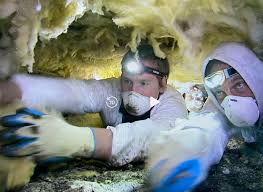
I want to offer a quick congratulations to my friend Matt Malone, who put his money where his mouth is, as I knew he would.
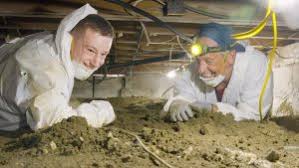
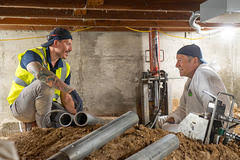
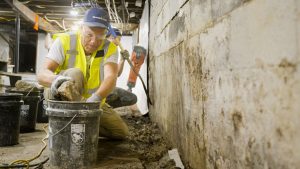
As the attached press release will attest, Matt’s company, @groundworks, just awarded $31 million dollars in dividends to several thousand employees who spend their days in crawlspaces, trenches, and basements, doing a long list of dirty jobs that have saved many thousands of homes across the country from all sorts of calamity. bit.ly/4kLQa2I
I took an interest in this company a few years ago, when I learned that Matt had implemented a program that turned all of their workers into owners, giving the frontline workers a chance to participate in whatever success the company might enjoy. I also encouraged Matt to feature his actual employees in a completely unscripted, totally authentic advertising campaign – something no one in his industry has ever dared to do.
“What would that look like?” he asked. “A totally unscripted ad campaign?”
“Well,” I said, “if we do it right, it’ll look a lot like an episode of Dirty Jobs.”
That was three years ago. Since then, Groundworks has doubled in size, and their employees, (who are now owners), have kicked my ass with a level of vigor and enthusiasm that reminded me of the good old days. These guys are not only experts at what they do, they LOVE what they do, and I've enjoyed working alongside all of them.
Honestly, I hope more companies follow Groundworks example. It’s funny how so much of the traditional drama between labor and management fades away, when everyone owns a piece of the pie.
Congratulations, Ground Works! Keep it dirty!
82
1,372
7,503
90,018
Feb 19
Graffiti train gallery installation. On view at VSG Contemporary in Chic... youtube.com/shorts/wj8d5Tj7A… via @YouTube
1
16
247
Feb 18
YouTube is down! Fix it! Thank you for your attention to this matter.
13
377
Rob Bemis retweeted

Feb 15
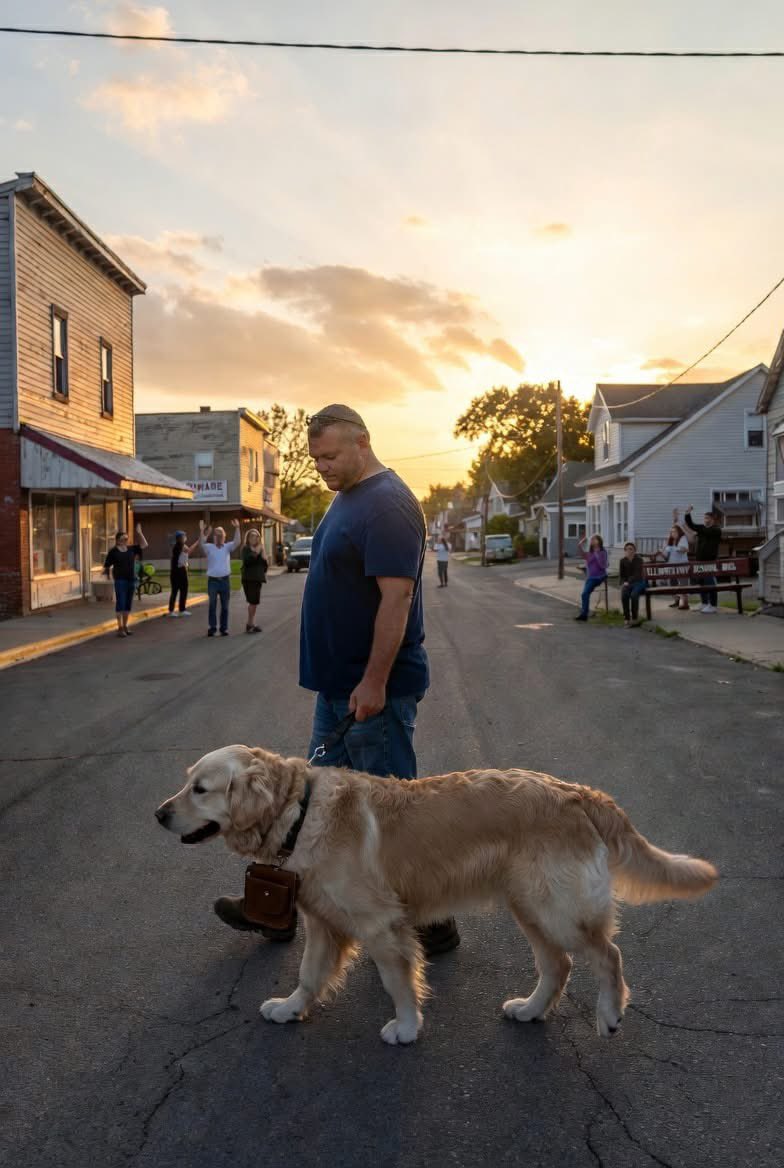
I scheduled the appointment to have my father’s dog put down for 9:00 a.m., the morning after the funeral.
I told myself it was mercy.
Dad was gone. Rusty—a massive, arthritic Golden Retriever with milky eyes and a slow, aching gait—looked like grief made flesh. I couldn’t bring a ninety-pound dog into my spotless, no-pets-allowed condo in downtown Seattle. I had a flight to catch. Meetings to attend. A life waiting for me.
My father, Frank “The Tank” Miller, wasn’t remembered for tenderness. He was a union steelworker carved from another era—quiet, blunt, permanently scowling. He kept the blinds closed, spoke in grunts, and terrified neighborhood kids if their soccer ball rolled onto his lawn. Vulnerability wasn’t something he practiced. I left home at eighteen to chase a tech career and rarely looked back.
Walking into his small, silent house after the funeral felt like stepping into wet cement. Rusty lay by the front door, tail thumping weakly when he saw me. Hanging from his collar was a battered, oil-stained leather pouch. It looked strange. Almost ceremonial.
“Come on, buddy,” I sighed the next morning, clipping on his leash. “One last walk.”
I planned a quick lap around the block. Efficient. Final.
Rusty had other ideas.
The moment his paws hit the sidewalk, the old dog straightened. He didn’t shuffle—he marched. He pulled with a strength that startled me, steering us past the park and straight toward Main Street.
He stopped in front of Miller’s Hardware & Feed, sat down hard, barked once, and waited.
Old Man Henderson limped out from behind the counter, wiping grease from his hands. He gave me a stiff nod—then saw Rusty, and his face collapsed.
“Well, hey there, boy,” he whispered, kneeling with a groan.
He pulled a folded receipt from his pocket and slipped it into the leather pouch. Then he fed Rusty a strip of good beef jerky.
“What is this?” I asked, glancing at my watch. “I’m in a hurry.”
Henderson looked up, eyes glassy. “Your dad hated small talk. Wouldn’t step foot inside. But every Tuesday for five years, he sent Rusty down here.” He nodded at the pouch. “Usually had a fifty in it.”
“A fifty? For what?”
“For Mrs. Gable,” he said quietly. “Widow down the street. Heat costs more than her Social Security check. Your dad paid for her porch repairs, too. Made me promise I’d never tell her.”
I stood frozen.
My father—the man who reused nails and stashed loose change in coffee cans?
Rusty tugged the leash again.
Next stop: the elementary school bus bench.
A boy sat alone, staring at his shoes. Maybe ten. Too thin. When he saw Rusty, he didn’t smile—he crumpled. He buried his face in Rusty’s fur and cried. Rusty stood perfectly still, licking the boy’s tears.
“He waits for Leo every morning,” the crossing guard whispered beside me. “Kid gets bullied. Your dad watched from his porch with binoculars. Sent Rusty over right before the bus came.”
She smiled sadly. “He told me once, ‘A kid can’t feel alone if he’s got a lion watching his back.’”
She nodded at the pouch. “Usually a candy bar in there.”
I finally understood.
That pouch wasn’t storage. It was a bridge.
My father didn’t know how to say I care. So he found another way. Rusty wasn’t a pet. He was a messenger. The kindness my father didn’t know how to hand directly to the world.
We walked for two hours.
A diner waitress received “anonymous” cash for diapers.
A librarian let Rusty sit while she read poetry out loud.
A town stitched together by quiet generosity and golden fur.
By sunset, we were back at the house.
My hands shook as I unclipped the leash. I canceled the vet appointment. Then I opened the pouch.
Inside, beneath the receipt, was a folded piece of notebook paper. The handwriting was shaky. Blocky. Dad’s.
If you’re reading this, I’m gone.
Don’t cage Rusty. He’s not a dog. He’s the part of me that knew how to be kind.
He’s the best part of me.
117
406
3,315
90,917
Rob Bemis retweeted

Feb 12
When Mr. Rogers read a poem to the congress (1969)
60
937
3,765
58,056
Rob Bemis retweeted

When men shut down, theres no coming back. Our heart doesn't break, it shatters. You just don't ever get to see it.
408
4,619
24,587
553,018