
ME/CFS since 2007 ~ I miss my life
Joined October 2016
- Tweets 10,608
- Following 222
- Followers 844
- Likes 29,756
242 Photos and videos







Bottsie Hicks retweeted

8 Nov 2025
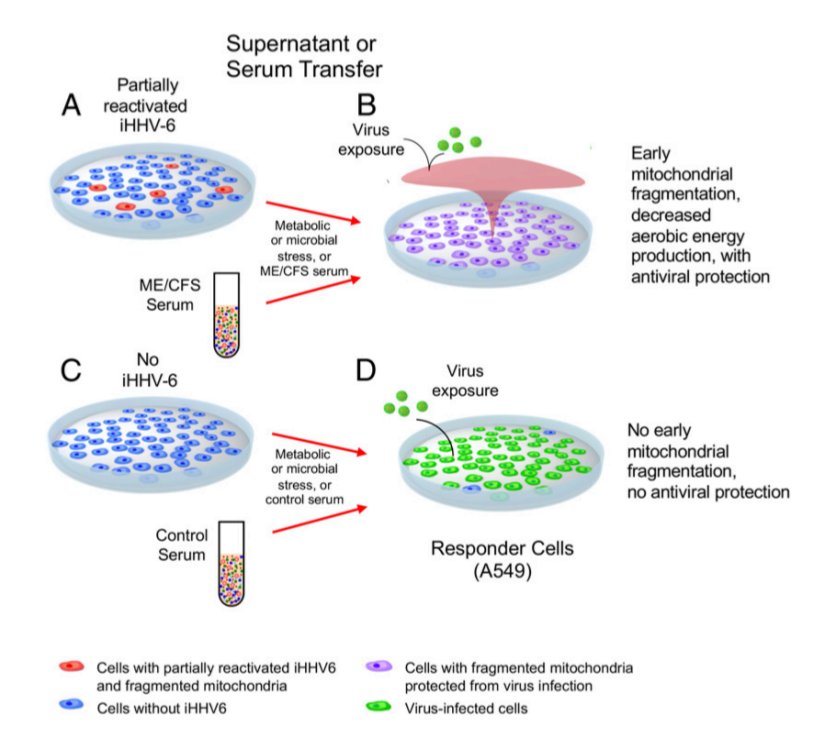
Isn't this expected based on the work of @BhupeshPrusty and Bob Naviaux?
"In this study, we found that none of 25 patients with ME/CFS had peripheral blood evidence of a fully reactivated HHV-6 or HHV-7 infection, and only 8 of 20 (40%; 95% CI = 0.19–0.64) had evidence of partial reactivation measured by FISH analysis of HHV-6 small noncoding RNA U14 in whole blood. However, using an in vitro reporter cell assay, we showed that serum from ME/CFS patients contained an activity that produced mitochondrial fragmentation, decreased mitochondrial ATP production, and induced a powerful antiviral state."
naviauxlab.ucsd.edu/wp-conte…
8 Nov 2025

New from Ron Davis team:
Virus Genome Sequences in the Blood of Myalgic Encephalomyelitis/Chronic Fatigue Syndrome Patients
medrxiv.org/content/10.1101/…
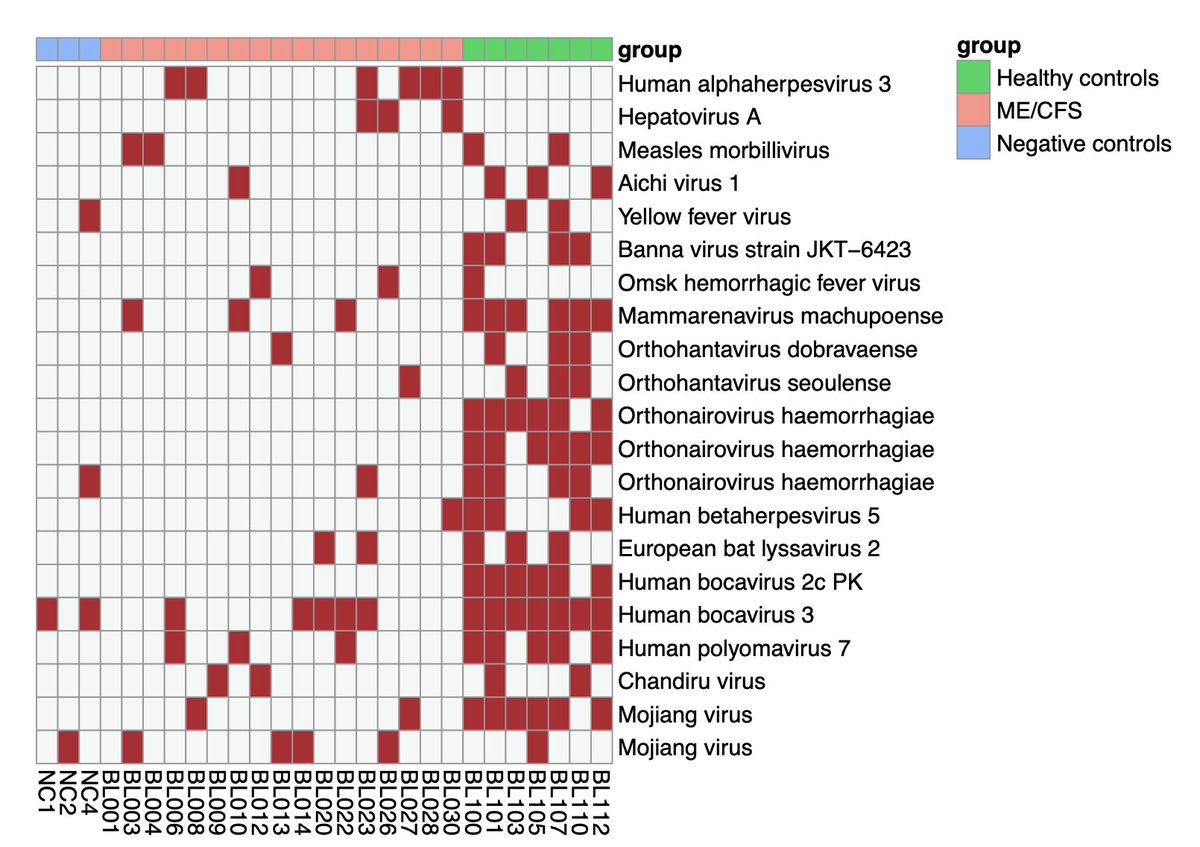
"Surprisingly, more viruses were found in the healthy controls than in the ME/CFS patients"
#MEcfs #CFS
![Figure 2. Virus sequences detected in each clinical sample. This figure
presents a heatmap of those molecular probes which are significantly
enriched. The rows correspond to individual probes. The right labels
present the virus name. The columns correspond to the individual clinical
samples. The top color bar indicates the group (blue, negative controls
[water reacted with the probe ensemble; no DNA present]; pink, ME/CFS
patients; green, healthy controls.) The bottom labels give the identification
of each clinical sample. Cell colors indicate the presence or absence of the
molecular probe in the sample (red, presence; white, absence).](https://venexa.site/media/G5PKcKAXEAAWBxP.jpg)
ALT Figure 2. Virus sequences detected in each clinical sample. This figure presents a heatmap of those molecular probes which are significantly enriched. The rows correspond to individual probes. The right labels present the virus name. The columns correspond to the individual clinical samples. The top color bar indicates the group (blue, negative controls [water reacted with the probe ensemble; no DNA present]; pink, ME/CFS patients; green, healthy controls.) The bottom labels give the identification of each clinical sample. Cell colors indicate the presence or absence of the molecular probe in the sample (red, presence; white, absence).
11
16
92
7,808

8 Nov 2025
Very interesting preprint from @Ronaldw_Davis's Stanford group! It backs up Lipkin's (aka The Virus Hunter) study concerning viruses present in #MECFS patients.
Ron said several years ago he didn't think antivirals were going to be the answer. Looks like he was right...again. 🧩
8 Nov 2025

1) New preprint from the Stanford group of Ron Davis.
They looked for 185 human viruses, and found traces of 17 viruses in patients or controls. "Surprisingly", the authors write "more viruses were found in the healthy controls than in the ME/CFS patients."
5
7
44
3,596
Bottsie Hicks retweeted

5 Nov 2025
Next up: @DrRebeccaRyan!
Immediately talking about autonomic dysfunction, POTS, and MCAS, in the context of “functional” GI disorders - which she points out are NOT psychologically driven.
So excited for this one.
#ICanCME2025
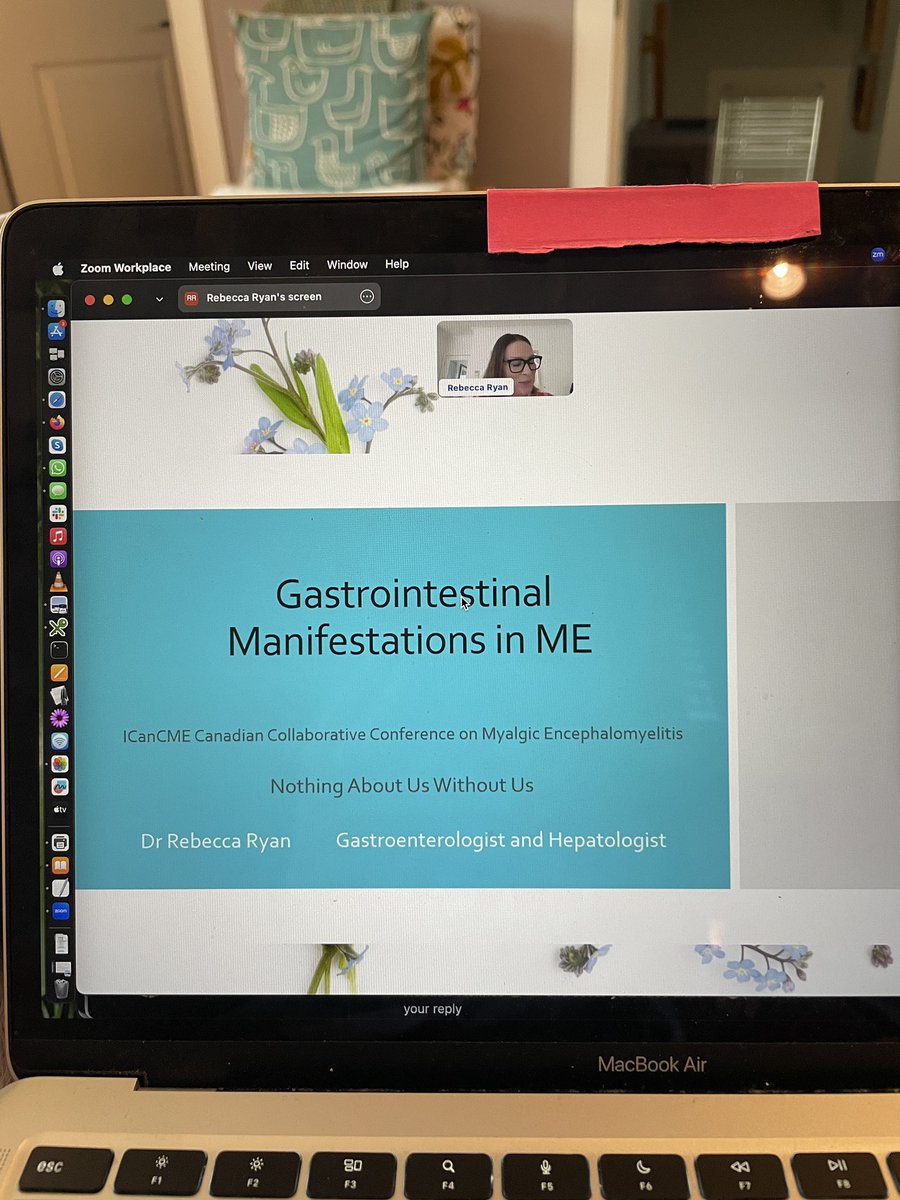
ALT Photo of zoom opening slide
5
18
89
2,401

Bottsie Hicks retweeted

6 Nov 2025
This clip from 2018 perfectly captures just how passionate @davidtuller1 is and how shocked he was by the way the PACE trial was defended.
His crowd funding has just 1 day to go and he’s ~$10k from his target. I’ve just donated again so he can carry on doing his important work
3
42
91
3,873
Bottsie Hicks retweeted

7 Nov 2025
ME/CFS is not going back in the box. That shit is over. We are at the beginning of something new. Families & friends are starting to get the right information. Once most of them forgive themselves, anger will come. Some of that energy will find its way into redemption and grace.
8
17
162
3,529
Bottsie Hicks retweeted

6 Nov 2025
6 Nov 2025

Kicking off now. The theme is "Collective Deep Thinking in ME Research Design"
11
17
1,019
Bottsie Hicks retweeted
7 Nov 2025
It’s strange that, as far as I know, smooth muscle has never (?) been studied in ME/CFS. Given its major role in blood vessels, the gut, and autonomic regulation, all affected in ME/CFS, this seems like a major blind spot. Am I missing something? What's going on there?
7
12
127
3,926
Bottsie Hicks retweeted

Excited to have you back, Simon.
#ICanCME2025
6 Nov 2025
Will be back to live tweet Day 3 of the @ICanCMEResearch conference.
1
4
17
535
6 Nov 2025
I trust the @OpenMedF team because the core researchers/key members of the organization have loved ones who have #MECFS. They are motivated and have first-hand knowledge. OMF has several centers around the globe with one goal: find answers/treatment(s)/cure. 🧩💙🧩
Donate! Share!
6 Nov 2025

🌍 People worldwide used their limited energy to finish “ME/CFS is…” Their voices show the challenges, losses & urgent need for change. Thanks to matching donors, every gift to OMF is tripled up to $500K! 👉 Donate: omf.ngo/?form=donate-tgn.
#mecfs #pwME #mecfsresearch
1
6
33
1,378
Bottsie Hicks retweeted

3 Nov 2025
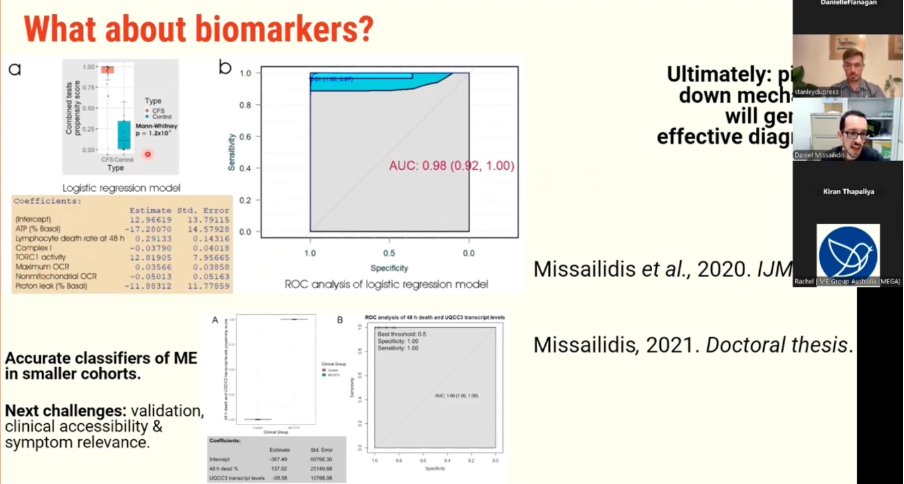
1) 🇦🇺 Interesting interview with molecular biologist Dr Daniel Missailidis.
He has been conducting ME/CFS research since 2016 at at La Trobe University, focusing on the intersection of energy metabolism and immune dysfunction.
2
19
68
2,807
Bottsie Hicks retweeted

5 Nov 2025
Something depressing about novel findings from excited researchers that does not concord at all with my own l results… either there’s a clear subgroup problem, or the heart of the matter isn’t being hit. I’d say we need a massive injection of funding to look at all possibilities
7
1
19
1,168
6 Nov 2025
Ok...getting ready for Day 3 of @ICanCMEResearch Conference! I misspoke yesterday...follow THIS guy if you want/need to read about what's going on at the conference. I've managed to attend, but can't concentrate, so will read back through Simon's posts to fill in the gaps. 🙏🫶
4 Nov 2025
A little late to the party but following the @ICanCMEResearch conference.
First keynote coming on
5
11
597
Bottsie Hicks retweeted
We’re so lucky to have @RobWust researching LC and ME.
He’s passionate about his work and listens to people living with these illnesses to learn. A real example to follow.
#ICanCME2025 💙
4 Nov 2025

2
4
25
884
Bottsie Hicks retweeted

6 Nov 2025
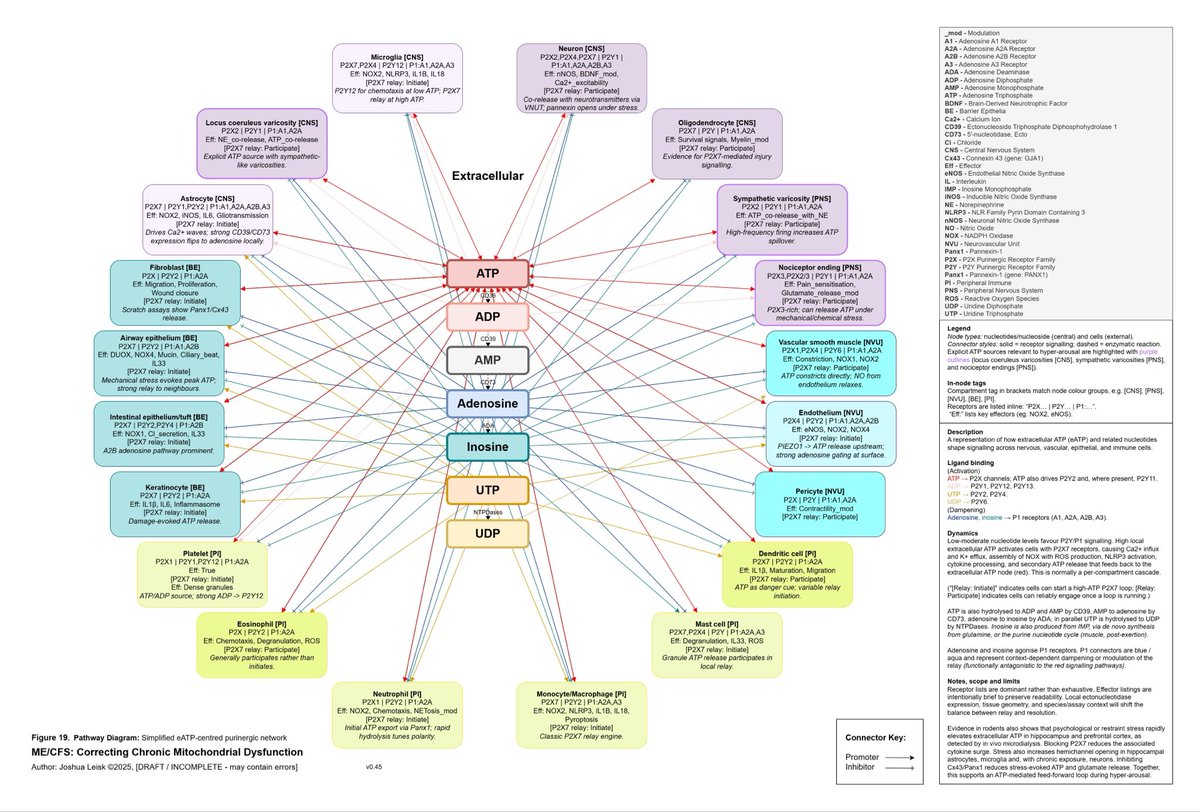
Following up on Naviaux’s excellent work around extracellular ATP (eATP) / “Cell Danger Response”, which can act as an “alarm signal” relay and/or loop that bridges nervous system cells and other tissues.
This extracellular ATP signalling has been observed in ME/CFS, ASD, ADHD, PTSD and various other disorders / syndromes.
pubmed.ncbi.nlm.nih.gov/3867…
The pathway also works in both directions, allowing a systemic cascade / loop to be created from any source, where sufficient eATP signalling exists to overcome CD39/73/ADA purine salvage metabolism, which also provides the corresponding “alarm dampening signal” - adenosine and inosine.
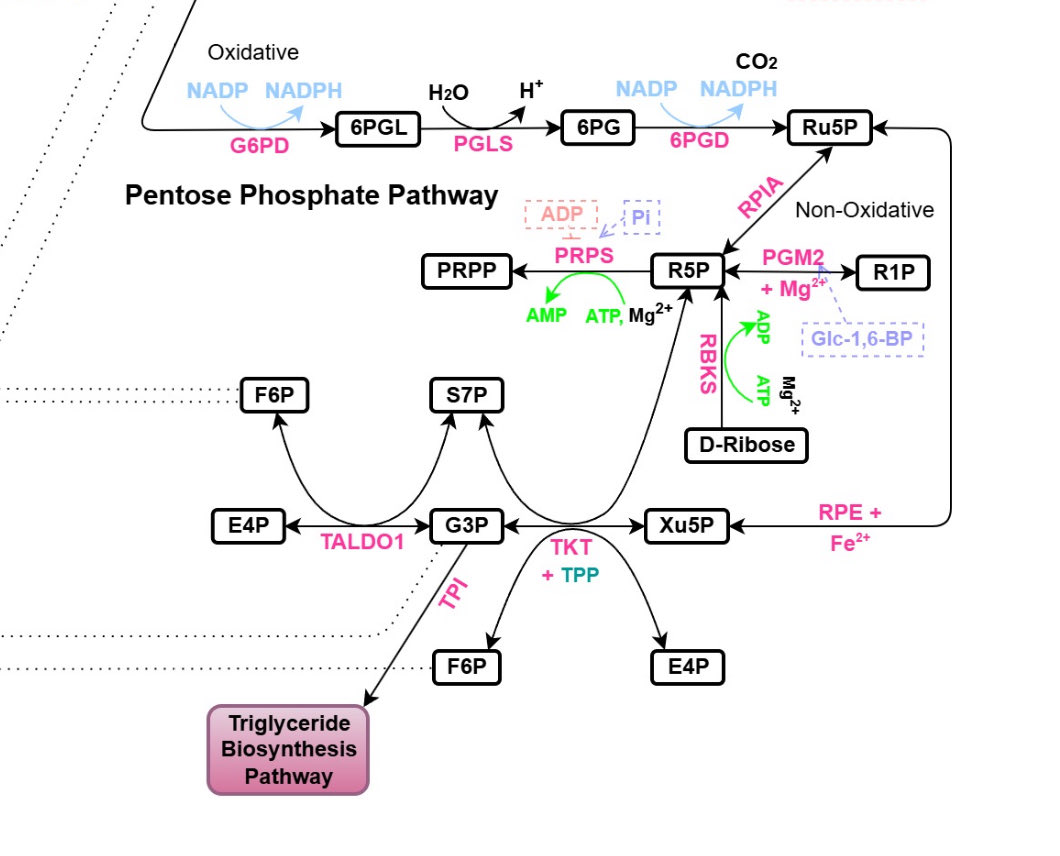
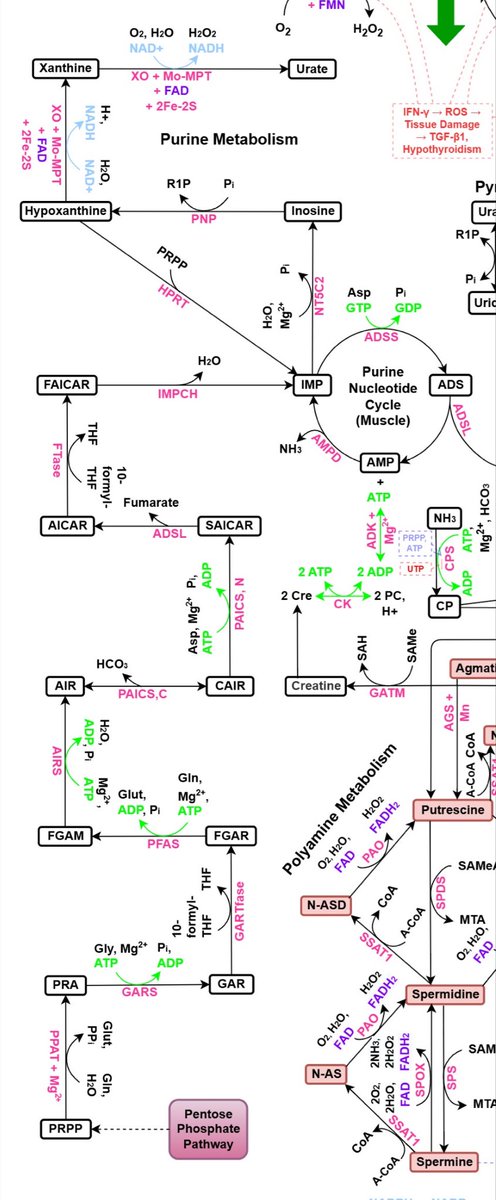
Interestingly enough, the main de novo “dampening signal” synthesis pathway is inhibited by impaired glycolysis -> pentose phosphate pathway -> PRPP (and other) metabolism and the purine nucleotide cycle in muscles, post-exertion. These are known issues in ME/CFS, LC, PVS, etc
In this manner, with the “dampening signal” inhibited, various accumulated “insults” could potentially lead to a form of dysautonomia, where the nervous system’s pattern recognition systems identify and amplify existing metabolic alarm signals, manifesting biochemically as a wide range of effectors - including hyperactive innate immune response and mast cell activation (see figure 19).
Naviaux and others have been exploring suramin as an intervention to help shut down the P2X7 relay / loop with early success.
I’m currently researching a different approach - restoring the problematic “dampening signal” metabolism, as part of a more comprehensive process.
[Watch this space.]
10
35
133
7,747
Bottsie Hicks retweeted

30 Oct 2025
📉 The person with ME we tested had a significant drop in blood flow to the head during PEM: 17% while supine and 23% while standing. The healthy person did not have a decline. 4/n
4
16
110
2,464
Bottsie Hicks retweeted

5 Nov 2025
@exceedhergrasp1's presentation at #ICanCME2025 was so good! 💙
I learned so much about #MECFS and neurodivergence.
5 Nov 2025

We are excited and ready for day 2 of @icancmeresearch conference!
#MEAction’s Scientific Director, Jaime Seltzer @exceedhergrasp1, is speaking soon!
#ICanCME2025 #pwME #MECFS
7
11
714
5 Nov 2025
I made it to...and basically most of the way through...today's @ICanCMEResearch Conference! Yay! But my brain is fried, and I can't remember much of what I watched. However, I can tell you it was AWESOME again!! One more day tomorrow. Maybe you could follow @mecfsskeptic. :)
4 Nov 2025
Useful Tweets and summaries of the Canadian conference on ME/CFS 👇
1
2
19
671
Bottsie Hicks retweeted

5 Nov 2025
In #MECFS, there’s evidence that microglia are activated more often than in healthy people, which contributes to #neuroinflammation. OMF’s CRC at Uppsala is analyzing microglia activity via MRI as a way of detecting neuroinflammation.
👉 Learn more: omf.ngo/microglia/
1
12
56
1,185
Bottsie Hicks retweeted

5 Nov 2025
Sudden onset myalgic encephalomyelitis is a medical emergency. Hospitalization IV antivirals, in lieu of so-far absent targeted therapy, may be opportunity to avoid life-long disability. Doctors need training to identify this disease when they see it. Do something, don't wait
7
40
268
6,316