
Joined November 2008
- Tweets 86,054
- Following 141
- Followers 573,212
- Likes 2,034
12,750 Photos and videos


Pinned Tweet

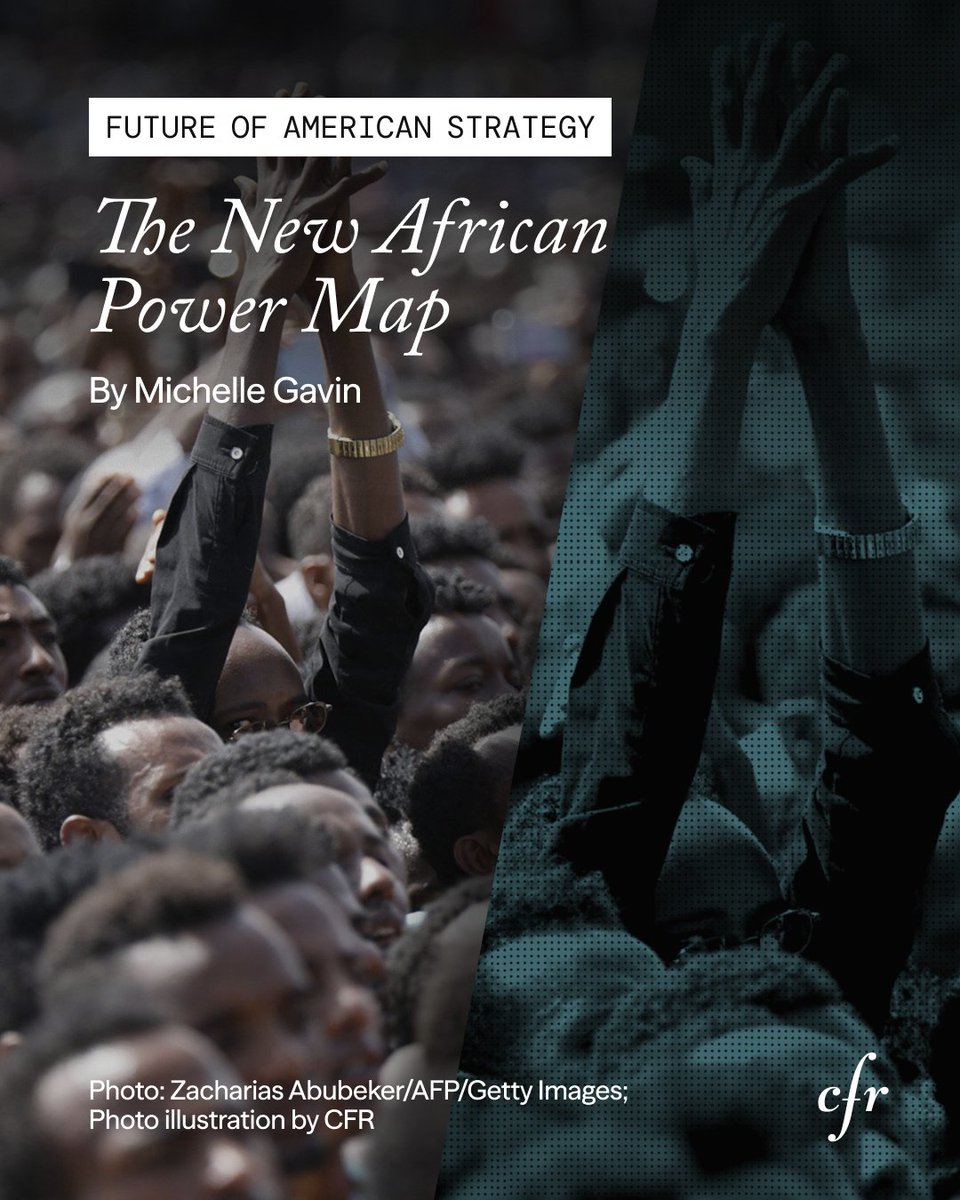
America’s global role is more contested and uncertain than at any time since World War II, and the time is ripe for a fundamental reevaluation of the nation’s strategy. To meet this moment, the Council on Foreign Relations is launching the Future of American Strategy Initiative, a multiyear effort that aims to answer one defining question: Where does America go from here?
To kickstart this conversation, CFR scholars, across 27 essays, explore the evolving strategic environment the United States will face over the next decade, spanning American strategy, great power rivalry, global order, geoeconomics, and warfare: cfr.org/future-of-american-s…
20
76
85
66,061
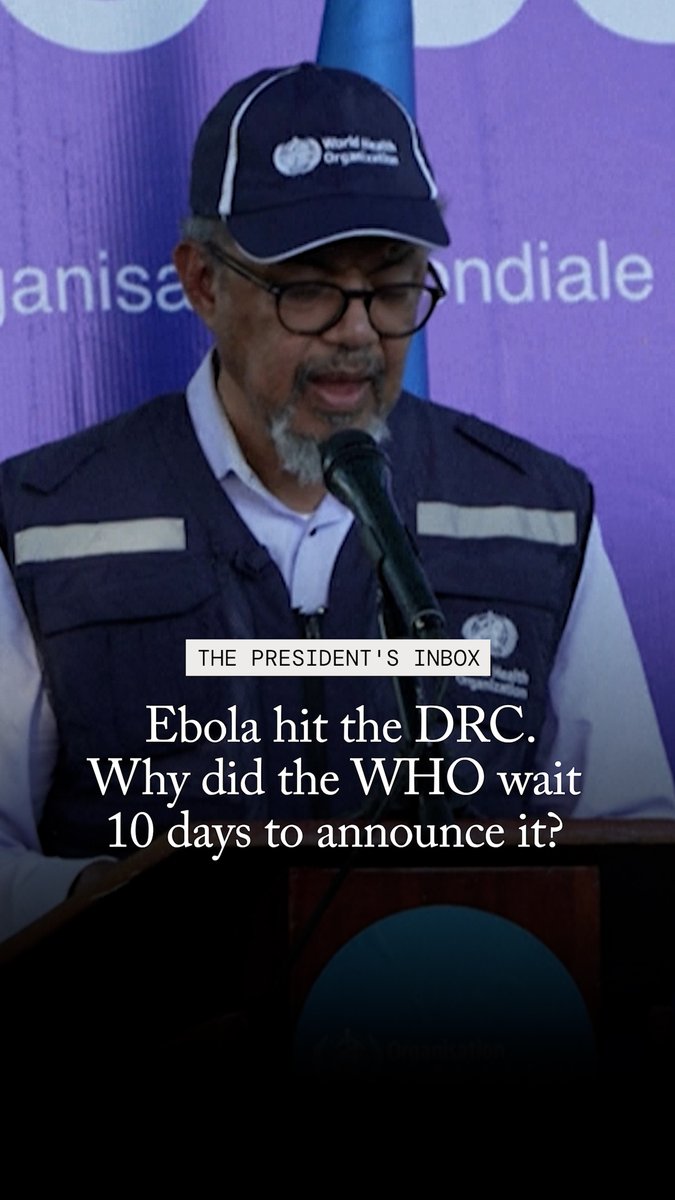
“Ten days is a long time. And one of the areas where we will need scrutiny after this outbreak is what led to that ten-day delay,” says CFR global health expert @TomBollyky.
Bollyky joined @JamesMLindsay on The President’s Inbox podcast to discuss how a major Ebola outbreak in Central Africa exposed critical gaps in global health surveillance and assess U.S. preparedness for future biological threats.
Watch or listen to the latest episode of The President’s Inbox wherever you get your podcasts.
4
8
2,367
Kharg Island has been a flash point in the U.S.-Israeli war on Iran. Here's what to know about Kharg—the small island in the Persian Gulf that handles roughly 90% of Iran's crude oil exports:
cfr.org/articles/kharg-islan…
4
10
1,888
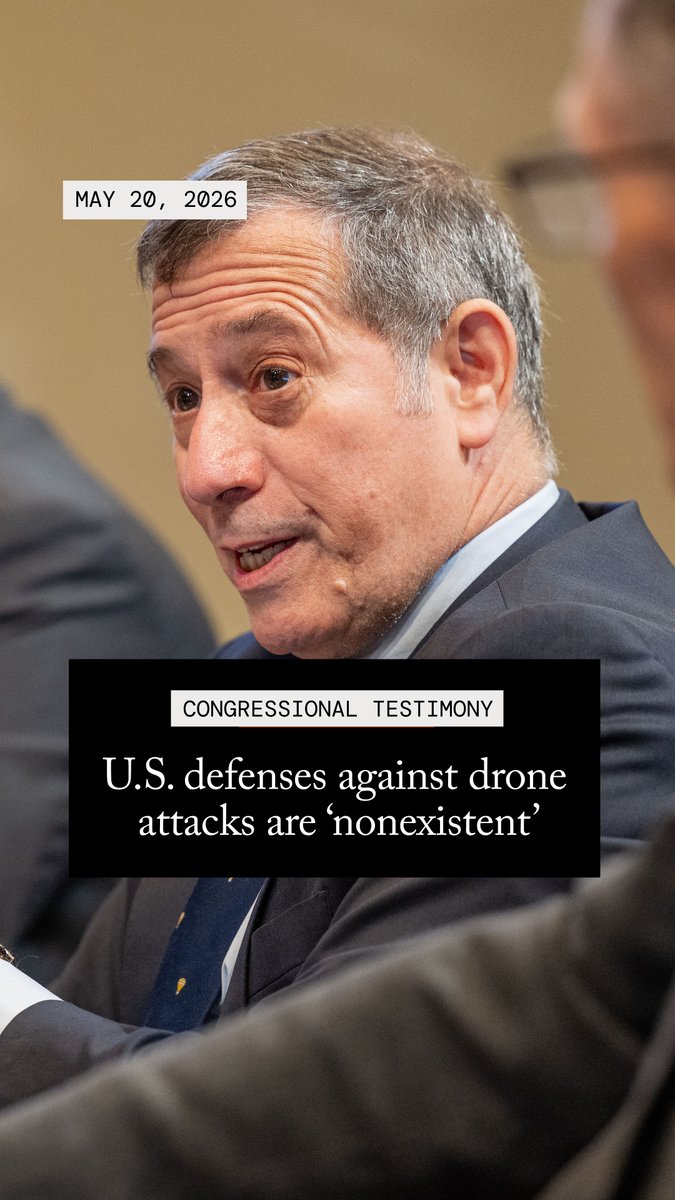
“Our defenses against drone attacks, in my view, are nonexistent or at least lamentably behind what has emerged . . . as a salient threat,” says @hoffman_bruce, CFR counterterrorism and homeland security expert, while testifying before the House Permanent Select Committee on Intelligence.
“What’s to stop any terrorist group anywhere from importing commercial drones and carrying out an attack on a major urban center? And how well is any city in the United States, much less the coordination between federal, state, and local, to deal or to handle or to counter such an attack? I’d say it’s not very encouraging.”
1
8
18
3,211
Council on Foreign Relations retweeted

Jun 12
Russia had momentum throughout 2025 & many wondered if Ukraine could keep fighting. Now Ukraine is back on the offensive retaking 78 sq miles in 5 days @mchorowitz Erin D. & I look at how longer-range drones & AI/autonomy reversed the trend for @CFR_org cfr.org/articles/how-ukraine…
5
6
2,171
The United States and Iran are reportedly close to a long-awaited agreement, but it remains to be seen whether it resolves their major differences—including nuclear and missile programs, the Strait of Hormuz, and Israel’s war with Iranian proxies.
“We have been here before only to discover the parties cannot bridge the remaining gaps,” expert @stevenacook said. "Negotiations on the outstanding issues, especially on Iran’s nuclear program, will be long and difficult."
cfr.org/articles/is-a-u-s-ir…
1
4
11
2,518
Ukrainian innovation on the battlefield has reversed recent Russian gains and presented new avenues for its success, argue senior research analyst Lauren Kahn and CFR experts @mchorowitz and Erin D. Dumbacher.
"Now, compared to the start of the war, Ukrainian drones are able to strike at longer ranges, including 30 to 100 kilometers behind the front lines, expanding the kill zone and forcing Russia to divert resources to protect its supply lines and infrastructure," they write.
"By fielding precise mass systems faster than Russia can develop effective countermeasures, Ukrainian forces are once again making small territorial gains in spite of Russia's vast arsenal."
Read their analysis: cfr.org/articles/how-ukraine…
1
12
14
2,157
"SpaceX should not be dominating anyone's performance or portfolio," says host Rebecca Patterson, assuaging concerns about the effect SpaceX's record-breaking IPO might have on passive investors.
Watch the latest episode of The Spillover hosted by @scmallaby and Rebecca Patterson: youtu.be/IoWXpI7cASY?si=xkbr…
2
7
2,401
"The United States may emerge from this war facing the prospect of diminished basing rights, and of longtime allies hedging their bets—whether by inviting in other powers like Russia and China or by striking their own accommodations with Iran that ensure their security at the expense of U.S. interests and influence," writes CFR President @MikeFroman.
"Whatever the weekend brings—deal or no deal, new strikes or a new ceasefire, a relatively open strait or a closed one—it is one thing to change the rules of the game, and quite another to win it," he writes. cfr.org/articles/the-limitat…
2
12
21
2,956
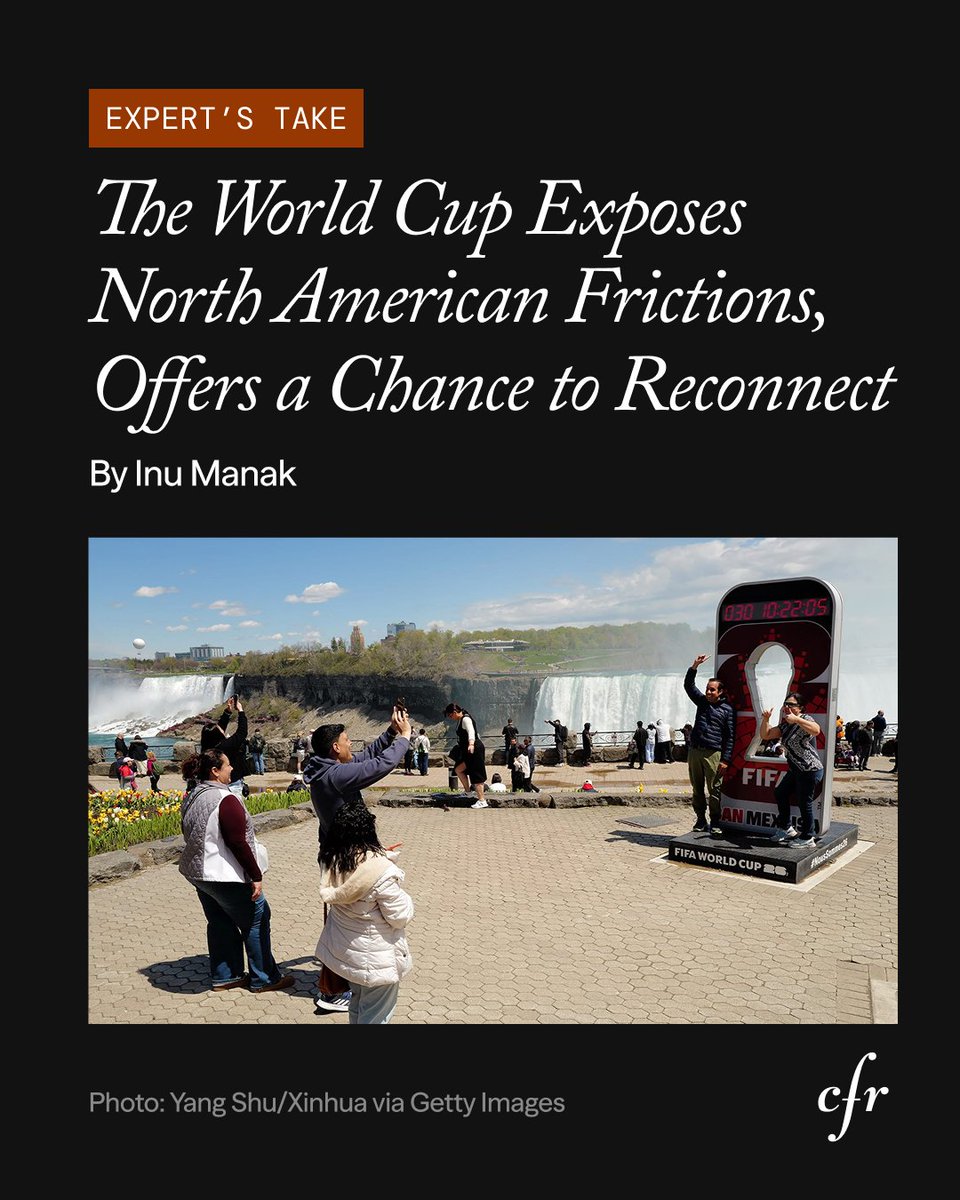
For the first time in the World Cup’s history, athletes will compete across three countries: Canada, Mexico, and the United States.
"The North American trio won the bid to host the soccer tournament in 2018 with the slogan 'United As One,' writes expert @InuManak. But the countries today "feel less like friends and more like suspicious neighbors."
1
4
10
4,263
Read her full analysis: cfr.org/articles/the-world-c…
3
3,396
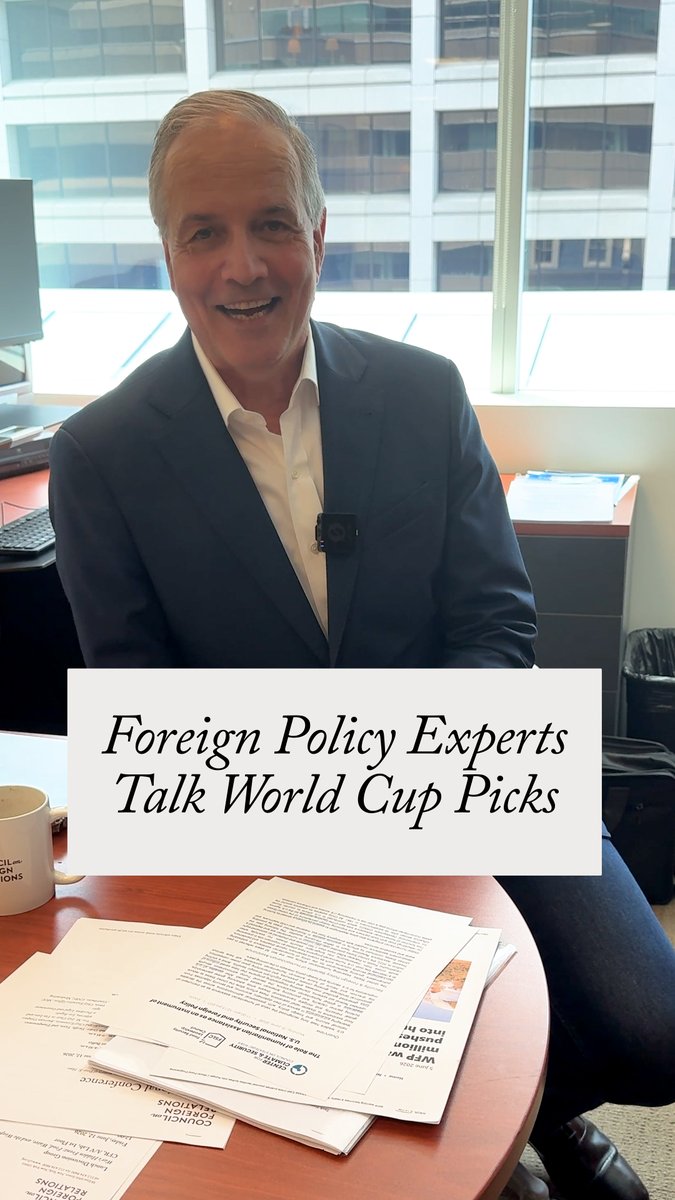
Experts at the Council on Foreign Relations spend a lot of their time researching and writing about world affairs. But does that expertise carry over to soccer? We asked five CFR fellows what they were looking forward to most in this World Cup.
6
1,971
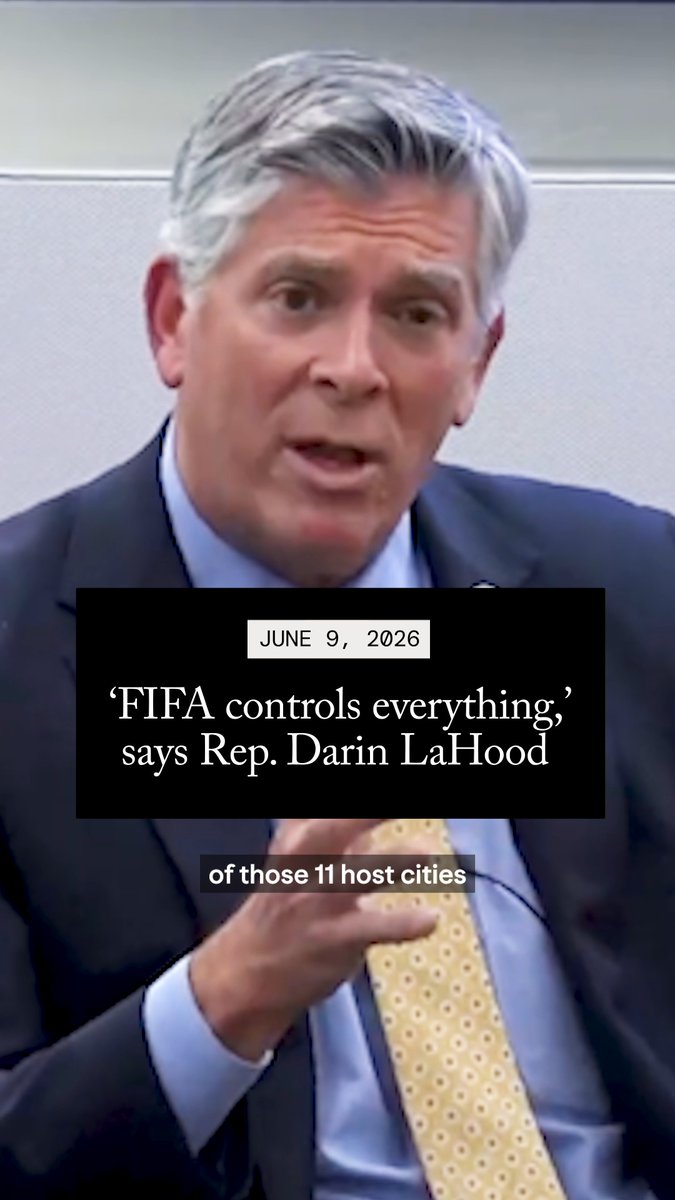
“FIFA controls everything,” says Representative (R-IL) Darin LaHood, cochair of the Congressional Soccer Caucus. “FIFA now requires you to do so many different things. So when every one of those 11 host cities signed that contract with FIFA, it says in bold letters, ‘We don’t pay for transportation. We don’t pay for this. We control everything.’”
🔗 Watch the full conversation: bit.ly/4ejzfBZ
3
9
76
15,869
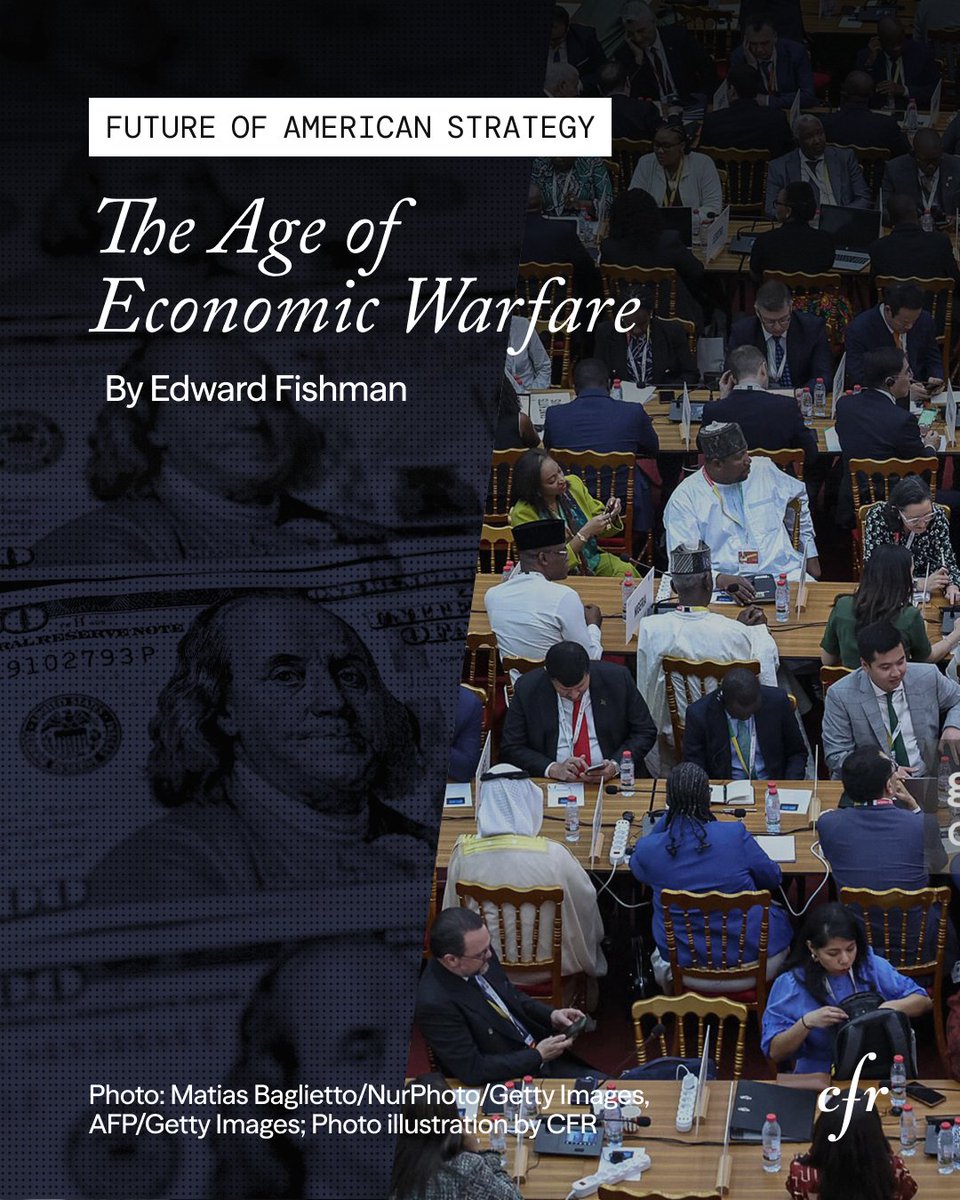
"President Trump did not start the age of economic warfare. Nor will it end when he leaves office. Every U.S. president in the 21st century has imposed sanctions at roughly twice the rate of his predecessor, and in recent years this trend has gone global," writes expert @edwardfishman. "The world is drifting into an every-nation-for-itself tussle, uncomfortably reminiscent of the beggar-thy-neighbor breakdown of the 1930s."
Read more from the Future of American Strategy Initiative: cfr.org/articles/the-age-of-…
2
54
113
17,516
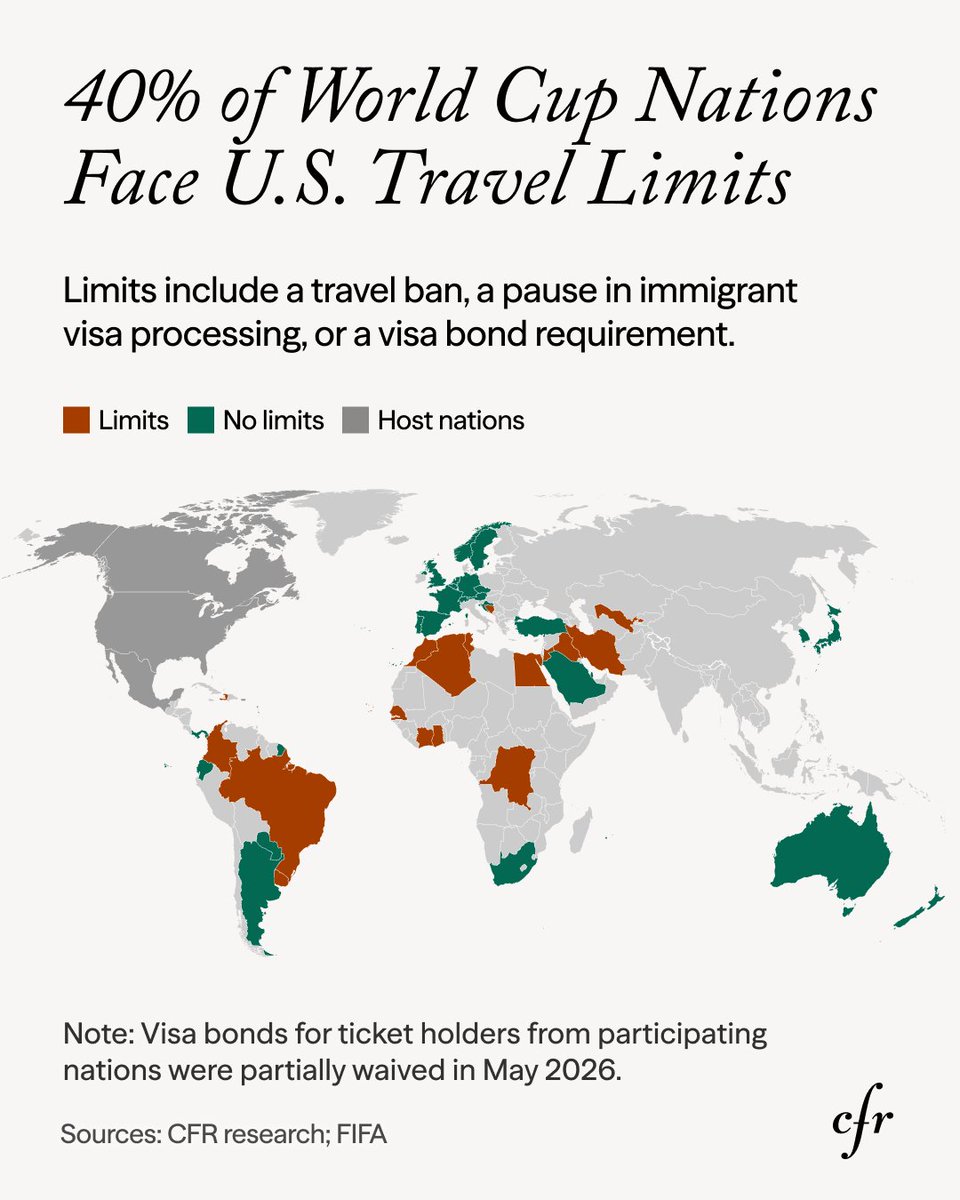
The 2026 World Cup kicked off today. But as the first teams take to the field, several stadiums are on track to have empty seats.
Travel bans, visa denials, safety fears, and record-high ticket prices are suppressing World Cup attendance—and threatening both FIFA’s promised $40 billion windfall and a U.S. tourism industry that was already struggling before the opening whistle.
At least 4 competing nations—Haiti, Iran, the Ivory Coast, and Senegal—are subject to a full U.S. travel ban (which affects tourists but not players), and a handful of others must undergo heightened screening to enter the country.
This year's World Cup also features the most expensive tickets of any previous tournament. One front-row seat reportedly sold for $32,000. FIFA has also been heavily criticized and investigated for its pricing scheme. FIFA previously estimated the tournament would attract more than 5 million visitors across 3 countries and generate $40 billion in revenue.
But there are concerns that the expected payout won’t fully materialize. The opening matches in the United States and Canada were not sold out on the official platform as of Monday, and across the opening group phase of the tournament, the resale portal still had 176,000 unsold tickets, according to the Financial Times.
That lack of global fans in the stands could be felt on the field, expert Ebenezer Obadare said. “It’s one thing to have a hundred people in one corner of the stadium rooting for you. It’s another thing to have five thousand.”
Read more: cfr.org/articles/fifa-promis…
1
7
11
3,422
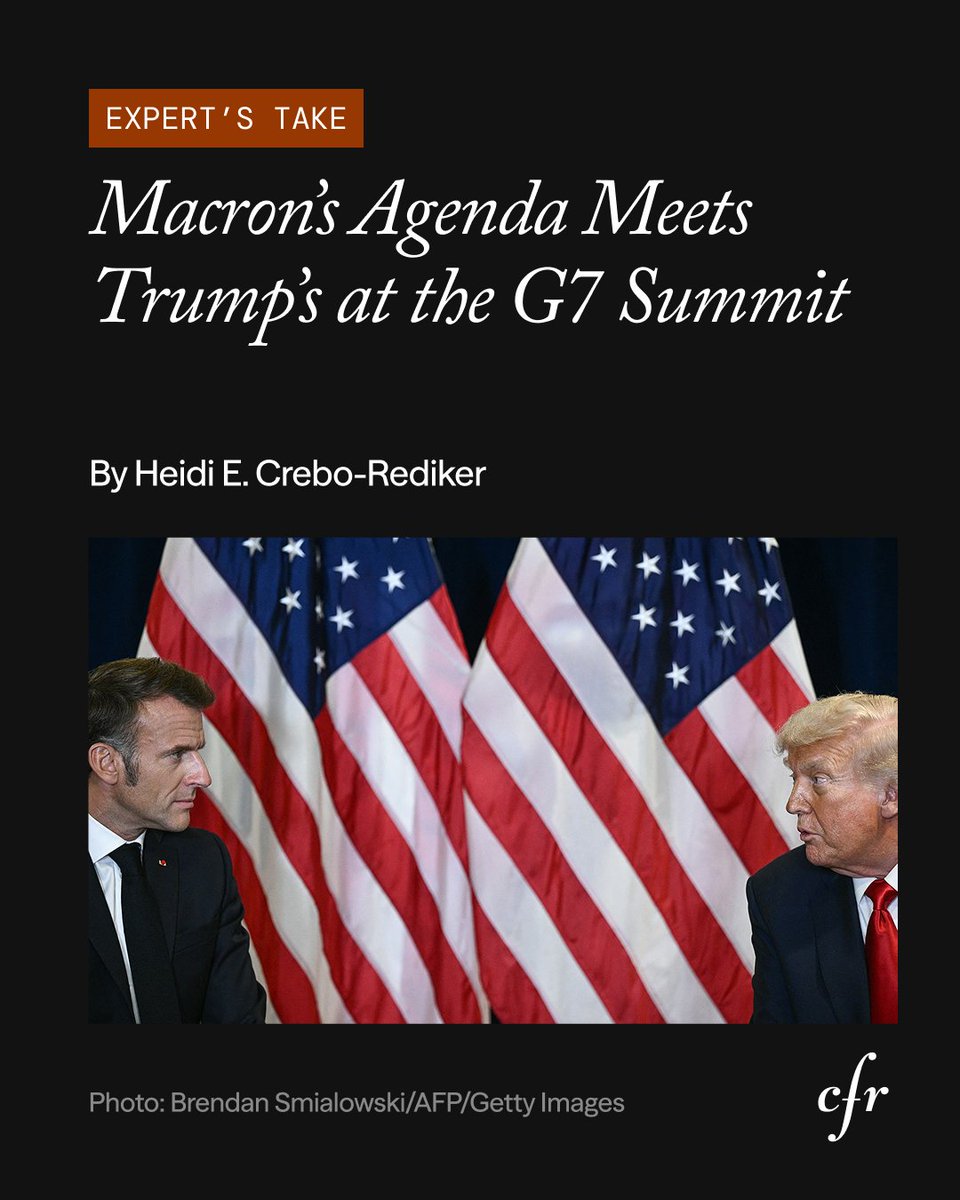
President Trump's decision to attend next week's G7's summit in France "is noteworthy," writes expert @heidirediker.
"France could find itself confronting two sets of competing summit agendas: the one it planned and the one that geopolitical events—and Trump—have created."
2
3
10
2,901
Read her full analysis: cfr.org/articles/macrons-age…
1
4
1,853
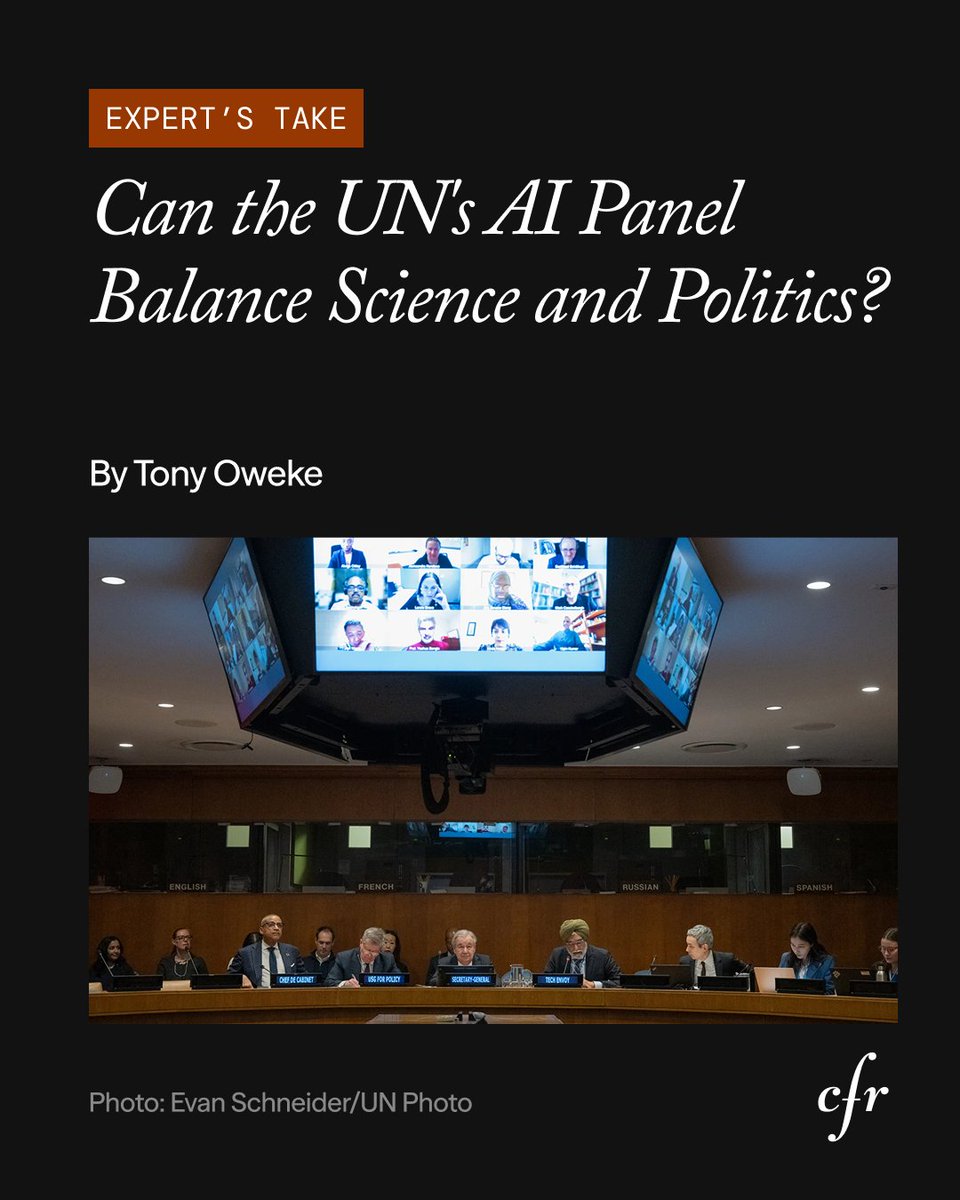
The UN's new Scientific Panel on AI was established to equip "governments to grapple with the most transformative technology of our time," writes expert Tony Oweke. But its success hinges on striking the right balance between independence, expertise, and political legitimacy, he argues.
"The central dilemma for any science–policy interface is that excessive government involvement can compromise scientific credibility, while complete isolation from governments can render scientific findings irrelevant to policymakers."
AI research is also "heavily funded by industry," Oweke writes, "creating an incentive structure that is overwhelmingly skewed toward commercial applications at the expense of research on societal implications." Four of the panel's 40 experts hold primary positions at U.S. big tech firms—some of which have been accused of suppressing unfavorable research by their employees.
When the balance between political legitimacy and scientific credibility is achieved, Oweke argues, "collective action can be galvanized to address humanity's most pressing challenges." When it isn't, "institutions lose authority and wither."
3
8
14
5,747
Read his full analysis: cfr.org/articles/the-uns-ai-…
1
1
3
3,221
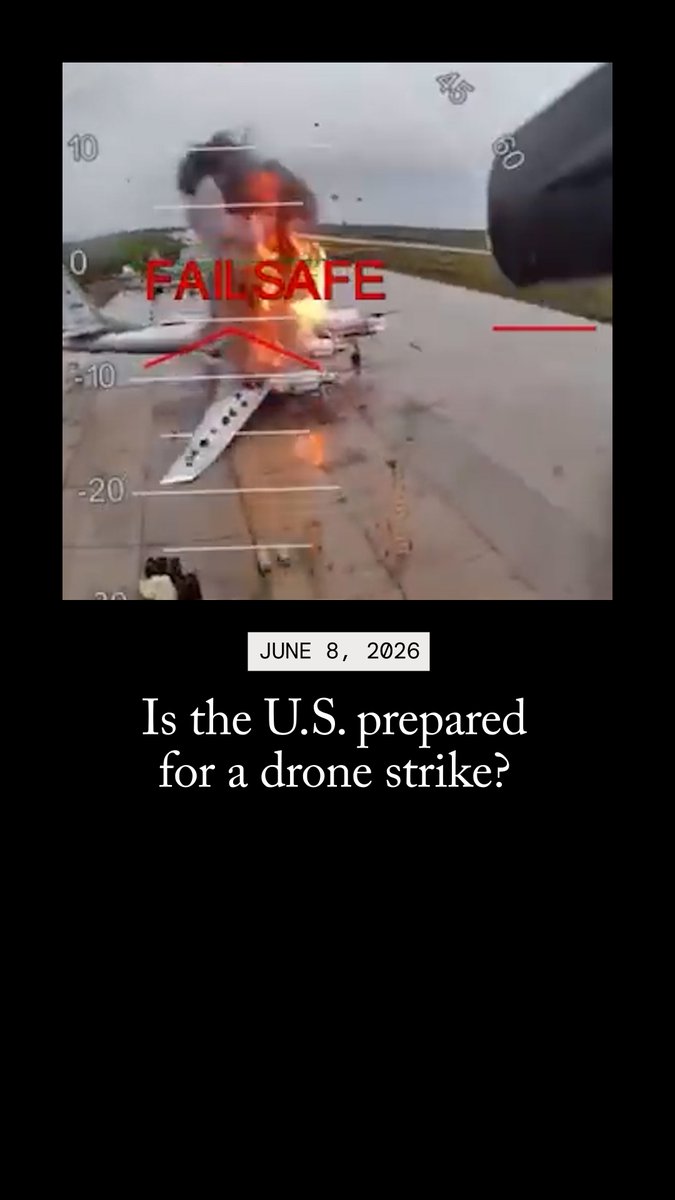
“I am genuinely surprised—I’ve even used the word shocked—that we have not been hit [by a drone strike] yet in this country,” says Jack N.T. Shanahan, former inaugural director of the Joint Artificial Intelligence Center at the Department of Defense. “I am not convinced Golden Dome will solve this problem. There has to be a lot of local, very local, measures put in place to detect the potential drones, to counter the drones. This is going to be a massive national coordination issue.”
🔗 Watch the full conversation: bit.ly/3Sl7BwV
2
11
43
10,880
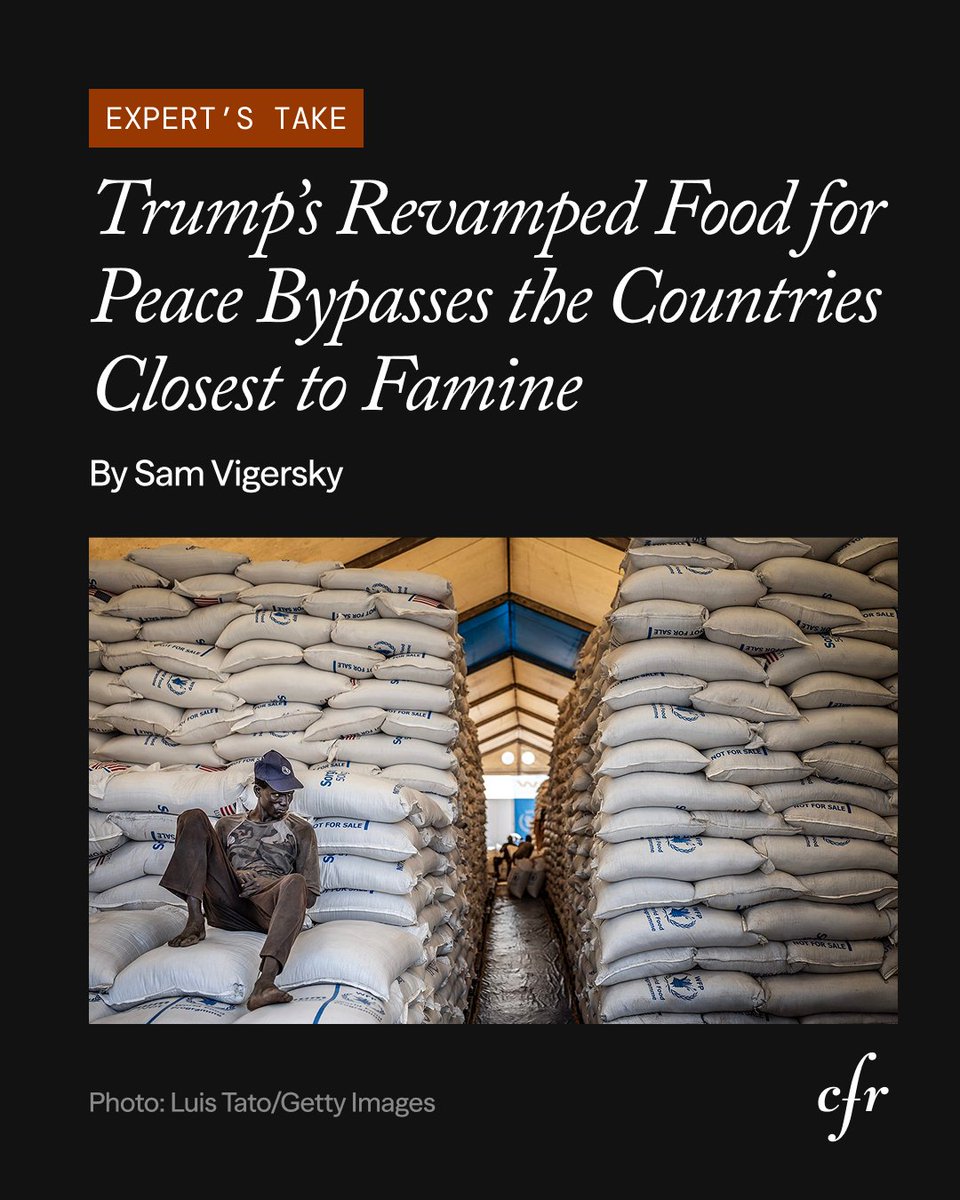
After DOGE dismantled USAID in 2025, the United States’ oldest emergency food aid program, Food for Peace, was moved to the U.S. Department of Agriculture, an agency with no crisis-response expertise, expert Sam Vigersky notes.
Now, Food for Peace is sending U.S.-grown commodities like wheat and rice to nonemergency countries, bypassing places in famine or barreling toward it, such as Somalia, South Sudan, and Sudan.
1
11
17
2,263