Now retired Branch Secretary for the CWU Postmaster's Branch, the only independent trade union representing postmasters across the UK .
Joined August 2015
- Tweets 8,192
- Following 118
- Followers 787
- Likes 7,573
73 Photos and videos





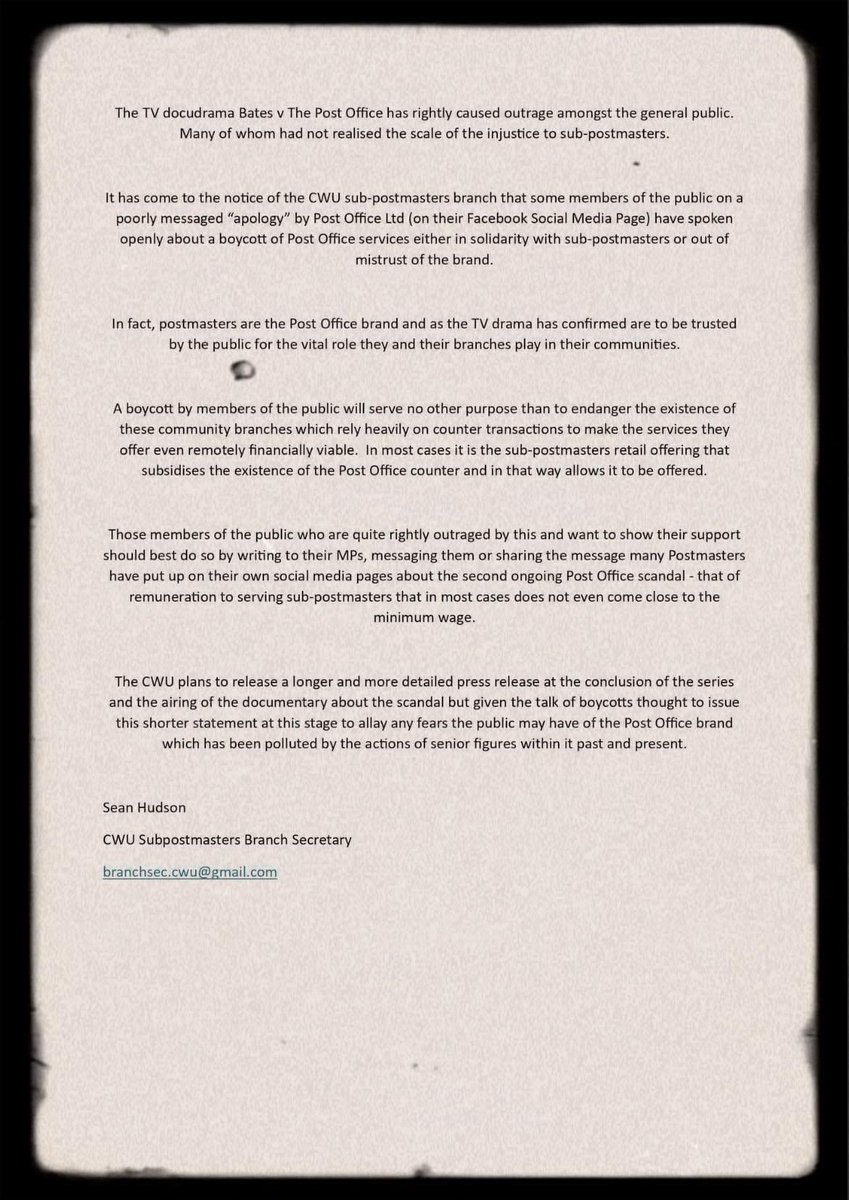



Mark Baker retweeted

Jun 15
Post Office Horizon IT Inquiry report delayed yet again:
postofficescandal.uk/post/po…
#PostOfficeScandal
4
102
206
13,958
Mark Baker retweeted

Jun 3
#PostOfficeScandal #NFSP Following the NFSP ransomware attack, the Post Office has "paused" all email to and from the Fed "as a precaution."
A precaution against what, precisely❓They have been paying for that silence since 2015. This merely makes it official — and, for once, free of charge‼️ @PostOffice
@NFSP_UK @PostOfficeNews @Karlfl @CWUPostmaster @voiceofthePM @nickwallis @NigelRailton
computerweekly.com/news/3666…
2
8
23
667
Mark Baker retweeted
Jun 1
Thoughts on the Post Office's top secret Project Brisbane from Professor Richard Moorhead (and yet more on Brian Altman KC's curious role in this scandal).
open.substack.com/pub/richar…
2
22
45
3,594
Mark Baker retweeted
May 27
Former Post Office general counsel Jane MacLeod "significant individual" in criminal investigation.
postofficescandal.uk/post/po…
#postofficescandal
12
99
243
10,342
Mark Baker retweeted

May 26
More information surfaces about Project Brisbane; as yet, just the tip of a very big iceberg… postofficescandal.uk/post/mo…
3
32
75
3,166
Mark Baker retweeted
May 20
In June the Post Office will be challenging the Information Commissioner at Tribunal because it is adamant it will not disclose a short redacted piece of information. The ICO ordered it to do so on grounds of Public Interest.
We’re starting to see why…. postofficescandal.uk/?noptin…
14
101
221
13,260
Mark Baker retweeted
May 18
#PostOfficeScandal #CAPTURE #Accountability #CourtofAppeal #CCRC #LegalEthics #HumanRights
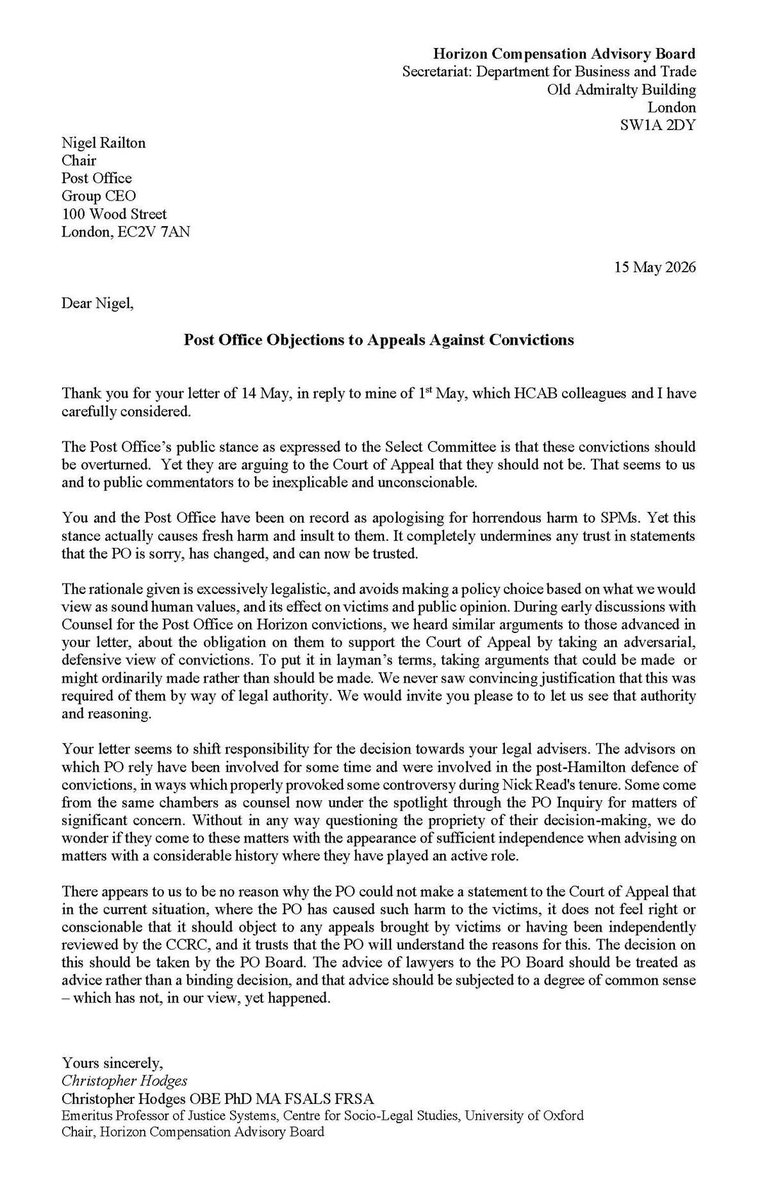
The Horizon Compensation Advisory Board has written to Post Office chair Nigel Railton, and it does not make comfortable reading. (See below).
In a letter dated 15 May, HCAB Chair Christopher Hodges OBE dismantles the Post Office's justification for contesting Capture conviction appeals point by point — and does so with the precision of someone who has run out of patience.
The core contradiction is simple. Railton told the Business and Trade Select Committee that Capture convictions should be overturned en masse. The Post Office is simultaneously arguing to the Court of Appeal that they should not be. Hodges calls this exactly what it is: "inexplicable and unconscionable."
On the role of lawyers, Hodges is pointed but careful. He notes that those advising the Post Office Board have been involved in the post-Hamilton defence of convictions, and that some come from the same chambers now under inquiry scrutiny. He doesn't question their propriety. He simply asks whether they "come to these matters with the appearance of sufficient independence."
The message to the Board is unambiguous: legal advice is advice, not a binding decision, and it should be "subjected to a degree of common sense — which has not, in our view, yet happened."
The Post Office has apologised. It says it has changed. It says it can be trusted.
Hodges' letter asks, quietly and forensically, what any of those statements mean if this is how the organisation continues to act.
The Post Office continues to be deeply, profoundly sorry. Just never that sorry.
Words are cheap - unless of course you engage external Crisis PR Agencies, in addition to the 26 directly employed in the POL Comms Team‼️
computerweekly.com/news/3666…
@PostOffice @PostOfficeNews @liambyrnemp @CommonsBTC @HouseofCommons @UKHouseofLords @premnsikka @CastletonLee @BBCEmmaSimpson @SkyNewsAdele @SkyNews @Karlfl @nickwallis @The_Real_JSP @hudgellsol @NeilHudgell @marksweney @rbrooks45 @Rebecca_SPaul @NAOorguk

6
64
106
9,850
Mark Baker retweeted

Mar 28
"The Overturn, a new independent documentary series, is not like this. In every episode, it examines a particular UK criminal case, but not for thrills. This show is about the miscarriage of justice."
✍️ Miranda Sawyer
bit.ly/3NuXjZh
1
13
17
2,024
Mark Baker retweeted

Mar 27
The Overturn episode 1 - Robin Garbutt: Innocent Robbery Victim or Cold-Blooded Killer? thejusticegap.com/the-overtu…
2
2
63
Mark Baker retweeted

Mar 26
Post Office Horizon Scandal: 1,400 Victims Still in Limbo — Evidence "Cannot Be Found" computerweekly.com/news/3666…
8
85
113
5,559
Mark Baker retweeted
Mar 22
#PostOfficeScandal #NFSP
THE NATIONAL FEDERATION OF SUBPOSTMASTERS: A VERY GENEROUS ARRANGEMENT
Or: How To Spend £30 Million of Public Money Buying Silence and Call It "Representation"
The National Federation of Subpostmasters — that fearless champion of the nation's Sub-Postmasters which, when its members were being wrongly prosecuted, bankrupted and imprisoned, bravely... checks notes... did absolutely NOTHING.
This, it transpires, was not mere incompetence but contractual obligation. The NFSP's 2015 Grant Funding Agreement with Post Office Limited — a snip at £30 million-plus of publicly-backed funds over 15 years — contained "restrictive covenants" prohibiting media campaigns, public protests, funding litigation, or indeed any behaviour "materially detrimental" to Post Office interests.
An organisation nominally representing Sub-Postmasters was contractually forbidden from representing Sub-postmasters. One imagines the irony was lost on nobody except the NFSP's leadership.
Mr Justice Fraser was characteristically direct, finding the NFSP "not remotely independent of the Post Office" and noting it had "put its own members' interests well below its own."
A 2013 email from then-General Secretary George Thomson rather gave the game away: "If necessary, NFSP will drop Union badge to sign contract."
The badge duly dropped. The cheques duly cleared.
THE PROCUREMENT QUESTION NOBODY ASKED
The agreement was styled as a "grant" — conveniently sidestepping the competitive tendering requirements of public procurement law.
Yet the Post Office wasn't dispensing charity. It was purchasing two very specific services: (1) professional representation of its network; and (2) guaranteed organisational silence. That, in any rational analysis, is a public services contract requiring open competition under the Public Contracts Regulations 2015.
No advertisement. No tender. No competition. No transparency. Just a quiet arrangement between paymasters and the paid.
THE VALUE FOR MONEY QUESTION
Which brings us to the matter HM Treasury and/or the Public Accounts Committee might wish to examine with some urgency.
Post Office Limited is government-owned. This was effectively public money. Did spending £30 million-plus to fund an organisation contractually prevented from challenging Post Office decisions — during a period when those decisions were destroying innocent lives — represent value for money?
Does it satisfy Treasury rules on Managing Public Money, which require that expenditure achieves "good value for the Exchequer as a whole"?
Or did the British taxpayer unwittingly bankroll the institutional gagging of the very people who needed a voice most?
THE DEMOCRACY QUESTION
The NFSP's constitution, meanwhile, prevents ordinary members from voting directly — requiring instead "board-approved intermediaries," with Directors retaining absolute veto power.
Former National Executive Officer Mark Baker called this arrangement "nothing more than a sham." It would take a braver commentator than this one to disagree.
THE EXISTENTIAL QUESTION
The Procurement Act 2023 will finally require competitive tendering for Sub-Postmaster representation.
The NFSP must now compete on merit — a novel experience for an organisation whose primary qualification was its willingness not to rock the boat while it sank.
Sub-Postmasters deserved a representative body that would fight for them. They got one contractually bound to silence.
The invoice, naturally, went to the taxpayer.
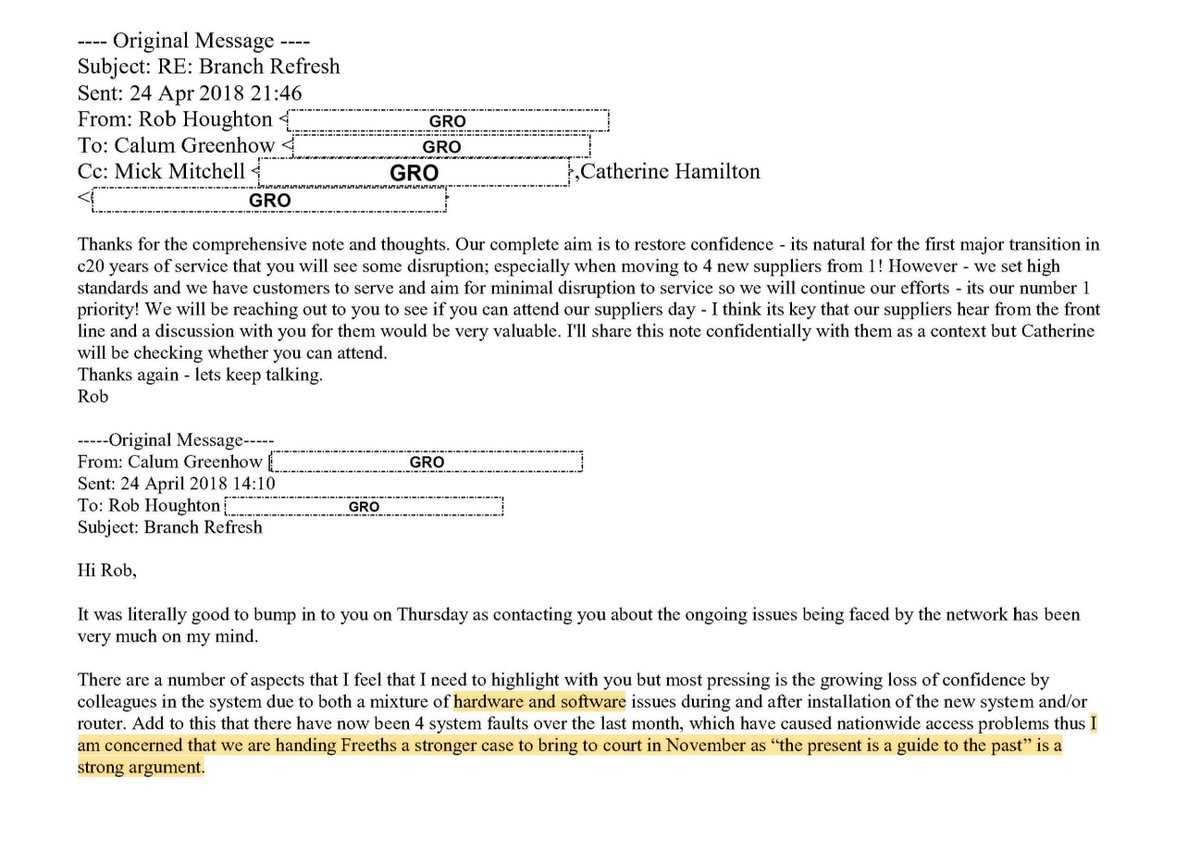
PS. Note the magnaminous advice below assisting @PostOffice in their fight against 555 SubPostmasters in the Bates vs. The Post Office GLO Litigation. 🤷♂️
@NFSP_UK @voiceofthePM @CWUnews @CWUPostmasters @CWUPostmaster @CommonsBTC @liambyrnemp @CommonsPAC @hmtreasury @RachelReevesMP @darrenpjones @DavidDavisMP @premnsikka @UKHouseofLords @HouseofCommons @NigelRailton @PostOfficeNews @marksweney @Karlfl @BBCEmmaSimpson
6
30
66
1,678
Mark Baker retweeted
Mar 20
Trustees of the Horizon Scandal Fund pay tribute to the late Parmod Kalia: horizonscandalfund.org/news
2
11
31
1,376
Mark Baker retweeted
Mar 19
Details of how the Family Members Horizon Redress Scheme will operate can be found here:
gov.uk/government/collection…
1
9
20
991
Mark Baker retweeted
Mar 19
The government has just announced a new redress scheme for family members of Post Office victims.
It will be open for business this summer.
It looks like there's some consensus behind the scheme. Lord Arbuthnot has endorsed it, saying...
5
33
74
6,847
Mark Baker retweeted
Mar 16
#PostOfficeScandal #ParmodKalia #StateSponsoredCrime
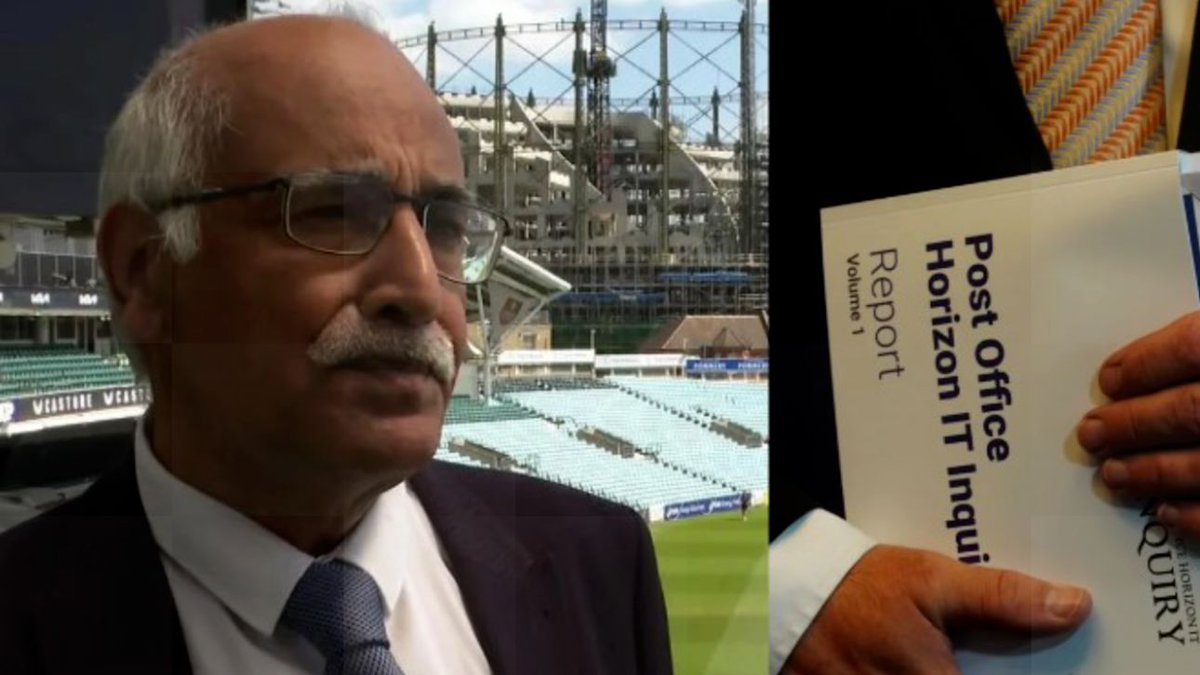
The Quiet Dignity of Parmod Kalia (6th December 1958 –13th March, 2026)
Parmod Kalia was a trained Banker. An Associate of the Institute of Bankers. Assistant Bank Manager. Treasurer of an International Charity. A man for whom every penny had to be accounted for.
He chose the Orpington Post Office for the quiet life. Stable hours. Time with his wife and four children. The Horizon system repaid that modest ambition with a phantom shortfall of £22,202.01.
Post Office Ltd told him he was "the only one."
The National Federation of SubPostmasters — his supposed protector — told him to repay the money and fabricate a story.
He borrowed £22,000 from his Mother's life savings.
Post Office pocketed every penny. Then they prosecuted him anyway.
6 months in Prison. 14 years in hiding. 3 occasions where he nearly took his own life. A 17 year estrangement from his son Mahesh, who was just 17 when they took his father away.
Children who grew up asking: "Dad, have you taken the money?" His own children. Asking if their father was a thief. Because the State told them he was.
His conviction was finally quashed in May 2021.
He should have spent his remaining years in peace, rebuilding what was stolen. Instead, the Post Office unleashed elite City law firms to fight tooth and claw over every penny piece of his Redress.
They challenged causation. They delayed. They low-balled.
They rejected his interim claim of £100,000 on "public interest grounds."
Highly paid lawyers — billing more per hour than Parmod earned in a week — deployed forensic cruelty against a traumatised, terminally declining man whose only demand was that someone look him in the eye and say: 'we did this to you, and we are sorry'.
He tragically died on March 13, 2026. Still fighting. Still waiting. Still uncompensated. Still dignified.
The inhumane savages masquerading as lawyers who wage this war of attrition against Parmod, his family and hundreds like him will simply move on, adjust their cufflinks, sip their flat whites, and open the next file.
Another victim. Another billable hour.
This obscene tragedy simply cannot continue.
The time is long overdue for the Prime Minister to intervene — to show some leadership, some backbone, and some basic human decency.
These are not commercial disputes. These are traumatised victims of a State-sponsored crime.
The lawyers instructed to handle their redress must be ordered — ordered — to show compassion, humanity, and urgency.
Every day of delay is another day stolen. And as Parmod Kalia's demise has proved, the days run out.
Rest now, Parmod. The truth outlived them all.
The shame belongs to those who made you wait.
@Keir_Starmer @darrenpjones @biztradegovuk @AGinsight @liambyrnemp @commonsBTC @RachelReevesMP @DavidDavisMP @kevinhollinrake @CastletonLee @Janetsk20073533 @SeemaMisra_OBE @edwardhenry1 @BBCEmmaSimpson @nickwallis @Karlfl @marksweney @hrw @Cyclefree2 @DanNeidle @SkyNewsAdele @BBCBreakfast @ElCShaikh @VarchasPatel @Pinsent_Masons @hmtreasury @HouseofCommons @premnsikka @TimBushLondon @UKHouseofLords @TjX50 @Malcolm22206844 @NFSP @postoffice @PostOfficeNews @NFSP_UK @voiceofthepm @NigelRailton
Mar 16
#PostOfficeScandal
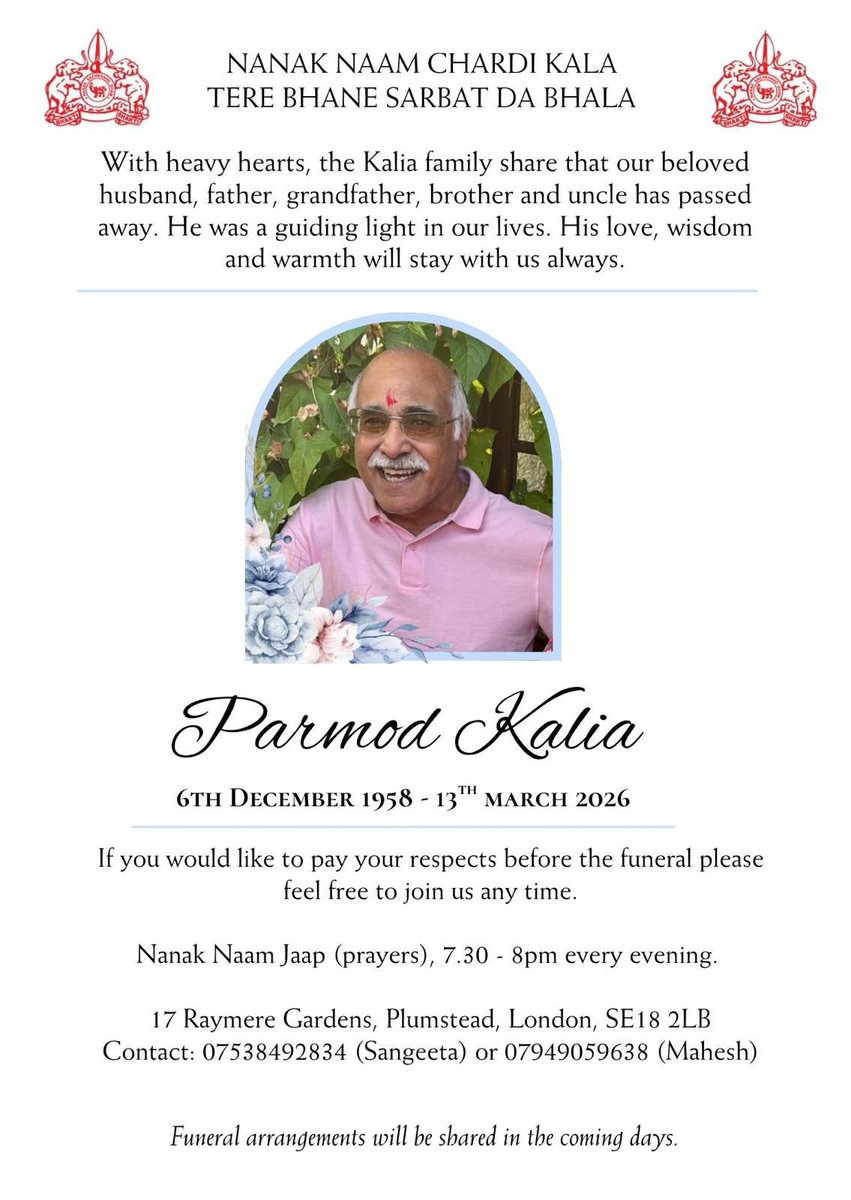
Desperately sad news 😔
Parmod was such a lovely man in every way imaginable - RIP.
Yet another SubPostmaster passes away without seeing the full just he fought for for so hard and with such dignity.
Condolences to all his family 🙏
120
1,174
2,189
141,804